


That iconic yellow border catches your eye from across any newsstand. For over a century, National Geographic Magazine covers have transported readers to remote corners of our planet through stunning wildlife photography and cultural exploration.
These covers represent more than just magazine design. They’re windows into conservation efforts, scientific discoveries, and the natural world’s most breathtaking moments captured by award-winning photographers.
Each cover tells a story of adventure journalism and environmental advocacy. From endangered species documentation to archaeological findings, these images have shaped how we understand our planet’s biodiversity and cultural heritage.
This guide explores the visual storytelling techniques, color theory principles, and graphic design principles that make National Geographic covers so compelling. You’ll discover how typography choices and visual hierarchy create impact that drives both conservation awareness and newsstand sales.
National Geographic Magazine Covers
Afghan Girl (June 1985)

Steve McCurry photographed 12-year-old Sharbat Gula at Nasir Bagh refugee camp, Pakistan in 1984. Her piercing green eyes became National Geographic’s most recognized photograph.
Visual Elements & Composition
Direct eye contact creates immediate focal point connection. Red headscarf provides contrast against olive skin tones. Green irises form analogous colors with fabric elements.
Historical Context & Significance
Published during Soviet-Afghan War peak with 3.5 million refugees displaced. Generated unprecedented circulation metrics and established human-focused editorial approach.
Subject Matter Expertise
Documented authentic Pashtun refugee conditions in eastern Pakistan. Geographic location: Nasir Bagh camp near Afghanistan border during 1980s conflict.
Technical Production Details
Equipment: Nikon FM2, Nikkor 105mm lens, Kodachrome 64 film. Pre-print processing by Graphic Art Service, Georgia. Print quality maintained highest editorial standards.
Legacy & Influence
Influenced documentary photography ethics debates. Original prints valued at $178,900 auction prices. Educational adoption across photojournalism programs globally.
Tutankhamun’s Golden Mask

Howard Carter’s 1925 discovery showcased the 22.6-pound golden funerary mask. Multiple National Geographic covers featured this archaeological treasure.
Visual Elements & Composition
23-karat gold construction with lapis lazuli inlays. Symmetry follows ancient Egyptian divine proportions. Specialized lighting captures metallic reflectivity and intricate details.
Historical Context & Significance
Discovery sparked 1920s Egyptomania movement. Carter’s 10-year cataloging of 5,398 artifacts revolutionized archaeological documentation standards.
Subject Matter Expertise
New Kingdom craftsmanship (1332-1323 BCE) from Valley of the Kings, Luxor. Hieroglyphic inscriptions follow Book of the Dead Chapter 151 specifications.
Technical Production Details
Kenneth Garrett’s high-resolution digital imaging captured microscopic artifact details. Museum partnerships enabled controlled photography access.
Legacy & Influence
Established National Geographic’s archaeological authority. Influenced popular culture Egyptian representations and museum exhibition standards.
Jane Goodall with Chimpanzees (December 1965)

Hugo van Lawick documented Jane Goodall’s revolutionary primate research at Gombe Stream, Tanzania. First cover appearance launched wildlife documentary precedents.
Visual Elements & Composition
Natural lighting captured authentic human-chimpanzee interactions. Earth-tone color palette reinforced African forest authenticity. Proximity demonstrated Goodall’s acceptance within primate groups.
Historical Context & Significance
Challenged scientific theories about tool use separating humans from animals. Launched National Geographic’s first documentary film production in 1962.
Subject Matter Expertise
Gombe Stream National Park research documented Pan troglodytes behavioral patterns. Louis Leakey’s mentorship provided scientific credibility despite Goodall’s non-academic background.
Technical Production Details
16mm film captured 65+ hours of footage. Patient observation techniques required minimal human intrusion for authentic documentation.
Legacy & Influence
Influenced generations of primatologists and conservationists. Established long-term field study documentation standards for wildlife research.
Great White Shark Breach
National Geographic’s shark photography captured apex predators in dramatic hunting behaviors. Multiple covers showcased marine conservation themes.
Visual Elements & Composition
High-speed photography froze breach moments mid-air. Dynamic balance between predator power and ocean environment. Underwater perspectives provided unique visual hierarchy.
Historical Context & Significance
Coverage shifted public perception from fear-based to conservation-focused messaging. Marine protected area advocacy increased following publication.
Subject Matter Expertise
Research locations included South Africa’s Seal Island and California’s Farallon Islands. Carcharodon carcharias behavioral documentation during hunting seasons.
Technical Production Details
Underwater housing protected cameras during cage diving operations. Fast shutter speeds captured split-second breach behaviors.
Legacy & Influence
Advanced underwater photography techniques. Influenced marine conservation legislation and shark protection initiatives globally.
Emperor Penguins in Antarctica
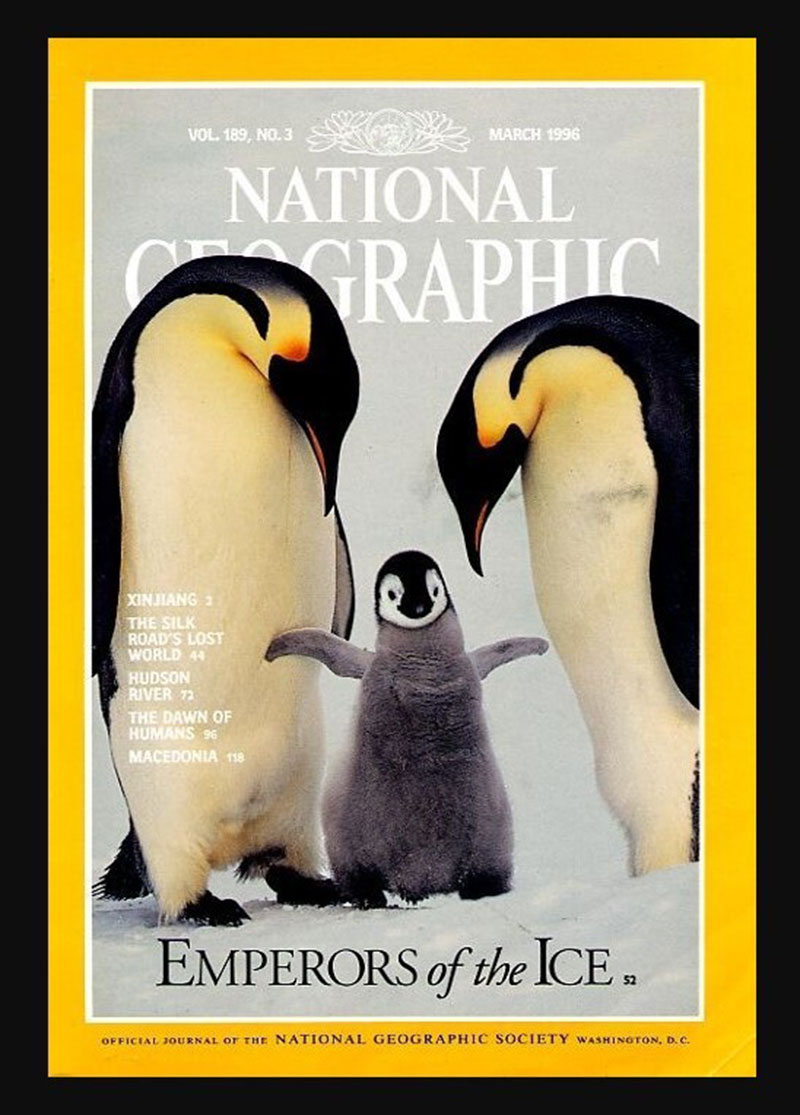
Antarctic expedition photography showcased Aptenodytes forsteri colonies during harsh winter conditions. Multiple covers featured penguin survival behaviors and climate impacts.
Visual Elements & Composition
White space emphasized penguin silhouettes against pristine snow landscapes. Repetition patterns showed colony formations and synchronized behaviors.
Historical Context & Significance
Coverage supported Antarctic Treaty conservation efforts. Published during increasing climate research focus on polar regions.
Subject Matter Expertise
Research documented breeding cycles at Ross Sea and Weddell Sea colonies. Scientific collaboration with British Antarctic Survey and McMurdo Station.
Technical Production Details
Extreme cold weather equipment operated at -40°F temperatures. Specialized battery heating systems maintained camera functionality during extended shoots.
Legacy & Influence
Advanced polar photography techniques. Influenced Antarctic conservation policies and climate change research funding.
Snow Leopard in Mountains
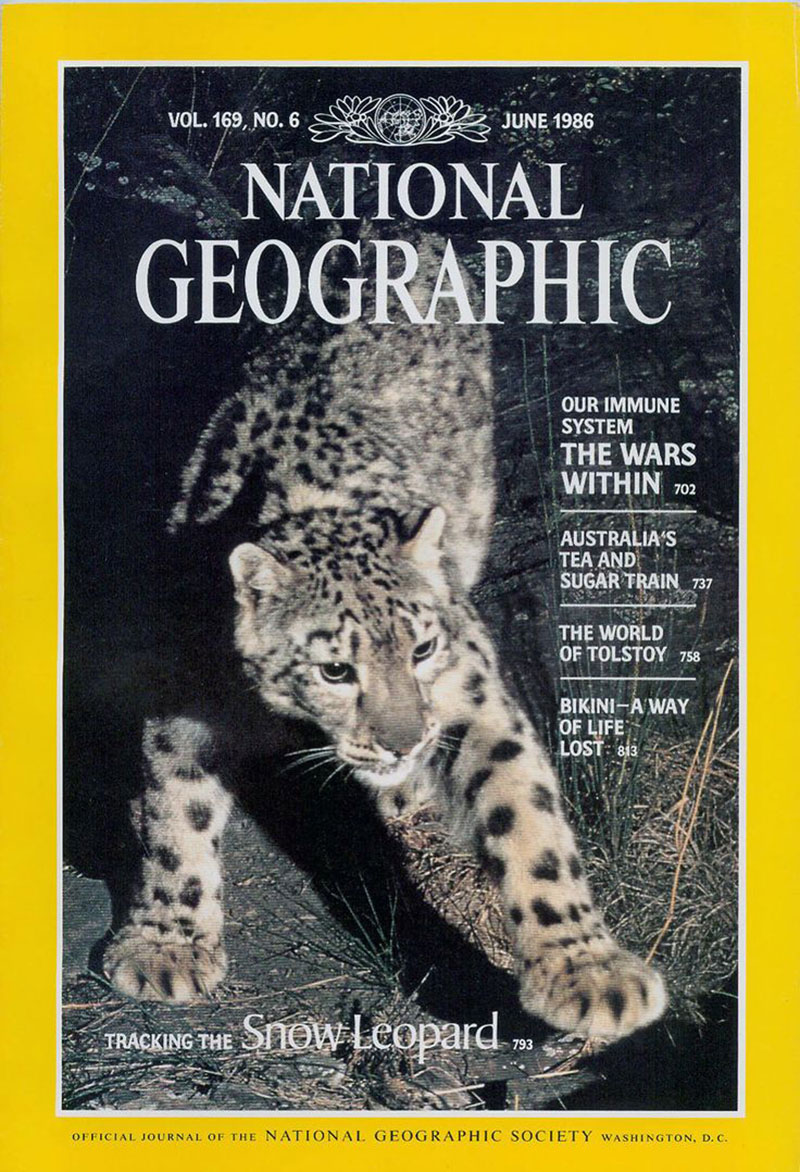
Panthera uncia photography in Central Asian highlands showcased elusive predator adaptations. Multiple expeditions documented high-altitude behaviors.
Visual Elements & Composition
Rocky terrain provided natural texture elements complementing leopard camouflage patterns. Mountain scale emphasized habitat remoteness.
Historical Context & Significance
Coverage raised awareness of declining snow leopard populations. Published during international conservation agreement negotiations.
Subject Matter Expertise
Research spanned Himalayas, Altai Mountains, and Hindu Kush ranges. Camera trap technology supplemented direct observation methods.
Technical Production Details
High-altitude photography required acclimatization protocols. Cold weather battery management essential for extended field operations.
Legacy & Influence
Established high-altitude wildlife photography standards. Influenced snow leopard conservation initiatives across 12 range countries.
Mount St. Helens Eruption (January 1981)
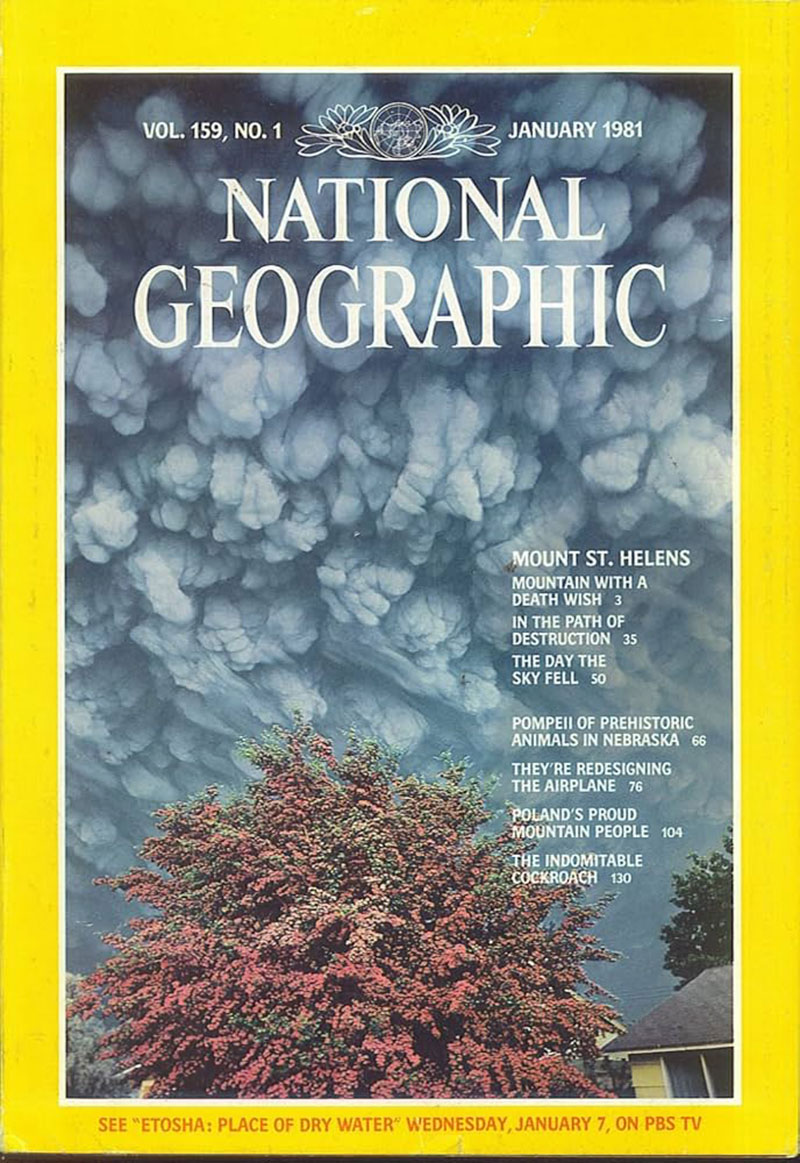
Volcanic documentation captured the May 18, 1980 catastrophic eruption that devastated Washington State. Aerial photography showcased geological forces and environmental recovery processes.
Visual Elements & Composition
Ash cloud formations created dramatic movement across sky compositions. Gray and black monochrome colors emphasized destruction scale and atmospheric impact.
Landscape framing showed before-and-after devastation comparisons. Volcanic debris created natural texture patterns across former forest areas.
Historical Context & Significance
Published eight months after eruption during recovery assessment period. Coverage supported geological research funding and volcanic monitoring system improvements.
Scientific documentation influenced volcanic hazard prediction models. Public fascination increased geology education program enrollment nationwide.
Subject Matter Expertise
Research documented lateral blast zone covering 230 square miles. Geographic coordinates: 46.1912°N, 122.1944°W in Cascade Range, Washington.
Geological analysis revealed magma chamber collapse mechanisms. Environmental impact studies tracked ecosystem recovery patterns across multiple elevation zones.
Technical Production Details
Aerial photography required specialized aircraft navigation around restricted airspace. Ash contamination protection essential for camera equipment functionality.
High-resolution print design captured fine ash particle details. Multiple exposure techniques documented eruption sequence timing.
Legacy & Influence
Established volcanic disaster photography standards. Influenced United States Geological Survey monitoring protocols and early warning system development.
Educational adoption across geology curricula worldwide. Modern volcanic tourism industry referenced original National Geographic documentation.
Great White Shark (April 2000)

Carcharodon carcharias coverage featured breakthrough underwater photography and shark behavior research. Multiple expedition documentation emphasized marine conservation messaging.
Visual Elements & Composition
Underwater perspectives created dramatic focal point emphasis on shark power. Ocean blue backgrounds provided natural color theory depth effects.
Breach photography captured apex predator dynamics. Contrast between shark size and human scale emphasized species magnificence.
Historical Context & Significance
Published during shark population decline awareness campaigns. Coverage shifted public perception from fear-based to conservation-focused messaging.
Marine protected areas received increased support following publication. Scientific research funding expanded for shark behavioral studies.
Subject Matter Expertise
Research locations included South Africa’s Seal Island and California’s Farallon Islands. Behavioral documentation revealed hunting strategies and migration patterns.
Tagging technology tracked individual sharks across ocean basins. Population studies indicated significant declines requiring conservation intervention.
Technical Production Details
Underwater housing systems enabled close shark approaches during cage diving operations. Fast autofocus technology captured rapid predator movements.
Specialized strobes penetrated deep water conditions. Safety protocols required experienced dive masters and emergency procedures.
Legacy & Influence
Advanced underwater predator photography techniques. Influenced shark protection legislation and marine sanctuary establishment globally.
Anti-finning campaigns referenced National Geographic imagery. Eco-tourism development balanced conservation with economic benefits.
Climate Change Special Issue (September 2004)

Global warming documentation featured comprehensive climate science analysis and environmental impact visualization. Multiple photographer collaboration showcased worldwide climate effects.
Visual Elements & Composition
Satellite imagery provided planetary scale perspective on climate patterns. Temperature data visualizations employed color psychology for impact communication.
Glacier retreat photography demonstrated movement through time-lapse comparisons. Environmental destruction imagery created powerful emotional responses.
Historical Context & Significance
Published during climate science consensus formation period. Coverage preceded major international climate agreement negotiations.
Scientific authority established through peer-reviewed research integration. Public opinion shifts tracked following comprehensive climate documentation.
Subject Matter Expertise
Research spanned Arctic ice loss, coral bleaching, and species migration documentation. Geographic precision included specific coordinate measurements for glacial retreat.
Temperature records revealed accelerating warming trends across multiple decades. Ecosystem disruption patterns documented across all major biomes.
Technical Production Details
Multi-location expedition coordination required extensive logistical planning. Specialized equipment operated across extreme temperature ranges.
Data visualization techniques translated complex climate models into accessible graphics. Infographic design communicated scientific findings effectively.
Legacy & Influence
Influenced international climate policy discussions and funding priorities. Educational institutions adopted materials across multiple academic disciplines.
Conservation initiatives received increased support following publication. Modern climate communication strategies referenced National Geographic approaches.
The Mind Issue (March 2005)
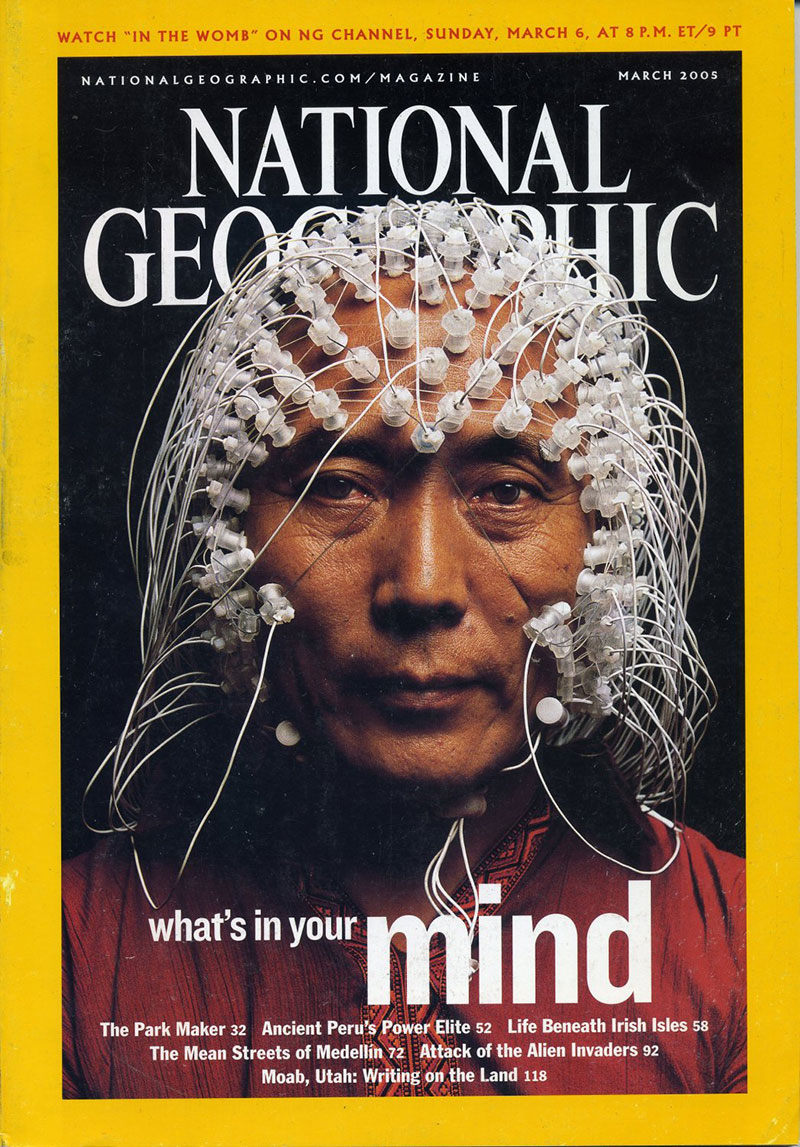
Neuroscience exploration featured cutting-edge brain research and consciousness studies. Medical photography and brain imaging showcased scientific breakthroughs.
Visual Elements & Composition
Brain scan imagery created intricate visual hierarchy patterns. Neural network visualizations employed color theory for scientific communication.
Medical photography maintained scientific accuracy while creating emotional connection. Symmetry in brain imaging emphasized anatomical precision.
Historical Context & Significance
Published during neuroscience research acceleration period. Coverage supported increased brain research funding and public interest.
Medical breakthroughs gained wider recognition through accessible science communication. Educational impact included psychology and neuroscience program growth.
Subject Matter Expertise
Research featured leading neuroscientists and cutting-edge brain imaging technology. Geographic locations included major research institutions worldwide.
Consciousness studies explored philosophical and scientific boundaries. Mental health research addressed societal challenges and treatment advances.
Technical Production Details
Medical photography required sterile environment protocols. Brain imaging technology integration demanded specialized technical knowledge.
Scientific illustration techniques clarified complex neurological concepts. Color coding systems organized information hierarchy.
Legacy & Influence
Advanced science communication photography standards. Influenced neuroscience education and public understanding of brain research.
Mental health awareness campaigns referenced National Geographic approaches. Modern brain research visualization techniques evolved from original methods.
Population 7 Billion (January 2011)

Demographics milestone documentation explored global population growth impacts and sustainability challenges. Multiple cultural photography showcased worldwide diversity.
Visual Elements & Composition
Crowd photography emphasized human density and population scale. Cultural diversity imagery celebrated global human variety and traditions.
Repetition patterns in urban photography showed population concentration effects. Resource visualization communicated sustainability challenges.
Historical Context & Significance
Published coinciding with global population reaching 7 billion milestone. Coverage examined demographic trends and future projections.
Sustainability discussions gained prominence following publication. International development policies referenced population growth documentation.
Subject Matter Expertise
Research spanned urbanization patterns across all continents. Geographic analysis revealed population distribution and migration trends.
Demographic data included birth rates, life expectancy, and economic indicators. Cultural documentation preserved traditions amid rapid change.
Technical Production Details
Multi-country expedition coordination required extensive cultural sensitivity training. Urban photography techniques captured population density effectively.
Statistical visualization translated demographic data into accessible formats. Cultural documentation maintained authenticity and respect.
Legacy & Influence
Influenced global population policy discussions and resource planning. Educational adoption across demographics and sociology curricula.
Urban planning initiatives referenced National Geographic analysis. Modern sustainability communication strategies evolved from original approaches.
FAQ on National Geographic Magazine Covers
What makes National Geographic covers so recognizable?
The iconic yellow border has been their signature since 1888. This distinctive framing creates instant brand recognition while the stunning wildlife photography and nature documentaries tie-ins make each cover memorable. The consistent visual hierarchy and typography elements reinforce the magazine’s authority in geographic education and conservation photography.
How are cover subjects chosen for National Geographic?
Cover selection focuses on conservation efforts, scientific discoveries, and cultural exploration stories. Editorial teams prioritize endangered species photography, archaeological findings, and environmental advocacy campaigns. The goal is balancing educational content with visual impact that drives newsstand sales while supporting the National Geographic Society’s mission.
Who designs National Geographic magazine covers?
The creative team at National Geographic Partners works under editorial guidance from the Editor-in-Chief. Professional photographers, art directors, and graphic designers collaborate on cover design layouts. The design process emphasizes storytelling through powerful imagery and strategic placement of cover lines.
What photography techniques create impactful covers?
Award-winning photographers use specialized equipment for wildlife behavior documentation and landscape photography excellence. Techniques include macro photography for detailed shots, telephoto lenses for remote location exploration, and advanced lighting for emphasis on subjects. Each image must tell a complete story within seconds.
How do covers support conservation awareness?
National Geographic covers highlight conservation success stories, environmental issues, and wildlife preservation efforts. The magazine’s global reach amplifies conservation photography and environmental education initiatives. Cover stories often feature endangered species protection programs and climate change awareness campaigns, driving reader engagement with conservation initiatives.
What fonts does National Geographic use?
What font does National Geographic use varies between cover headlines and body text. The magazine employs custom typefaces that reflect exploration history and scientific credibility. Font psychology plays a crucial role in conveying authority while maintaining readability across different cultural contexts and age groups.
How has cover design evolved over time?
Early covers featured simple typography and minimal imagery. Modern covers emphasize full-bleed photography with strategic text placement. Digital printing advances allow for enhanced color theory application and improved image quality. The yellow border remains constant while layout sophistication has dramatically increased through decades.
What role does color play in cover design?
The signature yellow border creates consistent brand identity while interior colors vary by story theme. Photographers and designers use color psychology to evoke emotions and guide reader attention. Natural color palettes dominate wildlife covers while cultural stories may feature more vibrant, diverse color schemes.
How do covers perform commercially?
Successful covers combine scientific credibility with visual appeal to maximize newsstand performance. Market research shows wildlife and adventure stories generate highest sales. The iconic design helps National Geographic maintain premium positioning among educational magazines while competing with digital media for reader attention and magazine subscription retention.
What makes a cover worthy of awards?
Award-winning covers demonstrate exceptional wildlife photography, innovative composition, and powerful storytelling. Industry recognition comes from photojournalism excellence, conservation impact, and design innovation. The best covers seamlessly blend artistic vision with educational value, creating images that become part of conservation photography history and geographic research documentation.
Conclusion
National Geographic Magazine covers continue defining excellence in photojournalism and educational publishing. Their distinctive approach to wildlife conservation and cultural documentation has shaped public understanding of environmental issues for generations.
The magazine’s commitment to scientific expeditions and field research creates authentic content that resonates globally. Through powerful marine life documentation and indigenous culture preservation, each cover reinforces National Geographic Society’s mission of exploration and discovery.
Modern covers balance artistic innovation with conservation awareness campaigns. The integration of design elements and contrast creates visual impact while maintaining scientific credibility.
Looking ahead, National Geographic’s iconic covers will continue bridging the gap between entertainment and education. Their legacy in nature education resources and conservation photography awards ensures these covers remain powerful tools for environmental advocacy and cultural heritage preservation in an increasingly digital world.

Renowned for his expertise in logo design and visual branding, Bogdan has developed a multitude of logos for various clients.
His skills extend to creating posters, vector illustrations, business cards, and brochures. Additionally, Bogdan's UI kits were featured on marketplaces like Visual Hierarchy and UI8.
He also wrote in the past years on sites like Design Your Way, WebDesignerDepot, WPDean, Designmodo, Speckyboy, Slider Revolution, and more.
- The Cursor Logo History, Colors, Font, And Meaning - 24 September 2026
- Top 7 Web Design Subscription Services That Replace Full-Time Hires - 24 September 2026
- Canva vs PowerPoint: Which Is Better for Presentations? - 22 September 2026

Bogdan Sandu is a seasoned designer who has been designing websites since 2008. Renowned for his expertise in logo design and visual branding, Bogdan has developed a multitude of logos for various clients. His skills extend to creating posters, vector illustrations, business cards, and brochures. Additionally, Bogdan's UI kits were featured on marketplaces like Visual Hierarchy and UI8. He also wrote in the past years on sites like Design Your Way, WebDesignerDepot, WPDean, Designmodo, Speckyboy, Slider Revolution, and more.
You Might Also Like


