









A shoe logo gets very little room. It has to tell people who made the shoe from a tongue label, a heel tab, a side panel or a sole, and some of the best-known ones are just a curve or a few stripes. The Nike Swoosh and the Adidas three stripes are the obvious cases. Legally these are trademarks, registered in Nice Class 25 along with clothing and headgear.
To work, a mark has to stay legible at small sizes. A factory also needs to be able to stitch, print or mold it, and a trademark office has to be willing to register it. From what I've seen, designs that look great on a poster often fall apart on that first requirement.
Marks like these are also what counterfeiters copy, and the numbers are big. The OECD and EUIPO put global trade in counterfeit goods at $467 billion in 2021 (2025 report).
Shoe Logo Types and What Each One Does on a Shoe
Most of what a shoe logo has to survive comes from where it sits. It lands on curved leather, mesh, rubber and foam, on the tongue, heel tab, side panel, insole or outsole, so it has to stay readable at small sizes and across a lot of colorways.
The simplest approach is a wordmark, which is just the brand name in set lettering. Dr. Martens does this, and so does the Clarks script. Cut the name down to initials and you get a lettermark, like the New Balance N or the Vans V.
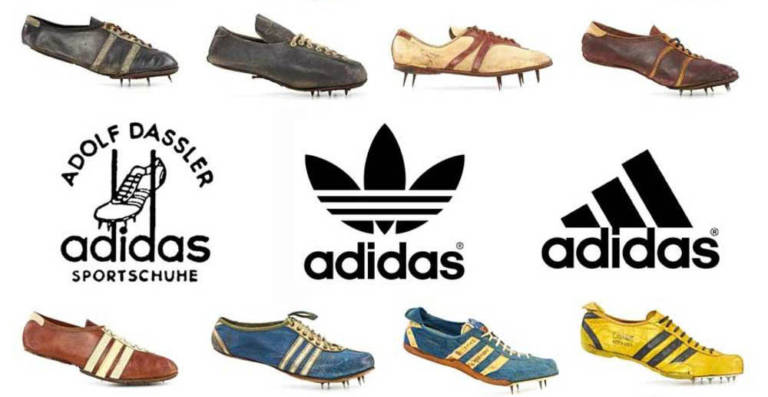
Pictorial marks go the other way and draw an animal or a figure, like the Puma leaping cat or the Jordan Brand Jumpman silhouette. An abstract device shows nothing literal, only a shape or a line. That's the Nike Swoosh and the Adidas three stripes, which are the classic side-panel marks. The Adidas Badge of Sport is a combination mark, a symbol paired with a name, since it joins the three bars to the wordmark (Adidas, 2022).
Sneaker logos lean toward minimalist design because they get stitched, printed or molded onto the shoe itself, according to Fabrik Brands.
In practice, a single curve or letter holds up on a tongue label better than a detailed illustration.
Origins of the Best-Known Shoe Logos
The best-documented origin stories are the Nike Swoosh (1971, Carolyn Davidson) and the Adidas three stripes (on shoes from 1949, with a reported 1952 purchase from Karhu). The Jordan Brand Jumpman (created 1987, on a shoe in 1988) isn't far behind. Prices and dates shift depending on the source, so where they disagree I've said so.
Nike Swoosh
Footwear people call a shoe logo a stripe, and the Swoosh started out as a brief for one.
Phil Knight needed a mark for Nike's first shoes in 1971. He told Carolyn Davidson, then a Portland State design student, that it had to convey motion and could not resemble the Adidas three stripes (Wikipedia's Swoosh entry).
Davidson presented at least a half-dozen marks. Knight picked the curve, said he did not love it but that it might grow on him, and went ahead because production deadlines were close. The fee was $35 for 17.5 hours of work (Wikipedia's Swoosh entry, which cites Nike's history page and BBC reporting). That comes to $2 an hour.
The Swoosh was trademarked on June 18, 1971. It reached athletes on the Nike Cortez at the 1972 US Track and Field Olympic Trials in Eugene, Oregon. In 1983 Knight thanked Davidson with a gold Swoosh ring set with a diamond, plus Nike stock. Given the 1971 fee, the ring and the stock make a bit more sense.
Adidas three stripes
Two accounts of the three stripes exist, and they do not match.
Adidas says Adolf Dassler tested several versions and numbers of stripes and found that three showed up most prominently in photography, so the count carries no numerological meaning (Adidas, 2022). That page never mentions Karhu.
The Karhu version goes differently. The Finnish brand used three stripes first, and Adidas bought the trademark in 1952 for the equivalent of 1,600 euros, per Wikipedia's Karhu entry. Popular retellings add two bottles of whiskey to the price, but Adidas has never confirmed that, and a former Karhu brand manager says no record exists (VinePair).
The Finnish Sport Museum holds a 1940s Karhu shoe with three stripes, so Karhu was using the mark in the same decade Adidas was founded (1949). Treat the sale as widely reported but not confirmed by Adidas.
Jumpman and the Rentmeester dispute
Where the Jumpman starts depends on which source you read, because the photo, the logo and the first shoe all fall in different years.
It begins in 1984, when Life magazine ran Jacobus Rentmeester's photograph of Michael Jordan and Nike borrowed two transparencies for slide use. In March 1985 Nike agreed to pay $15,000 for two years of North American poster and billboard use of its own Jordan photo (Ninth Circuit opinion, 2018). That summer a Jordan pose showed up on the Air Jordan I hang tag and in ads, but never on the shoe (ESPN).
Nike created the Jumpman in 1987, a silhouette that tracks the outline of Jordan in Nike's own photo. The Air Jordan III shipped with it on the tongue in 1988, its first appearance on a shoe (ESPN, 2018). In 2018 the Ninth Circuit ruled the logo is not substantially similar to Rentmeester's photograph.
Wikipedia dates the logo's introduction to 1988, while the court opinion says Nike created it in 1987. Both fit, since 1987 is the design and 1988 is the first shoe. The 1987 date comes from allegations the court accepted as true at the dismissal stage, so it describes the pleadings, not a finding.
Logo families and redesigns
Adidas runs three marks at once, each tied to a product line (Adidas brand history post, September 2022).
| Adidas mark | Line it represents | Colors |
|---|---|---|
| Performance logo (three bars) | Main brand mark | Black and white only |
| Badge of Sport | Sportswear | Black and white only |
| Trefoil | Originals | Black and white, or Originals blue |
Adidas dates the Trefoil to clothing in 1972 and to shoes from 1976. Wikipedia says it was designed in 1971 and launched in 1972, in time for the Munich Olympics.
The three-bar mark started in 1989 from sketches of the stripes as seen from inside an Adidas shoe, and it reached the public in 1991.
Nike went the other way. Until 1995 its corporate logo put the NIKE name in Futura Bold inside the Swoosh (there's more on that in the history of the typeface behind the Nike name), and since then the Swoosh has run alone.
Product lines still add words under it, though. Nike Air and Nike SB both sit beneath the curve (Fabrik Brands).
Where Do Logos Go on a Shoe, and How Are They Applied?
A logo can sit on the tongue, heel tab, quarter (the side panel), insole, midsole, outsole or lace hardware. Factories apply it by die cutting, screen printing, woven labels, embroidery, TPR injection, metal hardware or molding, and which one is cheapest depends on how many pairs you're making. Low-volume runs favor methods with no setup charge. High-volume runs can justify tooling.
Placement zones
The side panel gets the big marks. Sewn-on die cuts are the most common treatment there, and the Swoosh, the Adidas stripes, the New Balance N, the Vans V and the Puma Formstrip are the classics (Shoemakers Academy).
Tongues usually carry woven labels, which is where the New Balance tongue logo and the classic Nike marks live. The Jumpman debuted on the Air Jordan III tongue. Heel counters take embroidered marks, as on the Air Jordan 1 (LegitGrails).
Lower down, molded logos on the midsole and outsole cost nothing extra once they are cut into the mold, and TPR badges can sit on the bottom of an outsole. Lace hardware is the last spot: custom eyelets, lace fobs and logo plates.
Application methods compared
Shoemakers Academy lists the common methods with their setup traits. The site carries no publication date on its prices, so confirm costs with a factory. I'd treat the numbers as a rough guide only.
| Method | Best for | Setup | Watch for |
|---|---|---|---|
| Die cut, sewn on | High-visibility side panels | Material cost only | Detail limited to what can be sewn |
| Screen print | Big, high-contrast marks | No setup charge | Suede, elastic, waxed or oiled surfaces |
| Embroidery | Rich, thread-textured marks | Usually no setup charge | Snags and soiled light thread |
| TPR micro injection | Fine detail on tongue or outsole | Mold under $200 | Needs a mold |
| Metal hardware | Eyelets, lace fobs, plates | Tooling $300 to $3,000 | Widest tooling range of the group |
| Molded into the sole | Crisp logos in EVA and rubber | Free once cut into the mold | Logo is fixed at the mold stage |
Choosing a method by run size
Volume decides more than taste does.
For short runs, stick with the methods that have no setup charge, meaning screen printing, embroidery and sewn-on die cuts. Anything that needs a custom mold can wait.
Once volume goes up, injection-style logos and other tooled methods start to make sense. A sole mold carries the logo for free on every pair, and metal hardware fits if the budget covers its tooling.
Each method fails somewhere. Screen printing cracks on elastic fabric and prints poorly on rough or waxed surfaces, and embroidery lets water in on waterproof shoes.
If the mark carries letters, a guide to which fonts hold up in embroidery saves a failed first sample.
How to Design a Shoe Logo That Works on Small Surfaces and Many Colorways
Start from the smallest placement on the shoe and the most restrictive production method, and design up from there. Flat colors, and not many of them. Then test the mark on every colorway before anyone approves artwork. A logo that only works large, or only in one color, usually breaks down once a factory stitches or prints it.
Size and detail limits
Printful's embroidery guide sets the floor for text at 0.25 inches tall with strokes at least 0.05 inches thick. Those figures are written for garments and hats, so a shoe factory's limits can differ.
Printful and Exclaim both say that thin or tiny lettering and overlapping elements are the first things to go. Gradients and shading go too, since they get simplified in digitizing.
Screen printing runs into trouble with multicolor marks, which are hard to register (Shoemakers Academy).
Color across colorways
A shoe line ships in many colors, so the mark has to hold up on each one.
Black and black-and-white dominate sneaker marks because they work on many designs, Fabrik Brands notes. Adidas follows that rule, keeping its Performance and Sportswear marks to black and white while the Trefoil adds Originals blue (Adidas, 2022).
Check the contrast between the mark and each upper color, because a mark that vanishes on navy fails like one that clashes on red.
Then record the brand color as a Pantone value so factories can match it across leather, mesh and rubber.
Design steps in order
- Find the smallest placement on the shoe (tongue label, heel tab or lace tip) and size the mark for it.
- Ask the factory which methods it runs in-house, since sending embroidery out adds cost.
- Decide between a symbol on its own and a combination mark, which makes sense if the name still needs reading (Nike kept its name in the logo until 1995).
- Draw in flat, solid colors with strokes thick enough for thread, and cut the gradients.
- Build one-color and reversed versions for dark and light uppers.
- Test a physical sample on the real material before approving production artwork.
Skip that last step and the first production run becomes the test.
Which File Format Works Best for a Shoe Logo?
Keep the master logo in a vector format, meaning SVG, AI, EPS or a PDF saved from vector artwork. Factories digitize, print and mold from clean paths. PNG covers web use, mockups and quotes.
SVG is the W3C's XML-based format for two-dimensional graphics and is resolution independent by design. Shops accept it when the paths are clean (Digit-IT). Many embroidery and print shops still prefer AI or EPS masters, and a PDF only works if it was saved from vector artwork.
Why enlarged raster files lose their edges is explained in this look at how vector and raster artwork behave in print.
Decorators take PNG or JPG only at a minimum of 300 DPI, and lower-resolution files get redrawn, sometimes for a fee (Custom Caps).
Logo libraries supply brand files, but the marks themselves stay trademarked.
How Shoe Logos Are Protected as Trademarks
Protection comes from registering the logo as a trademark for footwear in Nice Class 25 (clothing, footwear, headgear). In the United States that means the USPTO, in the EU it means the EUIPO, and for other markets there's WIPO's Madrid System. What gets protected is the mark as shoppers see it on goods, not the artwork file.
Routes and offices
The route depends on where the shoes will sell.
| Route | Covers | Catch |
|---|---|---|
| USPTO | United States | Needs a specimen of real use, one per class |
| EUIPO | European Union | One unitary right, which one earlier national right can block (Harris Sliwoski) |
| WIPO Madrid System | 130+ markets from one application | Each office examines on its own |
The market count comes from WIPO's Madrid FAQ, consulted in November 2026. A refusal by one member does not affect the registration elsewhere, but WIPO states that protection is not guaranteed.
Madrid also builds on a basic national or regional mark. If that basic mark is refused or cancelled within five years of the international registration, the international registration falls with it (Wikipedia's Madrid system entry).
What a registration covers
A footwear registration can protect more than a drawn logo.
Louboutin shows how far that goes. In Case C-163/16 (12 June 2018), the Court of Justice of the EU held that a mark consisting of a colour applied to the sole of a shoe does not consist exclusively of a shape, which is how Louboutin's red sole is treated as a position-type colour mark. The registration claims the red (Pantone 18-1663TP) on the sole, with the shoe outline showing only where the colour sits.
Converse had a harder road. Its Chuck Taylor midsole design (toe cap, toe bumper and two midsole stripes) was registered in 2013, and the company says it has used the design since 1932. The ITC held the registration invalid for lack of secondary meaning in 2016, and the Federal Circuit vacated that finding on 30 October 2018 because the ITC applied the wrong standard.
When the protected feature is part of the shoe itself, the owner has to prove that shoppers read it as a brand signal.
Where protection breaks down
Specimens are where US filings tend to trip. The USPTO refuses mockups, printer's proofs and digitally altered images, and a label or tag must show the mark in real use on goods (USPTO specimen guidance, last updated May 2023). Madrid filers skip the specimen at registration but still owe one at later maintenance filings (USPTO).
The Louboutin ruling has an age problem too. It interpreted a directive that has since been replaced, so its reach under current EU law is less settled, according to law-firm commentary.
File the logo as it is stitched, printed or molded, not as it looks in the design file.
When a Logo Check Fails to Spot a Fake Shoe
A logo check catches sloppy fakes but fails against careful ones, because it rests on a few visible cues that counterfeiters study and copy. Treat logo details as one signal, and confirm them against the box label, the inner tag and a verified pair.
Logo cues authenticators check
Embroidery and print come first. Stitches should be crisp and evenly spaced, and frayed thread or blurry printing points to a fake (LegitGrails). On the box, wrong fonts, off colors or misplaced logos are red flags (Mad Kicks).
The SKU, size and colorway must match across the box label and the shoe tag. Converse tongue labels carry a serial number that should match on both shoes and the box, and the zig-zag tongue stitching should run straight (LegitGrails).
Where the checks stop working
Real pairs vary too. In a side-by-side test reported by FRIDAY Digital, an appraiser at Fake Busters found the genuine shoe's stitching was also uneven and the tags looked identical, so no single cue separated the pair.
Checklists also age. eBay's sneaker general manager, Garry Thaniel, told the Portland Press Herald that the company keeps parts of its test private because sellers plan around whatever becomes public.
A workable rule is to count mismatches. Several independent ones together point to a fake, while one oddity on its own does not.
For resale pairs, eBay, StockX and GOAT use authenticators who inspect each pair, which is a stronger check than a buyer's own look at the logo.
What counterfeiting costs the footwear sector
In 2016, footwear held the largest share of seized counterfeit value at 22%, ahead of clothing and leather goods (OECD and EUIPO 2019 report, as covered by Just Style).
The EU's own sector estimates don't agree from one edition to the next. The EUIPO 2018 edition had the clothing, footwear and accessories sector losing 8.1% of sales to counterfeits (Leatherbiz coverage), while the EUIPO 2019 status report put it at 9.7% (Croatian State Intellectual Property Office summary).
The editions covered different sector sets, and a Spanish patent office summary of the 2019 report rounds the sector share differently. The sources do not explain the gap, so treat the sector loss as a range between the two figures.
Read together, the two data sets show footwear as both the top seized category by value and part of the EU's hardest-hit sector, a pairing neither report states on its own.
Common Questions About Shoe Logos
Why don't shoe logos show a shoe?
A shoe pictogram ties a brand to footwear alone, which gets awkward once the product range grows. Adidas's first logo in 1949 showed a track spike, and the Trefoil was added in 1972 when the company introduced apparel (Adidas, 2022).
How long does it take to register a footwear logo?
At the USPTO, the fiscal year 2026 average runs 9.5 months from filing to registration or abandonment, and the first examining action arrives after 4.1 months (USPTO, 28 October 2026).
An unchallenged EU application registers in four to five months, according to Mathys and Squire. An opposition adds time.
Does a shoe logo trademark expire?
Not if it is maintained. The USPTO requires a declaration of use with a specimen between the fifth and sixth year after registration, then every ten years.
EU registrations renew every 10 years, per Mathys and Squire.
What is the second logo inside the tongue or on the insole for?
Mostly product data. It pairs the mark with details such as size and SKU. The USPTO accepts a label attached to the goods as a specimen of use, and authenticators check the SKU against the box (Mad Kicks).
Can I put a famous shoe logo on custom sneakers?
No, not for sale. When MSCHF sold modified Nike Air Max 97s, Nike sued for trademark infringement, and a US district judge temporarily blocked further sales (Reuters, 2021).
Nike also argued the shoes wrongly linked its brand to their imagery.
Which Shoe Logo Decisions Come First
A shoe logo should be cleared and filed before the first production run. Test it at the smallest decoration size next, and lock the vector master only after that.
Registration is the slowest of these, so it goes first.
The US and EU averages are not like-for-like, but the gap is wide. An unchallenged EU filing registers in roughly half the time of the average US one, so filing both on the same day still leaves the US mark pending longer.
The US figure is the USPTO's fiscal year 2026 average and the EU figure is a typical straightforward case. A shift in either office's average changes how early to file, not the order of the steps.