HP ads have been running since November 1939, when a single page for the Model 200B audio oscillator appeared in Electronics.
Eighty-seven years later the work spans 6 lead agencies and 8 flagship campaigns, across every medium from trade print to ad-supported streaming.
Most ad galleries stop at pretty pictures. This one names the agency, year and market behind each campaign, then takes the layout apart.
Here is what the article covers:
- Every major campaign, from The Computer is Personal Again to Work Happy
- The typography, palette and grid rules behind HP print ads
- How the TV commercials break from the print system
- What Goodby Silverstein, Giant Spoon and Wieden+Kennedy each contributed
HP advertising spans 87 years, 6 lead agencies and 8 flagship campaigns, from the Model 200B oscillator ad printed in Electronics in November 1939 to the Work Happy platform still running in 2026.
The work is built on one repeated device: ordinary people doing specific things with machines, shot close and cropped tight.
This page covers each campaign by name, with the agency, year and market behind it, plus the layout, palette and type decisions that hold the work together.
HP Advertising at a Glance
HP has advertised since November 1939, working primarily with Goodby, Silverstein & Partners and Wieden+Kennedy. Its best-known campaigns are The Computer is Personal Again, The Wolf and Work Happy. The visual signature combines HP Electric Blue, a 20-degree stripe system and the Forma DJR Office typeface.
| Attribute | Value |
|---|---|
| First documented ad | Model 200B audio oscillator, Electronics, November 1939 |
| Lead agencies | Goodby, Silverstein & Partners (1999-2019), 180LA, BBDO, Giant Spoon, Wieden+Kennedy (2021-present) |
| Best-known taglines | “Invent” (1999), “The Computer is Personal Again” (2006), “Bend the Rules” (2014), “Keep Reinventing” (2015), “Work Happy” (2022) |
| Primary media | Trade print, consumer print, TV, OOH, long-form digital film, YouTube |
| Awards | Effie United States, 2008, for The Computer is Personal Again |
| Visual signature | HP Electric Blue, 20-degree stripe system, Forma DJR Office, left-aligned type only |
HP reported advertising costs of $628 million in fiscal 2024, up from $611 million in 2023, according to its Form 10-K.
Which HP Ad Campaigns Are the Most Famous?
Six HP campaigns carry lasting recognition: The Computer is Personal Again (2006), Hands (2006), Bend the Rules (2014), Keep Reinventing (2015), The Wolf (2017) and Work Happy (2022). Each ran globally, each carried its own tagline, and four of the six were built on human gesture rather than product hardware.
The Computer Is Personal Again (2006-2008)

The Computer is Personal Again ran from 2006 across North America, Europe and Asia-Pacific, created by Goodby, Silverstein & Partners in San Francisco. It repositioned the PC as a personal object rather than a spec sheet.
The campaign launched in San Francisco on May 9, 2006, and rolled into India on June 2 through Publicis, with Zenith Optimedia buying media.
Roughly a third of GS&P’s 300 staff worked on it, per Leavcom’s account of the launch. It won an Effie in the United States in 2008.
Hands (2006-2007)
Format: subject filmed from shoulder to waist, face never shown, hands doing all the talking.
Cast: Jay-Z, Shaun White, Pharrell Williams, Mark Cuban and Mark Burnett, with Michel Gondry and Paulo Coelho announced later.
Production: Motion Theory handled the animation, layering chessboards, waveforms and photo grids directly onto the actors’ gestures.
The Jay-Z spot premiered online before its TV debut during the NBA playoffs. That online-first sequencing was unusual for a hardware brand in 2006, and the motion graphics did the heavy lifting that a product shot normally would.
Bend the Rules (2014-2016)

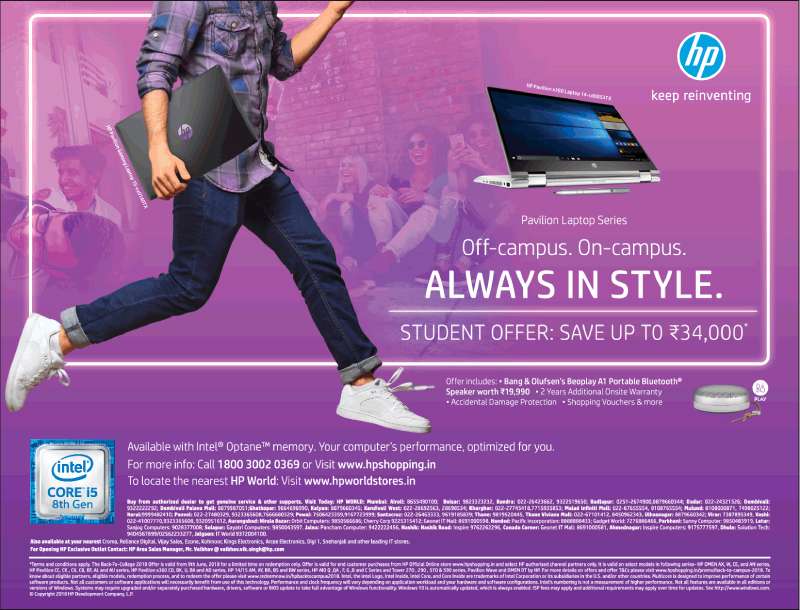
Bend the Rules sold one product idea: the Pavilion x360 folds, so the people in the ads should too.
- Agency: 180LA
- Talent: Meghan Trainor, surfer Ian Walsh, dance crew Les Twins
- India edition: a year-long run with Bindass featuring Everest climber Malavath Poorna and surf-school founder Ishita Malaviya
India’s version stretched across TV, print, OOH, webisodes and Vine, which tells you how much of the budget went to short-form video that year.
Keep Reinventing (2015-2019)

HP Inc. launched as a separate Fortune 100 company on November 2, 2015, and Keep Reinventing arrived with it as the first post-split brand platform, built by BBDO and 180LA.
The launch films tied into Star Wars: The Force Awakens. One spot follows a teenager building a life-size R2-D2 in a garage, a deliberate echo of the Palo Alto garage at 367 Addison Avenue.
CMO Antonio Lucio described the line as a company mission rather than a slogan. HP’s own brand guidelines restrict Keep Reinventing to the logo lock-up to prevent wear-out, which is a rare piece of self-discipline in tech branding.
The Wolf (2017-2018)

The Wolf is HP’s most-copied piece of B2B work. Christian Slater plays a hacker who walks through a company’s network by way of its unsecured printers.
| Film | Year | Credits |
|---|---|---|
| The Wolf | 2017 | Giant Spoon and gyro, directed by Lance Acord, edited by Kirk Baxter |
| The Hunt | 2017 | Giant Spoon, Christian Slater returning |
| True Alpha | 2018 | Giant Spoon x Zac&Adam, Slater plus Jonathan Banks |
Episode one opens on a hard statistic: under 2% of the world’s business printers are adequately secured. WARC reported the series more than doubled its purchase-intent target and beat its printer sales goal by over three times.
Work Happy (2022-2026)

Agency: Wieden+Kennedy Portland, which expanded its HP remit in 2021 alongside its Budweiser and Stella Artois work.
The best-known execution, Navigate the Nonsense, was directed by Craig Gillespie through MJZ and ran in nine markets including France, Germany, Japan and Australia through Q1 2024.
The joke is dry and the film knows it: executives keep changing the hybrid-work rules while employees quietly get on with the job. It’s the closest HP has come to genuine storytelling in design rather than product demonstration.
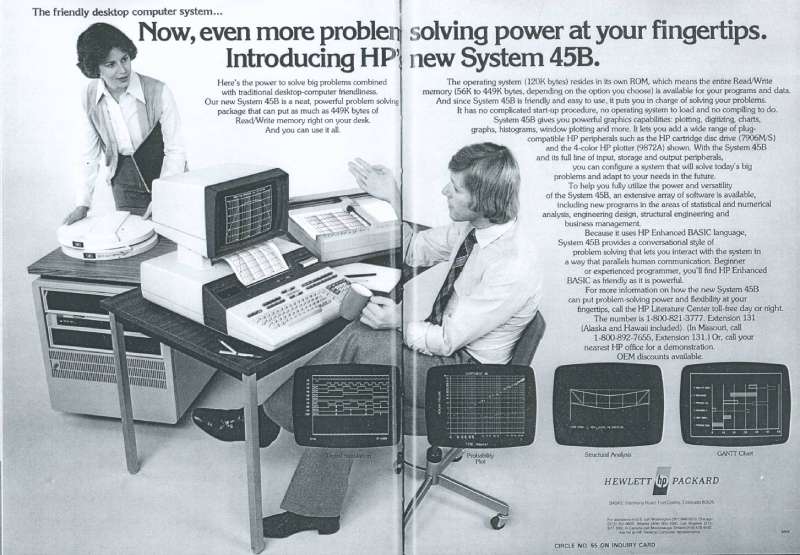
HP Print Ads From the Instrument Years (1939-1979)
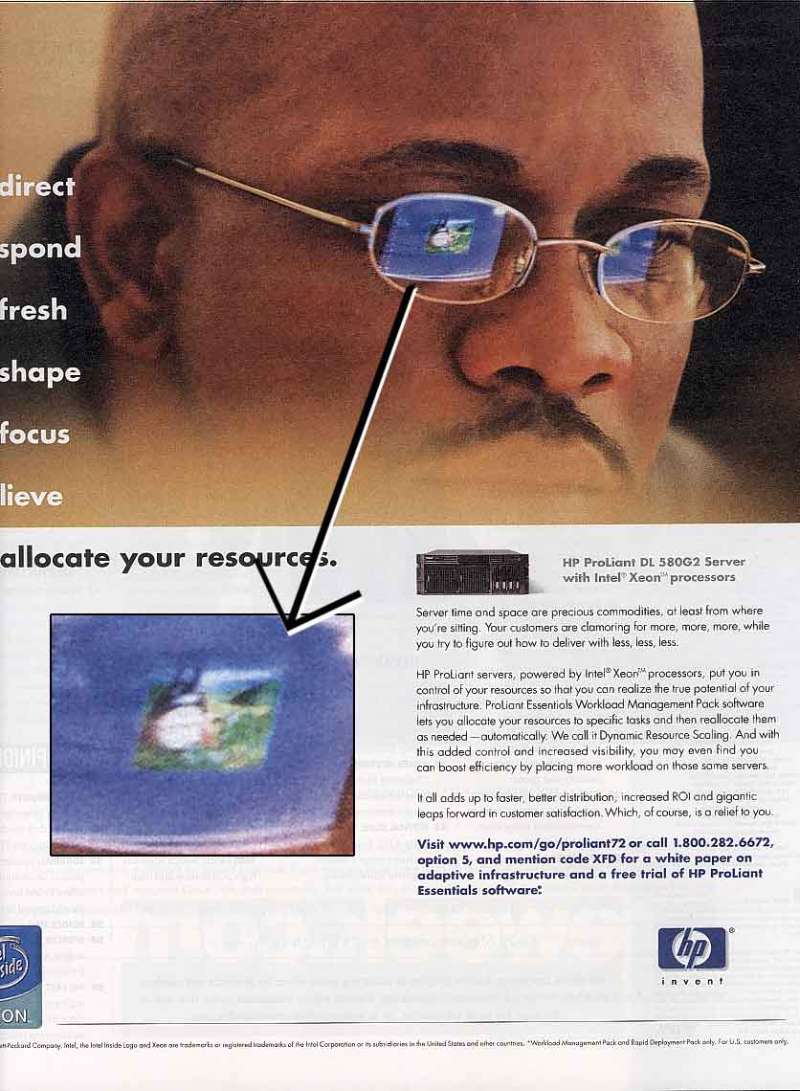
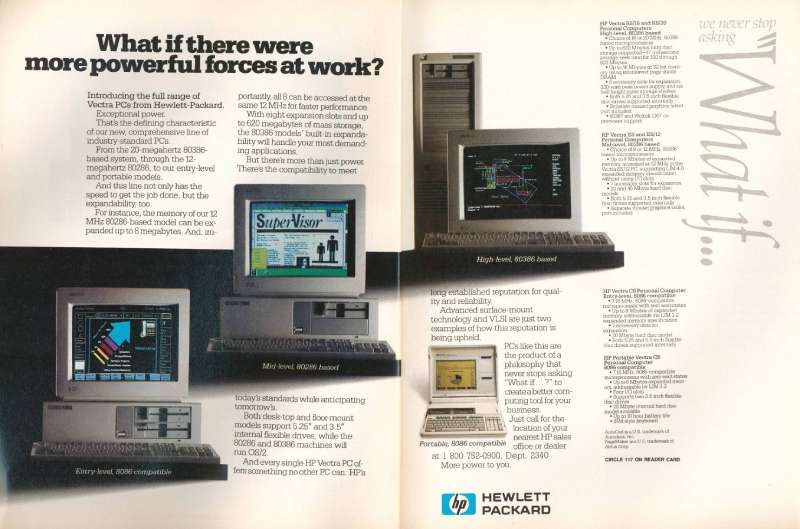
Before HP sold anything to consumers, it advertised oscillators, voltmeters and signal generators in engineering trade magazines.
The first ad, November 1939, promoted the Model 200B, the oscillator Walt Disney Studios bought eight of at $54.40 each to test Fantasound for Fantasia.
These pages read like data sheets. Product photo, frequency range, price, address. No headline in the modern sense.
How Do HP Print Ads Work Visually?
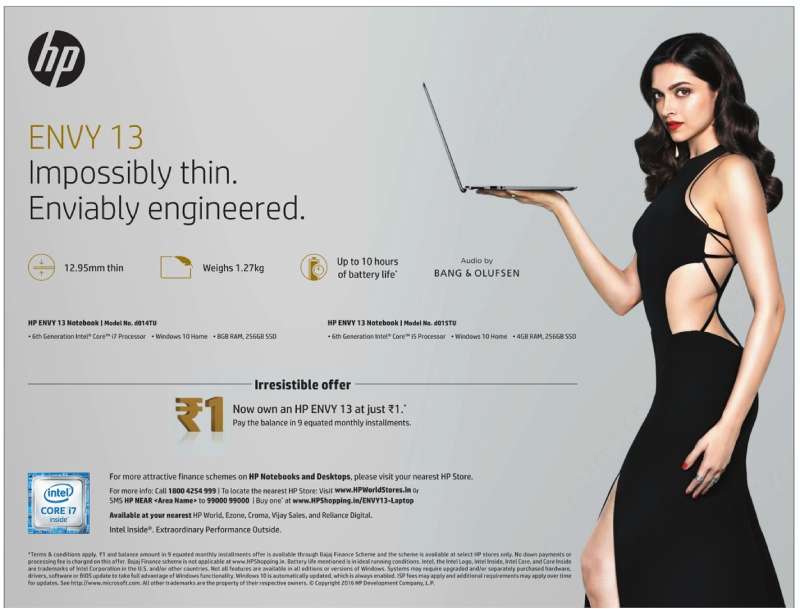
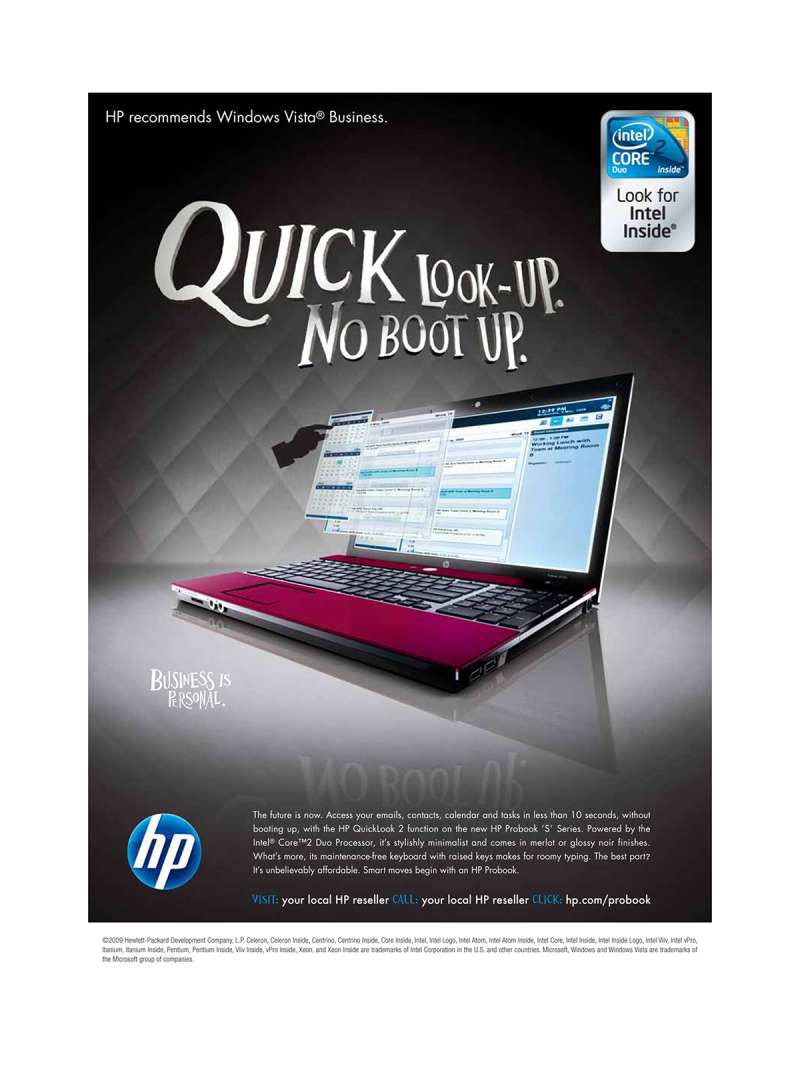
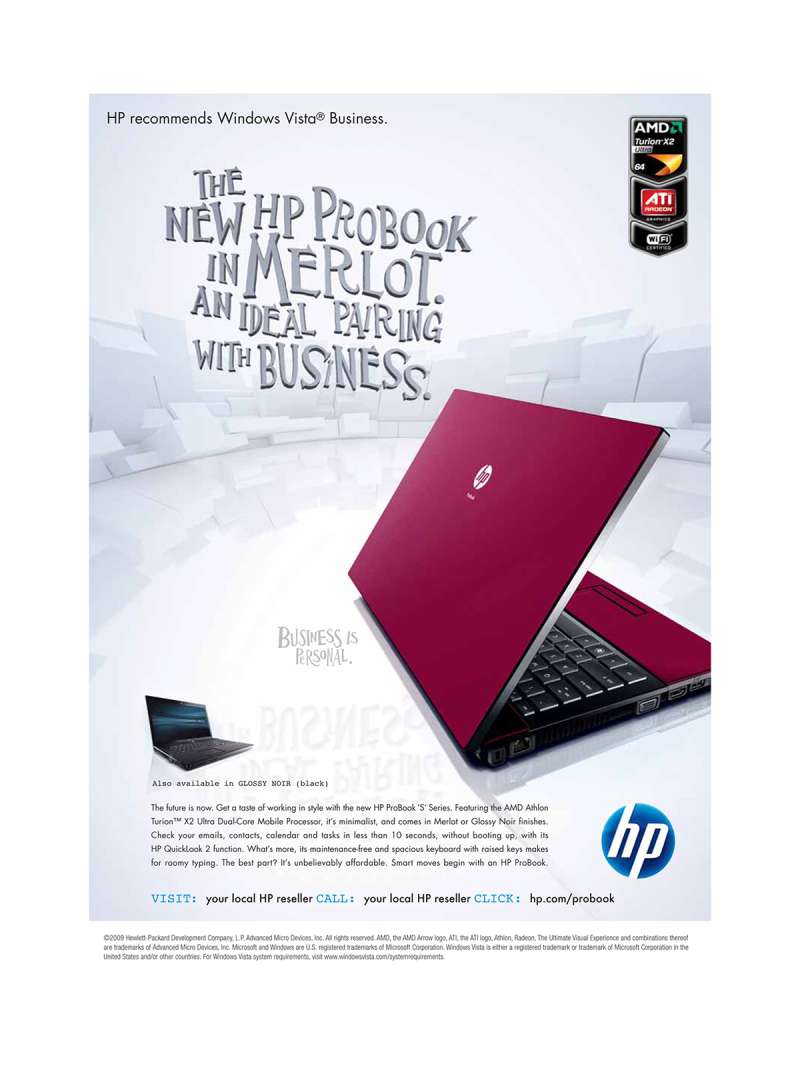
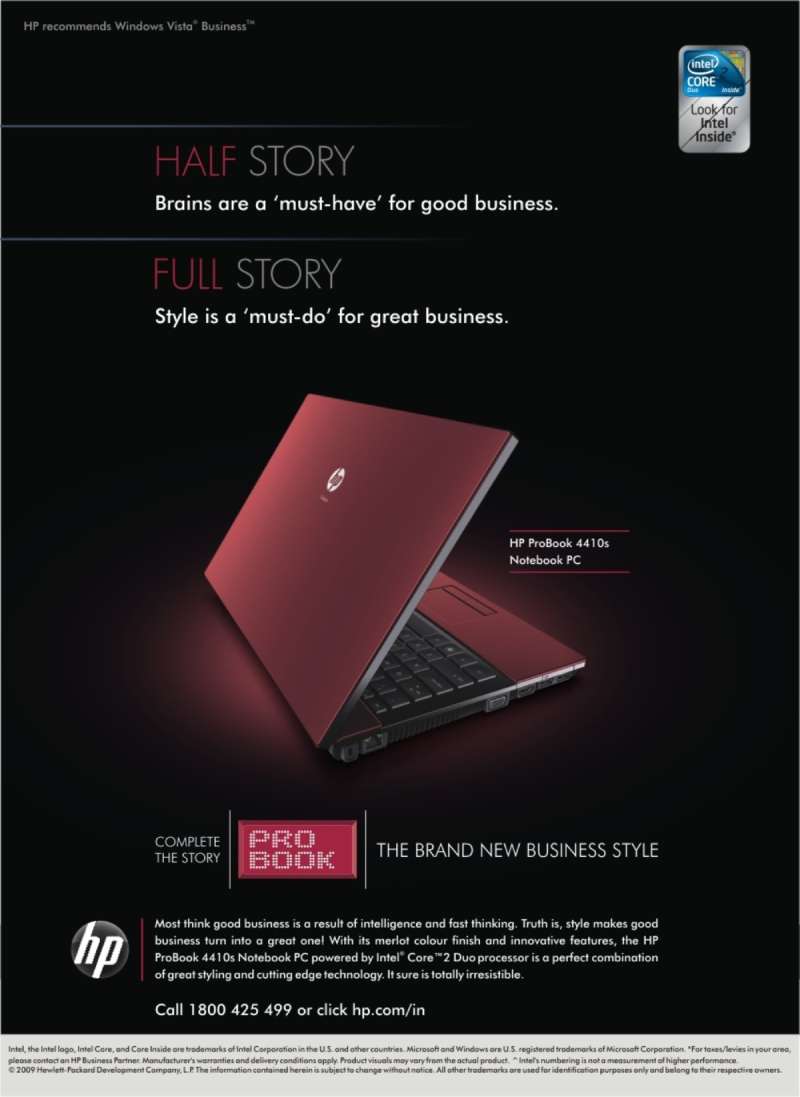
HP print ads use a left-aligned single-column layout, a two-tone palette of HP Electric Blue and black on white, and a single typeface at two weights. The product sits low and small. Copy blocks stay short, and the logo anchors a corner rather than the optical center.
The current system is unusually strict. HP’s brand central specifies Forma DJR Office as the sole brand typeface, Medium weight for headlines and Regular for everything else, with alignment set to left only.
Type is black or white. Never mixed on one layout, never given a drop shadow.
| Element | HP rule | Design effect |
|---|---|---|
| Typeface | Forma DJR Office, two weights | Uniform letterspacing across all sizes |
| Color | Electric Blue plus black | Ownable without needing the logo |
| Stripes | 20-degree angle from the logo | Direction and motion in a static frame |
| Alignment | Left only | Predictable reading path |
Forma DJR is a revival of Aldo Novarese’s 1968 Nebiolo original, drawn by David Jonathan Ross. It is a neo-grotesque, which places HP firmly in the Swiss design lineage rather than the humanist camp Dell and Lenovo tend to sit in.
The stripe system is the smartest part. Because it derives from the 20-degree slant of the letterforms, a poster reads as HP even when the mark is cropped out, which is what a color palette plus one geometric motif is supposed to achieve.
Where the layouts get their air: HP campaign pages typically run a 60/40 image-to-text split, with the copy block sitting below the optical center and generous white space above the headline.
That restraint is also what keeps the typographic hierarchy readable at billboard scale. Larger to smaller, top to bottom, nothing competing.
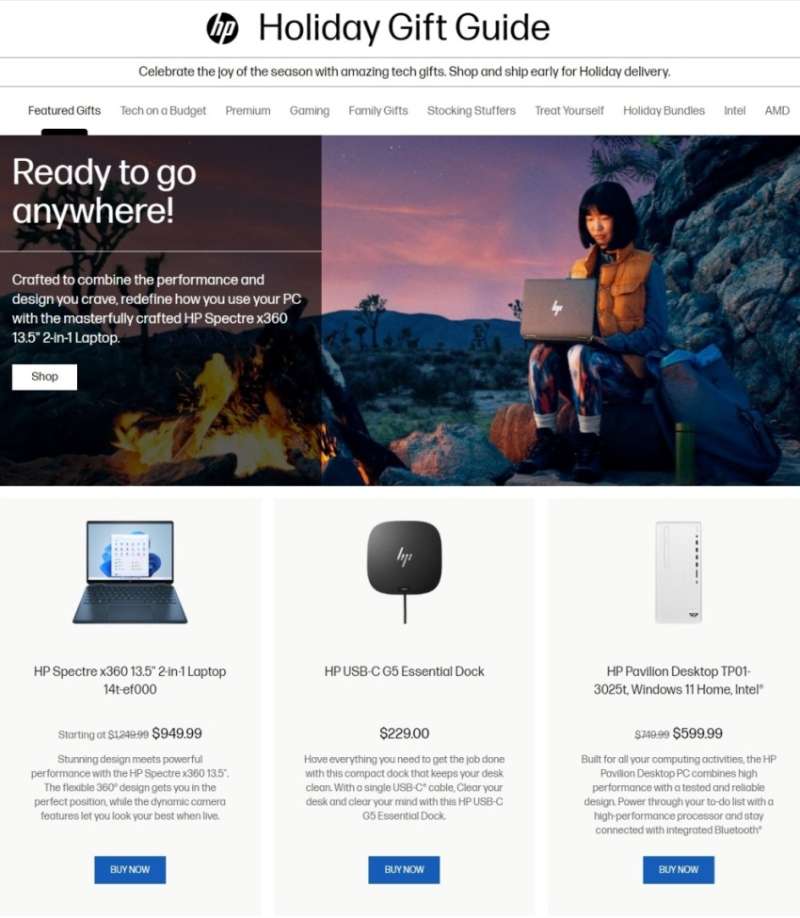
One honest limitation: HP’s sans-serif font discipline makes the retail and promotional work look almost identical to its brand work. Great for recognition, less great when you want a sale ad to feel urgent.
How Do HP TV Commercials Differ From Its Print Ads?
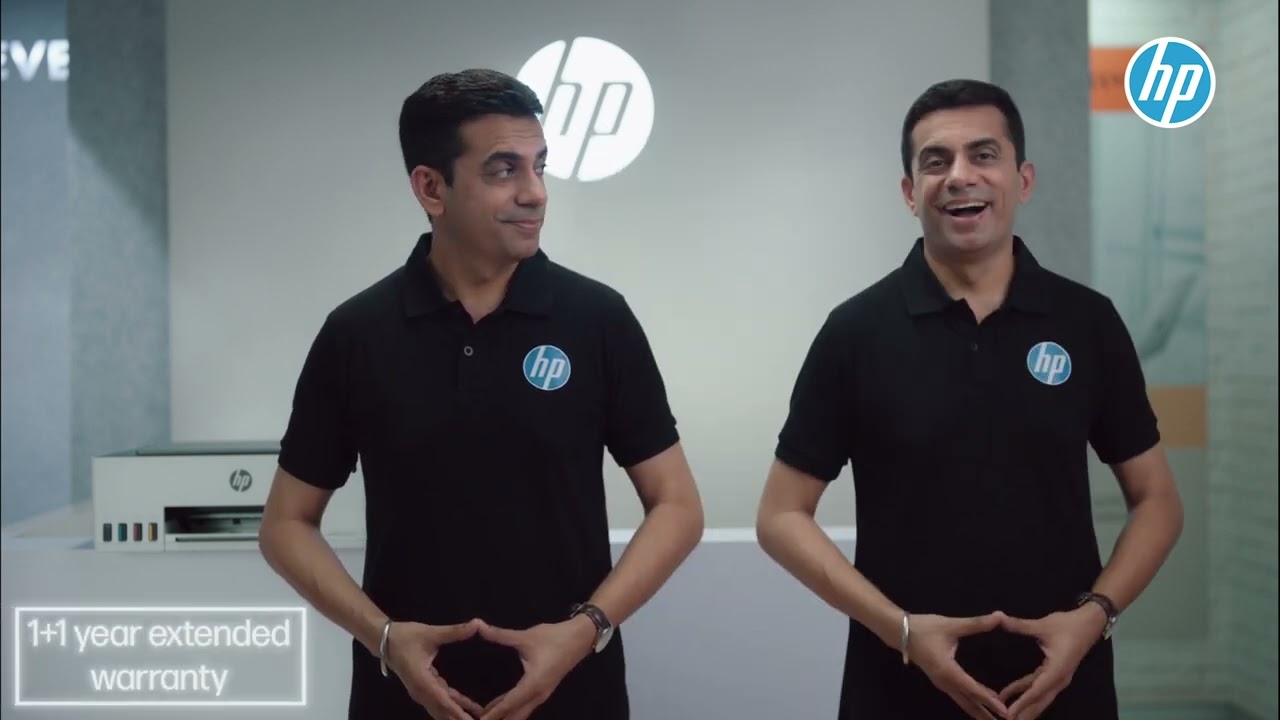
HP TV commercials use narrative and celebrity where the print ads use structure and silence. Film work runs 30 to 380 seconds, casts named actors and directors, and often skips the product entirely for the first half. Print work never does. The type system stays constant across both.
HP Hands, Jay-Z, 2006, 60 seconds. Goodby, Silverstein & Partners with Motion Theory. Jay-Z talks through his laptop’s contents while chessboards, tour maps and album art unfold from his fingers. His face never appears.
The Wolf, 2017, 6 minutes 20 seconds. Giant Spoon and gyro, directed by Lance Acord, edited by Kirk Baxter. Christian Slater moves from mailroom to boardroom through unsecured printers, narrating each step to camera.
The Wolf: True Alpha, 2018. Giant Spoon x Zac&Adam. Slater returns opposite Jonathan Banks as The Fixer, in a film Adweek described as elaborate enough to warrant a cinematic release.
Navigate the Nonsense, 2024, 60 seconds. Wieden+Kennedy Portland, directed by Craig Gillespie through MJZ, shot by Nicolas Karakatsanis. Global CEOs contradict each other about hybrid work while staff carry on regardless.
Go Make Things, 2015, 60 seconds. 180LA, directed by Lance Acord, for Sprout by HP. A girl grows into a maker across a single unbroken emotional arc.
The contrast is deliberate. Film carries the contrast and emotion, print carries the system.
How Has HP Advertising Evolved Since 1939?
HP advertising has moved through 5 distinct eras: trade instrument ads (1939-1979), consumer computing and calculators (1980-1998), the Invent rebrand (1999-2005), celebrity personalization (2006-2014), and post-split brand platforms (2015-present). Each shift followed a change in what HP actually sold.
The Trade Era
Ads ran in Electronics and similar engineering titles. Product, specification, price. The audience was 500 lab engineers, not 500 million consumers.
The Invent Rebrand
Carly Fiorina became CEO in 1999 and authorized $200 million to Goodby, Silverstein & Partners for a full rebrand, including a new logo and the “Invent” line.
GS&P executive Steven Simpson read Packard’s 1995 book The HP Way and rewrote it as the Rules of the Garage, an 11-point manifesto that ran as a print campaign. “Believe you can change the world” was rule one.
The Personalization Era
2006 through 2014 belonged to hands, faces cropped out, and named talent. HP moved past Dell to become the largest PC maker during this period, and the campaign is taught as a Harvard Business School case.
The Platform Era
HP Inc. and Hewlett Packard Enterprise separated on November 1, 2015. HP Inc. inherited PCs and printing, and with them Keep Reinventing, Work Happy and the Wolf Security sub-brand.
The 2021 identity work moved the brand font from HP Simplified to Forma DJR. Wieden+Kennedy commissioned Arabic, Devanagari, Greek, Hebrew and Thai cuts through Type Network, which is a serious font licensing commitment for a company operating in more than 180 countries.
Forma DJR UI followed as a variable font tuned for screen legibility, and the 2025 refresh added HP Electric Blue under a “One HP” visual identity banner.
Which Agencies Created HP Advertising?
Six agencies have led HP advertising since 1999. Goodby, Silverstein & Partners created Invent in 1999 and Get Real in 2019. 180LA created Bend the Rules in 2014. Giant Spoon created The Wolf in 2017. Wieden+Kennedy Portland created Work Happy in 2022.
| Agency | Years on HP | Signature work |
|---|---|---|
| Goodby, Silverstein & Partners | 1999-2019 | “Invent,” “The Computer is Personal Again,” “Get Real” |
| 180LA | 2014-2016 | “Bend the Rules,” “Go Make Things” |
| BBDO | 2015-2016 | “Keep Reinventing” launch films |
| Giant Spoon | 2017-2018 | The Wolf trilogy |
| Wieden+Kennedy | 2021-present | “Work Happy,” OMEN, brand typography rollout |
Regional partners matter here too. Publicis handled Asia-Pacific rollout for The Computer is Personal Again, McCann Erickson covered Europe and Latin America, and Saatchi & Saatchi ran Asia-Pacific creative alongside GS&P.
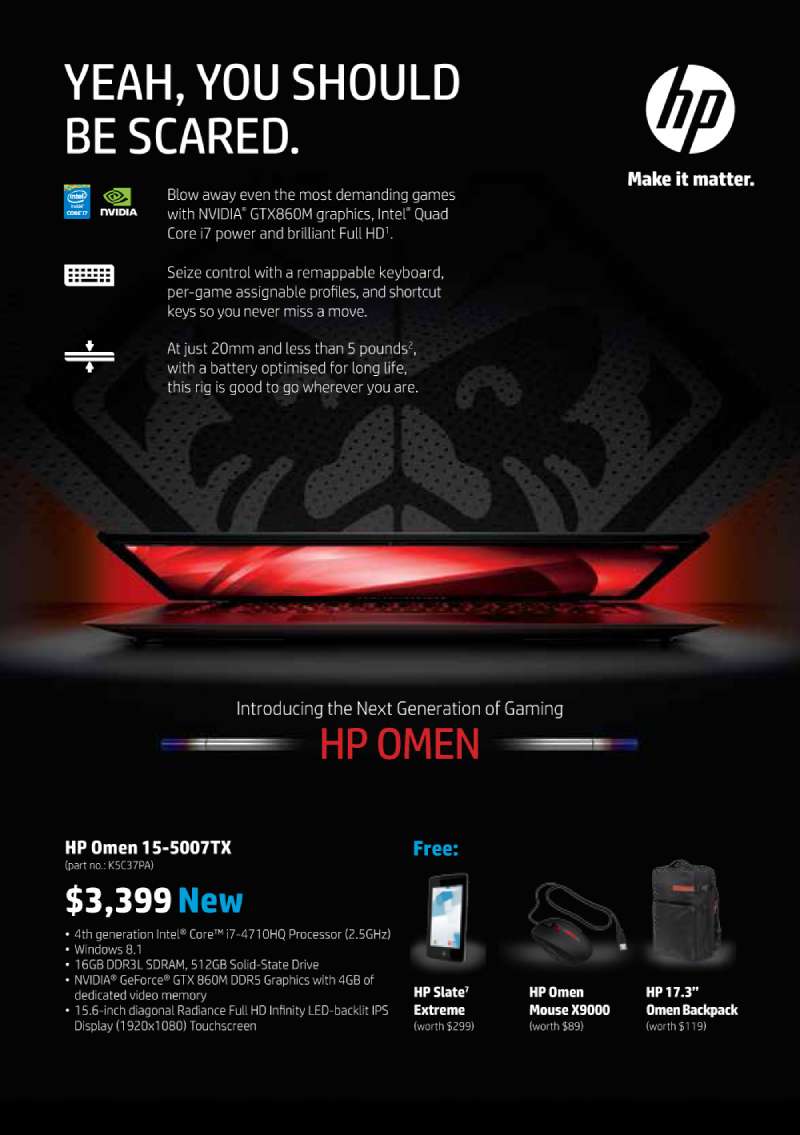
Wieden+Kennedy also made I’m Not Gaming for Me, I’m Gaming For You for OMEN by HP in 2021, plus a Korean OMEN campaign attacking status culture. NEM Digital produced OMEN static work in India in 2023.
Named directors recur: Lance Acord shot both Go Make Things (2015) and two Wolf films (2017, 2018), which is why the two campaigns share a lighting language despite different agencies.
What Can Designers Learn From HP Ads?
HP ads offer 5 transferable lessons: crop the human subject, derive a secondary motif from the logo, hold the palette to two colors, restrict the type system to one family, and let long-form film carry the emotion the print system cannot.
- Crop the face out of the frame. The Hands campaign proved gesture reads faster than portrait, and it removes the celebrity-endorsement smell.
- Build a motif from the logo geometry. HP’s stripes take their 20-degree angle straight from the letterforms, so the asset stays branded even when the mark is cropped.
- Limit the palette to two colors plus black. Electric Blue and white does everything HP needs across print, OOH and screen.
- Set every size in one family at two weights. Medium for headlines, Regular for the rest, which kills the temptation to solve hierarchy with more fonts instead of better grid systems.
- Put the emotional work in film and the systematic work in print. Trying to make one asset do both is how you get a layout that neither moves nor scans.
Worth flagging the trade-off honestly: HP’s system produces consistency at the cost of surprise. Compare a decade of HP layouts against a decade of Apple layouts and HP wins on coherence, loses on memorability.
How Do HP Ads Compare to Dell, Lenovo and IBM Ads?
HP, Dell, Lenovo and IBM sell overlapping hardware to overlapping buyers, and their advertising diverges sharply on where the human sits in the frame.
HP puts the person first and the machine second, a pattern running unbroken from the 2006 Hands films to Navigate the Nonsense in 2024. Dell ads historically led with configuration and value, which produced the opposite layout logic: product large, copy dense, human incidental.
Lenovo advertising campaigns lean harder on transformation narratives and global-market localization, while IBM ads operate in a different register entirely, selling capability and intelligence to enterprise buyers with almost no consumer-facing product photography.
The closest structural comparison is actually Sony ads, which share HP’s habit of hiring film directors for brand work and letting the spot run long. Both brands treat the 60-second film as the primary asset and the print layout as the residue of it.
In market terms the comparison is not academic. Lenovo led global PC shipments in 2025 with 27.2% share against HP’s 21.3%, per Gartner, and HP’s print design and film budget of $628 million is spent almost entirely on holding that second position.
What Makes HP Advertising Work?
The through-line is subtraction.
Faces get cropped out, palettes stop at two colors, the type system runs one family at two weights, and the product usually arrives late in the frame.
That restraint gives the film work room to carry emotion and the print work room to stay legible at any size, which is a cleaner division of labor than most hardware brands manage.
It also explains the weakness. A system this tight produces recognition rather than surprise, and the retail work looks almost identical to the brand work.
Treating advertising design as an engineering problem is very much in character for a company that started with an oscillator, and after 87 years the discipline still holds.
HP Ads Examples






FAQ on HP Ads
What is HP’s advertising slogan?
Keep Reinventing, adopted when HP Inc. launched on November 2, 2015. Earlier lines include Invent (1999), The Computer is Personal Again (2006) and Bend the Rules (2014). Work Happy has carried the recent campaign work since 2022.
Who creates HP’s ad campaigns?
Goodby, Silverstein & Partners led the account from 1999 to 2019. 180LA and BBDO handled the 2014-2016 work, Giant Spoon made The Wolf, and Wieden+Kennedy Portland has run global creative since 2021.
Who is the hacker in HP’s printer security ads?
Christian Slater plays The Wolf across three films released between 2017 and 2018. Jonathan Banks joined him as The Fixer in True Alpha. Lance Acord directed, and Kirk Baxter edited the first installment.
What was The Computer is Personal Again about?
It repositioned the PC as a personal object rather than a spec sheet. Launched May 9, 2006 in San Francisco by Goodby, Silverstein & Partners, it rolled into North America, Europe and Asia-Pacific and won a US Effie in 2008.
Which celebrities have appeared in HP commercials?
Jay-Z, Pharrell Williams, Shaun White, Mark Cuban and Mark Burnett fronted the 2006 films. Meghan Trainor and surfer Ian Walsh carried Bend the Rules. Slater and Banks handled the printer security work.
How much does HP spend on advertising each year?
HP reported advertising costs of $628 million in fiscal 2024, against $611 million in 2023 and $696 million in 2022, per its Form 10-K. Media spend specifically ran $194 million globally in 2023.
What typeface do HP ads use?
Forma DJR Office, a custom cut of David Jonathan Ross’s revival of Aldo Novarese’s 1968 Nebiolo original. HP uses the typeface at two weights only, Medium for headlines and Regular for everything else.
What is the HP Hands campaign?
A 2006 film series shot from shoulder to waist, so the subject’s face never appears. Motion Theory animated chessboards, photos and tour maps directly onto the gestures. Jay-Z’s spot premiered online before airing during the NBA playoffs.
What colors do HP ads use?
HP Electric Blue plus black on white, with no third color permitted on a single layout. A stripe system pulled from the logo’s 20-degree slant carries the brand when the mark is cropped out.
Has HP advertising won awards?
The Computer is Personal Again took an Effie in the United States in 2008. HP also sponsored the Cannes Lions Young Lions competition in 2010 and 2011, supplying digital print equipment rather than entering work.
Conclusion
HP ads reward a second look because the system underneath them barely moves across eight decades. Keep Reinventing, Bend the Rules and Work Happy all sit on the same skeleton.
Electric blue, one sans-serif family at two weights, a 20-degree stripe, and a person doing something specific with a machine.
The work that landed hardest ignored the hardware entirely. Christian Slater walking through unsecured printers moved more units than any spec sheet.
Borrow the discipline rather than the look. Two colors, one type family, and let the film carry the feeling your layout cannot.
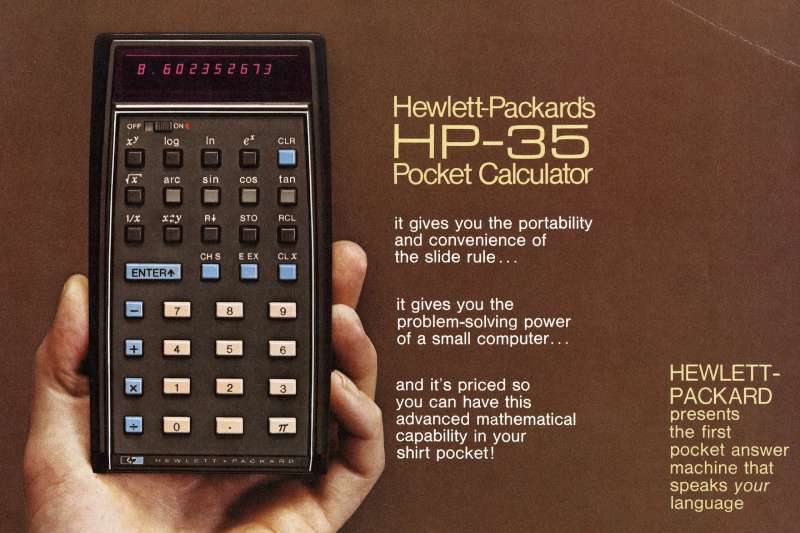
Then go back to the 1972 calculator pages. The restraint was already there, decades before anyone thought to call it a design system.

Renowned for his expertise in logo design and visual branding, Bogdan has developed a multitude of logos for various clients.
His skills extend to creating posters, vector illustrations, business cards, and brochures. Additionally, Bogdan's UI kits were featured on marketplaces like Visual Hierarchy and UI8.
He also wrote in the past years on sites like Design Your Way, WebDesignerDepot, WPDean, Designmodo, Speckyboy, Slider Revolution, and more.
- Canva vs PowerPoint: Which Is Better for Presentations? - 22 September 2026
- How to Install Fonts on Mac (Step-by-Step Guide) - 20 September 2026
- From Mockup to Code: How AI-Augmented Development Speeds Up the Design Handoff - 19 September 2026

Bogdan Sandu is a seasoned designer who has been designing websites since 2008. Renowned for his expertise in logo design and visual branding, Bogdan has developed a multitude of logos for various clients. His skills extend to creating posters, vector illustrations, business cards, and brochures. Additionally, Bogdan's UI kits were featured on marketplaces like Visual Hierarchy and UI8. He also wrote in the past years on sites like Design Your Way, WebDesignerDepot, WPDean, Designmodo, Speckyboy, Slider Revolution, and more.
You Might Also Like