Green light on a black field, one product, one number. That is the whole grammar of NVIDIA ads, and it has barely changed in 20 years.
NVIDIA advertising runs across game splash screens, esports broadcast, retail box art and GTC keynote film, built by an in-house team with outside work from Cutwater and Alecoppe.
This page collects the campaigns with the year, agency and market attached to each one.
You will also get the design breakdown: palette, typography, composition and logo placement.
- The Way It’s Meant to Be Played, Busterfumper, Frames Win Games and I Am AI
- How GeForce RTX print work builds visual hierarchy
- Where NVIDIA ads diverge from Intel and AMD advertising
NVIDIA advertising spans 27 years, 2 named outside agencies and 5 flagship campaigns, from the GeForce 256 launch in 1999 to the I Am AI keynote films still running today. The work is built on one repeated device: green light against black, product silhouette first, logo last.
This page covers the campaigns, taglines and agencies behind NVIDIA ads, campaign by campaign, with the year and market attached to each one.
It also breaks down the layout, palette and type decisions that make the print and video work read the way it does.
NVIDIA Advertising at a Glance
NVIDIA has run branded consumer campaigns since the GeForce launch in 1999, working mostly through an in-house creative team with outside film work from Cutwater in San Francisco. Its best-known campaigns are The Way It’s Meant to Be Played, Frames Win Games and I Am AI.
| Attribute | Value |
|---|---|
| First major campaign | “The Way It’s Meant to Be Played,” launched 2002 |
| Lead agencies | Cutwater (San Francisco, 2009), Alecoppe, in-house NVIDIA creative |
| Best-known taglines | “The way it’s meant to be played” (2002), “Frames win games” (2020), “The Ultimate Play” (2020) |
| Primary media | Game splash screens, retail box art, YouTube, keynote film, esports broadcast, OOH |
| Signature colors | NVIDIA Green (#76B900), black (#000000), white (#FFFFFF) |
| Visual signature | Eye mark, all-caps custom wordmark, green light source on near-black field |
Brand references cite Pantone 376 C as the print match for NVIDIA Green, with an RGB value of 118, 185, 0.
The restraint here is the point. Three values carry the entire color palette, which is unusual for a category that loves rainbow RGB lighting.
Which NVIDIA Ad Campaigns Are the Most Famous?
NVIDIA’s 5 most recognized campaigns are The Way It’s Meant to Be Played (2002), Busterfumper (2009), I Am AI (2017), Frames Win Games (2020) and The Ultimate Play (2020). Three of the five never ran as paid media in the traditional sense.
| Campaign | Years | Primary medium |
|---|---|---|
| The Way It’s Meant to Be Played | 2002 to mid-2010s | Game splash screens, box art |
| Busterfumper | 2009 | Broadcast and online film |
| I Am AI | 2017 to present | Keynote opening film |
| Frames Win Games | 2020 to present | Esports broadcast, landing pages, retail |
| The Ultimate Play | 2020 to 2022 | Launch video, social, partner co-op |
The Way It’s Meant to Be Played (2002 onward)

Bill Rehbock launched the program after joining NVIDIA as Director of Developer Relations in December 2001. Studios got hardware and engineering help; NVIDIA got its circle logo on the game’s startup screen and retail packaging.
Rules from the official logo guidelines:
- Circle version is the preferred lockup over the horizontal one
- Preferred minimum size is 1.25 inches in height and width
- Clear space equals the height of the graphic symbol on all four sides
Distribution, not media buying, did the work. Every copy of a partnered game shipped with the mark attached.
Busterfumper (2009)
Cutwater created this film campaign for NVIDIA, published in January 2009 and catalogued by Ads of the World under Electronics and Technology. The nonsense product name is the whole joke.
| Role | Credit |
|---|---|
| Agency | Cutwater, San Francisco |
| Executive Creative Director | Chuck McBride |
| Director | Rocky Morton |
| Production company | MJZ |
Absurdist naming was a deliberate swerve away from spec-sheet advertising, which is where every other GPU brand was parked at the time.
Frames Win Games (2020 onward)

NVIDIA Reflex shipped in September 2020, and this became the esports-facing line attached to it. The claim is numeric rather than emotional.
Landing pages state sub-25 ms system latency, 144 FPS as the baseline target and G-SYNC refresh rates up to 360 Hz at 1440p.
Featured titles rotate with the hardware generation:
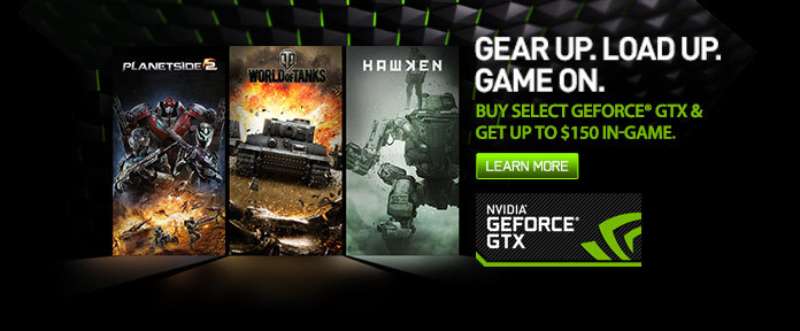
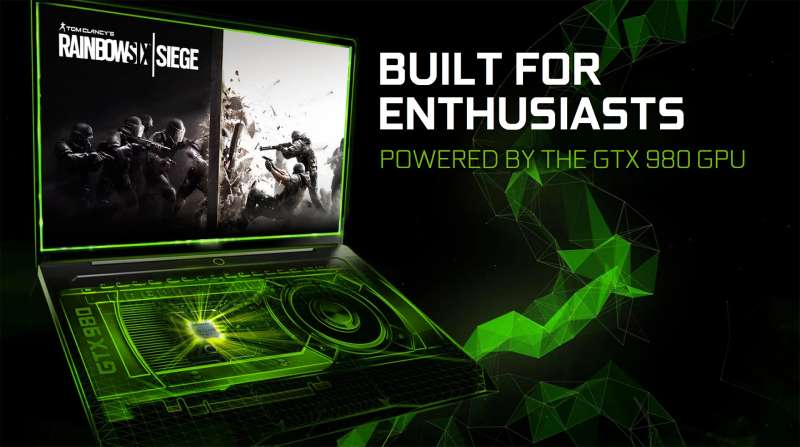
- 2020 to 2022: Apex Legends, VALORANT, Rainbow Six Siege, Call of Duty: Warzone, PUBG
- 2025: VALORANT, THE FINALS, Counter-Strike 2, paired with RTX 50 Series and Reflex Frame Warp
The three-word structure was built for stadium LED and stream overlays, where you get roughly one second of legibility.
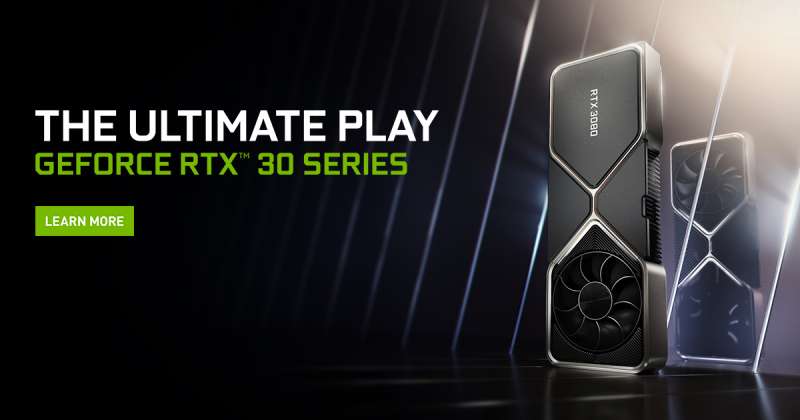
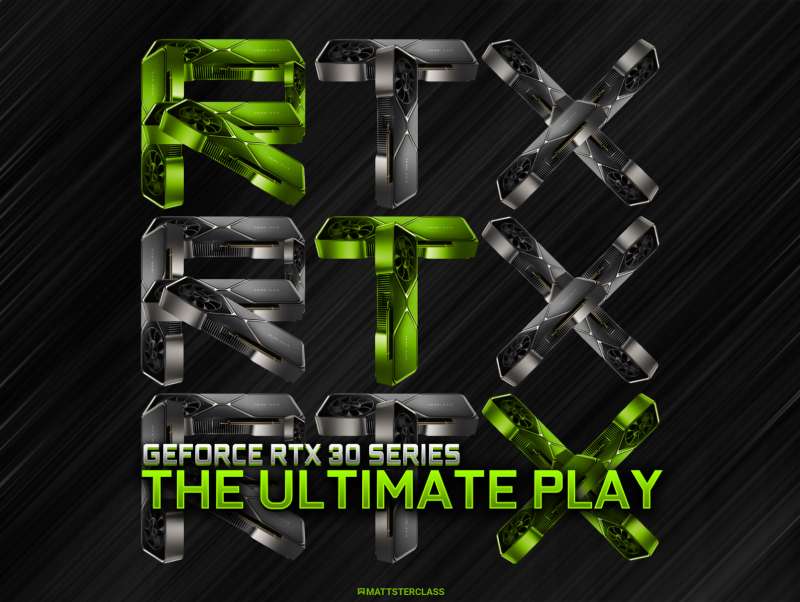
The Ultimate Play (2020 to 2022)

Launch window: announced with the RTX 30 Series on September 17, 2020, running through partner co-op promotions into 2022.
Structure: a single hero video plus 8 feature tiles covering Ampere, second-gen ray tracing, DLSS, Reflex, Game Ready Drivers, NVIDIA Encoder, Broadcast and Studio.
Activation: the Choose and Win contest ran March 3 to April 7, 2022, asking viewers to pick one of those 8 features and explain why.
Eight icons in a grid is a lot of message for one page. The saving grace is that each tile is a single glyph plus two lines, so the eye reads it as pattern before it reads it as copy.
I Am AI (2017 onward)

The keynote film is NVIDIA’s most-watched creative asset, and no ad agency touched it.
It debuted at GTC 2017 with an original orchestral score produced by AIVA and performed by the Aiva Sinfonietta Orchestra. At GTC Digital 2020, NVIDIA’s Flowtron speech synthesis model narrated the film, which meant the ad was partly generated by the product it sold.
The 2022, 2023 and 2024 editions kept the same montage logic: medicine, astronomy, agriculture, robotics, one beat each. Storytelling here runs on cumulative scale rather than a single narrative arc.
NVIDIA Ads From Independent and Student Studios
Not every NVIDIA ad in circulation came from NVIDIA.
- Sword, Sumo: print work credited to the agency Alecoppe on Ads of the World
- Titan V: a single-execution piece filed under the brand with no agency credit attached
- Second Player: spec work from Miami Ad School Mexico, not a client-approved campaign
Worth flagging because spec pieces circulate on Pinterest with no label, and half the “NVIDIA print ads” people share were never bought.
How Do NVIDIA Print Ads Work Visually?
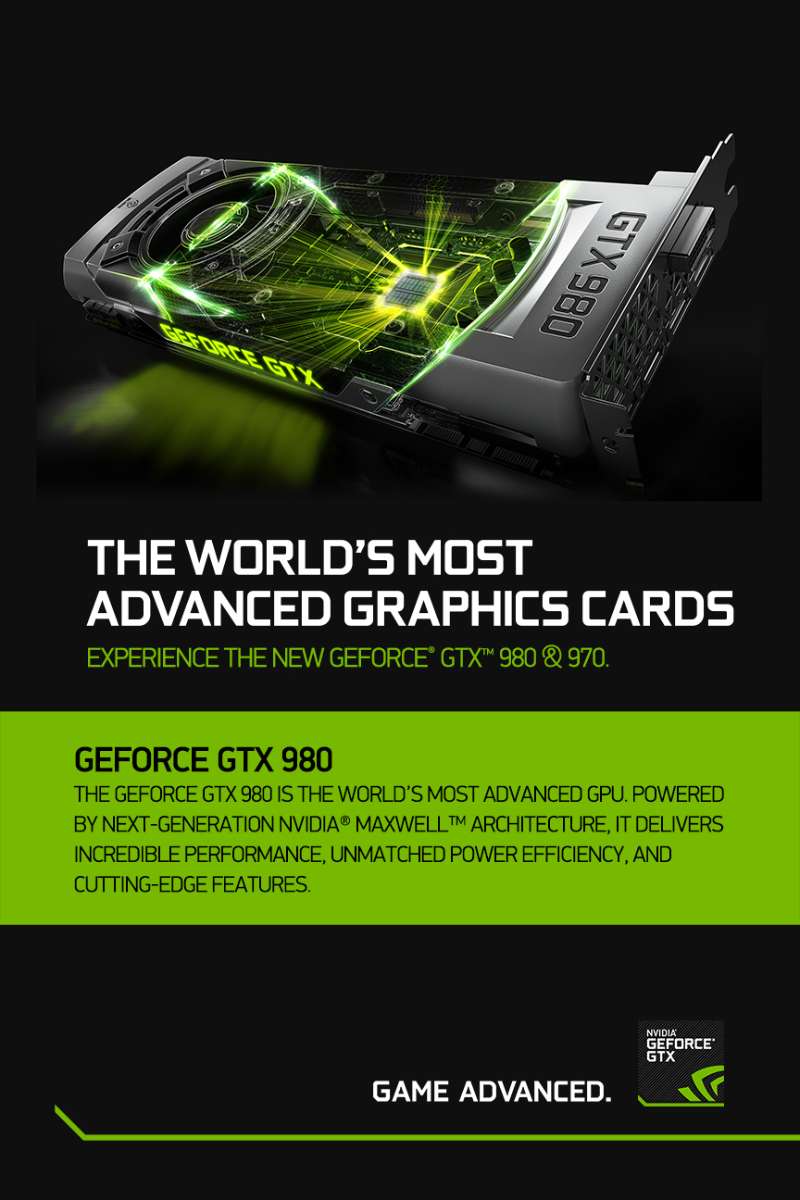
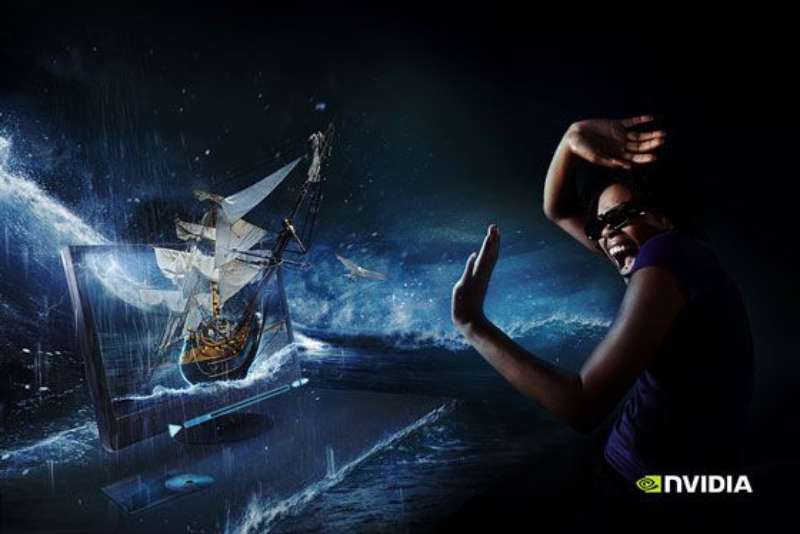
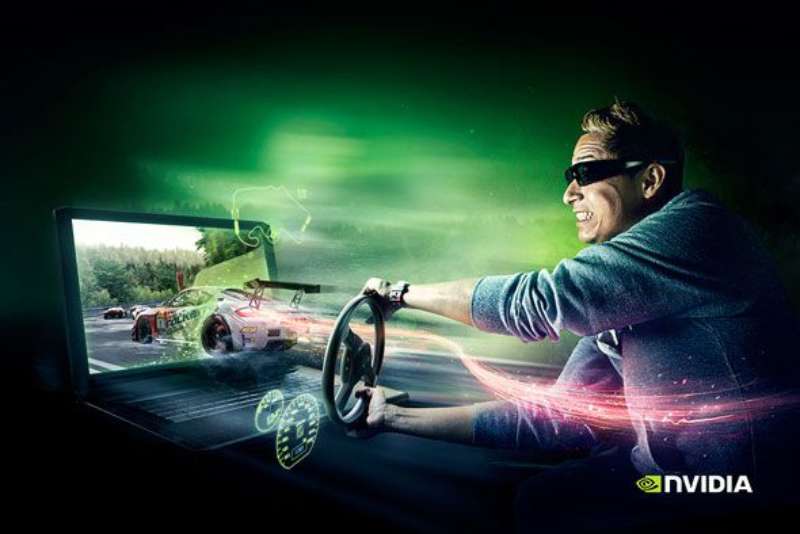
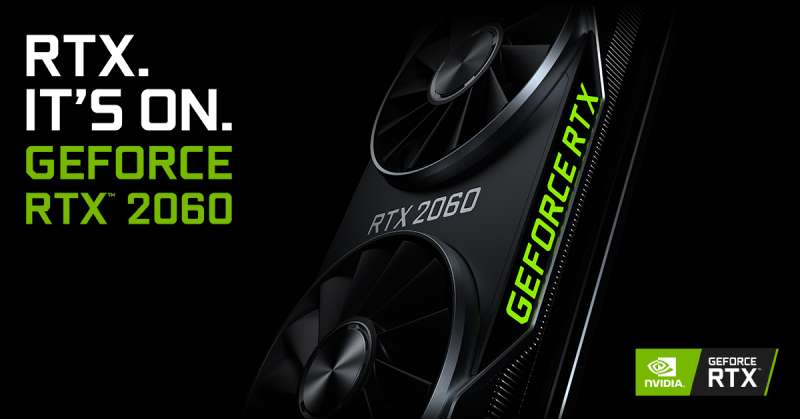
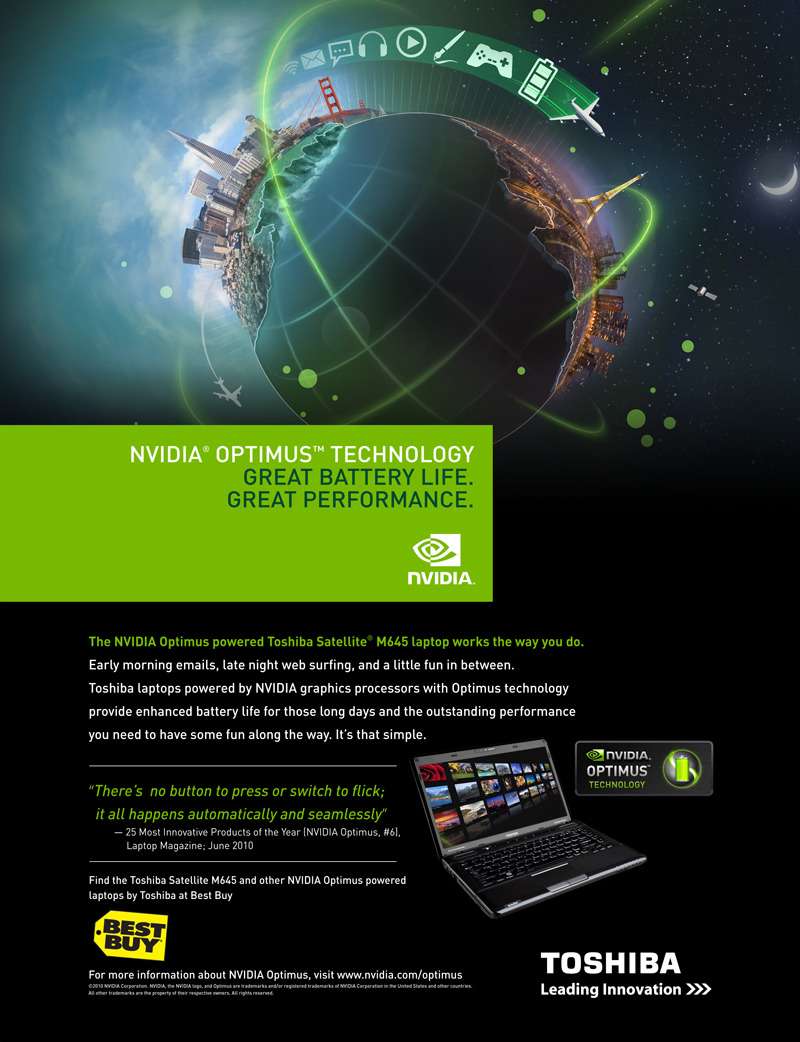
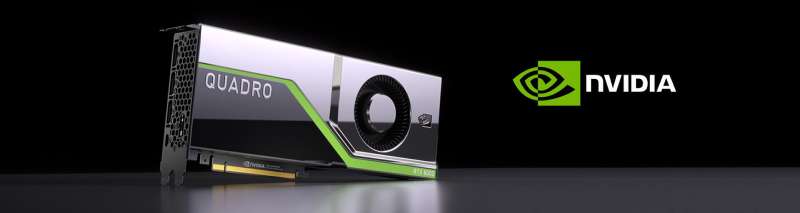
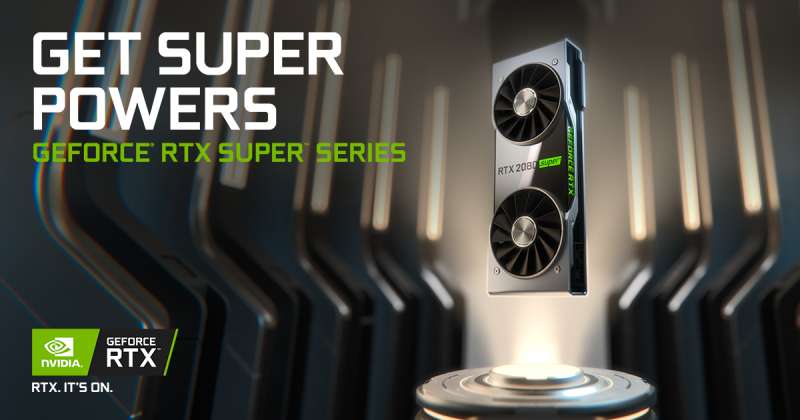
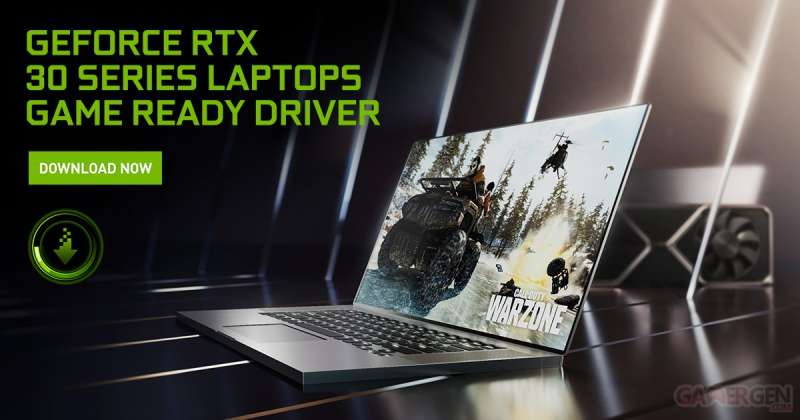
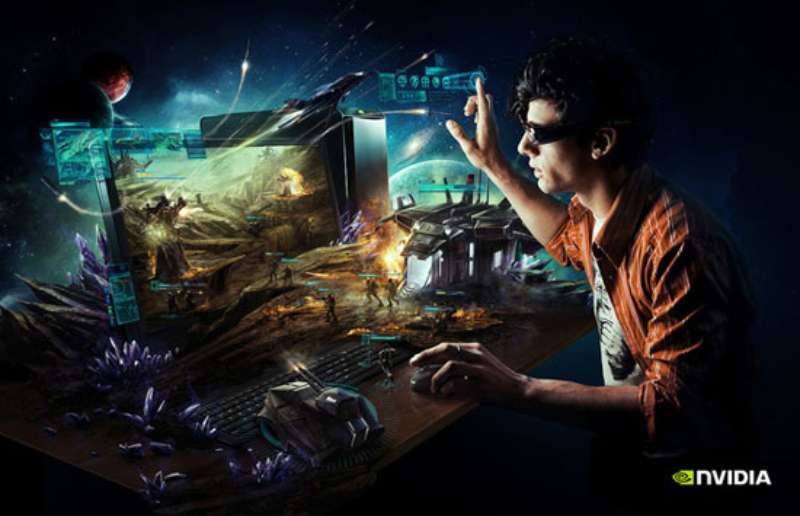
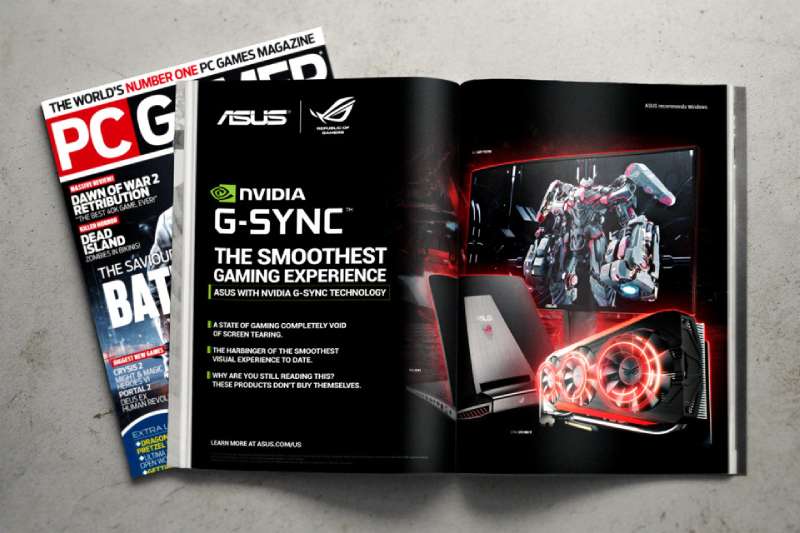
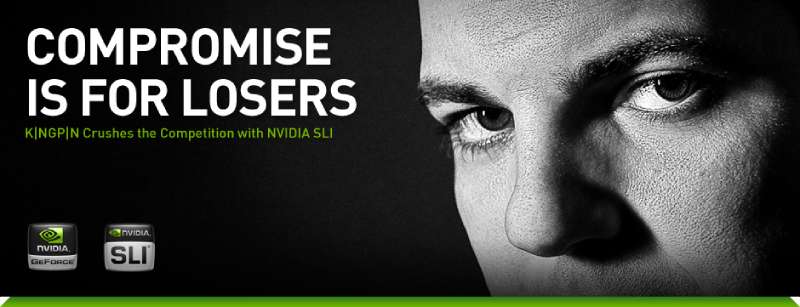
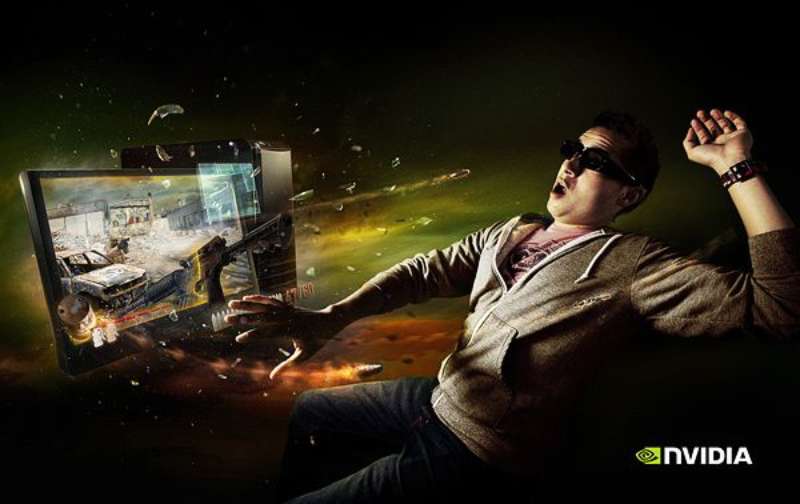
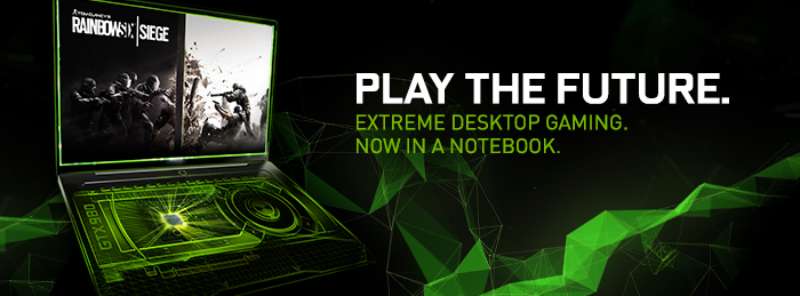
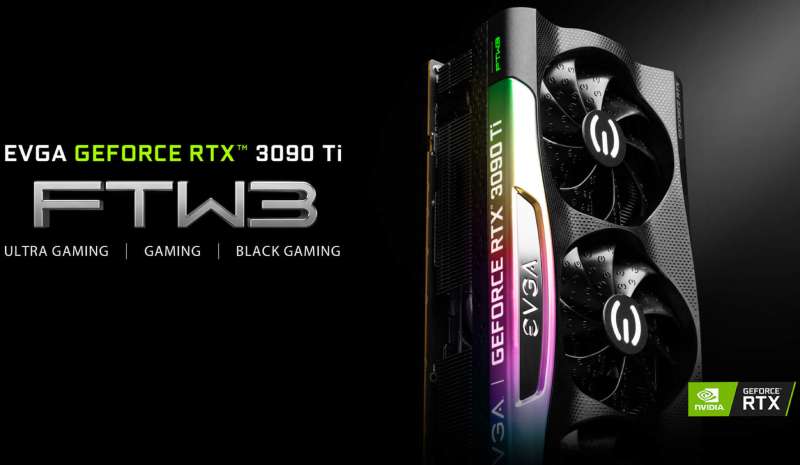
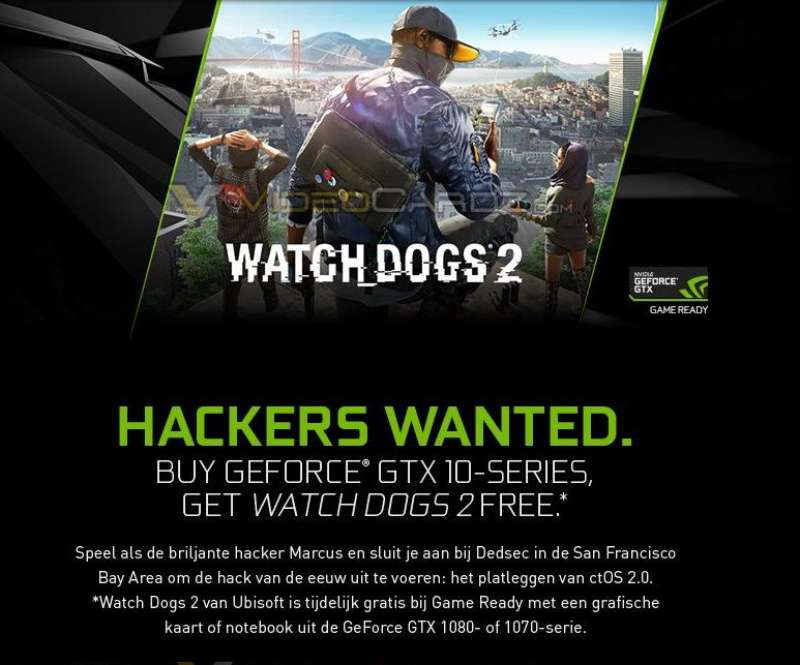
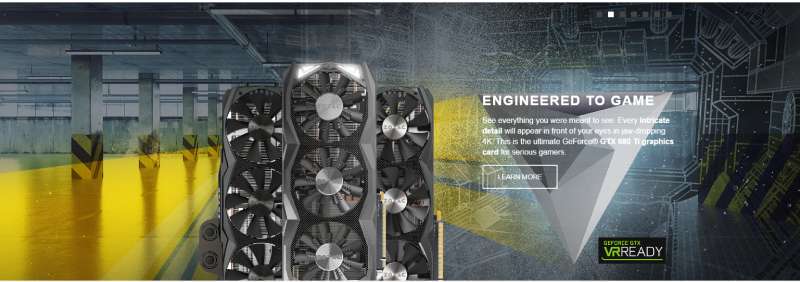
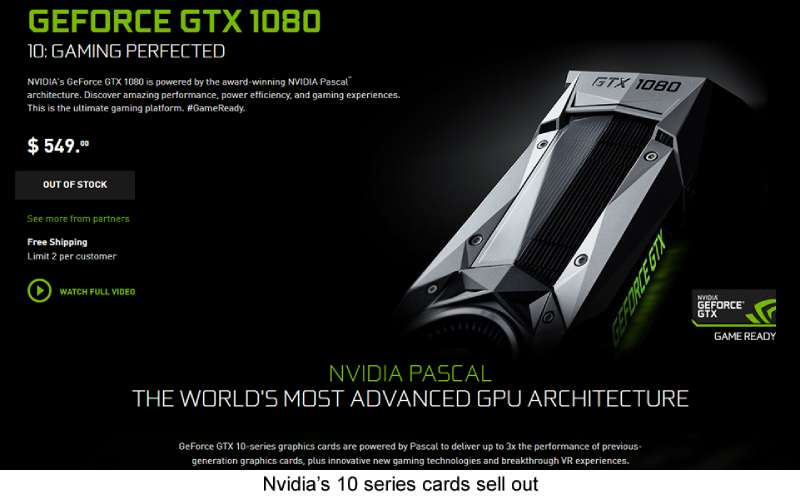
NVIDIA print and key-visual work follows one composition rule: a single illuminated product or character on a near-black field, with green as the only chromatic accent. Copy sits below the optical center. The logo lands bottom-right at roughly 8 percent of the frame width.
The contrast strategy is unusually simple. Black background, one green light source, everything else in neutral gray.
That single decision does most of the heavy lifting for visual hierarchy, because the brightest object in a dark frame becomes the focal point whether or not the layout deserves it.
Typography: the wordmark uses a customized sans-serif font derived from Handel Gothic, set all-caps with thick strokes and a distinctive angled cut on the left of the N. NVIDIA Sans handles body and UI type.
Type scale: headline, one subhead, one legal line. Rarely more. That flat typographic hierarchy is why the layouts survive being shrunk to a retail shelf-talker.
The eye mark itself is a study in negative space in logo design. The 2006 redesign dropped black out of the symbol entirely and let the counter-shapes carry the form.
Green on black is not an accident either. In color psychology terms, high-chroma green against a dark ground reads as active, powered-on, and slightly synthetic, which is precisely the association a GPU brand wants.
How Do NVIDIA TV Commercials Differ From Its Print Ads?
NVIDIA’s film work carries narrative and humor that the print work refuses. Print states a product claim in one frame. The films run 60 to 180 seconds and build a montage or a gag, and since 2017 the flagship films have been keynote openers rather than broadcast spots.
Busterfumper, 2009, Cutwater, directed by Rocky Morton at MJZ. Live-action absurdism built around an invented product name, cut by PS 260 with finishing at NTROPIC and motion work by Superfad.
I Am AI, GTC 2017 to GTC 2024, in-house. A rapid-cut montage of AI applications, each scene held for two to four seconds, scored orchestrally and narrated in later editions by NVIDIA’s own speech model.
The Ultimate Play, 2020, in-house. Feature-by-feature demonstration film built for the RTX 30 launch, later repurposed as the mechanic for a viewer contest.
The motion graphics language across all three is consistent: green wireframe overlays, particle dissolves, and hard cuts on the beat. No cross-fades.
How Has NVIDIA Advertising Evolved Since 1999?
NVIDIA advertising moved through 3 distinct eras: co-marketing through game partners (2002 to 2015), consumer brand film and esports positioning (2009 to 2020), and AI platform storytelling aimed at enterprise buyers (2017 to present). The audience shifted from gamers to CIOs without the visual system changing.
| Period | Strategic shift | Representative campaign |
|---|---|---|
| 2002 to 2008 | Logo placement inside partner games | “The Way It’s Meant to Be Played” |
| 2009 to 2016 | Standalone brand film with outside agency | “Busterfumper” |
| 2017 to 2019 | Keynote film as primary brand asset | “I Am AI” |
| 2020 to present | Performance claims and esports proof points | “Frames Win Games” |
The commercial backdrop explains the shift. Gaming revenue reached $11.4 billion in fiscal 2025 against $115.2 billion from Data Center, per NVIDIA’s own filings.
Gaming still grew to a record $16.0 billion in fiscal 2026, up 41 percent, so the consumer campaigns did not stop. They just stopped being the center of gravity.
Brand valuation followed. Interbrand recorded a 116 percent jump in NVIDIA’s brand value to $43.2 billion in 2025, the largest single-year increase in that ranking’s 25-year history, moving the company from 36th to 15th.
Kantar BrandZ put the 2025 figure at $509 billion, up 152 percent, placing NVIDIA fifth globally.
Which Agencies Created NVIDIA Advertising?
Cutwater created Busterfumper for NVIDIA in 2009. Alecoppe produced the Sword and Sumo print executions. NVIDIA’s in-house creative team produced I Am AI, The Ultimate Play and Frames Win Games. No holding-company network has held a publicly disclosed agency-of-record relationship.
Cutwater, San Francisco. Chuck McBride served as Executive Creative Director on the NVIDIA film work, with Joe Kayser as Group Creative Director and Fabio Costa and Marty Senn as Creative Directors.
MJZ. Rocky Morton directed the 2009 spot for MJZ, with Khris Kachikis as director of photography.
NVIDIA in-house. The keynote films, the campaign microsites and the brand guidelines documents all originate internally, which is why the visual system stays this consistent across 20 years.
WPP now works with NVIDIA in the opposite direction. Jensen Huang demonstrated the WPP generative production pipeline at Computex in 2023, and by June 2026 NVIDIA was showcasing GPU-accelerated adtech from Criteo, Taboola, Alembic and KERV.ai at Cannes Lions.
What Can Designers Learn From NVIDIA Ads?
Six practices transfer directly from NVIDIA’s work into general advertising design:
- Limit the palette to one saturated accent plus black and white
- Light the product from behind and let the rim edge become the composition
- Set the tagline in three words or fewer when it has to survive a stream overlay
- Place the logo last in the reading order, not first
- Attach a number to every performance claim (144 FPS, 360 Hz, sub-25 ms)
- Build the layout on a grid system tight enough to survive a shelf-talker crop
The last one is the least glamorous and the most useful. NVIDIA key visuals get resized by hundreds of board partners including ASUS, MSI and Gigabyte, so the artwork has to hold at sizes nobody in the original room ever saw.
How Do NVIDIA Ads Compare to Intel and AMD Ads?
Intel built its recognition on a five-note audio mnemonic and the Intel Inside sticker program, a co-marketing structure closer to a certification badge than a campaign. NVIDIA borrowed that logic with The Way It’s Meant to Be Played, then took it into software rather than hardware casings. AMD’s Radeon marketing has leaned on open-standard messaging (FreeSync, FSR) and price-per-frame comparisons, which is a rational appeal against NVIDIA’s atmospheric one.
The market outcome is lopsided. Jon Peddie Research put NVIDIA at 94 percent of add-in-board GPU shipments in Q4 2025, with AMD at 5 percent and Intel at 1 percent.
Sitting NVIDIA’s work next to Intel ads makes the difference in strategy obvious. Intel sells trust in a component you cannot see, while NVIDIA sells the visible output of one.
For the wider enterprise category, the layout conventions in IBM ads, Dell ads and Lenovo advertising campaigns stay closer to the white-background product shot that NVIDIA abandoned two decades ago.
What Makes NVIDIA Advertising Work?
The constraints never move. One accent color, one light source, one product silhouette, one claim with a number attached to it.
The creative roster changed, the buyer shifted from teenage gamers to enterprise procurement, and the primary medium moved from game splash screens to keynote film. The frame stayed recognizable through all of it.
That consistency is why a two-second stream overlay and a two-hour keynote read as the same brand.
The transferable lesson is unglamorous. Pick a small set of rules, write them down, and refuse to relax them every time a new format shows up.
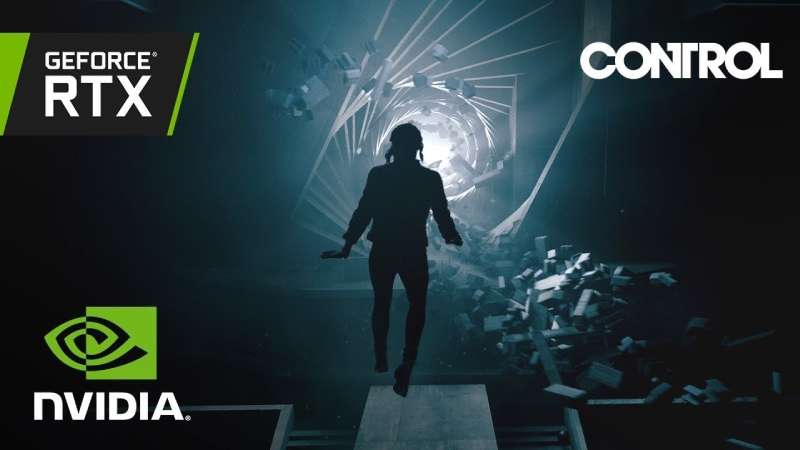
NVIDIA Ads Examples

FAQ on Nvidia Ads
When did NVIDIA start advertising?
NVIDIA launched in 1993 and shipped GeForce 256 in 1999, but its first structured campaign arrived in 2002. Bill Rehbock built The Way It’s Meant to Be Played program after joining as Director of Developer Relations in December 2001.
What is NVIDIA’s best-known tagline?
“The way it’s meant to be played” is the most recognized line, trademarked and governed by its own logo usage guidelines. “Frames win games” replaced it as the esports-facing message once NVIDIA Reflex shipped in 2020.
What green does NVIDIA use in its ads?
NVIDIA Green is hex #76B900, or 118, 185, 0 in RGB. Brand references cite Pantone 376 C for print. Black and white complete the palette, with no secondary accent in the consumer work.
Who directed the Busterfumper commercial?
Rocky Morton directed the 2009 film through production company MJZ, with Khris Kachikis shooting. Cutwater in San Francisco created the campaign under Executive Creative Director Chuck McBride, with PS 260 editing and NTROPIC finishing.
What happens in the I Am AI film?
The keynote opener runs a rapid montage of AI applications: medical imaging, astronomy, agriculture, robotics. It debuted at GTC 2017 with an AIVA orchestral score, and NVIDIA’s own Flowtron model narrated the 2020 edition.
Why do NVIDIA ads use black backgrounds?
A dark ground turns the brightest object into the subject without any layout work. NVIDIA Green sits at 100 percent saturation in HSL terms, so saturation alone carries the accent against near-black.
What does “Frames win games” actually claim?
Three measurable things: sub-25 ms system latency with NVIDIA Reflex, 144 FPS as the baseline target, and G-SYNC refresh rates up to 360 Hz. VALORANT, Counter-Strike 2 and Apex Legends carry the message.
Which games carried the NVIDIA logo at startup?
Hundreds shipped with the circle mark on their splash screen under the developer program. Titles demonstrated at NVIDIA’s 2013 event in Montreal included Batman: Arkham Origins and Assassin’s Creed IV: Black Flag.
Does NVIDIA advertise to creators as well as gamers?
Yes. The Ultimate Play feature grid gave equal weight to NVIDIA Studio, NVIDIA Broadcast and the NVIDIA Encoder, positioning GeForce RTX for streaming and content production rather than frame rates alone.
Where do NVIDIA ads appear offline?
Retail box art, board partner co-op materials, esports broadcast graphics and trade show builds. The NVIDIA Lounge at QuakeCon 2023 ran hands-on RTX 40 Series demos alongside the #RTXRoadshow social activation.
Conclusion
NVIDIA ads reward study because the system is small enough to copy. Two colors, one light source, one number per claim.
The campaigns changed shape as the buyer changed.
Splash-screen co-marketing gave way to launch trailers for Ampere and Blackwell, then to Jensen Huang on a Santa Clara stage selling accelerated computing to CIOs.
What held constant was the key visual: rim-lit hardware, generous negative space, logo placed last in the reading order.
Interbrand recorded a 116 percent jump in brand value in 2025, so the discipline is not decorative. It compounds.
Borrow the constraint, not the palette. Pick your accent, attach a measurable claim to every headline, and let the artwork survive the crop.

Renowned for his expertise in logo design and visual branding, Bogdan has developed a multitude of logos for various clients.
His skills extend to creating posters, vector illustrations, business cards, and brochures. Additionally, Bogdan's UI kits were featured on marketplaces like Visual Hierarchy and UI8.
He also wrote in the past years on sites like Design Your Way, WebDesignerDepot, WPDean, Designmodo, Speckyboy, Slider Revolution, and more.
- Best Visual Regression Testing Tools for Web and App Design in 2026 - 13 October 2026
- Jujutsu Kaisen Font Generator - 12 October 2026
- The Windsurf Logo History, Colors, Font, And Meaning - 10 October 2026

Bogdan Sandu is a seasoned designer who has been designing websites since 2008. Renowned for his expertise in logo design and visual branding, Bogdan has developed a multitude of logos for various clients. His skills extend to creating posters, vector illustrations, business cards, and brochures. Additionally, Bogdan's UI kits were featured on marketplaces like Visual Hierarchy and UI8. He also wrote in the past years on sites like Design Your Way, WebDesignerDepot, WPDean, Designmodo, Speckyboy, Slider Revolution, and more.
You Might Also Like