Chanel ads have never behaved like other fragrance advertising. A three-minute film in 2004 cost $33 million and never once showed the bottle.
That single decision explains most of the house’s approach. The work has been made in-house since 1974 and handed to feature directors: Ridley Scott, Jean-Paul Goude, Baz Luhrmann, Martin Scorsese, Luca Guadagnino.
This page covers the campaigns by name, with the year, director and market behind each one.
You will also get:
- The layout, palette and typography rules behind the print work
- How the commercials differ from the magazine spreads
- What the whole approach is worth to a working designer
Chanel has advertised since December 1924, when a small Parfums Chanel notice ran in The New York Times. The house has since built its image through 8 flagship campaigns, from Share the Fantasy (1979) to Matthieu Blazy’s La Pausa debut (2026), nearly all of them created in-house instead of by an outside agency.
This page covers those campaigns by name, with the director, year and market behind each one, plus the layout, palette and typography decisions that hold the work together.
Chanel Advertising at a Glance
Chanel has run paid advertising since 1924 and has controlled its creative in-house since 1974, first under artistic director Jacques Helleu. The best-known campaigns are Share the Fantasy, Egoiste and Bleu de Chanel. The visual signature combines black and white photography, wide-tracked capitals and a centered bottle.
| Attribute | Value |
|---|---|
| First major campaign | Share the Fantasy (1979), directed by Ridley Scott |
| Creative model | In-house since 1974, no agency of record |
| Best-known lines | Share the Fantasy (1979), Be Unexpected (2010), See You at 5 (2024) |
| Primary media | Magazine print, cinema, TV, outdoor, YouTube |
| Directors and photographers | Ridley Scott, Jean-Paul Goude, Baz Luhrmann, Martin Scorsese, Luca Guadagnino, Richard Avedon, Irving Penn |
| Awards | Golden Lion, 37th Cannes International Advertising Film Festival (1990) |
| Visual signature | Monochrome photography, all-caps sans-serif wordmark, bottle on the optical center |
| Brand-support spend | $2.45 billion in 2024, about 13% of $18.7 billion in revenue (WWD) |
Which Chanel Ad Campaigns Are the Most Famous?
The 6 most famous Chanel campaigns are Share the Fantasy (1979), Egoiste (1990), No.5 the Film (2004), Coco Mademoiselle (2007), Bleu de Chanel (2010) and See You at 5 (2024). Each one was built as a short film first and a print layout second.
Share the Fantasy (1979-1986)

Share the Fantasy launched in 1979 for the North American market, directed by Ridley Scott and produced in-house under Jacques Helleu. The spot puts a No.5 bottle beside a poolside sleeper, with no dialogue and no product demonstration.
Design note: saturated blues, a horizon line held flat across the frame, and a bottle small enough that the viewer has to look for it.
The French cut dropped the tagline entirely, on the reasoning that the name carried the message on its own.
Egoiste (1990-1993)

Jean-Paul Goude’s Egoiste film took the Golden Lion at the 37th Cannes International Advertising Film Festival in 1990, and started a partnership with the house that has now run for more than three decades.
Set: a 36-balcony hotel facade built in a desert outside Rio de Janeiro.
Cast: 36 women in evening dress, shouting adapted lines from Corneille’s Le Cid.
Palette: black and white, with the bottle as the only object of attention on the sill.
No.5 the Film (2004)

Baz Luhrmann directed a 180-second short with Nicole Kidman and Rodrigo Santoro, financed entirely by Chanel at a reported US$33 million, which Wikipedia and Far Out both record as the highest budget ever committed to a commercial.
- Costumes by Karl Lagerfeld, who also appears briefly
- Score built on Debussy’s Clair de Lune, arranged by Craig Armstrong
- Screened in North American cinemas before the feature, then cut to 30 seconds for primetime in 2006
The print layouts that followed used stills from the shoot, which kept the film and the magazine spread on one visual identity.
Coco Mademoiselle (2007-2015)
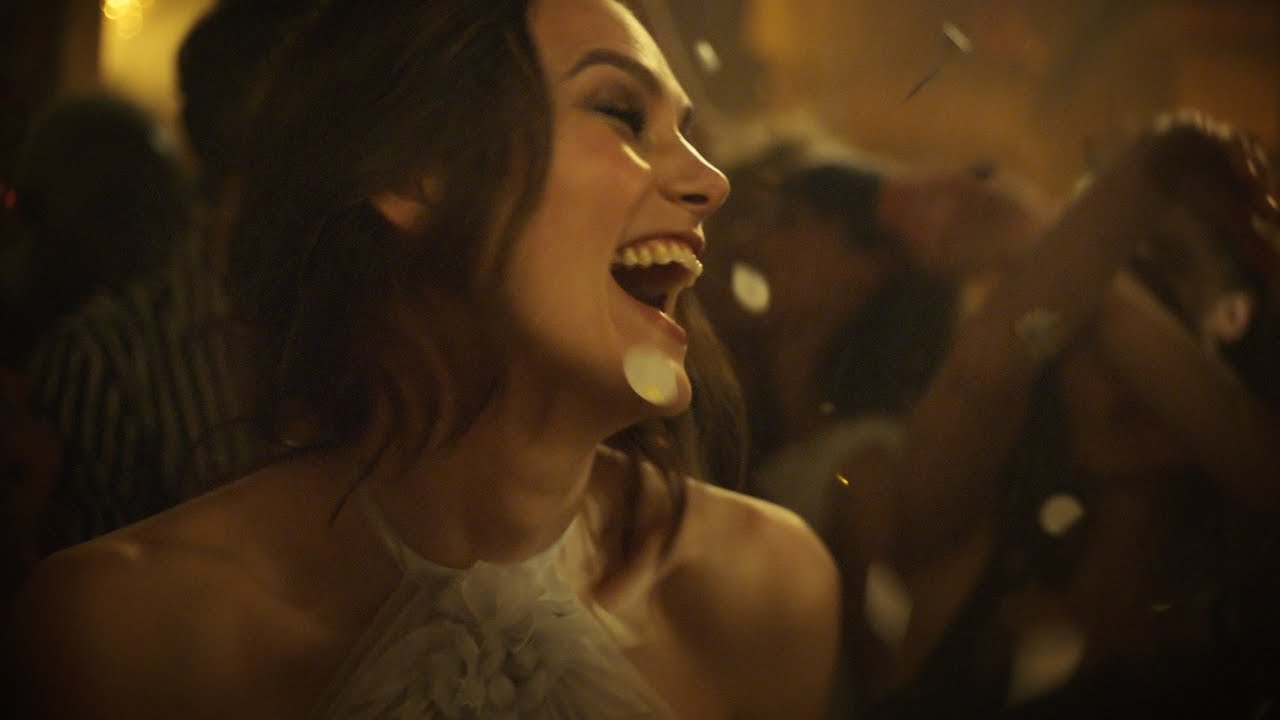
Keira Knightley became the face of Coco Mademoiselle in 2007 and stayed for 3 films, all directed by Joe Wright, her collaborator on Pride and Prejudice and Atonement.
- 2007: red dress, Paris, Joss Stone’s cover of L-O-V-E
- 2011: motorcycle and photo studio, set to It’s a Man’s Man’s Man’s World
- 2014: The Chase, with Danila Kozlovsky and The Zombies’ She’s Not There
The print work took a different route from the film. Knightley bites the bottle cap in the 2007 layout, a gesture that gives the page a focal point without a headline.
Bleu de Chanel (2010-2024)
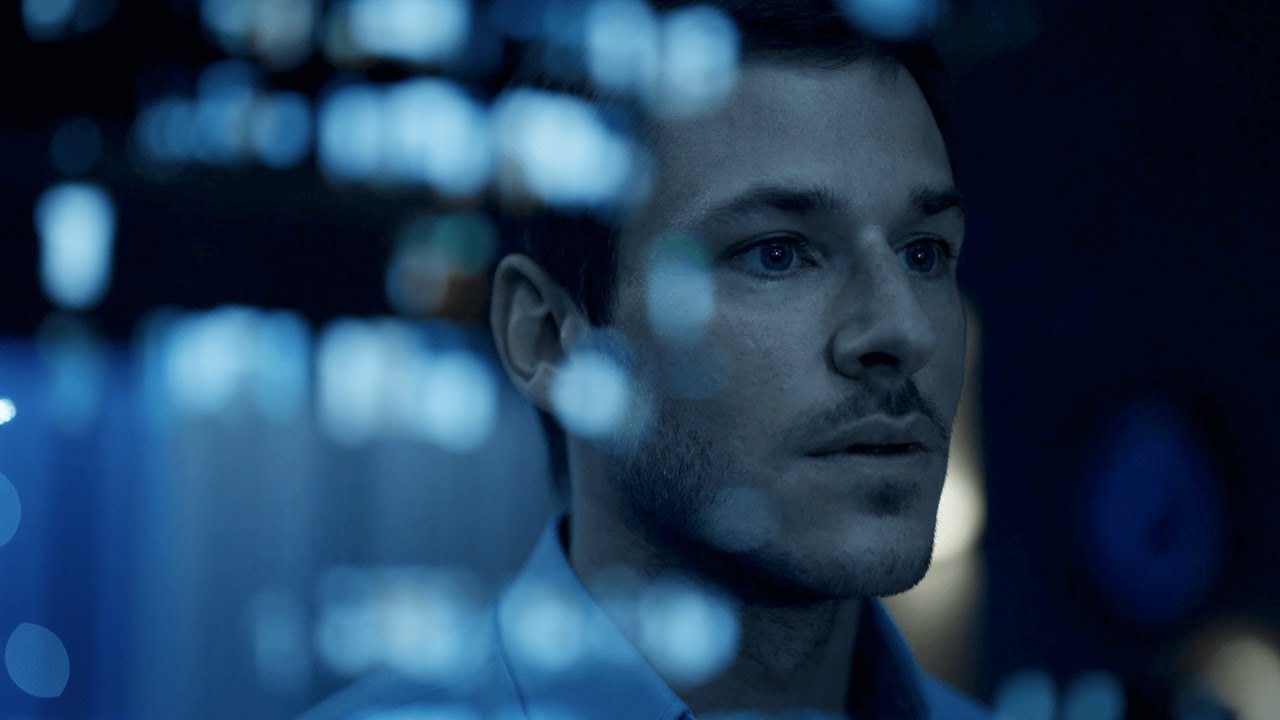
Bleu de Chanel is the only campaign the house has handed to the same director twice, 14 years apart.
| Year | Face | Director | Soundtrack |
|---|---|---|---|
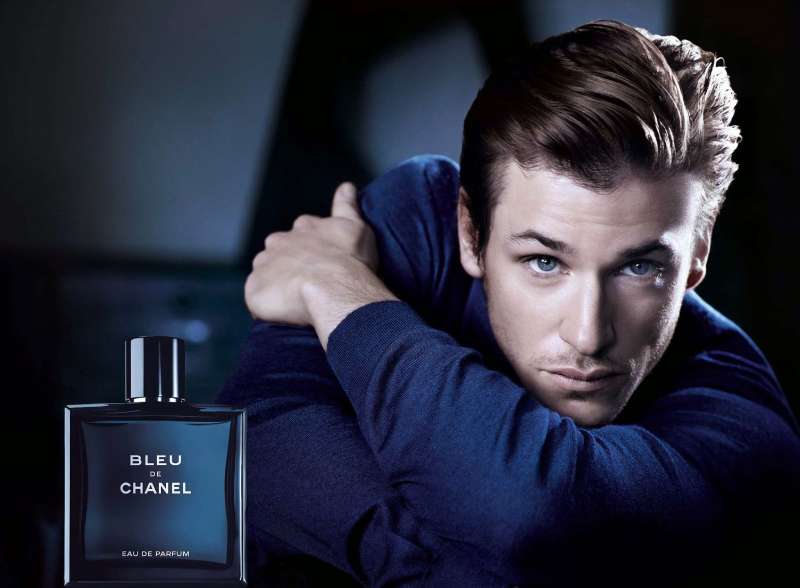
| 2010 | Gaspard Ulliel | Martin Scorsese | “She Said Yeah,” The Rolling Stones |
| 2024 | Timothée Chalamet | Martin Scorsese | “Rockit,” Herbie Hancock |
Ulliel was Chanel’s first male ambassador, announced on 16 February 2010. Chalamet took the role in May 2023, and the 90-second film released on 17 May 2024 borrows its structure from Fellini’s 1968 short Toby Dammit.
See You at 5 (2024)

Luca Guadagnino shot See You at 5 in California on 35mm, with Margot Robbie and Jacob Elordi driving toward a meeting that never quite happens. Daft Punk’s Veridis Quo carries the whole cut.
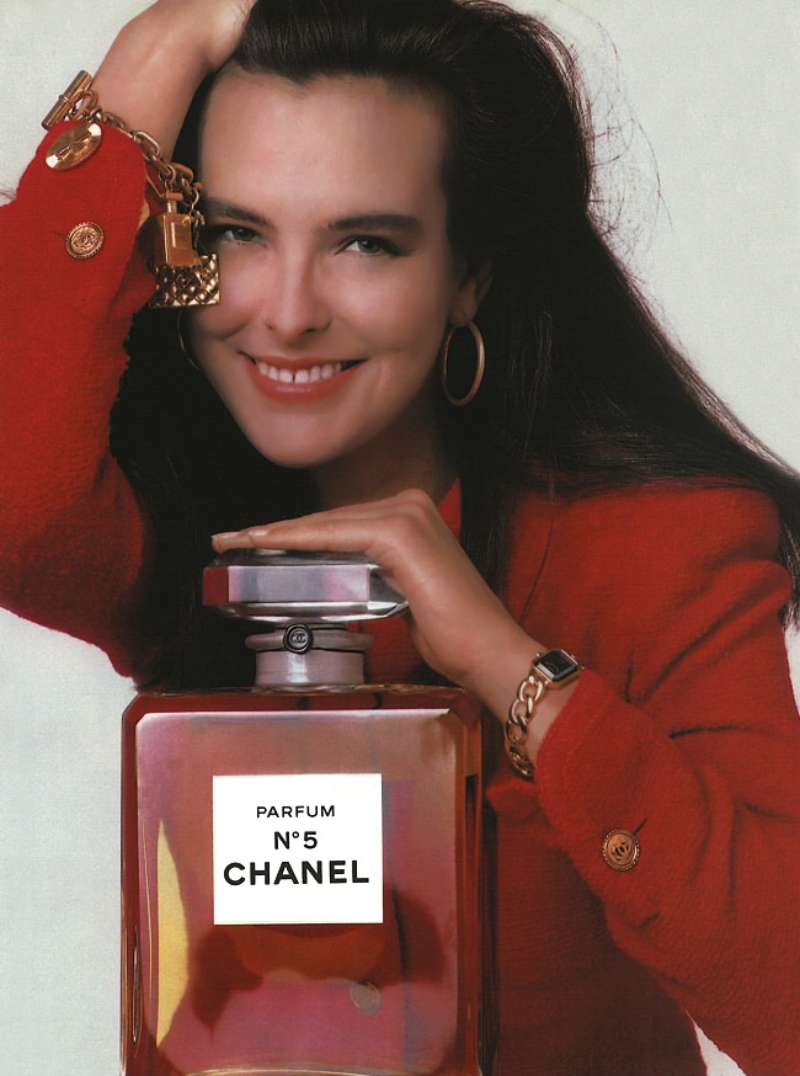
Robbie’s red skirt suit repeats the one Carole Bouquet wore in Ridley Scott’s 1986 Monuments campaign, which makes the reference legible to anyone who has seen the earlier work and invisible to anyone who hasn’t.
Chance Line Print Ads (2003-2020)
Jean-Paul Goude has directed the Chance campaigns since 2003, and the visual logic barely moves: a flat backdrop, a game or an audition, and four women in coordinated movement.
Bowling alley (2015): the Chance Eau Vive bottle replaces the ball and rolls a strike.
Audition (2019): choreography by Ryan Heffington, music by Sam Spiegel, models Ysaunny Brito, Rianne Van Rompaey, Camille Hurel and Abby Champion.
Chanel Ads From the Blazy Era (2026)

Matthieu Blazy’s first campaign moved the house away from single-celebrity casting.
Alec Soth photographed the Spring 2026 images at La Pausa, the Riviera villa Gabrielle Chanel built in 1928, with creative direction by Sheila Single and a 12-model ensemble. Craig McDean shot the Metiers d’art 2026 campaign in New York, with a film by Rahim Fortune.
How Do Chanel Print Ads Work Visually?
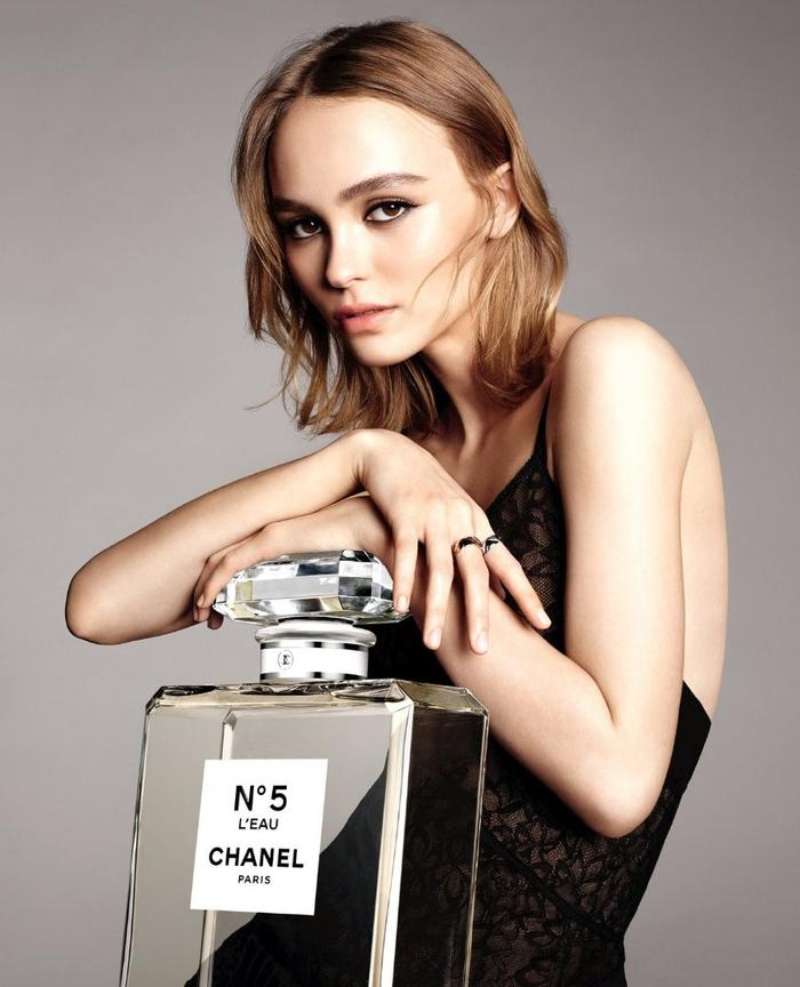
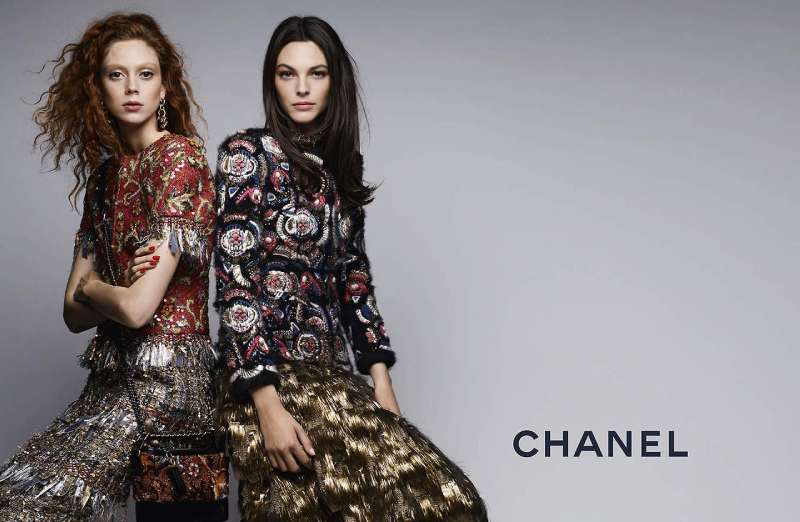
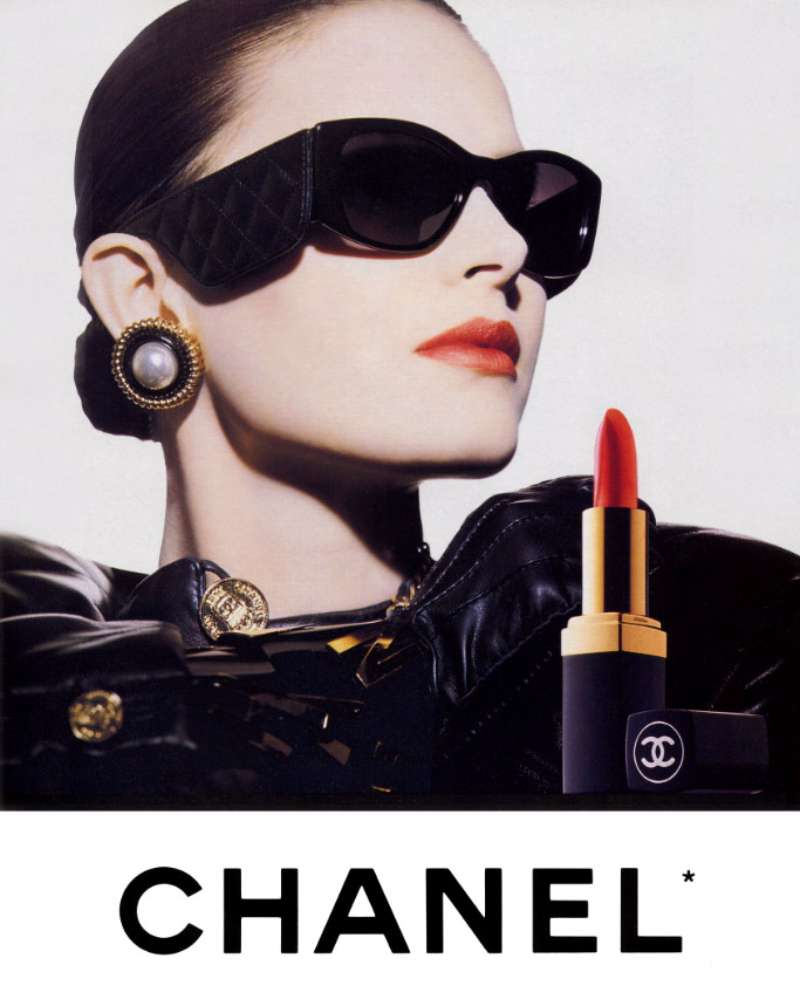
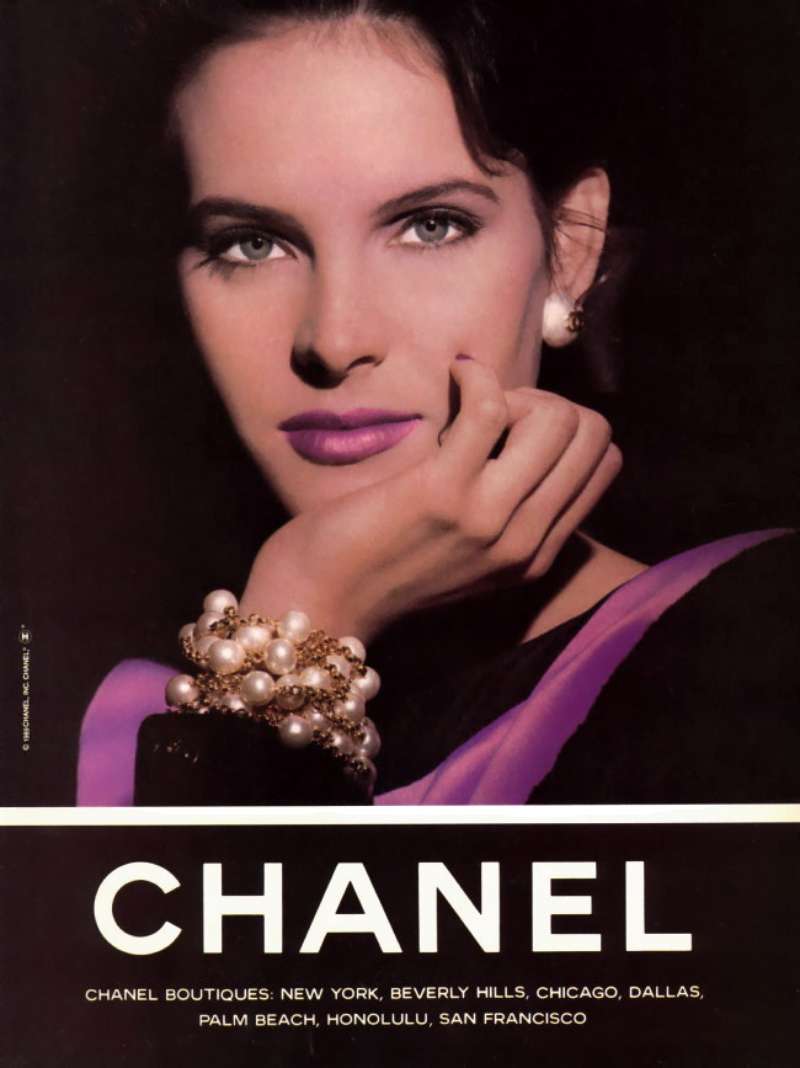
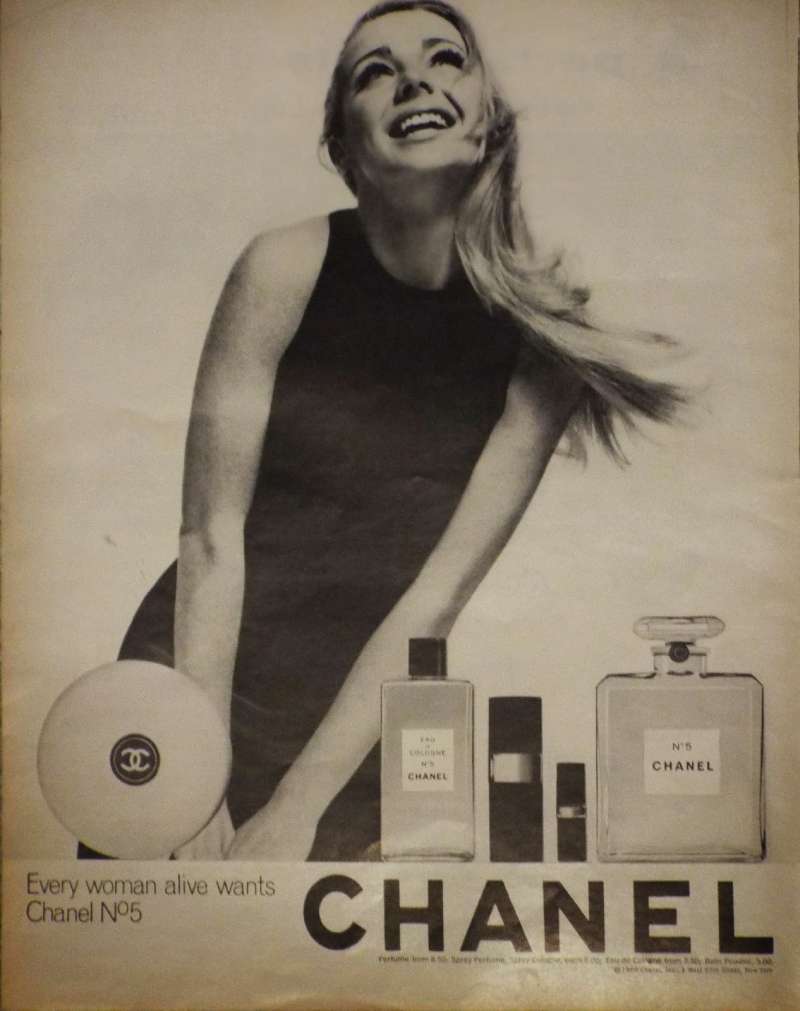
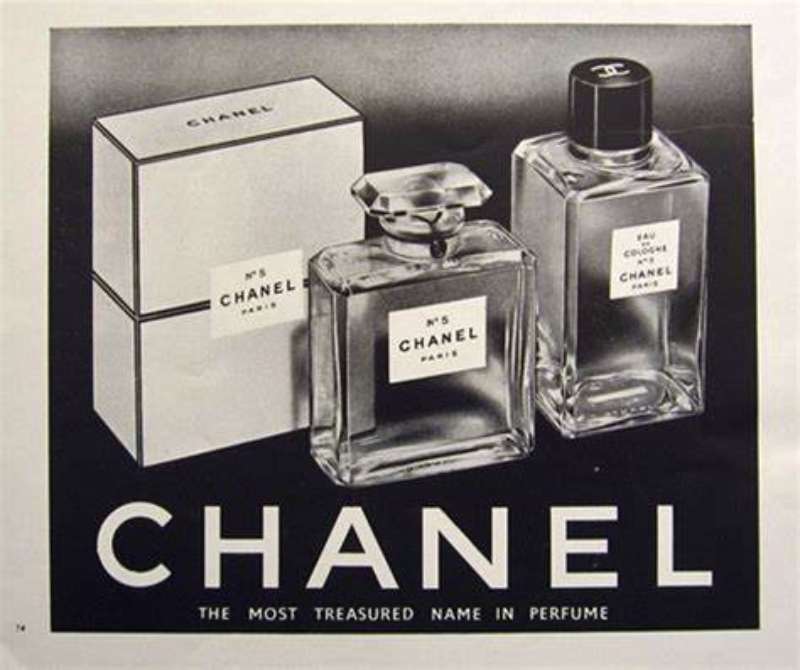
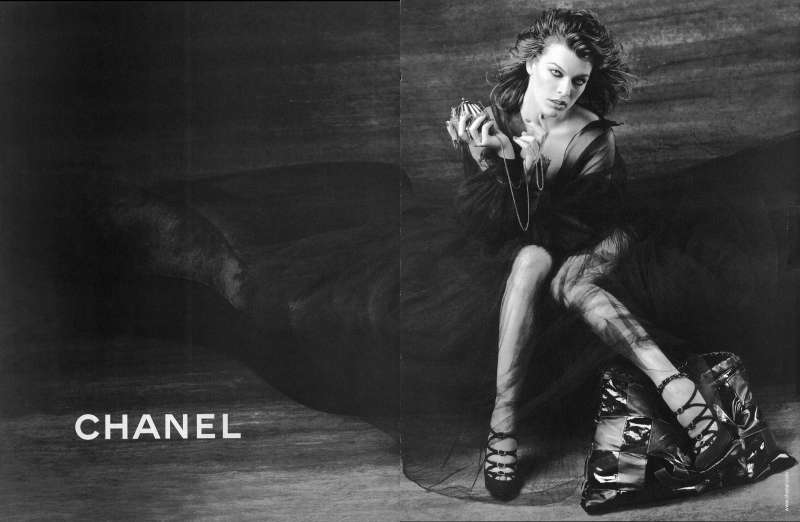
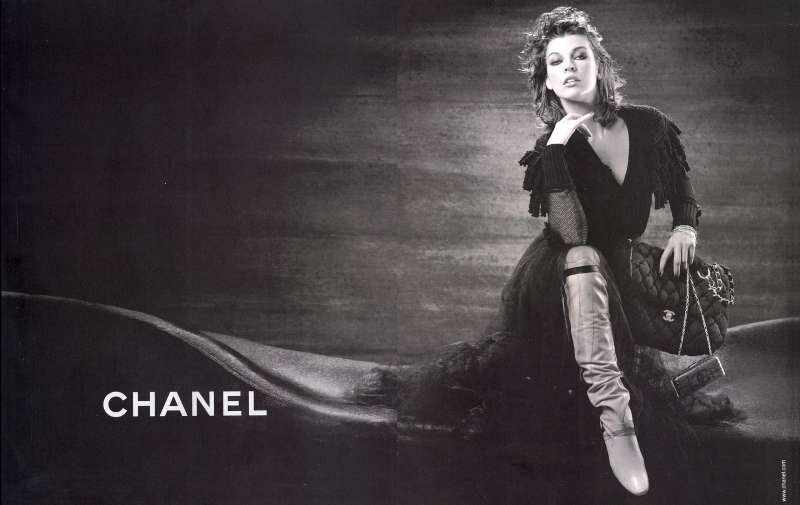
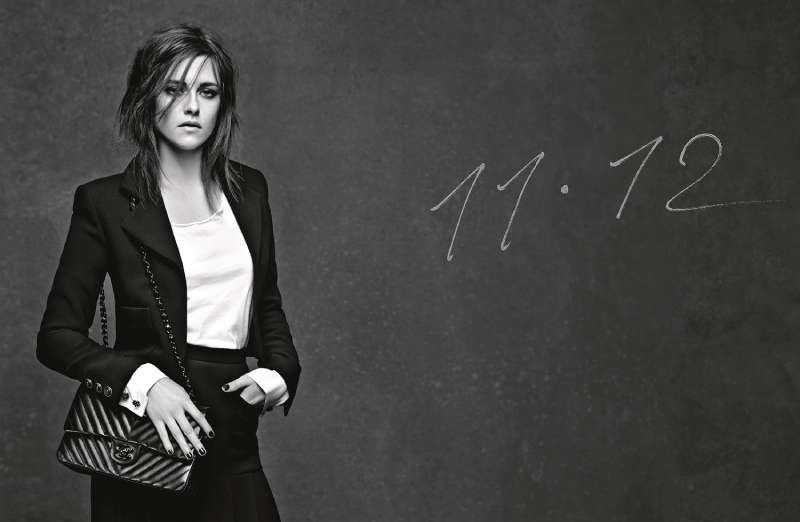
Chanel print ads run on 3 fixed rules: a monochrome or near-monochrome image, one all-caps wordmark set in a geometric sans-serif, and a bottle or product placed at the optical center. Copy is minimal or absent. Nothing competes for attention.
The wordmark is a proprietary sans-serif font (the web version is known internally as AB Chanel Corpo), set in caps with wide tracking and uniform stroke weight. There is no thick-thin modulation, no serif, no decoration.
That restraint puts the whole burden of the layout on the photograph.
Monochrome colors do most of the work. Skin, fabric and glass sit in the same tonal family, so the only real contrast in the frame is between the black wordmark and the paper.
Spacing: the margins are enormous by category standards. Generous white space around the bottle reads as price, which is the oldest trick in luxury print design and still the most reliable one.
Structure: most layouts are close to symmetry, with the product on a vertical axis and the logotype either top center or bottom center. The visual hierarchy runs image, then product, then name, and it almost never reverses.
How Do Chanel TV Commercials Differ From Its Print Ads?
Chanel’s TV and cinema work uses narrative, while the print work uses stillness. The films run 60 to 180 seconds, hire feature directors, and often delay or hide the product. The print layouts show the bottle immediately. Same codes, opposite pacing.
Share the Fantasy (1979, dir. Ridley Scott). A woman lies beside a pool as a shadow crosses her. No product shot until the final seconds. The blue-on-blue grading is the closest Chanel has come to a color-led campaign.
No.5 the Film (2004, dir. Baz Luhrmann). Kidman escapes the paparazzi into a taxi, falls for a stranger, then returns to the red carpet. Chanel’s own publicist noted there is no bottle in the film at all.
Bleu de Chanel (2024, dir. Martin Scorsese). Chalamet moves through a dream version of New York, from a talk show to a Queens subway platform. The storytelling carries the fragrance, which appears once.
How Has Chanel Advertising Evolved Since 1921?
Chanel advertising has moved through 4 distinct phases: founder-led press portraits, celebrity association without contracts, in-house cinematic branded content, and the current auteur model. The 1974 decision to fire all outside agencies is the hinge the rest of the history turns on.
| Period | Shift | Representative work |
|---|---|---|
| 1920s-1930s | Word of mouth becomes paid press | Sem’s 1921 drawing; 1937 Harper’s Bazaar portrait by François Kollar |
| 1950s | Association without a contract | Marilyn Monroe’s 1952 Life remark about five drops |
| 1970s-1980s | Agencies dropped, cinema language adopted | “Share the Fantasy” (1979), “Monuments” (1986) |
| 1990s-2010s | Choreographed absurdism, then serialized ambassadors | “Egoiste” (1990), “Coco Mademoiselle” (2007-2015) |
| 2020s | Auteur direction and model-led fashion imagery | “See You at 5” (2024), “La Pausa” (2026) |
The 1930s layouts sit squarely in the Art Deco conventions of the period, with heavy borders and drawn lettering. Anyone browsing vintage ads from that decade will spot how quickly Chanel abandoned ornament once photography took over.
Which Agencies Created Chanel Advertising?
No agency holds the Chanel account. Alain Wertheimer eliminated outside advertising agencies in 1974 and gave every creative decision to in-house artistic director Jacques Helleu, who joined the house in 1956 and led its image until his death in September 2007.
Helleu commissioned Richard Avedon to shoot Catherine Deneuve for the relaunch, then Irving Penn and Helmut Newton for later print work.
Helleu hired Ridley Scott for Share the Fantasy in 1979 and Jean-Paul Goude for Egoiste in 1990.
Karl Lagerfeld directed and styled a large share of the fashion imagery from 1983 until 2019, and designed the costumes for Luhrmann’s 2004 film.
Sheila Single took creative direction on Blazy’s first campaign in 2026, working with photographer Alec Soth.
The in-house model explains the consistency. When one office owns the brand guidelines, the logotype, the crop and the tonal range survive changes in director, market and decade.
What Can Designers Learn From Chanel Ads?
Chanel’s advertising offers 5 transferable rules, all visible in the layouts themselves rather than in any published style manual.
- Place the product on the vertical axis and let the model’s gaze point toward it
- Hold the palette to black, white and one warm skin tone, which is minimalist design used as a pricing signal
- Set the wordmark in one weight, all caps, tracked wide, and never scale it up to compensate for a weak image
- Cut every line of copy the photograph already communicates
- Keep brand typography identical across cinema credits, magazine spreads and packaging
- Hire a director when the film has to last a decade, and a photographer when the page has to last a season
How Do Chanel Ads Compare to Dior Ads?
Both houses hire feature directors and both build campaigns around a single ambassador. The difference is tonal control.
Dior’s fragrance work leans on gold, movement and open sexuality, with J’adore built around a poured-gold aesthetic. Chanel stays monochrome and withholds. Dior ads tend to show the product early and often, while a Chanel film can run three minutes without a bottle in frame.
Casting policy separates them too. Dior refreshes faces more frequently; Chanel kept Keira Knightley for 8 years and Gaspard Ulliel for 12.
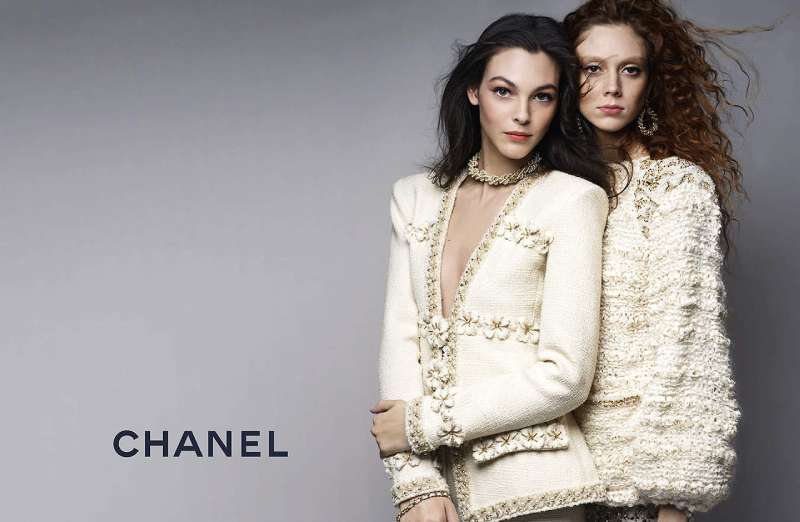
Against Louis Vuitton ads, which use travel imagery and heavy monogram repetition, Chanel’s frames carry almost no pattern. And where Gucci ads shifted hard into maximalism and internet-native color after 2015, Chanel held its palette steady, which is why a 1990 Chanel spread and a 2026 one still read as the same house.
What Makes Chanel Advertising Work?
Chanel advertising works because the house never handed the decision to a third party.
One office has controlled the crop, the palette and the logotype since 1974, which is why a 1990 spread and a 2026 spread read as the same brand despite different directors, different faces and 36 years between them.
The films buy attention with narrative. The print buys recall with restraint. Neither one explains the product, and neither one raises its voice.
The transferable lesson is consistency of format over novelty of message. Most brands rewrite their visual rules every three years and wonder why nothing accumulates.
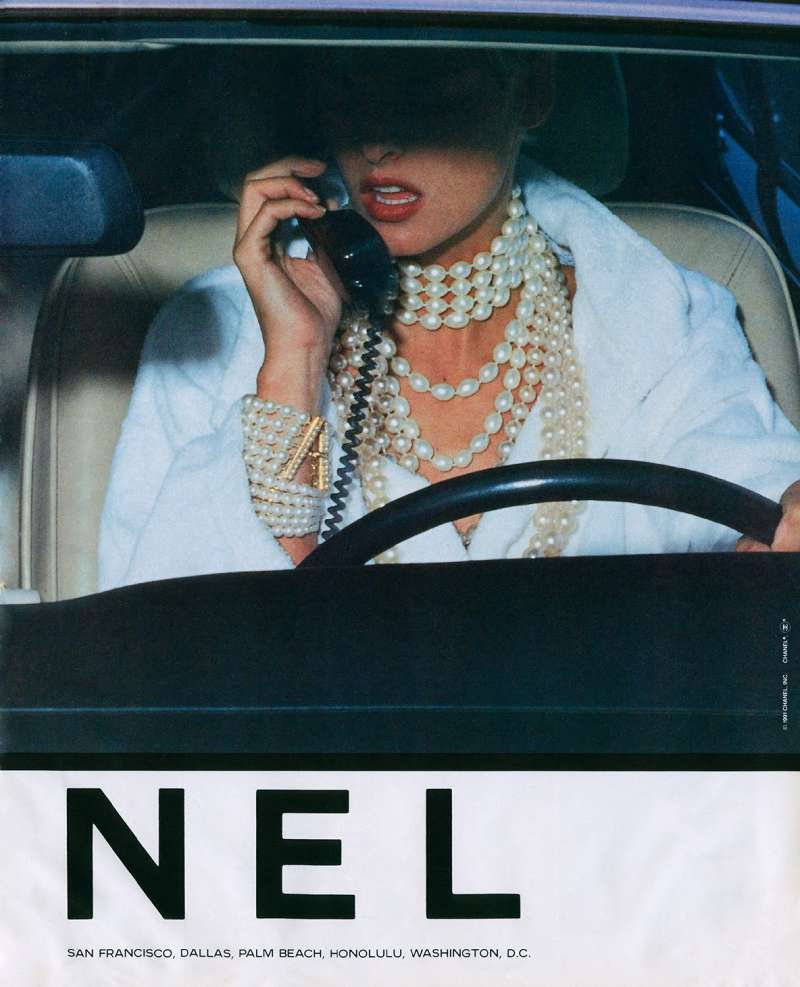
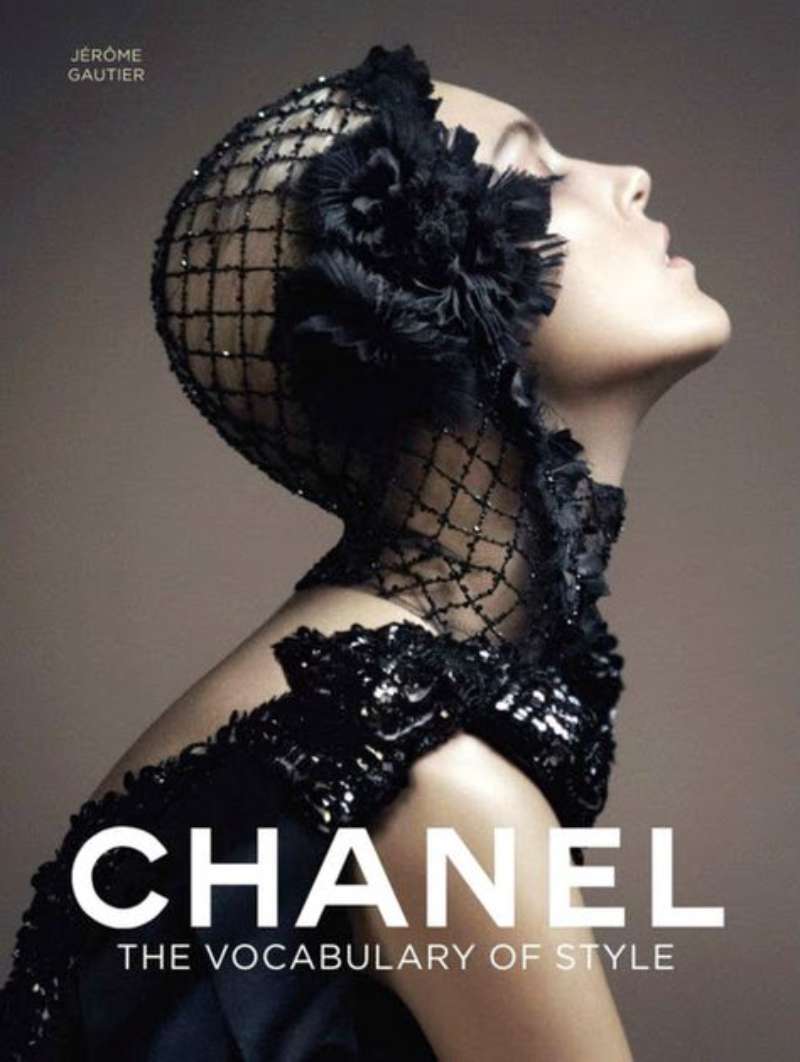
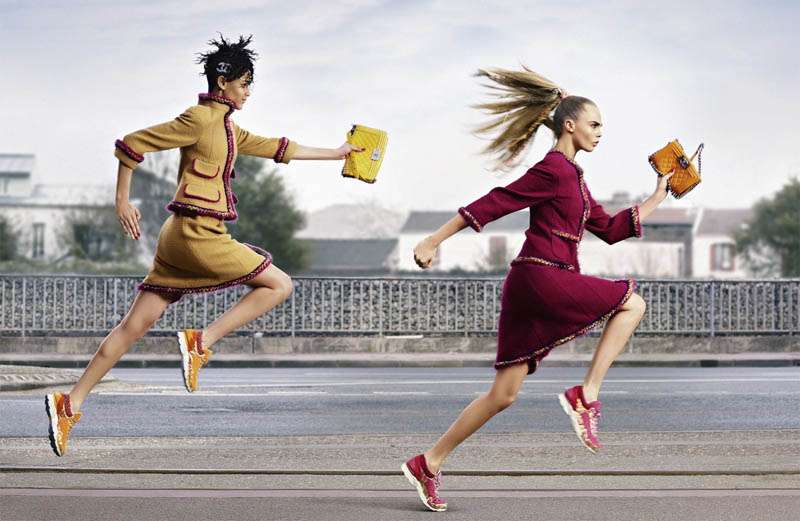
Chanel Ads Examples




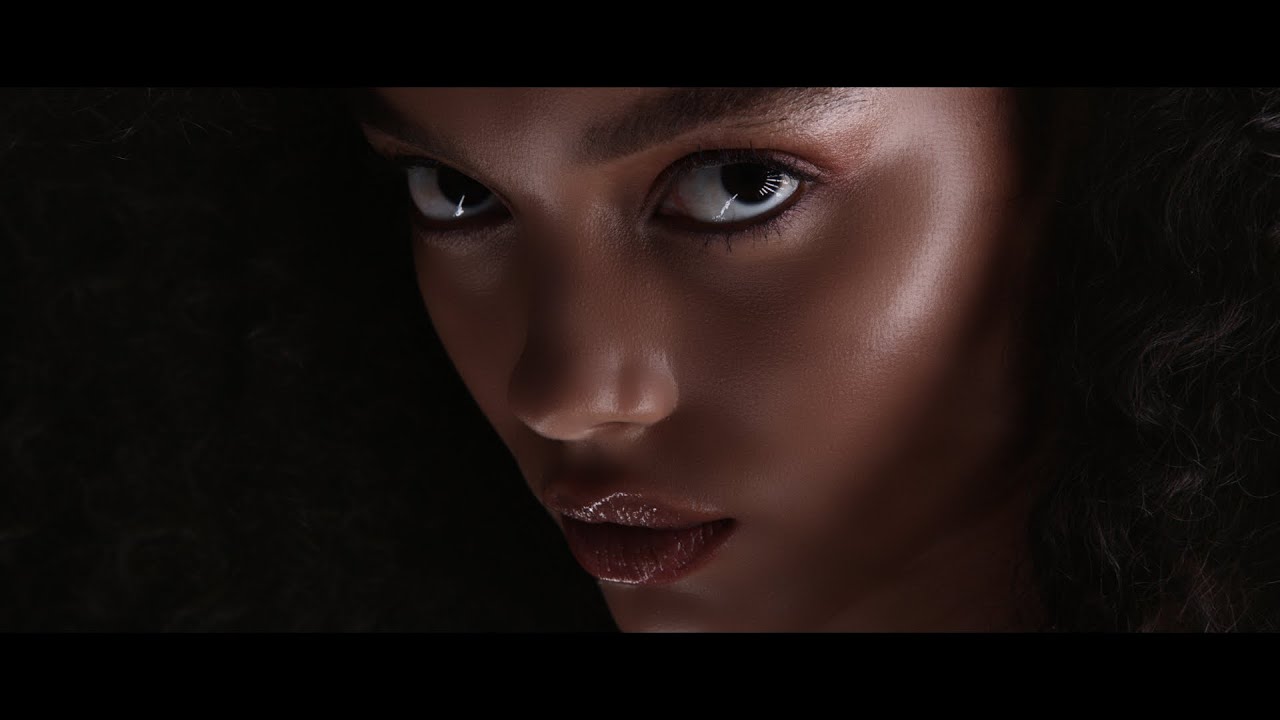
FAQ on Chanel Ads
Who directed Chanel’s first cinematic commercial?
Ridley Scott directed Share the Fantasy in 1979, three years before Blade Runner. The spot ran in North America, showed a No.5 bottle at a poolside, and carried no dialogue at all.
What is the most expensive Chanel ad ever made?
No.5 the Film, released in 2004, cost a reported $33 million for 180 seconds. Baz Luhrmann directed, Nicole Kidman starred for a fee widely reported at around $3 million, and Chanel financed the whole thing alone.
Does Chanel work with an advertising agency?
No. Alain Wertheimer dropped every outside agency in 1974 and moved creative control in-house under artistic director Jacques Helleu, who ran the image of the house until 2007. That structure still holds.
Why are so many Chanel ads black and white?
Monochrome removes the strongest competing signal in a magazine spread. With the color palette stripped back, the only real contrast left on the page sits between the black wordmark and white paper.
Who has been the face of Chanel No.5?
Catherine Deneuve, Carole Bouquet, Nicole Kidman, Audrey Tautou, Gisele Bundchen, Marion Cotillard and, since September 2024, Margot Robbie. Marilyn Monroe never signed a contract, though her 1952 Life remark did the work anyway.
What is the tagline in Chanel ads?
There often isn’t one. The house has used Share the Fantasy (1979), Be Unexpected (2010) and See You at 5 (2024), and dropped the line entirely in several markets, including the French cut of the 1979 spot.
Where did the first Chanel advertisement appear?
A small Parfums Chanel notice ran in The New York Times on 16 December 1924. The first campaign with a face came later: Gabrielle Chanel herself, photographed by Francois Kollar for Harper’s Bazaar in 1937.
How long are Chanel campaign films?
Between 60 and 180 seconds. Luhrmann’s 2004 short ran the full three minutes in cinemas before being cut to 30 seconds for primetime TV in 2006, which is still the standard pattern.
Which photographers shot Chanel print campaigns?
Richard Avedon photographed the 1970s relaunch with Deneuve, followed by Irving Penn and Helmut Newton. Recent work belongs to Steven Meisel, Craig McDean and Alec Soth, who shot the Spring 2026 campaign at La Pausa.
Are Chanel ads shot on film or digital?
Both, and the house still pays for film when the texture matters. Luca Guadagnino shot See You at 5 on 35mm in 2024, chosen to hold the grain of skin on screen.
Conclusion
Chanel ads hold up because the house treats art direction as a fixed asset instead of a campaign variable.
Egoiste, Coco Mademoiselle and Bleu de Chanel came from different directors in different decades. The interlocking CC logo, the monochrome frame and the typographic hierarchy behind them barely moved.
For designers the takeaway is unglamorous. Restraint reads as expense, empty space does the selling, and the wordmark never needs to shout.
Most brands do the opposite, rewrite the rules every few seasons, then pay for it in recall.
Put any Chanel print advertisement next to a campaign film from the same year and the codes match, only the pacing changes.
That is the method. Consistency compounds. Novelty resets the clock.

Renowned for his expertise in logo design and visual branding, Bogdan has developed a multitude of logos for various clients.
His skills extend to creating posters, vector illustrations, business cards, and brochures. Additionally, Bogdan's UI kits were featured on marketplaces like Visual Hierarchy and UI8.
He also wrote in the past years on sites like Design Your Way, WebDesignerDepot, WPDean, Designmodo, Speckyboy, Slider Revolution, and more.
- The Cursor Logo History, Colors, Font, And Meaning - 24 September 2026
- Top 7 Web Design Subscription Services That Replace Full-Time Hires - 24 September 2026
- Canva vs PowerPoint: Which Is Better for Presentations? - 22 September 2026

Bogdan Sandu is a seasoned designer who has been designing websites since 2008. Renowned for his expertise in logo design and visual branding, Bogdan has developed a multitude of logos for various clients. His skills extend to creating posters, vector illustrations, business cards, and brochures. Additionally, Bogdan's UI kits were featured on marketplaces like Visual Hierarchy and UI8. He also wrote in the past years on sites like Design Your Way, WebDesignerDepot, WPDean, Designmodo, Speckyboy, Slider Revolution, and more.
You Might Also Like