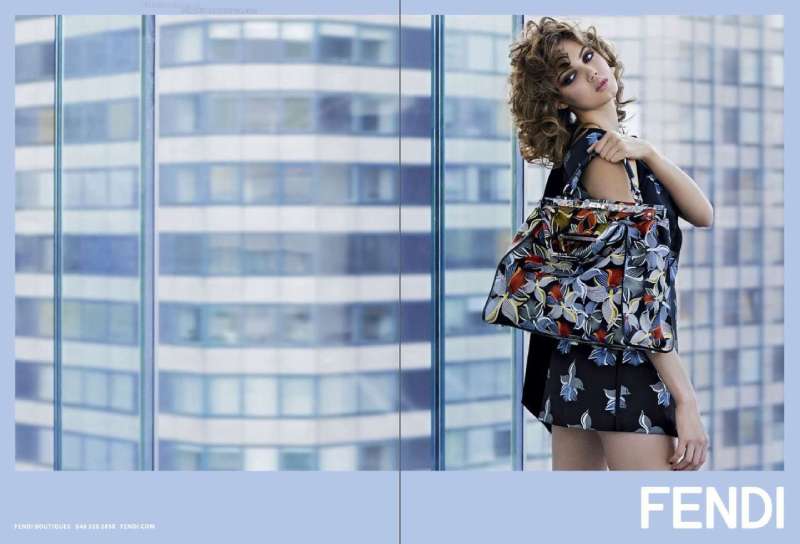
Ralph Lauren ads sell a house, a dog and a lawn. The clothes come second.
That method has held since 1972, from Bruce Weber’s safari frames and the Polo Sport campaigns with Tyson Beckford to the fall 2025 work shot by David Sims.
Most write-ups stop at nostalgia. This one names the photographer, year and market behind each campaign, then breaks down the composition, palette and typography that make the pictures work.
What follows:
- Six flagship campaigns, 1984 through 2025
- Why the 20-page magazine spread mattered
- How the print work differs from the TV commercials
- Six lessons designers can apply on a small budget
Ralph Lauren advertising goes back to 1972, spans more than 50 years of print-first image making, and runs through an in-house creative team instead of an outside agency. The line runs from the earliest tennis-court catalog photographs to the Polo Originals and Friends series shot in Tokyo in October 2025.
The work rests on one device: a complete American world that the product sits inside, not a product shot with copy stuck next to it.
This page covers the campaigns by name, with the photographer, year and market behind each one, plus the layout, palette and type decisions that hold them together.
- Campaign-by-campaign breakdown, 1984 to 2025
- Print composition analysis, including the 20-page magazine spread format
- Decade timeline and the people who shot the pictures
Ralph Lauren Advertising at a Glance
Ralph Lauren has advertised since 1972 and produces campaigns through its own creative department. Its best-known campaigns are Clotilde on Safari, Polo Sport and Romance. The visual signature combines warm neutral palettes, a serif wordmark and full-bleed photography with almost no body copy.
| Attribute | Value |
|---|---|
| First documented print ad | 1972 tennis image; Ralph Lauren fronted the 1978 Western-wear ads himself |
| Creative structure | In-house creative and advertising team, no agency of record |
| Photographers | Bruce Weber (from 1976), Patrick Demarchelier, Arnaldo Anaya-Lucca, Glen Luchford, Nadine Ijewere, Tyler Mitchell, David Sims |
| Primary media | Multi-page magazine spreads (up to 20 consecutive pages), TV, cinema, OOH, projection mapping, digital film |
| Marketing spend | 467 million dollars in fiscal 2024, up from 438.1 million in fiscal 2023 (Statista) |
| Sport platforms | Wimbledon official outfitter since 2006, Team USA Olympic outfitter since 2008 |
| Visual signature | Warm neutrals, deep navy, cream, oxblood; serif logotype; polo player mark small and low |
| Recurring copy device | Almost none. The image carries the argument, the wordmark closes it |
Which Ralph Lauren Ad Campaigns Are the Most Famous?
Six campaigns carry the brand’s advertising reputation: Clotilde on Safari (1984), Polo Sport with Tyson Beckford (1994 to 1998), Romance (1998 to 2014), The RL Gang (2010), Ralph’s Club (2021) and the Morehouse and Spelman collection campaign (2022). Bruce Weber shot the first three.
Clotilde on Safari (1984)
Bruce Weber shot the Spring/Summer 1984 series in Hawaii, standing in for East Africa, with French model Clotilde Holby as the lead.
What it did: it sold a khaki-and-linen expedition fantasy six years before the Safari fragrance arrived in 1990.
The frames run wide and horizontal, with the figure placed off-center and a large empty middle ground. Weber shot in warm desaturated color that reads almost like faded Kodachrome, which is why the pictures still date well.
Polo Sport (1994 to 1998)

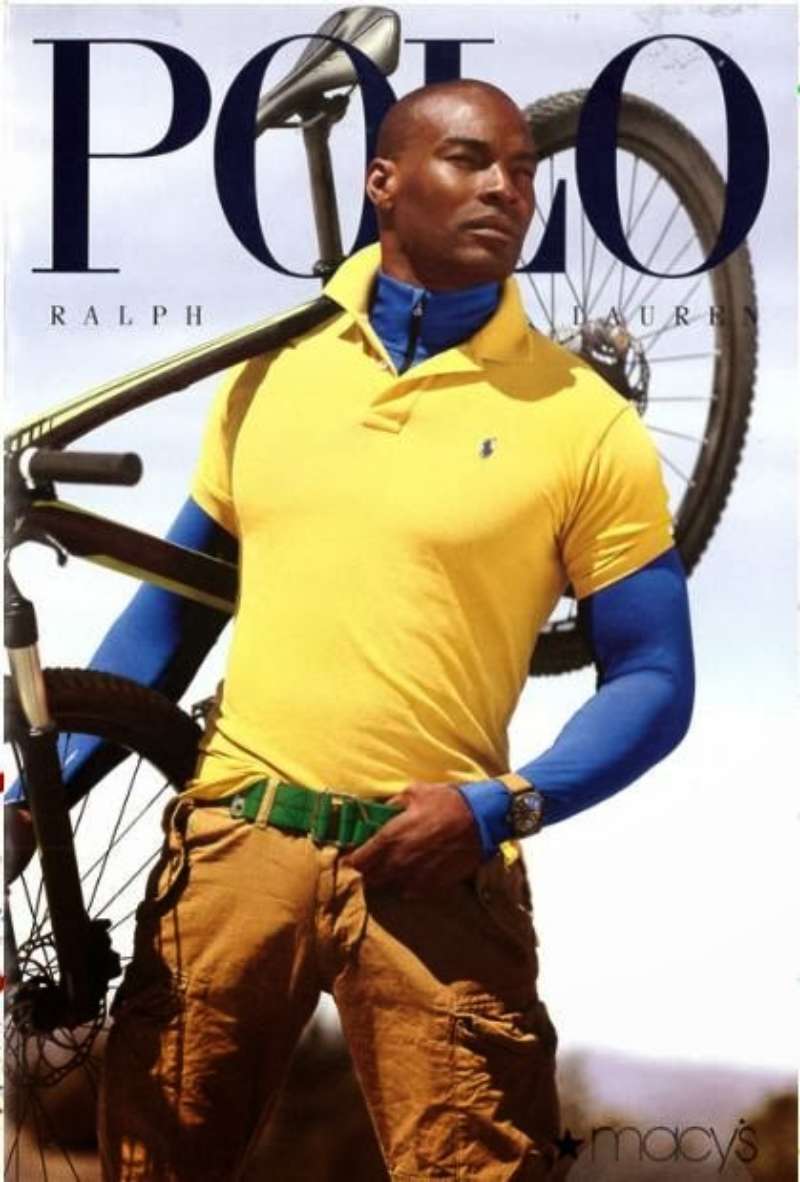
Tyson Beckford fronted the Polo Sport campaign from 1994 and signed an exclusive Ralph Lauren contract in 1995, the first Black male model to hold one at that level.
- Shot by: Bruce Weber, often with Naomi Campbell from 1997
- Activity, not pose: boxing, running, jet skiing, cycling
- Retail anchor: a 10,000 sq ft Polo Sport store opened on Madison Avenue in 1993, opposite the Rhinelander mansion
The palette breaks from the rest of the brand: flag red, hard white, cobalt, with the type set larger and tighter than the classic Polo work. Athlete-led casting like this is the standard case study in how brands use recognizable faces to move a sub-label into a new category.
Romance (1998 to 2014)

Format: black and white portraiture of real couples, not models playing couples.
Longest-running chapter: polo player Nacho Figueras and his wife Delfina Blaquier, shot by Weber for the 2011 films and again in 2014.
Why it holds up: the pictures use close crops and skin texture instead of product. The bottle appears once, usually bottom right, at a fraction of the frame.
Romance launched as a women’s fragrance in 1998, with Romance Men following in 1999.
The RL Gang (2010)
Polo Ralph Lauren replaced a childrenswear fashion show with an illustrated, shoppable online storybook in August 2010, starring eight real children and narrated by Harry Connick Jr.
Uma Thurman narrated the Spring 2011 follow-up, and 15% of first-month proceeds went to the nonprofit Room to Grow.
Illustration plus live-action photography is unusual for a luxury house. The layout borrows from children’s picture books: heavy left-page image, short right-page text block, generous margins. Clean narrative construction in visual design did more work here than any product shot could.
Ralph’s Club (2021)

Glen Luchford photographed the 2021 Ralph’s Club fragrance campaign with Gigi Hadid, Luka Sabbat, Lucky Blue Smith and Fai Khadra in a black-tie nightclub setting.
The scent grew out of the Ralph’s Club runway show, which paired Old Hollywood glamour with Art Deco design language and a Janelle Monae performance.
Design read: low-key lighting, deep shadow, a flask-shaped bottle photographed against black. The 2025 sequel, Ralph’s Club New York, moved to Usher and a 110-dollar price point.
Polo Ralph Lauren for Morehouse and Spelman (2022)

Nadine Ijewere photographed the March 2022 campaign on both Atlanta campuses. It was the first Ralph Lauren campaign with an all-Black cast, photographer, creative directors and cinematographer, mostly students, faculty and alumni.
| Element | Execution |
|---|---|
| Film | “A Portrait of the American Dream,” premiered March 28, 2022 |
| Print device | Archival campus photography set against new imagery |
| Follow-on | Polo Ralph Lauren for Oak Bluffs, also shot by Ijewere |
Ralph Lauren Print Ads From the 1980s

The 1980s run is the brand’s densest print period and the one collectors chase.
Weber shot the February 1988 tie campaign, the 1989 American-ideal series and dozens of catalog spreads in between. Lauren described what he was selling as taste and total feeling rather than garments, which explains why so many frames contain furniture, dogs and weather but very little product.
How Do Ralph Lauren Print Ads Work Visually?
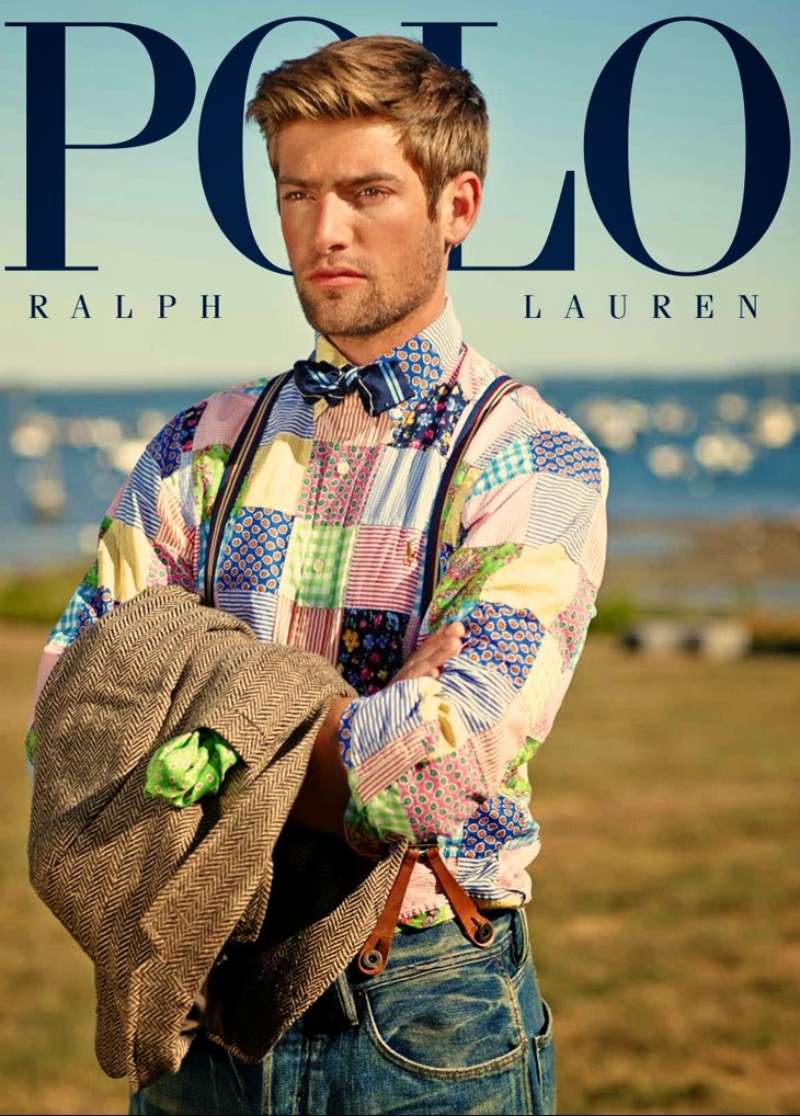
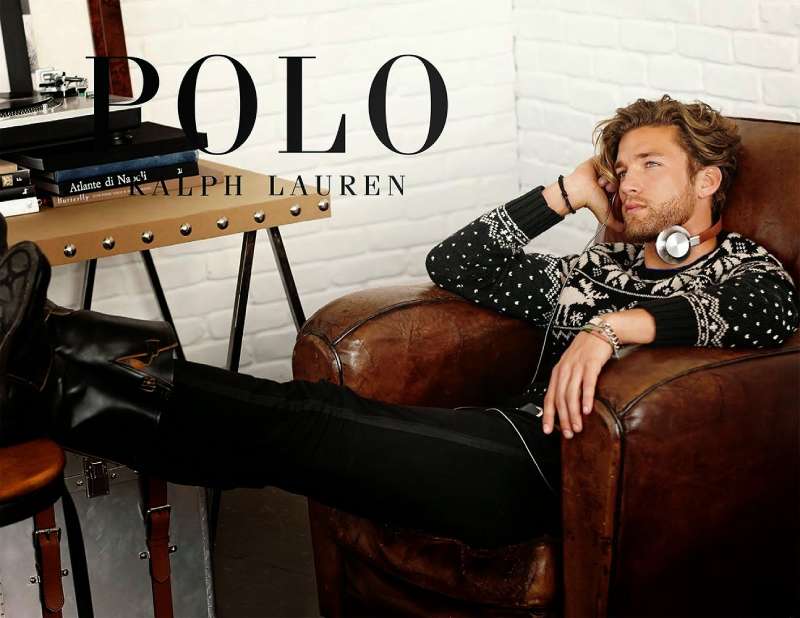
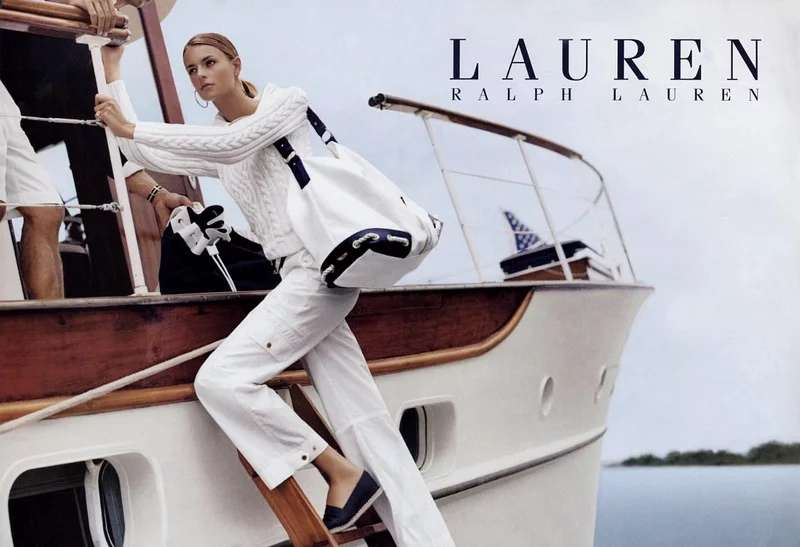
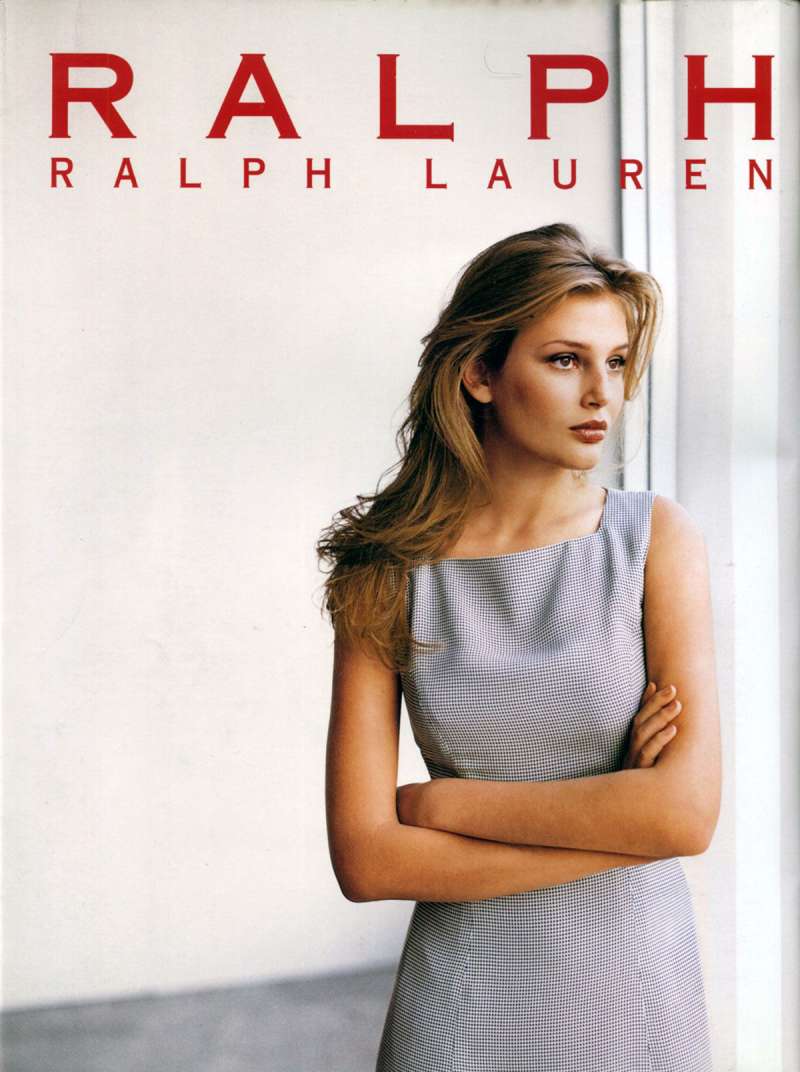
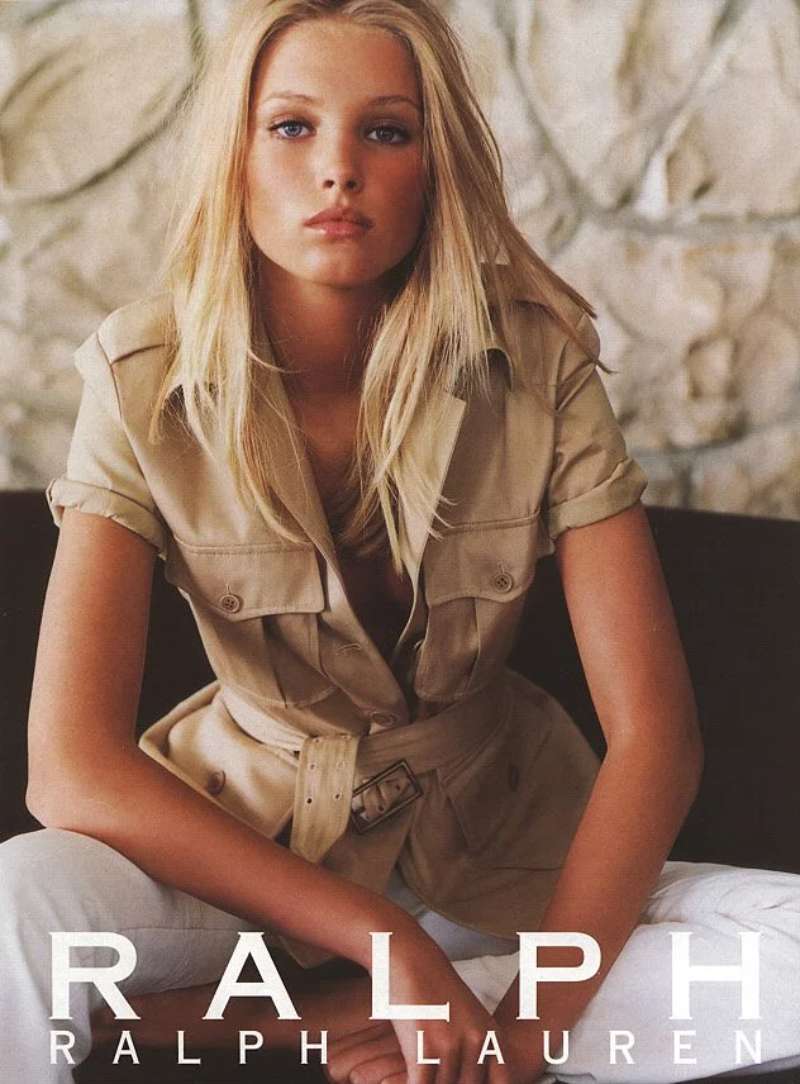
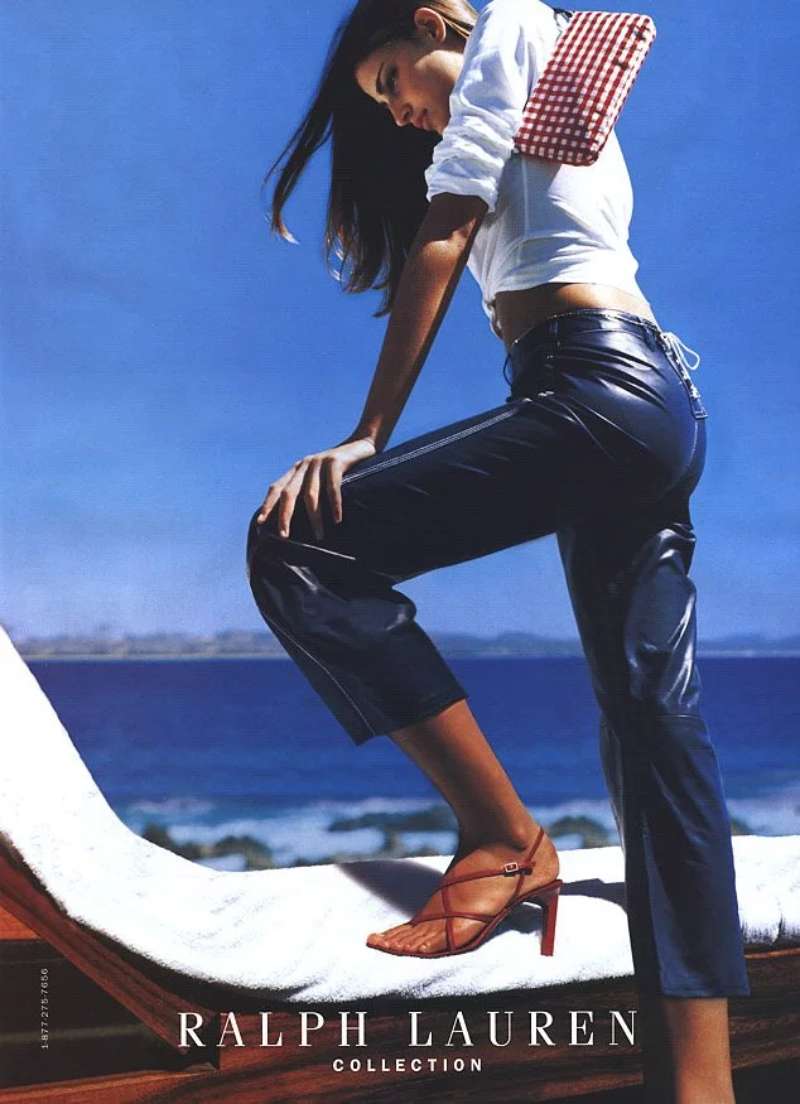
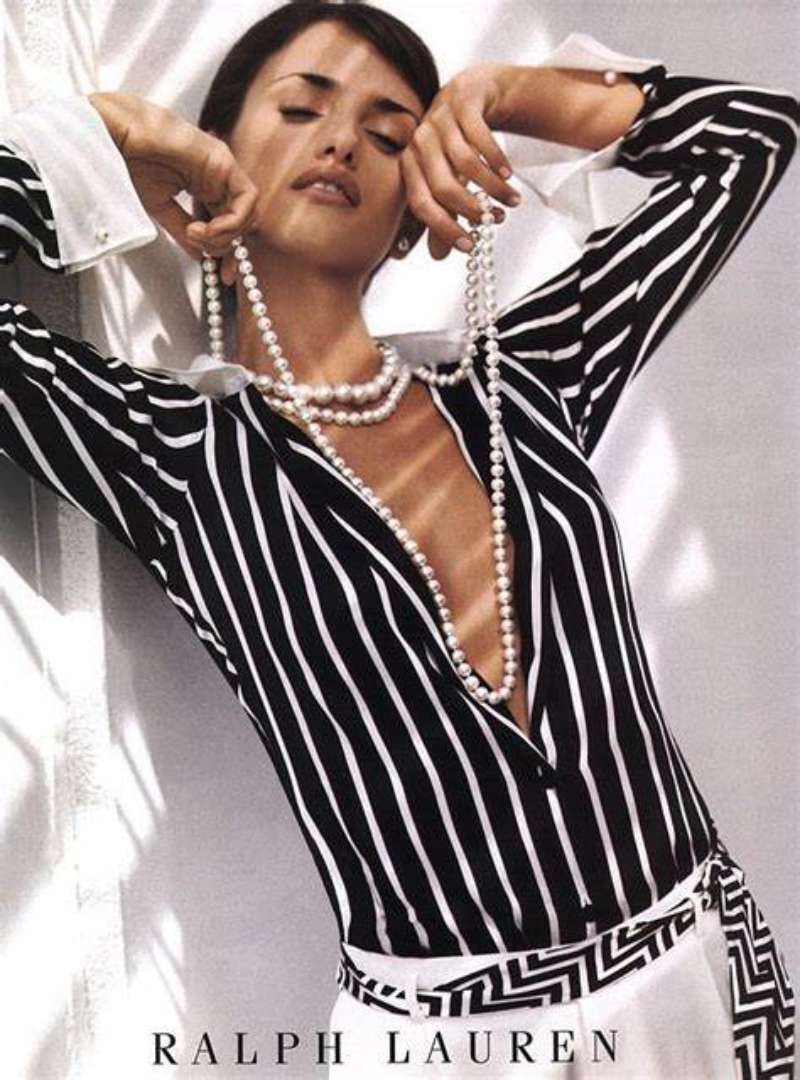
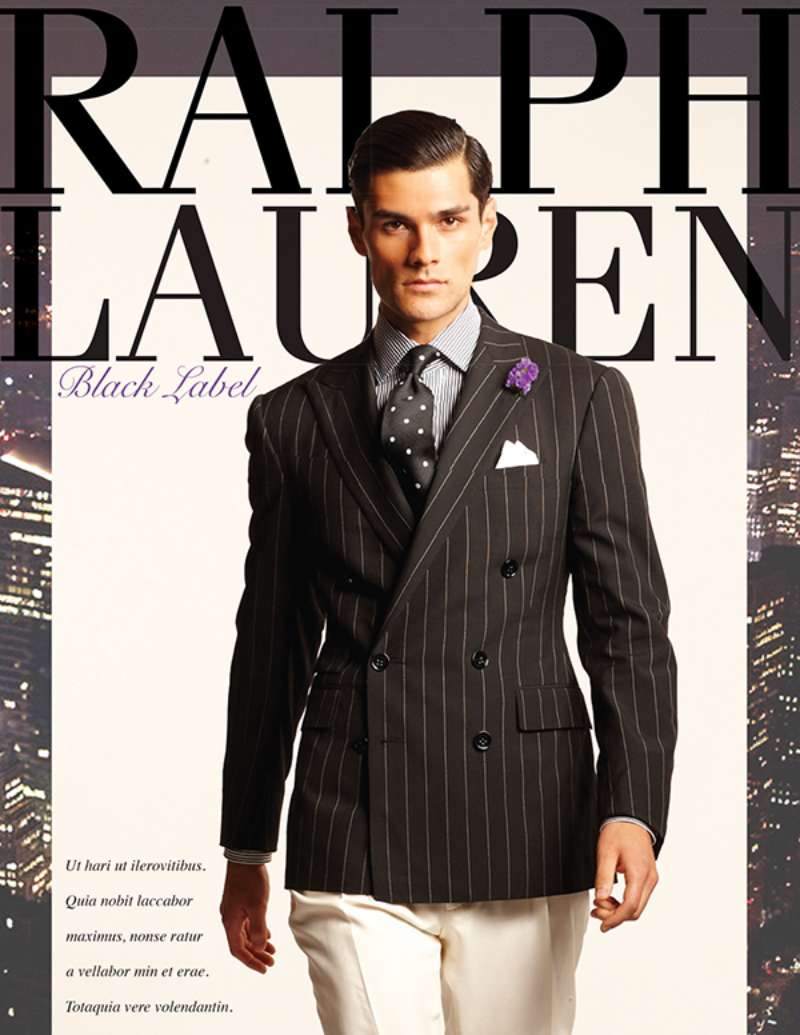
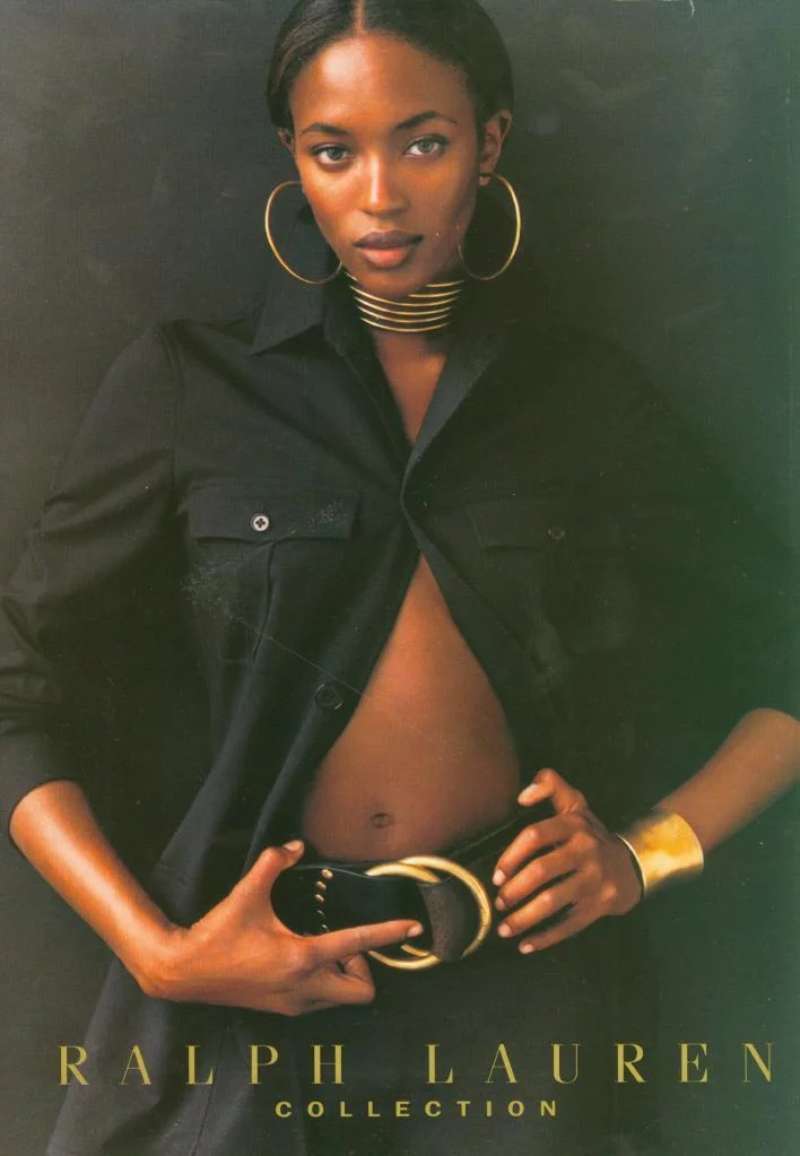
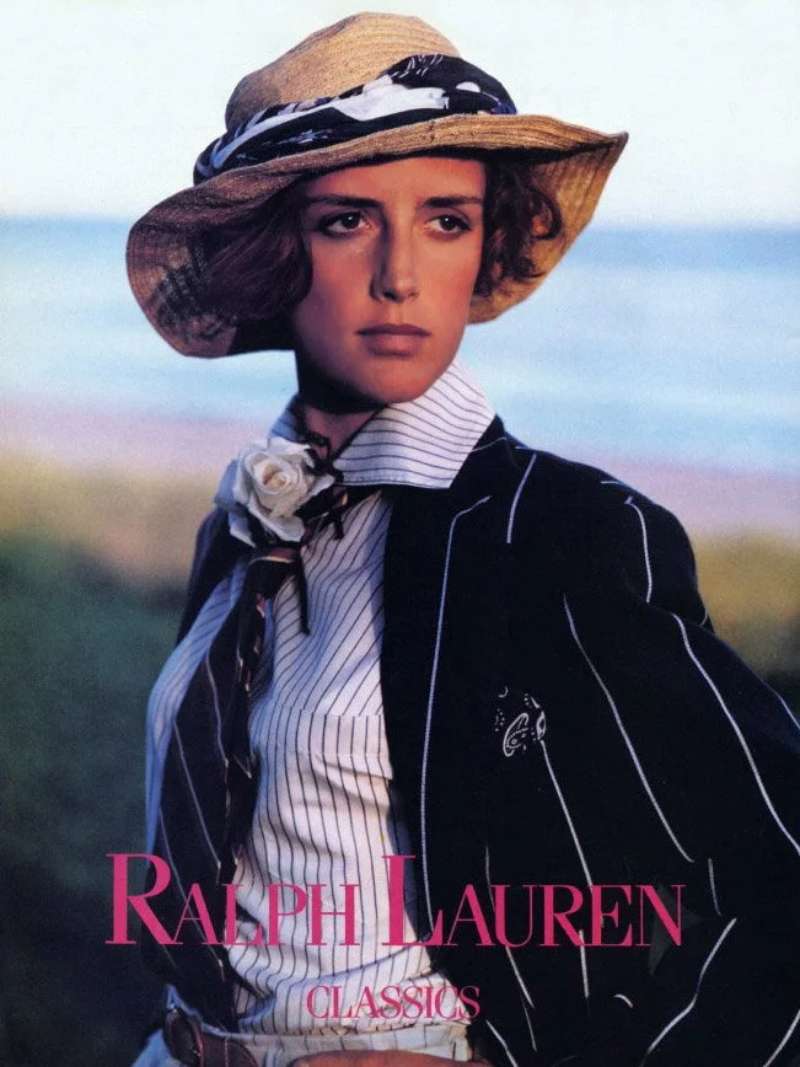
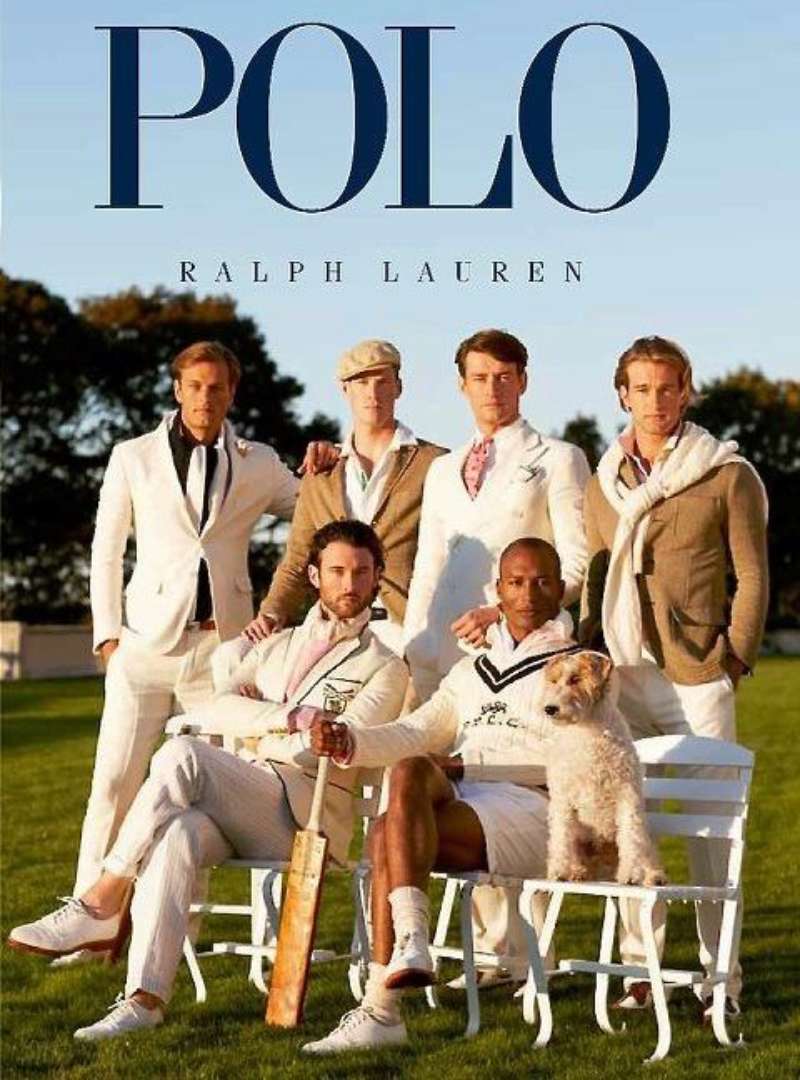
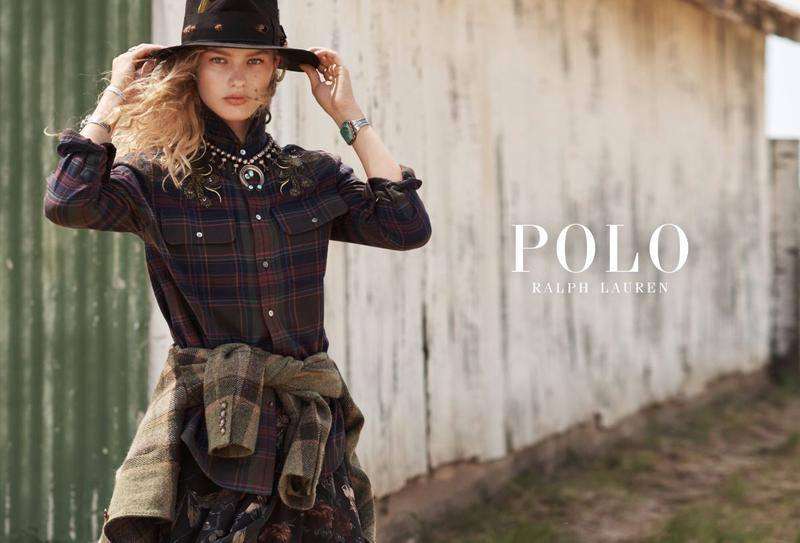
Ralph Lauren print ads use full-bleed photography, a serif logotype locked to one position, and copy reduced to a name. The image occupies 90 to 100% of the page. Composition follows classical portraiture rules rather than advertising layout conventions.
Composition and framing
Figures sit on the thirds, rarely dead center. Doorways, porch columns, tent flaps and window frames appear constantly, which is framing used as a compositional device rather than decoration.
The multi-page spread is the format that matters. Running 12 to 20 consecutive pages, as the brand did through the late 1970s and 1980s, turns a magazine buy into editorial page design, with a rhythm of wide shots, portraits and still lifes.
Type and logo placement
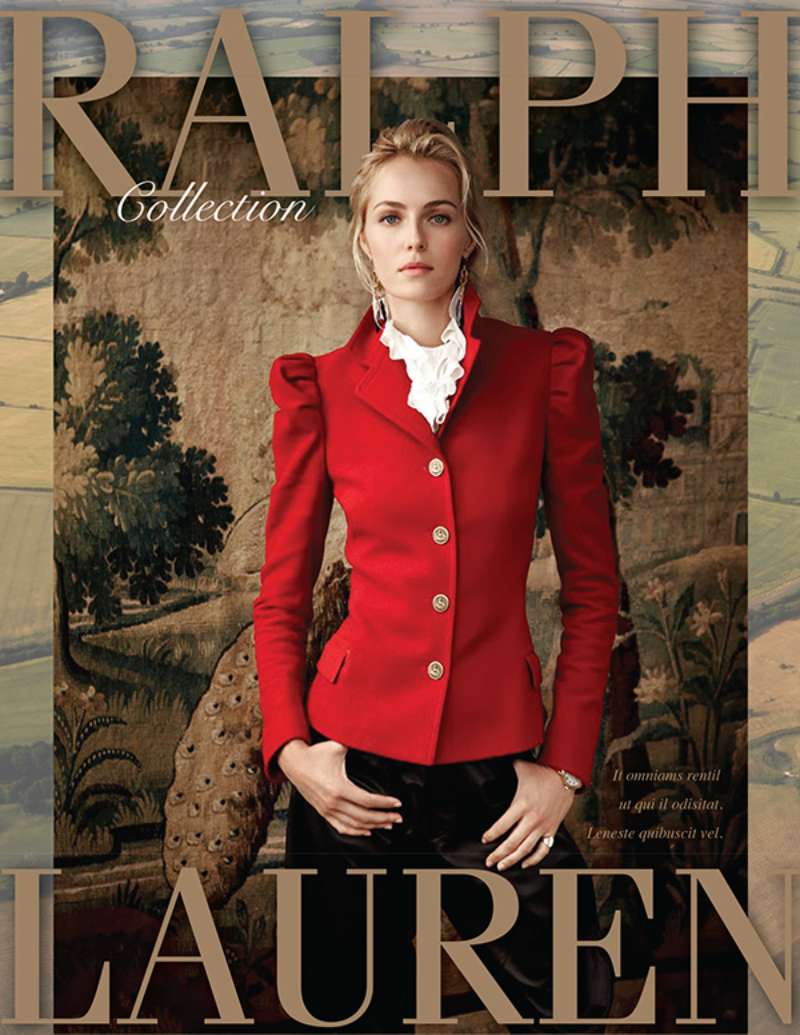
The wordmark is a serif typeface, letterspaced wide, set small, and dropped bottom right or centered in the bottom margin.
Nothing else competes with it. No headline, no starburst, no price. That restraint is what makes the hierarchy of type elements so easy to read: one level, one weight, one job.
Most fashion houses set their names in a sans-serif today. Ralph Lauren kept the serif, and the type choices that carry an ad are doing heritage signaling before anyone reads a word.
Palette
Navy, cream, camel, oxblood and forest green repeat across four decades. Saturation stays low and the whites stay warm.
The restricted color palette does two things: it makes 20 unrelated pages read as one campaign, and it keeps the clothes rather than the background at the top of the visual hierarchy.
Negative space
Lawn, sky, sand and empty interior walls fill roughly a third of most frames.
That open space in the layout reads as money. Cheap ads fill the page because media is expensive; Ralph Lauren leaves a quarter of it empty on purpose.
How Do Ralph Lauren TV Commercials Differ From Its Print Ads?
Ralph Lauren TV and film work adds motion, music and narration to the same visual system. The commercials run longer than a standard 30-second spot, carry almost no voiceover product claims, and often function as short films released online first. Weber directed as well as shot many of them.
Romance, Nacho Figueras and Delfina Blaquier (2011)
Weber directed the fragrance film around a real married couple, their horses and their children in Argentina. There is no product demonstration. The bottle appears in the final four seconds.
The 4D Experience, New York and London (November 10, 2010)
Ralph Lauren projection-mapped the facades of 888 Madison Avenue and 1 New Bond Street in an eight-minute show staged five hours apart. More than 1,000 guests attended each. Drive Productions, United Visual Artists and MKG worked under the brand’s creative team, roughly 150 people across seven months.
The fourth dimension was scent: an exploding fragrance bottle timed to Big Pony pumped over the crowd.
Polo Spring 2015 water-screen show (September 8, 2014)
MPC built a 60-foot-tall, 150-foot-wide water screen over Cherry Hill in Central Park, running 12 runway vignettes in mixed live action and CG. It doubled as the launch of the Fifth Avenue Polo flagship.
The through line: the brand treats motion-based visual work as an extension of the print frame, not a different discipline.
How Has Ralph Lauren Advertising Evolved Since 1972?
Ralph Lauren advertising has moved through five phases in 50 years: catalog realism in the 1970s, cinematic fantasy in the 1980s, sport and street casting in the 1990s, digital spectacle in the 2000s and 2010s, and documentary-style cultural collaboration in the 2020s. The visual grammar barely changed.
| Decade | Strategic shift | Representative work |
|---|---|---|
| 1970s | Multi-page magazine spreads, designer as protagonist | 1978 Western-wear ads starring Ralph Lauren |
| 1980s | Fantasy world building with a single photographer | “Clotilde on Safari,” 1984 |
| 1990s | Sport sub-brands and new casting | Polo Sport, Beckford and Campbell |
| 2000s to 2010s | Events as media, projection and film | 4D Experience 2010, water screen 2014 |
| 2020s | Community collaboration and location series | Morehouse and Spelman 2022, Tokyo 2025 |
What stays fixed across all five phases is the story the brand tells about itself: aspiration presented as memory. Lauren has described the ads as the movies he never made.
Which Agencies Created Ralph Lauren Advertising?
No outside agency of record created Ralph Lauren advertising. The company’s in-house creative and advertising team develops campaigns and hires photographers, directors and production studios directly. David Lauren has led advertising, marketing and communications since the early 2000s.
Sandy Carlson, then an art director at Young and Rubicam, showed Bruce Weber’s portfolio to Ralph Lauren in 1976. Lauren hired Weber to shoot the men’s collection on Shelter Island that year.
Weber then photographed Ralph Lauren campaigns across the 1980s, 1990s and 2010s, including Clotilde on Safari in 1984, the Polo Sport series with Tyson Beckford, and the Romance films of 2011 and 2014.
- MPC produced the 2014 Central Park water-screen show with Ralph Lauren’s creative team
- Drive Productions and United Visual Artists built the 2010 projection-mapped facade shows in London and New York
- MKG ran the New York side of the 2010 event
- Nadine Ijewere photographed the 2022 Morehouse and Spelman campaign and the later Oak Bluffs collection
- David Sims photographed the Fall 2025 campaign; Tyler Mitchell shot Pre-Fall 2025
Keeping the work in-house is the reason the brand’s visual identity reads as one continuous document rather than a series of agency reinventions.
What Can Designers Learn From Ralph Lauren Ads?
Five habits carry over from Ralph Lauren advertising into ordinary commercial design work: restraint in type, discipline in palette, patience with empty space, consistency across formats, and building a world instead of a message.
- Set the wordmark once, small, in one fixed position, and leave it there for 40 years
- Limit the palette to four warm neutrals plus one deep accent
- Give the subject a frame inside the frame: a doorway, a window, a treeline
- Cut the headline entirely when the photograph already states the argument
- Design the spread, not the page, when the buy runs longer than two pages
- Cast people who already live the story instead of models performing it
The last one is the hardest to fake and the reason the Figueras and HBCU campaigns landed. A stripped-back approach like this sits close to minimalist layout thinking, though the photography itself is anything but sparse.
How Do Ralph Lauren Ads Compare to Calvin Klein and Lacoste Ads?
Bruce Weber shot for Ralph Lauren and Calvin Klein in the same period, which makes the split in strategy easy to see. Weber’s 1982 Tom Hintnaus billboard for Calvin Klein isolates one body against sky, no context, no narrative. His Ralph Lauren frames from the same years fill the picture with houses, dogs, luggage and weather.
Calvin Klein advertising removes the world so the product carries the charge. Ralph Lauren builds the world so the product inherits it. One uses shock and scale, the other uses accumulation.
Lacoste advertising sits closer on the surface, since both brands own a small animal mark on a chest, but Lacoste plays sport for real and leans on flat color and motion. Ralph Lauren plays sport as costume.
Compared with Gucci campaigns, which reset their visual system every creative director, Ralph Lauren’s biggest advantage is that the 1984 pictures and the 2025 pictures share a palette, a crop and a typeface. Very few houses can say that.
What Makes Ralph Lauren Advertising Work?
Consistency does most of the work. The palette, the crop, the serif name in the corner and the near-total absence of copy have held since the late 1970s, so every new picture deposits into the same account instead of opening a new one.
The second thing is casting for lived experience over pure looks, which is what separates the Figueras films and the campus campaigns from generic aspiration photography.
Designers can steal the method without the budget. Pick four colors, one typeface, one logo position, then repeat those choices long enough that recognition does the selling.
That patience is the whole positioning strategy, and almost nobody has the discipline for it.
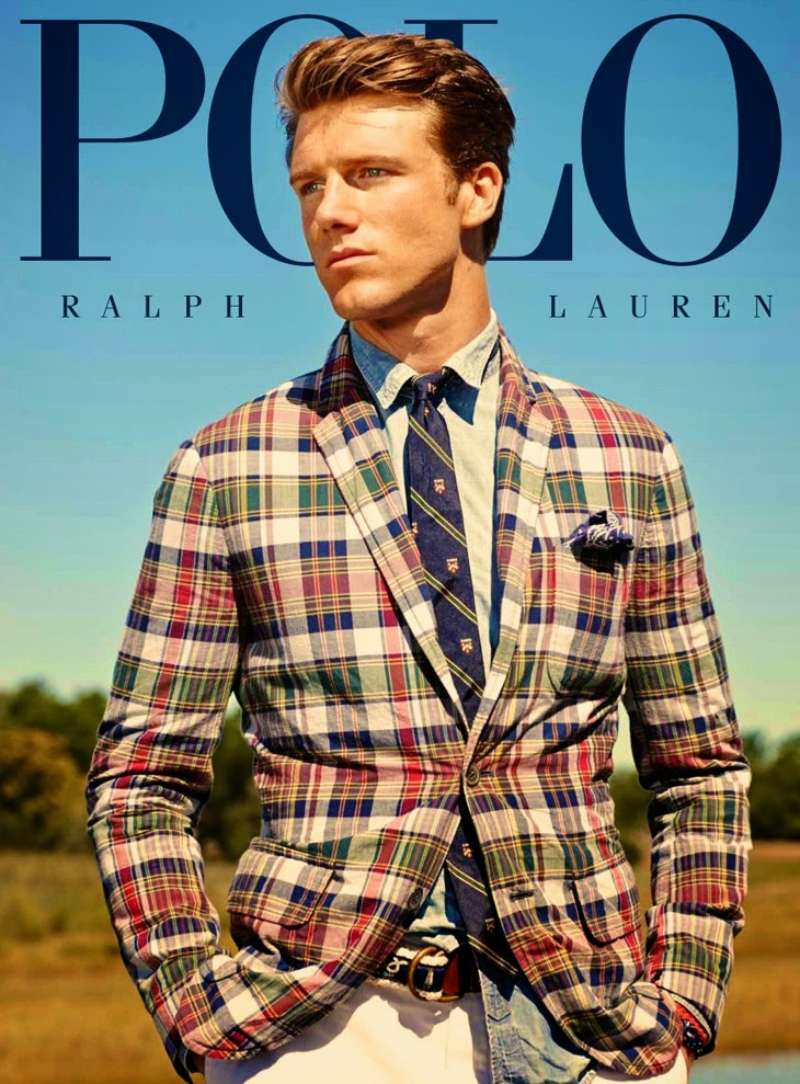
Ralph Lauren Ads Examples













FAQ on Ralph Lauren Ads
Did Ralph Lauren appear in his own ads?
Yes. He fronted the 1978 Western-wear campaign himself, wearing the collection he had just launched.
The move set the pattern for later casting: real people with a claim to the story, rather than models performing it.
Which sub-brands get their own campaigns?
Polo Ralph Lauren, Purple Label, Double RL, Polo Sport and Chaps have all carried separate advertising.
Club Monaco ran its own marketing until Ralph Lauren Corporation sold the brand to Regent LP in May 2021.
Who is Nacho Figueras and why does he keep appearing?
Figueras is an Argentine polo player, the face of Polo Black fragrance and a Black Label model since 2005.
He plays the sport that named the company, which makes the equestrian imagery literal instead of borrowed.
What is Polo Originals and Friends?
A location-based campaign series launched in October 2025, opening in Tokyo.
The cast includes fashion director Shuhei Nishiguchi, tailor Hiroki Koda, illustrator Aaron Chang, photographer James Harvey-Kelly and actor Andrew Lin, each shot in their own clothes.
Has Ralph Lauren ever run a Super Bowl ad?
No Ralph Lauren Super Bowl spot appears in the major ad archives.
The brand concentrates its broadcast money on fragrance commercials and Olympic and Wimbledon coverage, where the clothing is already on screen.
Does the Polo Bear show up in advertising?
Constantly, though usually as product rather than as a mascot in the frame.
The Racer Bear arrived in 1997 wearing a quilted neon Polo Sport jacket, and a Polo Bear patchwork sweater anchored the fall-holiday 2025 collection.
What was Postcards From Paradise?
A short film campaign that brought back two models from the 1980s ads, Andrew Smith and Tim Easton.
Framed prints from the original Bruce Weber shoots appear in the background, which makes the archive part of the set.
Which markets see the most Ralph Lauren advertising?
The United States first, then the United Kingdom, Japan and China.
London’s New Bond Street flagship carried the 2010 projection show, and the 2025 Tokyo series signals how much weight Japan now holds in the brand narrative.
Do the campaigns change every season?
Yes, on a pre-fall, fall-holiday and spring rhythm, with fragrance launches running on their own clock.
Tyler Mitchell shot pre-fall 2025 and David Sims shot fall 2025, six months apart, in the same palette.
Does Ralph Lauren advertise its Home collection?
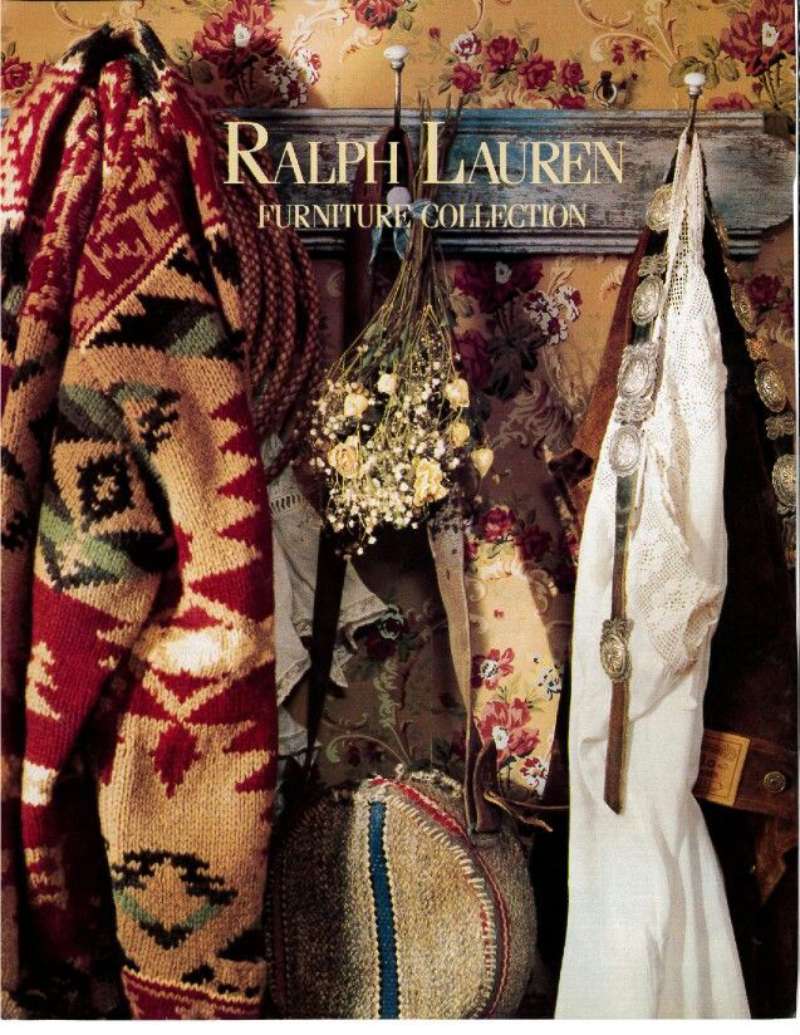
Yes, since the line launched in 1983 as the first home collection from a fashion designer.
The fall 2025 Ralph Lauren Home campaign featured designs by Navajo weavers Naiomi and Tyler Glasses, part of the Artist in Residence program.
Conclusion
Ralph Lauren ads hold up because the art direction never resets. Preppy Americana, warm neutrals and cinematic lighting carried the Romance films in 1998 and still carry the fall 2025 editorial spreads.
The aspirational imagery does something specific: it sells belonging first, then lets the garment ride along.
Nadine Ijewere’s campus portraits and Nacho Figueras on horseback both pass that test, twenty years apart.
Three things transfer to smaller budgets.
- Hold the palette across every asset
- Protect the negative space instead of filling it
- Keep the wordmark small, in the same corner, forever
Brand heritage is not a mood board or a filter. It is the pile of decisions nobody was allowed to change.

Renowned for his expertise in logo design and visual branding, Bogdan has developed a multitude of logos for various clients.
His skills extend to creating posters, vector illustrations, business cards, and brochures. Additionally, Bogdan's UI kits were featured on marketplaces like Visual Hierarchy and UI8.
He also wrote in the past years on sites like Design Your Way, WebDesignerDepot, WPDean, Designmodo, Speckyboy, Slider Revolution, and more.
- The Windsurf Logo History, Colors, Font, And Meaning - 10 October 2026
- How to Remove Background From Product Photos (No Photoshop) - 10 October 2026
- How Designers can Build a Stronger Online Creative Identity - 9 October 2026

Bogdan Sandu is a seasoned designer who has been designing websites since 2008. Renowned for his expertise in logo design and visual branding, Bogdan has developed a multitude of logos for various clients. His skills extend to creating posters, vector illustrations, business cards, and brochures. Additionally, Bogdan's UI kits were featured on marketplaces like Visual Hierarchy and UI8. He also wrote in the past years on sites like Design Your Way, WebDesignerDepot, WPDean, Designmodo, Speckyboy, Slider Revolution, and more.
You Might Also Like