Michael Jordan’s Nike deal started at $2.5 million in 1984. By 2024, it was paying him $300 million a year. That is the power of a well-matched famous brand ambassador.
Celebrity endorsement deals drive billions in annual revenue for companies like Nike, Adidas, Pepsi, and Nespresso. But not every partnership works. Some cost brands millions in wasted marketing budget and reputational damage.
This article breaks down the most successful brand ambassador campaigns in advertising history. You will find specific contract values, measurable sales results, and the criteria that separate a forgettable spokesperson from a global brand partnership worth hundreds of millions.
What Is a Brand Ambassador

A brand ambassador is a public figure contracted to represent a company through advertising campaigns, product launches, and media appearances. The role connects a person’s public identity to a brand’s commercial goals.
Celebrity endorsement deals have existed since the 1760s, when Josiah Wedgwood used royal endorsements to sell pottery. But the modern brand ambassador model took shape in the 1980s, when Nike signed Michael Jordan and changed the entire advertising industry.
Today, a brand ambassador does more than appear in a commercial. They participate in product development, attend corporate events, post on social media, and sometimes take equity stakes in the companies they represent.
The key difference between a standard paid partnership and a true ambassador role is duration and depth. Ambassadors typically sign multi-year endorsement contracts that tie their personal reputation to the brand’s market position. Short-term influencer deals rarely carry the same weight.
How Brand Ambassadors Work in Advertising
The brand pays. The ambassador shows up. That is the simplified version.
In practice, endorsement agreements involve detailed contractual terms covering exclusivity clauses, content creation obligations, appearance schedules, and usage rights for the ambassador’s name and likeness. Some contracts run 30+ pages.
There are three main deal structures:
- Flat-fee contracts pay a fixed amount per year regardless of sales performance. George Clooney’s Nespresso deal reportedly earned him over $40 million across nearly two decades on this model.
- Royalty-based deals tie compensation to product revenue. Michael Jordan earns roughly 5% of all Jordan Brand sales through Nike, which brought him an estimated $300 million in 2024 alone.
- Equity partnerships give the ambassador an ownership stake. Ryan Reynolds did this with Aviation Gin before selling the company to Diageo.
A 2023 study by Harvard Business School found that celebrity endorsements increase sales by an average of 4% following the announcement of an endorsement deal. But that number jumps significantly when the ambassador’s public persona matches the brand’s target audience.
The campaign strategy determines where the ambassador appears. Global campaigns might include television commercials, print design materials for magazines, outdoor billboard placements, and social media content across platforms. When brands produce visual campaign materials, the visual hierarchy of every advertisement places the ambassador’s face and the product in clear positions of dominance, because that is what drives consumer recall.
What Makes a Brand Ambassador Successful

Not every celebrity endorsement works. Some fail spectacularly.
The ambassadors who last decades, not months, share a few measurable traits. These are the criteria that separate a $2 million one-off commercial appearance from a $160 million lifetime contract.
Brand Alignment
The ambassador’s public identity has to match the brand’s values. George Clooney works for Nespresso because he projects sophistication and understated luxury. That same alignment between person and product is what makes or breaks a partnership.
Misalignment kills deals fast. Look at any brand that dropped an ambassador after a controversy.
Campaign Reach
Audience size matters, but it is not everything. A brand ambassador with 500 million social media followers who does not match the target demographic will underperform compared to someone with 10 million highly engaged followers in the right market.
The best ambassadors deliver reach and relevance simultaneously.
Sales Impact
This is the number that actually keeps contracts alive. When Nike projected $3 million in Air Jordan sales by year four, they got $126 million in year one. That kind of result turns a five-year deal into a lifetime partnership.
Brands track point-of-sale data, brand performance metrics, and online conversion rates tied to campaign launches to measure ambassador ROI.
Contract Duration and Renewal
Longevity is a success signal. David Beckham has been with Adidas since 2003. Clooney has been with Nespresso since 2006. These multi-decade partnerships exist because both sides keep profiting.
Cultural Influence
Some partnerships reshape how the public sees a brand entirely. Before Michael Jordan, Nike was a distant third in basketball behind Converse and Adidas. The Jordan partnership did not just sell shoes. It turned Nike into the dominant force in global sports marketing and created an entire sneaker culture that still drives billions in annual revenue.
Most Famous Brand Ambassadors
Below are the celebrity endorsement deals that defined modern brand representation. Each partnership is measured against the criteria above: alignment, reach, sales impact, duration, and cultural influence.
Michael Jordan for Nike

American basketball player, six-time NBA champion with the Chicago Bulls, widely considered the greatest player in league history.
Jordan signed with Nike in 1984 for $2.5 million over five years. He actually preferred Adidas at the time. His mother Deloris convinced him to hear Nike’s pitch, and his agent David Falk coined the term “Air Jordan.”
Nike expected $3 million in sales by year four. The Air Jordan 1, released in April 1985, generated $126 million in its first year. The NBA fined Jordan for wearing shoes that violated the league’s color standards. Nike paid every fine and turned the controversy into an advertising campaign.
By 2024, the Jordan Brand generated $7 billion in annual revenue. Jordan earns approximately 5% in royalties, putting his annual income from Nike at roughly $300 million, more than triple his entire NBA career salary of $94 million. Since 1984, Nike has paid Jordan an estimated $2.35 billion.
The partnership created a logo (the Jumpman silhouette) that became one of the most recognized commercial symbols on earth, comparable in awareness to the Nike Swoosh itself. What started as a basketball shoe deal became a lifestyle brand operating across footwear, apparel, and accessories with distribution in over 100 countries.
No other sports endorsement deal in history comes close in total value or cultural impact.
George Clooney for Nespresso

American actor, two-time Academy Award winner, known for Ocean’s Eleven, ER, and his work as a film director and producer.
Clooney became Nespresso’s brand ambassador in 2006, initially appearing in European advertising campaigns. The “What Else?” tagline became inseparable from his image. He expanded to North American campaigns in 2015 and currently serves as the brand’s global ambassador.
The deal has earned Clooney an estimated $40 million or more over the partnership’s duration. He also sits on Nespresso’s Sustainability Advisory Board alongside the Rainforest Alliance and Fair Trade International.
Nespresso built its premium coffee positioning largely on Clooney’s association with sophistication, wit, and understated class. The television commercials, which often feature humorous scenarios and cameos from other celebrities like Matt Damon and Eva Longoria, consistently rank among the most memorable advertisements in the beverage category. The brand’s campaigns use color theory in their visual materials, pairing deep espresso tones with metallic accents to reinforce that premium positioning.
At nearly 20 years, this is one of the longest-running celebrity endorsement partnerships in advertising history.
David Beckham for Adidas
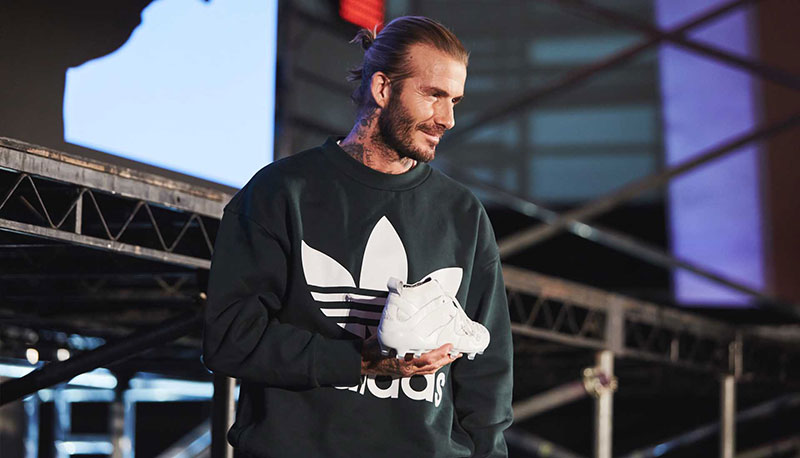
English footballer, former captain of the England national team with 115 caps, played for Manchester United, Real Madrid, LA Galaxy, AC Milan, and Paris Saint-Germain.
Beckham signed a lifetime contract with Adidas in 2003 worth $160 million, with nearly half paid upfront. At the time, it was one of the largest sponsorship deals in sports history. The deal included profit percentages on all Beckham-branded Adidas merchandise.
Two defining moments cemented the partnership’s value. The 1996 halfway-line goal against Wimbledon, scored wearing Adidas Predator boots, introduced Beckham to global audiences. The 2001 free-kick against Greece, which sent England to the World Cup, made him a national hero while wearing Predator Precision boots.
But Adidas saw something competitors missed. Beckham was not just a footballer with trophies and caps. He was a cultural figure whose marriage to Victoria Beckham, willingness to push fashion boundaries, and global media profile made him worth more off the pitch than on it.
The partnership continues in 2025, over 22 years after signing. Beckham still represents Adidas through ambassador roles, design collaborations, and Inter Miami CF’s kit sponsorship. He also earns from endorsement portfolios with Tudor, H&M, and other brands, but the Adidas deal remains the foundation. Few athletes in any sport have maintained a single brand relationship this long while remaining commercially relevant after retirement.
Beyonce for Pepsi

American singer, songwriter, and businesswoman. One of the best-selling music artists of all time, with 32 Grammy Awards.
Beyonce signed a $50 million endorsement deal with Pepsi in 2012. The contract included traditional television commercials, a Pepsi-funded creative content fund, and the brand’s sponsorship of her Super Bowl XLVII halftime performance in 2013.
The deal was structured differently from typical beverage endorsements. Pepsi did not just get a spokesperson. They got a creative partner who maintained control over her brand narrative throughout the collaboration. The advertising campaigns featured Beyonce’s music and visual style, giving Pepsi access to her audience while letting her maintain artistic direction.
Pepsi’s halftime sponsorship during the 2013 Super Bowl drew over 110 million viewers. The partnership also showed how brand ambassador deals were shifting. Instead of the brand dictating terms, top-tier ambassadors like Beyonce now negotiate creative influence, approval rights, and content ownership into their contracts.
Beyonce later moved into equity-based brand building with Ivy Park (Adidas) and her own ventures, following the same trajectory that Michael Jordan pioneered.
Jennifer Aniston for Aveeno

American actress best known for her role as Rachel Green on Friends, with a career spanning over 30 years in film and television.
Aniston became Aveeno’s brand spokesperson in 2013, promoting the skincare and body care line in television commercials, print advertisements, and digital campaigns. The partnership extended over a decade.
The alignment here is straightforward. Aniston’s public image centers on approachable beauty, health-conscious living, and aging naturally. Aveeno, owned by Johnson & Johnson, positions itself as a clean, dermatologist-recommended brand using naturally derived ingredients like oat extracts.
The advertising strategy leaned heavily on Aniston’s reputation for maintaining a natural look, which directly reinforced Aveeno’s product claims. Campaign visuals kept things minimal, using monochrome color palettes and clean compositions to reflect the brand’s identity. This is the kind of ambassador-brand match where the brand positioning and the celebrity’s personal brand overlap almost completely.
The partnership helped Aveeno grow its market share in the competitive skincare category, particularly among women aged 30-55 who represent the brand’s core demographic.
FAQ on Famous Brand Ambassadors
Who is the highest paid brand ambassador in history?
Michael Jordan holds that position. His Nike partnership has earned him an estimated $2.35 billion since 1984. In 2024 alone, Jordan Brand revenue hit $7 billion, paying him roughly $300 million in royalties.
What is the difference between a brand ambassador and a spokesperson?
A spokesperson delivers a brand’s message in specific campaigns. A brand ambassador maintains a long-term relationship with the company, often spanning years or decades, involving product development, event appearances, and ongoing social media promotion.
How much do celebrity brand ambassadors get paid?
Compensation varies widely. Mid-tier deals pay $1-5 million annually. High-profile endorsement contracts like David Beckham’s lifetime Adidas deal reached $160 million. Royalty-based structures, like Jordan’s Nike agreement, can generate hundreds of millions per year.
What makes a brand ambassador campaign successful?
Brand alignment is the biggest factor. The ambassador’s public identity has to match the company’s values and target audience. George Clooney works for Nespresso because his persona matches their premium positioning. Misalignment leads to failed campaigns.
Which brands use ambassadors the most?
Nike, Adidas, Pepsi, Coca-Cola, Dior, L’Oreal, and Samsung spend the most on celebrity endorsement deals. Sports apparel and luxury fashion brands invest the heaviest, followed by beverage companies and consumer electronics manufacturers.
Can a brand ambassador deal hurt a company?
Yes. When Tiger Woods faced personal controversy in 2009, multiple sponsors dropped him, losing millions in sunk marketing costs. Brands now include morality clauses and conduct requirements in ambassador contracts to limit reputational risk.
How do brands choose their ambassadors?
Brands evaluate audience overlap, social media following, public reputation, demographic fit, and controversy risk. Market research teams analyze whether the celebrity’s fan base matches the brand’s target consumers before negotiating any endorsement agreement.
What is the longest running brand ambassador partnership?
George Clooney has represented Nespresso since 2006, spanning nearly 20 years. David Beckham’s Adidas lifetime contract, signed in 2003, has run for over 22 years. Both partnerships remain active and commercially productive in 2025.
Do brand ambassadors actually influence purchasing decisions?
Research confirms they do. Celebrity endorsements increase sales by an average of 4% following deal announcements. When the ambassador’s image closely matches the product category, that number increases significantly, particularly in sports apparel and beauty markets.
Are social media influencers replacing traditional brand ambassadors?
Not replacing, but changing the model. Companies like Samsung and Puma now combine traditional celebrity deals with influencer marketing strategies. BTS as Samsung ambassadors blends both approaches, reaching global audiences through concert tours and digital content simultaneously.
Conclusion
The most famous brand ambassadors share one thing in common. Their personal identity and the brand’s market position overlap so tightly that consumers stop seeing the endorsement as advertising.
Jordan turned Nike into a $7 billion sub-brand. Clooney made Nespresso synonymous with premium coffee. Beckham kept Adidas relevant in lifestyle fashion for over two decades after retirement.
These results did not come from short-term influencer deals or one-off commercial spots. They came from long-term endorsement contracts built on measurable sales impact, audience trust, and consistent brand representation across every campaign touchpoint.
The ambassador selection process, contract structure, and cultural fit between celebrity and company determine whether a partnership generates billions or becomes a cautionary tale. Every example in this list proves that.

Renowned for his expertise in logo design and visual branding, Bogdan has developed a multitude of logos for various clients.
His skills extend to creating posters, vector illustrations, business cards, and brochures. Additionally, Bogdan's UI kits were featured on marketplaces like Visual Hierarchy and UI8.
He also wrote in the past years on sites like Design Your Way, WebDesignerDepot, WPDean, Designmodo, Speckyboy, Slider Revolution, and more.
- Canva vs PowerPoint: Which Is Better for Presentations? - 22 September 2026
- How to Install Fonts on Mac (Step-by-Step Guide) - 20 September 2026
- From Mockup to Code: How AI-Augmented Development Speeds Up the Design Handoff - 19 September 2026

Bogdan Sandu is a seasoned designer who has been designing websites since 2008. Renowned for his expertise in logo design and visual branding, Bogdan has developed a multitude of logos for various clients. His skills extend to creating posters, vector illustrations, business cards, and brochures. Additionally, Bogdan's UI kits were featured on marketplaces like Visual Hierarchy and UI8. He also wrote in the past years on sites like Design Your Way, WebDesignerDepot, WPDean, Designmodo, Speckyboy, Slider Revolution, and more.
You Might Also Like