A brand took its logo off its own shirt in 2018 and sold out in 24 hours. That is the confidence running through Lacoste ads, from the first print work to the Cannes Film Grand Prix.
Lacoste advertising covers 93 years, one agency relationship with BETC Paris, and campaigns that include The Big Leap, Crocodile Inside and Play Big.
Every campaign here is credited: year, agency, director or photographer, market and result.
What you get by the end:
- Seven flagship campaigns with dates and creative teams
- How the crocodile emblem, palette and typography hold the layouts together
- Why the TV commercials work differently from the print ads
- Six rules you can apply to your own work
Lacoste advertising covers 93 years of brand history, 8 flagship campaigns and one agency relationship that has held since 2006. The work runs from still print in French magazines to a Cannes Film Grand Prix.
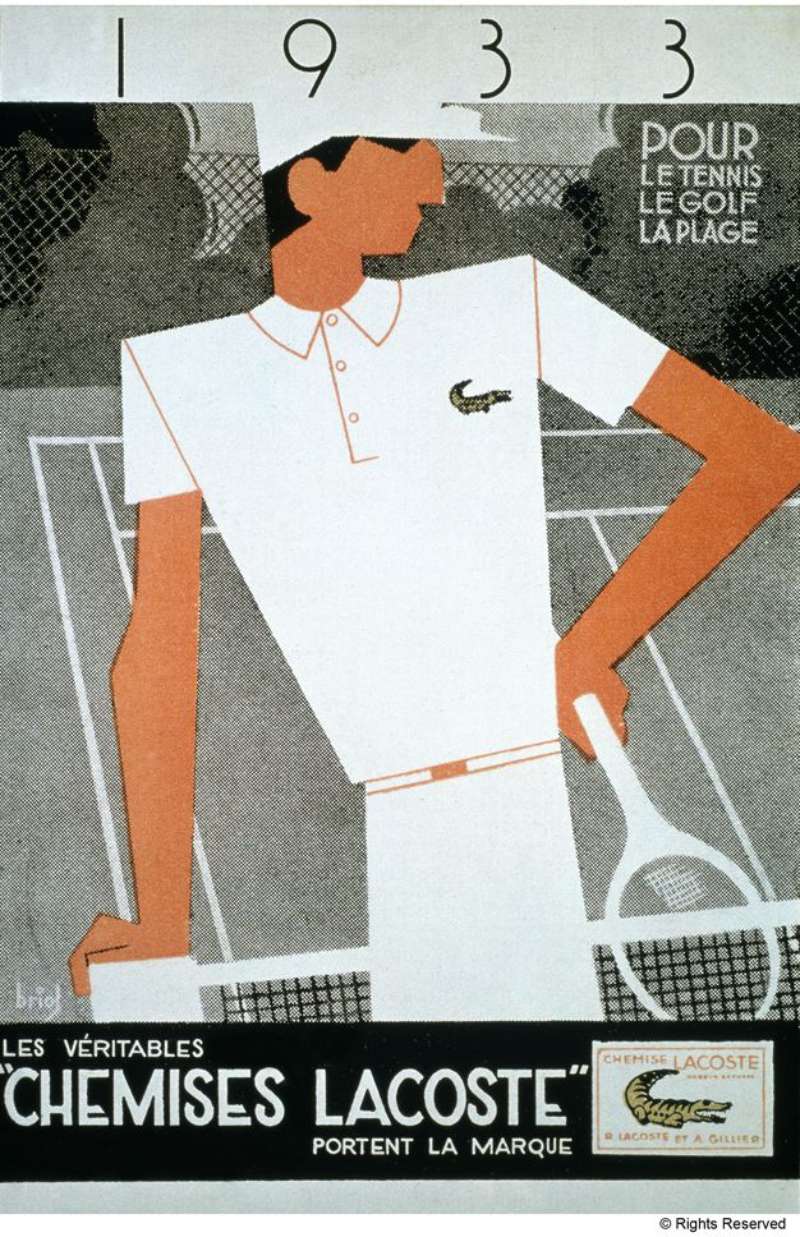
Its first television commercial, “The Big Leap,” aired in 2014. That was 81 years after Rene Lacoste and Andre Gillier founded the company in 1933.
This page covers the campaigns by name, with the agency, year, director and market behind each one, plus the layout, color and typographic decisions holding them together.
Lacoste Advertising at a Glance
Lacoste has advertised in print since the 1930s and on television since 2014, working almost exclusively with BETC Paris. Its best-known campaigns are The Big Leap, Crocodile Inside and Play Big. The visual signature combines flat single-color grounds, the green crocodile at chest height and short French-inflected copy.
| Attribute | Value |
|---|---|
| First major campaign | “Un peu d’air sur terre,” print, from 2006 |
| Lead agencies | BETC Luxe, then BETC Paris (2006 to present) |
| Best-known taglines | “Life is a Beautiful Sport” (2014, revived 2026), “Un peu d’air sur terre” (2006), “Play Big” (2024) |
| Primary media | Print, TV, cinema, billboards, digital, stadium screens at Roland-Garros and Wimbledon |
| Awards | Cannes Lions Film Grand Prix 2021, Cannes Silver Lion 2014, 6 D&AD pencils, 2 Clio golds |
| Visual signature | White or saturated ground, green crocodile emblem, one sans-serif weight, wide tracking |
Which Lacoste Ad Campaigns Are the Most Famous?
Seven campaigns define Lacoste advertising: Un peu d’air sur terre (2006), The Big Leap (2014), Timeless (2017), Save Our Species (2018), Crocodile Inside (2019), Unexpected Encounters (2022) and Play Big (2024). BETC made all seven. Two of them won at Cannes.
| Campaign | Year | Director or photographer | Medium |
|---|---|---|---|
| “Un peu d’air sur terre” | 2006-2012 | Ellen von Unwerth | Print, billboards |
| “The Big Leap” | 2014 | Seb Edwards | TV, cinema, print |
| “Crocodile Inside” | 2019 | Megaforce (Iconoclast) | TV, cinema |
| “Play Big” | 2024 | Willy Vanderperre | Print, film, OOH |
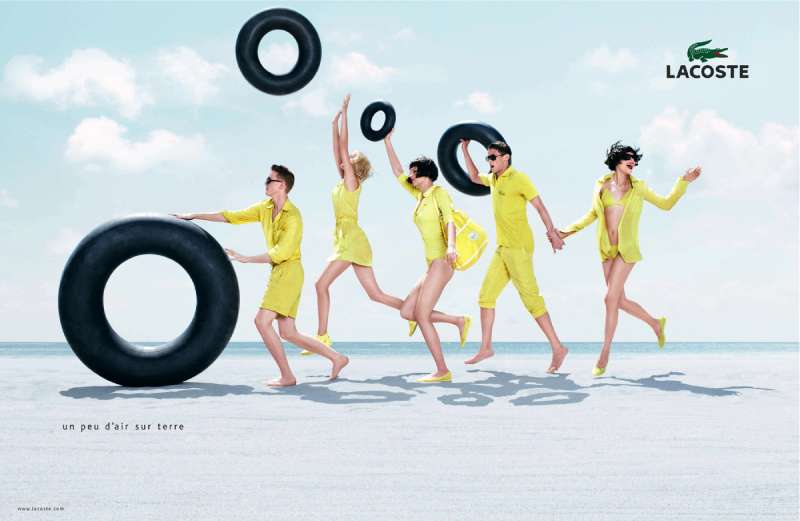
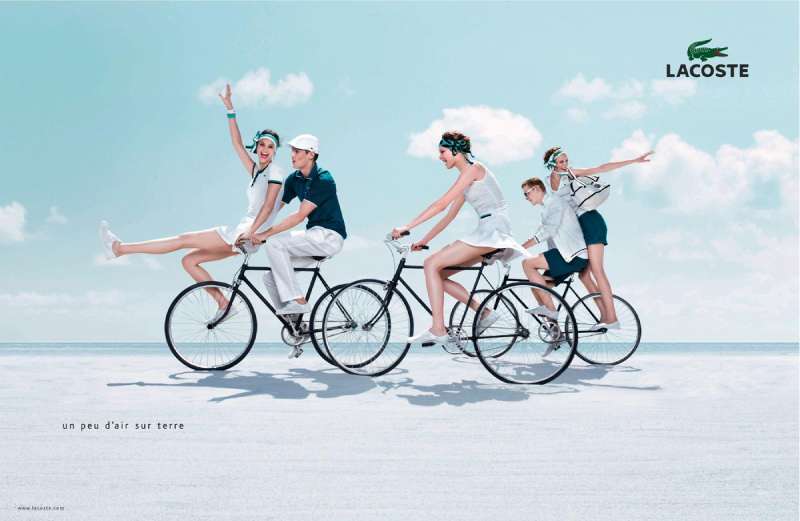
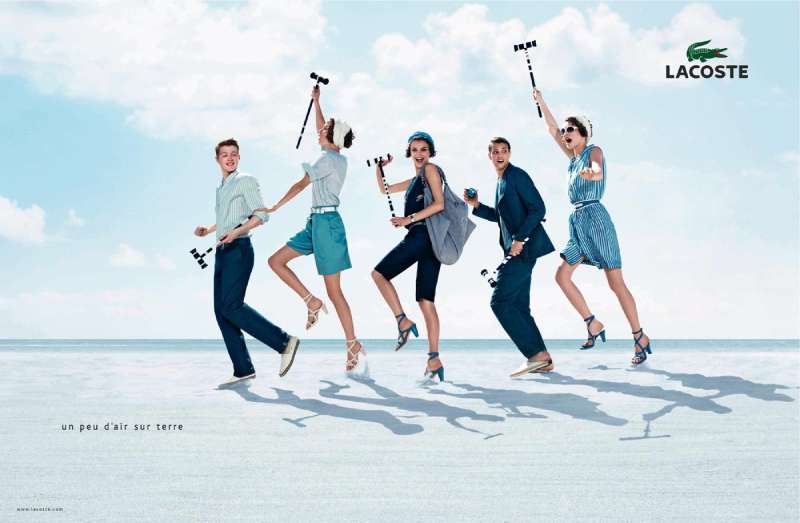
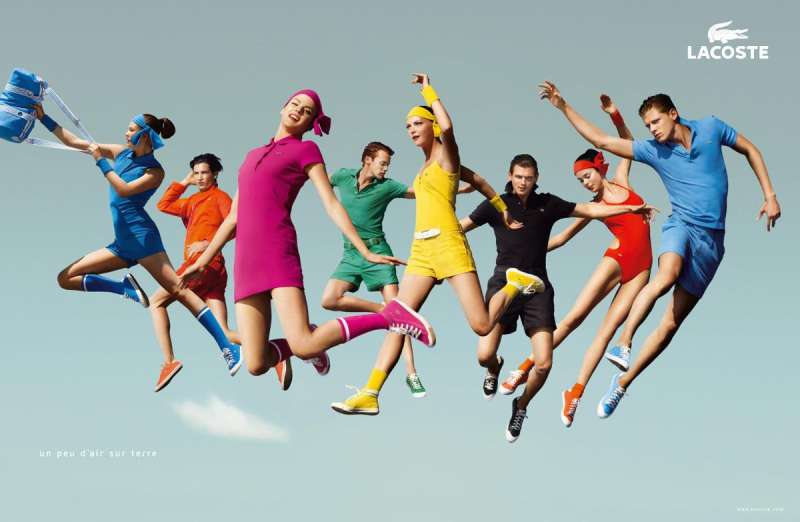
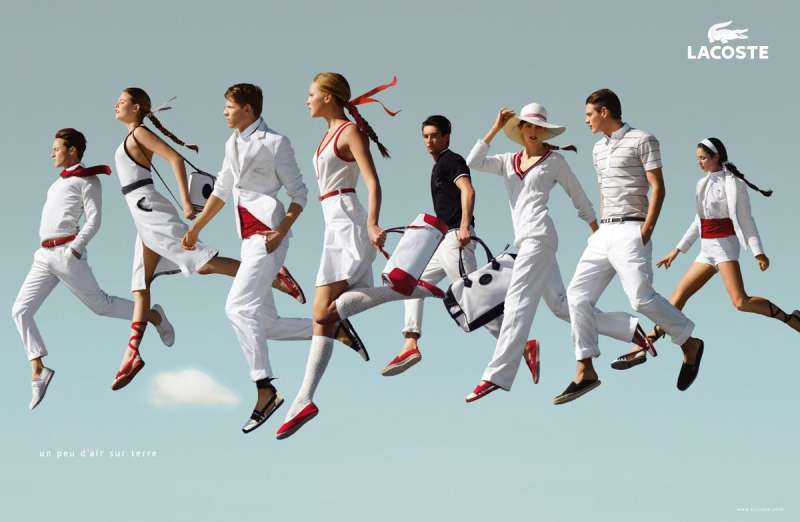
Un peu d’air sur terre (2006-2012)

BETC Luxe created the campaign and Ellen von Unwerth shot it, running across French print and billboards for roughly six years. The tagline translates as “a bit of air on earth.”
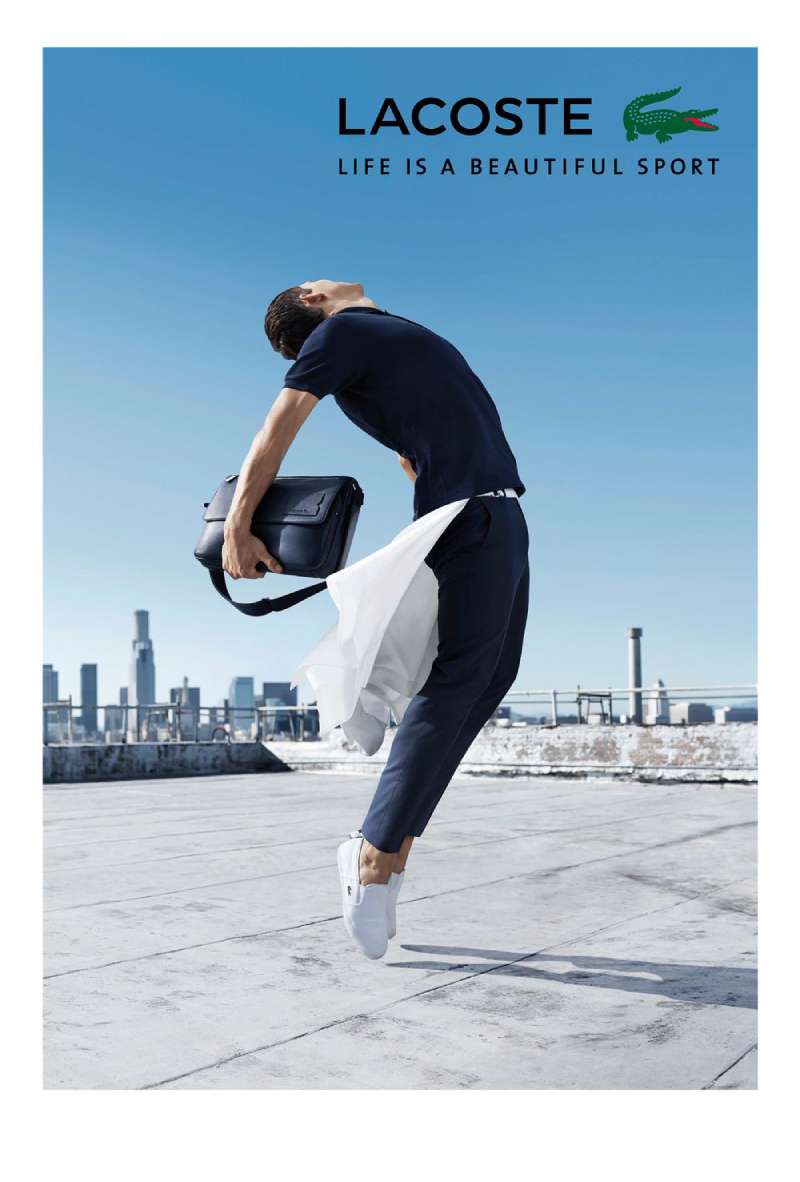
Composition device: every subject is mid-jump, feet off the ground, hair pushed back by an off-camera fan.
The images sit high in the frame with the horizon dropped low, which reads as lift rather than levitation. Compare it to the tighter, waist-up crops Lacoste used after 2020.
The Big Leap (2014)

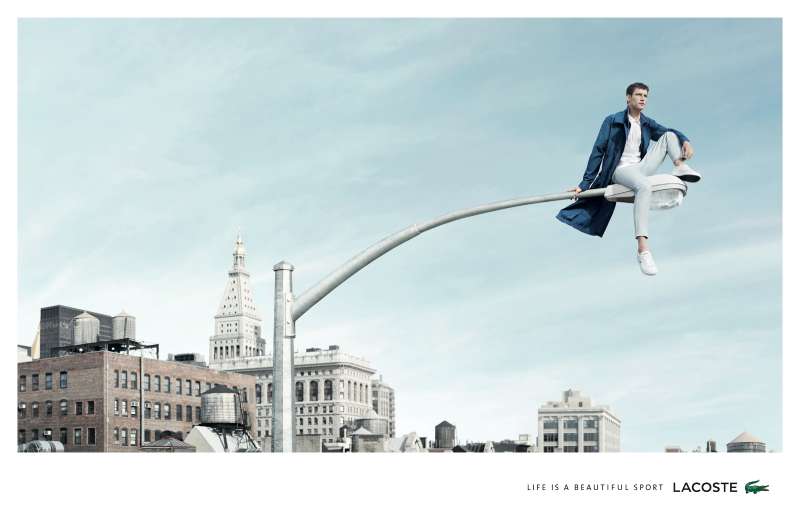
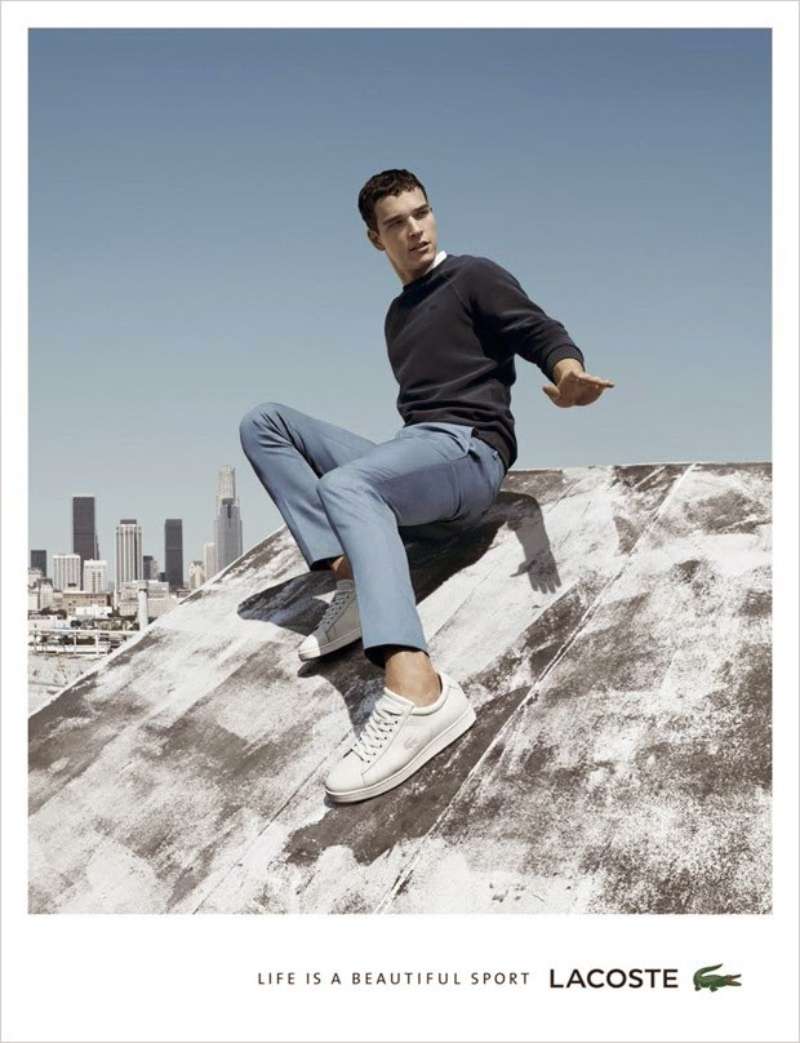
The Big Leap ran globally from February 2014 and introduced the tagline “Life is a Beautiful Sport.” Seb Edwards directed it for BETC Paris. A man leaps off a building at the moment before a first kiss.
Results: over 26 million YouTube views, a Cannes Silver Lion, a One Show Merit Award, and a Top 10 French chart placing for Flume’s remix of “You & Me.”
It was Lacoste’s first TV commercial in 81 years. It also ran in cinema and on the big screens at Roland-Garros, Wimbledon and Flushing Meadows.
Timeless (2017)

BETC Paris built Timeless around a single train journey that carries a couple through eight decades of Lacoste. The print half was shot by London photographer Jacob Sutton.
A second 30-second film, cut in a strictly monochrome palette, staged the founding myth: Rene Lacoste tearing the sleeves off a long shirt, intercut with Novak Djokovic on court.
At the time the brand reported worldwide sales of 2.15 billion dollars across retail in 110 countries.
Save Our Species (2018-2020)

The first logo change in the crocodile’s 85 years. BETC Paris pitched it, and Lacoste replaced the green crocodile with 10 endangered animals on limited polo shirts.
- Print runs matched wild population counts: 30 vaquita, 40 Burmese roofed turtles, 67 Javan rhinos
- 1,775 shirts total, 150 euros each, all proceeds to the IUCN
- Launched at Paris Fashion Week, sold out in 24 hours
Creative director Antoine Choque led the work, which took two Clio golds. In 2019 the crocodile was stripped from 10 flagship stores entirely.
Crocodile Inside (2019-2021)

A couple argue, and their apartment building physically tears apart around them. Megaforce directed through Iconoclast, with cinematography by Bradford Young and Edith Piaf’s “L’hymne a l’amour” over the top.
Oulaya Amamra and Kevin Azais play the couple. Olivier Aumard wrote it, Aurelie Scalabre art directed.
The film took the Cannes Lions Film Grand Prix in 2021, the first Film Grand Prix for a French agency in 30 years, plus a Yellow Pencil and four further pencils at D&AD.
Unexpected Encounters (2022-2023)

Two strangers spot each other wearing the same Lacoste piece. That is the whole idea, repeated across six vignettes, broadcast from 27 April 2022 on billboards, TV and social.
Casting: street casting of non-models, one day each. Photography: Ronan Gallagher, documentary approach, saturated color. Music: The Sugarhill Gang, “Apache.” ECD: Florence Bellisson at BETC.
The 2023 sequel, The Impossible Encounters, marked 90 years of the crocodile and cut between Paris, New York and Seoul. Yoni Lappin directed the films. The paired framing relies on near-mirror symmetry between the two halves of each shot.
Play Big and Play with Icons (2024-2025)
Play Big put an 8-metre crocodile sculpture, built largely from mesh, cotton pique and knitwear, at the center of the frame. Willy Vanderperre shot it, artists Imruh Asha and Ibby Njoya handled color and form, and Antonio Sanchez composed the score.
Play with Icons followed in May 2025, shot by American photographer Tyler Mitchell across print, TV, digital and flagship windows.
The five pairings: Novak Djokovic in a golden tennis-net cape, Venus Williams with the pleated skirt, Wang Yibo with polos rebuilt as flowers, Pierre Niney and Adele Exarchopoulos with the Lenglen bag.
Both campaigns lean hard on the gap between scale and proportion: the product stays life-size while the emblem grows absurd.
How Do Lacoste Print Ads Work Visually?
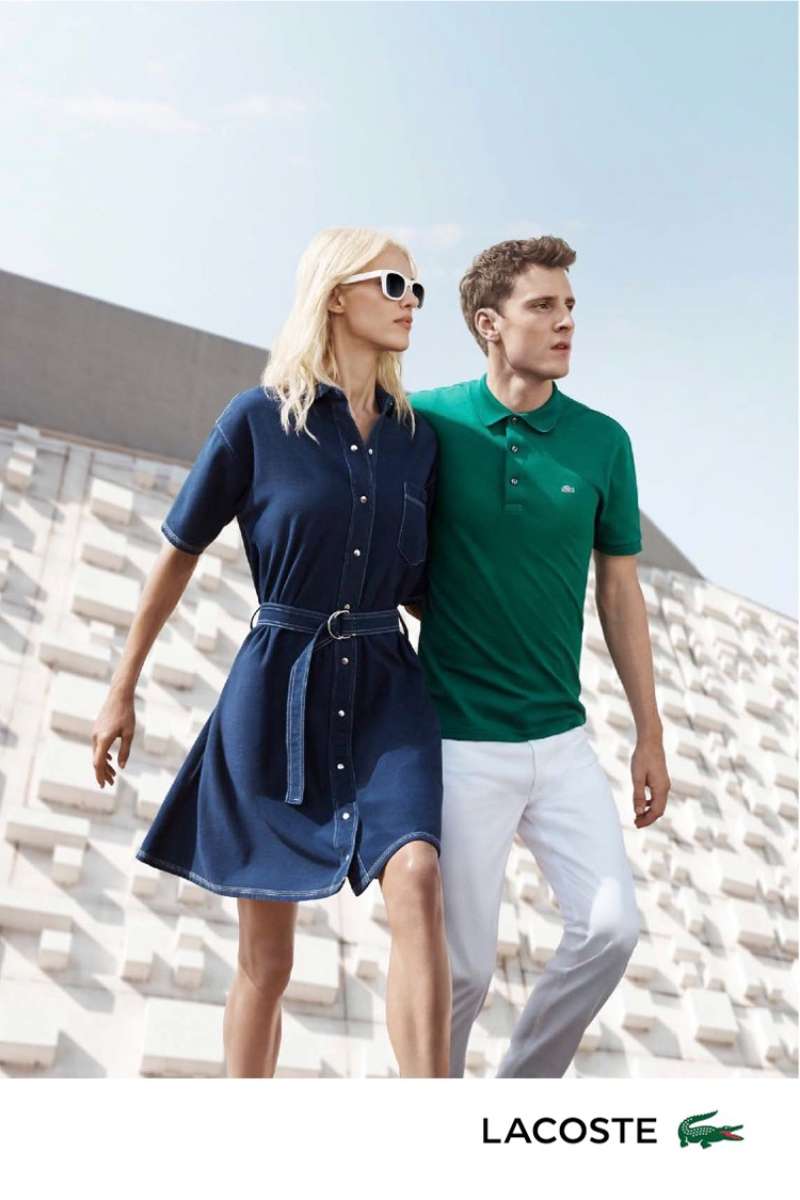
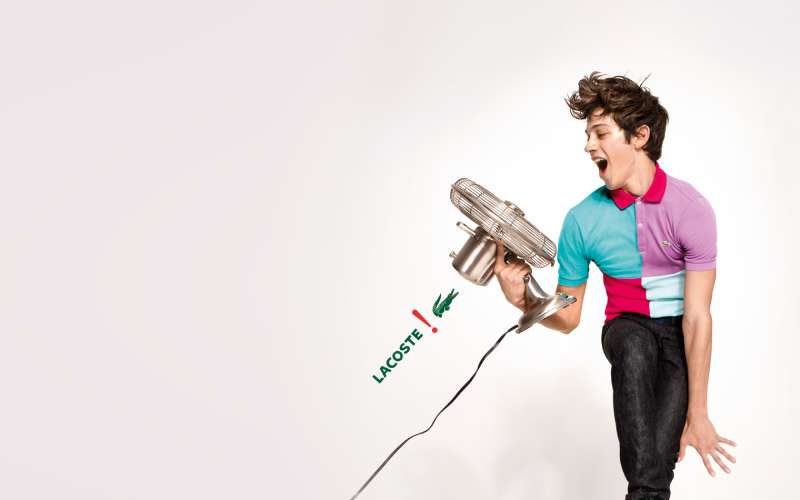
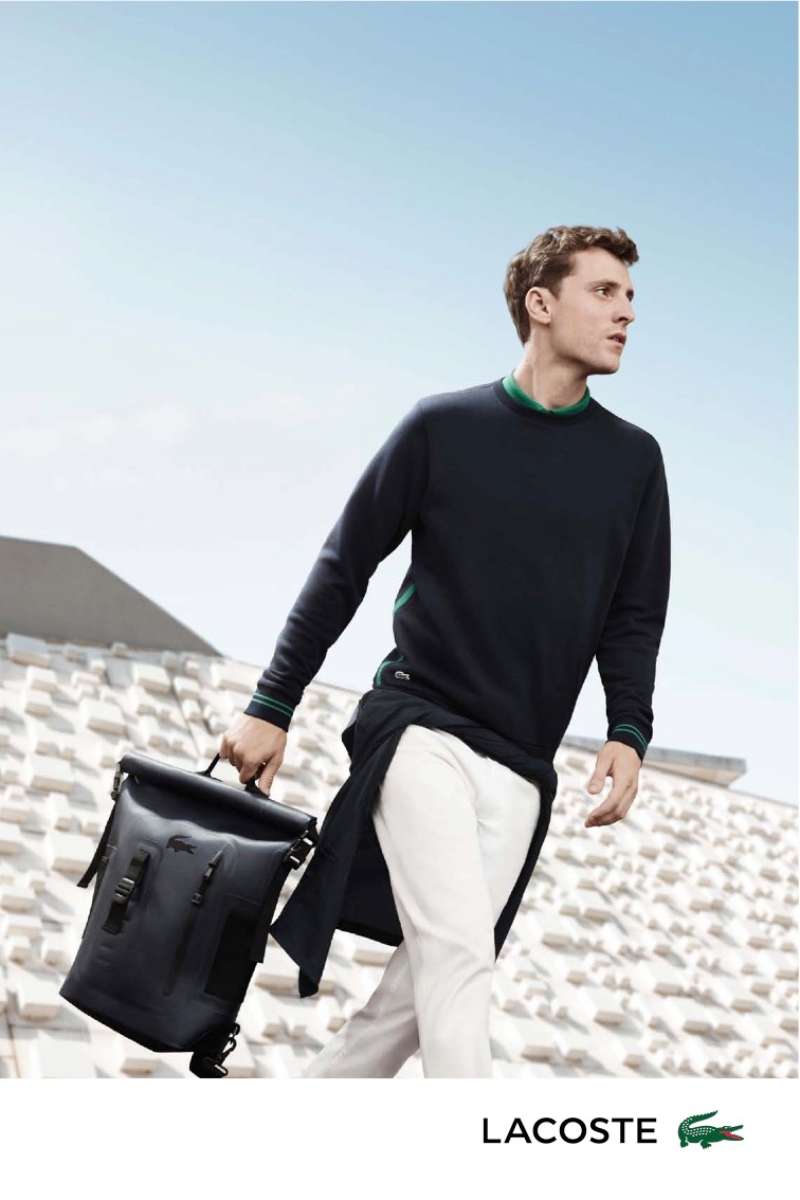
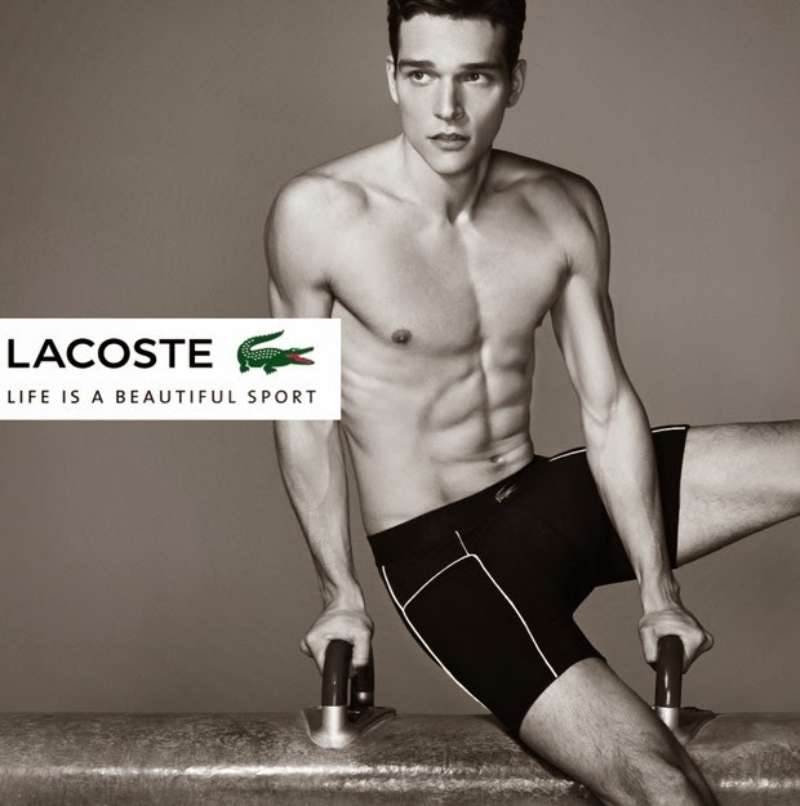
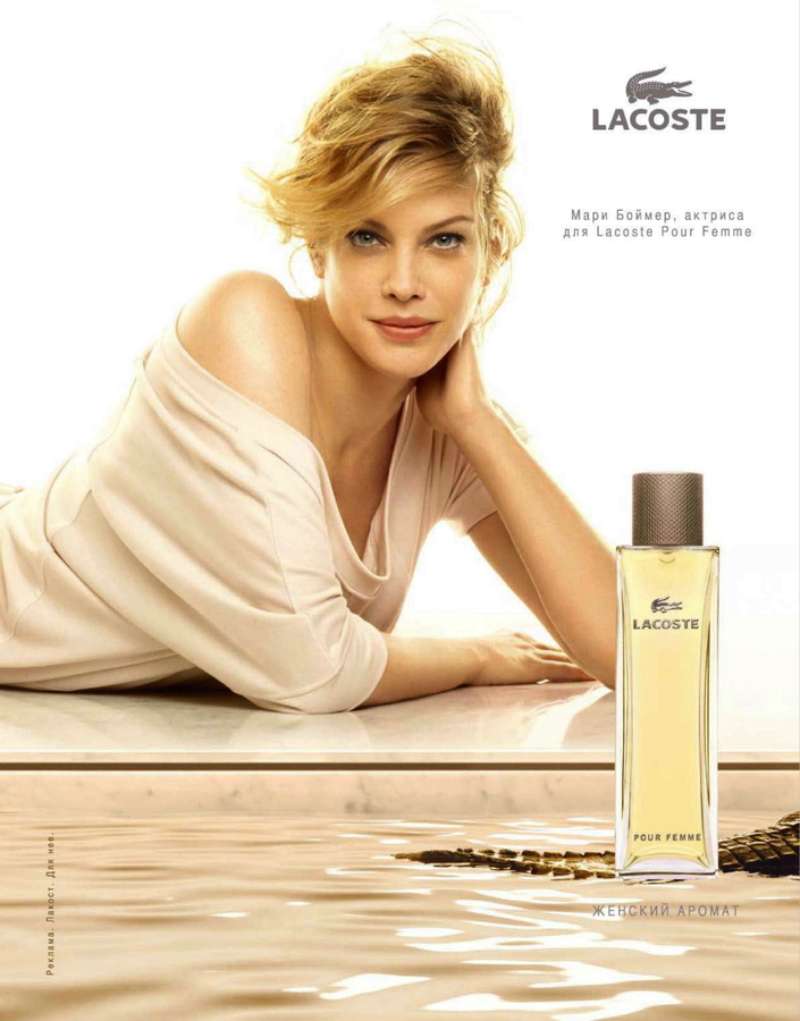
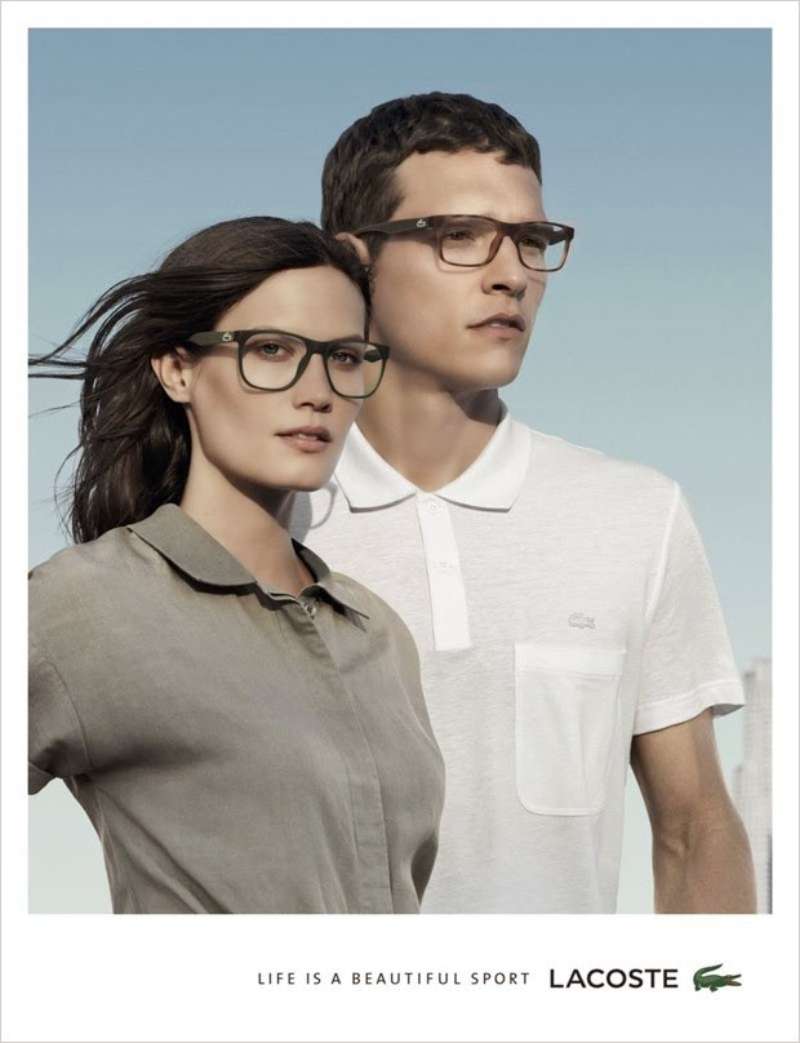
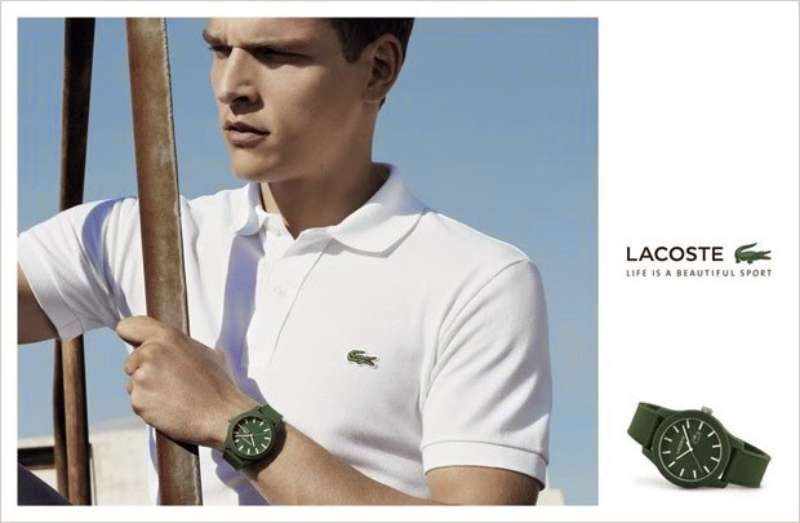
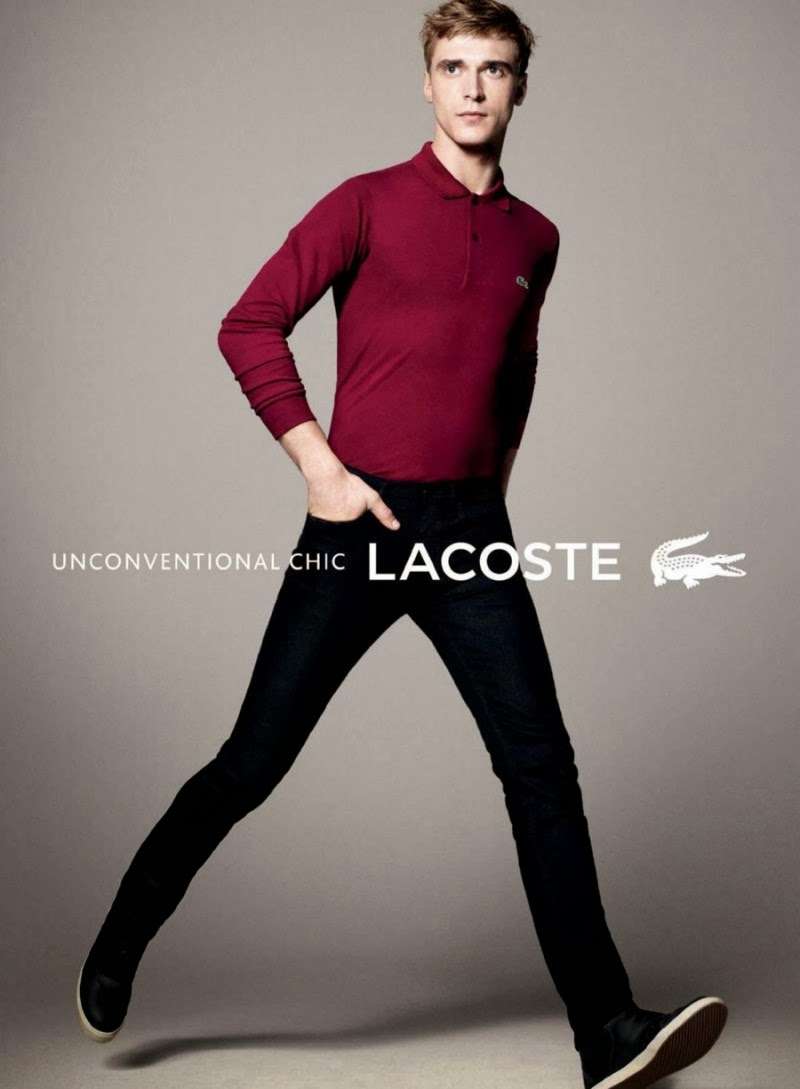
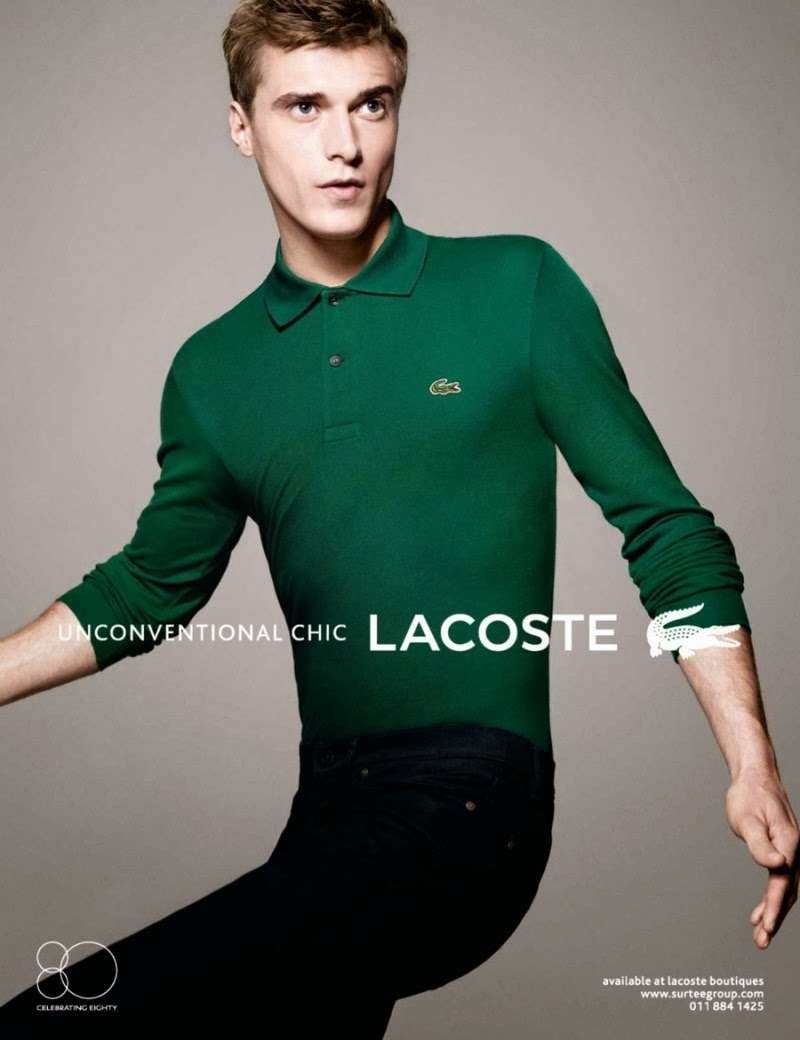
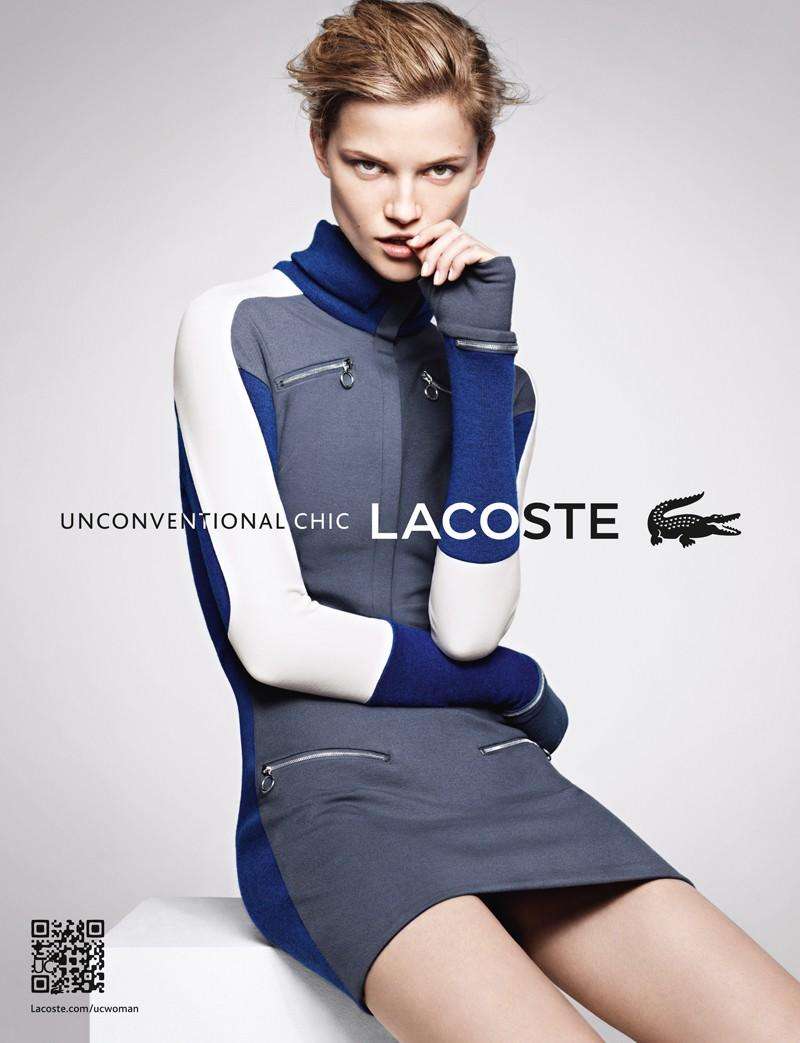
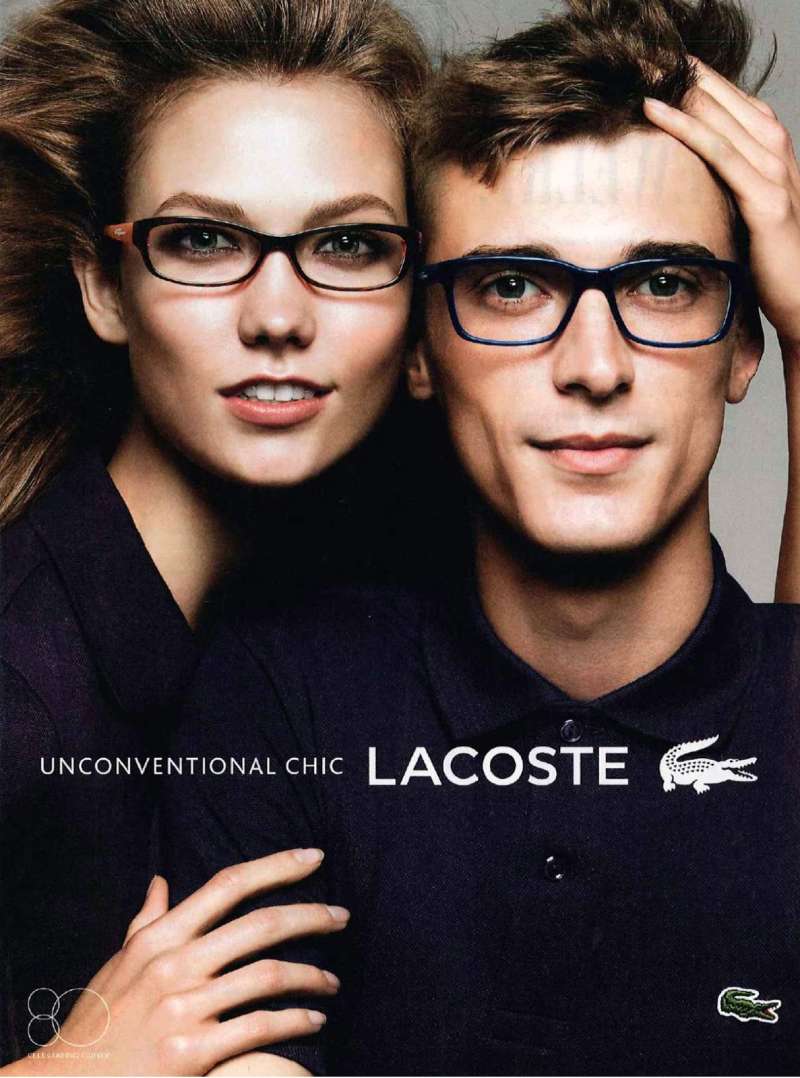
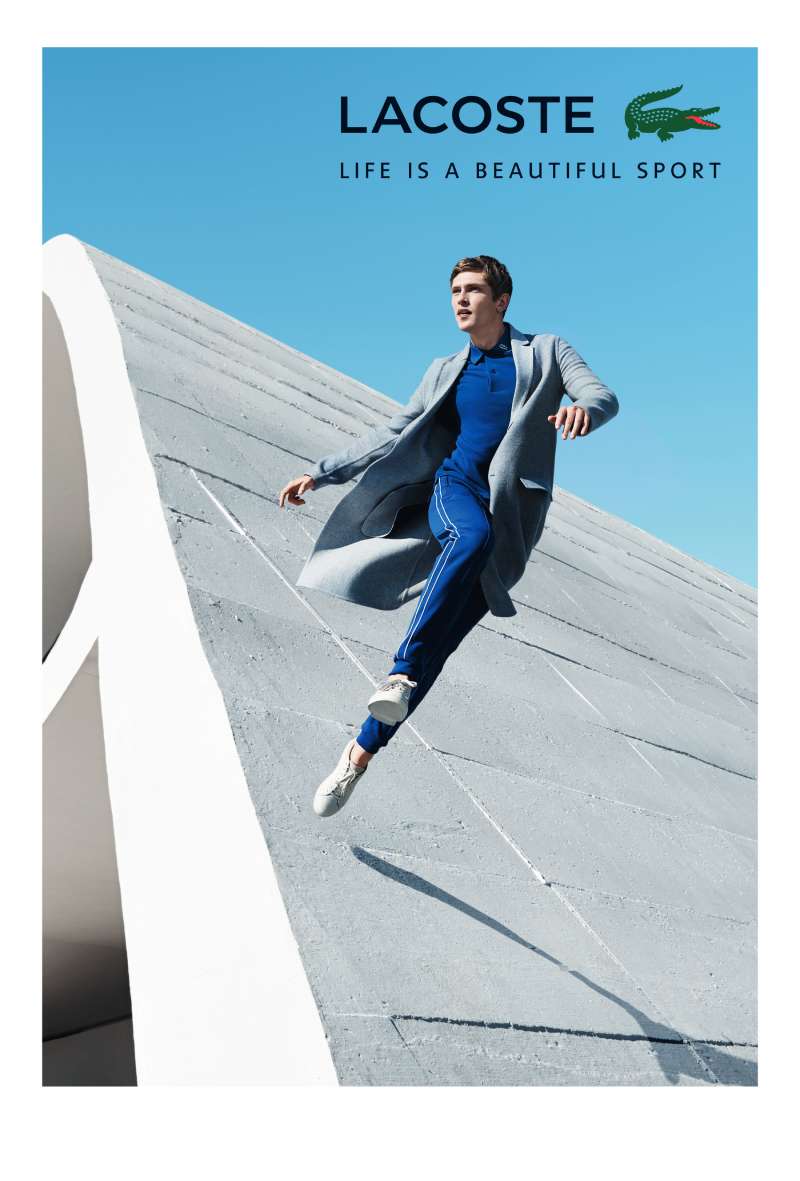
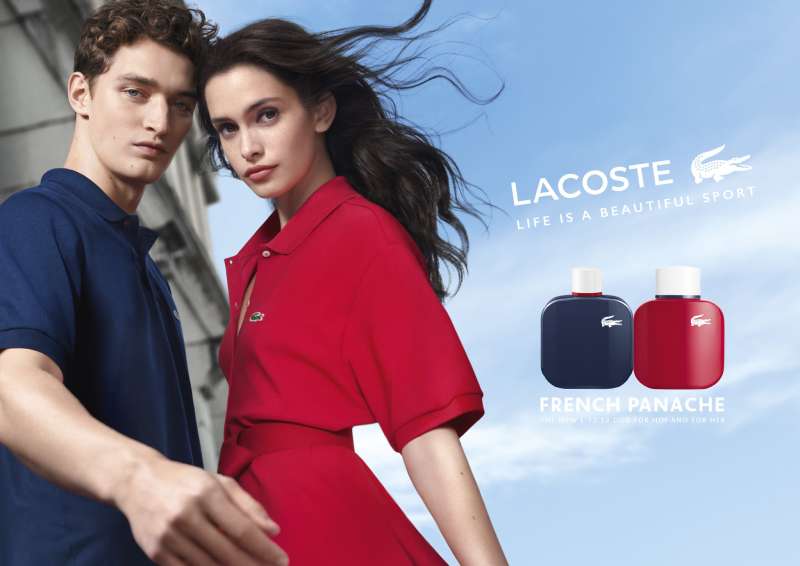
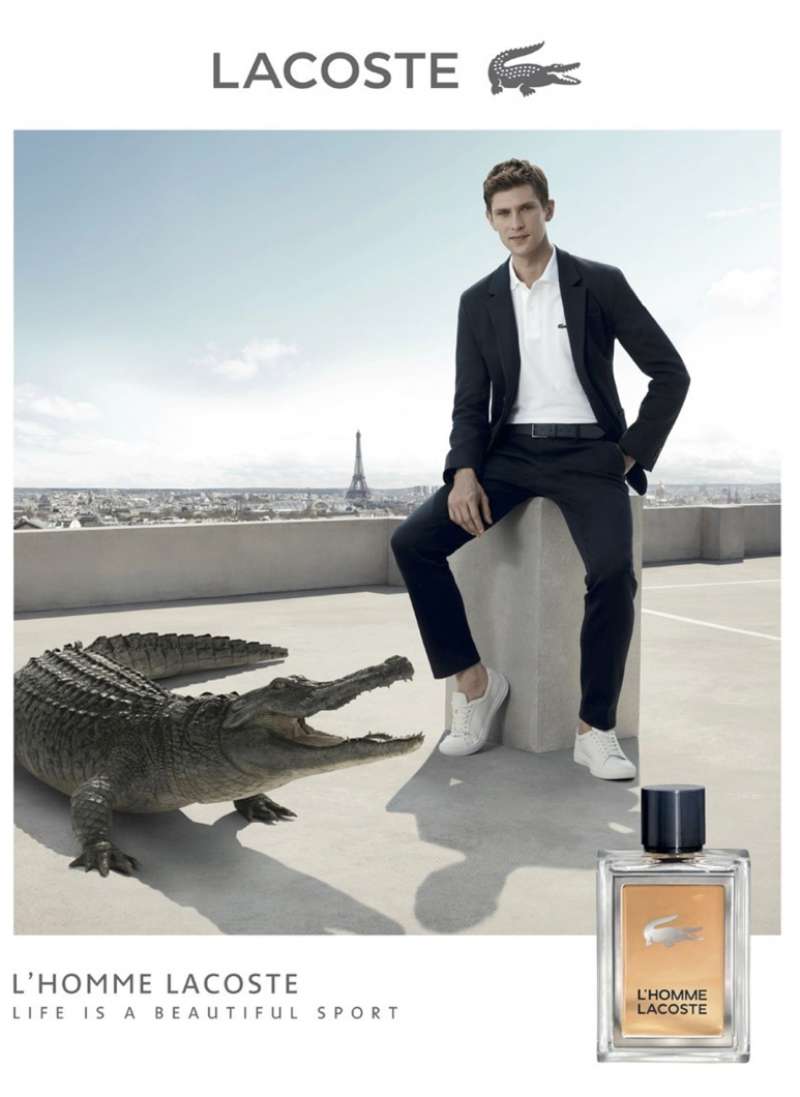
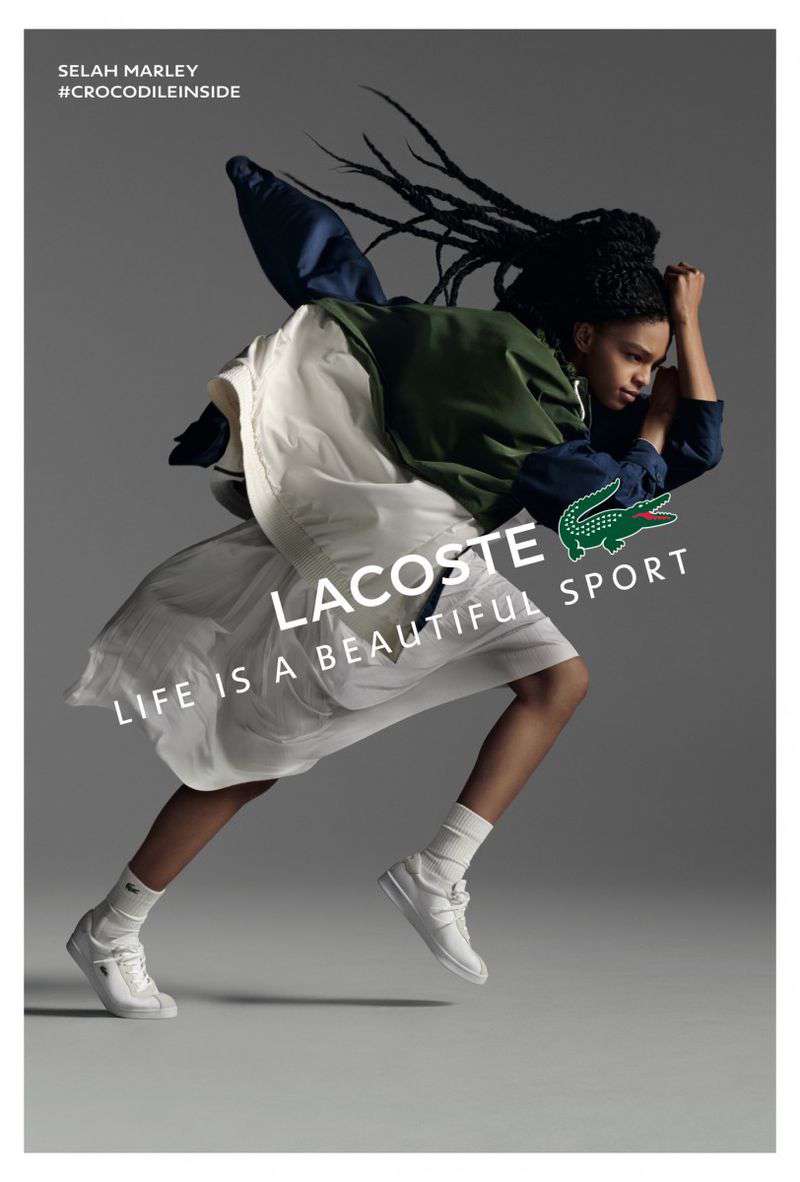
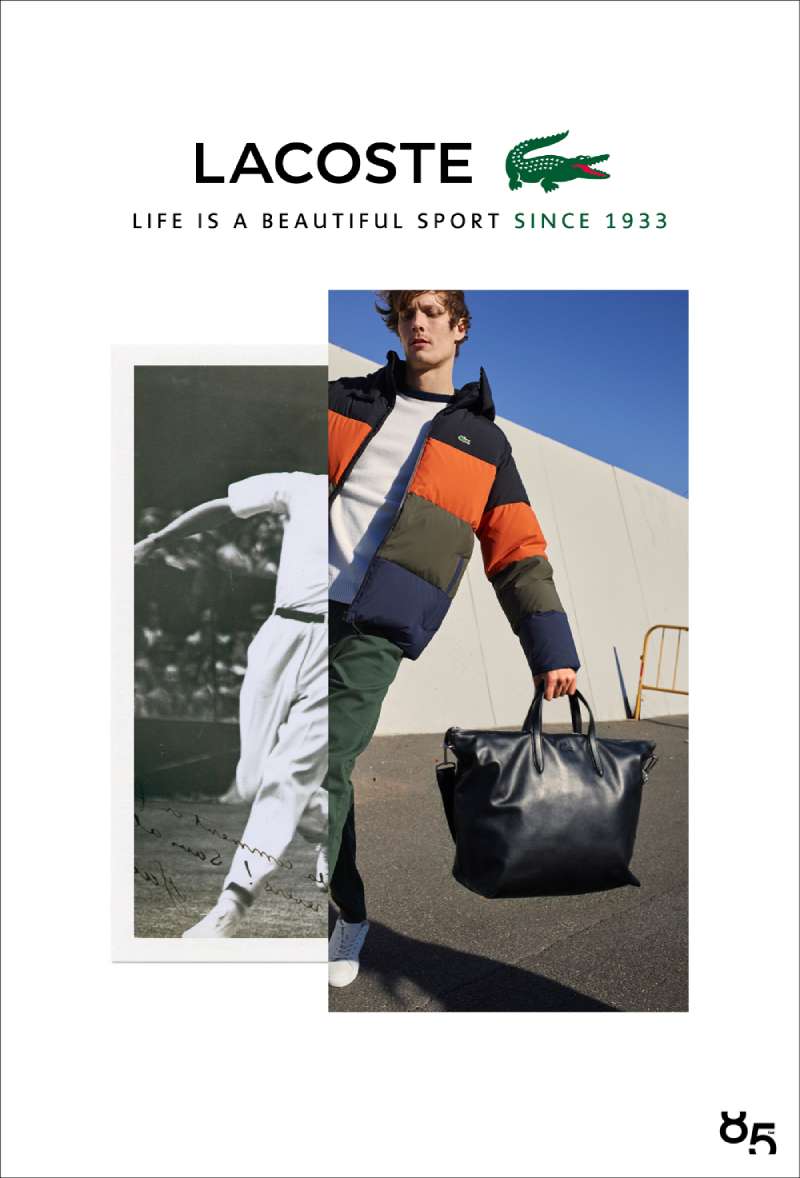
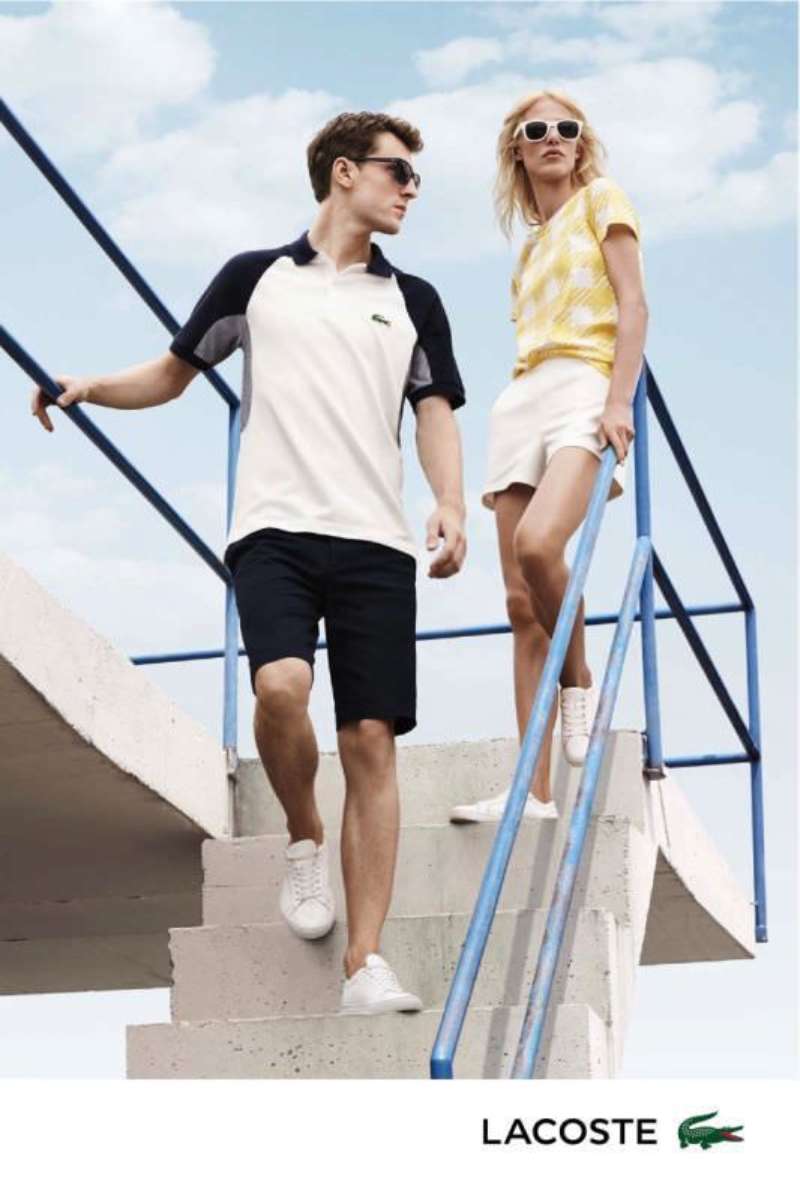
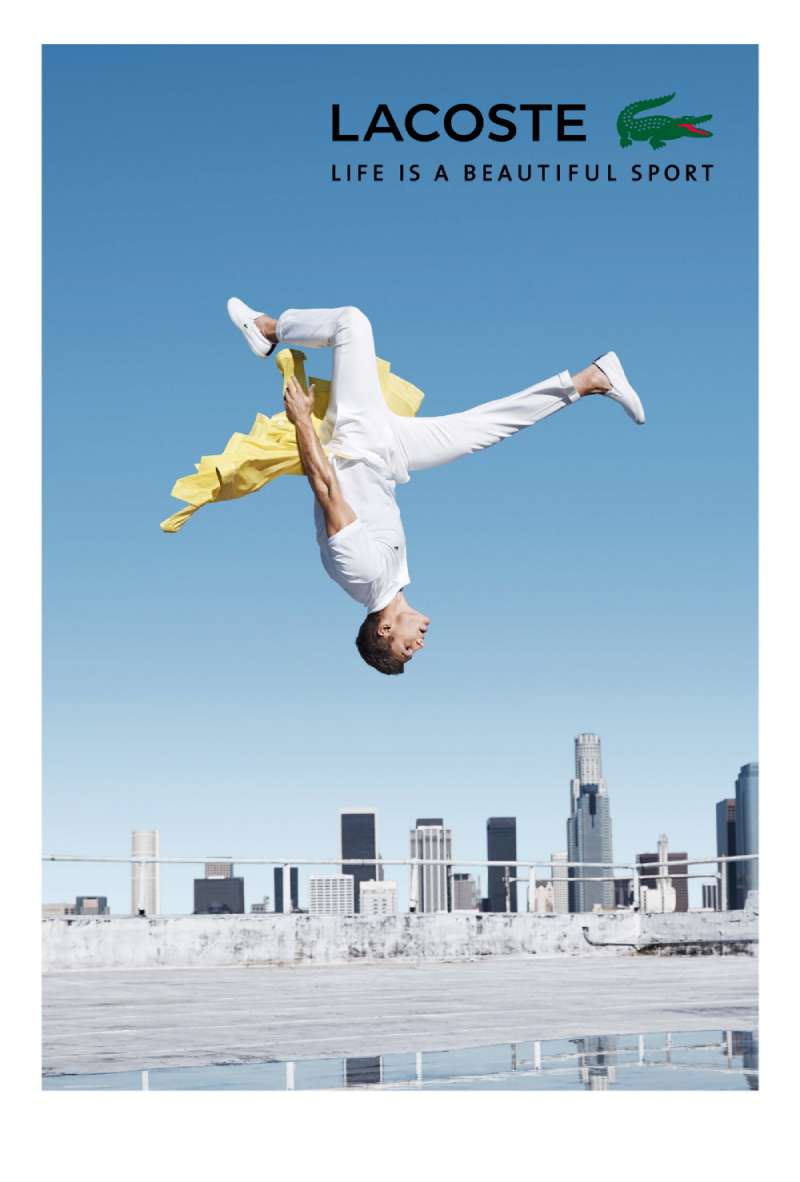
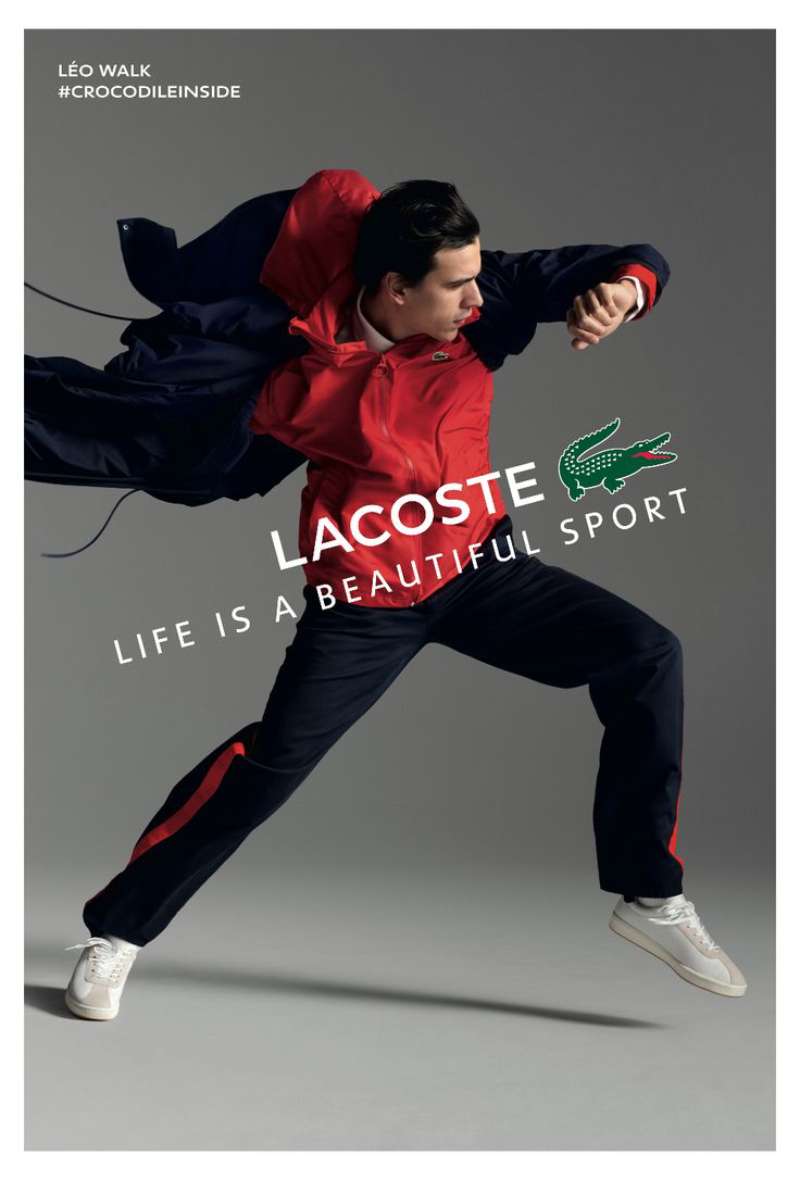
Lacoste print ads use a single flat ground, one human subject, and the crocodile placed at chest height as the reading anchor. Copy is minimal, set in one sans-serif weight. The green mark is the only element permitted to break the palette.
The visual hierarchy is unusually shallow. Garment first, face second, emblem third, wordmark last, and there is rarely a fourth level to read.
Palette: since 2022 the campaigns have run on saturated single-color grounds (pink, ochre, cobalt) rather than the studio white of the 2000s work.
Green against those grounds does most of the work. Color psychology aside, the practical reason is reproduction: a brand green that has to survive newsprint, backlit OOH and embroidery gets locked to a spot reference, which is where the Pantone system earns its keep.
Type: the Lacoste wordmark is a wide-tracked sans-serif set in caps, and the taglines match it. No italics, no second weight, no display face.
That restraint is why the tracking has to be right. At the sizes used on billboards, tight letter spacing turns the wordmark into a smudge from 40 metres.
Generous white space around the subject is the other constant. Most fashion print design fills the page; Lacoste consistently under-fills it.
Where the eye lands: the crocodile sits roughly at the upper-left third intersection in the majority of the 2014-2019 layouts, which is textbook rule of thirds placement dressed up as product photography.
How Do Lacoste TV Commercials Differ From Its Print Ads?
Lacoste TV commercials are built on one physical event, not on product. Print sells the garment; film sells a gesture. Every major spot since 2014 has one irreversible action at its center: a leap, a collapse, a run.
The Big Leap (2014, BETC Paris, dir. Seb Edwards). A man climbs a building and jumps into open air, cut to a first kiss. The product appears for maybe four seconds. It is the closest the brand has come to pure storytelling with no product argument at all.
Crocodile Inside (2019, BETC Paris, dir. Megaforce). An argument physically demolishes a Paris apartment block. Bradford Young shot it. The camera moves almost continuously, and the whole film is an exercise in movement as an emotional signal rather than a stylistic one.
Life is a Beautiful Sport (2026, BETC Paris). A young woman runs a continuous route through Paris, from gardens to the Opera to Roland-Garros, saying “Pardon” at every near-collision, scored to Paris Latino. Djokovic appears at the reveal.
Nicolas Lautier, executive creative director at BETC Paris, described the intent as returning to Rene Lacoste’s own act of tearing off his sleeves. He called it a French “sorry not sorry.”
The 2026 campaign runs globally across film, print, digital and social, with extended presence at the 2026 French Open.
How Has Lacoste Advertising Evolved Since 1933?
Lacoste advertising moved through 4 clear phases: product-led press through the 1970s, BCBG positioning in the 1980s and 1990s, BETC-authored lifestyle print from 2006, and award-driven brand film from 2014 onward. The tagline changed 3 times across that span.
| Decade | Strategic shift | Representative work |
|---|---|---|
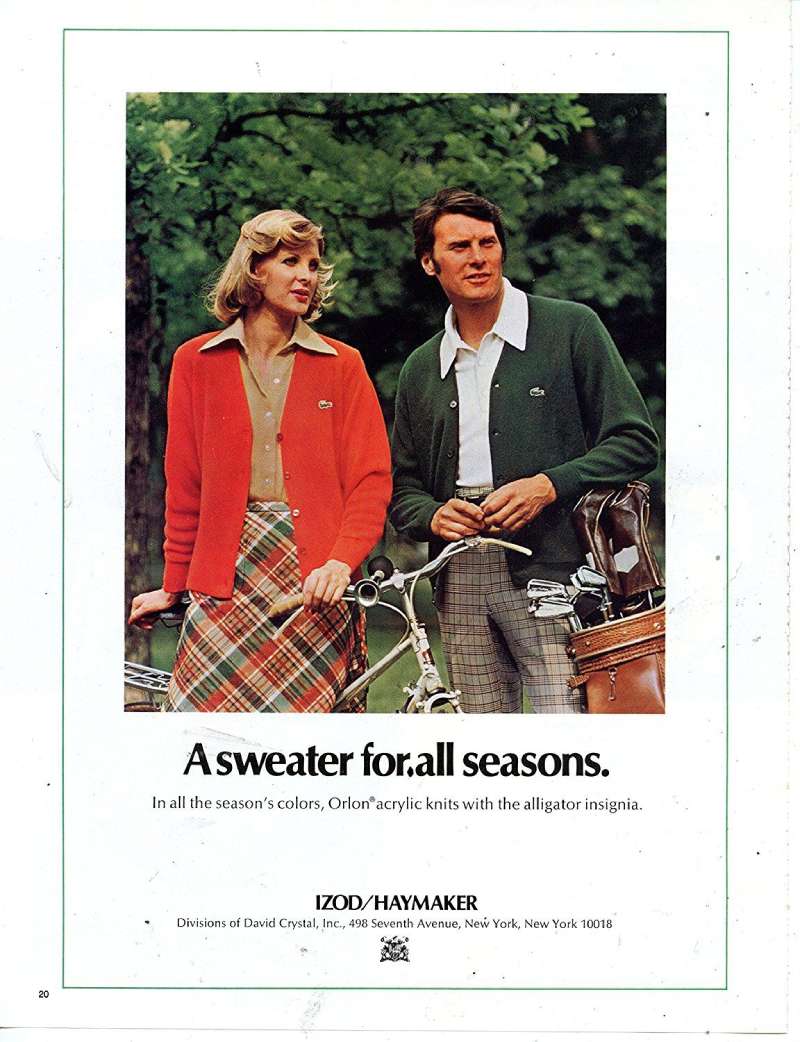
| 1930s-1970s | Product and provenance, tennis press | Crocodile emblem as proof of authenticity |
| 1980s-1990s | Bourgeois French positioning, ageing audience | Static studio print, no film |
| 2000s | Lightness and youth, BETC Luxe arrives | “Un peu d’air sur terre” (2006) |
| 2010s | First TV, emotion over product | “The Big Leap” (2014), “Crocodile Inside” (2019) |
| 2020s | Community, subculture, art direction as subject | “Unexpected Encounters” (2022), “Play Big” (2024) |
The 2010s reset had a commercial reason behind it. BETC’s own brief noted the brand was reading as classic to the point of bourgeois and struggling with a younger audience.
It worked. Lacoste sales grew from 1 billion euros in 2015 to roughly 2.9 billion euros in 2024, an 8 percent rise year on year, with polo shirts falling to 20 percent of revenue from over a third.
Which Agencies Created Lacoste Advertising?
BETC created every major Lacoste campaign since 2006. BETC Luxe produced the print era, BETC Paris produced the film era, and BETC sits inside Havas Group. No other agency has held the global account in that period.
BETC Luxe created Un peu d’air sur terre for Lacoste in 2006 and commissioned Ellen von Unwerth to shoot it.
BETC Paris created The Big Leap for Lacoste in 2014 under chief creative officer Remi Babinet, who co-founded the agency in 1995 with Mercedes Erra and Eric Tong Cuong.
Antoine Choque directed the creative on Save Our Species in 2018. Florence Bellisson served as executive creative director on Unexpected Encounters in 2022. Nicolas Lautier holds the executive creative director role on the 2026 work.
Production partners: Iconoclast produced Crocodile Inside with Megaforce directing; Time Based Arts handled post.
Bertille Toledano, president of BETC, has run the Lacoste account relationship on the agency side across multiple campaigns. That continuity is why the visual identity reads as one body of work rather than a sequence of pitches.
It also explains the discipline in the brand typography. Twenty years, one agency, one type treatment.
What Can Designers Learn From Lacoste Ads?
Lacoste ads teach 6 transferable rules, all of them about restriction rather than invention. The brand has run the same emblem, the same type treatment and the same compositional logic for two decades and kept winning with it.
- Anchor the emblem at chest height and let the garment carry the rest of the frame
- Limit the palette to one saturated ground plus the brand green, nothing else
- Set the tagline in a single weight at wide tracking, and resist adding a second face
- Cast for texture over fame when the story needs to feel observed rather than staged
- Build the film around one physical action that cannot be undone
- Keep a signature line for a decade before rewriting it, the way “Life is a Beautiful Sport” survived from 2014 to 2026
The crocodile itself is the clearest lesson in what makes a good logo: it survived being removed from the shirt entirely in 2018 and the brand still read as Lacoste.
Worth noting the trade-off. This system produces consistency, not surprise, and there are years of Lacoste print that look almost interchangeable.
How Do Lacoste Ads Compare to Ralph Lauren Ads?
Lacoste ads are agency-authored, campaign-led and built around one emblem. Ralph Lauren ads are photographer-led, seasonal and built around place. Lacoste holds a tagline for a decade; Ralph Lauren rarely uses one at all.
| Dimension | Lacoste | Ralph Lauren |
|---|---|---|
| Creative authorship | BETC Paris, single agency since 2006 | In-house, Ralph Lauren as chief creative officer |
| Campaign rhythm | One global brand campaign per year | Seasonal, spring and fall |
| Recurring device | Crocodile as the subject | Location as the subject |
| Tennis link | Founder was a player | Official outfitter, Wimbledon and US Open |
The Fall 2024 Polo campaign, “Ralph’s New York,” was shot by Lachlan Bailey against the Empire State Building and Central Park. Compare that to Play Big, where the backdrop is a studio and the only landmark is an 8-metre crocodile.
Scale gap: Ralph Lauren Corporation passed 8 billion dollars in revenue for the first time in fiscal 2026, against roughly 2.9 billion euros for Lacoste in 2024.
Lacoste spends less and wins more metal. That is a fair summary of the last ten years.
Readers comparing sportswear print work will find a different logic again in Puma ads, which lead with athletes and typography rather than a single mark, and in Calvin Klein ads, where the wordmark itself does the work the crocodile does here. For the full comparison set, see the Ralph Lauren ads archive.
What Makes Lacoste Advertising Work?
Lacoste advertising works because the constraints never move. One agency, one emblem, one type treatment, one signature line held from 2014 to 2026.
That consistency buys freedom elsewhere. A brand this locked down at the identity level can afford to demolish an apartment block on film or hand the polo to ten endangered animals, because the audience never loses the thread.
The other lesson is patience with a tagline. Most brands rewrite theirs every three years and wonder why nothing sticks.
The practical takeaway for designers: decide what cannot change, write it down in the brand guidelines, then spend the creative budget on everything that can.
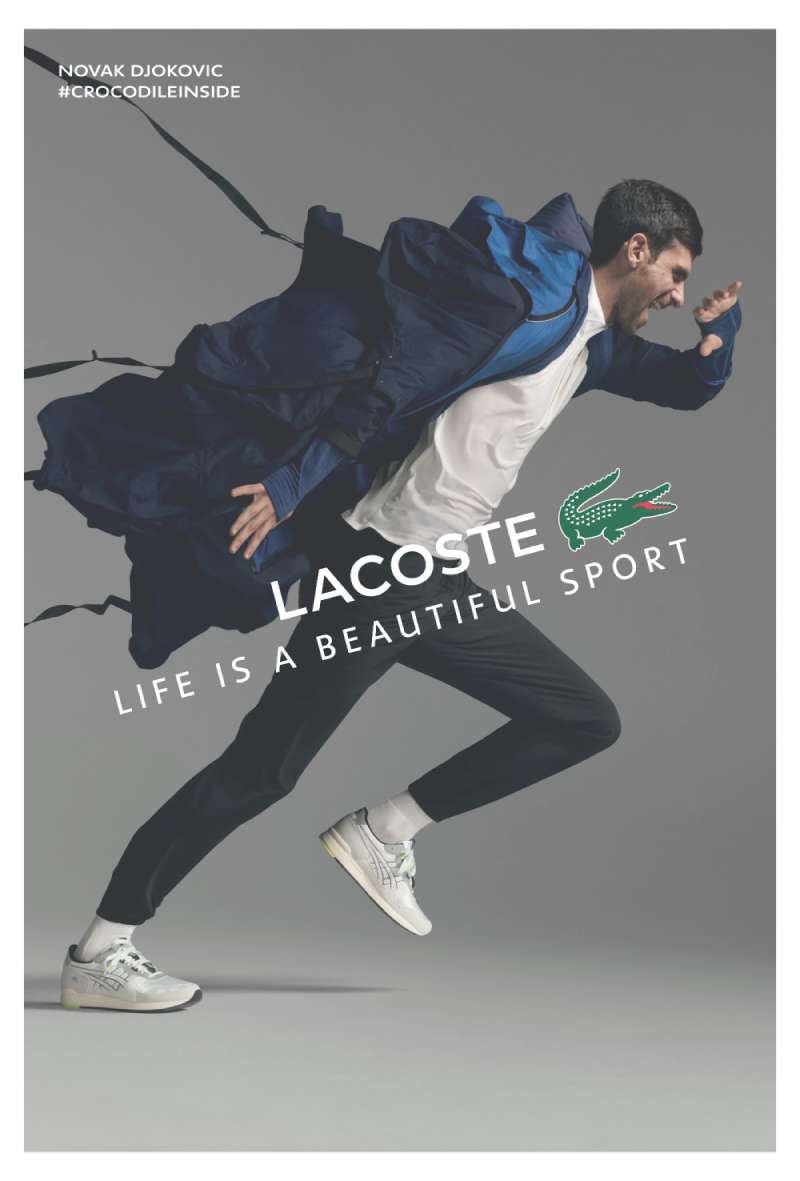
Lacoste Ads Examples
FAQ on Lacoste Ads
Why does a crocodile appear in every Lacoste ad?
Rene Lacoste was nicknamed the Crocodile for his tenacity on court. The emblem has sat on the polo since 1933, which is why the psychology behind the logo reads as character rather than decoration.
When did Lacoste air its first TV commercial?
February 2014, with The Big Leap. The brand had run print for eight decades before that, so its first spot arrived 81 years after founding. It launched during the Sochi Winter Olympics in France.
Which Lacoste ad has won the most awards?
Crocodile Inside. It took the Cannes Lions Film Grand Prix plus one Gold, two Silver and one Bronze in Film Craft, then five pencils at D&AD including a Yellow Pencil for production design.
What is Lacoste’s current tagline?
“Life is a Beautiful Sport.” BETC Paris introduced it in 2014, retired it for roughly a decade of other lines, then brought it back for the April 2026 global campaign.
Which directors have made Lacoste commercials?
Four names cover most of the film work: Seb Edwards on The Big Leap, the collective Megaforce on Crocodile Inside, Laure Atanasyan on the Unexpected Encounters videos, and Yoni Lappin on the 90th anniversary films.
Which photographers have shot Lacoste print campaigns?
Ellen von Unwerth shot Un peu d’air sur terre, Jacob Sutton shot Timeless, Ronan Gallagher shot 2022 and 2023, Willy Vanderperre shot Play Big, and Tyler Mitchell shot Play with Icons.
How many polo shirts did the Save Our Species campaign produce?
1,775 in total. Each of the ten runs matched the wild population of its species, from 30 vaquita shirts to 450 for the Anegada ground iguana. They sold at 150 euros each.
Who founded BETC, the agency behind Lacoste advertising?
Remi Babinet, Mercedes Erra and Eric Tong Cuong founded BETC in Paris in 1995. Tong Cuong left in 2002. Bertille Toledano now serves as president and has run the Lacoste relationship.
Did the advertising reset actually move Lacoste sales?
Yes. Revenue grew from 1 billion euros in 2015 to roughly 2.9 billion in 2024, up 8 percent year on year, while polo shirts dropped to 20 percent of total sales.
What does the 2026 Lacoste campaign show?
A young woman runs a continuous route through Paris, from gardens to the Opera, saying “Pardon” at each near-collision before arriving at Roland-Garros with Novak Djokovic. Wang Yibo features in the print half.
Conclusion
The value in studying Lacoste ads is not the crocodile. It is watching a French sportswear brand hold one set of rules across print advertising, billboards, cinema and campaign film without loosening them once.
Tennis heritage gave the work its subject. Roland-Garros gave it a stage. Megaforce, Iconoclast and Willy Vanderperre gave it craft.
What survives across all of it is the art direction: a saturated ground, generous negative space, one weight of type, the emblem at chest height.
That restraint is closer to minimalist design than to fashion advertising, and it is the reason a 93-year-old polo shirt still reads as current.
Steal the discipline. The crocodile is already taken.

Renowned for his expertise in logo design and visual branding, Bogdan has developed a multitude of logos for various clients.
His skills extend to creating posters, vector illustrations, business cards, and brochures. Additionally, Bogdan's UI kits were featured on marketplaces like Visual Hierarchy and UI8.
He also wrote in the past years on sites like Design Your Way, WebDesignerDepot, WPDean, Designmodo, Speckyboy, Slider Revolution, and more.
- The Windsurf Logo History, Colors, Font, And Meaning - 10 October 2026
- How to Remove Background From Product Photos (No Photoshop) - 10 October 2026
- How Designers can Build a Stronger Online Creative Identity - 9 October 2026

Bogdan Sandu is a seasoned designer who has been designing websites since 2008. Renowned for his expertise in logo design and visual branding, Bogdan has developed a multitude of logos for various clients. His skills extend to creating posters, vector illustrations, business cards, and brochures. Additionally, Bogdan's UI kits were featured on marketplaces like Visual Hierarchy and UI8. He also wrote in the past years on sites like Design Your Way, WebDesignerDepot, WPDean, Designmodo, Speckyboy, Slider Revolution, and more.
You Might Also Like