One tagline has carried Vans ads since 1976, and nobody has redrawn it since.
The archive runs from photocopied skate magazine pages to global brand films, through Warped Tour posters, checkerboard slip-on print work and out of home campaigns built by Anomaly and Fbiz.
Most collections of Vans advertising just stack images. This one labels them.
Here is what you get, campaign by campaign:
- The year, agency, market and medium behind each piece
- The layout and typography decisions that make the print work read fast
- How the TV commercials differ from the print ads, and why
- A decade-by-decade timeline from Anaheim in 1966 to the current reset
Designers leave with transferable rules. Not just a scroll of sneaker photography.
Vans advertising spans 60 years, one tagline and 7 named campaigns, from the first Off The Wall skate print ads in 1976 to Always Pushing in 2024. The work runs on documentary photography of real skateboarders, a two-color palette plus black, and a checkerboard pattern that carries recognition without the wordmark.
This page covers the campaigns by name, with the agency, year and market behind each one, plus the layout, type and color decisions that make them read at a glance.
Vans Advertising at a Glance
Vans has advertised since 1966 and adopted the Off The Wall tagline in 1976. Its best-known campaigns are Vans Warped Tour, Custom Culture, Foot the Bill and This Is Off The Wall. The visual signature combines checkerboard, the Sidestripe and a red-and-white wordmark.
| Attribute | Value |
|---|---|
| First major campaign | Off The Wall skate print ads, 1976 |
| Lead agencies | Anomaly (creative, 2023), OMD (global media, 2023 to present), Fbiz (Brazil), Picnic Studio (Netherlands) |
| Best-known taglines | “Off The Wall” (1976), “This Is Off The Wall” (2023), “Always Pushing” (2024), “Keep Being Weird” (2025, Brazil) |
| Primary media | Skate magazine print, event posters, out of home, social, brand film |
| Primary markets | 97 countries; strongest in the US, UK, Brazil, Mexico and Japan |
| Measurable results | Foot the Bill raised over $4 million across 160 businesses in 2020 |
| Visual signature | Checkerboard, Sidestripe, red wordmark, black slogan lockup |
| Recurring copy device | Community documentary, first-person testimony, headlines under 8 words |
Vans authentic collections sell in 97 countries through subsidiaries, distributors and international offices, according to VF Corporation press materials.
Which Vans Ad Campaigns Are the Most Famous?
Vans built its archive on 7 named campaigns: Off The Wall skate print (1976 to 1989), Warped Tour posters (1996 to 2019), Custom Culture (2010 to present), Foot the Bill (2020 to 2021), Checkerboard Day (2019 to present), This Is Off The Wall (2023 to 2024) and Always Pushing (2024 to 2026).
Off The Wall Skate Print Ads (1976-1989)
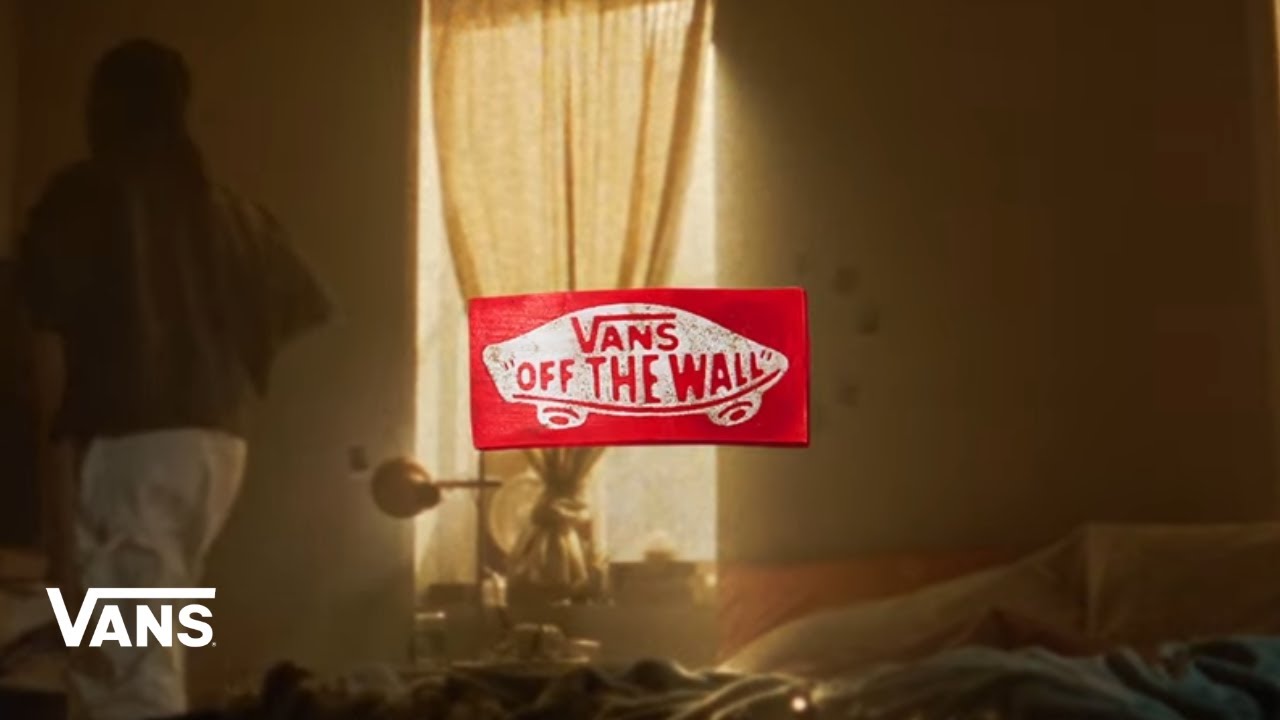
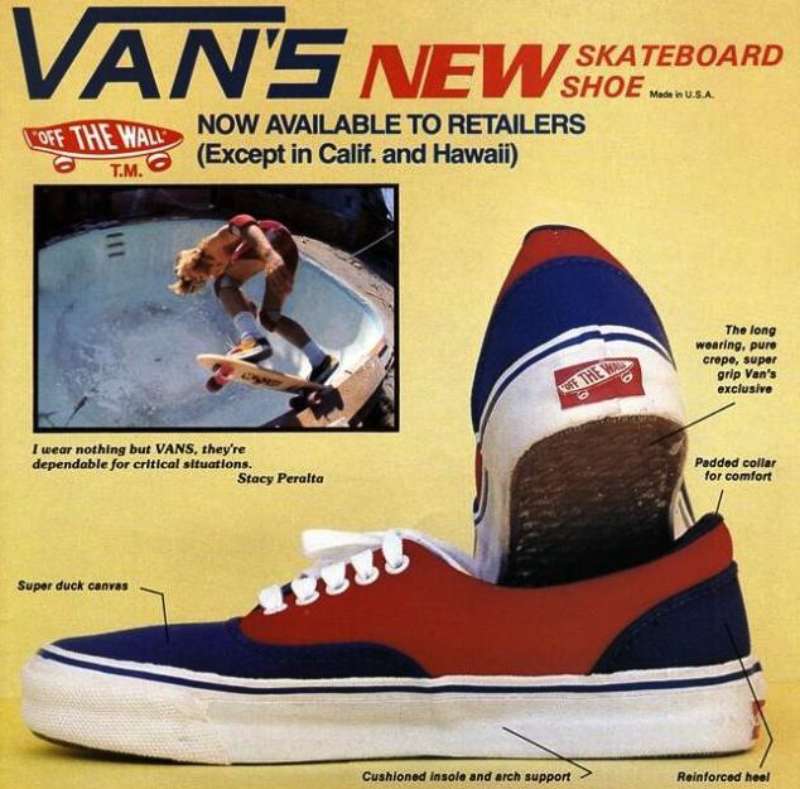
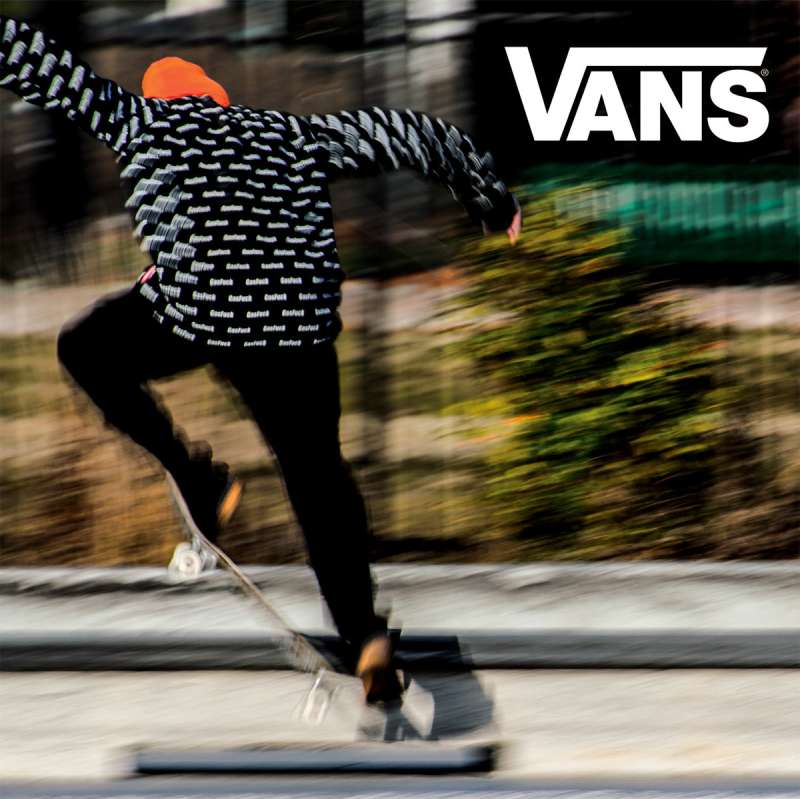
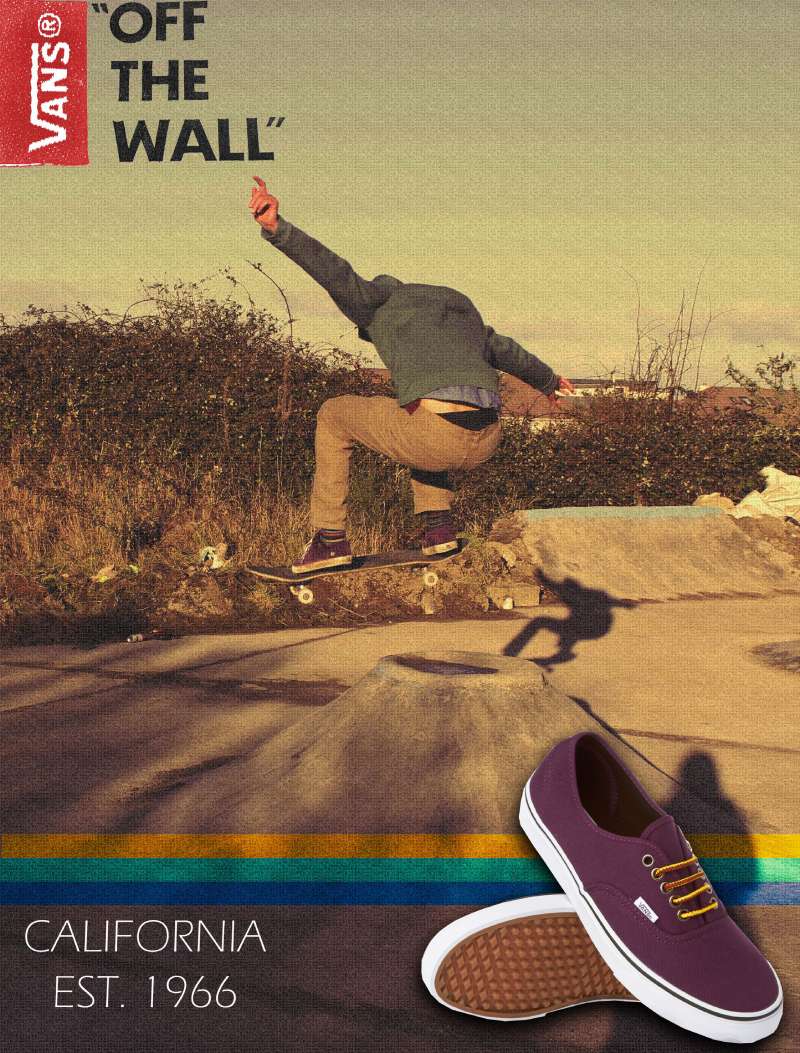
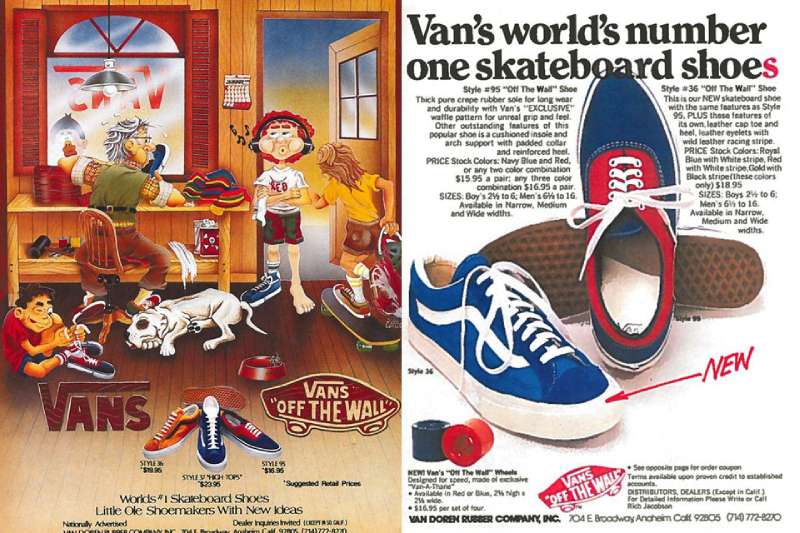
Vans ran its first skate advertising in magazines, not on television.
The company released its first dedicated skateboarding shoe in March 1976 carrying the newly drawn Off The Wall logo, and signed Stacy Peralta as its first paid skater that same year, followed by Tony Alva. The slogan came from pool-skating slang, not a copywriter.
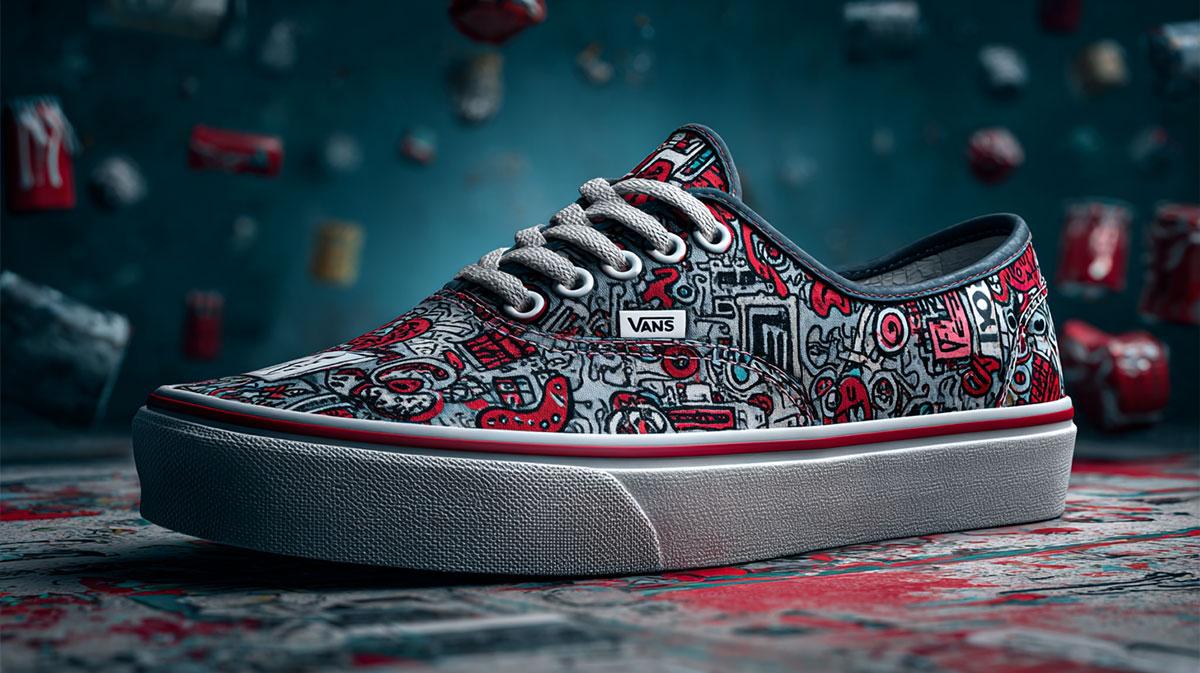
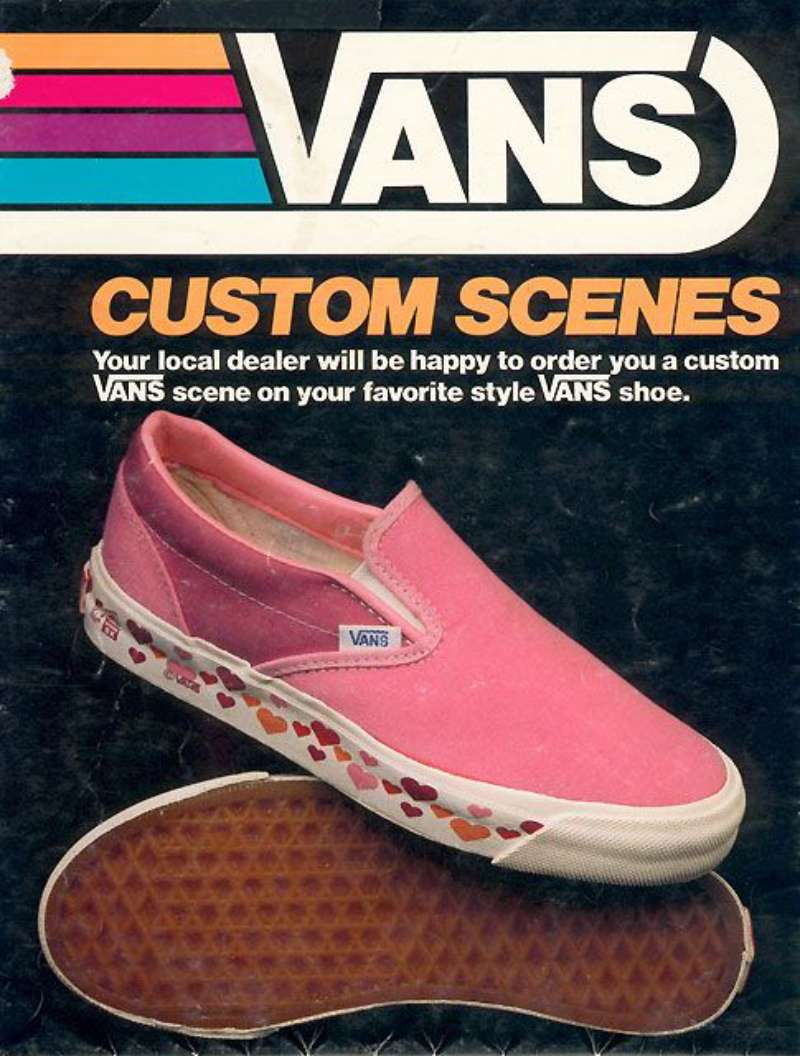
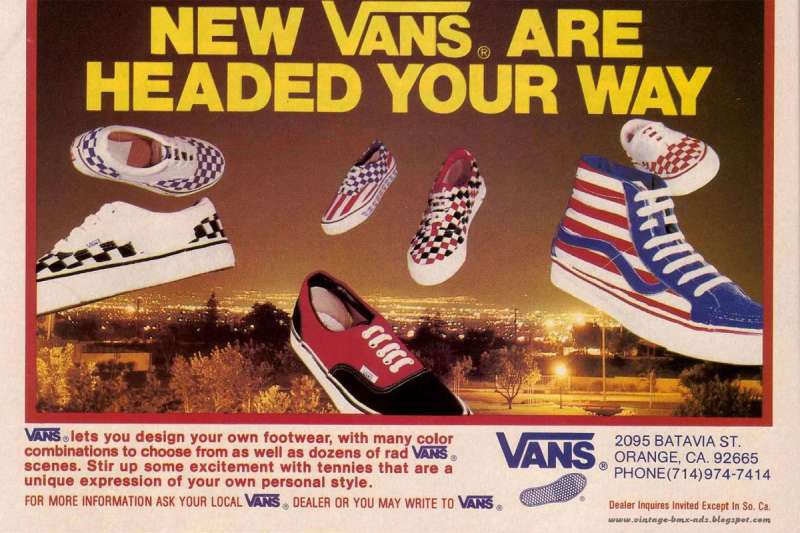
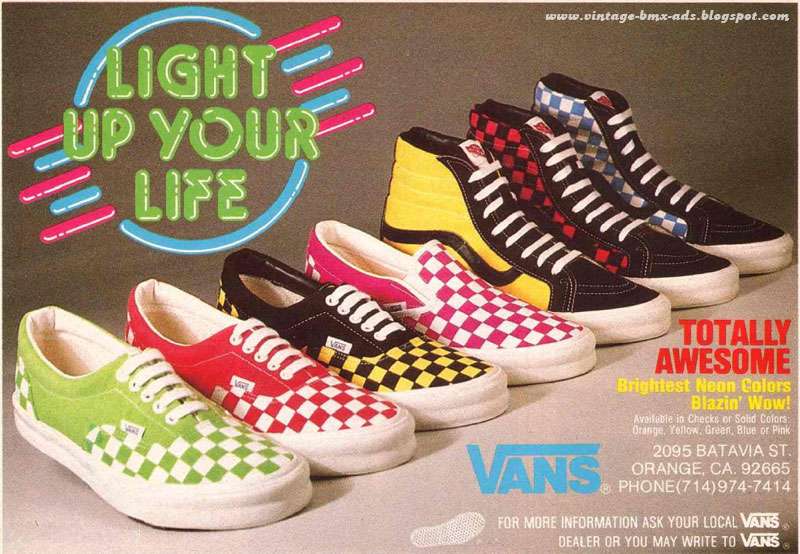
Checkerboard entered the print design work after Fast Times at Ridgemont High put slip-ons on screen in 1982.
Vans Warped Tour Poster Campaigns (1996-2019)

The Warped Tour poster is the longest-running piece of Vans advertising ever produced. Kevin Lyman created the festival in 1995, and Vans became title sponsor in 1996.
- Ran 25 consecutive editions from 1995 to 2019
- Toured roughly 40 cities with about 100 artists each summer
- Listed every band alphabetically with equal space, no headliners
That alphabetical grid inverted normal festival typographic hierarchy, which is why the posters read as a wall of names rather than a pyramid. Lyman told Billboard the 2026 revival reveals its 100-plus artist lineup one name per day across 30 days.
Vans Custom Culture (2010-Present)

The format: high school art students paint blank Vans, then the public votes.
The growth: 326 schools registered in 2010, and nearly 3,000 registered in 2015, the largest field in the competition’s history.
The money: over $1,110,000 donated to high school art programs by 2022, with partners including Journeys, truth and Americans for the Arts.
The grand prize climbed from $50,000 in the mid-2010s to $75,000 by the tenth year.
Foot the Bill (2020-2021)
Vans launched Foot the Bill on April 3, 2020, turning the Vans Customs configurator into a fundraising tool for shuttered skate shops, record stores, restaurants and venues.
Each partner uploaded one pattern onto a Classic Slip-On or Era, capped at 500 pairs, with 100% of net proceeds routed to that business.
The 2020 program sold 20,962 pairs and raised over $4 million, per Vans Americas marketing VP Carly Gomez, after committing roughly $4 million to 160 businesses within three weeks of launch.
- Launch partners included Uprise Skateshop in Chicago and Jon and Vinny’s in Los Angeles
- Contagious named it Campaign of the Week in 2020
Vans Checkerboard Day (2019-Present)
Vans and The Vans Checkerboard Fund at Tides Foundation donated over $1 million in 2021, bringing the total past $3 million since 2019, according to California Apparel News.
The mechanic is a date, not a film. Every November 18, the brand asks people to wear checkerboard and post it, then splits $50,000 grants across 15 regional charities.
DoSomething.org received $250,000 as global partner, and more than 18,000 fans took part in 2021. The campaign lives almost entirely on repetition of a single two-color motif across user photography.
This Is Off The Wall (2023-2024)
Agency and craft: Anomaly handled the 2023 global brand campaign, and Will Dohrn directed the anthem film through production company Love Song.
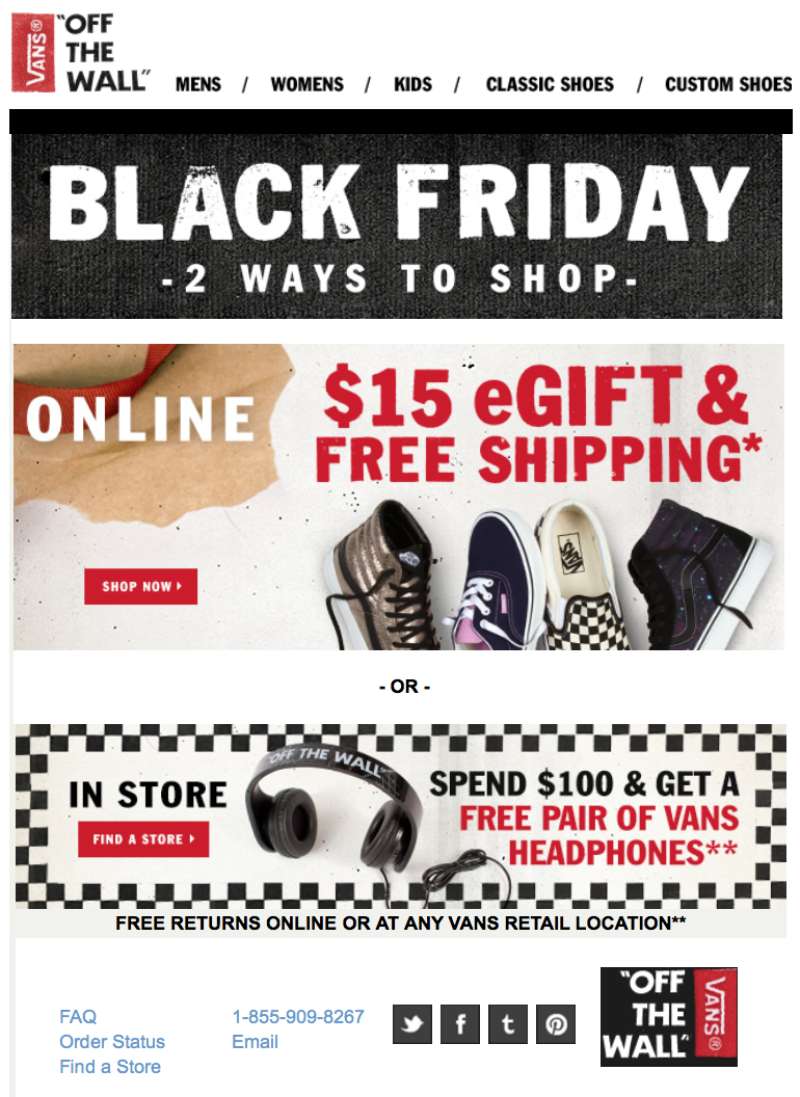
Media mix: digital, social and out of home, with no traditional TV buy.
Cast: the ambassador roster included Little Simz, Beatrice Domond, Felipe Nunes, Irene Kim, Cocona Hiraki, Arthur Bray and Salome Agbaroji.
Art direction leaned on deliberate optical distortion and saturated color blocks, timed to the Knu Skool launch. The 2024 chapter, Vision Walk, followed photographer Olivia Bee through Los Angeles.
Always Pushing (2024-2026)

Always Pushing is the campaign Vans built to win skateboarding back.
Launched in July 2024 and developed with ALEX/2TONE, co-founder of Los Angeles streetwear label Born X Raised, the launch film paired Vans Skate team riders and BMX riders with a Paris Texas soundtrack. Vans described the media approach as hyperlocal, keyed to fashion, sport and cinema moments rather than a single global flight.
The commercial backdrop was ugly. Vans revenue fell 16% to $2.35 billion in fiscal 2025, with a 22% drop in the fourth quarter, per VF Corporation results reported by WWD.
Global Brand President Sun Choe later credited the campaign with reclaiming skate and resetting the brand’s focus on youth.
Regional Vans Print Ads From Brazil and the Netherlands
Brazil: Fbiz, part of WPP, created “Vans. Keep Being Weird.” in 2025 with YouTuber Felca as protagonist, aimed at a market where his commentary on youth self-image had just gone national.
Netherlands: Picnic Studio produced “Rooted in skateboarding. Lost in Amsterdam.”, a locally shot campaign trading global gloss for city-specific documentary framing.
Both sit outside the global campaign architecture and use local copy voices rather than translated headlines.
How Do Vans Print Ads Work Visually?
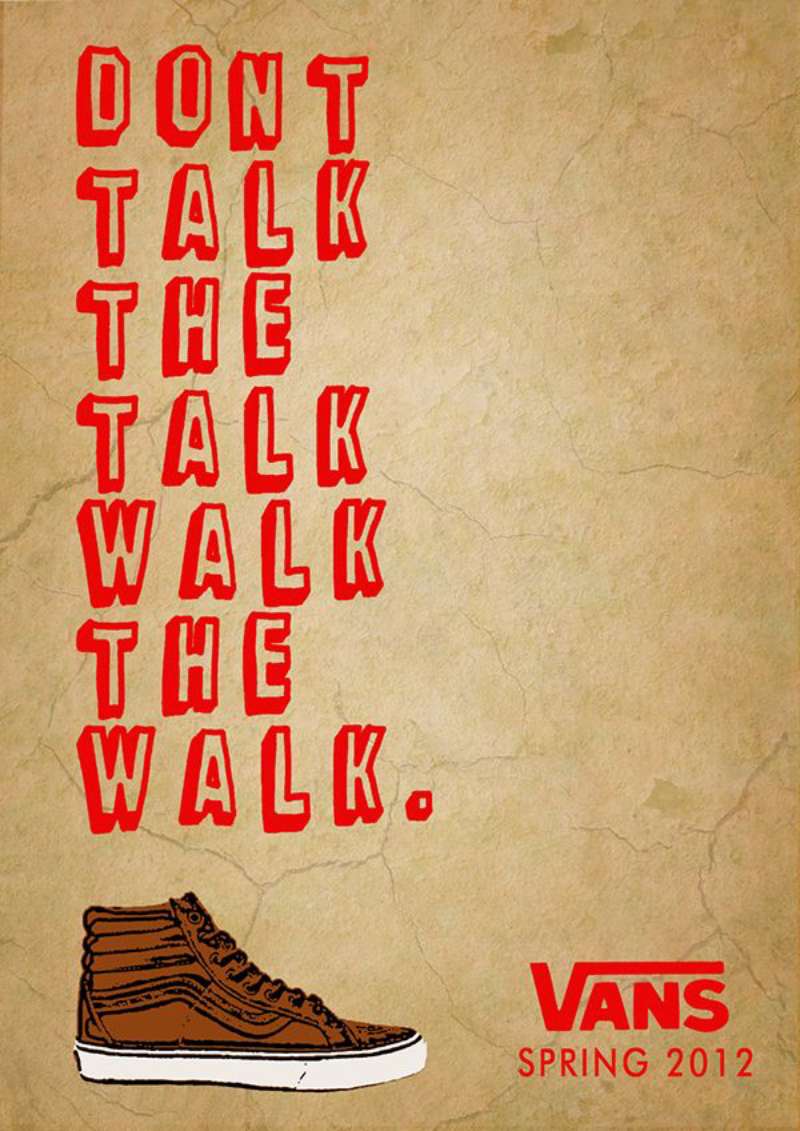
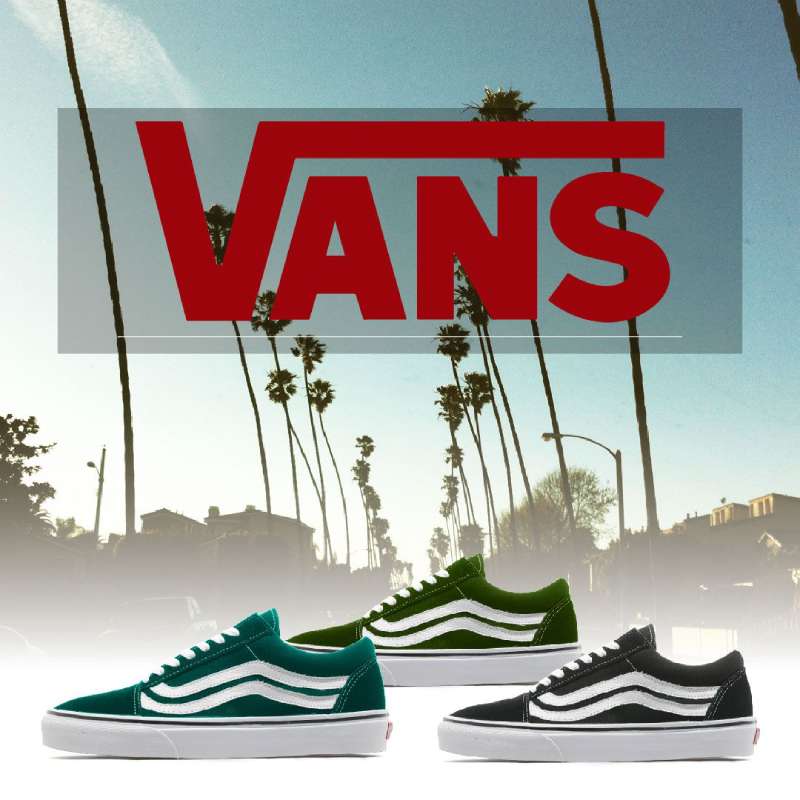
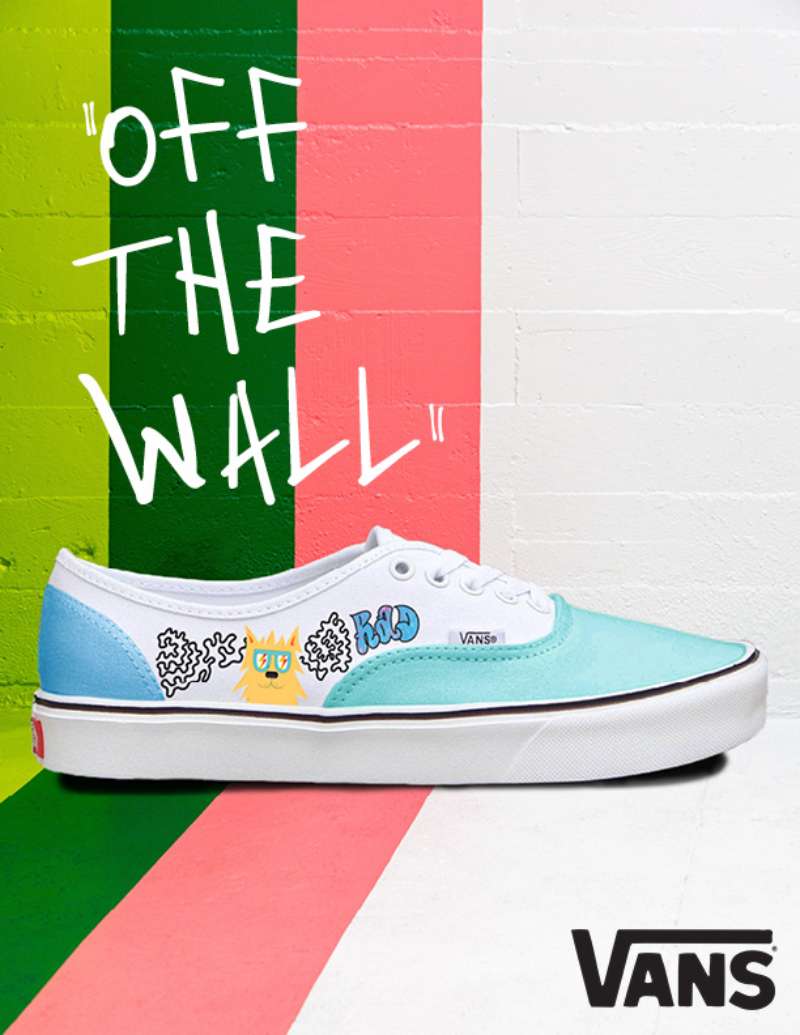
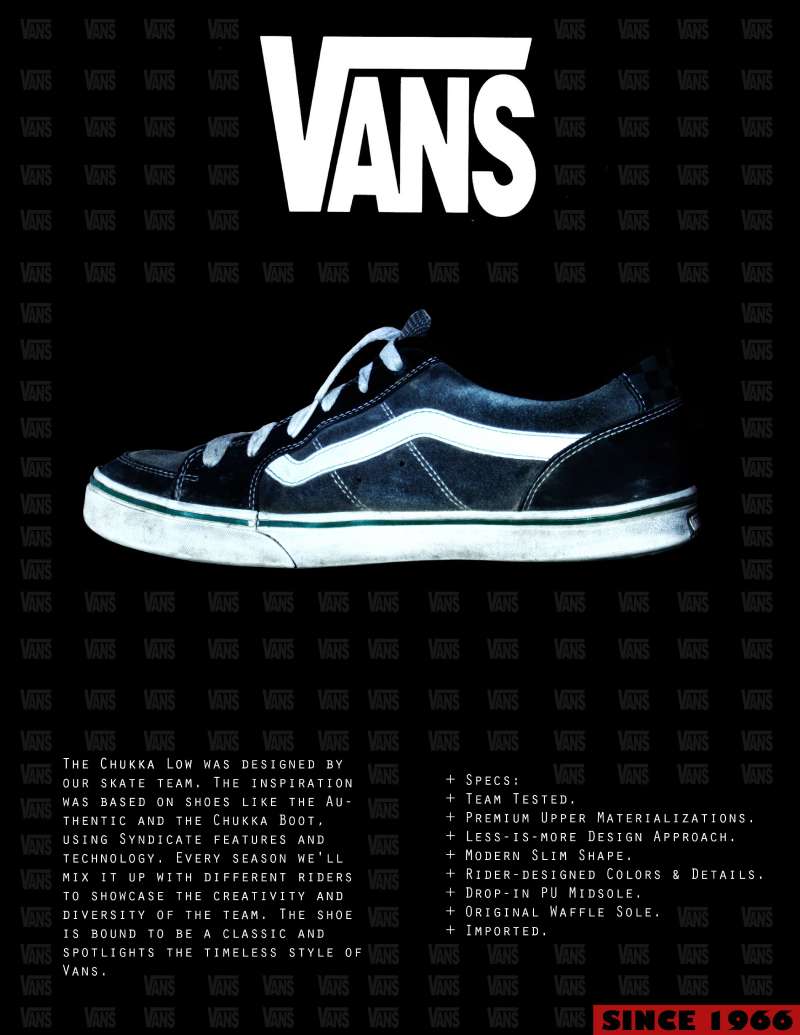
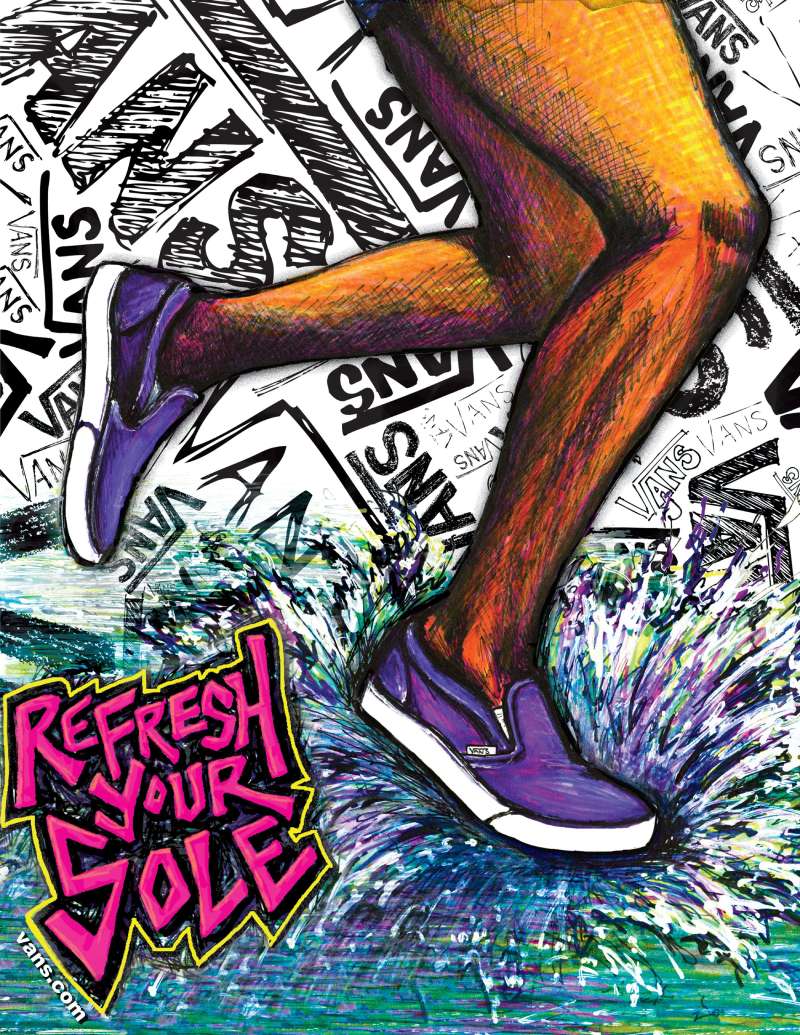
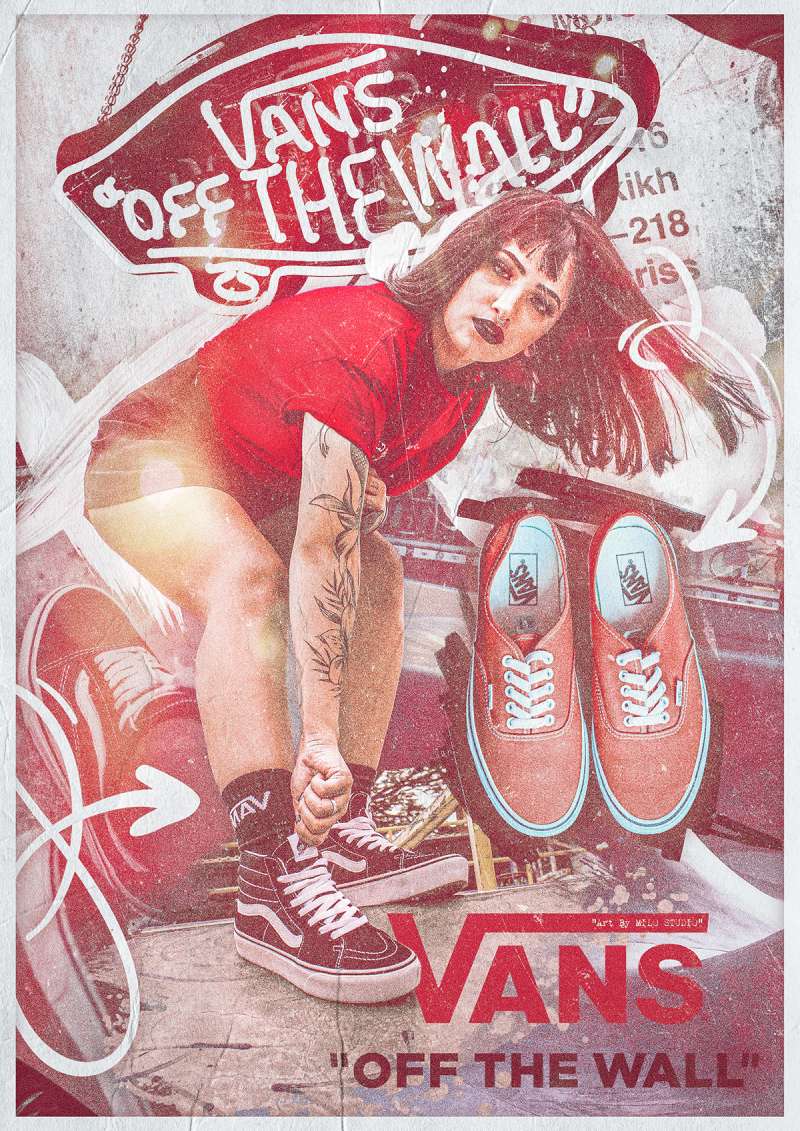
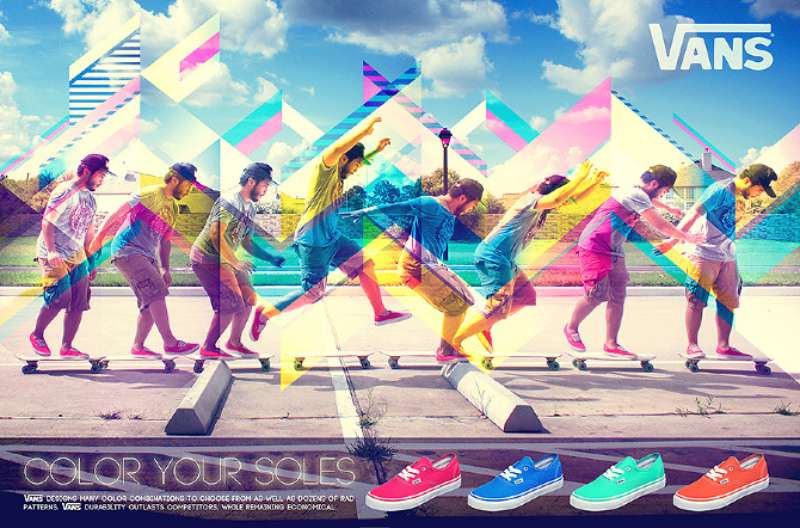
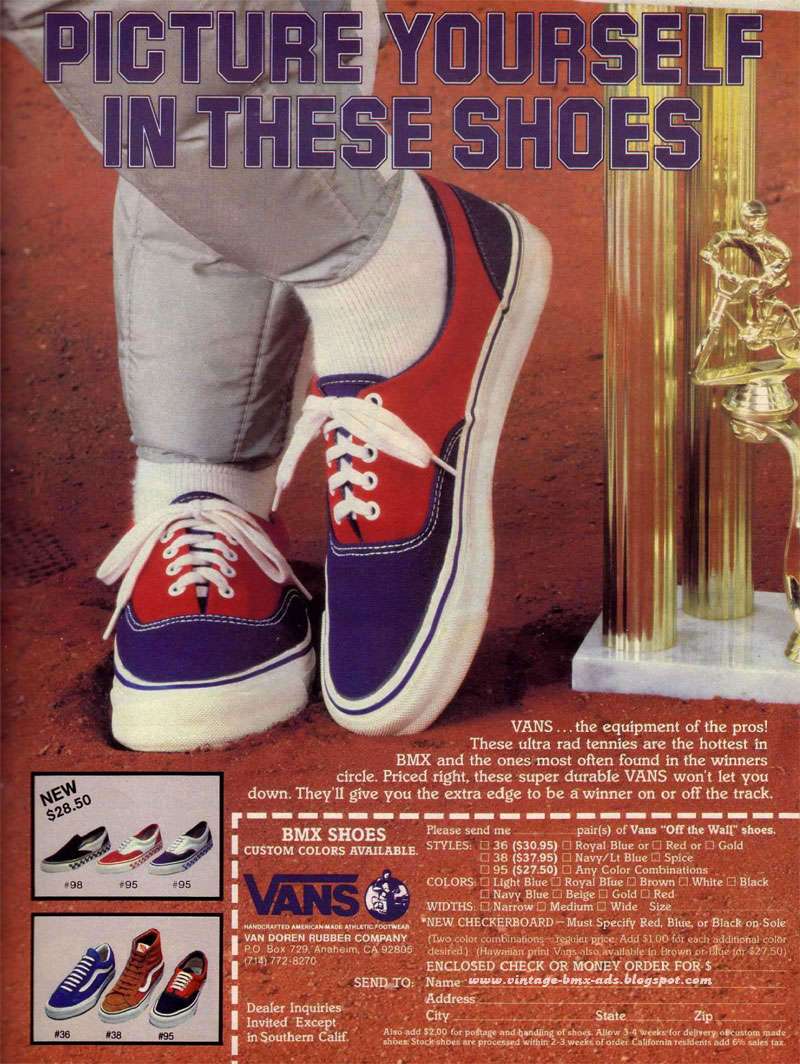
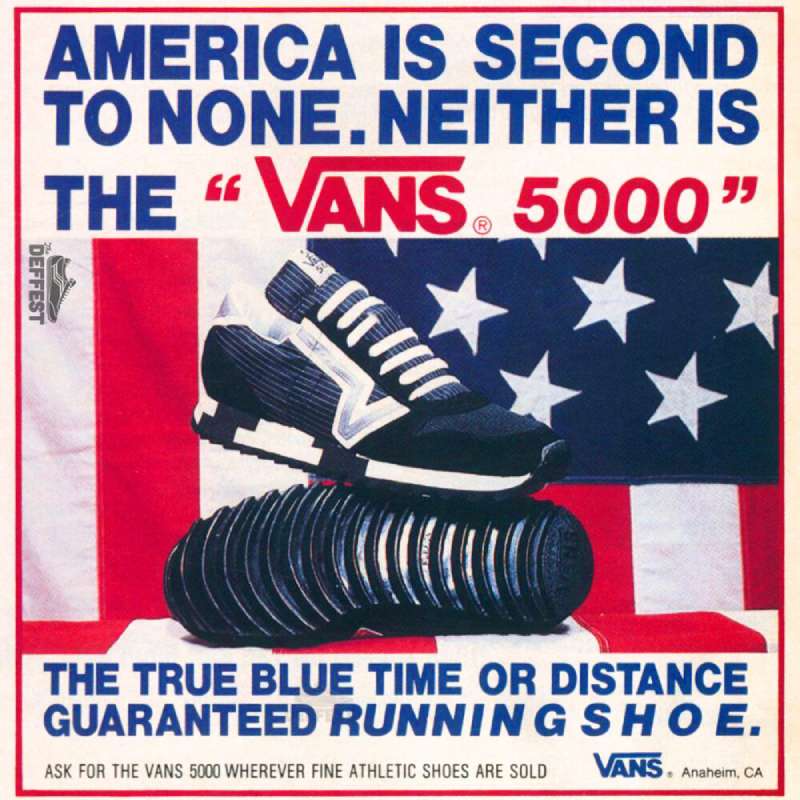
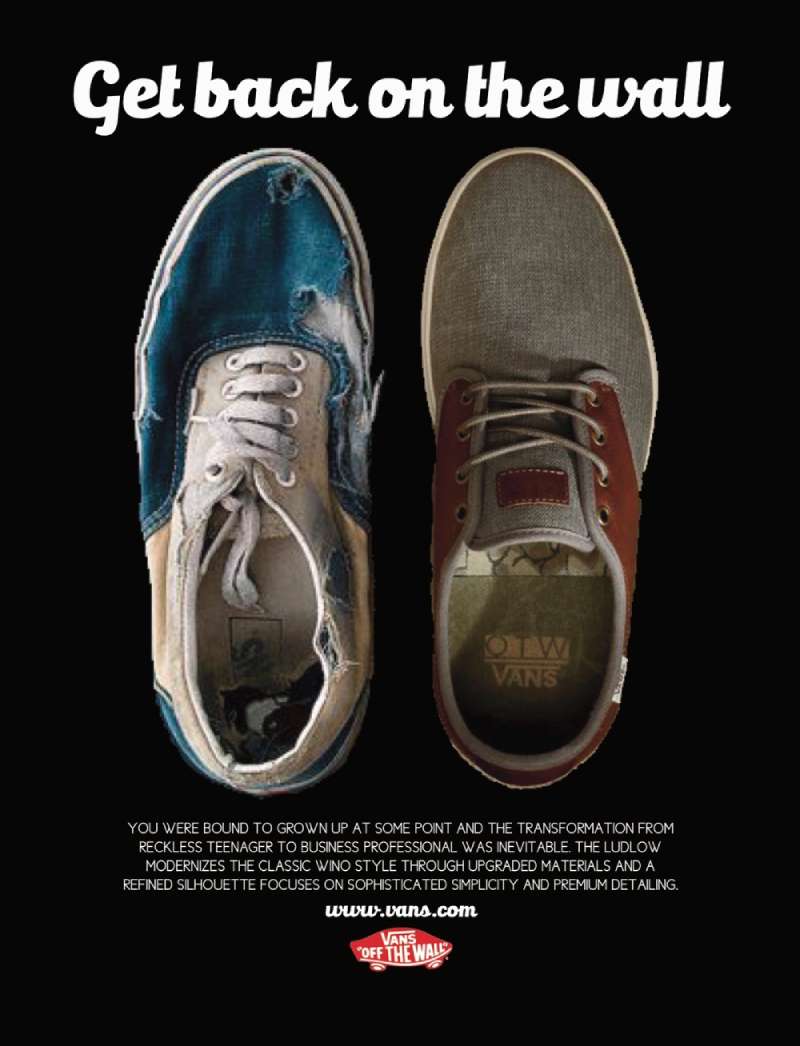
Vans print ads work on 3 devices: one silhouette shot flat against ground, a palette of two colors plus black, and the red wordmark parked in a corner. Headlines stay under 8 words. Pattern carries brand recognition instead of the logo.
The visual hierarchy almost always runs image first, headline second, wordmark last. That order survives across four decades of layouts.
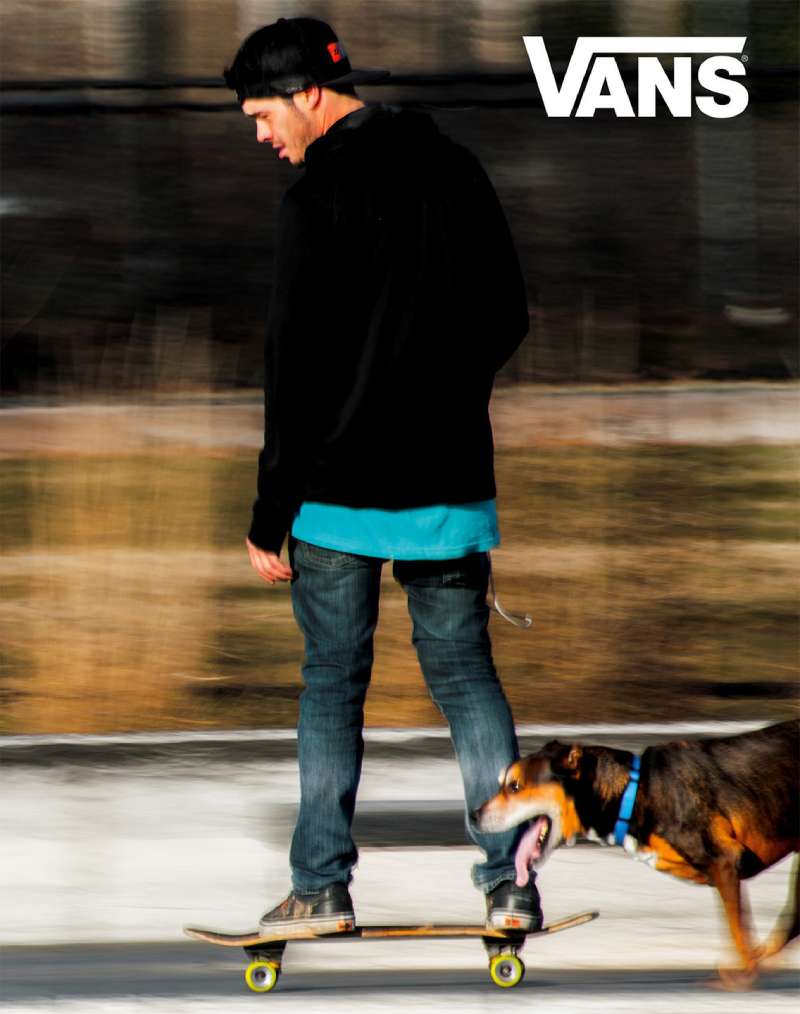
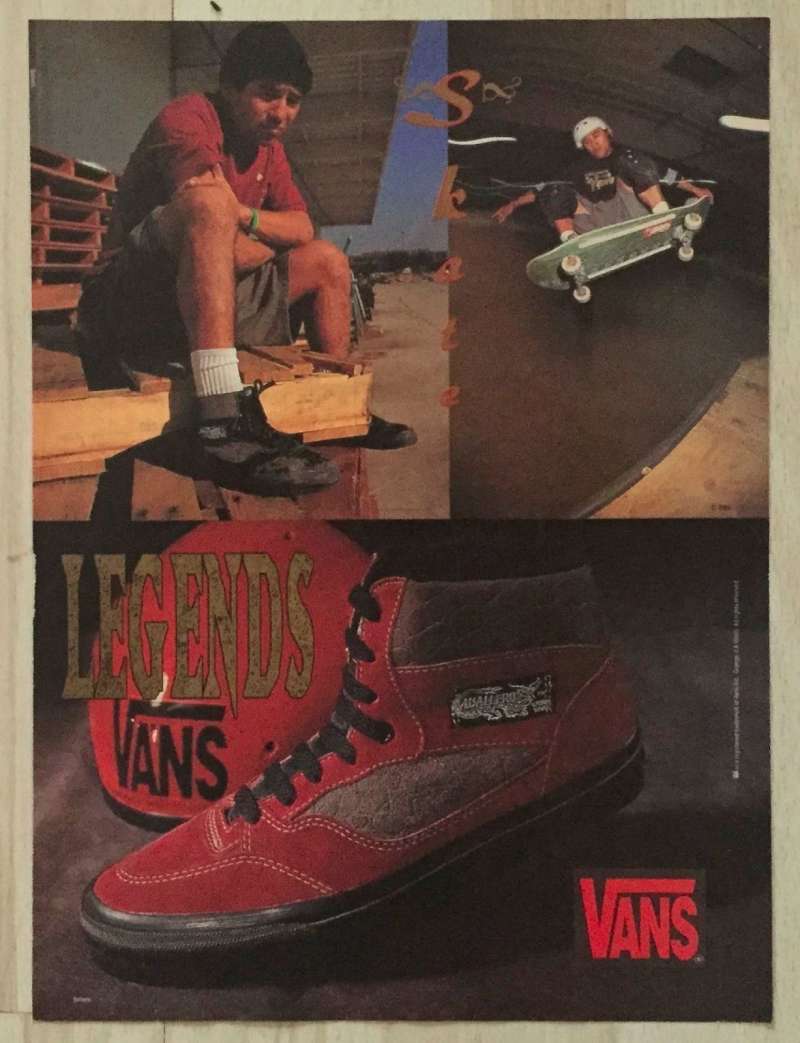
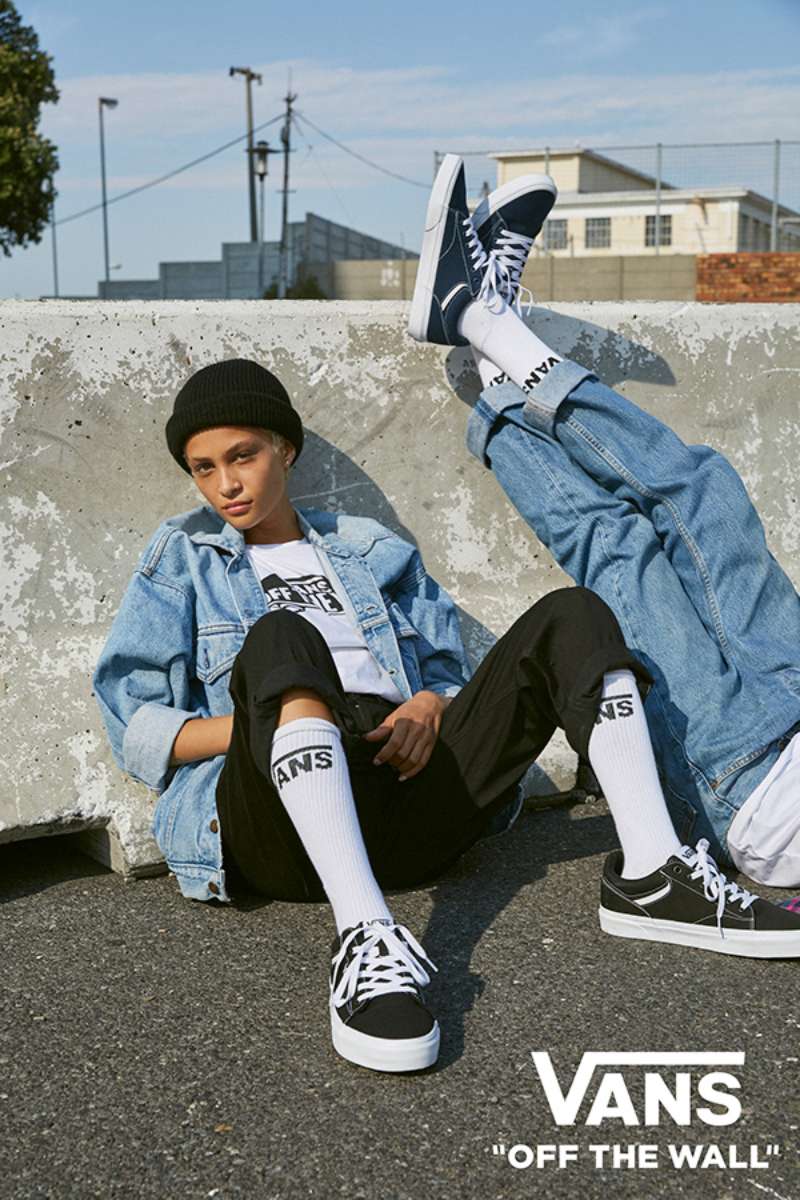
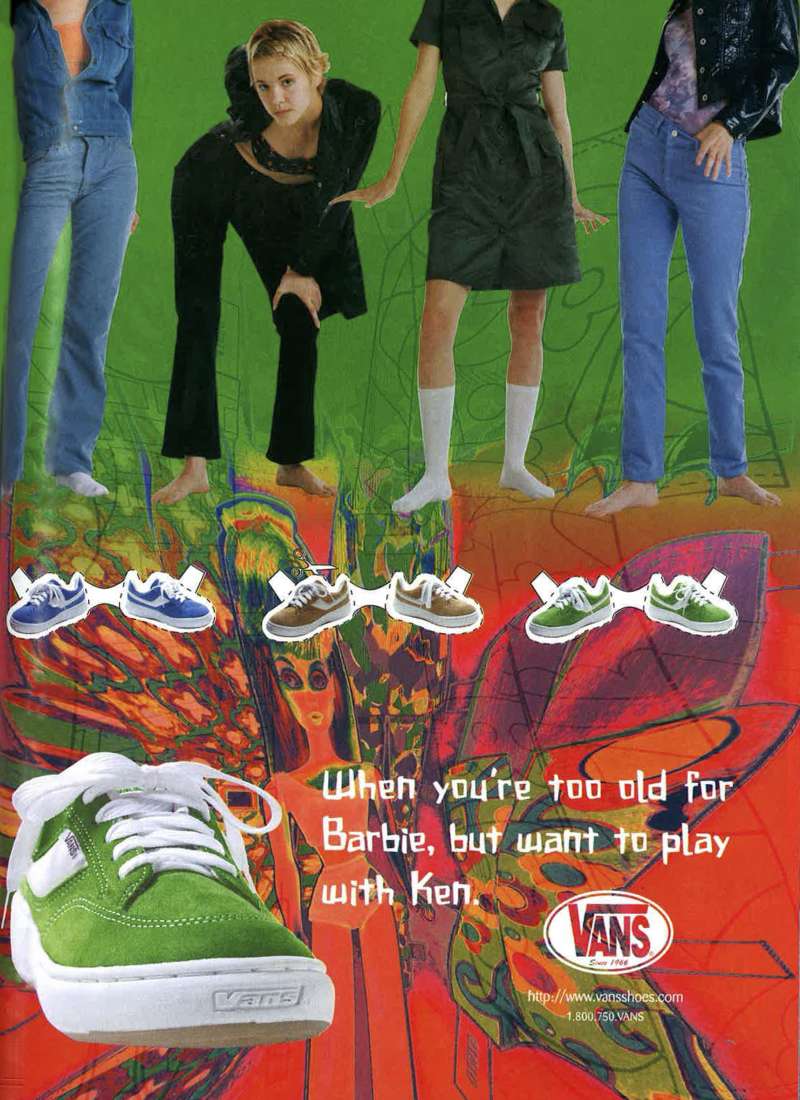
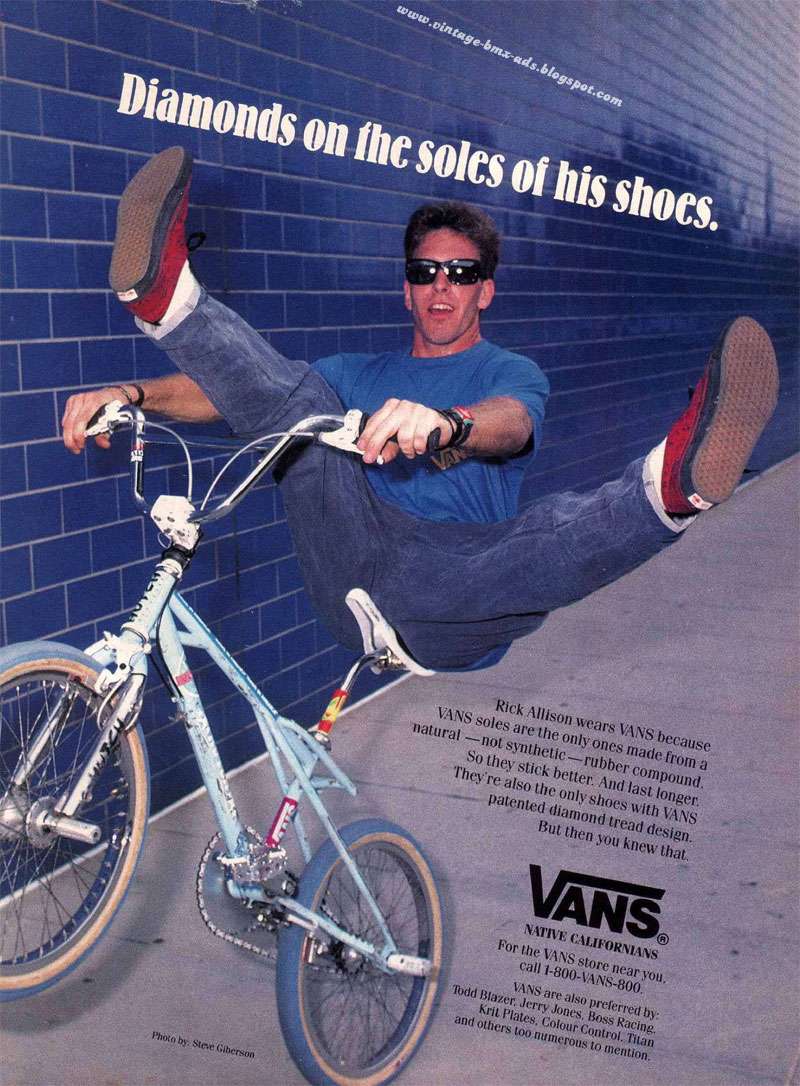
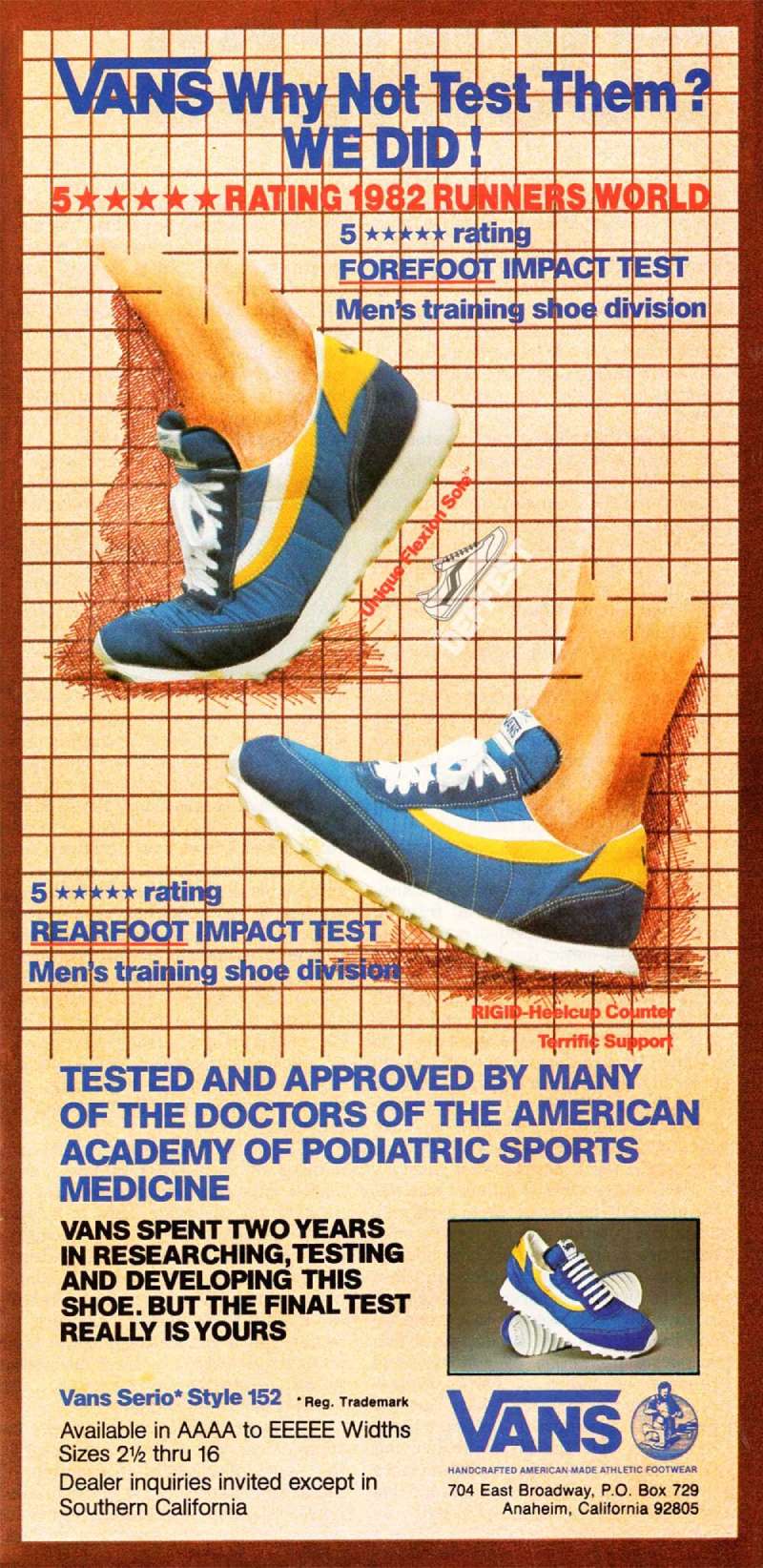
Product ads crop tight and leave the background empty. Culture ads do the opposite, filling the frame with a location and pushing the shoe to the lower third, which is why the two formats need different amounts of white space.
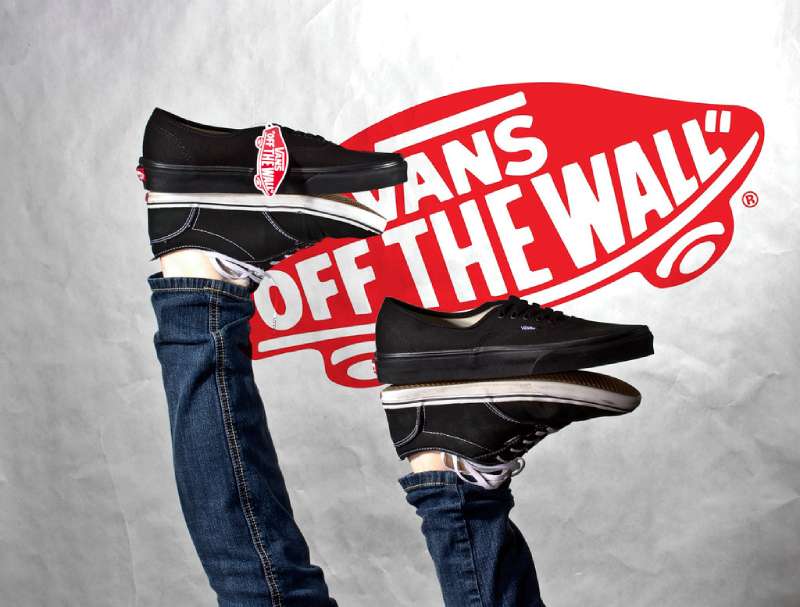
The wordmark itself is set in a modified Helvetica, a geometric all-caps sans-serif font drawn from a 1976 sketch by Mark Van Doren, then 13 years old and son of co-founder James Van Doren. Nothing about it has been redrawn to feel current.
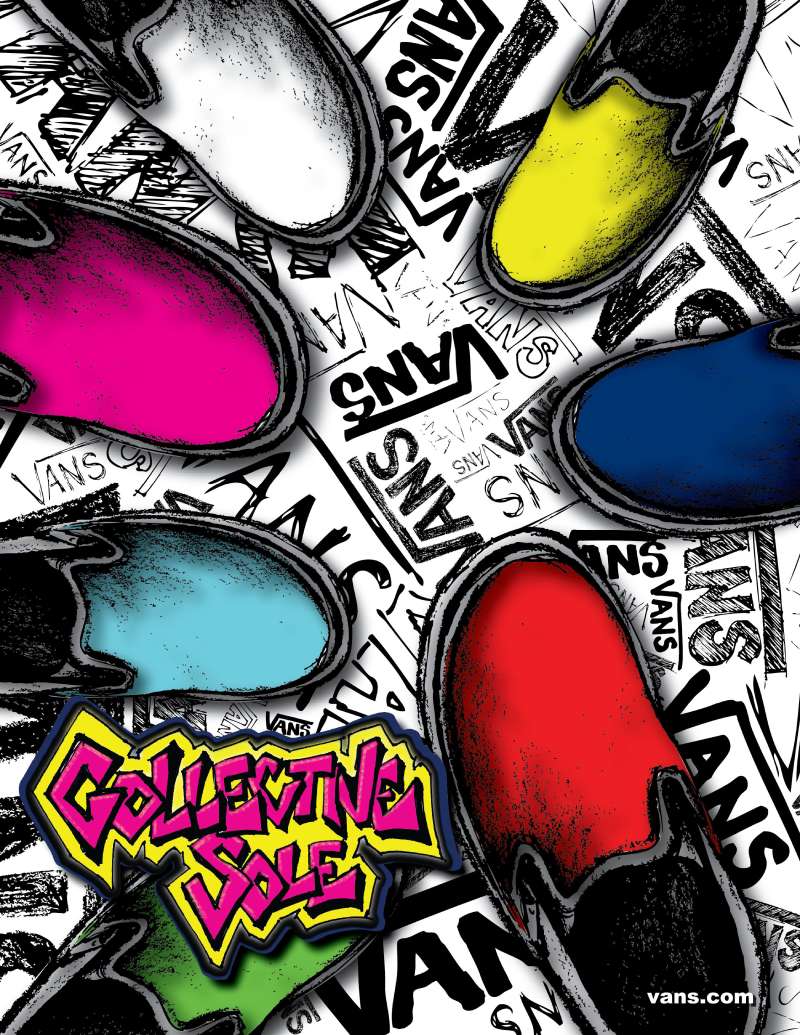
Color discipline is the part most brands get wrong and Vans gets right. The working color palette is red, white and black, and the checkerboard supplies maximum contrast without adding a fourth color.
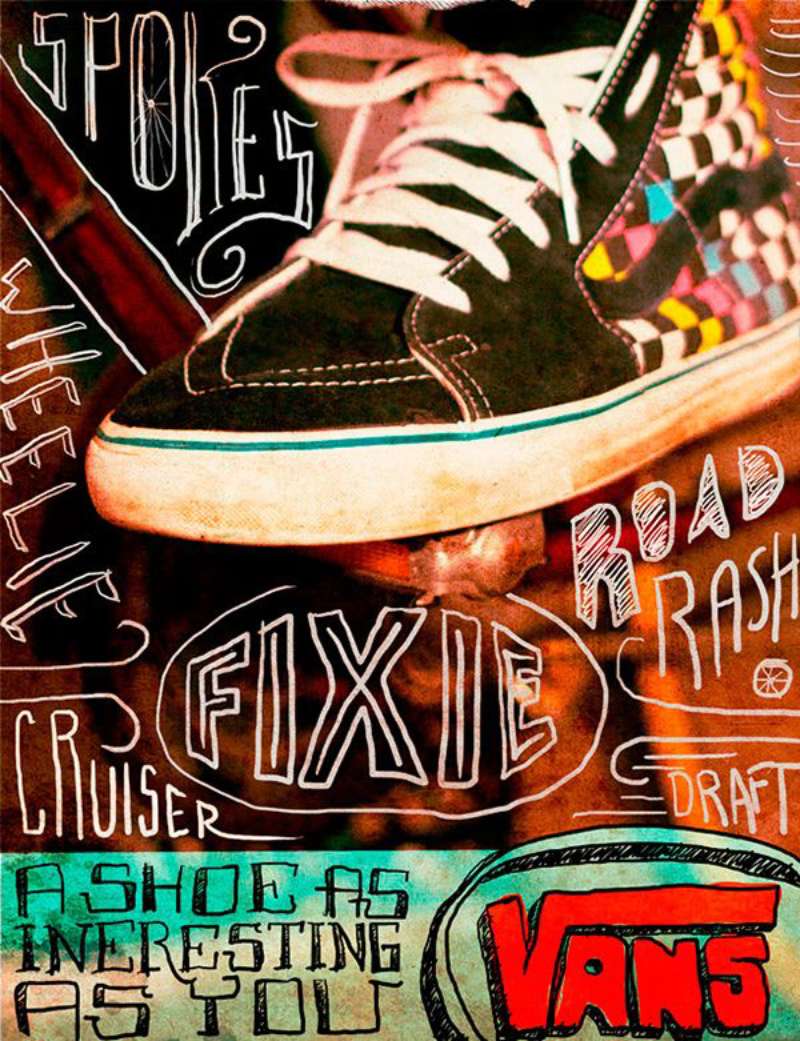
The 1990s skate-magazine work borrowed heavily from photocopied zines, which is where the torn edges, stacked type and deliberate misregistration of Grunge design enter the archive.
How Do Vans TV Commercials Differ From Its Print Ads?
Vans commercials run longer, use handheld documentary camera work, and put music ahead of product. Print sells one shoe. Film sells a community, and the logo often appears only in the final two seconds.
This Is Off The Wall anthem film (2023). Directed by Will Dohrn through Love Song for Anomaly. Little Simz, Beatrice Domond and Felipe Nunes move through distorted, color-shifted environments. No product close-ups until the last beat.
Always Pushing launch film (2024). Built with ALEX/2TONE and scored by rap group Paris Texas. Skate and BMX footage cut against artists working, with no voiceover carrying the tagline.
Vision Walk (2024). Photographer and director Olivia Bee leads a group through Los Angeles shooting film and digital. The spot documents a workshop rather than a product, and Vans ran real vision walks in cities afterward.
The through-line is storytelling built from footage that could exist without a brand attached. That choice costs immediate product clarity and buys credibility with the audience that actually skates.
How Has Vans Advertising Evolved Since 1966?
Vans advertising moved through 4 phases: shop-window and shoebox graphics through 1975, skate magazine print from 1976, music and event sponsorship from 1995, then purpose-led global campaigns from 2019. The tagline never changed across any of them.
| Decade | Strategic shift | Representative work |
|---|---|---|
| 1960s-70s | Retail signage, no advertising department | Van Doren Rubber Company store, 704 E. Broadway, Anaheim, opened March 16, 1966 |
| 1980s | Skate press print plus film placement | Checkerboard slip-on ads after Fast Times at Ridgemont High, 1982 |
| 1990s | Music sponsorship replaces media buying | Vans Warped Tour posters from 1996 |
| 2010s | Owned venues and participation campaigns | House of Vans Brooklyn (2010), Custom Culture (2010), House of Vans London (2014) |
| 2020s | Purpose campaigns, then brand resets | Foot the Bill (2020), This Is Off The Wall (2023), Always Pushing (2024) |
House of Vans is the clearest evidence of the shift from paid media to owned space. The Brooklyn location opened in 2010 in a 25,000 square foot Greenpoint warehouse, and the London site opened in 2014 across 32,000 square feet under Waterloo station with an 850-capacity venue, a cinema and an indoor skate park.
Vans leased the London tunnels for a multi-year run and sold no product inside, which is a media decision dressed as a venue. Black Sparrow Presents managed the venue operation.
The wordmark changed far less than the advertising around it, which makes Vans a useful case in the evolution of logos where the identity holds still and the campaigns absorb every strategic pivot.
Which Agencies Created Vans Advertising?
Anomaly created This Is Off The Wall for Vans in 2023. OMD won the global media account in April 2023 after a four-month review, per Ad Age. Fbiz made Keep Being Weird for Vans Brazil in 2025. Picnic Studio produced the Amsterdam skate campaign.
| Partner | Role | Work |
|---|---|---|
| Anomaly | Global creative | This Is Off The Wall, 2023 |
| OMD (Omnicom Media Group) | Global media agency of record | Appointed April 2023 |
| Love Song | Film production | 2023 anthem film, directed by Will Dohrn |
| ALEX/2TONE | Creative direction | Always Pushing, 2024 |
| Cuker | Digital | Vans 50th anniversary interactive timeline |
Vans also runs a large in-house creative function, and the 2023 campaign credits list internal creative directors Bruno Luglio and Matt Even alongside the agency team.
That split explains the consistency across markets. Local agencies write local copy, while the in-house team owns the brand guidelines that keep the wordmark, the Sidestripe and the checkerboard behaving the same way in Sao Paulo and Amsterdam.
What Can Designers Learn From Vans Ads?
Vans ads teach 5 transferable moves: lead with the silhouette, cap the palette at two colors plus black, keep headlines under 8 words, let pattern carry recognition instead of the logo, and cast people who actually use the product.
- Lead with the product silhouette, not the logo
- Limit the palette to two colors plus black, then hold that limit across every format
- Set the tagline in the brand typeface at one weight, and resist redrawing it every five years
- Build a pattern that works as identification when the wordmark is cropped out
- Shoot real locations and real users instead of studio approximations
- Give the audience something to make, as Custom Culture does, when you want participation rather than reach
The pattern lesson is the most portable one. Checkerboard functions as brand typography‘s visual counterpart: a single repeatable asset that identifies the brand at any scale, on any substrate, in any market.
How Do Vans Ads Compare to Converse Ads?
Vans ads document a subculture. Converse ads recruit one. Both brands sell a canvas sneaker with a silhouette older than most of their audience, and both lean on a two-color palette, but the casting logic splits hard.
Vans puts working skateboarders on camera and funds the scenes they come from, which is why Custom Culture and Checkerboard Day exist as advertising rather than as corporate social responsibility line items. Converse builds around musicians and fashion collaborators, and its layouts sit closer to editorial fashion than to skate press.
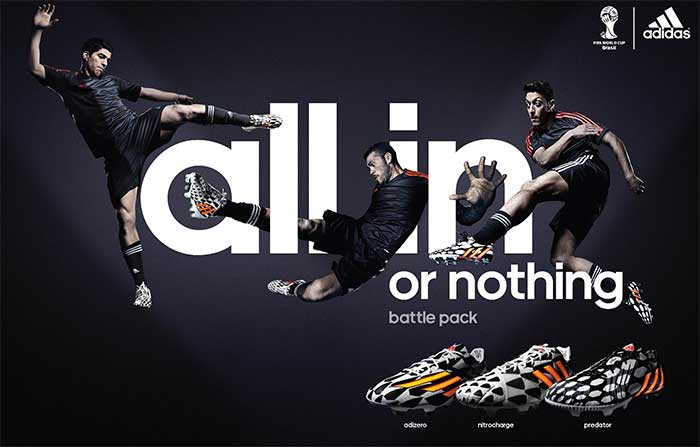
The comparison sharpens against the athletic brands. Adidas ads and Puma ads use stadium-scale performance imagery and signed athletes, while New Balance ads trade on understatement and product engineering copy.
Vans has neither a performance story nor an engineering story to tell. The waffle sole and the vulcanized construction have not changed materially since the 1970s, so the advertising sells belonging instead of technology.
What Makes Vans Advertising Work?
Vans advertising works because the constraints never moved. One tagline since 1976. Red, white and black. A pattern that identifies the brand when the wordmark gets cropped out of frame.
Casting comes from people who already wear the product, which is the part competitors copy and rarely sustain.
The commercial pressure of the past three years tested all of it, and the campaigns that landed were the ones that walked back toward skateboarding rather than away from it. That is a brand narrative decision before it is a media decision.
Designers get something usable out of that. Consistency is not a style choice. It is a refusal to redraw a working visual identity, held for sixty years across a dozen creative teams.
Vans Ads Examples
FAQ on Vans Ads
Who owns Vans?
VF Corporation owns Vans, trading on the NYSE as VFC. The portfolio also holds The North Face and Timberland. Sun Choe has served as Global Brand President since July 2024, reporting to CEO Bracken Darrell.
When did Vans start advertising?
The Van Doren Rubber Company opened on March 16, 1966 in Anaheim with retail signage and no ad budget. Paid advertising started properly in 1976, when Vans began running print in skateboarding magazines.
Who designed the Vans logo that appears in the ads?
Mark Van Doren drew it at 13 years old. He was the son of co-founder James Van Doren, and the sketch became the Off The Wall lockup that debuted in 1976 and still anchors campaign layouts.
Why does the checkerboard pattern show up in so many Vans ads?
Kids drew it on their slip-ons first. After Fast Times at Ridgemont High hit screens in 1982, Vans put the pattern into production and into its advertising, where it works as identification without the wordmark.
What font do Vans ads use?
The wordmark sits in a customised, geometric all-caps cut derived from Helvetica. Campaign headlines mostly follow suit, which is why fonts similar to Helvetica read as instantly on-brand in mock-ups.
Does Vans have an in-house creative team?
Yes, and it is sizeable. The 2023 global campaign credits list internal creative directors Bruno Luglio and Matt Even alongside Anomaly, with a global creative VP overseeing both sides of the work.
Is the Vans Warped Tour coming back?
It returned in 2025 for its 30th anniversary. Kevin Lyman is producing the 2026 edition with Insomniac Events across five two-day festivals, plus Montreal and Mexico City, each carrying over 100 artists.
How does a school enter Vans Custom Culture?
Art teachers and administrators register the school through the Vans Custom Culture site, usually by a late-January deadline. Selected schools paint blank Vans to set themes, then the public votes for the finalists.
What is House of Vans?
A permanent free venue programme. Brooklyn opened in 2010 across 25,000 square feet, London followed in 2014 with 32,000 square feet under Waterloo station, and Chicago runs a third site. No products are sold inside.
Did the new Vans campaigns fix the brand’s sales?
Not yet, though the trend flipped. Vans revenue fell 16% to $2.35 billion in fiscal 2025, then slipped only 1% globally in the fourth quarter of fiscal 2026, with Americas direct-to-consumer sales growing again.
Conclusion
Sixty years of Vans ads come down to a small set of repeated decisions: the Sidestripe, the waffle sole in frame, two colours plus black, and copy short enough to read from a moving car.
The Off The Wall campaign work, the Checkerboard Day activations and the Foot the Bill customisation programme all sit on that same base.
What changed was the medium. Skate magazine spreads gave way to event posters, then to owned venues, then to social-first film.
The brand identity never followed the medium, which is the part worth stealing.
Pull one campaign apart on your own grid. Note the image-to-text ratio, the logo placement and the negative space, then compare it to whatever you are working on now.

Renowned for his expertise in logo design and visual branding, Bogdan has developed a multitude of logos for various clients.
His skills extend to creating posters, vector illustrations, business cards, and brochures. Additionally, Bogdan's UI kits were featured on marketplaces like Visual Hierarchy and UI8.
He also wrote in the past years on sites like Design Your Way, WebDesignerDepot, WPDean, Designmodo, Speckyboy, Slider Revolution, and more.
- The Windsurf Logo History, Colors, Font, And Meaning - 10 October 2026
- How to Remove Background From Product Photos (No Photoshop) - 10 October 2026
- How Designers can Build a Stronger Online Creative Identity - 9 October 2026

Bogdan Sandu is a seasoned designer who has been designing websites since 2008. Renowned for his expertise in logo design and visual branding, Bogdan has developed a multitude of logos for various clients. His skills extend to creating posters, vector illustrations, business cards, and brochures. Additionally, Bogdan's UI kits were featured on marketplaces like Visual Hierarchy and UI8. He also wrote in the past years on sites like Design Your Way, WebDesignerDepot, WPDean, Designmodo, Speckyboy, Slider Revolution, and more.
You Might Also Like