The Carlsberg logo is one of the most recognized marks in the global beer industry. It’s been around since 1904, and honestly, it hasn’t changed that much. That kind of staying power is rare.
Designed by Danish architect Thorvald Bindesbøll, the mark was created for the launch of Carlsberg Pilsner. The brewery itself dates back to 1847, founded by J.C. Jacobsen in Copenhagen. But the logo we recognize today took nearly three decades after its creation to become the official brand mark, finally adopted in 1931.
The current version sits within the Art Nouveau tradition and has gone through roughly four to five subtle refinements. The most recent came in 2018 when Taxi Studio handled the global rebrand. In 2004, the Danish Design Center gave the logo a design prize on its 100th anniversary. That had never happened before for a logo.
What Is the Carlsberg Logo?
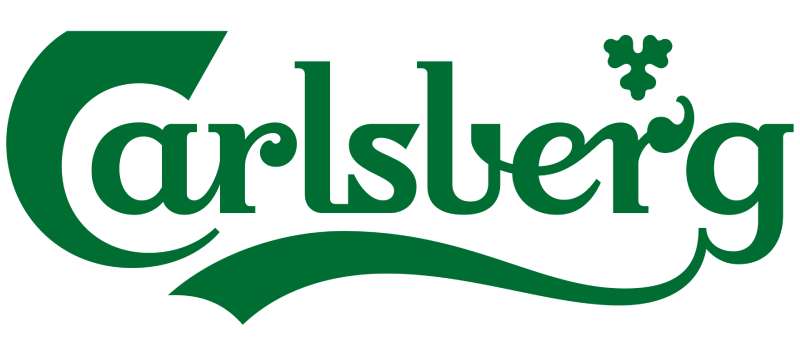
The Carlsberg logo is a custom script wordmark in green, featuring stylized hand-drawn lettering with a hop leaf emblem above the letter “r.” Introduced in 1904 and designed by Thorvald Bindesbøll, it represents Danish brewing heritage and the pursuit of quality.
Here’s what you need to know about the mark:
- Design Type: Combination mark. It pairs a custom script wordmark with a hop leaf symbol. On product labels, it also includes a crown and the founder’s signature.
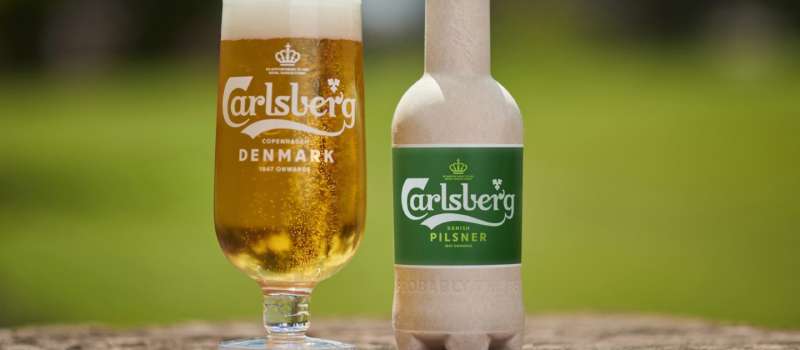
- Primary Elements: The hand-drawn “Carlsberg” lettering, a three-lobed hop leaf placed above the “r,” and (on packaging) a royal crown in gold and red.
- Official Introduction Date: Created in 1904 for the Carlsberg Pilsner launch, officially adopted as the primary brand mark in 1931.
- Designer: Thorvald Bindesbøll, a Danish architect and industrial designer recognized as a pioneer of Danish design. He was paid 500 kroner for the work.
- Trademark Status: Registered globally by Carlsberg Breweries A/S (Carlsberg A/S). The name “Carlsberg” was first trademarked in India in 1949 and has been registered across multiple jurisdictions under Class 32 for beer.
- Color Palette: Primary colors are Carlsberg Green (#00321E for the corporate version, #17B169 for the consumer-facing brand green) and white. Secondary colors on packaging include gold and red (used for the crown). The 2017 corporate visual identity introduced seven additional secondary shades.
- Usage Context: Beer bottles, cans, draft systems, advertising, sponsorship materials (notably Liverpool FC from 1992 to 2016 and UEFA Euro tournaments), digital platforms, and corporate communications.
How Has the Carlsberg Logo Evolved Over Time?
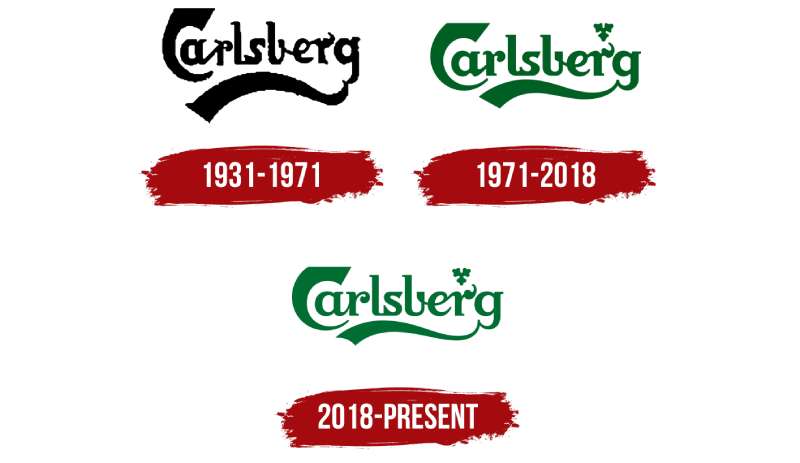
The Carlsberg logo has gone through a handful of changes since the brewery’s founding in 1847, but the core script design from 1904 has stayed remarkably intact. Each update was more of a refinement than a full redesign.
That’s actually unusual for a brand this old. Most companies their size have completely reworked their look at least a few times.
Early Carlsberg Marks (1847–1904)
- Years Active: 1847 to 1904
- Design Description: J.C. Jacobsen originally used a 12-pointed star (resembling a compass card) when he founded the brewery. His son Carl Jacobsen, who opened Ny (New) Carlsberg in 1882, adopted a swastika with four dots as his trademark. At that time, the symbol represented good luck and prosperity across many cultures.
- Color Scheme: Varied, typically dark tones on product labels
- Context: These marks reflected late 19th-century branding conventions. The elephant also became a recurring motif, tied to the famous Elephant Gate completed in 1901 at the brewery complex.
- Cultural Significance: The swastika was discontinued in the mid-1930s because of its association with the Nazi Party in neighboring Germany. The elephant imagery, however, survived and became the basis for Elephant Beer, launched in 1955.
The Bindesbøll Script Logo (1904–1930)
- Years Active: 1904 to 1930 (existed but was not the primary mark)
- Design Description: Thorvald Bindesbøll created a flowing Art Nouveau script with elongated tails on the “C,” “R,” and “G.” A three-lobed hop leaf emblem sat above the inscription. The lettering was handwritten with a fluid, organic quality.
- Color Scheme: Originally rendered in dark green on labels
- Designer: Thorvald Bindesbøll
- Context: Designed for the new Carlsberg Pilsner product. But here’s the thing. It sat unused for over two decades before becoming the official company logo.
- Key Changes from Previous: Complete departure from the star and swastika marks. This was the first script-based wordmark for the brand.
- Cultural Significance: Bindesbøll was already a respected figure in Danish design, known for ceramics and architectural work. This mark put his influence on one of Denmark’s biggest exports.
Official Adoption and Black-to-Green Shift (1931–1970)
- Years Active: 1931 to 1970
- Design Description: The Bindesbøll script became the official logo, replacing the older swastika-based marks. The lettering was initially rendered in black with the characteristic curved connections between letters. Through the 1940s and 1950s, small details shifted. The “a” and “r” connection changed, the tail on the “g” grew longer, and the tops of the “l” and “b” became straighter.
- Color Scheme: Transitioned from black to Carlsberg’s signature dark green
- Context: The brand needed to move away from the politically toxic swastika imagery. The Bindesbøll script offered a ready-made, distinctive alternative.
- Key Changes from Previous: Formalization of the script as the primary brand identifier across all markets
Addition of the Hop Leaf (1971–2017)
- Years Active: 1971 to 2017
- Design Description: The stylized hop leaf icon was added above the letter “r,” giving the logo its now-familiar silhouette. Letters became clearer and more refined. The typography kept its handwritten character but was tightened up overall.
- Color Scheme: Dark green (close to forest green) with white
- Context: This was the version most people grew up seeing on bottles, cans, and football kits. The brand’s “Probably the best lager in the world” slogan launched in 1973 (originally voiced by Orson Welles), and this logo version became inseparable from that campaign.
- Key Changes from Previous: Introduction of the hop leaf graphic element and overall letter refinement
- Cultural Significance: This version carried Carlsberg through decades of global expansion, major sports sponsorships, and its rise to one of the world’s largest brewery groups.
The Taxi Studio Rebrand (2018–Present)
- Years Active: 2018 to present
- Design Description: Taxi Studio, a Bristol-based agency that had worked with Carlsberg since 2010, led a careful global rebrand. The script was refined with thinner, more rounded letterforms. Letter spacing widened. The hop leaf shifted closer to the center of the “r” for better symmetry. The crown illustration was simplified. A custom brand typeface called Carlsberg Sans was created for supporting communications.
- Color Scheme: Lighter, brighter green (a “greener green” using more easily recyclable ink) with white. Red was removed entirely from the packaging palette.
- Designer: Taxi Studio, led by Creative Director Spencer Buck
- Context: Carlsberg’s perception in markets like the UK had become “laddish” and cheap. The rebrand aimed to reclaim the brand’s premium Danish heritage while also addressing sustainability (the new inks were designed to be easier to recycle).
- Key Changes from Previous: Thinner letterforms, wider spacing, repositioned hop leaf, simplified crown, removal of red, new “greener” ink technology
- Cultural Significance: The redesign was so subtle that many consumers didn’t notice it at all, which was the point. Jessica Felby, design director at Carlsberg, put it well when she said the goal was for it to look like what Carlsberg should always have been.
What Do the Design Elements of the Carlsberg Logo Mean?
Every piece of the Carlsberg logo ties back to the brewery’s Danish roots and its position as a premium pilsner brand. The hop leaf above the “r” directly references the key ingredient in beer production.
The flowing script lettering reflects the Art Nouveau movement that was popular in early 1900s Denmark. And the crown on product labels? That’s a nod to Carlsberg’s Royal Warrant, which earned the brand its “Hof” (court) nickname in Denmark.
Why Did Carlsberg Choose These Specific Colors?

Carlsberg Green
The primary brand color. The corporate version uses a deep green (#00321E), while the consumer-facing shade is brighter (#17B169). According to color theory, green connects to freshness, growth, and quality. But there’s a practical reason too. The green mirrors the tinted glass of Carlsberg’s beer bottles. It’s both a design choice and a product reference at the same time.
White
The secondary primary color. Hex: #FFFFFF. Used for the logotype on green backgrounds and for overall clarity. The green-and-white pairing creates a clean, refreshing impression that fits the product category.
Gold and Red
Found on the crown element of product labels. Gold represents premium quality and the brand’s royal connections. Red adds energy. These were reduced during the 2018 rebrand, with red completely removed from packaging.
The psychology behind these color choices works on multiple levels. Green is calming and fresh. White carries simplicity. Gold signals heritage. Together, they build a color palette that reads “premium but approachable.”
What Typography Style Is Used in the Carlsberg Logo?
The main logo uses a custom hand-drawn script that doesn’t match any commercially available font exactly, though it shares traits with typefaces like Aligarch Semi Bold and Gestura Semi Bold.
Some letters connect while others stand alone. The “C” curves like a sickle. A wavy line extends from the “g” to the left. It’s a serif-adjacent approach with Art Nouveau flair.
For brand communications beyond the logo, Kontrapunkt (a Copenhagen design agency) developed Carlsberg Slab, a two-weight slab serif typeface. The corporate identity uses Carlsberg Sans in three weights (light, regular, bold) with italic versions. Montserrat serves as the fallback sans-serif font for accessibility.
What Are the Hidden Meanings in the Carlsberg Logo?
The three-lobed hop leaf above the “r” doubles as a visual that resembles a shamrock or clover when reversed (white on green), tying into luck and fortune themes.
The flowing, unbroken quality of the script mirrors the idea of continuous brewing tradition. Took me a while to notice, but the way the “g” tail sweeps left actually creates a visual underline that holds the whole word together. Bindesbøll was trained as an architect, and you can feel that structural thinking in how the letterforms support each other.
How Does the Carlsberg Logo Compare to Competitor Logos?
In the beer logo space, Carlsberg sits in a unique position. Most major lager brands lean on crests, shields, or heavy illustration. Carlsberg went with script.
Look at the Heineken logo, which uses a horizontal red star and straight, clean lettering. Totally different approach. Or the Budweiser logo with its bow-tie shape and Americana styling. The Guinness logo pairs a harp with a serif wordmark, leaning into Irish heritage.
The Corona logo keeps things simple with a painted-on look. The Stella Artois logo goes full heraldic with its crest and horn. And brands like Modelo or Dos Equis lean heavily into Latin heritage through their mark designs.
What makes Carlsberg different? It’s one of the few global beer brands where the script lettering itself is the logo. No shield. No crest. No separate icon that works without the name. The wordmark does all the heavy lifting, which follows core logo design principles around simplicity and memorability.
The green color also sets it apart. While most competitors use red, gold, blue, or black as their dominant color, Carlsberg owns green in the beer category.
What Are the Technical Specifications of the Carlsberg Logo?
Official Color Codes
- Primary Color: Carlsberg Green (Corporate)
- Hex: #00321E
- RGB: (0, 50, 30)
- CMYK: (100, 0, 40, 80)
- Primary Color: Carlsberg Green (Consumer Brand)
- Hex: #17B169
- RGB: (23, 177, 105)
- CMYK: (87, 0, 41, 31)
- Secondary Color: White
- Hex: #FFFFFF
- RGB: (255, 255, 255)
- CMYK: (0, 0, 0, 0)
The corporate visual identity also includes seven secondary colors (ranging from pink and red-brown to light blue, blue, yellow, light green, and khaki) to support the diversity of Carlsberg Group’s brand portfolio.
Dimensions and Proportions
- Aspect Ratio: The logo is horizontally oriented. The SVG source file is nominally 115 x 65 pixels, giving an approximate ratio of roughly 1.77:1.
- Minimum Clear Space: Defined by the width of the Carlsberg “C.” This padding must always be maintained around the logo.
- Free Placement Rule: When not in a fixed position, the logo should be scaled down 50% to 80% from CAPS-height and centered relative to surrounding text.
- Usage Guidelines: Headlines and display text in brand communications must always appear in ALL CAPS using Carlsberg Sans. The logo itself should only appear in Carlsberg Green on white backgrounds or white on colored/image backgrounds. The hop leaf graphic element should be toned down in opacity for subtle, tone-on-tone effects.
The logo is available as vector graphics (SVG, EPS, AI) and raster formats (PNG). For print work, proper DPI settings matter. At least 300 DPI for any printed material.
What Cultural Impact Has the Carlsberg Logo Had?
The Carlsberg logo became a fixture in European football culture through decades of shirt sponsorships, most famously with Liverpool FC from 1992 to 2016. For a whole generation of football fans, the green script on a red jersey is a deeply familiar image.
The logo also made history when it was rendered in Chinese characters for a Liverpool match against Chelsea on May 2, 2010, celebrating Liverpool’s twin-city relationship with Shanghai during the World Expo. That kind of cross-cultural adaptation of a brand identity across different writing systems is tricky, and Carlsberg has done it in Hebrew, Arabic, Korean, and several other scripts over the years.
In 2004, the Danish Design Center gave the logo a design prize on its centenary. No other logo had received that recognition. It confirmed what many in the design community already felt: Bindesbøll’s script had become a lasting piece of Danish cultural identity, not just a beer brand mark.
How Does the Carlsberg Logo Fit Into the Overall Brand Identity?
The logo is the anchor of a larger brand system. It connects directly to the hop leaf graphic (used as a standalone decorative element), the JC Jacobsen signature (referencing the founder), the crown (representing the Royal Warrant), and the “Probably the best beer in the world” tagline launched in 1973.
Carlsberg’s brand style guide treats the script logo as the master brand element. Sub-brands like Carlsberg Export, Carlsberg Elephant, and Carlsberg Sport all build from it. The corporate group identity uses the same script with Carlsberg Sans for typographic hierarchy in reports, presentations, and digital products.
The packaging design strategy from the 2018 rebrand stripped things back to let the logo breathe. Less clutter, more white space, simpler label layouts. That approach to visual hierarchy puts the wordmark front and center on every touchpoint.
How Should the Carlsberg Logo Be Used?
Do’s:
- Use the logo in Carlsberg Green on white backgrounds or white on colored/image backgrounds
- Maintain the minimum clear space (defined by the width of the “C”)
- Follow the 50%–80% scaling rule when placing the logo freely in layouts
- Use Carlsberg Sans for all display text and headlines in ALL CAPS
- Combine primary colors with only one secondary color per layout
Don’ts:
- Don’t modify the letterforms, spacing, or proportions of the script
- Don’t use the logo in unapproved colors
- Don’t place the logo on cluttered or low-contrast backgrounds without ensuring legibility
- Don’t separate the hop leaf from the wordmark in contexts where they appear together
- Don’t reproduce or alter materials from the Carlsberg website without written permission from Carlsberg Breweries A/S
Official logo assets are managed through Carlsberg’s internal brand portal. For external use, the corporate design guide is publicly available on carlsberggroup.com. The Carlsberg trademark is registered and enforced globally by Carlsberg A/S, headquartered at Ny Carlsberg Vej 100, 1799 Copenhagen V, Denmark.
All trademark reproductions require prior authorization. Unauthorized use of the Carlsberg name, logo, or any associated brand elements may result in legal action under applicable intellectual property laws.
FAQ on The Carlsberg Logo
What does the Carlsberg logo look like?
It’s a green script wordmark spelling “Carlsberg” in custom hand-drawn lettering. A stylized hop leaf sits above the letter “r.” On product labels, a gold-and-red crown appears above the text. The whole thing screams Art Nouveau.
Who designed the Carlsberg logo?
Danish architect Thorvald Bindesbøll created it in 1904 for the Carlsberg Pilsner launch. He was paid 500 kroner. The design sat unused for decades before becoming official in 1931. Bindesbøll was already well-known for ceramics and ornamental work in Copenhagen.
When was the Carlsberg logo first introduced?
Bindesbøll drew it in 1904. But the Carlsberg brand identity didn’t formally adopt it until 1931, replacing earlier marks that included an elephant and a swastika symbol. The script has remained largely unchanged since.
What do the colors in the Carlsberg logo mean?
The signature Carlsberg green represents freshness and quality. It also matches the green glass of their beer bottles. White provides clarity. Gold and red on the crown reference the brand’s Royal Danish Court connections and premium positioning.
Has the Carlsberg logo changed over the years?
Yes, but subtly. The biggest shifts were the 1971 addition of the hop leaf icon and the 2018 rebrand by Taxi Studio. That last update refined the letterforms, widened spacing, and introduced a lighter, more recyclable green ink.
What font does the Carlsberg logo use?
The logo itself uses a custom script. No commercial font matches it exactly. For brand communications, Kontrapunkt developed Carlsberg Slab, a two-weight typeface. Corporate materials use Carlsberg Sans in light, regular, and bold weights.
What is the hop leaf symbol above the letter “r”?
It’s a three-lobed hop leaf emblem referencing hops, a core ingredient in beer brewing. Added in 1971, it gives the Carlsberg visual identity its distinctive silhouette. When reversed to white on green, it resembles a shamrock.
Why does the Carlsberg logo have a crown?
The crown reflects Carlsberg’s Royal Warrant from the Danish court. In Denmark, the beer was called “Hof” (court) because of this connection. The crown uses gold and red, though red was removed from packaging during the 2018 beer label redesign.
What is the Carlsberg logo’s connection to Danish design?
Bindesbøll was a pioneer of Danish industrial design. In 2004, the Danish Design Center gave the logo a design prize on its 100th anniversary. No other logo had received that honor. The mark is considered part of Denmark’s design heritage.
Can I use the Carlsberg logo for my own projects?
No. The Carlsberg trademark is registered globally by Carlsberg Breweries A/S. Any reproduction requires written permission. Their corporate design guide on carlsberggroup.com outlines approved usage. Unauthorized use can lead to legal action.
Conclusion
The Carlsberg logo has held its ground for over a century. Few beer company logos can claim that kind of durability, and even fewer have done it with a design that still feels modern.
Bindesbøll’s Art Nouveau script from 1904 gave the Carlsberg Group something most brands spend millions trying to find: a mark that doesn’t need replacing. The 2018 brand refresh by Taxi Studio proved you can update a logo without losing what made it work in the first place.
From Copenhagen to global markets, from green bottles to football kits, the Carlsberg logo remains a case study in how restraint and heritage can outperform trends. That hop leaf over the “r” isn’t going anywhere.

Renowned for his expertise in logo design and visual branding, Bogdan has developed a multitude of logos for various clients.
His skills extend to creating posters, vector illustrations, business cards, and brochures. Additionally, Bogdan's UI kits were featured on marketplaces like Visual Hierarchy and UI8.
He also wrote in the past years on sites like Design Your Way, WebDesignerDepot, WPDean, Designmodo, Speckyboy, Slider Revolution, and more.
- Canva vs PowerPoint: Which Is Better for Presentations? - 22 September 2026
- How to Install Fonts on Mac (Step-by-Step Guide) - 20 September 2026
- From Mockup to Code: How AI-Augmented Development Speeds Up the Design Handoff - 19 September 2026

Bogdan Sandu is a seasoned designer who has been designing websites since 2008. Renowned for his expertise in logo design and visual branding, Bogdan has developed a multitude of logos for various clients. His skills extend to creating posters, vector illustrations, business cards, and brochures. Additionally, Bogdan's UI kits were featured on marketplaces like Visual Hierarchy and UI8. He also wrote in the past years on sites like Design Your Way, WebDesignerDepot, WPDean, Designmodo, Speckyboy, Slider Revolution, and more.
You Might Also Like