Karl Lagerfeld drew the FF monogram in three seconds. Fendi has been building ads around it for sixty years.
Fendi ads run on a small set of fixed parts: the double F, a Helvetica Bold wordmark, a tobacco-and-black palette and Rome. Everything else moves.
This page collects the campaigns that defined the house, from Lagerfeld’s first shoot in 1988 to the Baguette work of 2026, with the year, photographer and market behind each one.
You also get the design analysis most galleries skip:
- Layout and visual hierarchy in the print work
- Typography and monogram scaling
- How the campaign films differ from the spreads
- What designers can take from it
Fendi advertising covers 100 years of the house and 60 years of the FF monogram, from the first campaign Karl Lagerfeld shot in 1988 to the Baguette campaign photographed by Bibi Borthwick in 2026.
The work runs on two constants: a single repeated graphic mark and the city of Rome.
This page covers the Fendi ad campaigns that defined the house, grouped by campaign, with the year, the photographer and the market behind each one. It also covers the layout, type and color decisions that make the print work hold together across six decades.
Fendi Advertising at a Glance
Fendi has advertised under in-house creative direction since 1988, when Karl Lagerfeld shot the maison’s first campaign. Its best-known campaigns are #MeAndMyPeekaboo, Fendace and the Baguette anniversary series. The visual signature combines the FF monogram, Roman locations and a tobacco-and-black palette.
| Attribute | Value |
|---|---|
| Founded | Rome, 1925, by Adele and Edoardo Fendi |
| First house campaign | 1988, photographed by Karl Lagerfeld |
| Creative direction | Karl Lagerfeld (1965–2019), Kim Jones (2020–2024), Silvia Venturini Fendi (2025), Maria Grazia Chiuri (2025–present) |
| Best-known campaigns | #MeAndMyPeekaboo, Fendace, Baguette anniversary, Fan di Fendi |
| Recurring photographers | Karl Lagerfeld, Steven Meisel, Craig McDean, David Sims, Darius Khondji |
| Primary media | Magazine spreads, OOH, campaign film, social |
| Visual signature | FF monogram, Rome as backdrop, tobacco and black, Helvetica Bold wordmark |
| Owner | LVMH, Fashion and Leather Goods division |
Which Fendi Ad Campaigns Are the Most Famous?
Five campaigns carry the house: Lagerfeld’s studio work (1988-2019), #MeAndMyPeekaboo (2018-2024), Fendace with Versace (2022), the Baguette anniversary series (2022-2026) and the Fan di Fendi fragrance launch (2010). Each one solved a different problem, and only two of them lead with a garment.
Karl Lagerfeld’s Studio Campaigns (1988-2019)
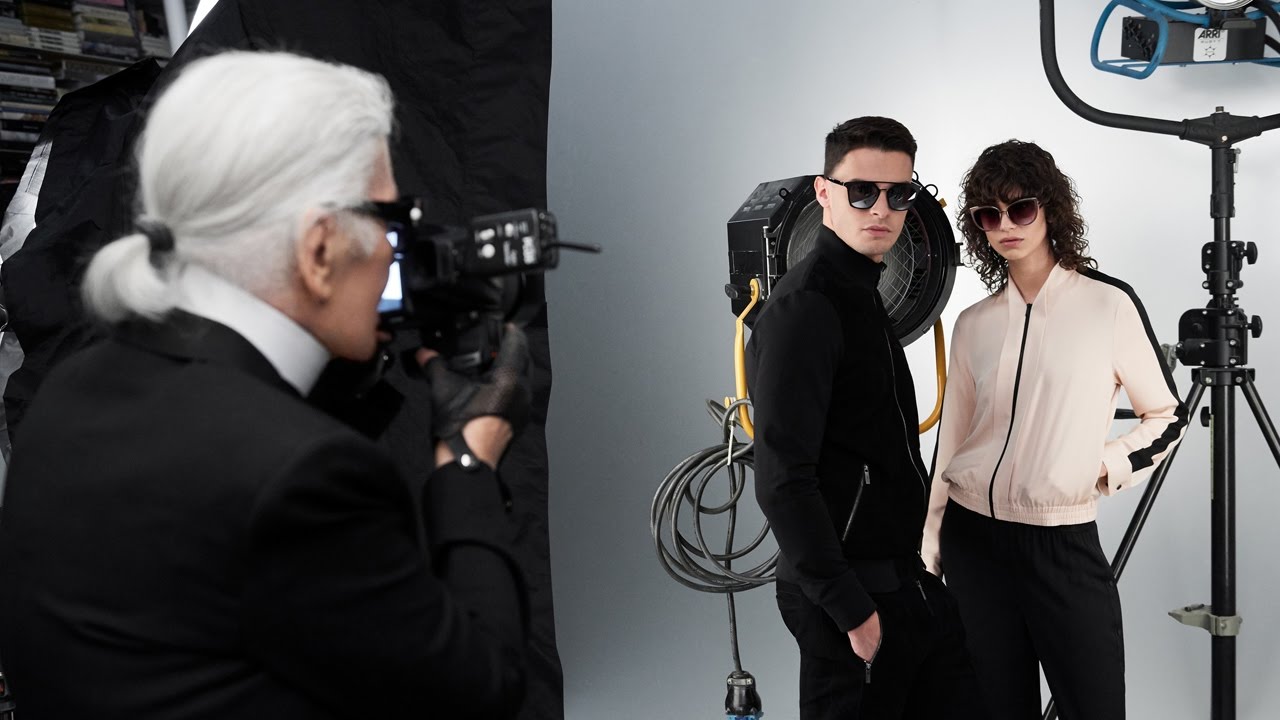
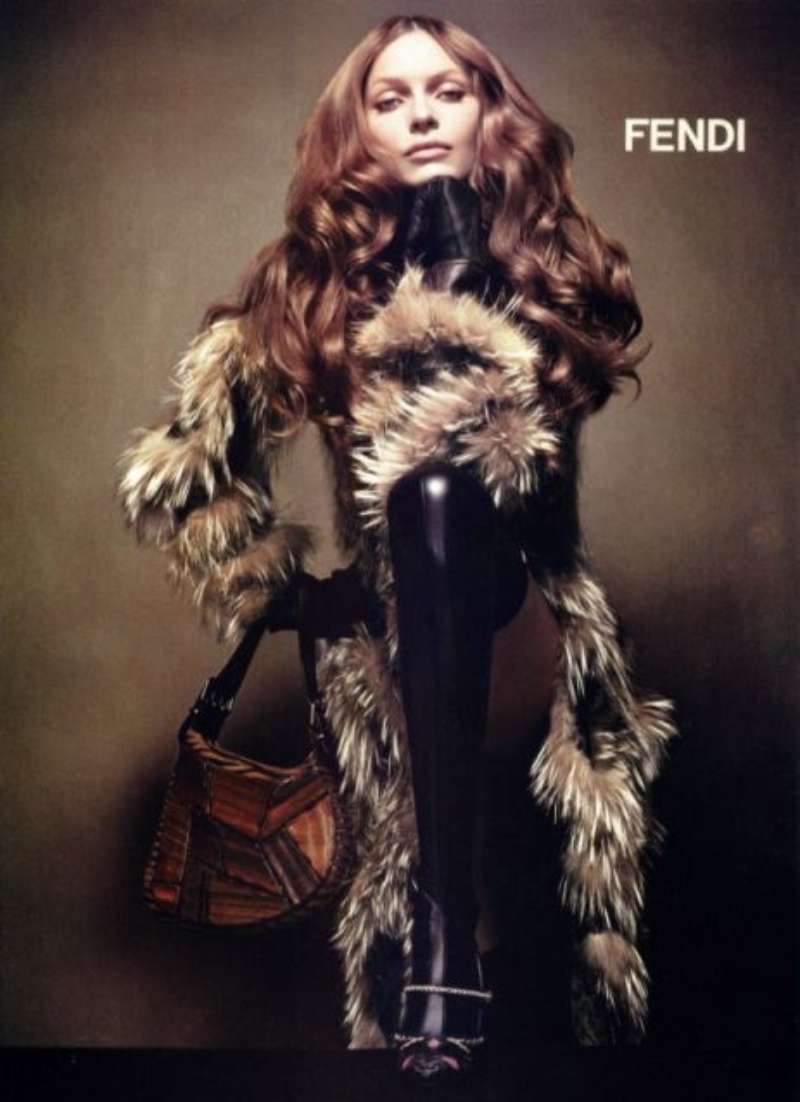
Lagerfeld shot the first Fendi advertising campaign in 1988 and kept the camera for 31 years, which is close to unheard of in luxury.
The setup barely moved: seamless backdrop, hard directional light, models cut out against flat color or bare white.
Why it worked: a controlled studio removes location noise, so the fur, the leather and the monogram carry the whole frame. It also made the ads cheap to reformat across markets.
His final campaign, for Spring 2019, put Kaia Gerber, Adut Akech and Anok Yai against a clean white background at his Paris studio, styled by Charlotte Stockdale and Katie Lyall.
#MeAndMyPeekaboo (2018-2024)

Launched in 2018 for the Peekaboo bag’s 10th anniversary, this is the house’s longest-running product campaign. Six installments over six years, per WWD.
The casting rule: real families, always women, always more than one generation.
- 2018: Silvia Venturini Fendi with daughters Delfina Delettrez Fendi and Leonetta Luciano Fendi
- 2018: Kris Jenner, Kim Kardashian and North West
- 2019: Catherine Zeta-Jones and Carys Douglas, shot in Rome
- 2023: Naomi Campbell, lensed by David Sims
- 2024: Kate Moss and Lila Grace Moss, shot by Craig McDean
The 2024 images are almost aggressively plain. Neutral wardrobe, grey seamless, two bodies, two bags. All the contrast comes from the hardware.
Fendace (2022)

Steven Meisel photographed the Fendace campaign, released in May 2022 to launch the Fendi and Versace collection swap first shown at Milan Fashion Week in September 2021.
The concept was a fictional nightclub. Alec Maxwell filmed two campaign videos in which Naomi Campbell and Kristen McMenamy work the door while Adut Akech, Anok Yai, Imaan Hammam, Anja Rubik, Amar Akway and Lina Zhang queue to get in.
Design note: the FF monogram and the Versace Greek key sit in the same frame at the same weight. Neither logo wins, which is the entire point of the swap.
The Baguette Anniversary Campaigns (2022-2026)

Silvia Venturini Fendi designed the Baguette in 1997. It has sold more than a million bags since, according to WWD.
Sarah Jessica Parker turned it into a cultural object in season three of Sex and the City with a six-word correction to a mugger: it is not a bag.
Fendi rebuilt the anniversary program around that fact. The 2022 silver anniversary brought in Marc Jacobs, Tiffany & Co., Porter and Parker to reinterpret the bag. Kim Jones staged the show at Hammerstein Ballroom in New York rather than Milan.
The 2026 campaign, shot by Bibi Borthwick to Addison Rae’s “Fame Is a Gun”, brought Parker back alongside Jessica Alba, Emma D’Arcy, Iris Law, Bang Chan, Song Yuqi, Ren Meguro and Mina.
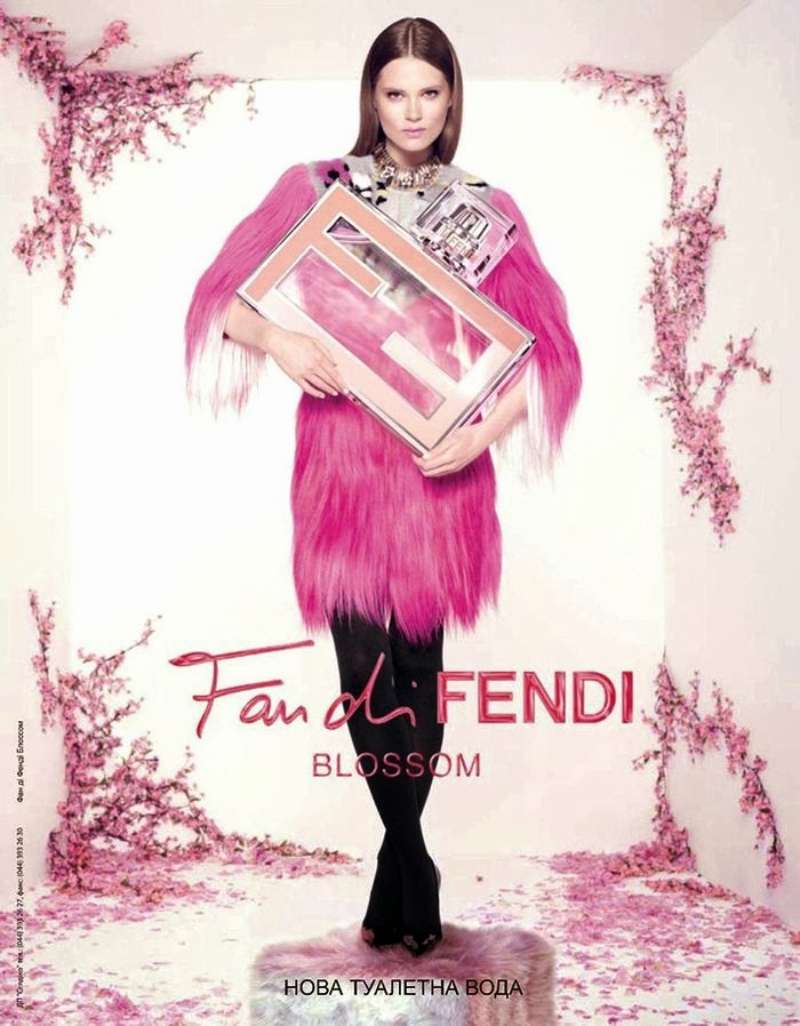
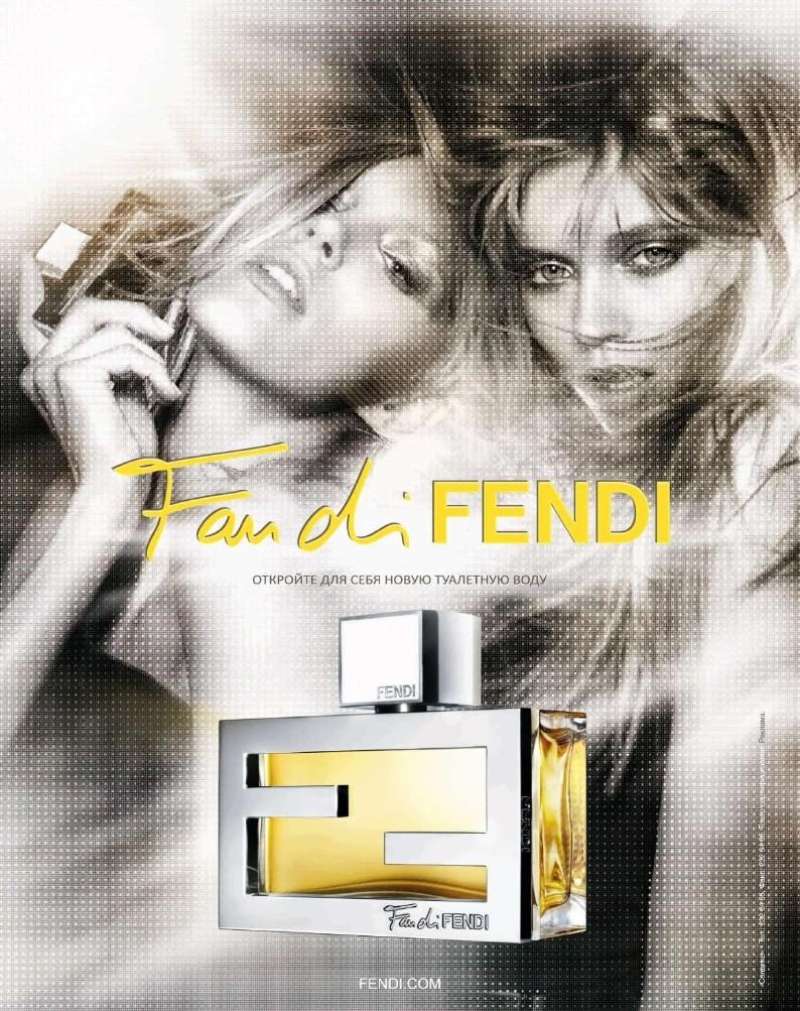
Fan di Fendi Fragrance Advertising (2010-2014)

Art direction: Fabien Baron Photography: Darius Khondji Cast: Anja Rubik, Abbey Lee Kershaw, Karmen Pedaru Soundtrack: The Kills
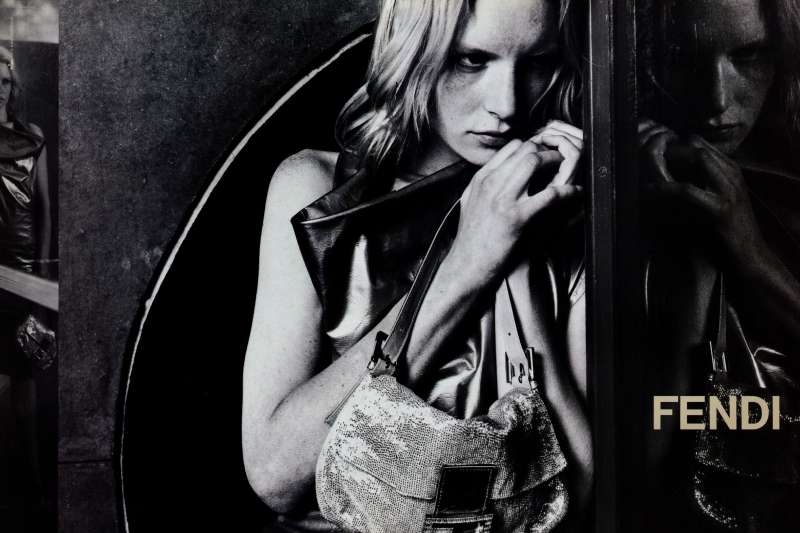
Baron shot it monochrome, which is unusual for Fendi and reads as a deliberate break from the fur-and-color house style.
Fendi followed with Fan di Fendi pour Homme in 2012, pairing Mark Ronson with Rubik, photographed by Lagerfeld.
Fendi Logo Capsule Campaigns From 2018 and 2019

Three back-to-back capsules turned the monogram itself into the campaign subject.
FF Reloaded launched in London in May 2018 with five graffiti writers. Fendi Mania followed in October 2018, fusing the Fendi F with the Fila F. Fendi Roma/Amor arrived in May 2019 with British 3D lettering artist Pref and eyewear label Gentle Monster.
Fendi ran the Roma/Amor lettering as dimensional wave and parallelepiped forms. Reading the Fila mashup as a mistake misses what it did commercially, which was hand a 93-year-old furrier a streetwear audience overnight.
How Do Fendi Print Ads Work Visually?
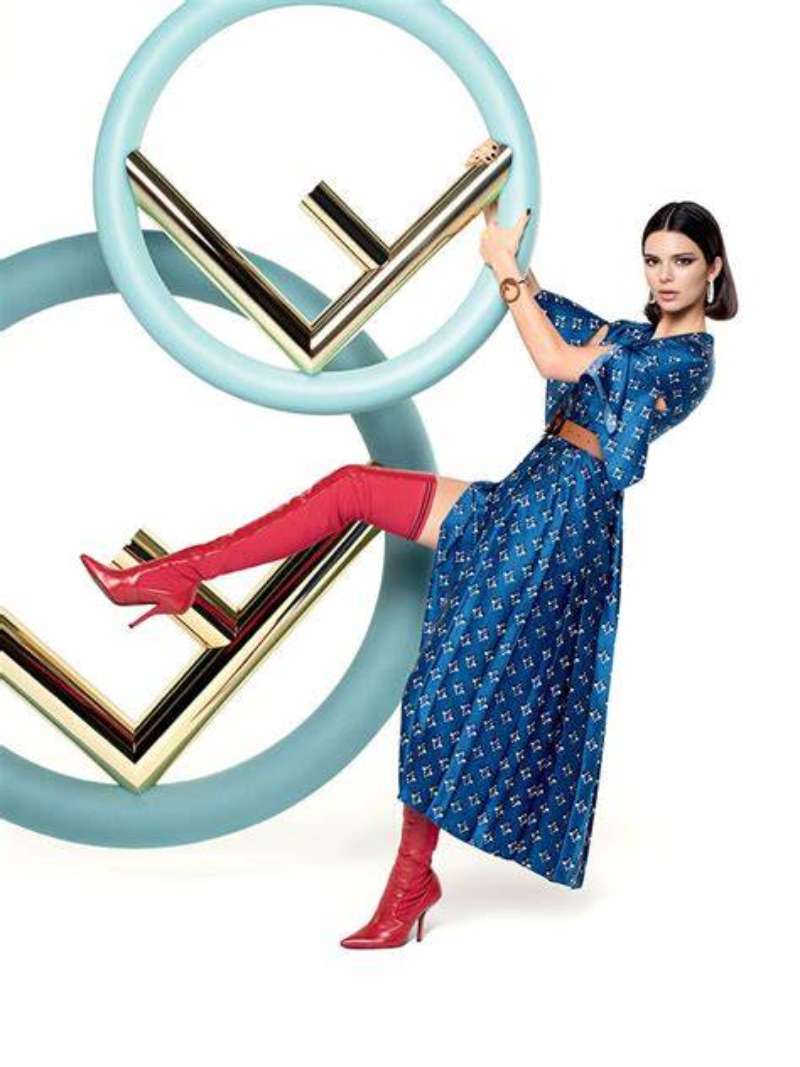
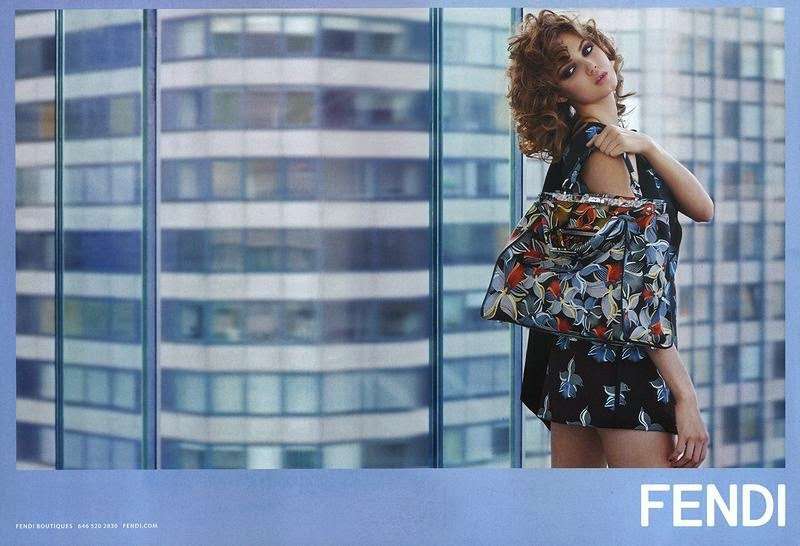
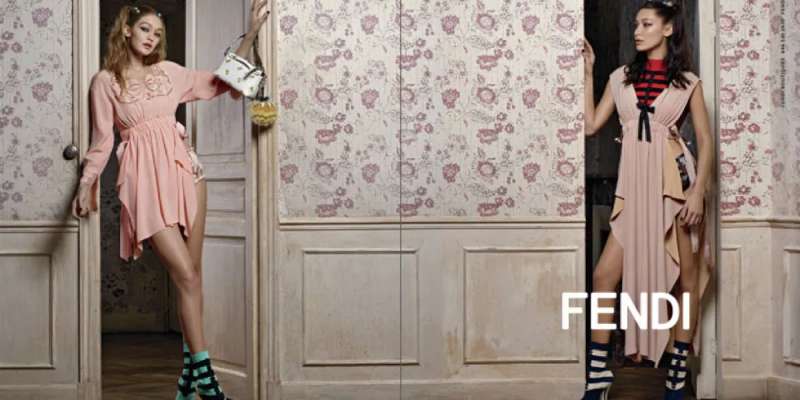
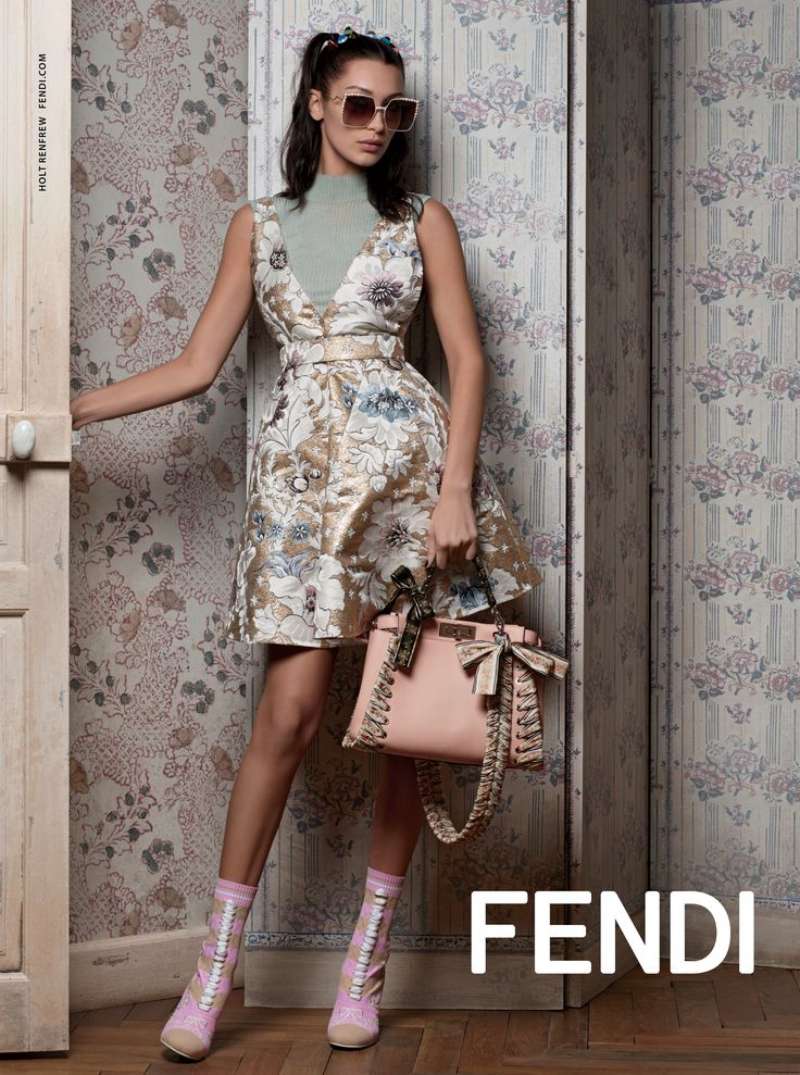
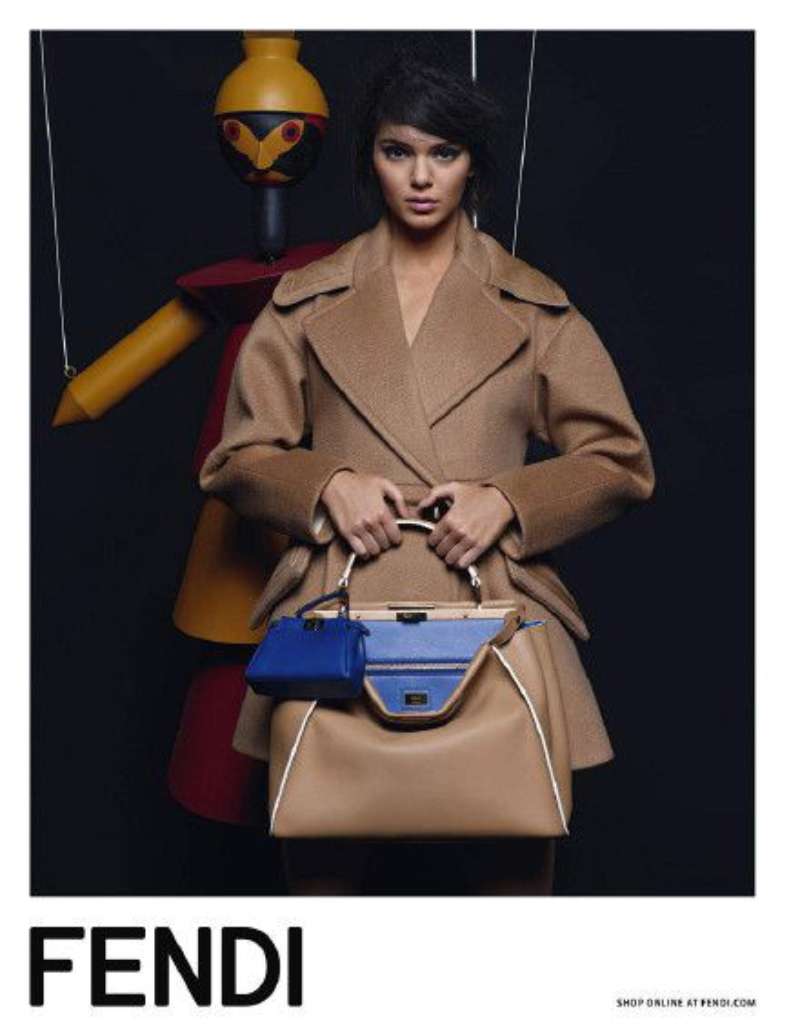
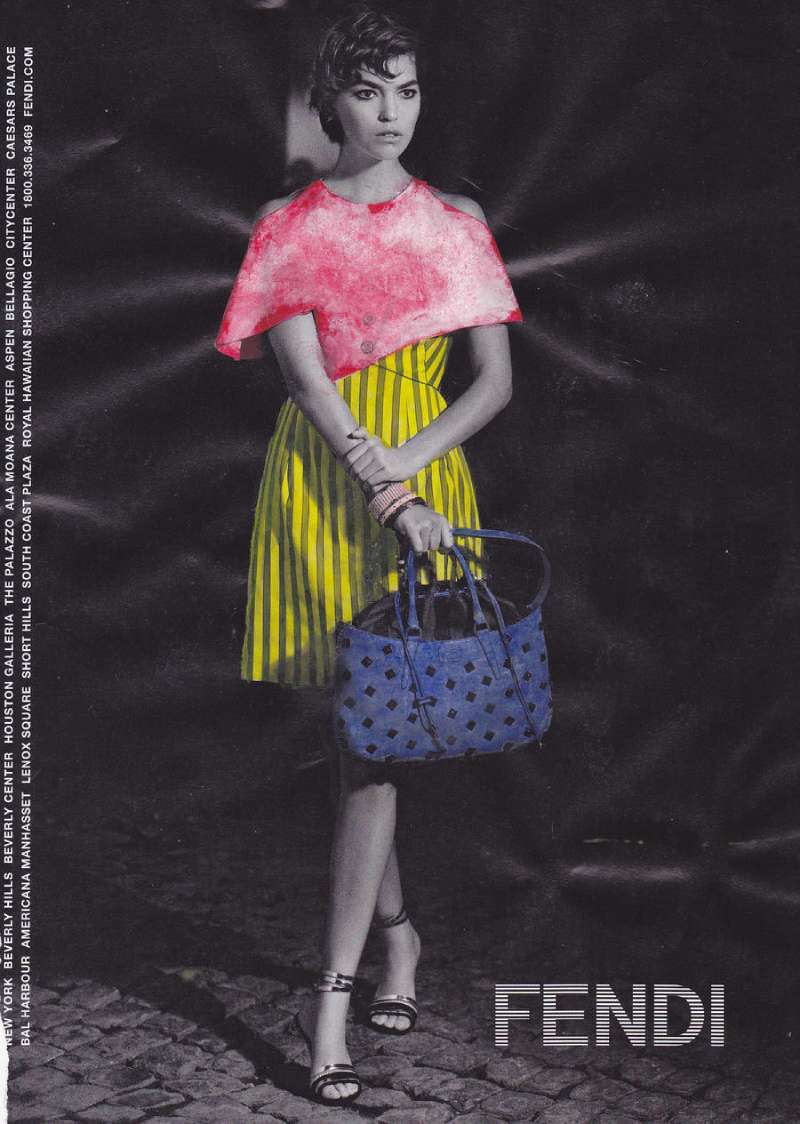
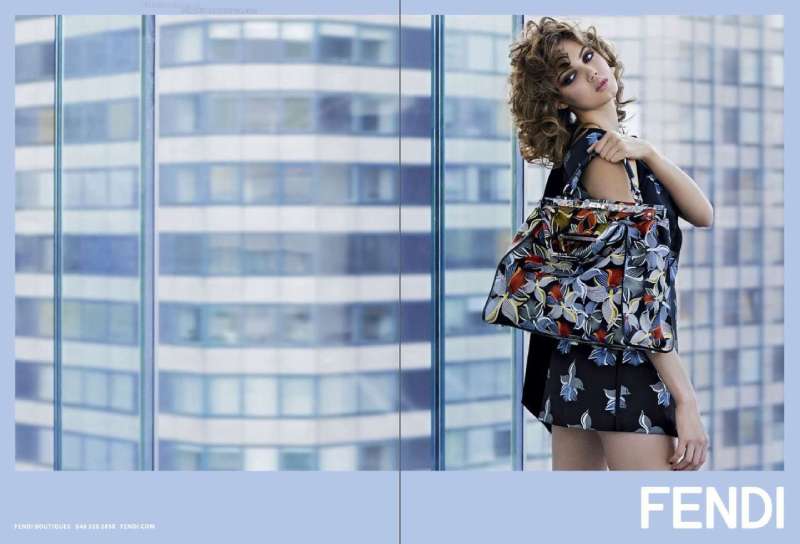
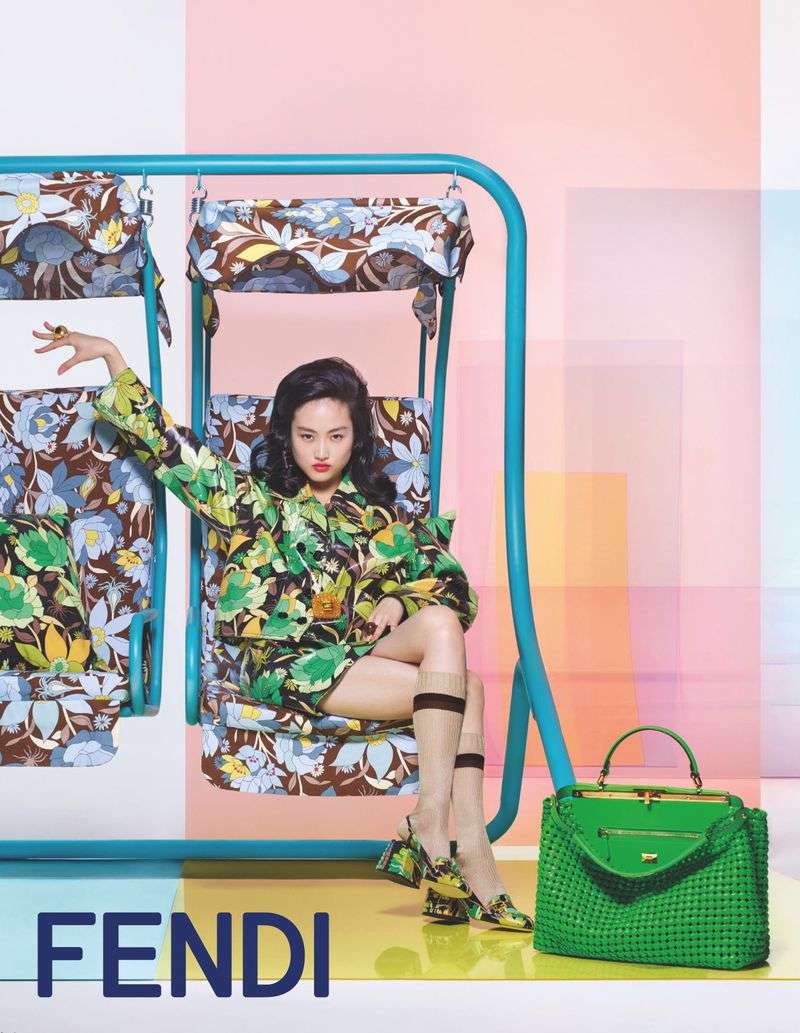
Fendi print ads use a repeating monogram field, a neutral grotesque wordmark and a tobacco-and-black core palette. Product sits high in the frame, copy sits low or vanishes entirely, and the logo lock-up almost always parks in a bottom corner rather than the optical center.
Type
The Fendi wordmark is set in Helvetica Bold, tight, uppercase, no letterspacing games.
That is the whole brand typography system. A sans-serif with no personality of its own is the correct call here, because the monogram is already doing the identity work.
Compare the Karligraphy mark Lagerfeld drew in 1981, a script treatment that reads as ornament, not as typography in the structural sense.
The Monogram as Pattern
Lagerfeld drew the double F in 1965 and later said it took three seconds. It stands for Fun Furs, not Fendi.
The Zucca print, launched in 1967, scales that mark up and tiles it. Repetition at that size stops being a logo and becomes a texture, which is why a Zucca-heavy ad needs almost no other graphic element.
The interlock also depends on negative space in the logo. One F is inverted, so the counters of the two letters share a single void.
Layout and Hierarchy
Typical Fendi spread, top to bottom:
- Model and product, upper two thirds
- Empty background field, middle
- Wordmark, bottom edge, small
That order is deliberate. The visual hierarchy puts the bag above the brand, which only works when the brand is already known.
Fendi uses far more white space than its Roman peers, and it uses that space as a framing device rather than as decoration.
Color
Tobacco brown, black, cream. That is the historic core.
The yellow used on the 2025 centenary stamp is the exception, and the house treats it as a signature accent rather than a base.
Seasonal campaigns push the color palette further (the 2022 Peekaboo film runs pink, green, yellow and brown bags in the same sequence), but the archive palette snaps back every anniversary.
Scale
Fendi campaigns rely on scale and proportion shifts more than most luxury houses.
The Spring 2016 campaign, shot by Lagerfeld with Vanessa Moody and Edie Campbell, staged the models against an oversized replica of the collection’s floral motif. Same graphic, wrong size, and the image reads as set design instead of pattern.
How Do Fendi TV Commercials Differ From Its Print Ads?
Fendi film work uses named directors, Roman locations and narrative, while the print work stays in the studio. The films run three to five minutes rather than 30 seconds, live on YouTube and Instagram rather than broadcast, and often carry no product close-up until the final frame.
Peekaboo, directed by Luca Guadagnino (2022)
Guadagnino directed Adwoa Aboah floating over Roman rooftops before landing on the steps of Fendi’s headquarters, the Palazzo della Civilta Italiana.
Why the location matters: the building is the FF monogram’s rumored source. Landing the model on it closes a loop the print ads only imply.
Fendace nightclub films (2022)
Alec Maxwell shot two videos of models arriving at a fictional club, cut fast, scored loud.
Print for the same campaign is static and posed. The film supplies the joke that the still images cannot, which is a clean example of storytelling being handed to the medium that can carry it.
#MeAndMyPeekaboo video chapters (2018-2020)
The video arm ran as interviews. Women talk about the bag they inherited.
Kanye West scored the Kardashian chapter with Love Lockdown. In 2020, Chloe x Halle were given full creative control of their chapter, assembling their own team, which Fendi had not done before.
How Has Fendi Advertising Evolved Since 1965?
Fendi advertising moved through four phases: monogram creation in the 1960s, logo maximalism in the 1980s, product-hero it-bag advertising from 1997, and family-and-heritage narrative from 2018. Rome enters the frame as a subject only in the 2010s.
| Period | Strategic shift | Representative work |
|---|---|---|
| 1965-1979 | Fur repositioned as fun, monogram created | Zucca print, 1967 |
| 1980-1999 | Logo maximalism, first shot campaigns | Lagerfeld’s first house campaign, 1988 |
| 1997-2009 | Product as hero, entertainment placement | Baguette in Sex and the City |
| 2010-2019 | Rome as brand asset, family narrative | Trevi Fountain show, 2016; #MeAndMyPeekaboo, 2018 |
| 2020-2026 | Collaboration, wider casting, K-pop ambassadors | Fendace, 2022; Baguette, 2026 |
The Rome pivot has a receipt. Fendi funded the Trevi Fountain restoration at 2.18 million euros over 17 months, then staged the Legends and Fairy Tales couture show on a transparent runway across the basin in July 2016 for the house’s 90th anniversary.
Forty-six looks. Kendall Jenner opened, Bella Hadid closed, roughly 600 guests watched.
Fendi extended the program under the Fendi for Fountains name, restoring four more Roman fountains for 280,000 euros, unveiled in 2019. The initials are the joke.
Which Agencies Created Fendi Advertising?
Fendi has no traditional agency of record. Creative direction sits in-house, with the artistic director commissioning photographers directly, and House + Holme handling campaign direction on selected projects. This is standard for LVMH houses and unusual against consumer brands.
House + Holme
Ronnie Cooke Newhouse, owner and creative director of House + Holme, directed Fendi’s 2023 astrology capsule campaign with Irina Shayk alongside Karl Bolander.
The same agency has worked with Lanvin, Dunhill, Moncler and Comme des Garcons, which tells you the brief type: image-led luxury, low copy volume, no retail message.
The photographer-as-agency model
Lagerfeld photographed Fendi campaigns himself from 1988 until his death in February 2019. That collapses the usual client-agency-photographer chain into one person.
After 2019 the house started commissioning outside names per campaign. Steven Meisel shot Fendace, David Sims shot Naomi Campbell for Peekaboo in 2023, Craig McDean shot the Moss campaign in 2024.
Fragrance is a separate pipeline
Fan di Fendi came out of LVMH Fragrance Brands, not the fashion house.
Fabien Baron art-directed the campaign and designed the bottle. Darius Khondji shot it. Neither had a standing Fendi relationship, and it shows in the advertising design, which looks nothing like the 2010 ready-to-wear work.
What Can Designers Learn From Fendi Ads?
Fendi’s advertising offers 5 transferable lessons: treat the monogram as texture, keep the wordmark neutral, let the location carry meaning, cast for relationship over reach, and hold the palette even when the product changes.
- Repeat one mark until it reads as pattern, not as a signature. Zucca works because it tiles.
- Set the wordmark in a neutral grotesque and then leave it alone. Helvetica Bold has survived every creative director since 1965.
- Put the city in the frame when the city is the story. Rome earns its place in Fendi work because the house paid to restore it.
- Cast for relationship, not reach. Mother and daughter in one frame communicates inheritance faster than any line of copy.
- Hold the accent color to one. The Fendi yellow works because nothing else competes with it.
Fendi’s whole visual identity rests on a mark that took three seconds to draw and 60 years to enforce. The enforcement is the skill.
How Do Fendi Ads Compare to Versace and Gucci Ads?
Fendi advertises quieter than its Italian rivals. Versace leads with the body and gold, Gucci leads with narrative maximalism and set dressing, Prada leads with intellectual detachment. Fendi leads with the object and a flat background, and lets the monogram do the shouting.
| House | Lead element | Typical background |
|---|---|---|
| Fendi | Bag or fur, monogram texture | Seamless studio, or Rome |
| Versace | Body, gold hardware, Greek key | High-saturation set or club |
| Gucci | Scene and styling density | Built narrative environment |
| Prada | Face and posture | Architectural, near-empty |
The Fendace campaign is the useful test case, because it put two of these systems in one frame. Meisel gave Versace the color and Fendi the structure, and the results read as a negotiation rather than a merger.
For the wider picture, compare how Versace ads handle the same Italian luxury audience, how Gucci ads use set design as the primary message, and how Prada ads strip the frame down. French competitors run differently again, as Dior ads show.
What Makes Fendi Advertising Work?
Fendi advertising works because the house has changed almost nothing about its graphic system in sixty years while changing nearly everything about who appears inside it.
The mark stays. The wordmark stays. The tobacco and black stay.
The casting moved from studio models to real families to K-pop ambassadors, and the backdrop moved from seamless paper to the city of Rome, without either shift requiring a redesign.
That is the discipline worth copying. Most brands respond to a new audience by rebuilding their identity, then wonder why recognition drops.
Fendi kept the container fixed and swapped the contents. A hundred years in, a reader can identify a Fendi ad from the corner of the page, before reading a single word of it.
Fendi Ads Examples



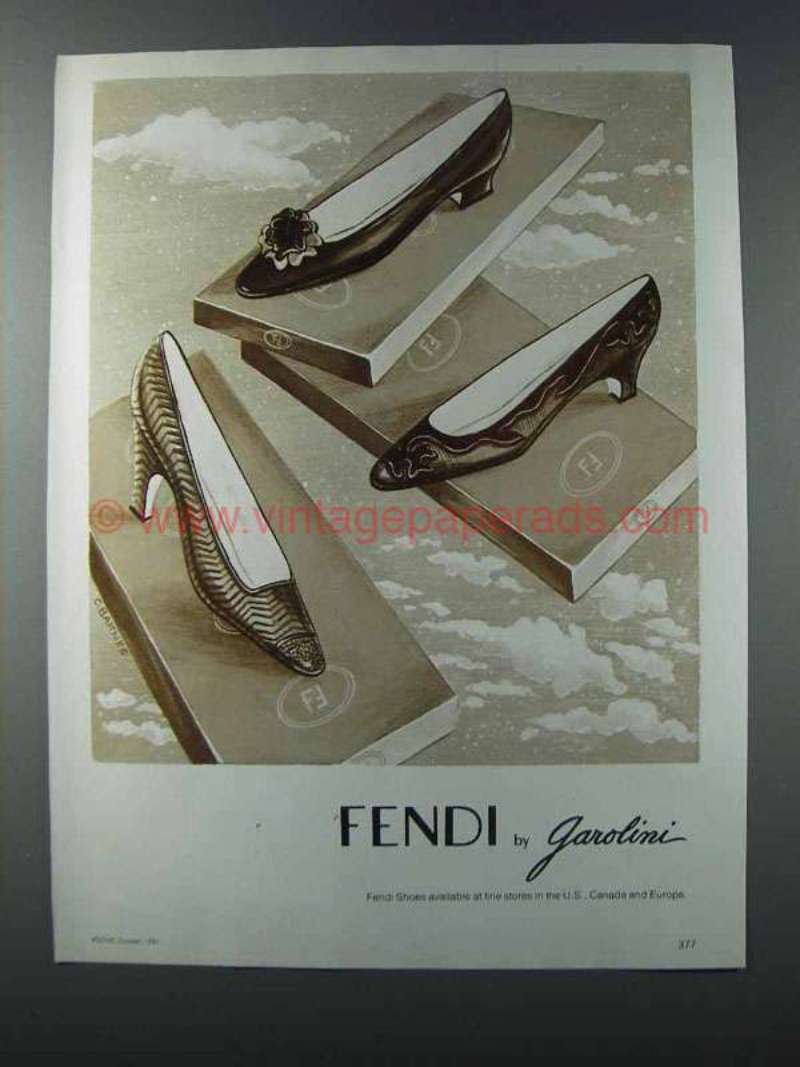

FAQ on Fendi Ads
When did Fendi run its first advertising campaign?
- Karl Lagerfeld photographed it himself, 23 years after joining the house in 1965.
Before that, Fendi relied on press coverage, cinema placement and the Zucca print doing its own work in the street.
Does Fendi use a tagline in its ads?
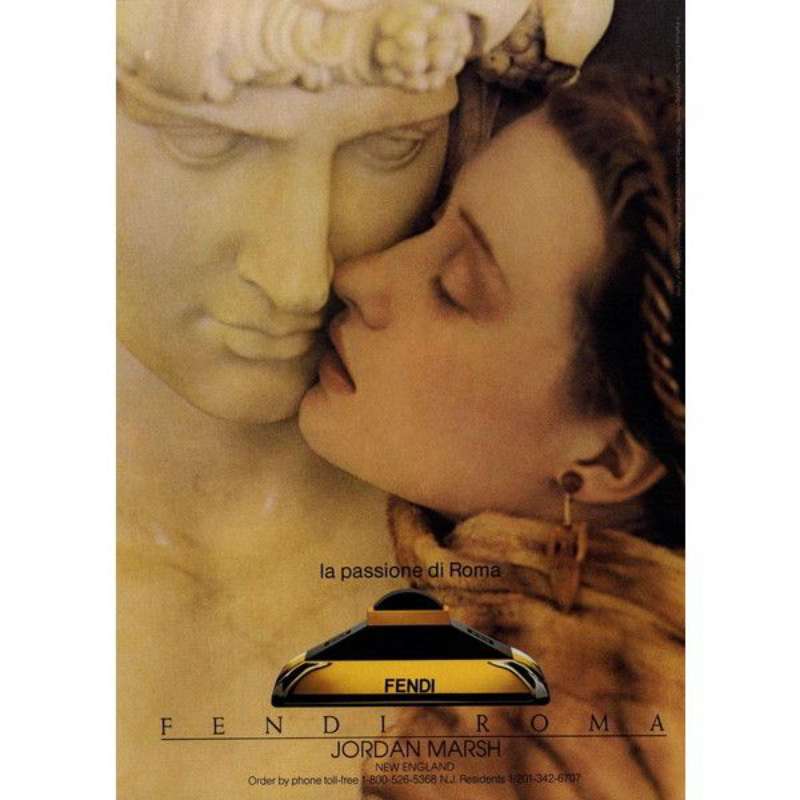
No persistent one. The house runs the Fendi Roma lock-up instead of a slogan, treating the city name as the claim.
The 2019 Roma/Amor capsule pushed that wordplay onto product, which is as close to copywriting as Fendi gets.
Which Fendi campaign featured the Kardashians?
The 2018 #MeAndMyPeekaboo chapter, shot for the bag’s 10th anniversary.
Kris Jenner, Kim Kardashian and North West appeared as three generations. Silvia Venturini Fendi told WWD the brief was expanding the idea of family beyond her own.
Did North West appear in a Fendi ad?
Yes, at age five, in that same 2018 chapter.
It was her modelling debut. Kanye West’s Love Lockdown scored the accompanying short film, which is unusual credit stacking for a handbag campaign.
What was Fendi’s “Thank you Karl” newspaper ad?
A full-page tribute placed in international newspapers in February 2019, days after Lagerfeld’s death.
The image showed him on the terrace of the Rome headquarters, signed off by the Fendi family. Pure obituary format, no product.
What music has Fendi used in its campaign films?
- The Kills, for Fan di Fendi in 2010
- Kanye West, Love Lockdown, 2018
- Let’s Walk from The Light in the Piazza, 2022
- Addison Rae, Fame Is a Gun, 2026
Which supermodels have fronted Fendi campaigns?
Kate Moss, Naomi Campbell, Kristen McMenamy, Adut Akech, Anok Yai, Imaan Hammam, Anja Rubik, Kaia Gerber, Edie Campbell and Adwoa Aboah.
Kendall Jenner opened the Trevi Fountain show and Bella Hadid closed it.
Did Fendi really run a campaign with Fila?
Yes. Fendi Mania launched in October 2018, fusing the Fendi F with the Fila F into a single mark.
The blend read as a logo dispute to purists and as a streetwear entry point to everyone under 30.
What is Fendi for Fountains?
A patronage programme, not a campaign, though it feeds the advertising directly.
Fendi funded the Trevi Fountain restoration at 2.18 million euros, then four more Roman fountains for 280,000 euros in 2019. The initials are the wink.
What is the Baguette 26424?
The re-edition at the centre of the 2026 Baguette campaign, designed under Maria Grazia Chiuri.
Fendi showed it at Palazzo Fendi on Via Montenapoleone during Milan Design Week, then built the Bibi Borthwick campaign around it.
Conclusion
Fendi ads reward a second look. The campaign imagery is quiet on the surface, and the decisions underneath it are not.
Sixty years of art direction rest on one graphic asset, a Zucca field, and a city.
Silvia Venturini Fendi built the Peekaboo and Baguette programmes around inheritance rather than novelty, which is why a 1997 leather goods design still anchors a 2026 shoot.
Fendace proved the system survives contact with its opposite.
Take the restraint: neutral wordmark, one accent, product above brand, and casting that carries meaning without a caption.
Then go back through the spreads. The layout choices get easier to see once you know which ones were deliberate.

Renowned for his expertise in logo design and visual branding, Bogdan has developed a multitude of logos for various clients.
His skills extend to creating posters, vector illustrations, business cards, and brochures. Additionally, Bogdan's UI kits were featured on marketplaces like Visual Hierarchy and UI8.
He also wrote in the past years on sites like Design Your Way, WebDesignerDepot, WPDean, Designmodo, Speckyboy, Slider Revolution, and more.
- The Windsurf Logo History, Colors, Font, And Meaning - 10 October 2026
- How to Remove Background From Product Photos (No Photoshop) - 10 October 2026
- How Designers can Build a Stronger Online Creative Identity - 9 October 2026

Bogdan Sandu is a seasoned designer who has been designing websites since 2008. Renowned for his expertise in logo design and visual branding, Bogdan has developed a multitude of logos for various clients. His skills extend to creating posters, vector illustrations, business cards, and brochures. Additionally, Bogdan's UI kits were featured on marketplaces like Visual Hierarchy and UI8. He also wrote in the past years on sites like Design Your Way, WebDesignerDepot, WPDean, Designmodo, Speckyboy, Slider Revolution, and more.
You Might Also Like