A trunk, a face, and one line of type. That layout has carried Louis Vuitton ads from a 1927 magazine page to the Spring 2026 campaign shot by Cass Bird.
Most galleries dump the images and leave. This one names the agency, the photographer, the year and the market behind each campaign.
By the end you will know why the layouts work, not just that they look expensive.
What follows:
- Core Values, L’Invitation au Voyage, Spirit of Travel and the Murakami re-edition
- The Futura wordmark and the print grid underneath it
- Agencies, from Ogilvy Paris to the in-house studio
- Six habits designers can lift straight away
Louis Vuitton advertising covers roughly 99 years of print work, 3 lead agencies and 5 flagship campaigns, from a 1927 magazine page selling trunks to the Spring 2026 women’s campaign shot by Cass Bird. The work runs on one repeated device: one person, one journey, one trunk placed in frame like evidence.
This page covers the campaigns by name, with the agency, photographer, year and market behind each, plus the layout and type decisions that hold them together.
Louis Vuitton Advertising at a Glance
Louis Vuitton has run print ads since the 1920s and television spots since 2008, working mainly with Ogilvy & Mather Paris and its own in-house studio. Its best-known campaigns are Core Values, L’Invitation au Voyage and Spirit of Travel. The visual signature combines Monogram canvas, Futura capitals and a single human subject.
| Attribute | Value |
|---|---|
| First major campaign | Core Values, September 2007 |
| Lead agencies | Ogilvy & Mather Paris (creative), OgilvyOne (digital), Publicis Groupe (LVMH media, from March 2025) |
| Best-known copy lines | “A single journey can change a course of a life” (2011), “L’Invitation au Voyage” (2012), “Victory travels in Louis Vuitton” (2025) |
| Primary media | Print, cinema, TV, out-of-home, digital film |
| Photographers | Annie Leibovitz, Patrick Demarchelier, Steven Meisel, Inez and Vinoodh, Stef Mitchell, Cass Bird |
| Visual signature | Monogram canvas, Futura Medium capitals, wide letter spacing, single subject, natural light |
| Brand value | $112 billion, most valuable French brand for the fifth year running (Kantar BrandZ 2025) |
LVMH recorded revenue of 84.7 billion euros in 2024, and The Robin Report puts group advertising spend at 9.5 billion euros, around 11.5% of revenue, across its 75 houses.
Which Louis Vuitton Ad Campaigns Are the Most Famous?
Five campaigns define Louis Vuitton advertising: Core Values (2007-2012), L’Invitation au Voyage (2012-2013), Spirit of Travel (2015-2016), the Murakami re-edition (2025) and the LVERS menswear series under Pharrell Williams (2023-2026). Each one pairs a recognisable face with a piece of luggage.
Core Values (2007-2012)

Core Values ran from September 2007 to 2012 in global print and digital, created by Ogilvy & Mather Paris and photographed by Annie Leibovitz. The campaign cast achievers rather than models, then shot them in the places their reputations came from.
The layout is close to editorial: full-bleed photograph, one line of copy set small at the bottom, monogram wordmark bottom right. Product sits inside the scene instead of being cut out, which is why the focal point lands on the face first and the bag second.
- Mikhail Gorbachev at the Berlin Wall, 2007
- Sean Connery, Keith Richards and the Coppolas, 2008
- Buzz Aldrin, Jim Lovell and Sally Ride, 2009
- Angelina Jolie in Siem Reap, Cambodia, 2011
Ogilvy’s Paris team credited Christian Reuilly as creative director and Edgard Montjean as copywriter on the 2008 print run, per Ads of the World.
L’Invitation au Voyage (2012-2013)

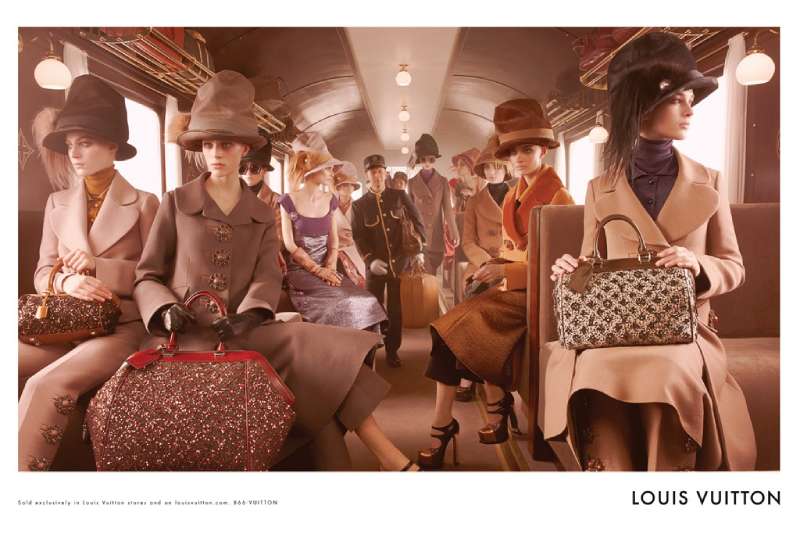
Chapter one: Arizona Muse crosses the Cour Carree of the Louvre and leaves Paris by hot air balloon, November 2012.
Chapter two: the balloon lands in Piazza San Marco, Venice, where David Bowie plays a harpsichord version of “I’d Rather Be High” at a masked ball, November 2013.
Romain Gavras directed the Venice film. David Sims shot the accompanying press images.
The print executions borrow the film’s palette directly: magenta dusk, low fog, gold interiors. That single decision keeps the still and the moving work reading as one piece, which is the whole point of a color palette locked before production rather than after.
Spirit of Travel (2015-2016)
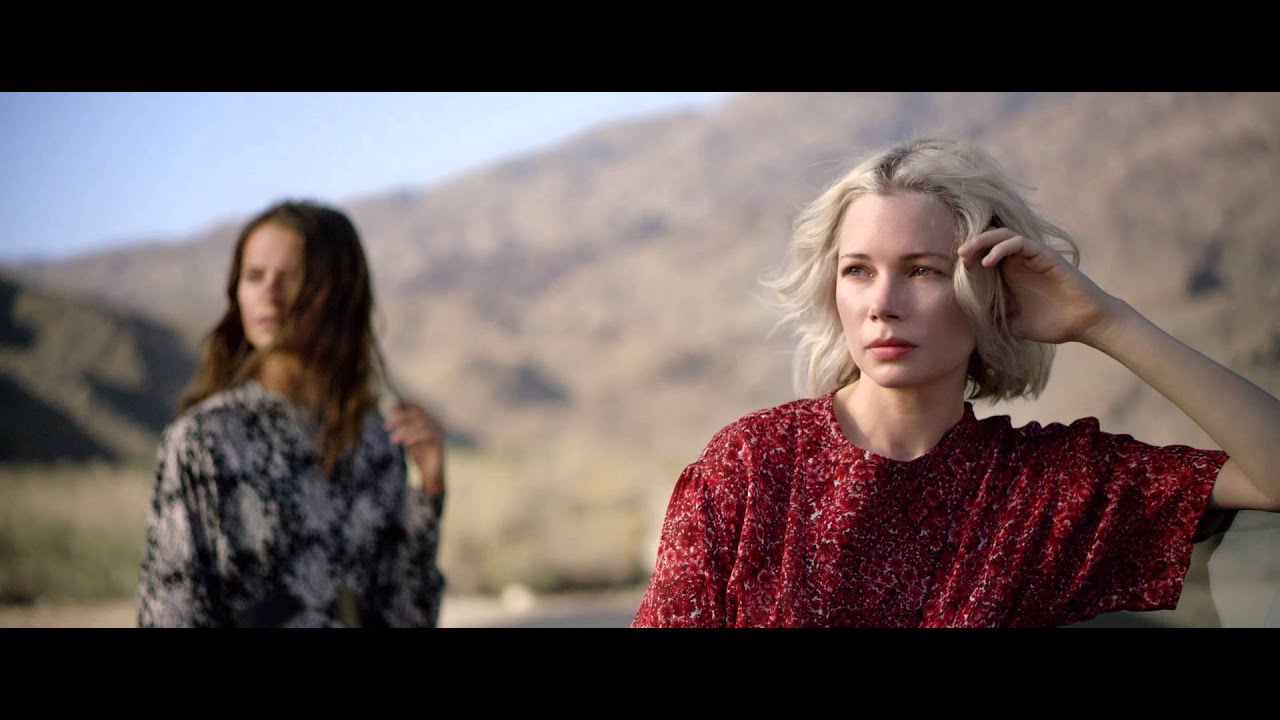
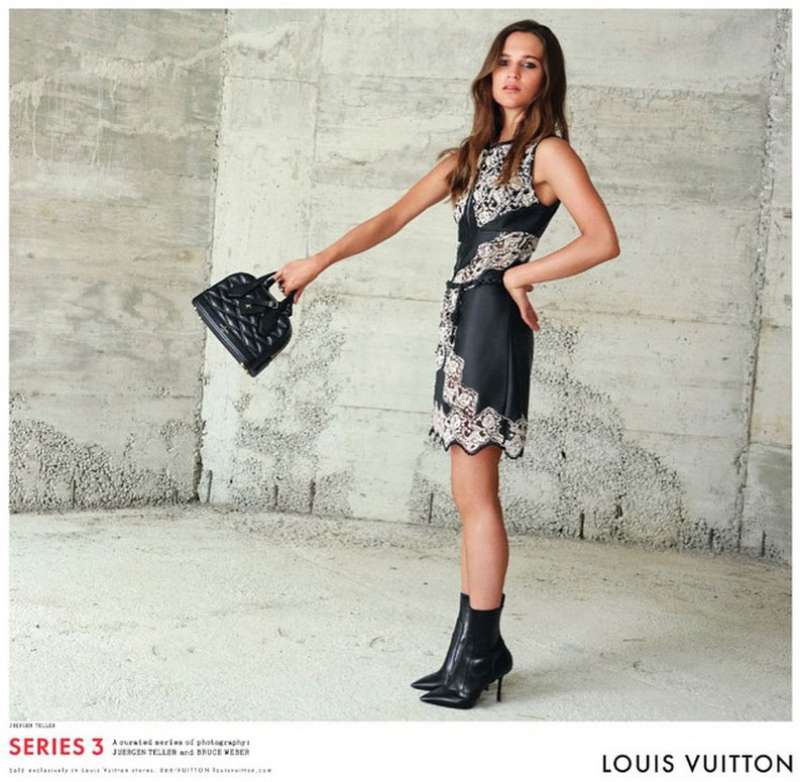
Patrick Demarchelier shot both chapters under Nicolas Ghesquiere, with Marie-Amelie Sauve styling.
| Chapter | Location | Cast |
|---|---|---|
| Spring 2015 | St. Barths, French West Indies | Liya Kebede, Julia Nobis, Maartje Verhoef |
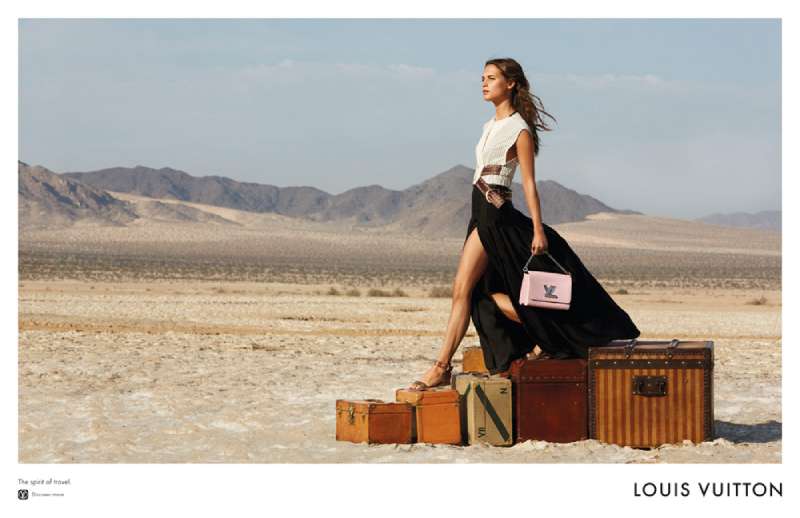
| Fall 2015 | Desert terrain, film by Gordon von Steiner | Michelle Williams, Alicia Vikander |
Product focus: the Twist, the Capucines, the Alma, and the City Steamer introduced at the Cruise 2016 show.
The first ad broke in Harper’s Bazaar UK on 4 March 2015, and the Epi leather line ran in Vuitton store windows worldwide from April to June that year.
Louis Vuitton x Murakami (2003 and 2025)

Over 200 items shipped in the 2025 re-edition, with 170 pieces in Chapter One alone.
Marc Jacobs brought Takashi Murakami into the house in 2003, producing the Monogram Multicolore. The 2025 relaunch was photographed by Inez van Lamsweerde and Vinoodh Matadin with Zendaya, under in-house creative director Lina Kutsovskaya.
- Campaign broke globally on 1 January 2025
- Superflat Panda, Cherry Blossom and Cherries motifs returned
- The final chapter set Zendaya among oversized cherry sculptures, a straight play on scale and proportion
LVERS Menswear Under Pharrell Williams (2023-2026)

Pharrell Williams took the men’s creative director job in February 2023. His campaigns treat menswear as a set of characters rather than a product grid.
Spring 2025: shot by Stef Mitchell at Maison de l’UNESCO in Paris, casting young men as future diplomats, with Gabriel Moses directing the film.
Fall 2025: a joint collection with Nigo, staged around 24 archival vitrines in the Cour Carree du Louvre.
The through-line is location as argument. UNESCO House says global citizenship faster than any headline could, which is what good storytelling in a campaign actually does.
Louis Vuitton Print Ads From the Marc Jacobs Era (1997-2013)

Marc Jacobs spent 16 years at the house and built the artist-collaboration model that every luxury brand copied afterwards.
Stephen Sprouse, 2001: graffiti scrawled over the Monogram, first shown at the Spring 2001 runway. The Graffiti Speedy sold out and now trades high on the resale market.
Yayoi Kusama, 2003 and 2012: polka dots applied across canvas and windows.
Richard Prince, 2008: the Nurse series translated into runway and campaign imagery.
Inez van Lamsweerde and Vinoodh Matadin shot Kate Moss, Christy Turlington and Stephanie Seymour for the house during this stretch.
How Do Louis Vuitton Print Ads Work Visually?
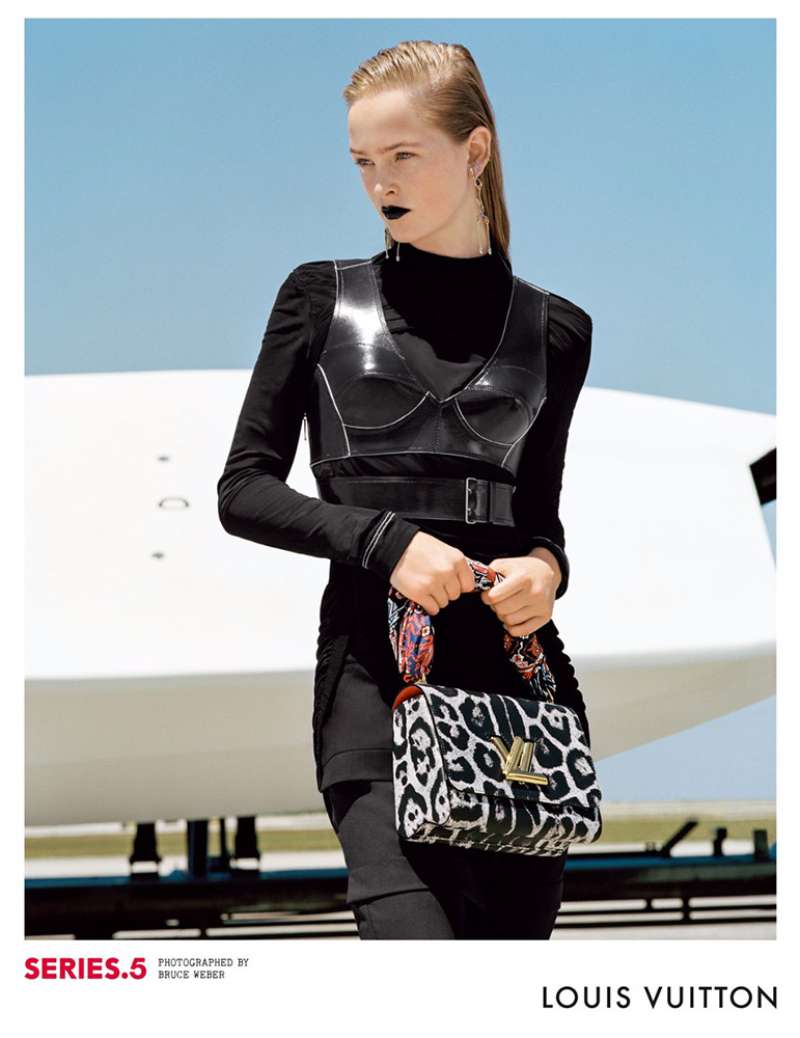
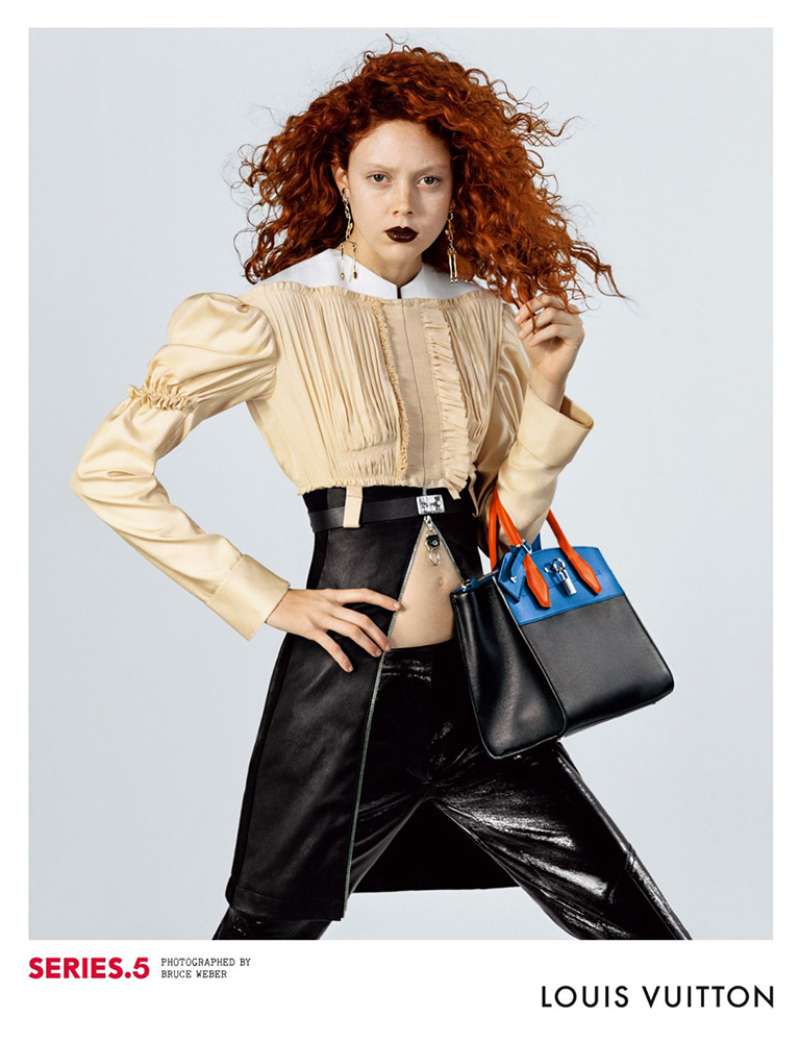
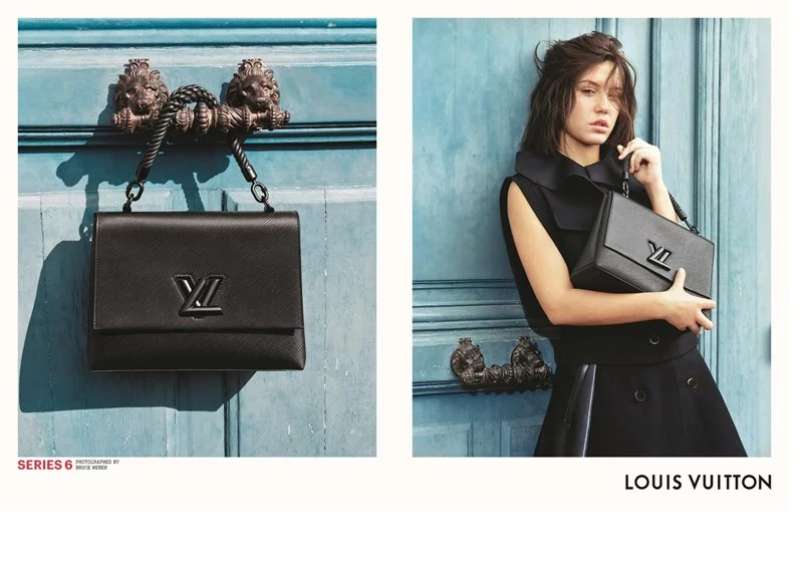
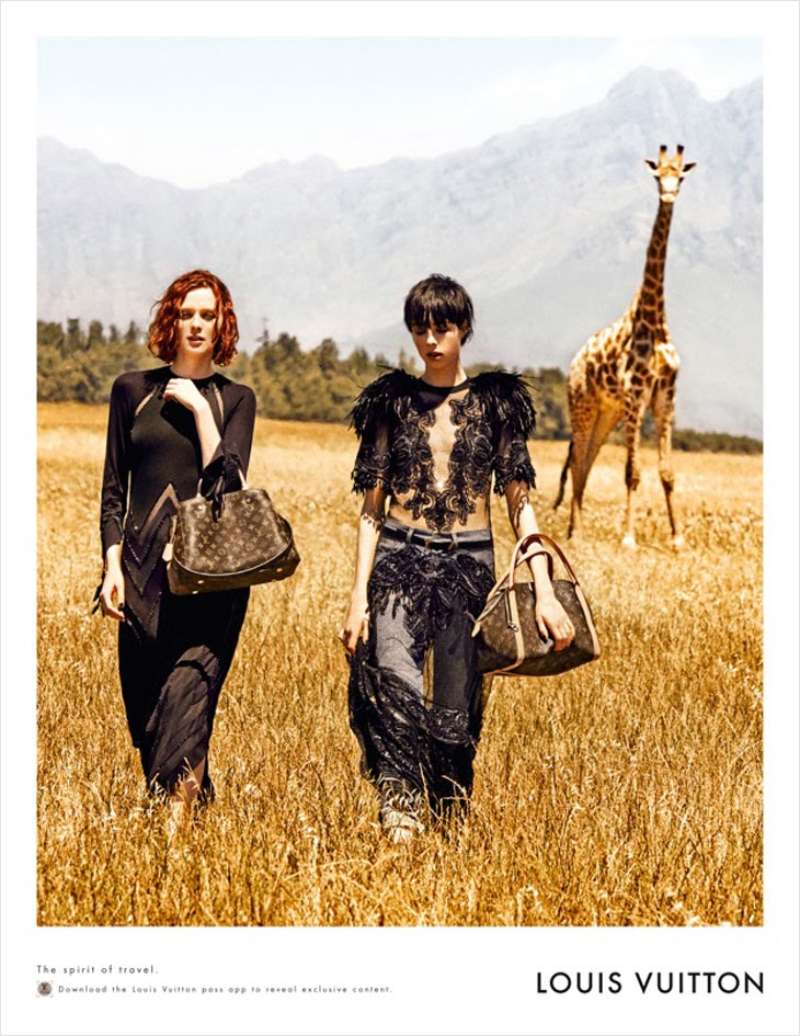
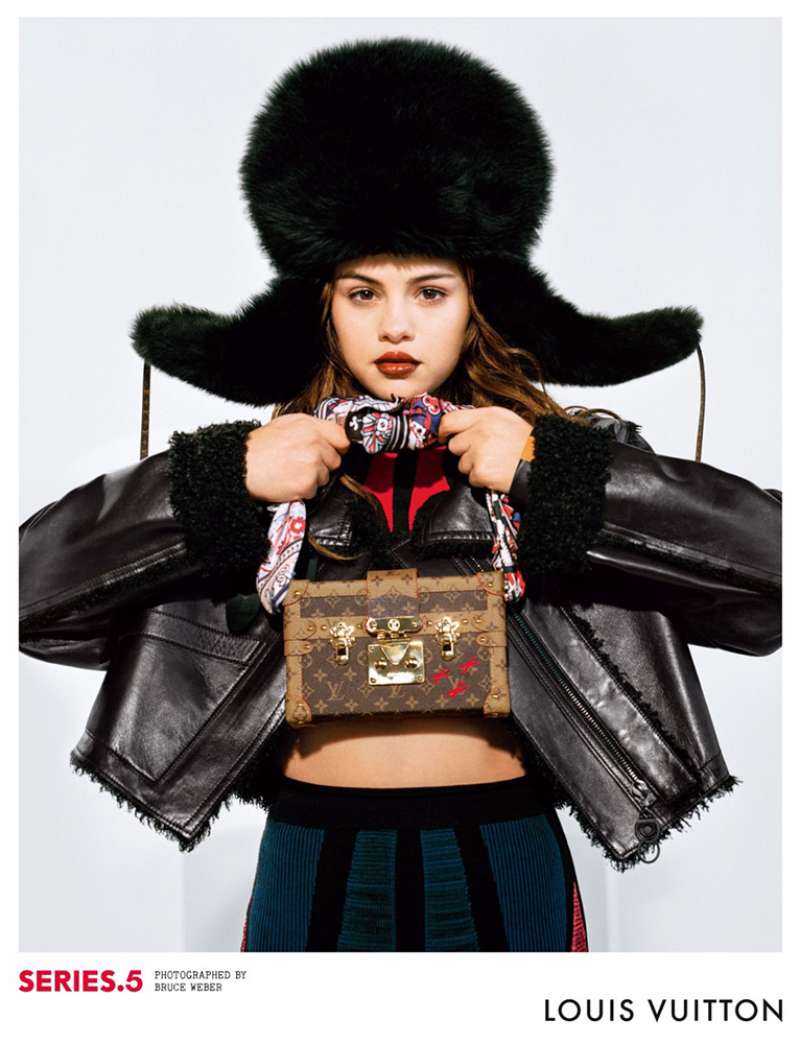
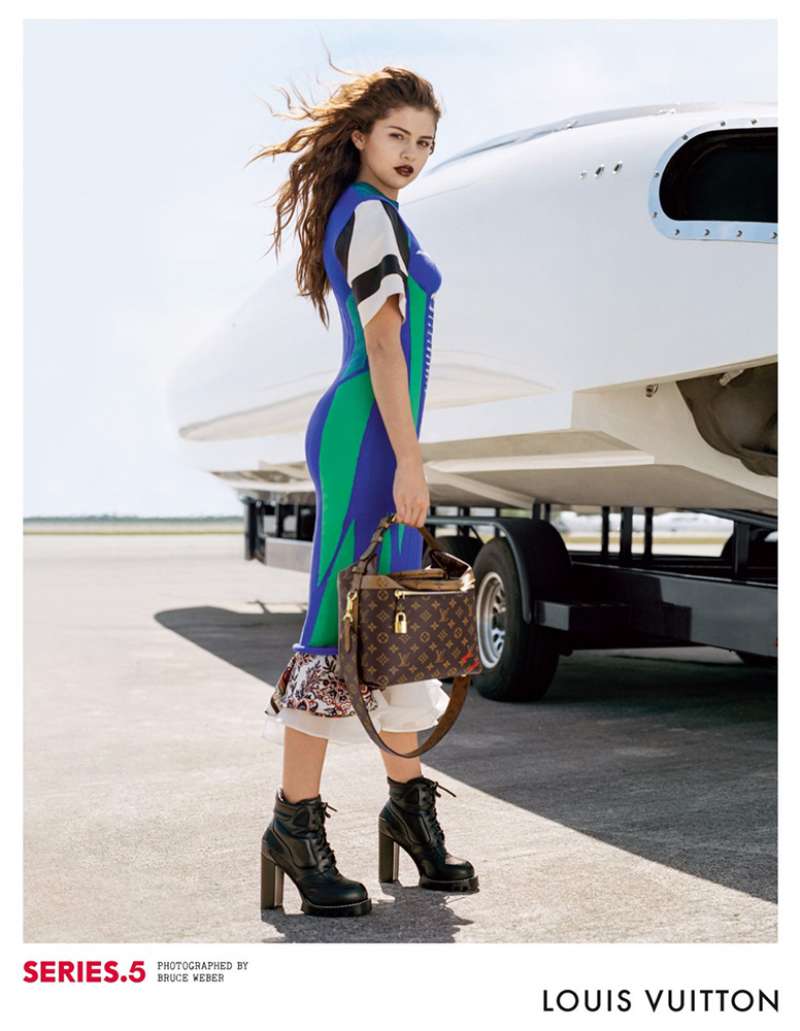
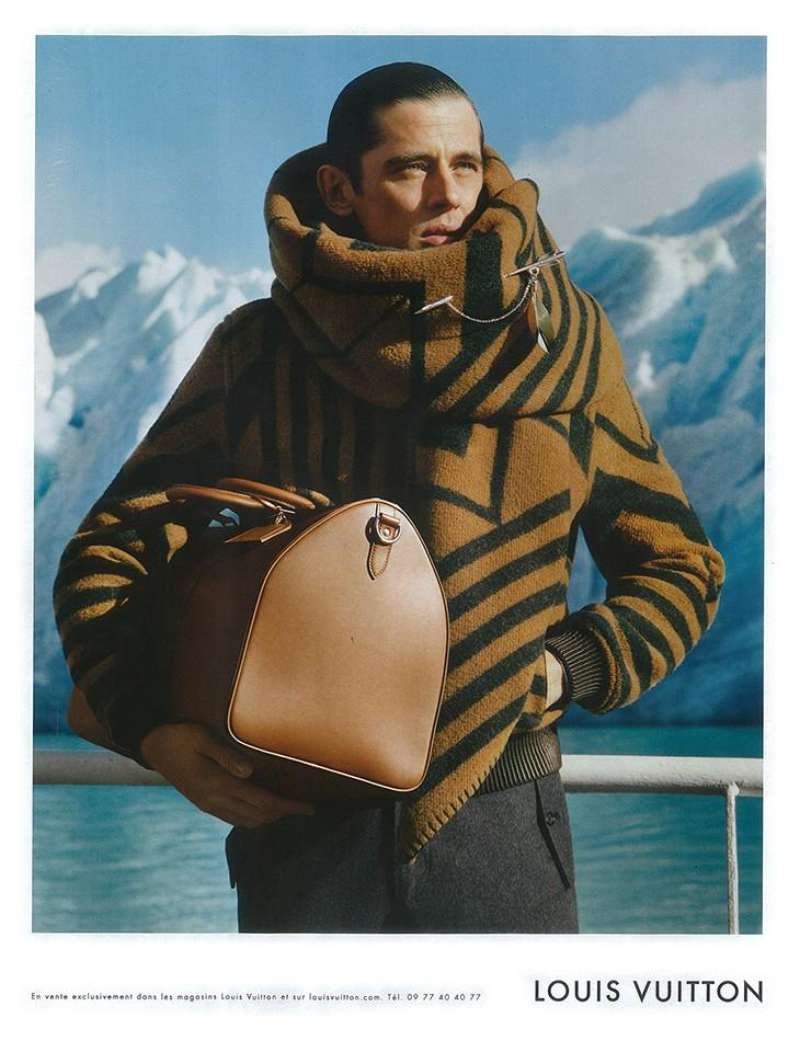
Louis Vuitton print ads use a single full-bleed photograph, a two-line copy block set small, and the wordmark locked to one corner. Contrast comes from the subject, never from the type. The house palette stays close to black, white and Monogram brown.
Typography and the wordmark
The LOUIS VUITTON wordmark uses Futura Medium in all capitals with wide letter spacing. Paul Renner drew Futura between 1924 and 1927, and the Bauer Type Foundry in Frankfurt released it in 1927.
The wide tracking does most of the work. Set the same geometric sans-serif font tight and the mark reads as sportswear, not luxury.
The LV monogram itself is hand-drawn, not typed. Georges Vuitton drew it in 1896 to fight counterfeiters, using classical Roman letterforms as a base. Two systems sit on the same page: a hand-lettered serif mark and a geometric sans wordmark, which is the tension the whole brand typography depends on.
Composition and hierarchy
The reading order is fixed across almost every execution: face, then product, then wordmark.
Copy sits below the optical centre and never competes. Generous white space around the type block keeps the photograph doing the selling, and the visual hierarchy holds even at thumbnail size on a phone.
Double-page magazine spreads use a two-column grid system with the gutter falling in dead space, which is why the fold rarely cuts a face.
Color and restraint
Core Values ran almost entirely in desaturated colour, close to minimalist design in its refusal to add anything decorative.
The Murakami work is the exception and proves the rule. When Louis Vuitton goes loud, it goes loud on the canvas pattern and leaves the layout untouched.
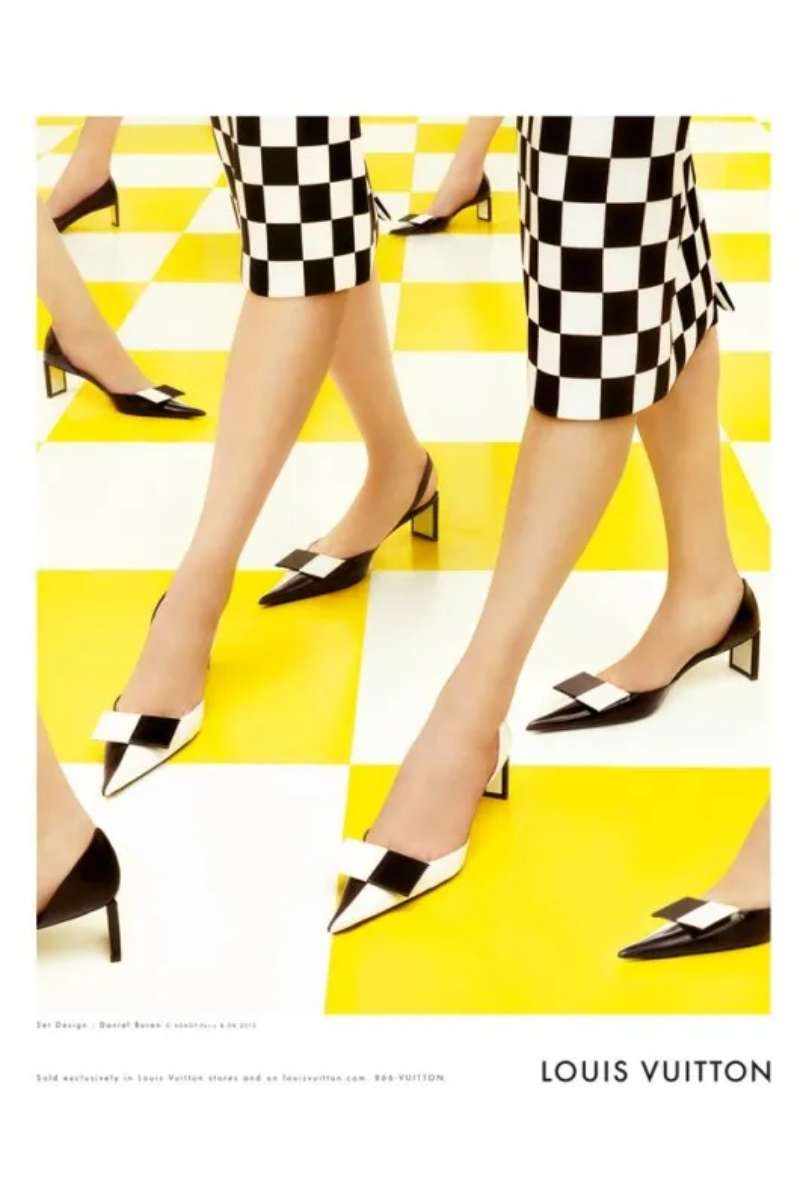
Colour contrast in the house style comes from the subject’s clothing against the setting, not from a background fill behind the type.
How Do Louis Vuitton TV Commercials Differ From Its Print Ads?
Louis Vuitton TV commercials add narrative time and remove the product close-up. The print ads state a destination, the films show the journey to it. The house did not run a television spot until 2008, more than 150 years after founding.
The first television and cinema film (2008)
Ogilvy & Mather Paris made a 90-second spot with no celebrity and almost no product on screen, built as an atmospheric account of travel. It was Louis Vuitton’s first TV and cinema campaign in company history.
L’Invitation au Voyage – Venice (2013)
Romain Gavras directed. Arizona Muse arrives by balloon in Piazza San Marco and joins a masked ball where David Bowie plays “I’d Rather Be High” on harpsichord. Released in one-minute, ninety-second director’s cut and six-minute versions.
Spirit of Travel (2015)
Gordon von Steiner directed the film alongside Demarchelier’s stills, with Michelle Williams and Alicia Vikander. Same location, same wardrobe, same grade as the print run.
The films get longer edits online and short cutdowns in cinema. That split is deliberate: cinema buys attention, the website keeps it.
How Has Louis Vuitton Advertising Evolved Since 1927?
Louis Vuitton advertising moved through four phases: product-only print design until the 1990s, celebrity portraiture from 2007, film-led storytelling from 2012, and sport and artist partnerships from 2021.
| Period | Strategic shift | Representative work |
|---|---|---|
| 1920s-1930s | Trunks sold as travel equipment | 1927 French magazine page, pure Art Deco layout |
| 1997-2006 | Ready-to-wear and artist collaborations arrive | Stephen Sprouse graffiti, 2001 |
| 2007-2012 | Corporate campaign built on named achievers | “Core Values” by Annie Leibovitz |
| 2012-2016 | Film becomes the lead format | “L’Invitation au Voyage,” “Spirit of Travel” |
| 2021-2026 | Sport, music and art partnerships | Formula 1 trophy trunks, Murakami re-edition |
The sport move is the sharpest recent change. LVMH signed a 10-year Formula 1 partnership in late 2024, Louis Vuitton became title partner of the 2025 Australian Grand Prix, and all 24 trophy trunks from the season were presented together at Abu Dhabi in December 2025.
The audience logic is plain. Formula 1 reported fan numbers up 12.2% year over year to 827 million at the 2025 half-year mark, with 43% of that base under 35.
Which Agencies Created Louis Vuitton Advertising?
Three organisations have handled the account. Ogilvy & Mather Paris created Core Values in 2007 and the first television film in 2008. OgilvyOne won the global digital account. Publicis Groupe took LVMH media duties in March 2025.
Ogilvy and Mather Paris
Ogilvy & Mather Paris created the Core Values print campaign for Louis Vuitton and worked with Annie Leibovitz on every instalment between 2007 and 2012.
Christian Reuilly served as creative director and art director on the 2008 executions. Laurence Nahmias handled art buying.
OgilvyOne
Louis Vuitton awarded its global digital advertising account to OgilvyOne after a pitch against Razorfish and Digitas.
The louisvuittonjourneys.com site built for the 2009 astronaut campaign let visitors reorder interviews, zoom on individual subjects and download the films, which was new territory for the house at the time.
Publicis Groupe and the in-house studio
Publicis Groupe won LVMH media accounts including Louis Vuitton in March 2025, taking the business from incumbent Dentsu, per Ad Age.
Creative direction now sits largely inside the house. Lina Kutsovskaya directed the Murakami 2025 campaign, and Nicolas Ghesquiere and Pharrell Williams commission photographers directly for womenswear and menswear.
What Can Designers Learn From Louis Vuitton Ads?
Six habits from the house style transfer cleanly to smaller budgets. None of them need a celebrity.
- Place the product inside the scene, not cut out beside it
- Set the wordmark in one weight, one size, one corner, every time
- Track the capitals wide and leave them alone
- Shoot the location before you write the line
- Hold the palette to the subject and let the background stay quiet
- Keep the copy block below the optical centre and under 12 words
Consistency is the actual asset here. The monogram has run since 1896 and the wordmark treatment has barely shifted, which is what a visual identity looks like when nobody is allowed to redesign it every three years.
Louis Vuitton topped Kolsquare’s 2025 ranking of luxury ready-to-wear brands mentioned by influencers, with 16.6 million euros in earned media value from 6,000 pieces of content and a 13.7% engagement rate.
How Do Louis Vuitton Ads Compare to Gucci Ads?
The two brands sit at opposite ends of the same category. Louis Vuitton builds around travel, restraint and a fixed layout. Gucci ads run on maximalism, art direction that changes with each creative director, and denser image compositions.
Louis Vuitton keeps the same Futura wordmark treatment across decades. Gucci has restyled its logotype repeatedly, most visibly during the Alessandro Michele years.
The numbers track the difference in reach rather than approach. Louis Vuitton passed 56 million Instagram followers against Gucci’s 51.5 million, per eDigital Agency, and Launchmetrics placed Louis Vuitton second on Instagram media impact value at $554.6 million, behind Dior at $782.1 million.
Chanel ads sit closest to Louis Vuitton on restraint and furthest on colour, since Chanel holds black and white harder. Dior ads lean on a single face per season. Prada ads go the other way entirely, using flat colour fields and graphic type where Vuitton uses photography.
My own preference runs to the Vuitton method, though the honest downside is real: when every ad follows the same grid for 15 years, the good ones and the forgettable ones look identical in an archive. The house also relies heavily on brand ambassadors, and a campaign that depends on Zendaya or Jennifer Connelly is not a campaign a small studio can learn to copy.
What Makes Louis Vuitton Advertising Work?
Three things hold it together: a fixed layout, a fixed typeface, and a subject who arrives with a story already attached.
The house buys attention with faces and then spends it on the same page structure it was using sixty years ago.
That discipline pays hardest when the market softens. LVMH revenue came to 80.8 billion euros in 2025, down 1% organically, and Fashion & Leather Goods fell 5% to 37.8 billion, yet the division held a 35% operating margin.
Copy the restraint, not the budget. A brand narrative built on one idea and repeated without redesign is the part a two-person studio can actually put to use on Monday.
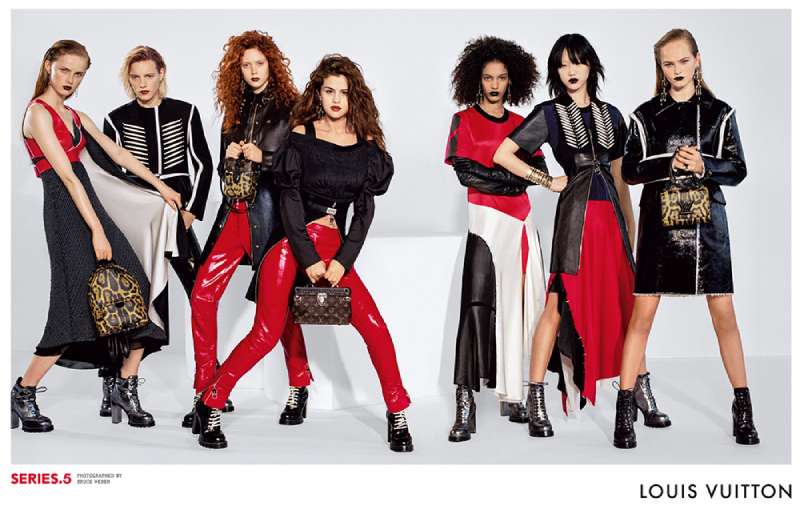
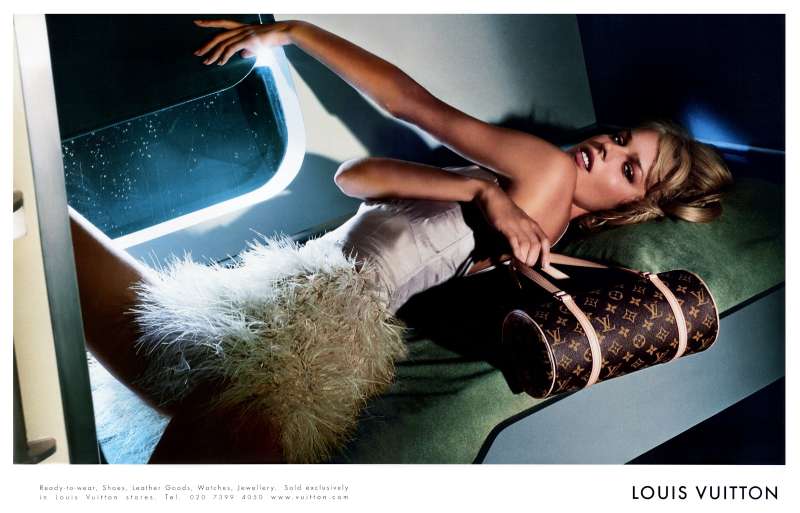
Louis Vuitton Ads Examples








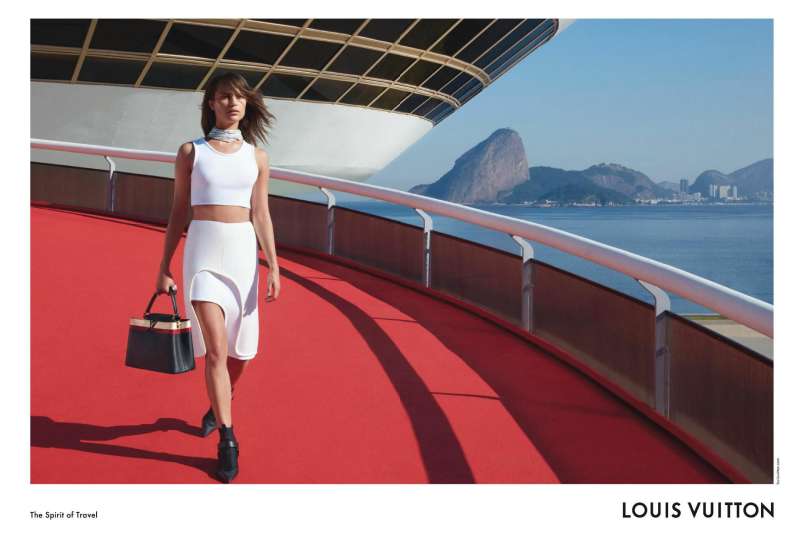
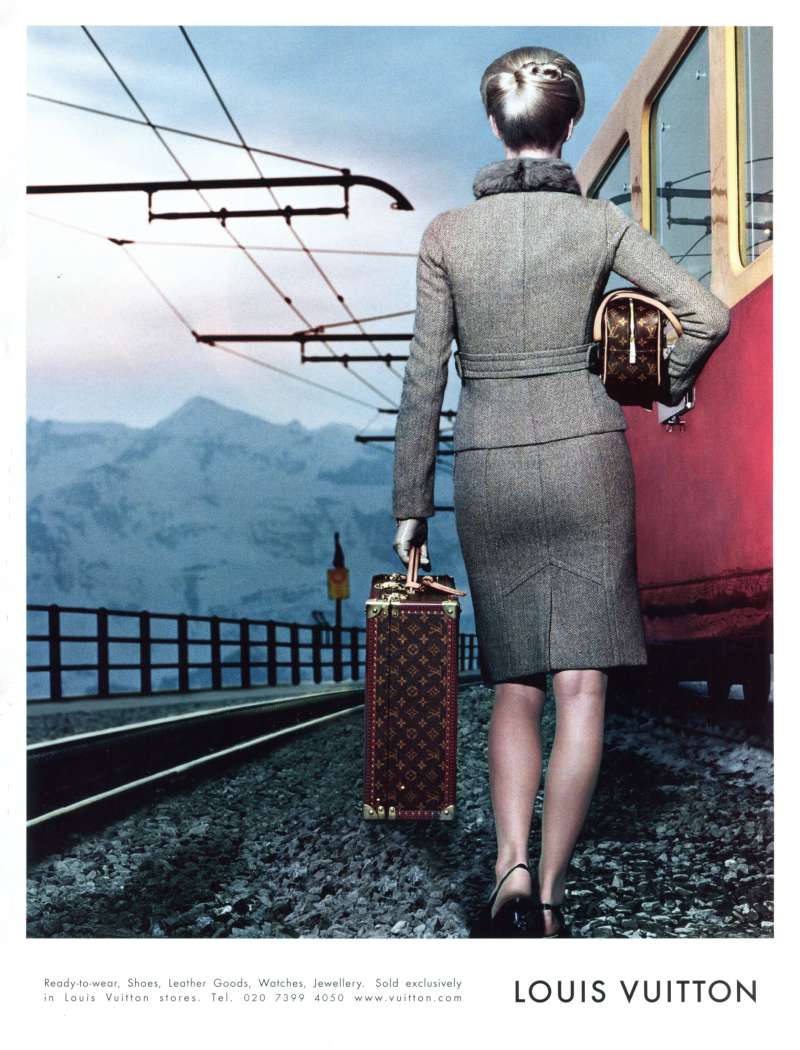
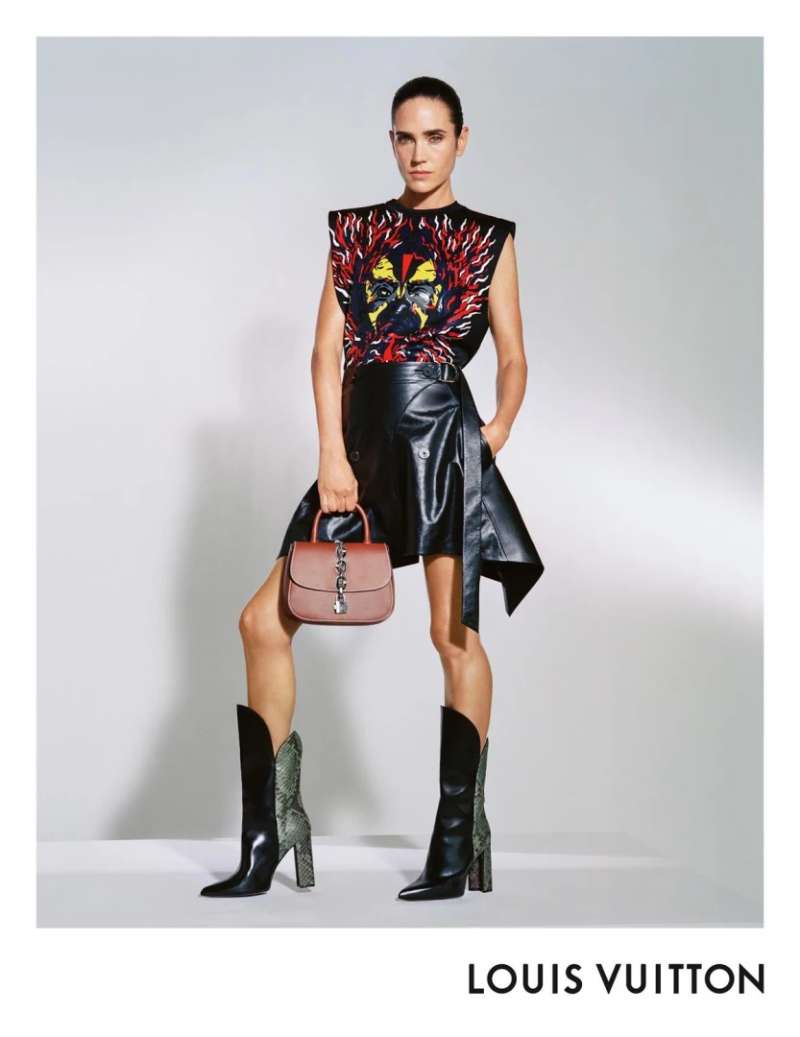
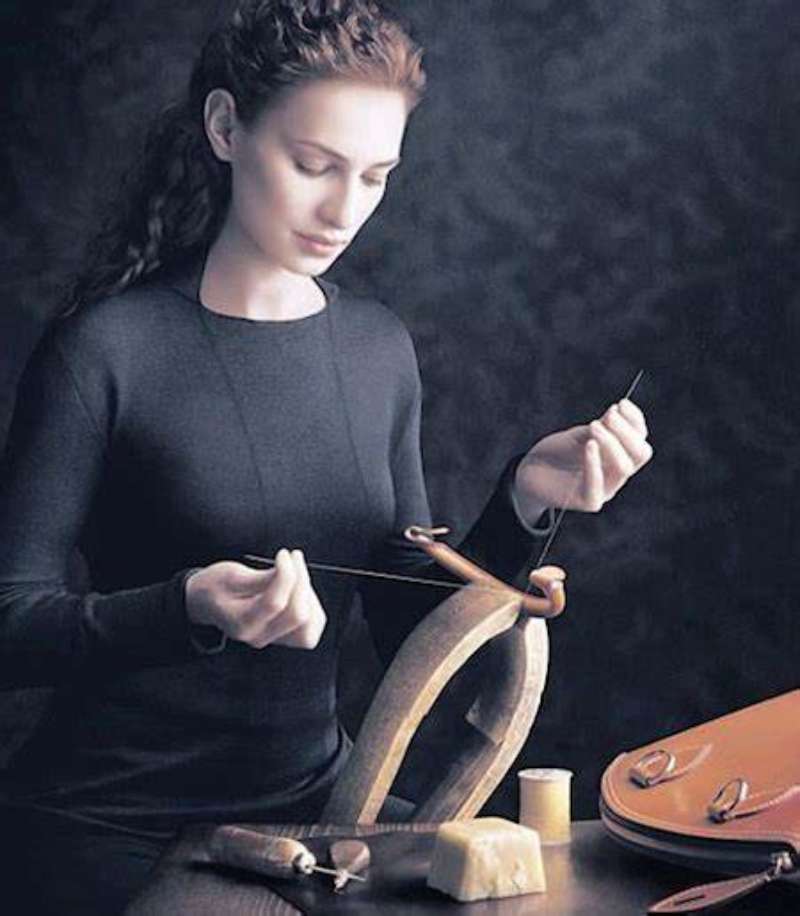


FAQ on Louis Vuitton Ads
Who photographs Louis Vuitton ads?
Annie Leibovitz shot every Core Values instalment between 2007 and 2012. The house has rotated since: Patrick Demarchelier, Steven Meisel, Inez and Vinoodh, Stef Mitchell on menswear, and Cass Bird for Spring 2026.
What is the most famous Louis Vuitton ad campaign?
Core Values, launched September 2007. It cast Mikhail Gorbachev, Muhammad Ali, Sean Connery and Angelina Jolie as travellers rather than models, each paired with one line about journeys. Ogilvy & Mather Paris created it.
What font do Louis Vuitton ads use?
The wordmark is Futura Medium in capitals with wide letter spacing, a geometric typeface Paul Renner drew between 1924 and 1927. The interlocking LV monogram is hand-lettered, made by Georges Vuitton in 1896.
Which agency makes Louis Vuitton ads?
Ogilvy & Mather Paris built the creative for Core Values and the first television film. OgilvyOne took the global digital account. Publicis Groupe won LVMH media duties in March 2025, replacing Dentsu.
Does Louis Vuitton advertise on television?
Yes, since 2008. The first TV and cinema spot ran 90 seconds with no celebrity and almost no product on screen. Romain Gavras later directed the 2013 Venice film with David Bowie and Arizona Muse.
Who are the faces of Louis Vuitton campaigns?
House ambassadors, not runway models. Jennifer Connelly joined in 2014, Alicia Vikander in 2015, Naomi Osaka in 2021, Zendaya in 2023 and Lisa in 2024. Emma Stone and Chase Infiniti also front womenswear.
Where do Louis Vuitton print ads run?
Glossy fashion titles, mostly. The first Spirit of Travel page broke in Harper’s Bazaar UK on 4 March 2015, and Vogue UK carried a foldout that November. MediaRadar counts more than 100 media properties.
How much does Louis Vuitton spend on advertising?
MediaRadar puts brand-level digital and print spend under $100 million a year. Parent group LVMH spends far more, roughly 9.5 billion euros or 11.5% of revenue across 75 houses, per The Robin Report.
Why do Louis Vuitton ads always feature travel?
Trunks were the original product, sold from 1854. The advertising has stayed on that theme ever since, from the mid-1960s slogan Volez, Voguez, Voyagez to the trophy trunks made for Formula 1 and the World Cup.
Where can I find old Louis Vuitton print ads?
Ads of the World carries the 2008 Ogilvy run with full credits. AdsSpot archives commercials by year. The Archives Louis Vuitton Malletier hold the originals, including Therese Bonney’s 1927 travel photographs.
Conclusion
Ninety-nine years of Louis Vuitton ads come down to one repeated bet: put a person with a history next to a Monogram canvas trunk and let the photograph carry the argument.
Nicolas Ghesquiere and Pharrell Williams commission different photographers, different casts, different cities. The page structure barely moves.
That is the lesson worth stealing. Art direction that holds still for decades compounds, while art direction chasing a redesign every season resets to zero.
Three things to take away:
- Consistency beats novelty in luxury advertising
- Negative space does the selling, not the copy
- A trophy trunk in Monaco is still a trunk ad
The Asnieres-sur-Seine archive proves it: same trunk, same monogram, a new face every decade.

Renowned for his expertise in logo design and visual branding, Bogdan has developed a multitude of logos for various clients.
His skills extend to creating posters, vector illustrations, business cards, and brochures. Additionally, Bogdan's UI kits were featured on marketplaces like Visual Hierarchy and UI8.
He also wrote in the past years on sites like Design Your Way, WebDesignerDepot, WPDean, Designmodo, Speckyboy, Slider Revolution, and more.
- Best Visual Regression Testing Tools for Web and App Design in 2026 - 13 October 2026
- Jujutsu Kaisen Font Generator - 12 October 2026
- The Windsurf Logo History, Colors, Font, And Meaning - 10 October 2026

Bogdan Sandu is a seasoned designer who has been designing websites since 2008. Renowned for his expertise in logo design and visual branding, Bogdan has developed a multitude of logos for various clients. His skills extend to creating posters, vector illustrations, business cards, and brochures. Additionally, Bogdan's UI kits were featured on marketplaces like Visual Hierarchy and UI8. He also wrote in the past years on sites like Design Your Way, WebDesignerDepot, WPDean, Designmodo, Speckyboy, Slider Revolution, and more.
You Might Also Like