
Gotham Font Pairing
This Gotham font pairing tool sets Gotham next to a serif, slab or sans partner in real layouts: an article, a landing page, pricing cards or a dashboard. Edit the text, swap the roles, switch to dark mode, then copy the code.
- Designer
- Tobias Frere-Jones for Hoefler&Co.
- License
- Commercial
- Preview
- Montserrat, a free stand-in
- Pairings
- 14 tested
Use this pairing
Every Gotham pairing side by side
Your heading and body text in each pairing, with Gotham on the headings in most of them and on the body where a display or slab partner takes over.
Most people who license Gotham run into the same follow-up question pretty quickly: what goes next to it for body text? The answer that keeps holding up is a serif. Mercury Text and Sentinel are my first two picks for paid projects, with Monotype Baskerville close behind. If a second license fee is off the table, Georgia, Source Serif 4 or Merriweather will do the job fine.
You're matching construction and lowercase height here, not mood. Gotham handles headings and interface text, and the serif handles the reading. Neither should try to do the other's job.
Hoefler&Co's own pairing guide advises against putting Gotham next to another sans-serif. It makes room for humanist designs such as Stone Humanistic and Legacy Sans (MyFonts, 2025), and that's about it.
How to use the Gotham font pairing tool
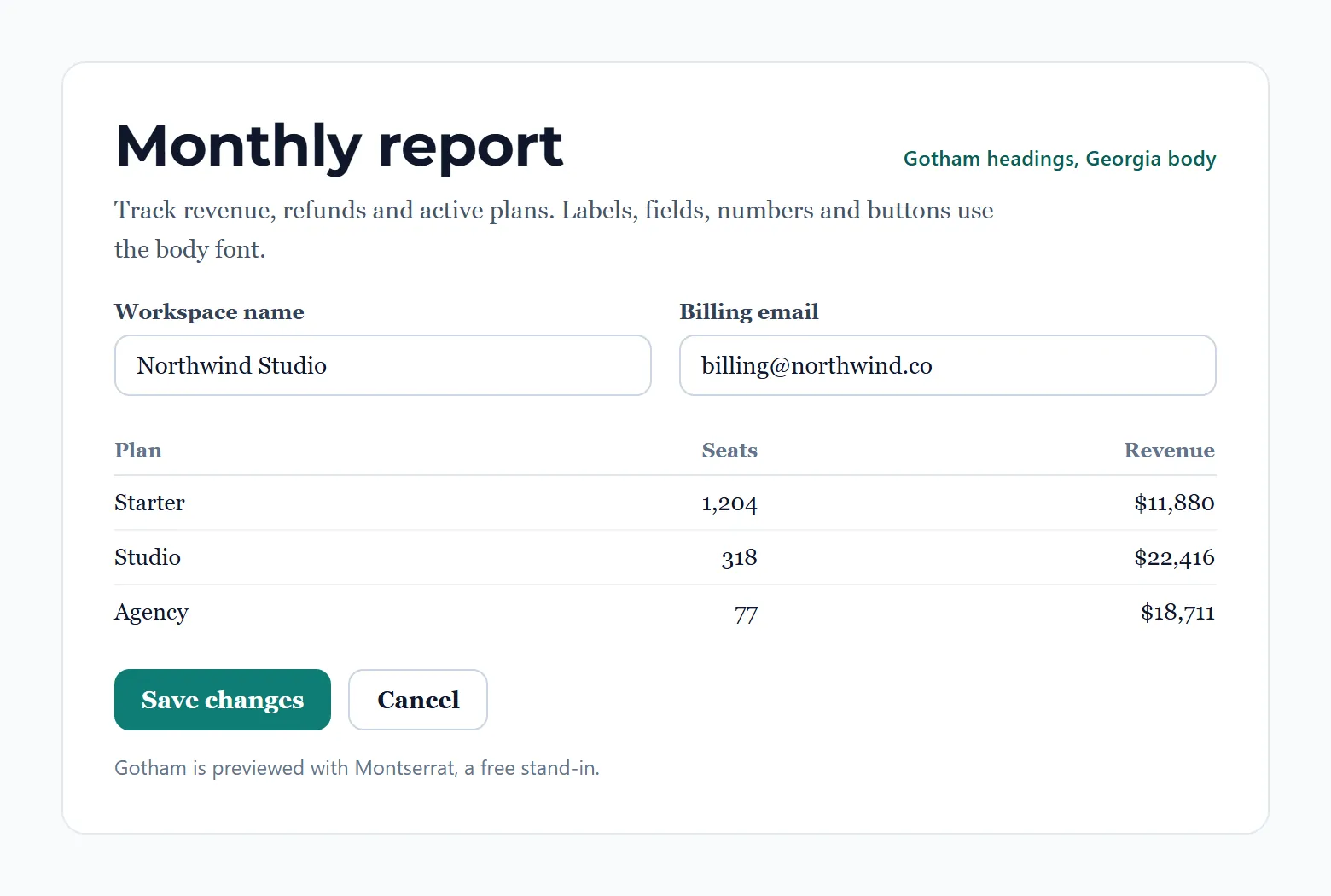
This Gotham font pairing tool sets Gotham next to 14 partner fonts and shows each pair in layouts you actually ship. Gotham is a commercial font from Hoefler&Co., so the preview and the copied link use Montserrat, a free geometric sans with similarly wide letters. Most partners come from Google Fonts, plus Georgia, Futura and three classic designs, Garamond, Baskerville and Bodoni, previewed with free stand-ins.
- Pick a partner from the list. Filter by serif, display or sans if you already know the mood you want.
- Switch the layout between Specimen, Article, Landing page, Pricing cards and Dashboard. A pairing that looks great in a hero can feel heavy in a dashboard.
- Type your own heading and body text. Real copy shows problems that sample text hides, like long words in a wide font.
- Swap roles to move Gotham between the headings and the body. Display fonts like Bodoni and Oswald stay on headings, so the button turns off for them.
- Check dark mode and adjust the heading and body sizes.
- Copy the code as a Google Fonts link, plain CSS or a Tailwind v4 theme. The CSS stack tries Gotham first, then Montserrat.
Gotham pairings at a glance
| Partner font | Type | Role | Notes |
|---|---|---|---|
| Source Serif 4 | Transitional serif | Body text | Formerly Source Serif Pro |
| Georgia | Screen serif | Body text | System font, nothing to load |
| Merriweather | Screen serif | Body text | Try 300 or 400 for the body |
| Baskerville | Transitional serif | Body text | Previewed with Libre Baskerville |
| Garamond | Old-style serif | Body text | Previewed with EB Garamond |
| Lora | Calligraphic serif | Body text | Works both ways |
| Playfair Display | High-contrast display serif | Headings, 700 | Headings only |
| Bodoni | Didone display serif | Headings, 700 | Headings only, previewed with Bodoni Moda |
| Roboto Slab | Slab serif | Headings, 700 | Works both ways |
| Arvo | Geometric slab serif | Headings, 700 | Only 400 and 700 |
| Oswald | Condensed gothic | Headings, 600 | Headings only |
| Roboto | Neo-grotesque sans | Body text | Narrower than Gotham |
| Open Sans | Humanist sans | Body text | Large x-height |
| Futura | Geometric sans | Headings, 500 | Commercial, previewed with Jost |
Which fonts pair best with Gotham?
For paid work, start with Mercury Text or Sentinel. Monotype Baskerville is the more formal option. On a budget, Georgia, Source Serif 4 and Merriweather cost nothing extra. Playfair Display can work too, but only in headlines.
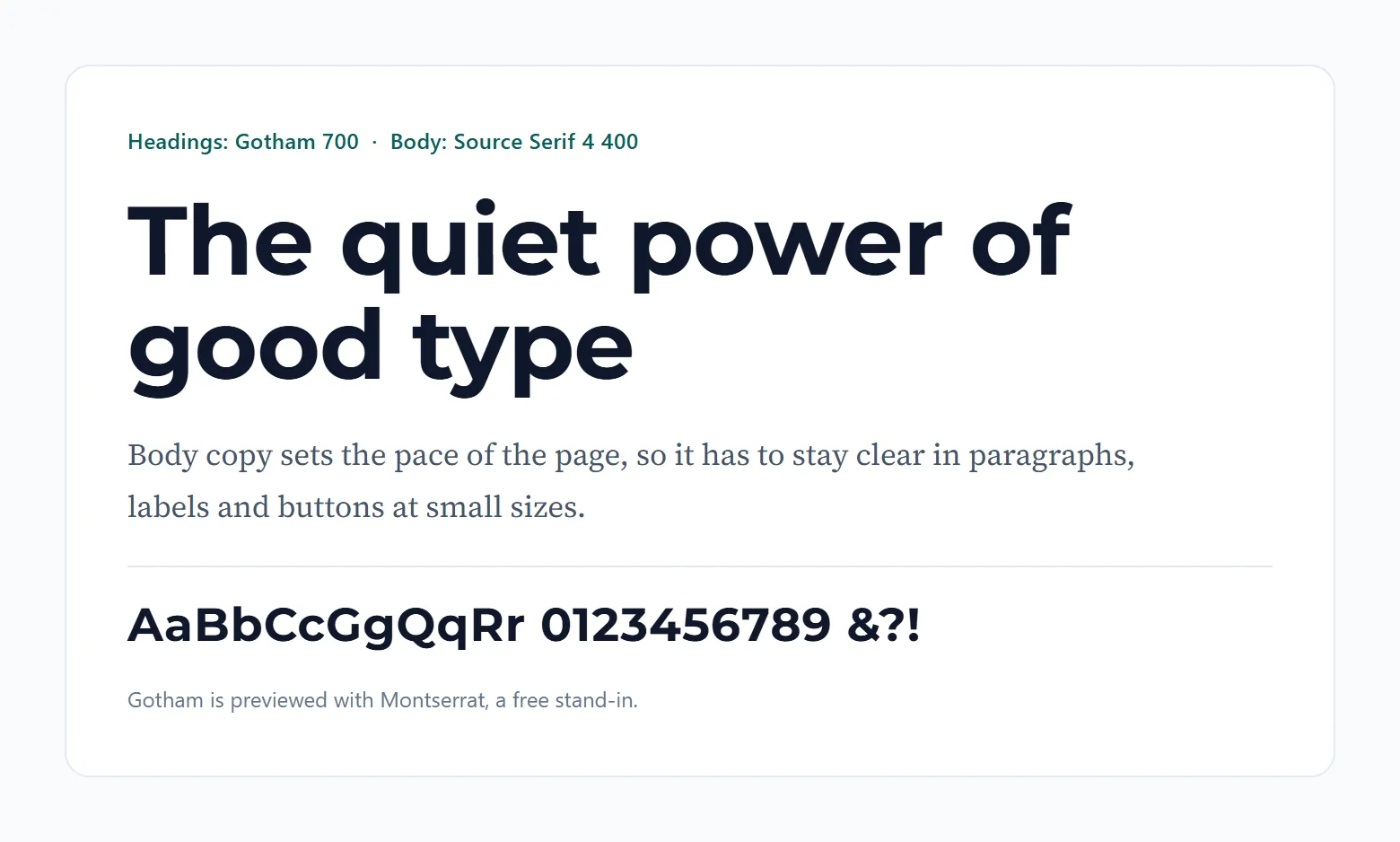
The foundry's guide on MyFonts says partners should contrast with Gotham's geometric build. Its examples are transitional serif designs like Monotype Baskerville and slab serifs like Rockwell Nova (MyFonts, 2025).
I've ranked the options below with that in mind, plus how each one behaves once real content goes in.
| Partner | Type and role | Why it works | Limit |
|---|---|---|---|
| Mercury Text | Text serif, body copy | Same foundry and design year as Gotham | Paid license |
| Sentinel | Slab serif, headings and text | Italics across all weights | Paid; pushes the tone toward craft |
| Monotype Baskerville | Transitional serif, text | Named in Hoefler&Co's guide | Paid; formal tone |
| Georgia | Transitional serif, screen text | Drawn for low-resolution screens | Plain, widely seen |
| Source Serif 4 | Transitional serif, body copy | Free, open license, variable weights | Set the optical size axis |
| Merriweather | Screen serif, body copy | Free, open license | Heavier texture, test weights |
| Playfair Display | High-contrast display serif | Strong contrast with Gotham's even strokes | Large headings only |
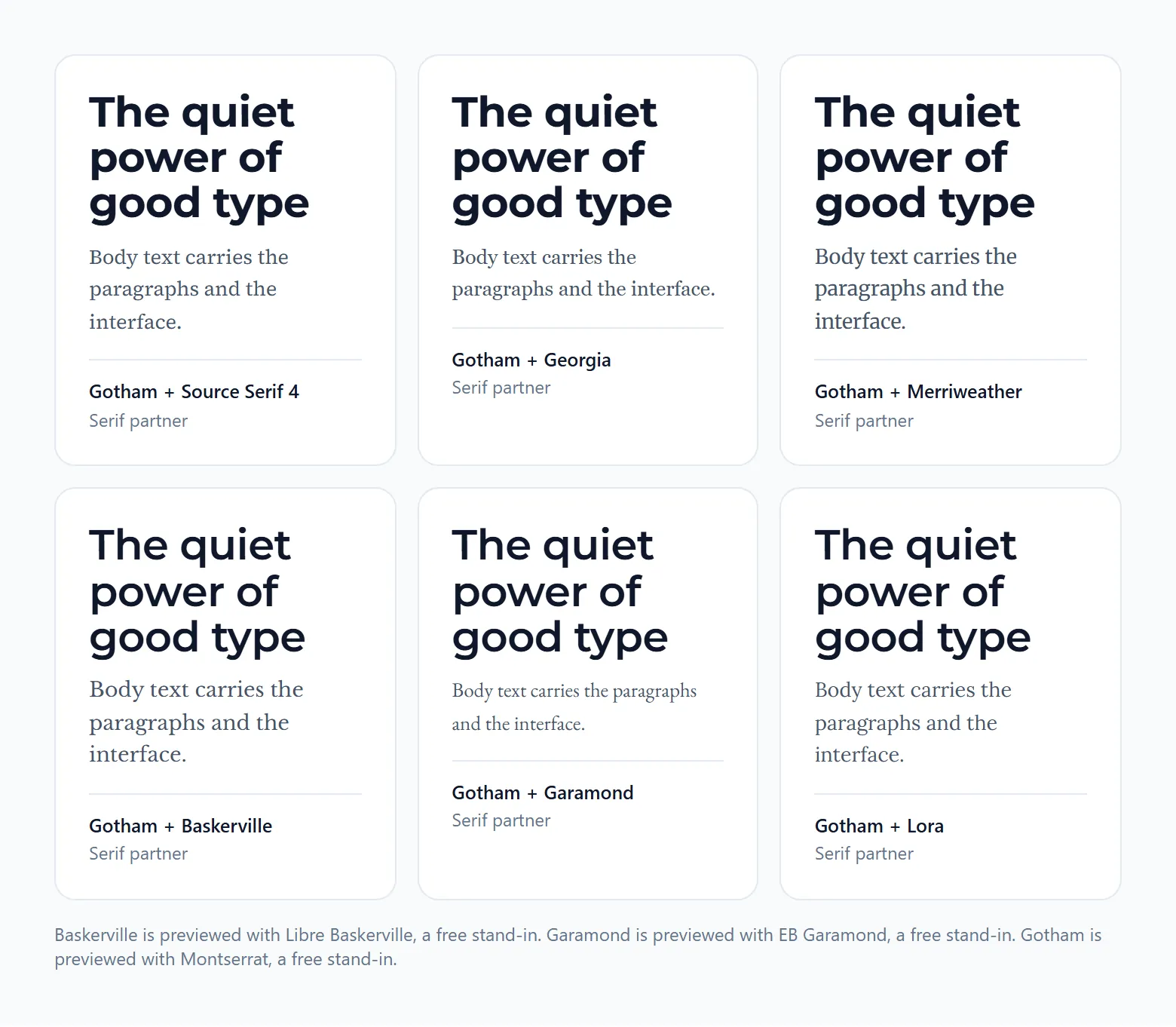
Text serifs for long reading
Mercury Text has the strongest claim. In 2000, the year Gotham was designed, Jonathan Hoefler and Tobias Frere-Jones drew it as the text-size counterpart to Hoefler's Mercury Display of 1996 (MyFonts). Typewolf's own suggested pairing for Gotham is Mercury, which says something.
Georgia is older and plainer. Matthew Carter drew it for Microsoft in 1993 to stay clear at low screen resolutions (Microsoft Typography), and Typewolf logs it beside Gotham on Bar am Lützowplatz (February 4, 2014).
Then the free ones. Source Serif 4 is Adobe's open-source transitional serif by Frank Grießhammer, released under the SIL Open Font License, and it has an optical size axis that you should actually set. Merriweather comes from Sorkin Type. It was built for screens and sits on Google Fonts under the same license, though it runs a bit heavier than the rest.
If the budget covers it, go with Mercury Text. If not, Georgia, Source Serif 4 and Merriweather keep you at one license fee, the one you already paid for Gotham.
Slabs and display serifs for headlines and accents
H&FJ made Sentinel because the classic Clarendon slabs had no italics, which kept them out of text settings (H&FJ announcement, CreativePro). Sentinel has italics at every weight.
Obama for America brought it in as the companion serif in 2012. A slab serif like this answers Gotham's even strokes with squared-off feet, so at the same weight the two still sound like different voices.
- Sentinel shows up next to Gotham on Ideo (April 22, 2016) in Typewolf's Site of the Day archive.
- Monotype Baskerville and Rockwell Nova are the text and slab picks Hoefler&Co names in its guide
- Playfair Display belongs over Gotham Book at large heading sizes. Go smaller and the hairlines fall apart.
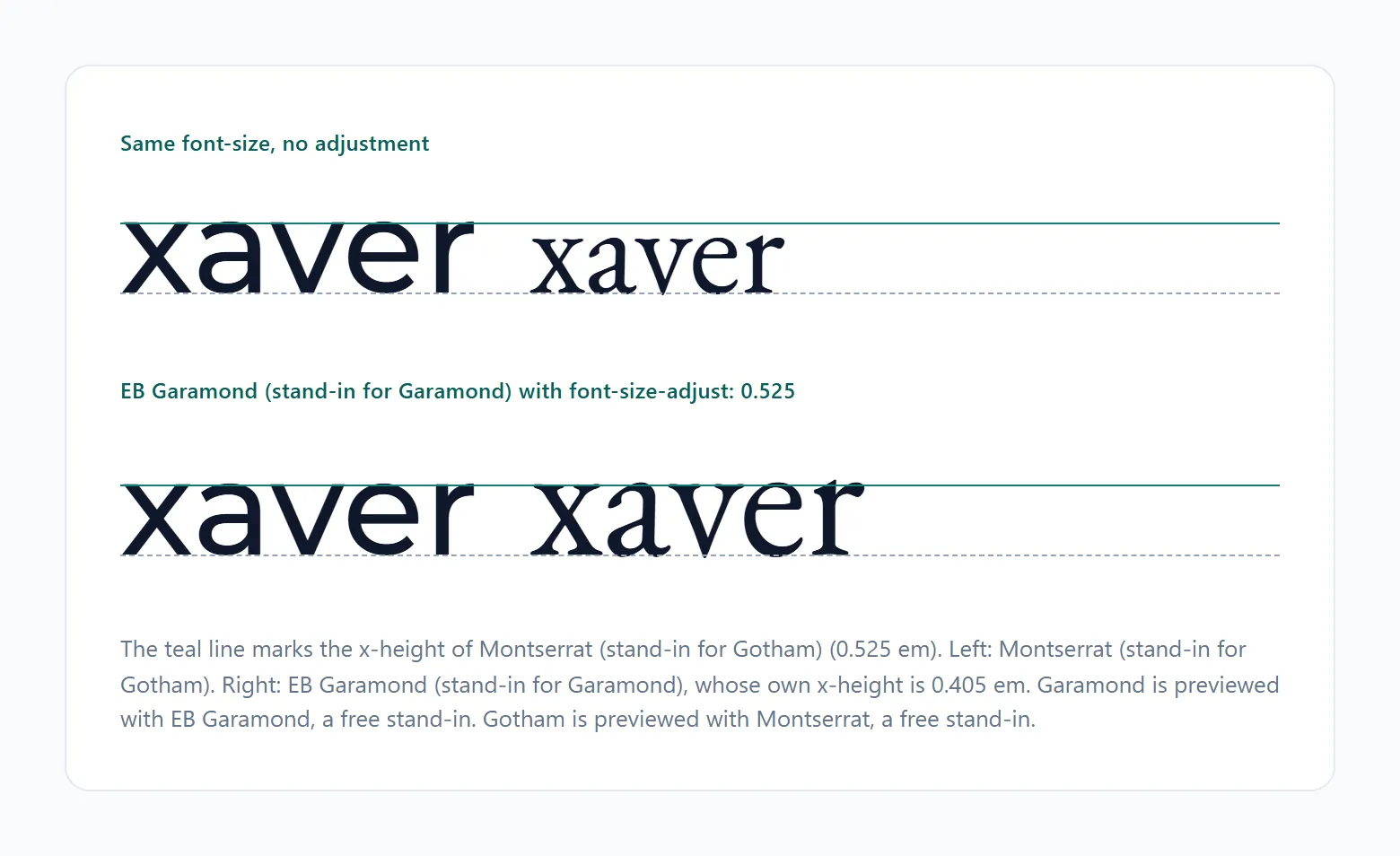
- Garamond is a maybe. Its lowercase runs smaller than Gotham's, so test it at body size before you commit.
A slab does give Gotham a sturdy partner, but the tone drifts toward handmade and editorial. For a quiet corporate look I'd use Mercury Text or Georgia instead.
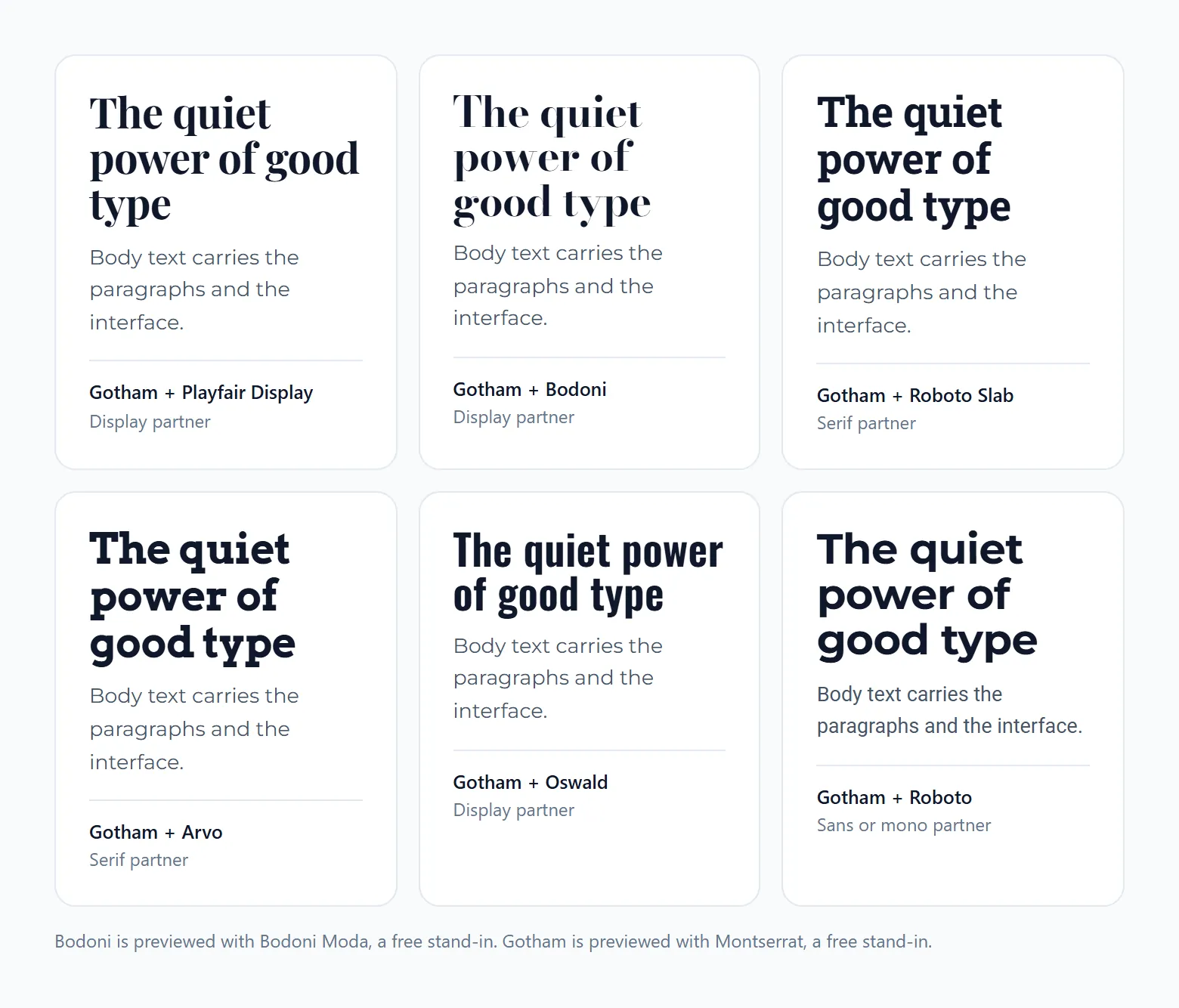
Why a serif balances Gotham's geometry
Gotham's letters are wide and even, drawn from engineered signage. A serif with stroke contrast moves at a different rhythm, so readers can tell which font is doing which job without thinking about it.
Tobias Frere-Jones designed Gotham with Jesse Ragan after a GQ commission, working from the lettering on the Eighth Avenue façade of the Port Authority Bus Terminal (Wikipedia; Fonts In Use). It's a geometric sans-serif with broad proportions. Put a second plain sans-serif next to it and you mostly get more of the same.
The lowercase matters more than people expect. Gotham's lowercase stands tall against its capitals, and the apertures are open. A serif with a small lowercase looks undersized at the same point size, so check x-height before anyone starts arguing about taste.
My usual test is boring, but it works. Set both fonts at 16 px in one paragraph and look at the lowercase. If the serif reads a size smaller, bump it up a point or two. That's usually enough to save the pair.
Hoefler&Co's guide describes the goal as a counterpoint to Gotham's geometric overtones (MyFonts, 2025). Oddly, its text pairings include Archer, a slab serif that is itself usually described as geometric.
Typewolf logged Gotham with Archer on FormKeep on October 22, 2014. So contrast can come from how the serif is built, even when some geometry stays.
Some background on the family. Gotham was designed in 2000 on commission from GQ, first appeared on GQ's January 2001 cover, and went on public release in August 2002 (Fonts In Use). It's published by Hoefler&Co, part of Monotype since 2021 (Fonts In Use).
The dates vary by source. Typewolf lists 2000 as the release year, while Fonts In Use and Wikipedia put the public release in August 2002. The earlier year lines up with the design work and the GQ commission.
Can Gotham pair with another sans-serif?
Sometimes. The foundry says don't, plenty of live sites do it anyway, and the safer version uses a sans with a different construction.
Hoefler&Co's guide tells you to avoid sans-serifs, but it allows humanist sans-serifs such as Stone Humanistic and Legacy Sans, which pair reasonably well (MyFonts, 2025).
Typewolf's Site of the Day archive shows something looser. It logs Gotham beside Knockout on the Campaign for Black Male Achievement (October 12, 2017) and beside Antenna on Munchery (December 13, 2013).
These two sources aren't really arguing. A foundry sheet describes the cleanest contrast, while a gallery archive records what one editor liked on a given day.
Montserrat gets suggested as the free Gotham stand-in more than anything else, and that's exactly why it makes a weak partner. It copies Gotham's construction and adds no contrast. Use one or the other.
If you want a second sans anyway, Stone Humanistic and Legacy Sans are the safer picks. Or stay inside the family and use Gotham Narrow for contrast.
H&FJ released Gotham Rounded in 2007 and Narrow and Extra Narrow in 2009 (Wikipedia). Rounded softens the terminals. Narrow changes the width, which I find more useful when pairing.
Gotham pairings used in campaigns and live sites
Obama for America is the best-documented case. Perpetua opened the 2008 campaign, Gotham took over as the main face, and Sentinel joined it as a companion slab serif in 2012.
From 2007 into early 2008, Perpetua, a serif, sat beside the sunrise logo the campaign launched with (Rice Thresher, November 6, 2008; Wikipedia).
Later in 2008, Gotham became the primary face for slogans such as "CHANGE", and after the nomination the candidate's name moved to a modified Requiem in small caps (Rice Thresher).
Work on the second run started early. On April 4, 2011, H&FJ announced a serifed version of Gotham drawn for the 2012 campaign's wordmark, never released publicly (Wikipedia, citing H&FJ). On election day 2012, H&FJ called Gotham the campaign's typographic keystone, with Sentinel added as a companion slab serif. The Romney campaign, for what it's worth, used Mercury and Whitney (Core77, November 6, 2012).
Look at the whole run and a serif sits beside Gotham in every phase. Only its job changed. The common story that the campaign's brand typography simply switched to Gotham leaves the serifs out.
Paul Shaw noted in Print that official Obama stickers set in Perpetua were still easy to find, and that Gotham was not the only face used with the logo. Fonts In Use archives the 2008 branding with credits to Sol Sender, John Slabyk and Scott Thomas.
Outside politics, Typewolf's archive logs a wide spread of serifs beside Gotham, from slabs to old-style and Didone designs.
| Site | Logged | Serif beside Gotham |
|---|---|---|
| Mount Vernon | September 4, 2014 | Mercury |
| Stumptown Coffee | June 26, 2015 | Sentinel |
| Loeffler Randall | July 27, 2015 | Caslon |
| Carolina Herrera Confidential | August 7, 2015 | Didot |
Keep in mind this is one editor's picks. It shows taste, not market share. I'd treat it as a source of ideas and then test each pairing at real content length.
How to set up a Gotham pairing, step by step
This is the order I'd work in.
- Assign roles. Gotham takes headings, navigation and captions, and the serif takes paragraphs.
- Pick Gotham weights by size. Typewolf lists eight weights from Thin to Ultra (the 2026 Gotham Variable release adds intermediate styles, per Monotype), and the useful range is Book or Medium for small text and Bold or Black for headings.
- Check variants before buying them. Gotham Narrow suits tight columns, Gotham Rounded suits friendlier brands, and MyFonts lists Rounded and Office as separate families with their own prices.
- Give each family its own line height and letter spacing instead of one global value.
- Define the fallback stack with font-display: swap, then add size-adjust and the ascent and descent overrides to the fallback face (Chrome for Developers).
- Build the pair in Figma with real headings and real paragraphs, and check it at 375 px wide.
Spacing is the step people skip, and it's the one that causes trouble later. WCAG 2.2 success criterion 1.4.12 requires content to survive a line height of at least 1.5 times the font size and letter spacing of 0.12 times the font size (W3C). So use flexible containers and set tracking in em units.
A type scale generator sorts out the sizes once you've chosen, but it can't judge lowercase proportions. You still check that by eye.
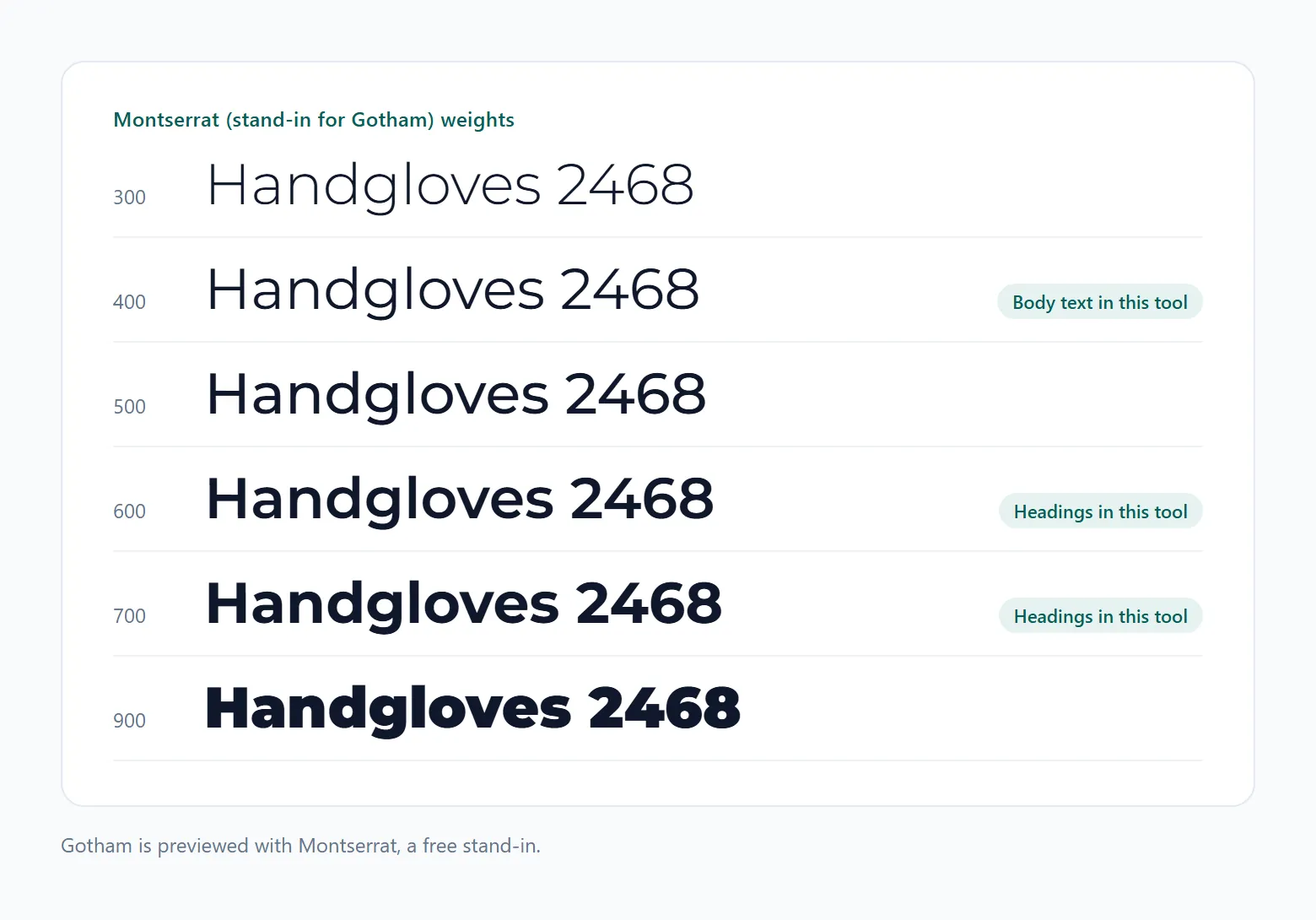
Matching the pairing to a logo, a website or a print layout
The job decides which font leads. In logos and interfaces it's Gotham, and anywhere people read long text, the serif takes over.
Logos and wordmarks
Set the name in Gotham and give the serif one small job, usually the tagline or descriptor.
New York City FC set its badge lettering in Gotham until a 2024 redesign (Wikipedia), so the sans-serif clearly works as a wordmark on its own.
- Uppercase Gotham Bold or Black for the name
- A lowercase serif for the descriptor, at a size where the hairlines still hold up
Save the finished lockup as a file too, so nobody has to retype the pair. And if the serif starts competing with the name, shrink it before you swap it for something else.
Websites and UI
Gotham handles navigation, buttons and form labels well. The strings there are short, and wide letterforms stay legible.
For delivery, Hoefler&Co offers Cloud.typography, a cloud-hosted service that uses no JavaScript, and self-hosted woff and woff2 files licensed by monthly traffic (typography.com). Creative Cloud subscribers can also serve Gotham through an Adobe Fonts web project.
Article paragraphs go to the serif. Typewolf logged Ólafur Arnalds on June 10, 2015 with Freight Text beside Gotham.
Keep the serif out of the controls.
Editorial and print
Typewolf logged Verse on October 25, 2015 with Chronicle Display and Chronicle Text next to Gotham. One Hoefler&Co serif family covered both the large and the small sizes there.
That's basically the print model. Gotham goes on section heads, captions and pull quotes, and a text serif sets the running copy. Editorial design adds columns and a baseline rhythm, so the serif's line spacing is the first number to settle.
Pick the serif for the column, then size Gotham to match it.
Gotham license cost and free alternatives
Gotham is a commercial family from Hoefler&Co, and since April 2025 it's also part of Adobe Fonts. The free route is Montserrat with an open-license serif. Which one makes sense depends on traffic, client rules and who edits the files.
Do the font licensing check before the pairing. Hoefler&Co prices web use separately from desktop use, by monthly traffic, and that catches a lot of people out.
Cloud.typography plans scale by monthly pageviews, from 250,000 up to 5 million (Hoefler&Co user guide).
Self-hosting means woff and woff2 files licensed by total monthly traffic (typography.com).
Adobe Fonts is the newer route. Gotham joined it in April 2025 as part of an Adobe expansion of more than 1,500 fonts (Adobe, April 2025), and Adobe has not metered web font pageviews on Creative Cloud plans since October 2018. The listing covers desktop and web projects, but not self-hosting, which needs a separate Monotype license. Still, for a high-traffic site whose team already pays for Creative Cloud, that's the gap between a metered Cloud.typography plan and an unmetered Adobe Fonts web project.
| Option | Cost | Where to license | Where it differs |
|---|---|---|---|
| Gotham (Adobe Fonts) | Included with Creative Cloud plans | Adobe Fonts, added April 2025 | No self-hosting; that needs a separate Monotype license |
| Gotham Office | Priced separately | MyFonts | Listed separately from core Gotham |
| Gotham Rounded | Priced separately | MyFonts | Rounded terminals, separate family |
| Gotham Variable | $1,200 for 2 fonts | MyFonts, launched May 12, 2026 | Upright and italic variable fonts |
| Montserrat | Free, SIL Open Font License | Google Fonts | Drawn from Buenos Aires signage, not New York |
| Proxima Nova | Adobe Fonts plan or direct purchase | Adobe Fonts, Mark Simonson Studio | Released 2005, geometric look with modern proportions |
Julieta Ulanovsky started Montserrat in 2010 from old posters and signs in Buenos Aires. It came out through Google Fonts after a 2011 Kickstarter (Montserrat project repository).
The Government of Puerto Rico uses Montserrat for body text, with Cormorant Garamond for headlines (Wikipedia). That's the free stack in real use, though the roles are flipped compared with the Gotham advice above.
I'd pick Gotham when the brand already owns a license, the team already has Creative Cloud, or the client asks for it by name. Otherwise Montserrat with Source Serif 4 costs nothing, and the wider field of fonts similar to Gotham is worth a look before paying.
When a Gotham pairing breaks down
None of these problems show up in a static mockup. They show up after launch.
Metrics usually go wrong first. A licensed web font that loads late swaps in over a fallback with different dimensions, and the layout jumps. Chrome for Developers documents size-adjust and the ascent, descent and line-gap overrides as the fix.
Spacing is next. Fixed-height boxes clip text once users raise leading and letter spacing, a failure pattern under WCAG 2.2 1.4.12 (W3C). Wide letterforms like Gotham's tend to wrap sooner, so headings in Gotham Bold clip first.
Tooling can trip you up too. Montserrat's repository lists variable font display issues in certain Adobe Creative Cloud versions, so hand the print team static files if they work in Adobe apps.
Fit is harder to fix. Typewolf describes Gotham as feeling very American, unlike Swiss or German sans-serifs, and also ranks it among the most widely used fonts of the last decade. All that use costs it some distinctiveness.
A brand that wants a neutral European voice, or just something people haven't seen everywhere, should start from a different sans.
Gotham Font Pairing FAQ
Does Gotham pair with Helvetica?
Not by Hoefler&Co's standard. Its guide advises against sans-serif partners and only makes exceptions for humanist designs such as Stone Humanistic and Legacy Sans (MyFonts, 2025).
Helvetica is a grotesque, so it doesn't qualify.
Can Gotham pair with a script font?
Yes, as a single accent. Typewolf logged Gotham with Sign Painter, a brush-lettering face, on Busy Beaver (May 8, 2016).
Keep the script to a name or one short line, and let Gotham or a serif carry the paragraphs.
Which font goes with Gotham on a resume?
Georgia for the entries, with Gotham Bold on your name and the section heads.
Send it as a PDF. Gotham is a licensed font, and most recipients won't have it installed.
Is Gotham the same as Proxima Nova?
No, though they get mixed up a lot. Gotham was drawn from New York signage. Proxima Nova is Mark Simonson's 2005 family, which Typewolf describes as a hybrid of Futura and Akzidenz Grotesk, with a geometric appearance and modern proportions.
They're close enough that Proxima Nova became a common web substitute while Gotham was missing from Adobe Fonts. Since April 2025, Adobe Fonts includes both.
Recording a Gotham Font Pairing in Brand Guidelines
Write the pairing down properly or it drifts the first time a new designer joins. The brand guidelines should name who holds the license, which font does which job, and the exact weights.
- License scope and traffic tier
- Roles for Gotham and the serif
- Exact weights for each
- Fallback stack and spacing values
Put the license first, since it's the only item with a renewal date. Cloud.typography renews automatically ten days before the anniversary, with an email reminder 30 days ahead (Hoefler&Co user guide).
Locking weights has a downside. A set of brand guidelines that fixes static weights blocks a later move to Gotham Variable until someone revises the document.
Monotype launched that family on May 12, 2026, so this advice holds as of November 2, 2026.
Other font pairings
Same idea, different starting font. Each guide lists tested partners with notes on where they work.
- Abril Fatface font pairing
- Baskerville font pairing
- Bodoni font pairing
- Cormorant Garamond font pairing
- DM Sans font pairing
- Futura font pairing
- Garamond font pairing
- Georgia font pairing
- Google Font pairings
- Helvetica font pairing
- Inter font pairing
- Josefin Sans font pairing
- Karla font pairing
- Lato font pairing
- Libre Baskerville font pairing
- Lora font pairing
- Merriweather font pairing
- Montserrat font pairing
- Nunito font pairing
- Open Sans font pairing
- Playfair Display font pairing
- Poppins font pairing
- Raleway font pairing
- Roboto font pairing
- Source Sans Pro font pairing
- Space Grotesk font pairing
- Work Sans font pairing