
Bodoni Font Pairing
This Bodoni font pairing tool sets Bodoni on the headlines and a partner font on the body text, then previews both in real layouts: an article, a landing page, pricing cards and a dashboard. Bodoni is shown with Bodoni Moda, a free revival, so you can edit the text, switch to dark mode and copy working code.
- Designer
- Giambattista Bodoni
- License
- Classic design, many digital cuts
- Preview
- Bodoni Moda, a free stand-in
- Pairings
- 13 tested
Use this pairing
Every Bodoni pairing side by side
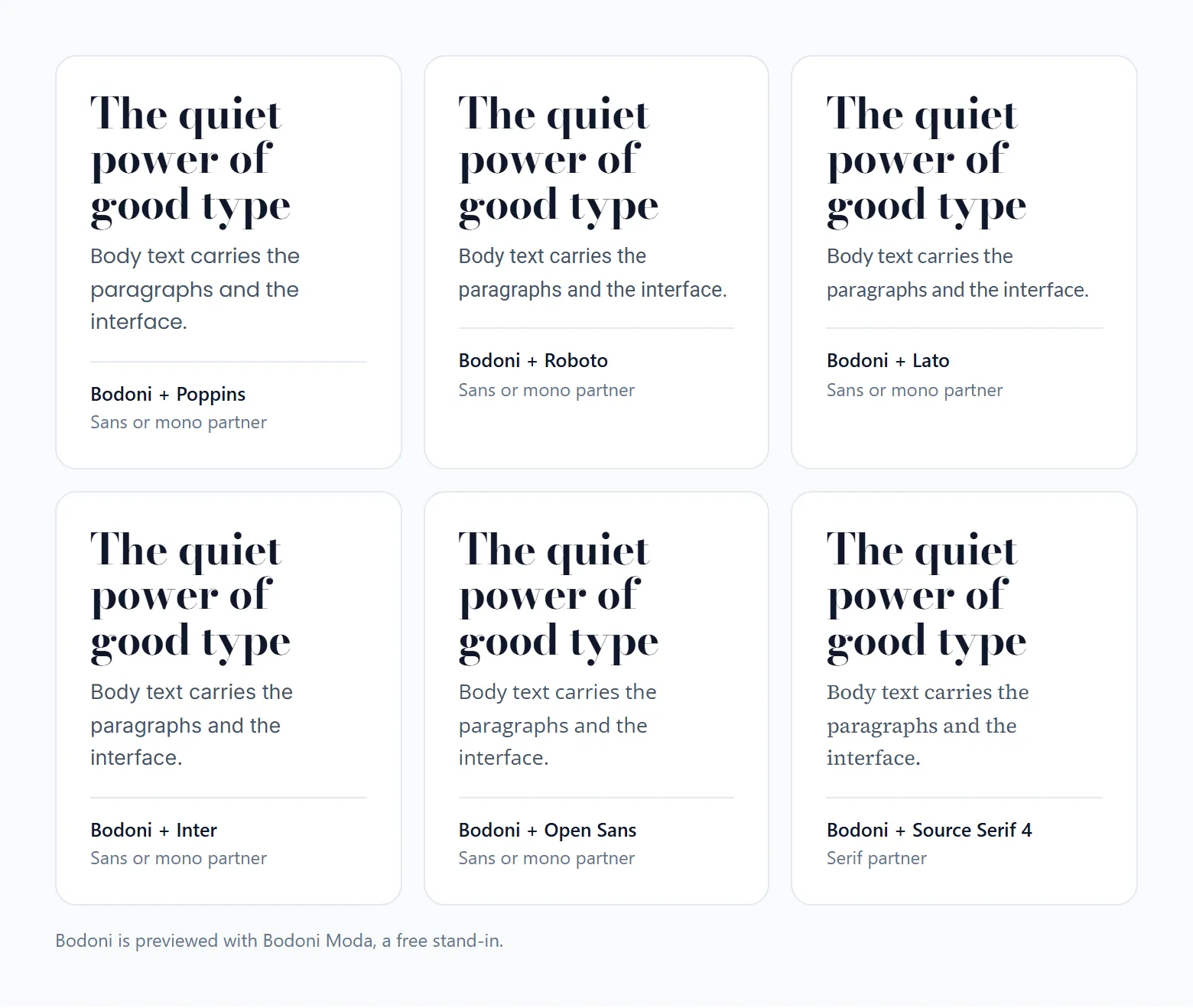
Your heading text set in Bodoni, previewed with Bodoni Moda, with each partner font on the body copy.
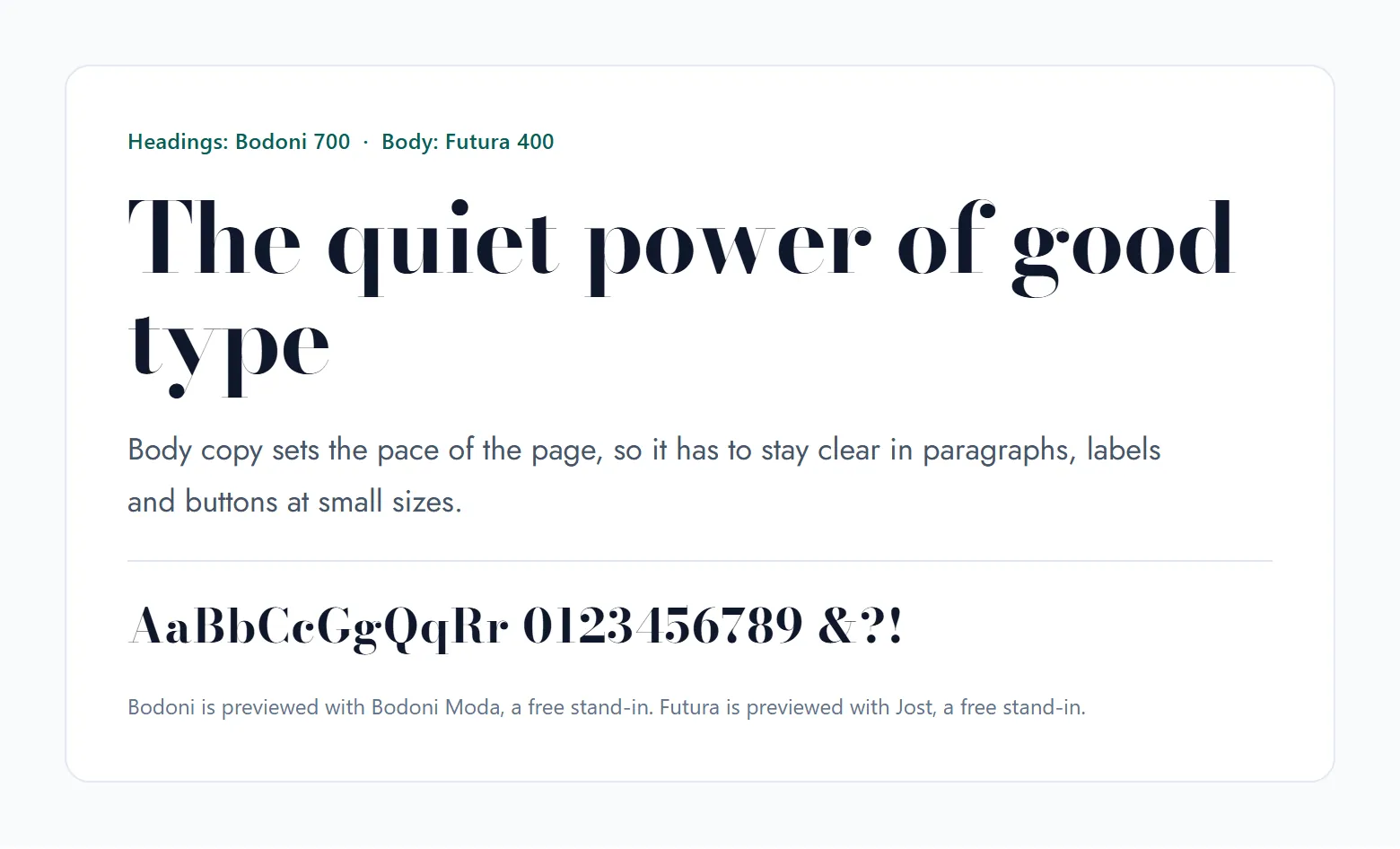
Put Bodoni in the headlines and a low-contrast sans with even strokes underneath it. Futura, Montserrat, Helvetica, Gill Sans, or Lato all do the job. Bodoni already brings all the thick-thin contrast a page can handle, so the partner only has to be readable and stay out of the way.
Typewolf's Bodoni page tracks real sites from 2013 to 2017. Eight of its nine entries pair Bodoni with a sans serif, drawn from grotesque, humanist and geometric families. Funny detail: none of them uses Futura, which is the pairing Typewolf itself recommends.
How to use the Bodoni font pairing tool
This Bodoni font pairing tool sets Bodoni on the headlines and puts 13 partner fonts on the body text, then shows each pair in layouts you actually ship. Bodoni is a classic design from the late 18th century, and its digital versions vary by foundry, so the preview and the copied code use Bodoni Moda, a free revival on Google Fonts.
- Pick a partner from the list. Filter by serif or sans if you already know the mood you want.
- Switch the layout between Specimen, Article, Landing page, Pricing cards and Dashboard. A Bodoni hero can look sharp while a Bodoni card title feels too delicate.
- Type your own heading and body text. Real copy shows how the hairlines hold up in your actual headline length.
- Keep Bodoni on the headings. Its contrast is too extreme for paragraphs, so the Swap roles button stays off on this page.
- Check dark mode and adjust the heading and body sizes. Light text on a dark background makes thin hairlines look even thinner.
- Copy the code as a Google Fonts link, plain CSS or a Tailwind v4 theme. Futura and Helvetica are commercial, so their code uses Jost and a system font stack.
Bodoni pairings at a glance
| Partner font | Type | Role | Notes |
|---|---|---|---|
| Futura | Geometric sans | Body text | Commercial, previewed with Jost |
| Helvetica | Neo-grotesque sans | Body text | System font, Arial on Windows |
| Montserrat | Wide geometric sans | Body text | Use a narrower column |
| Source Sans 3 | Humanist sans | Body text | Set paragraphs at 17px or 18px |
| PT Sans | Humanist sans | Body text | 400 and 700 only |
| Raleway | Elegant sans | Body text | Switch to lining numbers for prices |
| Work Sans | Grotesque sans | Body text | Good at screen sizes |
| Poppins | Geometric sans | Body text | Use 300 or 400 for paragraphs |
| Roboto | Neo-grotesque sans | Body text | Practical in apps and dashboards |
| Lato | Semi-rounded sans | Body text | Warm and polished |
| Inter | Screen sans | Body text | Crisp in forms and tables |
| Open Sans | Humanist sans | Body text | Neutral, easy in long paragraphs |
| Source Serif 4 | Transitional text serif | Body text | Needs a big size jump |
Which fonts pair best with Bodoni?
Low-contrast sans serifs with even strokes. My shortlist is Futura, Montserrat, Helvetica or Neue Haas Grotesk, Gill Sans, and Lato, with Bodoni on the headline and the sans on anything people actually read.
The nine sites Typewolf logs back this up. Eight set Bodoni beside a sans: Neue Haas Grotesk, Gill Sans, Akzidenz Grotesk, Brandon Grotesque (twice), Sofia, Folio and Proxima Nova. The odd one out is The Mark, which pairs it with two serifs, Americana and Times New Roman.
Those picks are all over the place category-wise. What they share is the stroke. Even weight, not much contrast, nothing fancy going on in the letterforms.
| Partner | Type | Why it works | Best role |
|---|---|---|---|
| Futura | Geometric sans | Roman-capital proportions, even strokes | Body, subheads |
| Montserrat | Geometric sans | Wide, plain forms | Navigation, UI text |
| Helvetica, Neue Haas Grotesk | Neutral grotesque | No character to compete | Body, captions |
| Gill Sans | Humanist sans | Warmth without contrast | Subheads, body |
| Lato | Humanist sans | Soft, open forms | Body, UI text |
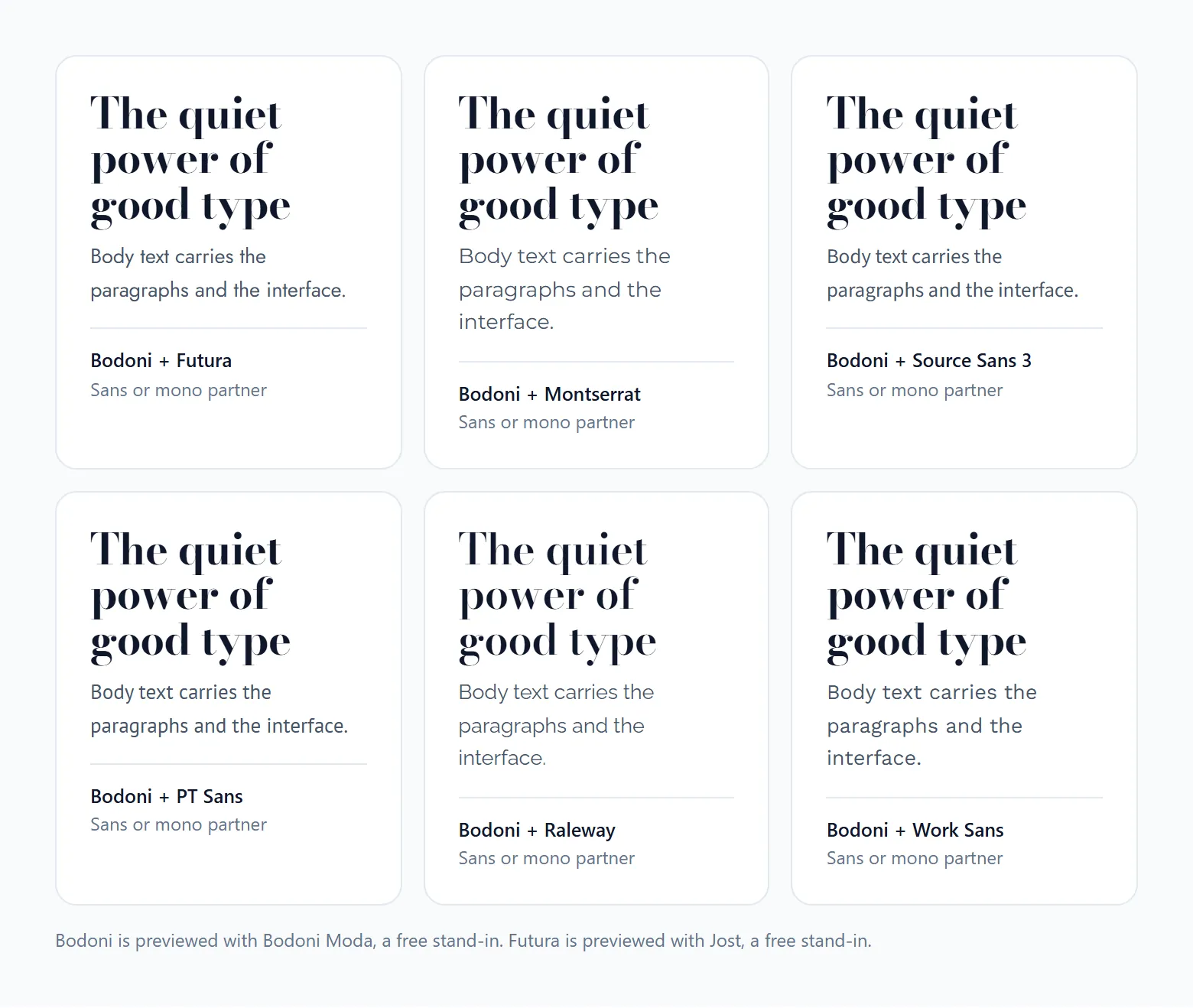
Geometric sans partners
Futura is a 1927 Paul Renner design. Bauer Types, its publisher, describes it as the proportions of Roman capitals combined with the logic of elementary geometry.
That classical skeleton is why it sits so comfortably under a Didone headline. Same proportions, different stroke. It gets along with plenty of other faces too (here's a breakdown of Futura pairings if you're curious).
If you want free, Montserrat on Google Fonts is the obvious pick. It's wide and plain, which makes it good for navigation and interface text. Brandon Grotesque, Sofia and Proxima Nova, all logged by Typewolf next to Bodoni, lean geometric as well.
Neutral grotesque partners
- Helvetica, the neutral default, has no character to fight with
- Neue Haas Grotesk sat beside Bodoni on Eric Hu's site (Typewolf, 2017)
- Akzidenz Grotesk was the partner on Shinola's site (Typewolf, 2016)
Go grotesque when the headline carries the brand and you want everything else quiet. Futura and Montserrat have shapes of their own. A grotesque basically doesn't.
Humanist and other sans partners
Humanist sans faces add some warmth, which takes the edge off Bodoni's severity without bringing in more contrast.
A humanist typeface keeps traces of handwriting in its forms. Gill Sans is the classic example, and The Weekender paired it with Bodoni in 2017, per Typewolf.
- Lato for body copy
- Open Sans if you need long reading plus wide language coverage
- Inter, which I'd reach for on dashboards, apps and other screen interfaces
The catch is personality. Humanist faces have more of it than a grotesque, and in a layout already heavy on display type, that extra character starts to get in the way.
How to divide the work between Bodoni and its partner
Bodoni gets the loud jobs: headlines, display lines, pull quotes, logotypes. Anything involving sustained reading goes to the partner, from body copy and captions to interface text.
What each face handles
Typewolf points out that the extreme thick-thin contrast makes Bodoni better as a display typeface than a text face.
It belongs to the Didone class, which Fonts.com defines by extreme weight contrast, vertical stress, and serifs with little or no bracketing. The partner should be the opposite of all that.
- Bodoni brings heavy thicks, hairline thins, upright stress and sharp serifs
- The partner brings even strokes and open forms, with plain serifs or none at all
You get a clear typographic hierarchy out of this split without doing anything extra. Loud face on top, quiet face below.
Why the cut matters
There's no single "Bodoni" to begin with. Giambattista Bodoni ran the Duke of Parma's private press, and his Manuale Tipografico, published by his widow in 1818, shows a vast range of roman alphabets.
Digital revivals are just as inconsistent. Typewolf notes that earlier Bodoni versions read as transitional and later ones as modern, so the cut you load decides how much the partner has to balance out.
The harder the Bodoni cut, the plainer the partner should be.
Can Bodoni be paired with another serif or a script?
Sometimes. A second serif can work if it's a sturdy text face with lower contrast. A script works as a single accent line, and that's about it.
Typewolf logs Times New Roman beside Bodoni on The Mark (2015) and Seersucker (2013), so a plain text serif isn't a strange choice.
Text serif partners
Ignore the font name and look at the contrast. A sturdy text serif with moderate contrast and bracketed serifs works fine, so think Times New Roman or a Garamond cut. A second high-contrast display serif clashes, because it wants the exact job Bodoni already has.
Labels can mislead you here. Google Fonts describes Playfair Display as a transitional serif, a class that normally implies moderate contrast. The same Google Fonts description, though, says the design has high contrast and delicate hairlines.
I'd treat Playfair Display as a second display serif and keep it off text partner duty.
Script accents
One script, one short line.
A script font belongs on a signature or a name, maybe a single phrase. Never in running text.
Pick one with light, even strokes, and stop at three typefaces total (Bodoni, a sans, the script). Swash-heavy scripts tangle with Bodoni's thin hairlines, and the accent just turns into noise.
When does a Bodoni pairing fail?
Small sizes and long paragraphs are where it falls apart first. It also fails next to a second high-contrast serif, and on low-resolution screens where the hairlines drop out. Almost every fix comes down to a plainer partner doing more of the work.
Emigre's Filosofia specimen explains the small-size problem. Bodoni's own small sizes were cut with reduced contrast and slightly widened characters so the hairlines would not break up.
A single display cut set at text size has none of those adjustments. Don't stretch Bodoni. Take the text face from a list of fonts built for small text instead.
- In small text and long paragraphs, the hairlines break up and the contrast wears readers out. Set the reading text in the partner.
- Next to a second high-contrast serif, two faces fight over the headline. Swap in a lower-contrast text serif or a sans.
- Low-resolution screens lose thin strokes in anti-aliasing, so proof on a standard-resolution display and not only on a Retina one.
- Decorative, condensed or swashy partners add noise. Keep it plain.
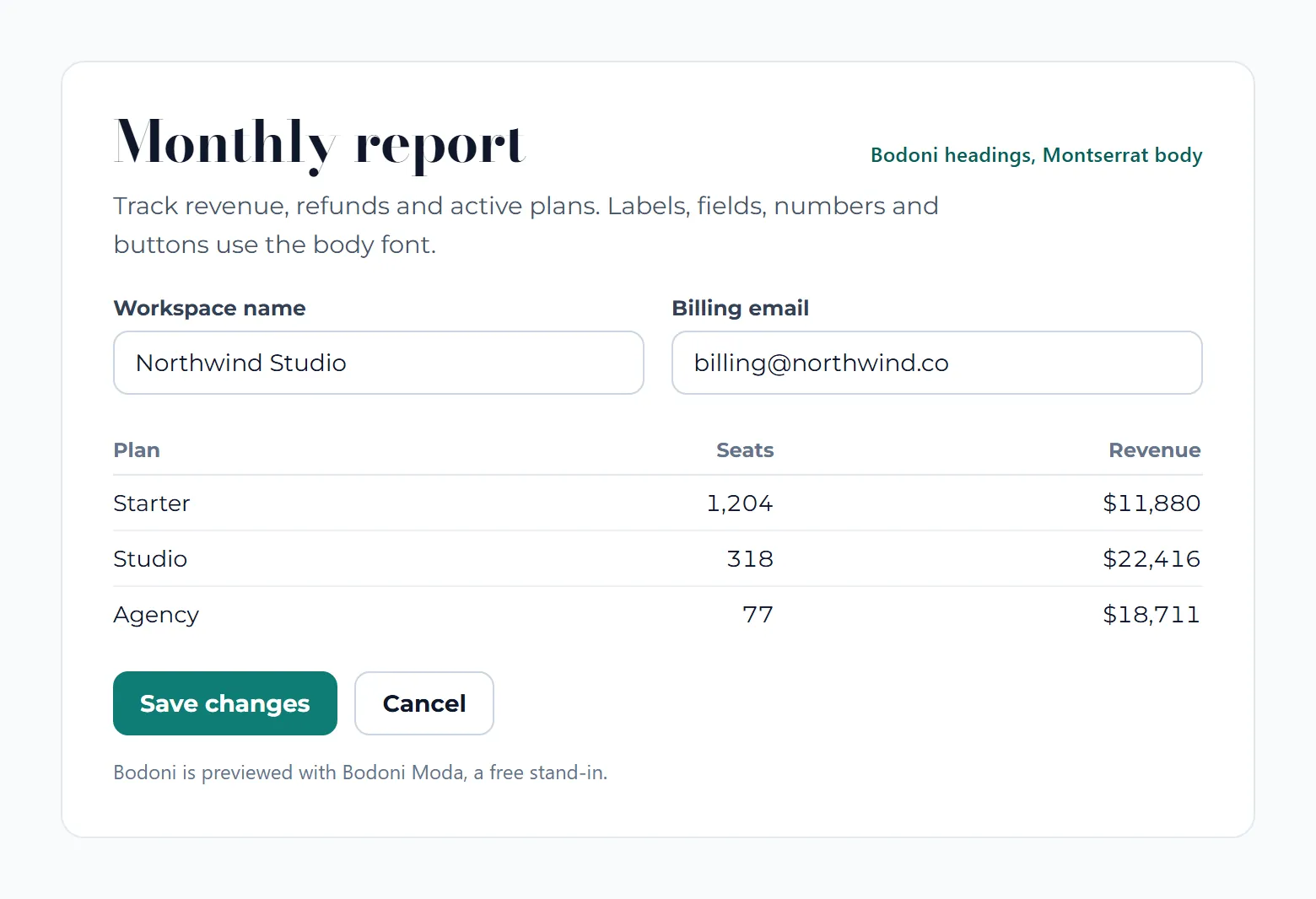
Dense interfaces are the clearest bad fit. In a product that's mostly tables and labels, Bodoni gets one decorative line and the sans handles everything else.
Which Bodoni version should anchor the pairing?
For headlines that need to scale across screen sizes, I'd go with Bodoni Moda. Libre Bodoni is fine for display-only settings. Print and brand work is where a commercial cut like Bauer Bodoni or ITC Bodoni earns its price. Size handling and licensing decide it.
| Version | Made by | Cost | Best use |
|---|---|---|---|
| Bodoni Moda | Owen Earl (2020) | Free, OFL | Responsive headlines and captions |
| Libre Bodoni | Pablo Impallari, Rodrigo Fuenzalida | Free, OFL | Display settings, weight control |
| Bauer Bodoni | Heinrich Jost, Louis Hoell (1926) | Paid | Headlines, logos |
| ITC Bodoni | Sumner Stone and team for ITC (1994), now Monotype; three size cuts | Paid | Captions, text, display |
Free versions on Google Fonts
Both free families are variable fonts. They just vary on different axes.
Bodoni Moda is Owen Earl's family from indestructible type, built with optical sizes in mind. It has an optical size axis and a weight axis (400 to 900). Libre Bodoni is based on Morris Fuller Benton's ATF Bodoni, and weight (400 to 700) is its only variable axis.
Variable fonts can carry any axis, so the useful question is which one you're getting. A weight axis can't lower contrast at small sizes. An optical size axis can, and for Bodoni that's the one you care about.
On Google Fonts, Bodoni Moda ships as two variable files, roman and italic, each carrying both the optical size and weight axes.
The foundry's README adds that version 2.4 re-mastered the sources for Google Fonts and recalibrated the axes mapping. For web work, trust the Google Fonts build, and check the axes on its specimen page before relying on them.
Commercial versions
Bauer Types credits Heinrich Jost with Bauer Bodoni, designed around 1926. Fonts In Use adds that Louis Hoell cut the punches.
- Bauer Bodoni, mostly for headlines, logos and advertising
- ITC Bodoni in three cuts keyed to size
- Bodoni Old Face, which is Berthold's 1983 text cut for book printing
Those three ITC size cuts are the print-era answer to the problem Bodoni Moda solves with an axis.
Before you ship anything, read the font licensing terms. Web, desktop and app use are often licensed separately, and that catches people out more often than you'd think.
At what size and weight does Bodoni stop working?
Any cut set outside its intended size range will look off, and it goes both ways. The less obvious failure is a text cut at large sizes, where the thins look too heavy and the spacing too open.
Monotype's TypeTalk column describes the small-size side as tight spacing and thins that no longer hold. In both cases, a cut built for that size beats manual font spacing tweaks.
Print: cuts built for a size
- ITC Bodoni Six is for very small type, around six point, so captions and credits
- ITC Bodoni Twelve handles text copy
- ITC Bodoni Seventy-Two is the display cut
- Bodoni Old Face targets book printing around nine point, and Gunter Gerhard Lange oversaw it at Berthold
Monotype's rule for choosing a cut is simple. The thin strokes should stay proportionally thin at the size you're setting.
Screen: the optical size axis
Bodoni Moda on Google Fonts has an optical size range of 6 to 96.
Leave font-optical-sizing on auto (it's the default) and the browser adjusts the glyphs to the font size. MDN notes that small sizes render with thicker strokes and larger serifs, and large sizes with more contrast. That's the same adjustment Bodoni's size-specific romans made by hand.
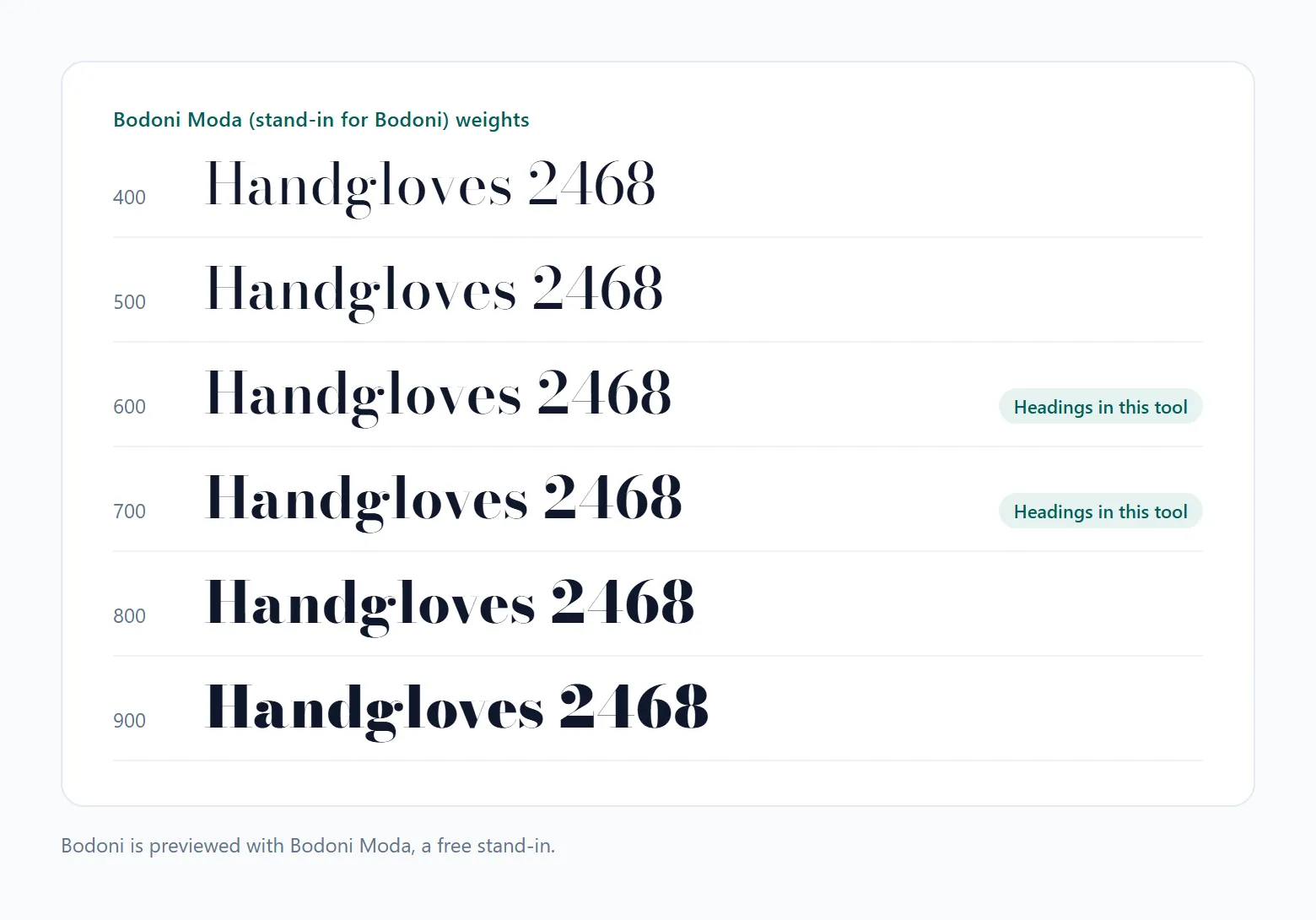
Weight
None of the sources above sets a weight limit for Bodoni headlines.
The documented constraint is the thin-stroke rule, so test each weight at its final size. A name like Regular or Bold doesn't tell you much.
Which Bodoni pairings suit editorial, fashion, branding and packaging?
For editorial layouts I'd go with a neutral grotesque. Fashion and luxury branding lean toward a geometric sans, while logos and packaging just need something plain.
Monotype's TypeTalk column lists logos, titles, headlines, branding, packaging, and publishing as Bodoni's usual territory.
Editorial layouts
The Van Gogh site paired Bodoni with Sofia in Typewolf's 2015 site of the day.
Magazines and books run on the same split. Bodoni handles titles and decks, and the partner carries the story. Good editorial design keeps that partner quiet so the headline owns the page.
Fashion and luxury branding
The Didone look became the luxury default mostly because of fashion magazines.
Eye magazine traces Harper's Bazaar's Didot signature to Alexey Brodovitch, who art-directed the title from 1934 to 1958. MoMA's collection records that HTF Didot was commissioned for a 1991 Bazaar redesign.
Sources disagree on which typeface Vogue's masthead uses. Some font sites say Bodoni, while an ATypI presentation traces both the Vogue and Bazaar nameplates to the Didot family's typestyle. The Didot attribution is better documented.
A fashion masthead is a Didone at one fixed, large size, repeated on every issue. Brand systems are messier. You'll usually need Bodoni at two or three sizes, with a light geometric partner holding everything else.
Logos and packaging
Fedrigoni's site, in Typewolf's 2014 site of the day, set Bodoni beside Folio, a plain sans that did the small work.
A logotype or pack front gets scaled to lots of sizes, and the smallest reproduction size decides the cut. Choose the Bodoni for that size first. Then pick the partner.
How to set up a Bodoni pairing on a website
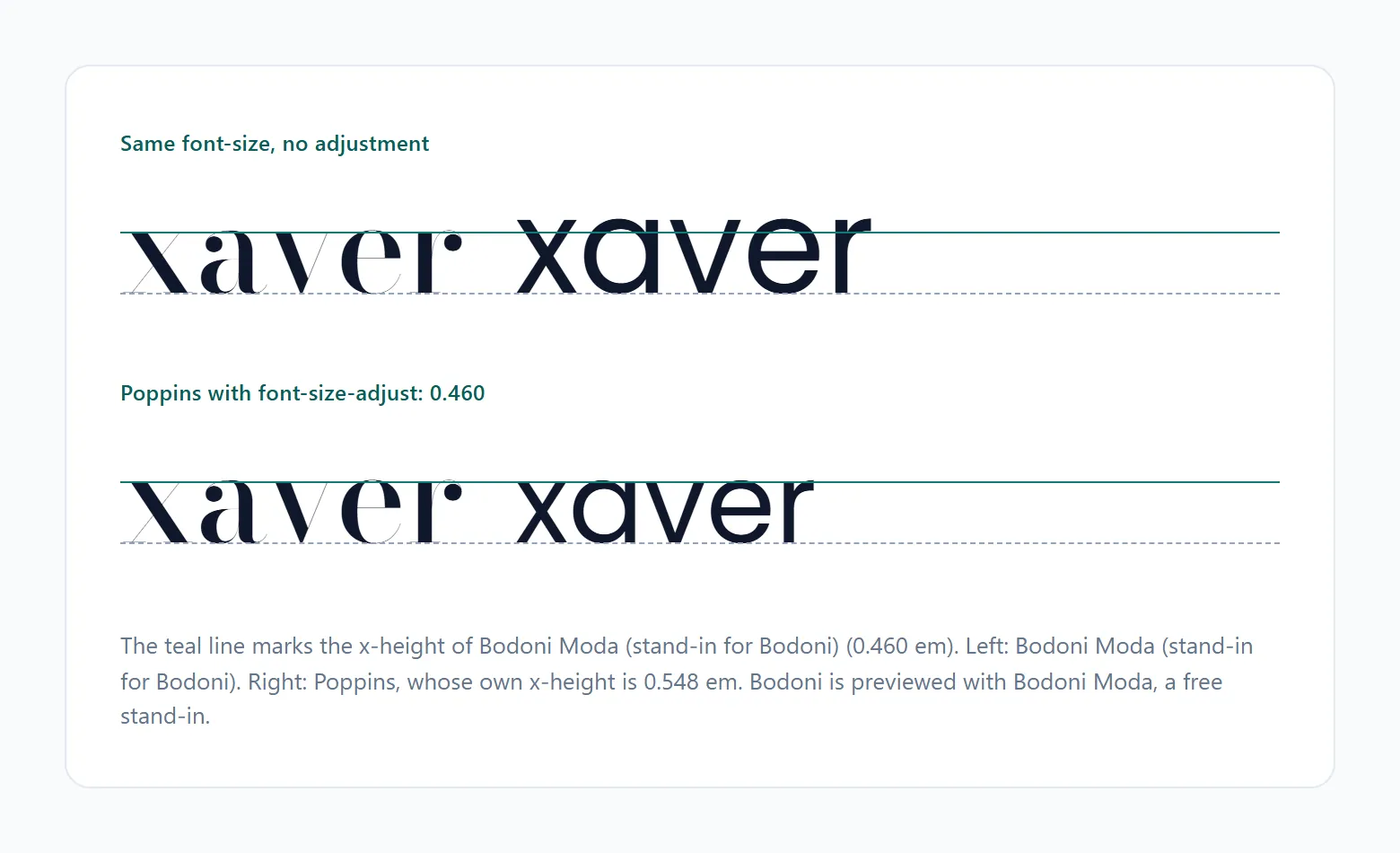
Load both fonts from Google Fonts or Adobe Fonts and request only the axes and weights you'll use. Add a metric-matched fallback, then check contrast and rendering before it goes live.
- Pick the build. That's Bodoni Moda or Libre Bodoni from Google Fonts, or a licensed Bodoni from Adobe Fonts, which Typewolf lists as the closest Adobe Fonts match and which has no web pageview limits on Creative Cloud plans.
- Request only what you use. Google's CSS2 API wants axes listed alphabetically and tuples sorted numerically, so a Bodoni Moda request reads
css2?family=Bodoni+Moda:opsz,wght@6..96,400&display=swap. - Leave font-optical-sizing on auto. MDN lists it as Baseline widely available, supported across browsers since March 2020.
- Assign roles in CSS, with Bodoni on the heading selectors and the partner on body copy, captions and navigation.
- Set font-display to swap and end the stack with a generic serif.
- Preview the pairing at real sizes before the first deploy.
Fallback stack and layout shift
With font-display swap, the browser paints a fallback font first, and the text reflows once the Bodoni file arrives. Shopify's developer documentation puts the cumulative layout shift from a font swap at 0.05 to 0.15 CLS units on text-heavy pages.
The fix is a fallback face with size-adjust, ascent-override, descent-override and line-gap-override values measured for the exact font pair. Shopify warns that the values depend on the weights and styles in use, so you have to measure each pair. Tedious, but you only do it once.
Put a web-safe serif after the metric-matched fallback, so the stack never ends on the browser default.
Testing the pairing
Libre Bodoni is a Google Font, so you can mock the pairing up in Figma directly. A licensed cut such as Bauer Bodoni has to be installed first, and this walkthrough covers how to add fonts to Figma.
For contrast, W3C's WCAG 2.2 success criterion 1.4.3 sets a ratio of at least 4.5:1 for normal text and 3:1 for large text, defined as 18 point, or 14 point bold.
Logotypes are exempt. Headlines aren't. I'd aim for 4.5:1 on Bodoni headlines even where 3:1 technically qualifies, since the thin strokes carry less ink than the ratio assumes.
Bodoni Font Pairing FAQ
How does Bodoni differ from Didot?
The difference is mostly where they came from. Didot traces back to the Didot family in France, Bodoni to Giambattista Bodoni in Parma. Both are Didones, so the same low-contrast partners suit either one.
Fonts.com defines the class by extreme weight contrast, vertical stress and serifs with little or no bracketing, and the class name itself blends the two.
Is Playfair Display a good Bodoni substitute?
For display use it's a close substitute, not a replica. Claus Eggers Sørensen released it in 2011, and Google Fonts classes it as a transitional design.
If you want a faithful Didone look, load Libre Bodoni or Bodoni Moda instead.
How many typefaces can a Bodoni layout hold?
Three, at most. Bodoni, a sans partner, and maybe one script accent.
Typewolf's Folklore Surf entry (2014) combines Bodoni with Courier and Proxima Nova, so a third face has precedent.
Does Bodoni have an italic, and what goes with it?
It does. Bodoni Moda ships with italics.
I'd keep the Bodoni italic for display emphasis and let the partner's italic handle emphasis inside body copy.
Which Pairing to Test First, and When to Switch
Start a Bodoni font pairing with the plainest partner for the medium. For editorial work that's a neutral grotesque. Fashion and luxury branding usually want Futura or Montserrat.
Then test in this order, changing one thing per round:
- The Bodoni cut at its smallest size
- The plainest partner at body size
- A partner swap, but only once the cut passes
The cut comes first because a new partner can't rescue hairlines that fill in. A new cut can.
One thing to accept going in: the plainest partner adds no character, so whatever makes the brand distinctive has to come from Bodoni and the layout.
A font pairing generator lets you preview candidate partners beside Bodoni before the first mockup.
Other font pairings
Same idea, different starting font. Each guide lists tested partners with notes on where they work.
- Abril Fatface font pairing
- Baskerville font pairing
- Cormorant Garamond font pairing
- DM Sans font pairing
- Futura font pairing
- Garamond font pairing
- Georgia font pairing
- Google Font pairings
- Gotham font pairing
- Helvetica font pairing
- Inter font pairing
- Josefin Sans font pairing
- Karla font pairing
- Lato font pairing
- Libre Baskerville font pairing
- Lora font pairing
- Merriweather font pairing
- Montserrat font pairing
- Nunito font pairing
- Open Sans font pairing
- Playfair Display font pairing
- Poppins font pairing
- Raleway font pairing
- Roboto font pairing
- Source Sans Pro font pairing
- Space Grotesk font pairing
- Work Sans font pairing