The Maserati Logo stands as one of the most recognized symbols in the luxury automotive world. A trident rising from a sea of Italian heritage and racing history.
This emblem represents over a century of high-performance engineering. It connects directly to Bologna’s iconic Neptune Fountain, where the god of the sea holds his three-pronged weapon.
The current version has remained largely unchanged since the company’s founding in 1914. That’s unusual for automotive branding. Most manufacturers have redesigned their logo multiple times.
Maserati has gone through roughly six iterations of their emblem. Each kept the trident as the central element while refining the surrounding design and typography.
What is the Maserati Logo?
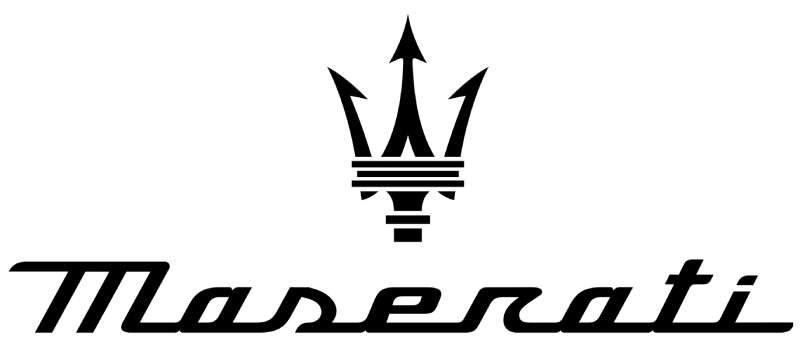
The Maserati logo features a steel-blue trident symbol inspired by the Neptune statue in Bologna’s Piazza Maggiore. Introduced in 1926, it was designed by Mario Maserati, one of the founding brothers. The trident represents strength, power, and the brand’s deep connection to its Italian birthplace.
Design Type: Combination mark (symbol with wordmark)
Primary Elements:
- Three-pronged trident symbol
- Oval or shield-shaped badge (varies by application)
- MASERATI wordmark in capitalized lettering
Official Introduction Date: 1926 (first appearance on the Tipo 26 race car)
Designer: Mario Maserati, the artistic brother among the founders
Trademark Status: Registered trademark owned by Maserati S.p.A., now under Stellantis
Color Palette:
- Primary Blue: #0C2340 (Maserati Blue)
- Silver/White: #FFFFFF
- Red accent: #CC0000 (used in heritage applications)
Usage Context: Vehicle grilles, steering wheels, key fobs, dealership signage, marketing materials, merchandise, and digital platforms
How Has the Maserati Logo Evolved Over Time?
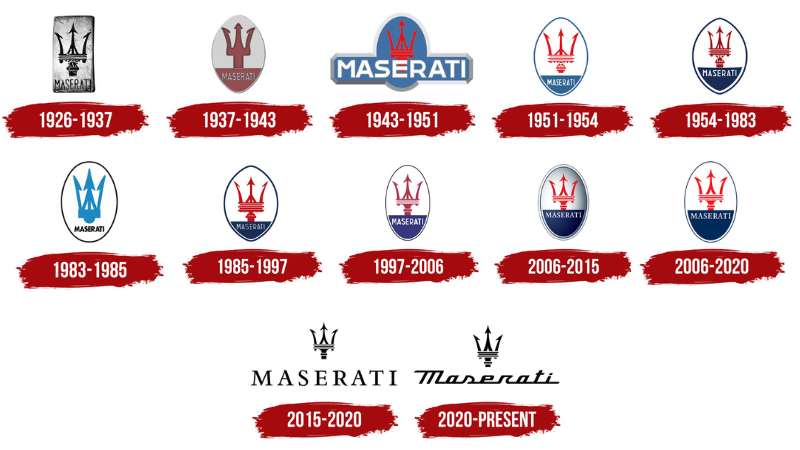
The Maserati trident has maintained remarkable consistency since 1926.
Unlike many car logos that underwent complete redesigns, Maserati refined rather than replaced.
The core symbol stayed the same. The surrounding elements shifted with design trends and ownership changes.
Original Maserati Logo (1914-1920)
Years Active: 1914-1920
Design Description: The earliest Maserati vehicles didn’t carry the trident at all. The brothers operated as Officine Alfieri Maserati, focusing on building and modifying race cars for other manufacturers.
Color Scheme: No standardized branding existed during this period
Designer: N/A
Context: The company was still finding its identity. Alfieri Maserati was the driving force, but the brothers hadn’t yet created their own cars.
Key Changes from Previous: This was the starting point
Cultural Significance: Represented the workshop era before Maserati became a true manufacturer
First Trident Logo (1920-1926)
Years Active: 1920-1926
Design Description: Mario Maserati created the trident design during this period, though it wasn’t immediately used on vehicles. The concept drew from the Neptune Fountain, which the brothers passed daily in Bologna.
Color Scheme: Early versions appeared in red and silver
Designer: Mario Maserati
Context: The brothers needed a symbol that would represent their racing ambitions and Bologna roots. Mario, who was an artist rather than an engineer, took on the task.
Key Changes from Previous: First appearance of the now-iconic trident shape
Cultural Significance: Established the permanent visual identity that would define the brand
Racing Era Logo (1926-1937)
Years Active: 1926-1937
Design Description: The trident debuted publicly on the Tipo 26 race car. It appeared on a triangular badge with the trident in white against a dark background.
Color Scheme: White trident on dark blue or black
Designer: Mario Maserati (original design applied)
Context: This was Maserati’s first true production car. The logo needed to be visible and memorable on the racing circuit.
Key Changes from Previous: Formal badge shape introduced around the trident
Cultural Significance: Connected the brand permanently to motorsport excellence
Orsi Family Era Logo (1937-1968)
Years Active: 1937-1968
Design Description: When the Orsi family purchased Maserati, they kept the trident but moved operations to Modena. The logo became more refined, with cleaner lines and better proportions.
Color Scheme: Blue and white standardized
Designer: Company design team under Orsi direction
Context: The brand transitioned from pure racing to grand touring road cars. The logo needed to feel more luxurious.
Key Changes from Previous: More elegant proportions, oval badge shape introduced
Cultural Significance: Marked Maserati’s shift toward becoming a luxury manufacturer
Citroen Partnership Era (1968-1975)
Years Active: 1968-1975
Design Description: Citroen’s ownership brought technical changes but the logo remained largely untouched. Some applications featured the trident alongside Citroen branding.
Color Scheme: Traditional blue and white maintained
Designer: No significant changes made
Context: A tumultuous ownership period. The brand identity was preserved despite corporate uncertainty.
Key Changes from Previous: Minor refinements only
Cultural Significance: Showed the trident’s strength as a brand asset worth preserving
Modern Era Logo (1993-Present)
Years Active: 1993-Present
Design Description: Under Fiat and later Stellantis ownership, the logo received its most polished treatment. The trident sits within an oval badge, with clean geometric proportions. The wordmark uses a custom serif typeface.
Color Scheme: Deep blue (#0C2340), silver, and white
Designer: Maserati Centro Stile with input from parent company designers
Context: Maserati repositioned as a direct competitor to Porsche and BMW’s luxury models. The logo needed premium refinement.
Key Changes from Previous: Sharper trident points, modernized typography, standardized proportions
Cultural Significance: Represents Maserati’s current identity as a luxury performance brand
What Do the Design Elements of the Maserati Logo Mean?
The trident carries layered meaning. It references the Roman god Neptune and his association with power over the seas.
But there’s also a local connection. The Maserati brothers drew inspiration from Bologna’s Piazza Maggiore, where Giambologna’s Neptune Fountain has stood since 1567.
The three prongs represent the three Maserati brothers who were active in the business: Alfieri, Ettore, and Ernesto.
Why Did Maserati Choose These Specific Colors?
The deep blue connects to Italian racing heritage. Italy’s national racing color was traditionally red, but Maserati went a different direction.
Blue suggested the sea, tying back to Neptune and the trident symbolism.
Maserati Blue (#0C2340): Conveys sophistication, depth, and premium positioning. Understanding color psychology reveals why blue builds trust and suggests reliability.
Silver/White (#FFFFFF): Represents purity, precision, and the metallic quality of finely engineered machinery.
Red Accent (#CC0000): Used sparingly, it nods to Italian passion and the brand’s racing roots. You can see how other blue logos in the automotive industry create similar effects.
What Typography Style Is Used in the Maserati Logo?
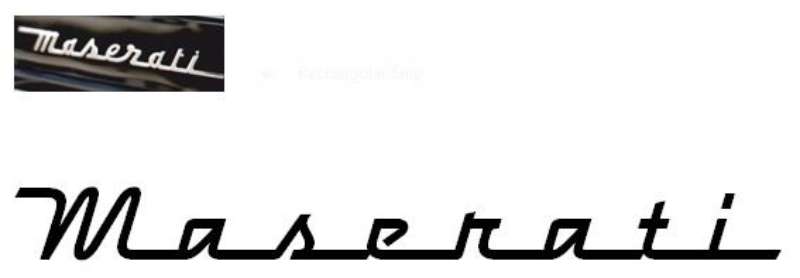
The MASERATI wordmark uses a custom serif font with distinctive characteristics.
The letterforms are tall and narrow. They suggest elegance without being delicate.
Capital letters throughout convey authority and permanence. The serifs add classical refinement that matches the brand’s heritage positioning.
Over time, the typography has been cleaned up. Earlier versions had more ornate characteristics. The current version is simpler but still distinctly premium.
What Are the Hidden Meanings in the Maserati Logo?
The three prongs equal three brothers. That’s the official story, anyway.
Some interpret the upward-pointing trident as representing ambition and forward motion. The psychology of shapes suggests that pointed forms create feelings of energy and direction.
The oval badge can be read as a wheel or racing oval. Intentional? Hard to say.
Mario Maserati never documented his full creative process. What we know comes from family accounts passed down over decades.
How Does the Maserati Logo Compare to Competitor Logos?
Italian luxury car brands favor animal and mythological symbolism. Maserati chose differently.
The Ferrari Logo features a prancing horse. The Lamborghini Logo shows a charging bull. The Alfa Romeo Logo combines a cross with a serpent.
Maserati’s trident stands apart by referencing classical mythology rather than animals. It feels older, more connected to European history.
Against German competitors like the Porsche Logo and BMW Logo, Maserati’s emblem appears more ornate. German brands trend toward geometric abstraction. Italian brands embrace storytelling.
British luxury brands like Bentley Logo, Rolls-Royce Logo, and Aston Martin Logo use wings extensively. Maserati avoids this, maintaining its distinctive position.
What Are the Technical Specifications of the Maserati Logo?
Official Color Codes:
Primary Color (Maserati Blue):
Secondary Color (Silver):
- Hex: #C0C0C0
- RGB: (192, 192, 192)
- CMYK: (0, 0, 0, 25)
- Pantone: 877 C (Metallic)
Accent Color (White):
- Hex: #FFFFFF
- RGB: (255, 255, 255)
- CMYK: (0, 0, 0, 0)
Dimensions and Proportions:
- Aspect ratio: Approximately 1:1.2 (width to height) for the full badge
- Trident proportions follow classical geometric principles
- Minimum size: 15mm width for print applications
- Clear space: Equal to the height of one trident prong on all sides
The logo works as vector graphics, which allows scaling without quality loss. This matters for applications ranging from tiny key fobs to massive dealership signs.
What Cultural Impact Has the Maserati Logo Had?
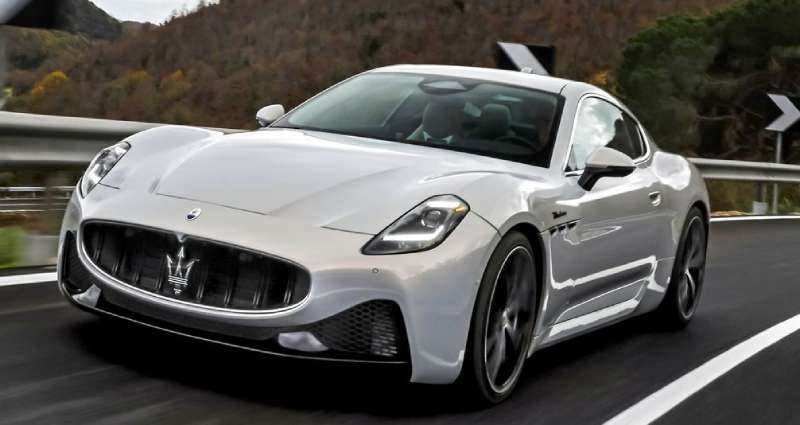
The trident transcends automotive circles. It appears on fashion collaborations, luxury watches, and lifestyle products.
Musicians reference Maserati in lyrics. The brand name and its trident carry associations with success and Italian style.
In design education, the logo serves as an example of effective heritage branding. It shows how simplicity and consistency build recognition over decades.
How Does the Maserati Logo Fit Into the Overall Brand Identity?
The trident anchors everything Maserati does visually. It connects their brand guidelines across vehicles, dealerships, and marketing.
Interior details on Maserati cars feature the trident on headrests, clock faces, and steering wheel centers.
Exterior applications include the grille badge, C-pillar badging, and wheel center caps.
Marketing materials use the trident as a focal point, often appearing larger than the wordmark.
The brand’s sonic identity even incorporates the trident concept through three-note audio signatures.
How Should the Maserati Logo Be Used?
Official Usage Guidelines:
Do:
- Maintain minimum clear space around the logo
- Use official color codes only
- Scale proportionally from vector source files
- Apply on backgrounds with sufficient contrast
Don’t:
- Rotate or skew the trident
- Change the proportions
- Apply unauthorized color variations
- Place on busy or patterned backgrounds
- Combine with other brand marks without approval
Where to Access Official Logos: Authorized dealers and partners receive assets through Maserati’s brand portal. Public use requires written permission from the trademark holder.
Licensing Information: The Maserati name and trident are protected trademarks. Commercial use requires licensing agreements through Stellantis legal departments.
Trademark Protection: The trident is registered in major markets worldwide. Unauthorized reproduction can result in legal action.
FAQ on The Maserati Logo
What Does the Maserati Trident Symbol Mean?
The trident symbol represents Neptune, the Roman god of the sea. It connects directly to the Neptune Fountain in Bologna’s Piazza Maggiore.
The three prongs also honor the three Maserati brothers who built the company. Strength, power, and Italian heritage all wrapped into one emblem.
Who Designed the Original Maserati Logo?
Mario Maserati created the trident design around 1920. He was the artistic brother among the founders.
While his siblings focused on engineering, Mario handled visual identity. The logo first appeared publicly on the Tipo 26 race car in 1926.
Why Did Maserati Choose a Trident Instead of an Animal?
Most Italian automakers picked animals. Ferrari has a horse. Lamborghini chose a bull.
The Maserati brothers wanted something tied to Bologna specifically. The Neptune Fountain was a daily landmark for them. Understanding storytelling in branding shows why local connections create authentic identity.
What Are the Official Maserati Logo Colors?
Deep blue and white form the primary color palette. The specific shade is called Maserati Blue, hex code #0C2340.
Silver appears in metallic applications. Red accents show up occasionally in heritage contexts, connecting to Italian racing tradition.
Has the Maserati Emblem Changed Since 1926?
The core trident has stayed remarkably consistent. Surrounding elements shifted over time.
Badge shapes evolved from triangular to oval. The typeface received updates. But the three-pronged symbol itself? Basically untouched for nearly a century.
What Font Does Maserati Use in Their Wordmark?
Maserati uses a custom serif font for their wordmark. Tall, narrow letterforms with classical serifs.
All capitals create authority. The kerning is tight but readable. Earlier versions were more ornate before modern refinements.
Where Is the Neptune Fountain That Inspired the Logo?
The Neptune Fountain stands in Piazza Maggiore, Bologna, Italy. Sculptor Giambologna created it in 1567.
The Maserati brothers lived and worked in Bologna. They passed this fountain regularly. It became the perfect source for their brand identity.
How Does Maserati Protect Their Logo Trademark?
The trident is a registered trademark owned by Maserati S.p.A. under Stellantis.
Commercial use requires licensing agreements. Unauthorized reproduction leads to legal action. The brand enforces protection in major markets worldwide.
Can I Download the Official Maserati Logo?
Official logo files require authorization. Dealers and partners access assets through Maserati’s brand portal.
Public use needs written permission. The company maintains strict brand style guide standards for all applications.
What Makes the Maserati Logo Different From Other Luxury Car Brands?
Mythological reference instead of animals sets it apart. The Jaguar Logo and Dodge Logo use creature imagery.
Maserati’s trident feels classical, almost ancient. This creates a distinct position among premium automotive emblems. The symmetry of the design adds to its timeless appeal.
Conclusion
The Maserati Logo has endured for nearly a century with minimal changes. That says something about the original design.
Mario Maserati created a symbol that balances Italian craftsmanship with motorsport heritage. The trident works across every application, from the Quattroporte grille to the GranTurismo steering wheel.
Under Stellantis ownership today, the emblem continues representing luxury vehicle excellence. The connection to Modena and Bologna remains strong.
Few automotive brands achieve this level of unity between past and present. The trident proves that thoughtful logo design principles create lasting visual identity.

Renowned for his expertise in logo design and visual branding, Bogdan has developed a multitude of logos for various clients.
His skills extend to creating posters, vector illustrations, business cards, and brochures. Additionally, Bogdan's UI kits were featured on marketplaces like Visual Hierarchy and UI8.
He also wrote in the past years on sites like Design Your Way, WebDesignerDepot, WPDean, Designmodo, Speckyboy, Slider Revolution, and more.
- The Windsurf Logo History, Colors, Font, And Meaning - 10 October 2026
- How to Remove Background From Product Photos (No Photoshop) - 10 October 2026
- How Designers can Build a Stronger Online Creative Identity - 9 October 2026

Bogdan Sandu is a seasoned designer who has been designing websites since 2008. Renowned for his expertise in logo design and visual branding, Bogdan has developed a multitude of logos for various clients. His skills extend to creating posters, vector illustrations, business cards, and brochures. Additionally, Bogdan's UI kits were featured on marketplaces like Visual Hierarchy and UI8. He also wrote in the past years on sites like Design Your Way, WebDesignerDepot, WPDean, Designmodo, Speckyboy, Slider Revolution, and more.
You Might Also Like