Your cleaning service flyer gets three seconds before it hits the trash. Make them count.
Knowing what to put on a cleaning service flyer separates businesses that book solid clients from those burning cash on ignored promotional materials. Wrong information loses calls, unclear pricing drives prospects to competitors, missing credentials kill trust.
This guide covers the exact elements that convert browsers into booked appointments. You’ll learn which contact details matter most, how to structure service categories for clarity, what pricing models build confidence, and which design choices make your flyer impossible to ignore.
Skip the guesswork. Build a flyer that actually fills your schedule.
What to Put on a Cleaning Service Flyer
| Element | Purpose | Key Attributes | Implementation Details |
|---|---|---|---|
| Catchy Headline | Captures immediate attention and communicates primary value proposition | Large font size, bold typography, action-oriented language | Position at top, use contrasting colors, keep to one clear message |
| Company Name | Establishes brand identity and enables recall for future service needs | Prominent placement, readable font, professional appearance | Include logo if available, ensure visibility from distance |
| Service Descriptions | Informs prospects about specific cleaning offerings and specializations | Bullet-point format, concise language, specific service types | List 4-8 core services such as deep cleaning, move-in/out, window cleaning, regular maintenance |
| Contact Information | Provides multiple channels for prospects to initiate service inquiries | Phone number, email address, website URL, physical location | Place near bottom, use clear formatting, prioritize phone for immediate response |
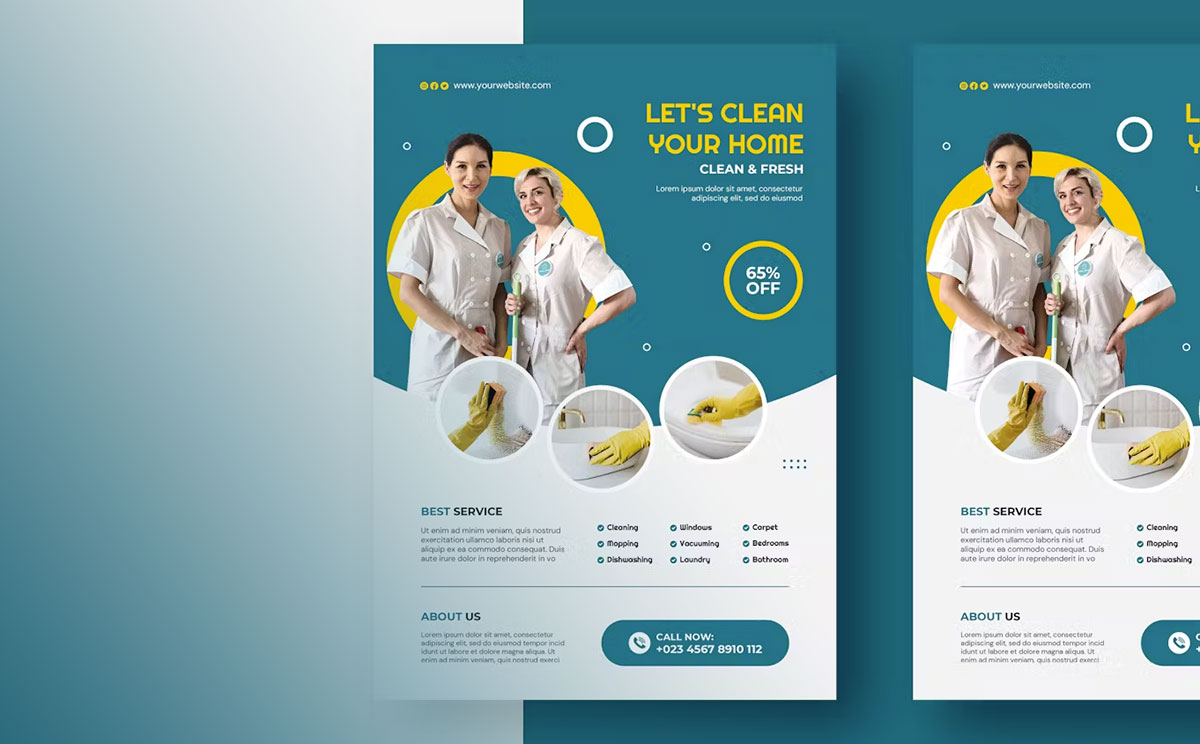
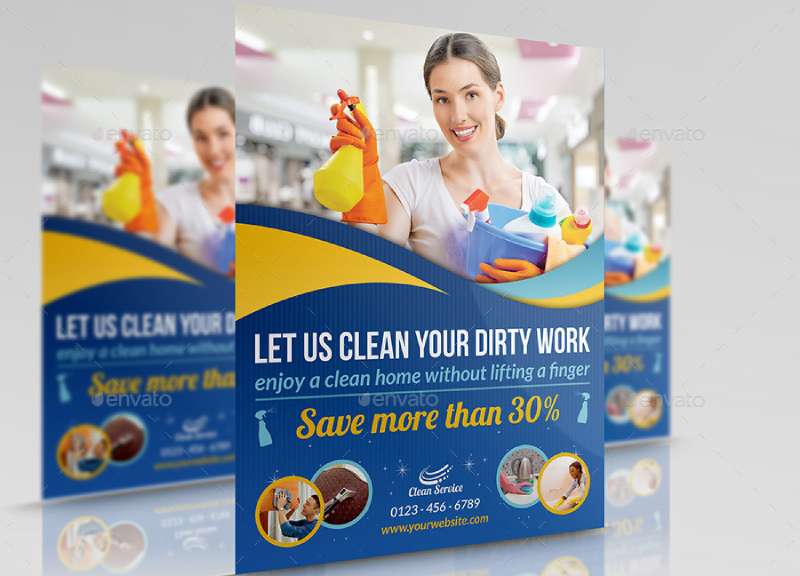
| High-Quality Graphics | Creates visual appeal and demonstrates tangible results customers receive | High-resolution images, clean spaces, relevant illustrations, professional photography | Show sparkling windows, organized rooms, or satisfied clients in action |
| Call to Action | Prompts immediate engagement and converts interest into bookings | Action verbs, urgency creation, clear next steps | Use phrases like “Call Today,” “Book Now,” “Get Free Quote,” or “Schedule Service” |
| Special Offers | Incentivizes first-time customers and differentiates from competitors | Discount percentages, free estimates, promotional codes, limited-time deals | Highlight with borders or contrasting colors, include expiration dates for urgency |
| Trust Indicators | Builds credibility and reduces hesitation in hiring service providers | Insurance status, certifications, years in business, customer testimonials | Include “Licensed & Insured,” experience duration, or brief positive reviews |
| Service Area | Clarifies geographic coverage and targets local customer base | City names, neighborhood references, zip codes, radius indicators | Mention specific locations served to improve local relevance and targeting |
| Design Layout | Ensures information hierarchy and prevents visual clutter | White space usage, organized sections, readable fonts, complementary colors | Standard 8.5″ x 11″ size, clean layout, avoid overwhelming text blocks |
Contact Information Requirements
Business Identification Elements
List your company name at the top in a readable font that reflects professionalism.
Include a professional logo that builds brand recognition across all marketing materials.
Physical address establishes legitimacy (even if you’re mobile-only, use a registered business address).
Phone number should be large, bold, and positioned where eyes naturally land. If possible, get a toll-free number for your business to make your service appear more professional.
Email and website create digital touchpoints for tech-savvy customers who prefer online booking.
Social media handles matter for younger demographics researching service providers.
Licensing Documentation
Display insurance certification numbers prominently-clients want proof you’re bonded and insured.
State license references validate you’re operating legally within your jurisdiction.
Professional association memberships (IICRC, ISSA) signal industry commitment and training standards.
Pricing Structure Display
Transparency builds trust. Vague pricing generates suspicion.
Pricing Models
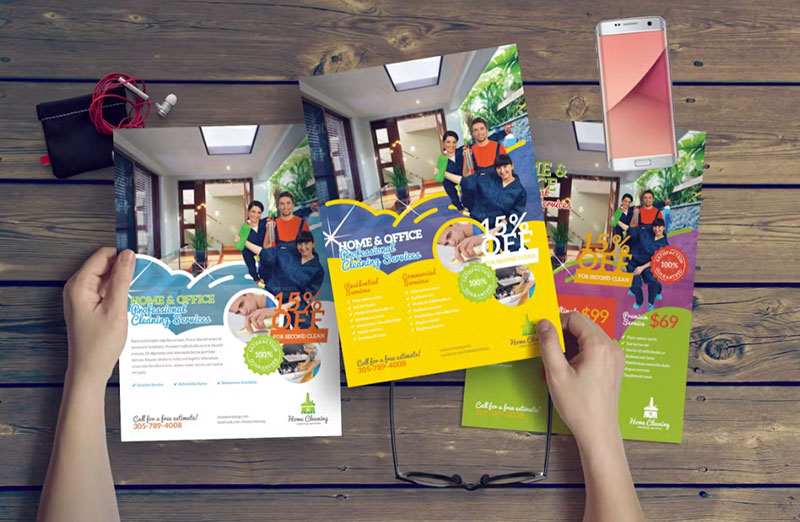
Hourly rates work for custom jobs where scope varies significantly.
Flat-rate packages simplify decisions for standard home sizes (studio, 2-bed, 3-bed).
Square footage calculations give commercial clients predictable budgeting.
“Call for quote” works only when paired with specific service categories and ballpark ranges.
Discount Opportunities
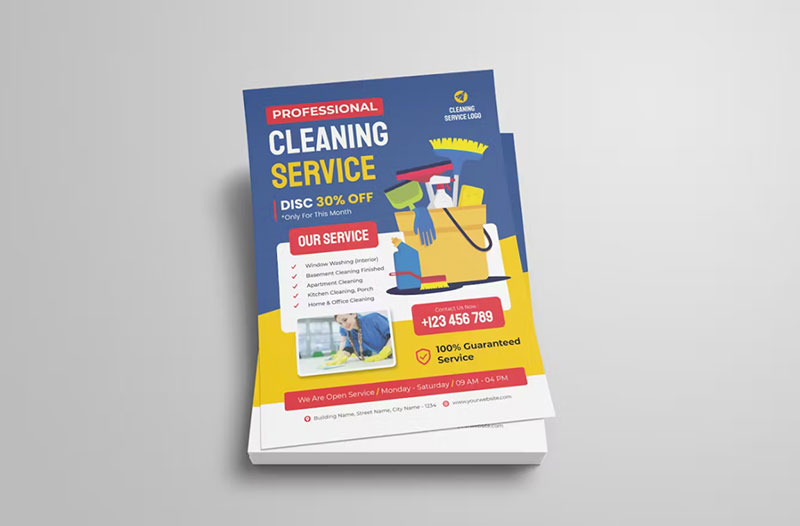
First-time customer rates lower the barrier to trying your service.
Referral programs turn satisfied customers into your sales team.
Seasonal promotions fill slow periods (post-holiday deep cleans, spring refresh packages).
Recurring service discounts (weekly, bi-weekly) lock in steady revenue and client relationships.
Package deals bundle services at better value than à la carte pricing.
Service Area Coverage
Define boundaries clearly. Nobody likes calling only to hear “we don’t service your area.”
Geographic Boundaries
List covered cities in order of primary service zones.
ZIP code listings work better than neighborhood names in sprawling metro areas.
Travel radius from your business location sets client expectations for response times.
Map graphics provide instant visual clarity but require enough white space to remain readable at flyer sizes.
Mention service zones if you operate tiered pricing based on distance from home base.
Before-After Visual Content
Transformation photos sell services better than words ever will.
Image Selection Criteria
High-resolution photography prevents pixelation when printed at standard DPI requirements.
Document dramatic transformations-grimy grout to sparkling tile, dusty blinds to pristine slats.
Show different surface types (hardwood, carpet, granite countertops) to demonstrate versatility.
Various room categories prove you handle kitchens, bathrooms, living spaces equally well.
Customer Testimonials and Reviews
Social proof converts skeptics into paying clients.
Review Elements
Client names (with written permissions) add authenticity that “Anonymous” never achieves.
Star ratings provide instant visual credibility markers.
Specific results (“removed 10-year-old pet stains”) beat vague praise (“great service”).
Recent service dates signal current reliability, not outdated testimonials from 2018.
Professional Certifications
Credentials separate pros from amateurs with a mop bucket.
Industry Credentials
IICRC certifications demonstrate technical training in carpet cleaning and water restoration.
ISSA memberships show commitment to sanitation industry standards and continuing education.
Green Seal approvals validate eco-friendly cleaning products and methods.
OSHA compliance proves you follow workplace safety protocols for chemical handling.
EPA registrations matter for disinfectants-especially post-pandemic awareness.
Equipment and Product Information
Clients care about what touches their homes.
Cleaning Tools
Commercial-grade equipment outperforms consumer vacuums and steam cleaners by measurable margins.
Specialized machinery (rotary scrubbers, carpet extractors) justifies premium pricing.
Chemical Safety
Non-toxic formulations address growing health consciousness among homeowners.
Allergy-friendly options accommodate sensitive individuals without sacrificing cleaning power.
Pet-safe products prevent poisoning incidents that destroy client relationships.
Child-safe solutions let parents feel comfortable with kids crawling on cleaned floors.
Service Guarantees
Risk reversal closes deals with hesitant prospects.
Quality Assurances
Satisfaction guarantee removes purchase anxiety-“not happy? We’ll make it right.”
Re-clean policies specify timeframes (usually 24-48 hours) for reporting issues.
Money-back options demonstrate confidence in service quality.
Response timeframes set expectations for addressing concerns (same-day callback, next-day fix).
Scheduling Information
Friction in booking equals lost customers.
Availability Details
Operating hours should span early mornings and evenings for working clients.
Same-day service availability captures urgent needs (pre-showing cleanups, post-party disasters).
Emergency cleaning slots address water damage, biohazard situations, move-out panic.
Multiple booking methods (phone, online form, text) meet different preference styles.
Appointment confirmation processes reduce no-shows and miscommunication.
Unique Selling Propositions
Differentiation prevents price-shopping commoditization.
Competitive Advantages
Years in business signal stability-startups fold, veterans endure.
Background-checked employees address security concerns about strangers in homes.
Training programs demonstrate investment in staff quality beyond “here’s a mop.”
Quality control measures (supervisor spot-checks, photo documentation) prove consistency.
Faster response times than competitors create urgency advantage.
Call-to-Action Elements
Clear direction converts interest into action.
Action Prompts
“Free estimate” lowers commitment barrier-no money down to explore options.
Online booking links capture impulse decisions when motivation peaks.
Phone numbers positioned as focal points using size and contrast.
Limited-time promotions create deadline pressure (“Book by Friday, save 20%”).
Design Layout Principles
Poor design kills good offers.
Visual Hierarchy
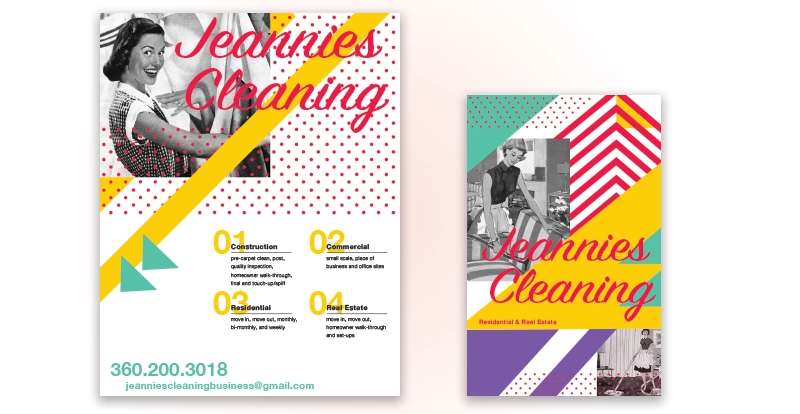
Headlines need sufficient emphasis through size, weight, or color psychology choices.
White space prevents claustrophobic layouts that overwhelm readers.
Color theory guides palette selection-blues for trust, greens for eco-friendliness.
Sans-serif fonts maintain readability at small sizes better than decorative options.
Image-text balance prevents either element from dominating inappropriately.
Flyer Dimensions
Standard 8.5×11 fits mailboxes and door hangers without folding.
5.5×8.5 half-sheets reduce printing costs while maintaining portability.
Door hanger die-cuts require specialized printing but guarantee visibility.
Digital dimensions (1080x1920px for social) repurpose print content for online distribution.
Legal Disclaimers
Protection matters even in small print.
Required Statements
Service limitations (“We don’t clean biohazards” or “No exterior window washing above second story”).
Liability boundaries clarify what insurance covers and doesn’t.
Property damage policies explain claims processes before problems arise.
Cancellation terms (24-hour notice required, fees for no-shows) prevent scheduling chaos.
QR Code Integration
Bridge physical and digital effortlessly.
Digital Connections
Website links drive traffic to portfolios and detailed service descriptions.
Booking portals enable instant scheduling without phone tag.
Review platforms (Google, Yelp) showcase social proof at scan.
Payment systems allow deposits or full prepayment for commitment.
Portfolio galleries display more before-after photos than print space allows.
Service Frequency Options
Flexibility accommodates different needs and budgets.
Cleaning Schedules
Weekly plans suit busy professionals and large families generating constant mess.
Bi-weekly arrangements balance cleanliness maintenance with budget constraints.
Monthly deep cleans work for neat individuals needing occasional help.
One-time services capture moves, events, post-construction situations.
Seasonal packages (spring cleaning, pre-holiday prep) create recurring touchpoints.
Additional Services
Upsells increase average transaction value.
Value-Added Offerings
Organization services transform cleaning into complete home management.
Laundry assistance removes time burden from working parents.
Dish cleaning post-party packages address specific event needs.
Interior plant care maintains greenery for clients lacking green thumbs.
Pet area cleaning (litter boxes, cages, outdoor runs) serves animal owners.
FAQ on What To Put On A Cleaning Service Flyer
What size should a cleaning service flyer be?
Standard 8.5×11 inches fits mailboxes and door slots without folding. Half-sheet 5.5×8.5 reduces printing costs while remaining portable.
Door hanger formats require die-cutting but guarantee visibility on residential doorknobs.
Should I include pricing on my cleaning flyer?
Yes. Transparent pricing builds trust and filters unqualified leads.
Display hourly rates, flat-rate packages by home size, or clear pricing ranges. Vague “call for quote” generates suspicion and reduces response rates compared to upfront cost structures.
What contact information is essential?
Phone number (large, bold), business email, website URL, and physical or registered business address.
Social media handles appeal to younger demographics. QR codes linking to online booking portals capture tech-savvy clients who prefer instant scheduling over phone calls.
Do I need to show before-after photos?
Absolutely. Transformation images prove capability better than text descriptions.
Use high-resolution photos showing dramatic results across different surfaces-tile grout, carpets, windows. Include 2-3 compelling images without overcrowding your layout or sacrificing readability.
Which certifications should I display?
IICRC certifications, insurance certificates, bonding documentation, and state licensing numbers establish legitimacy.
Professional association memberships (ISSA) signal industry commitment. Green Seal approvals attract eco-conscious clients. Display these prominently near your company name or contact details.
How many services should I list?
List 6-10 core services organized by category-residential, commercial, specialized.
Break residential into deep cleaning, regular maintenance, move-out services. Keep descriptions to one line each. Too many options paralyze decision-making; too few suggest limited capabilities.
What makes a good flyer headline?
Specific value propositions beat generic taglines.
“Professional Cleaning • Bonded & Insured • Same-Day Service Available” outperforms “Your Trusted Cleaning Partner.” Include your service area (“Serving Downtown Portland Since 2015”) for local relevance and immediate geographic qualification.
Should I offer discounts on the flyer?
Limited-time promotions create urgency and drive immediate action.
First-time customer discounts (15-20% off) lower trial barriers. Referral incentives turn satisfied clients into advocates. Recurring service discounts (weekly/bi-weekly) lock in steady revenue while delivering customer savings.
What design elements improve response rates?
Visual hierarchy guides eyes to phone numbers and calls-to-action first.
Strategic white space prevents overwhelming layouts. Complementary color schemes using blues (trust) and greens (cleanliness) reinforce brand messaging. Readable fonts maintain clarity at small print sizes.
How do I differentiate from competitors?
Highlight unique selling propositions-years in business, background-checked employees, specialized equipment, or niche expertise.
Customer testimonials with names and specific results build social proof. Guarantee policies (satisfaction or money-back) reduce perceived risk better than generic quality promises.
Conclusion
Deciding what to put on a cleaning service flyer determines whether prospects call or toss your marketing collateral in recycling. Every element matters-contact details, service categories, transparent pricing, professional certifications, before-after photos.
Your flyer competes with dozens of other promotional materials hitting the same mailboxes. Stand out through clear value propositions, strategic design using proper typography and color palettes, and compelling calls-to-action that drive immediate booking.
Skip generic taglines. Showcase customer testimonials, display relevant credentials (IICRC, bonded and insured status), and offer time-sensitive discounts that create urgency.
Your flyer is a salesperson working 24/7. Make every square inch earn its space.
If you liked this article about what to put on a cleaning service flyer, you should check out this article about what is a flyer.
There are also similar articles discussing flyer sizes, how to make a flyer in Photoshop, how to make a birthday flyer, and how to make a business flyer.
And let’s not forget about articles on how much to charge for flyer design, how much it costs to print a flyer, how much it costs to mail 1000 flyers, and how to make a flyer on a Mac.

Renowned for his expertise in logo design and visual branding, Bogdan has developed a multitude of logos for various clients.
His skills extend to creating posters, vector illustrations, business cards, and brochures. Additionally, Bogdan's UI kits were featured on marketplaces like Visual Hierarchy and UI8.
He also wrote in the past years on sites like Design Your Way, WebDesignerDepot, WPDean, Designmodo, Speckyboy, Slider Revolution, and more.
- The Cursor Logo History, Colors, Font, And Meaning - 24 September 2026
- Top 7 Web Design Subscription Services That Replace Full-Time Hires - 24 September 2026
- Canva vs PowerPoint: Which Is Better for Presentations? - 22 September 2026

Bogdan Sandu is a seasoned designer who has been designing websites since 2008. Renowned for his expertise in logo design and visual branding, Bogdan has developed a multitude of logos for various clients. His skills extend to creating posters, vector illustrations, business cards, and brochures. Additionally, Bogdan's UI kits were featured on marketplaces like Visual Hierarchy and UI8. He also wrote in the past years on sites like Design Your Way, WebDesignerDepot, WPDean, Designmodo, Speckyboy, Slider Revolution, and more.
You Might Also Like