AC/DC have sold over 200 million records. But before anyone ever heard a single riff from Angus Young or a scream from Bon Scott, they saw the cover.
AC/DC album covers did something most rock bands never figured out. They matched the music. The all-black sleeve of Back in Black. The devil horns on Highway to Hell. The cannon on For Those About to Rock. Each one told you exactly what you were getting before the needle dropped.
This article breaks down the best AC/DC album covers across the band’s five-decade career, from their early vinyl records with Albert Productions through their later releases on Atlantic and Columbia. You’ll see who designed them, what inspired the artwork, and why certain covers became just as legendary as the songs inside.
The Best AC/DC Album Covers
Highway to Hell (1979)
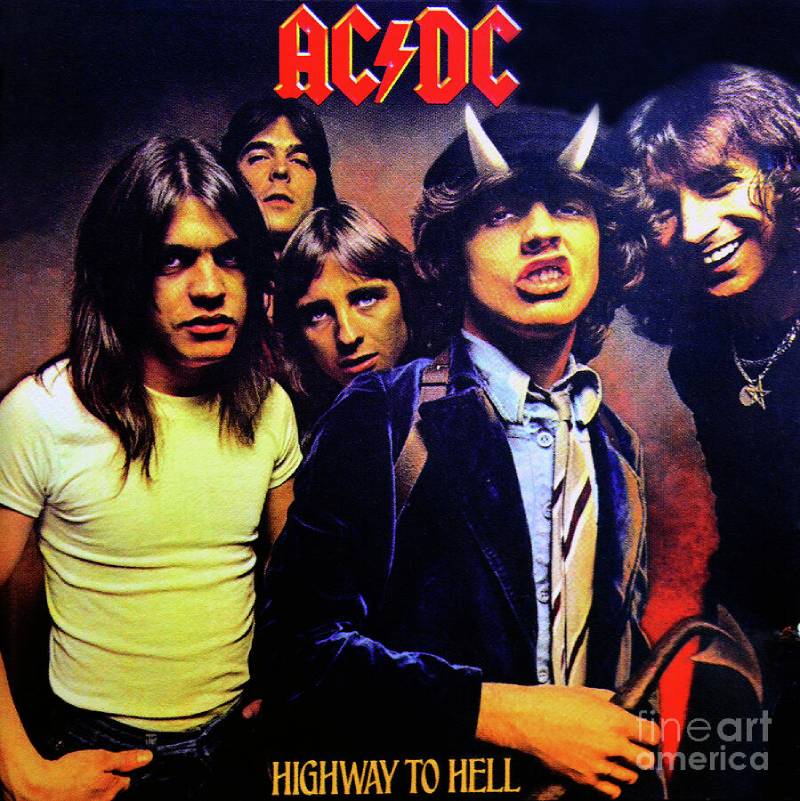
The Cover
Bon Scott stands front and center with devil horns and a pointed tail airbrushed onto his body. Angus Young lurks behind him. The rest of the band fills out the frame against a heavily retouched grey background that almost looks painted.
The red and orange tones give the whole thing a fiery, sinister feel. And that AC/DC logo in its now-classic gothic lettering sits right at the top. It’s the kind of record sleeve that made parents nervous in 1979.
Who Made It
Bob Defrin handled art direction at Atlantic Records. The original photograph was taken by Jim Houghton at his New York studio. Fun fact: the photo was actually an outtake from a 1977 session for the Powerage album. The horns and tail were added later through traditional airbrushing, long before Photoshop existed.
The Concept
The idea was simple. Make the album title literal. Scott as the devil leading you down the highway to hell. Atlantic Records in Australia initially released a different version with flames and a bass guitar neck, but the American label rejected it. The cleaner international version became the one everybody knows.
Band Lineup on This Album
- Bon Scott (vocals)
- Angus Young (lead guitar)
- Malcolm Young (rhythm guitar)
- Cliff Williams (bass)
- Phil Rudd (drums)
Key Singles
“Highway to Hell,” “Touch Too Much,” “Girls Got Rhythm,” and “If You Want Blood (You’ve Got It).”
Why Fans Remember It
This is the last AC/DC album with Bon Scott. He died in February 1980, just months after the release. That context alone makes the cover permanently iconic. But beyond the history, the image just works. It captures the band’s attitude in a single frame. Probably the most recognized piece of hard rock album artwork ever made.
Cover Variants
The Australian Albert Productions release featured flames and a guitar fretboard overlaid on the same band photo. The East German pressing had a completely different, much plainer design because authorities had issues with the original sleeve. The 2003 remastered edition on Epic Records kept the standard international artwork.
Back in Black (1980)
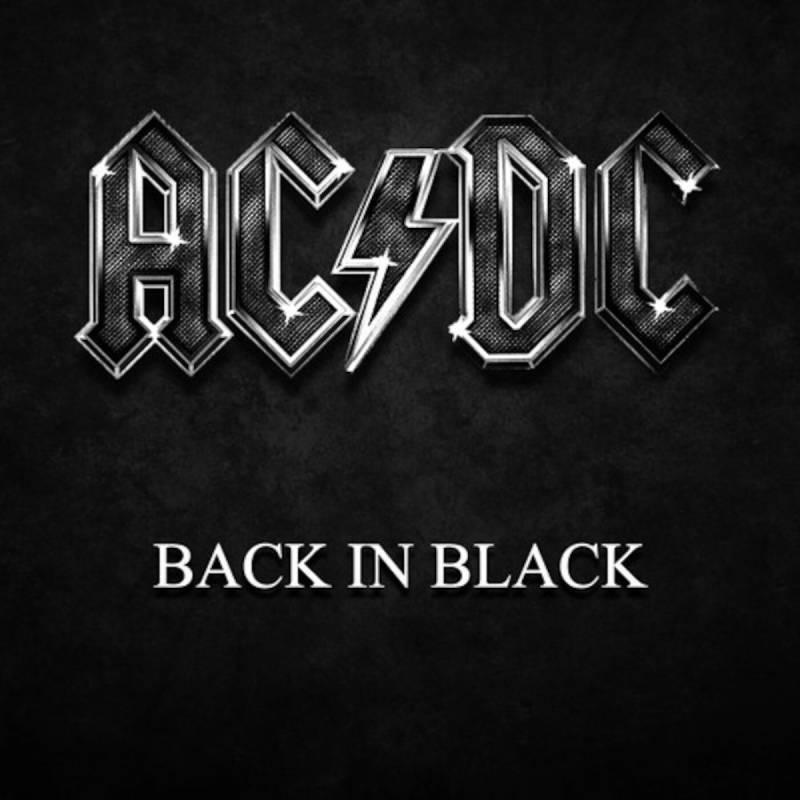
The Cover
All black. That’s it. A matte-black sleeve with the AC/DC logo and album title embossed in dark grey. You could barely see the lettering unless you held it at the right angle.
Atlantic Records hated it. They insisted on adding a grey outline around the logo so it would actually be visible. The band agreed, but only barely.
Who Made It
Bob Defrin did the art direction again. Robert Ellis shot the photography for the inner sleeve. The monochrome cover concept came from the band themselves.
The Concept
According to Angus Young, the all-black cover was a “sign of mourning” for Bon Scott. There’s really no deeper reading needed. It was grief turned into minimalist design. And it somehow became one of the most recognizable album covers in music history because of that simplicity.
Band Lineup on This Album
- Brian Johnson (vocals)
- Angus Young (lead guitar)
- Malcolm Young (rhythm guitar)
- Cliff Williams (bass)
- Phil Rudd (drums)
Key Singles
“Hells Bells,” “You Shook Me All Night Long,” “Back in Black,” “Rock and Roll Ain’t Noise Pollution.”
Why Fans Remember It
It’s the second best-selling album of all time. Over 50 million copies worldwide. The cover does well in this context because it’s the opposite of everything else on the record store shelf. No photo. No illustration. Just black. It became a statement about what a color palette stripped to nothing can actually communicate.
Cover Variants
An unofficial alternative cover surfaced with the band’s inner sleeve photos placed on the front, using a red color scheme. Early German pressings on Atlantic ATL 50735 are collectors’ favorites for their heavy vinyl weight and embossed sleeve detail.
Let There Be Rock (1977)
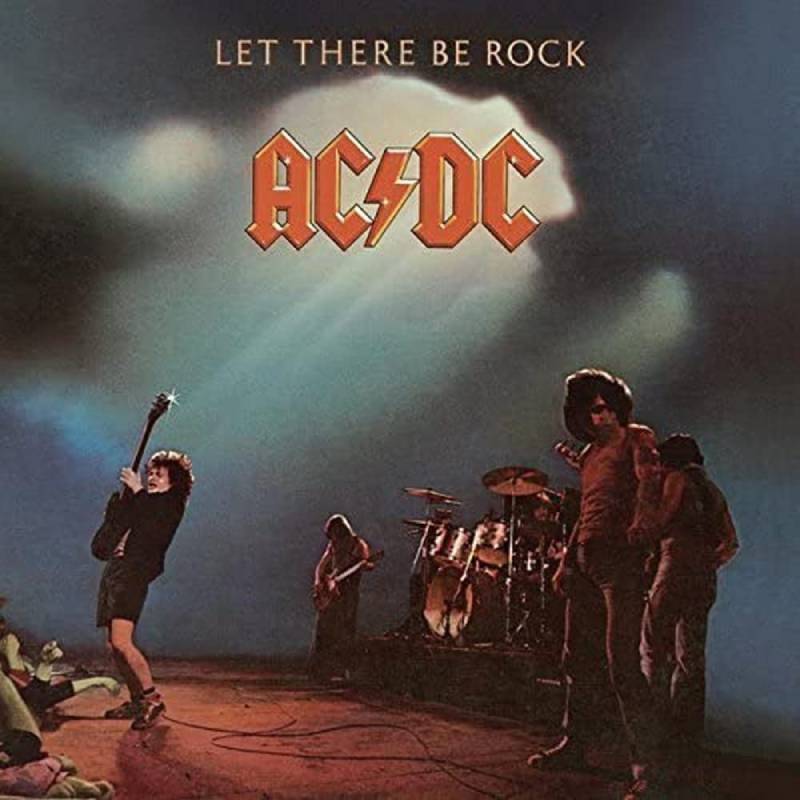
The Cover
A black and white live shot of the full band on stage. Light pours down from above like, well, a higher power just switched on the amps. It’s dramatic without trying too hard.
This cover also marked the very first appearance of the AC/DC logo in its now-famous gothic lettering, designed by Gerard Huerta. That detail alone makes it historically significant.
Who Made It
The photograph was taken by rock photographer Keith Morris at the Kursaal Ballroom in Southend, Essex, UK on March 19, 1977. Bob Defrin handled art direction for the international release. Gerard Huerta created the typographic treatment of the band’s name.
The Concept
The title says it all. And the cover shows it. Five guys playing rock and roll under a beam of light. No gimmicks. It communicates one thing: this is a band that plays. The contrast between the dark stage and the bright spotlight overhead gives it almost a religious quality, which fits the title perfectly.
Band Lineup on This Album
- Bon Scott (vocals)
- Angus Young (lead guitar)
- Malcolm Young (rhythm guitar)
- Mark Evans (bass)
- Phil Rudd (drums)
Key Singles
“Let There Be Rock,” “Problem Child,” “Whole Lotta Rosie.”
Why Fans Remember It
Many consider this the best AC/DC album cover period. Not because it’s flashy, but because it shows the band as they truly were: five musicians making music. The debut of the iconic logo only adds to its status. It launched a piece of graphic design that would become one of the most reproduced band logos in rock history.
Cover Variants
The Australian release had a completely different cover showing a close-up of a guitar fretboard and a hand. Many fans actually prefer it for its simplicity. The international version with the live photo is the one most people know.
Powerage (1978)

The Cover
A heavily processed photo of Angus Young, shot from a low angle to distort his features. He’s mid-scream, mouth wide open, looking like a man being electrocuted by his own guitar. Orange and yellow tones wash over the image, giving it a posterized, almost pop art feel.
Who Made It
Bob Defrin directed the art. Jim Houghton took the photograph. All the visual effects were done using traditional photo techniques since digital editing didn’t exist in 1978. The saturated orange glow was achieved entirely through darkroom work.
The Concept
Powerage. Electric power. The cover takes that literally and turns Angus into a human power surge. The distorted angle combined with the color treatment makes him look barely human. It’s raw and weird and perfectly suited to an album that Keith Richards and Eddie Van Halen both called their favorite AC/DC record.
Band Lineup on This Album
- Bon Scott (vocals)
- Angus Young (lead guitar)
- Malcolm Young (rhythm guitar)
- Cliff Williams (bass)
- Phil Rudd (drums)
Key Singles
“Rock ‘n’ Roll Damnation,” “Sin City.”
Why Fans Remember It
Powerage is the ultimate cult-favorite AC/DC record. The cover matches that energy. It’s not as immediately recognizable as Highway to Hell or Back in Black, but it has a different kind of staying power. The warm hue and raw processing give it a look that still feels aggressive decades later.
Cover Variants
Powerage was the first AC/DC album released with the same cover artwork worldwide. No regional variants for this one. The 2003 Epic Records remaster kept the original artwork unchanged.
For Those About to Rock We Salute You (1981)
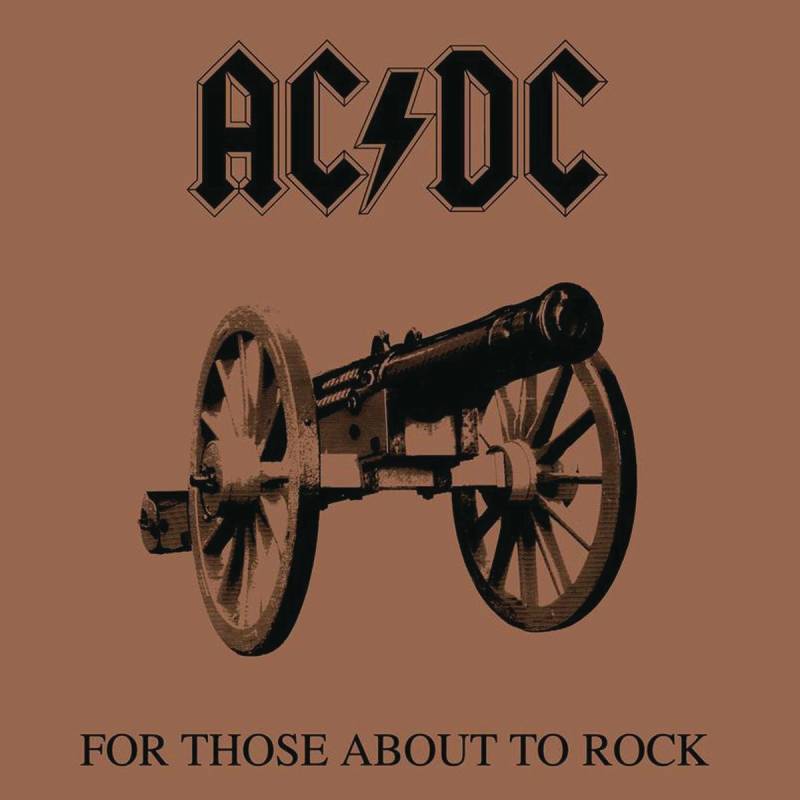
The Cover
A bronze cannon set against a black background. The AC/DC logo sits in white above it. That’s the whole composition. Clean, bold, military in feel.
The cannon image ended up becoming almost as iconic as the logo itself. You see it at every AC/DC live show, where they fire actual cannons during the title track.
Who Made It
Bob Defrin directed the artwork once more. The concept was a direct collaboration with the Young brothers, who wanted something that communicated power without being complicated. The cannon became the visual shorthand for the entire album and the tour that followed.
The Concept
It’s a salute. A military one. The cannon points outward, aimed right at you. The whole idea ties back to the title, which the band borrowed from an old Roman gladiator salute. The cover takes that imagery and grounds it in something physical and threatening. Strong use of emphasis through a single object on a stark background.
Band Lineup on This Album
- Brian Johnson (vocals)
- Angus Young (lead guitar)
- Malcolm Young (rhythm guitar)
- Cliff Williams (bass)
- Phil Rudd (drums)
Key Singles
“For Those About to Rock (We Salute You),” “Let’s Get It Up,” “Put the Finger on You.”
Why Fans Remember It
This was AC/DC’s first number one album in the United States. The cannon became a permanent fixture in their live shows. Every fan recognizes it instantly. The simplicity of the cover design, with its dark background and metallic subject, makes it one of the band’s cleanest visual statements.
Cover Variants
Some international pressings used slightly different color treatments on the cannon, ranging from bronze to gold tones. A Spanish release featured a different composition with a more detailed background.
If You Want Blood You’ve Got It (1978)
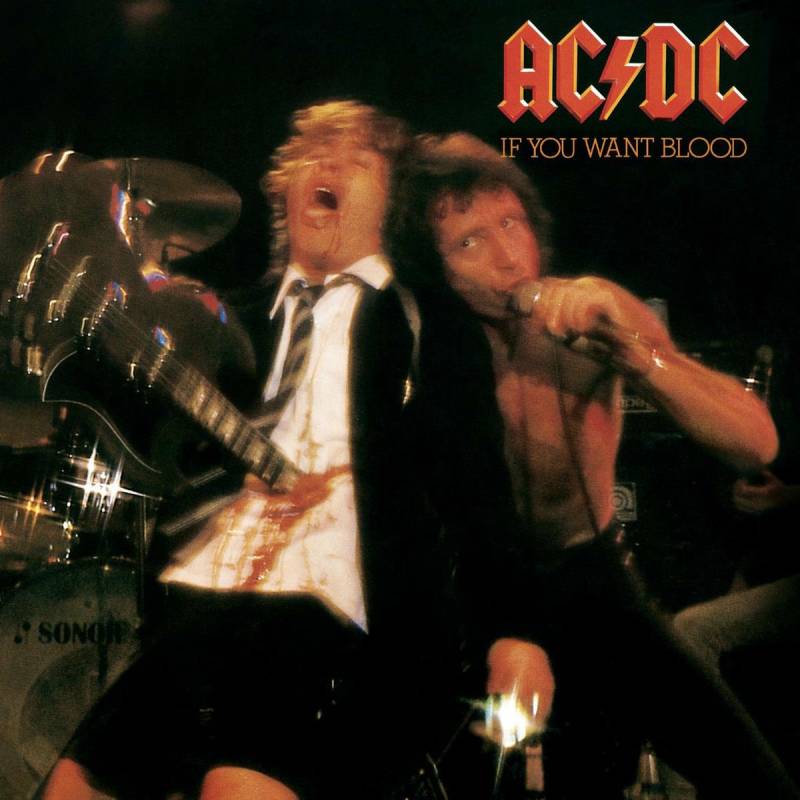
The Cover
Angus Young on stage, impaled through the chest by his own Gibson SG guitar. Bon Scott stands beside him, eyes glazed. Blood everywhere. It’s theatrical and shocking and completely over the top.
And it was done without Photoshop. All practical effects.
Who Made It
Bob Defrin pushed the special effects on this one further than anything he’d done before. As he later explained: “We just drove Angus’s guitar all the way through his body, and it just came out the back.” The whole thing was assembled using physical retouching techniques that predated digital manipulation.
The Concept
The title is “If You Want Blood You’ve Got It.” So the cover gives you exactly that. It’s AC/DC’s sense of humor running at full speed. The image captures what the band gave audiences every single night: everything they had, including the illusion that it might actually kill them.
Band Lineup on This Album
- Bon Scott (vocals)
- Angus Young (lead guitar)
- Malcolm Young (rhythm guitar)
- Cliff Williams (bass)
- Phil Rudd (drums)
Key Singles
This was a live album. Tracks included “Whole Lotta Rosie,” “Problem Child,” “The Jack,” and “Rock ‘n’ Roll Damnation.”
Why Fans Remember It
The visual impact is immediate. As a kid, seeing that cover in a record store bin, you stopped. It was impossible to ignore. The blend of horror and humor captured exactly what made this band different from every other hard rock act. It remains one of the most talked-about album cover designs in classic rock.
Cover Variants
The back cover featured a continuation of the concept, showing Angus lying “dead” on stage. Some fans have pointed out this would have made an incredible gatefold sleeve, but it was never released in that format.
High Voltage (1976, International)
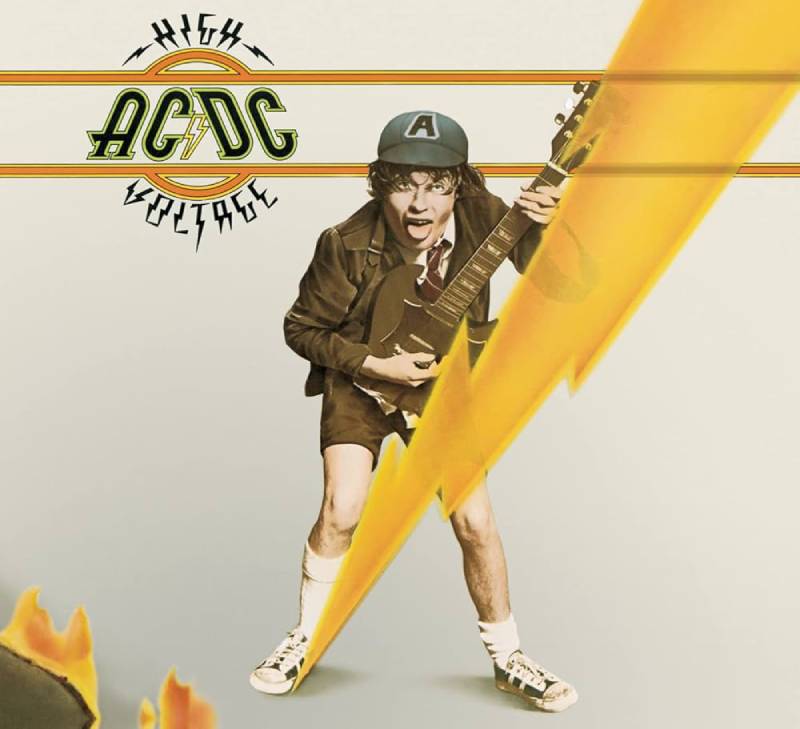
The Cover
Angus Young in his signature schoolboy uniform, guitar held high, with a stylized lightning bolt crashing behind him. Bright colors. Electric energy. The whole thing screams “turn it up.”
The photo was taken by Michael Putland and originally appeared on the Australian single for “It’s a Long Way to the Top.”
Who Made It
Bob Defrin art directed the international release. Gerard Huerta’s early version of the AC/DC lettering treatment appears here, though the fully finalized iconic typeface wouldn’t arrive until Let There Be Rock the following year.
The Concept
High Voltage. Lightning. Angus looking absolutely unhinged. The color choices are bright and aggressive, matching the music inside. This was the band’s introduction to international audiences, and the cover needed to communicate “loud” before anyone even dropped the needle.
Band Lineup on This Album
- Bon Scott (vocals)
- Angus Young (lead guitar)
- Malcolm Young (rhythm guitar)
- Mark Evans (bass)
- Phil Rudd (drums)
Key Singles
“It’s a Long Way to the Top (If You Wanna Rock ‘n’ Roll),” “T.N.T.,” “High Voltage.”
Why Fans Remember It
For many fans outside Australia, this was their first exposure to AC/DC. The cover set a tone that the band would carry for five decades. Angus in the uniform, guitar raised, electricity everywhere. Every concert poster and t-shirt design owes something to this image.
Cover Variants
The original Australian High Voltage (1975) had a completely different cover showing an electricity substation with a dog urinating against it. That concept came from Chris Gilbey at Albert Productions. The international version compiled tracks from both the Australian High Voltage and T.N.T. albums, creating what was essentially a different record with different artwork.
Dirty Deeds Done Dirt Cheap (1976)
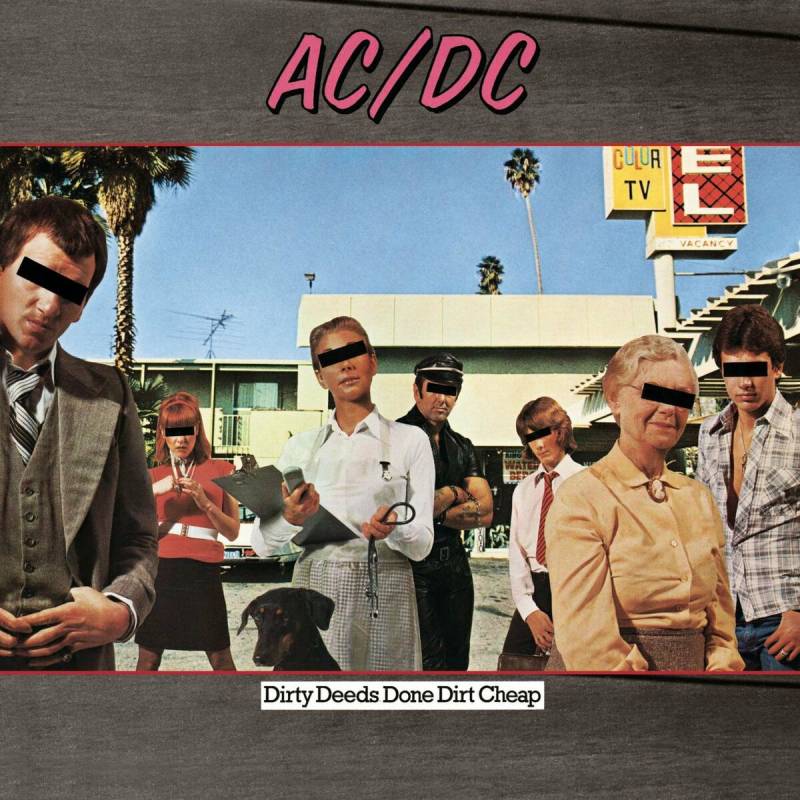
The Cover
The international version shows a motel at night with several mysterious, unidentifiable figures composited into the scene. An old woman. A man in leather. A dog. It’s deliberately strange and unsettling, like a crime scene nobody bothered to investigate.
Who Made It
Hipgnosis designed the international cover. Storm Thorgerson, the legendary art director behind Pink Floyd’s album artwork, photographed the motel scene at the Fortune 400 Angels Motel in Pico Rivera, near Los Angeles. The figures were shot separately and composited in.
Here’s the weird part: this cover wasn’t originally made for AC/DC. It had been designed for and rejected by another band. Atlantic Records picked it up for the international release of Dirty Deeds.
The Concept
The international cover tries to capture the seedy, tongue-in-cheek spirit of the album title. These anonymous people at a highway motel, all up to something they shouldn’t be. It’s more subtle than typical AC/DC artwork, which is exactly why many fans have mixed feelings about it.
Band Lineup on This Album
- Bon Scott (vocals)
- Angus Young (lead guitar)
- Malcolm Young (rhythm guitar)
- Mark Evans (bass)
- Phil Rudd (drums)
Key Singles
“Dirty Deeds Done Dirt Cheap,” “Problem Child,” “Jailbreak” (Australian version only).
Why Fans Remember It
It’s divisive. Some fans think it’s a cool, atmospheric piece that doesn’t match the band. Others think it cheapens the music. But it’s certainly memorable, and the Hipgnosis connection gives it art historical weight. The album itself wasn’t released in the US until 1981, where it outsold the then-current For Those About to Rock.
Cover Variants
The Australian version, assembled by Richard Ford at EMI Studios, featured a cartoon-style illustration that many fans consider far more fitting for AC/DC. It’s funnier, grittier, and matches the band’s personality. The pink AC/DC lettering on the international edition also predates the official logo, since the classic version by Gerard Huerta didn’t exist yet in 1976.
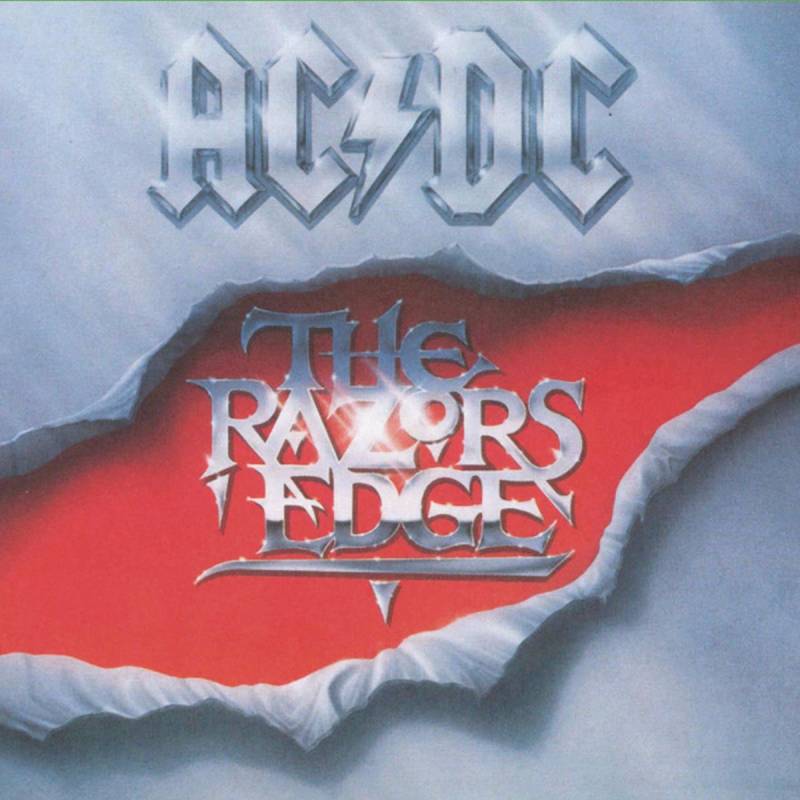
The Razors Edge (1990)
The Cover
A metallic surface sliced open by what appears to be a razor. The cut reveals a bright, fiery interior beneath the steel. The AC/DC logo and album title are rendered in a similar metallic finish, blending into the overall composition.
Who Made It
Bob Defrin continued his long collaboration with the band for this cover. The design shifted toward a more polished, commercial feel compared to the raw artwork of the late 1970s. The metallic gradient effect reflected the era’s production values.
The Concept
It’s literally the album title made visual. A razor’s edge cutting through metal. The fire underneath suggests the band’s energy still burning after a rough stretch in the late 1980s. This was a comeback record, and the cover tried to project sharpness and aggression.
Band Lineup on This Album
- Brian Johnson (vocals)
- Angus Young (lead guitar)
- Malcolm Young (rhythm guitar)
- Cliff Williams (bass)
- Chris Slade (drums)
Key Singles
“Thunderstruck,” “Moneytalks,” “Are You Ready.”
Why Fans Remember It
Because of what’s inside. “Thunderstruck” alone makes this album unforgettable. The cover is fine. Not the band’s strongest visual moment, but it served its purpose for a record that sold over five million copies in the US and brought AC/DC back to the top of the charts after years of declining sales.
Cover Variants
The 2003 remastered edition maintained the original artwork. No significant regional variants exist for this release.
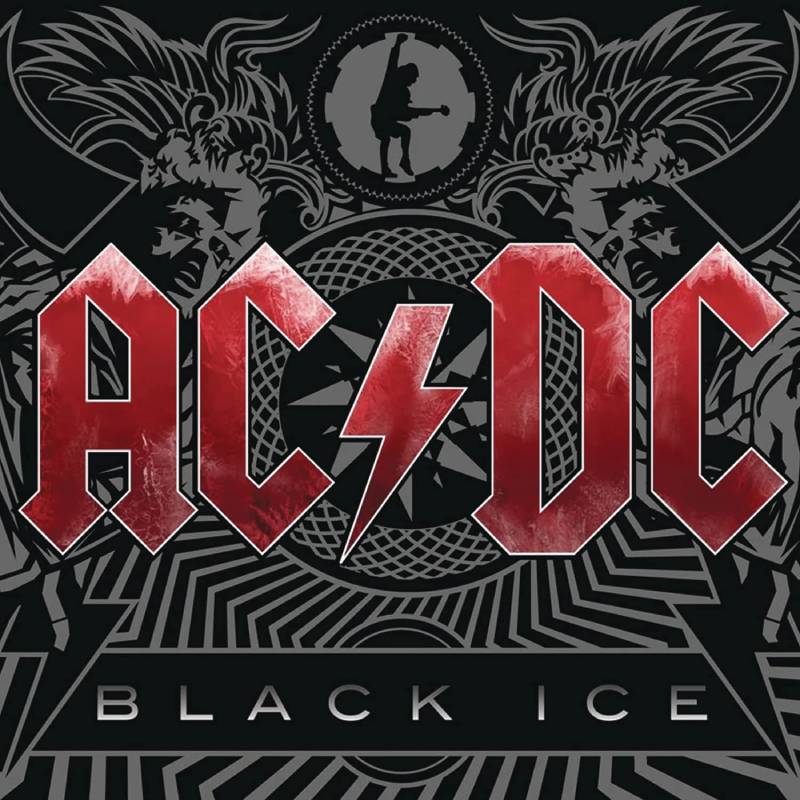
Black Ice (2008)
The Cover
A dark surface covered in intricate lightning bolt patterns and ornamental designs, all rendered in near-black tones that only become visible at certain angles. The AC/DC logo appears in color, with four different versions released: red, yellow, white, and a deluxe blue edition.
Who Made It
Joshua Marc Levy, art director at Columbia Records, designed and illustrated the cover. Levy was a longtime fan who volunteered for the project. The breakthrough came during a vacation when he sketched the idea of going “all graphic black on black,” creating a design where the artwork was almost hidden within its own surface.
The Concept
Black ice is transparent. You can’t see it until you’re already on it. The cover mirrors that idea. The patterns and details are there, but you have to look closely. It’s a smart concept. In practice, though, many fans found it too dark to appreciate on a small CD sleeve. The vinyl LP format shows it off much better.
Band Lineup on This Album
- Brian Johnson (vocals)
- Angus Young (lead guitar)
- Malcolm Young (rhythm guitar)
- Cliff Williams (bass)
- Phil Rudd (drums)
Key Singles
“Rock ‘n’ Roll Train,” “Big Jack,” “Anything Goes,” “Money Made.”
Why Fans Remember It
Black Ice debuted at number one in 29 countries. It was the band’s first studio album in eight years, and the marketing push was massive. Walmart got exclusive US distribution rights. The multiple cover variants created a collector’s market, with fans hunting down all four color editions. This was Malcolm Young’s final studio album with the band before his retirement and death in 2017.
Cover Variants
Four official color versions: red (standard), yellow, white, and blue (deluxe with bonus content). The LP was pressed on two 180-gram discs in a gatefold package featuring the red variant. Each color version has slightly different background patterns beyond just the logo change.
FAQ on AC/DC Album Covers
Who designed the AC/DC logo?
Gerard Huerta designed the iconic AC/DC gothic lettering. It first appeared on the international release of Let There Be Rock in 1977. Bob Defrin at Atlantic Records art directed its placement on album sleeves for the next two decades.
What is the best-selling AC/DC album cover?
Back in Black holds that title with over 50 million copies sold worldwide. Its all-black cover, art directed by Bob Defrin, was a mourning tribute to Bon Scott. Atlantic Records initially pushed back on the minimal design.
Why is the Back in Black cover completely black?
Angus Young said it was a “sign of mourning” for vocalist Bon Scott, who died in February 1980. The band wanted nothing else on the sleeve. Atlantic Records compromised by adding a grey outline around the logo.
Who took the Highway to Hell cover photo?
Photographer Jim Houghton shot it at his New York studio. The photo was actually an outtake from a 1977 Powerage session. The devil horns and tail on Bon Scott were added later through traditional airbrushing techniques.
How many AC/DC studio albums exist?
AC/DC have released 17 studio albums, from High Voltage in 1975 through Power Up in 2020. Each record features distinct album cover artwork. The band also released live albums, compilations, and soundtrack records across their career.
What does the For Those About to Rock cover show?
A bronze cannon against a black background. Bob Defrin designed it with input from the Young brothers. The cannon became a permanent fixture at AC/DC concerts, where real cannons fire during the title track performance.
Did AC/DC use different covers in Australia?
Yes. Several early albums had completely different Australian artwork. High Voltage originally showed a dog urinating on an electrical substation. Dirty Deeds Done Dirt Cheap had a cartoon-style illustration. Let There Be Rock featured a guitar fretboard close-up.
Who is Bob Defrin?
Bob Defrin was the head art director at Atlantic Records who designed AC/DC’s album covers from Let There Be Rock through Ballbreaker. He shaped the band’s visual identity across vinyl records, CD packaging, and promotional materials for nearly 20 years.
Are AC/DC album covers valuable to collectors?
First pressings of classic AC/DC vinyl records can be worth hundreds. Early German pressings of Back in Black and original Australian editions of High Voltage are especially sought after. Regional cover variants add extra collector value.
How many Black Ice cover versions were released?
Four official versions. The standard edition has a red logo, plus yellow, white, and blue (deluxe) variants. Joshua Marc Levy at Columbia Records designed all four. Each features slightly different background patterns beyond the color change.
Conclusion
AC/DC album covers tell the story of a band that never overthought its visual identity. From the airbrushed devil horns on Highway to Hell to the pitch-black mourning sleeve of Back in Black, every design matched the music inside.
Bob Defrin and Gerard Huerta built a visual language that lasted five decades. The gothic logo. The bold imagery. The stripped-down compositions. These choices turned record sleeves into rock and roll artifacts that fans still collect on vinyl today.
What stands out across the full discography is consistency. Whether it was Bon Scott’s era or Brian Johnson’s, the artwork never strayed far from the band’s core identity. Direct. Loud. No apologies.
The best album artwork doesn’t just package music. It becomes part of it. AC/DC understood that from day one.

Renowned for his expertise in logo design and visual branding, Bogdan has developed a multitude of logos for various clients.
His skills extend to creating posters, vector illustrations, business cards, and brochures. Additionally, Bogdan's UI kits were featured on marketplaces like Visual Hierarchy and UI8.
He also wrote in the past years on sites like Design Your Way, WebDesignerDepot, WPDean, Designmodo, Speckyboy, Slider Revolution, and more.
- Canva vs PowerPoint: Which Is Better for Presentations? - 22 September 2026
- How to Install Fonts on Mac (Step-by-Step Guide) - 20 September 2026
- From Mockup to Code: How AI-Augmented Development Speeds Up the Design Handoff - 19 September 2026

Bogdan Sandu is a seasoned designer who has been designing websites since 2008. Renowned for his expertise in logo design and visual branding, Bogdan has developed a multitude of logos for various clients. His skills extend to creating posters, vector illustrations, business cards, and brochures. Additionally, Bogdan's UI kits were featured on marketplaces like Visual Hierarchy and UI8. He also wrote in the past years on sites like Design Your Way, WebDesignerDepot, WPDean, Designmodo, Speckyboy, Slider Revolution, and more.
You Might Also Like