


Muhammad Ali’s fierce gaze piercing through the lens. Michael Jordan suspended in mid-air. The legendary swimsuit models who redefined beauty standards. These Sports Illustrated covers didn’t just capture moments. They shaped American sports culture for decades.
From championship celebrations to Olympic triumphs, SI’s iconic photography transformed athletes into legends and moments into immortal memories. Each cover tells a story that goes beyond the game itself.
Whether you’re a sports memorabilia collector hunting for vintage magazines or simply curious about the design principles behind these legendary covers, this guide reveals the secrets. You’ll discover what makes certain covers instantly recognizable, how typography choices influenced readability, and why specific color theory decisions made covers jump off newsstand displays.
We’ll explore the most valuable collectible issues, analyze the editorial design evolution, and examine how these covers influenced modern sports photography and magazine publishing.
Sports Illustrated Covers
Muhammad Ali Standing Over Sonny Liston

Photographer Neil Leifer captured one of the most recognized images in sports history on May 25, 1965, in Lewiston, Maine.
This photograph appeared inside the magazine initially, not on the cover.
Historical Context
The rematch happened fifteen months after their first fight in Miami. By 1965, Ali had converted to Islam and aligned himself with the Nation of Islam, causing public backlash.
The fight was moved from Boston to Lewiston after Massachusetts officials feared mob influence.
Rumors circulated that Ali faced threats from the Nation of Islam after Malcolm X’s assassination earlier that year.
Visual Elements
Leifer shot from an overhead position at the perfect moment. The ring filled with thick blue smoke from cigars that looked blue under strobe lights.
Key compositional elements:
- Ali stands over Liston in a dominant pose, right arm extended
- Overhead angle captures Ali’s full athletic form
- Liston lies on the canvas
- Stark contrast between victor and vanquished
Cultural Impact
The photograph initially received little recognition. It appeared on page four, not the cover.
Leifer entered it in the Encyclopedia Britannica photo contest but didn’t place.
A decade later, people began recognizing its significance. By the end of the century, the London Observer ranked it second among the 50 greatest sports pictures of all time.
Cover Subject
Ali, then 23, defended his heavyweight championship title. The fight lasted only one minute and forty-four seconds.
The punch became known as the “phantom punch.”
Controversy swirled:
- Many spectators missed it or doubted its power
- Questions about whether Liston took a dive
- Speculation continues to this day
Legacy
The photograph represents how people want to remember Ali before Parkinson’s disease affected him. It captures pure athleticism and dominance.
Sports Illustrated later used the image for its “Century’s Greatest Sports Photos” issue.
The magazine has featured Neil Leifer’s work on 170 covers throughout his career. Collectors seek vintage issues containing this image through eBay and auction houses like Heritage Auctions.
Brandi Chastain World Cup Celebration

Robert Beck photographed Brandi Chastain on her knees in a black sports bra on July 10, 1999, at the Rose Bowl in Pasadena.
The July 19, 1999 issue featured this image on its cover.
Historical Context
The 1999 FIFA Women’s World Cup final drew over 90,000 fans. President Bill Clinton attended.
The United States faced China in a penalty shootout after 120 scoreless minutes.
Women’s soccer struggled for recognition despite earlier victories:
- Won the first World Cup in 1991
- Olympic gold in 1996
- FIFA initially wanted small East Coast stadiums
Public enthusiasm forced them to book larger venues.
Visual Elements
Beck captured Chastain from a head-on angle, showing her full joy and physical power.
The composition placed Chastain alone for about six seconds before teammates engulfed her.
Beck’s position gave him the most direct angle while other photographers shot from the side.
Cultural Impact
The photograph graced covers of Time and Newsweek alongside Sports Illustrated.
In 2015, readers voted it the second most iconic cover in the magazine’s 60-year history.
A bronze statue now stands near the Rose Bowl parking lot.
After Chastain’s celebration, FIFA banned jersey removal for both men and women.
Cover Subject
Chastain scored the fifth and deciding penalty kick, giving the United States a 5-4 victory.
She had missed a penalty kick against China months earlier in the Algarve Cup. Coach Tony DiCicco had urged her to practice left-footed kicks because she’d become too predictable.
She followed his advice in the final.
The spontaneous celebration came from what she called “momentary insanity.” She described seeing countless male players celebrate big goals the same way.
Legacy
Sports Illustrated’s cover photograph became more indelible than images from other publications.
It defined women’s athletics in America during the 1990s.
Chastain kept her sports bra framed at home next to the magazine issue. She and Beck later met to discuss the moment and the photograph’s cultural impact.
Michael Jordan “Air Jordan” Dunks

Michael Jordan appeared on 50 Sports Illustrated covers between 1983 and 2013.
More than any other athlete.
Historical Context
Jordan’s first cover came in November 1983 while at the University of North Carolina.
His first professional cover appeared December 10, 1984:
- Titled “A Star Is Born”
- Showed him in an acrobatic layup against the Milwaukee Bucks
- Set a new standard for basketball coverage
The February 1988 Slam Dunk Contest in Chicago established the “Air Jordan” mythology. Jordan competed against Dominique Wilkins before 693 credentialed media in freezing temperatures.
Visual Elements
Walter Iooss Jr. photographed Jordan’s famous free-throw line dunk in 1988.
Before the contest, Jordan told Iooss which direction he’d go by tapping his knee, allowing perfect positioning.
The aerial perspectives showed Jordan seeming to defy gravity. His one-leg jumping ability differentiated him from two-legged jumpers like Charles Barkley.
Magazine covers used:
- Clean backgrounds
- Dramatic lighting
- Strong emphasis on Jordan’s athleticism
- Clear visual hierarchy
Cultural Impact
Jordan’s leaping ability, highlighted in back-to-back Slam Dunk Contest championships in 1987 and 1988, influenced an entire generation of young players.
Television ratings increased dramatically during his career. As late as 2022, NBA Finals ratings hadn’t returned to levels from his last championship season.
Jordan himself later lamented that his defensive skills and all-around game received less attention than his scoring and dunking.
Cover Subject
Jordan joined the Chicago Bulls in 1984 as the third overall draft pick.
He won NBA Rookie of the Year despite controversy about veteran players freezing him out during the 1985 All-Star Game.
His six NBA championships with the Bulls came in two separate three-year runs. The magazine documented each title with championship coverage.
Legacy
A 1984 “A Star Is Born” issue graded CGC 9.8 sold for $126,000 in August 2023.
This set a Sports Illustrated sales record. The previous record was $60,000 for a 1961 Wilt Chamberlain cover.
Collectors seek issues from:
- Rookie season
- Championship years
- Retirement announcements
Jordan’s 50 covers remain an unmatched record.
1980 U.S. Olympic Hockey Team
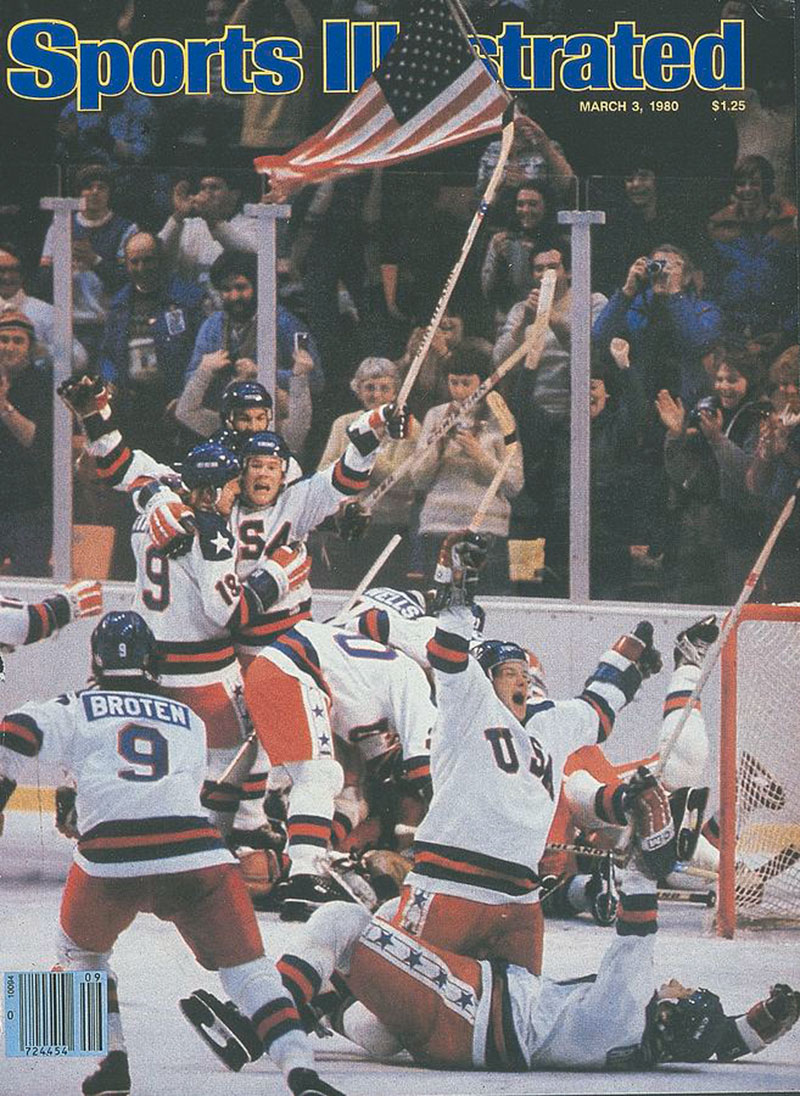
Heinz Kluetmeier photographed the U.S. hockey team celebrating with an American flag after defeating the Soviet Union 4-3 on February 22, 1980.
The March 3, 1980 cover featured no headlines or text.
Historical Context
The Soviet Union had won gold in five of the six previous Winter Olympics. Their team consisted of experienced professional players.
The United States fielded mostly amateur players:
- Average age of 21
- Coach Herb Brooks selected from 68 players
- 300-question psychological test
President Jimmy Carter was considering boycotting the 1980 Summer Olympics in Moscow to protest the Soviet invasion of Afghanistan.
Cold War tensions ran extremely high.
Visual Elements
The cover showed players embracing and waving the American flag.
No captions or explanatory text appeared because, as Kluetmeier said, “It didn’t need it.”
Everyone in America knew what happened.
The photograph captured infectious joy. Upflung sticks slowly cartwheeled into the rafters.
Players hugged in pairs rather than one massive group.
Cultural Impact
In 2014, Sports Illustrated asked readers to vote on the most iconic cover in the magazine’s 60-year history.
The “Miracle on Ice” cover won by a landslide.
The victory became more than sports. A sister of one player said she hadn’t seen so many flags since the 1960s. “And we were burning them then,” she added.
When the score was announced at a high school basketball game in Athens, Ohio, fans stood and roared.
Many had probably never seen a hockey game.
Cover Subject
Mike Eruzione scored the game-winning goal with exactly 10 minutes remaining in the third period.
Goaltender Jim Craig made critical saves against Soviet captain Boris Mikhailov.
The team still needed to beat Finland for the gold medal, which they accomplished 4-2. But the Soviet victory captured America’s imagination.
Of the 20 players on Team USA, 13 eventually played in the NHL.
Legacy
The team appeared on a second cover in December 1980 as “Sportsmen of the Year.”
ESPN declared the Miracle on Ice the top sports headline moment of the period 1979-2004.
Sports Illustrated voted it the greatest sports moment of the 20th century.
High-grade copies of the March 3, 1980 issue command tens of thousands of dollars.
A CGC 9.8 graded copy has an estimated value of at least $40,000.
Tiger Woods “The Chosen One”
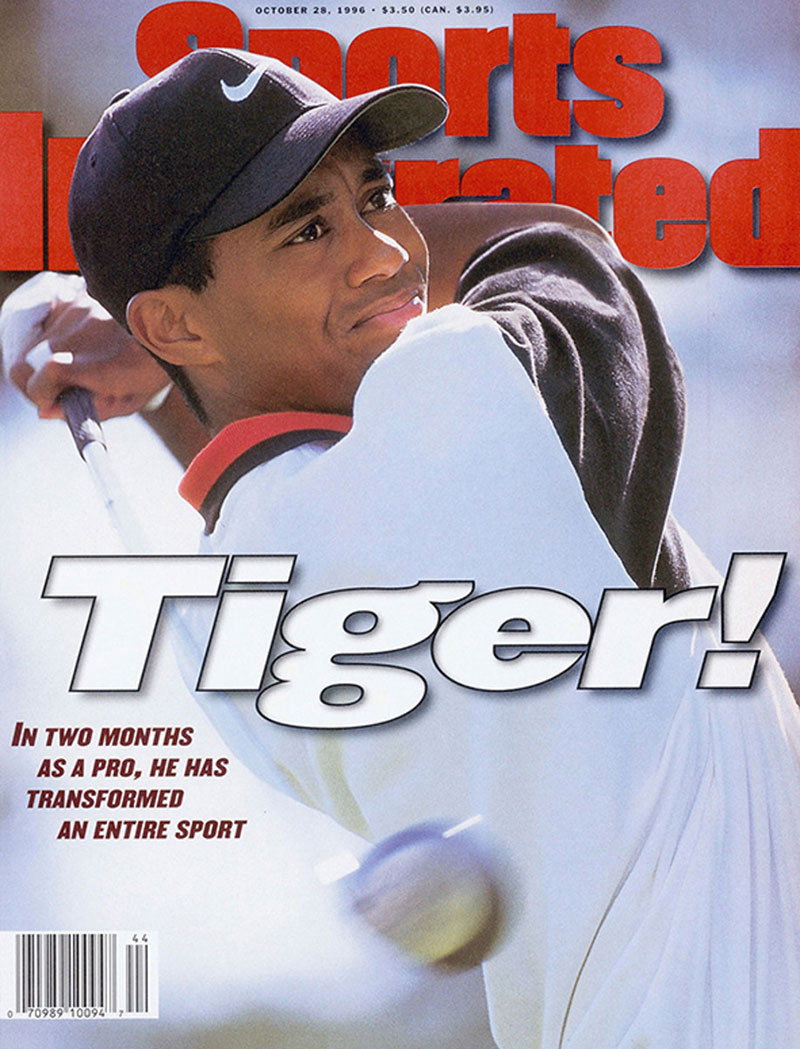
Tiger Woods first appeared on a Sports Illustrated cover on October 28, 1996.
Two months after turning professional. Photographer David Walberg captured the image.
Historical Context
Woods turned pro in August 1996 after winning a record third straight U.S. Amateur championship.
Nike and Titleist signed him to endorsement deals worth over $40 million before he played his first professional tournament.
By the end of 1996:
- Won two PGA Tour events
- Dramatically changed gallery demographics
- Crowds doubled and tripled in size
The December 23, 1996 Sportsman of the Year issue titled “The Chosen One” created even bigger expectations.
His father Earl Woods declared Tiger would “do more than any other man in history to change the course of humanity.”
Visual Elements
The October cover showed Woods mid-swing with the headline “Two months as a pro, he has transformed an entire sport.”
The clean composition focused entirely on Woods’ athletic form.
Later covers documented his dominance. The 1997 Masters victory, where he won by a record 12 strokes, generated multiple magazine features.
Photographers emphasized Woods’ mixed heritage and charismatic presence.
Cultural Impact
Woods emerged as one of the most famous athletes in the world during the 1990s.
His 1997 Masters win as the youngest champion in tournament history brought diverse new audiences to golf.
The Sportsman of the Year designation put immense pressure on a 20-year-old.
Woods significantly increased golf’s popularity globally. Television viewership spiked during tournaments he entered.
Cover Subject
Woods attended Stanford University before turning pro. As an amateur, he dominated junior and collegiate golf.
His professional debut generated massive media coverage.
The 1997 Masters established his dominance. He went on to win 15 major championships, second only to Jack Nicklaus.
Legacy
First Sports Illustrated covers featuring Woods command premium prices.
A 1996 first cover graded CGC 9.0 appears in major auctions.
The “Chosen One” headline followed Woods throughout his career.
He largely fulfilled the expectations, despite personal controversies that emerged later. Woods’ impact on golf participation, particularly among minority youth, validated much of his father’s vision.
LeBron James “The Chosen One”
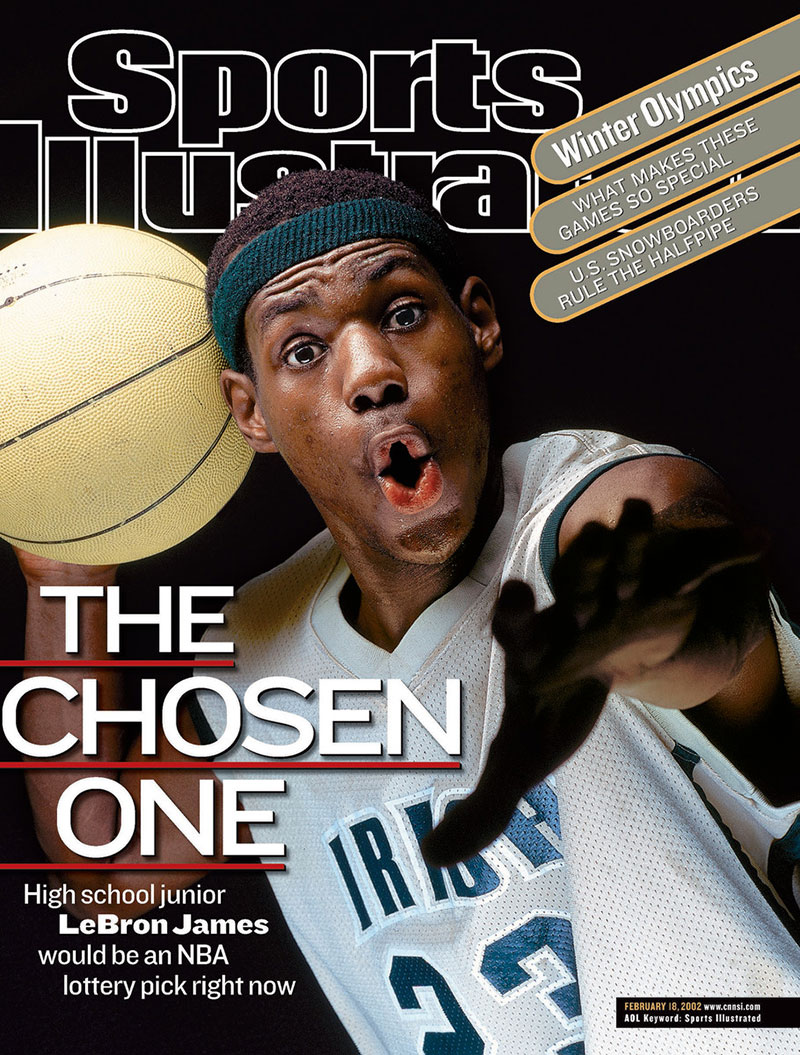
Michael J. LeBrecht II photographed 17-year-old LeBron James on February 3, 2002, at St. Vincent-St. Mary High School gymnasium in Akron, Ohio.
The February 18, 2002 cover declared him “The Chosen One.”
Historical Context
James was only a high school junior, making him the first junior ever featured on a Sports Illustrated cover.
NBA scouts already projected him as the No. 1 pick in the draft if league rules allowed his entry.
Writer Grant Wahl pitched the story after hearing buzz from the Adidas camp. Editor Greg Kelly immediately conceived the title “The Chosen One,” consciously echoing the earlier Tiger Woods cover.
The night before the photo shoot, James attended a Cleveland Cavaliers game where he met Michael Jordan.
Visual Elements
LeBrecht shot James wearing his green No. 23 St. Vincent-St. Mary jersey, holding a basketball.
The portrait emphasized James’ maturity and confidence despite his youth.
James arrived alone at 8 a.m., prompt and professional. No parents, coach, or friends accompanied him.
The clean, direct portrait avoided gimmicks. James stared confidently at the camera, already carrying himself like a professional.
Cultural Impact
The cover pushed James onto the national stage.
Consequences:
- Dozens of reporters attended his games
- Constant harassment by agents, autograph seekers, and sneaker company representatives
- Couldn’t eat in the school cafeteria
- Team atmosphere changed as players skipped classes and partied before games
They lost the state championship game, James’ only high school title loss.
“It wasn’t a basketball season anymore,” James later said. “It was a circus.”
The exposure gave LeBrecht instant credibility as a photographer.
Cover Subject
James grew up in Akron in difficult circumstances. He missed over 100 days of school in fourth grade.
Living with coach Frankie Walker’s family changed his life, leading to perfect attendance and a B average.
By his junior year, James was already being compared to Michael Jordan.
James would be selected first overall by the Cleveland Cavaliers in 2003. His $10.8 million rookie contract was dwarfed by over $100 million in endorsement deals.
Legacy
James exceeded all expectations from the Sports Illustrated cover.
He won four NBA championships, four MVP awards, and became one of basketball’s greatest players.
The cover became so iconic that James got “Chosen 1” tattooed across his back in bold, ornate letters.
The jersey James wore for both the photo shoot and a game was authenticated by The MeiGray Group. It sold at auction for significant value.
Derek Jeter Final Game
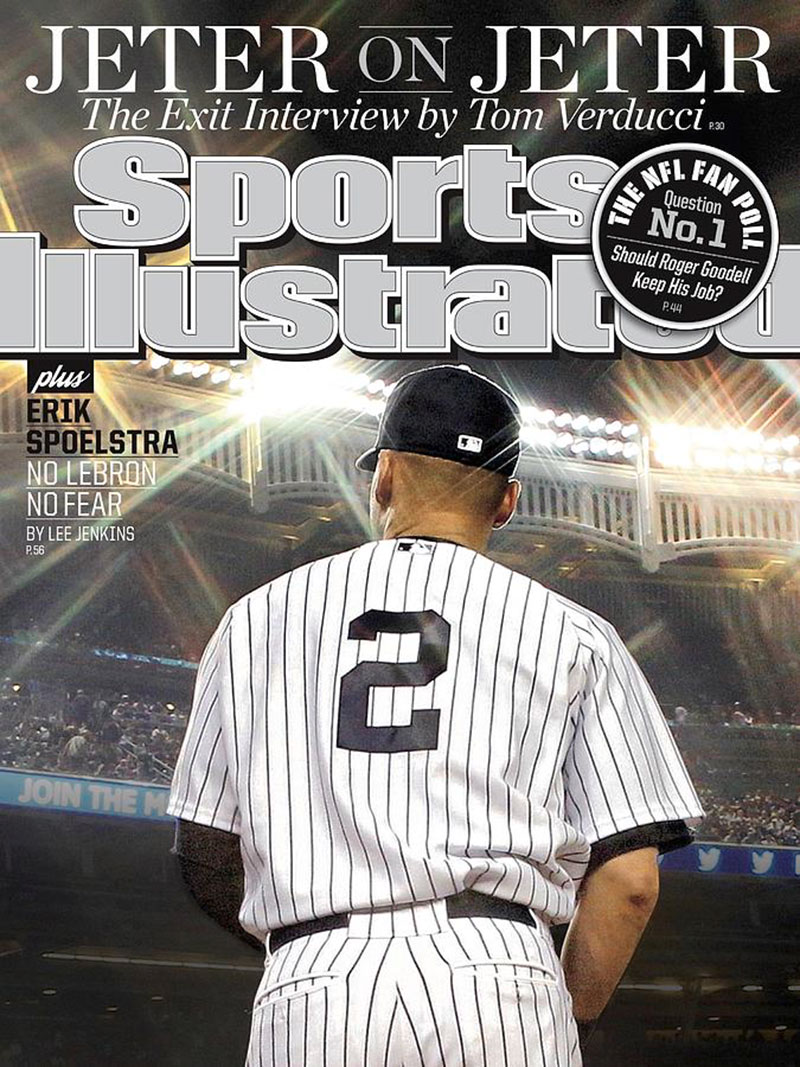
Sports Illustrated commemorated Derek Jeter’s final game at Yankee Stadium in September 2014.
The cover captured Jeter’s emotional farewell to baseball.
Historical Context
Jeter announced before the 2014 season that it would be his last.
He spent all 20 seasons with the New York Yankees:
- Won five World Series championships
- 14 All-Star selections
- .310 career batting average
His final home game at Yankee Stadium on September 25, 2014, became a celebration of his career.
Visual Elements
Cover photographs emphasized Jeter’s elegance and class. His number 2 jersey became synonymous with Yankees excellence.
The magazine used respectful, dignified imagery rather than action shots.
Jeter’s farewell deserved typography that matched his reputation.
Cultural Impact
Jeter represented consistency and professionalism throughout his career.
The farewell tour generated massive media coverage. Other teams honored him at their stadiums during his final season.
Cover Subject
Jeter debuted with the Yankees in 1995 and became the starting shortstop in 1996.
He won Rookie of the Year and helped the Yankees win the World Series.
His postseason heroics earned him the nickname “Mr. November” after hitting a game-winning home run shortly after midnight.
He collected 200 hits in a season eight times.
Legacy
Jeter’s final game ended with a walk-off single, the perfect storybook ending.
The moment became one of baseball’s most memorable farewells.
The Yankees retired his number 2. He was elected to the Baseball Hall of Fame in 2020 on his first ballot with 99.7% of votes.
Tom Brady Championship Covers
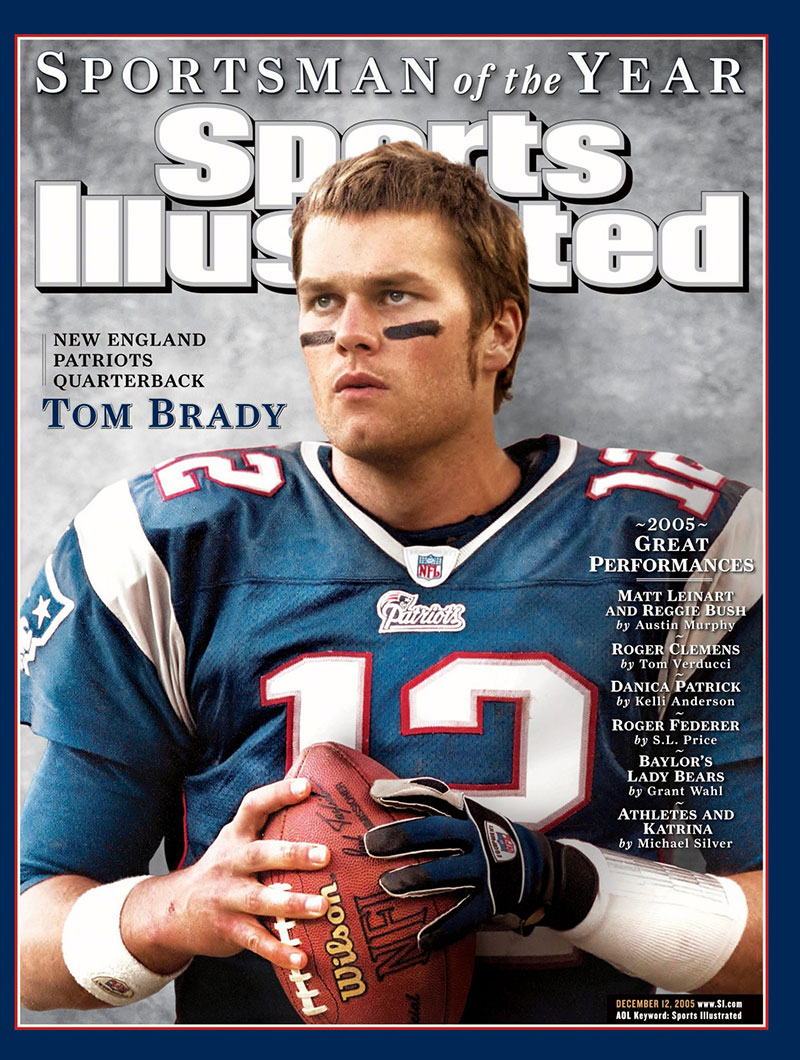
Tom Brady has appeared on multiple Sports Illustrated covers celebrating his seven Super Bowl victories.
His championships span from 2002 to 2021.
Historical Context
Brady was drafted 199th overall in the 2000 NFL Draft, the seventh quarterback selected.
Nobody predicted he would become the most successful quarterback in NFL history.
His first championship came in 2002 when he led the New England Patriots to victory over the St. Louis Rams. He was only 24 years old.
Three championships in four years (2002, 2004, 2005) established the Patriots dynasty.
Visual Elements
Championship covers typically showed:
- Brady holding the Lombardi Trophy
- Celebrating with teammates
- Logo placement emphasizing both Brady and team brand
Later Tampa Bay Buccaneers covers in 2021 marked his seventh championship at age 43.
The visual storytelling shifted to emphasize his longevity and sustained excellence.
Cultural Impact
Brady’s sustained success changed how people viewed quarterback longevity.
Playing into his mid-40s at an elite level was unprecedented.
The Patriots dynasty under Brady and coach Bill Belichick dominated the NFL for two decades.
His move to Tampa Bay at age 42 and immediate championship victory defied expectations. The 2021 Super Bowl win silenced doubters who attributed his success solely to Belichick’s coaching.
Cover Subject
Brady’s work ethic, preparation, and diet became legendary. His TB12 method emphasized flexibility, pliability, and nutrition.
Career achievements:
- Four Super Bowl MVP awards
- Three regular-season MVP awards
- Over 89,000 yards and 649 touchdowns
Statistical dominance combined with championship success separated Brady from other great quarterbacks.
Legacy
Sports Illustrated chronicled Brady’s entire career from draft day disappointment to GOAT status.
Championship covers became routine by the end of his career.
Collectors value issues from his first championship and his Tampa Bay victory. The narrative arc from underdog to legend drives collector interest.
Brady retired after the 2022 season as the most decorated quarterback in history.
Swimsuit Issue Covers

Sports Illustrated’s annual Swimsuit Issue launched in 1964.
Christie Brinkley, Elle Macpherson, and Kate Upton appeared on multiple covers.
Historical Context
The first Swimsuit Issue in 1964 featured Babette March on the cover.
What started as a filler issue during the slow winter sports season became the magazine’s best-selling issue annually.
Notable cover models:
- Christie Brinkley: Three consecutive covers from 1979-1981
- Elle Macpherson: Five covers during the 1980s and 1990s
- Kate Upton: 2012, 2013, and 2017
Visual Elements
Beach and exotic location photography dominated the aesthetic.
Photographers traveled to tropical destinations, capturing models in analogous colors that complemented ocean and sand.
Natural lighting and minimal retouching in earlier decades gave way to more polished production values.
The saturation and hue of tropical locations enhanced the visual appeal.
Body paint editions pushed creative boundaries.
Cultural Impact
The Swimsuit Issue helped fuel the rise of supermodels.
Kathy Ireland, Tyra Banks, and Brooklyn Decker built careers after Swimsuit Issue appearances.
Critics argued the issue objectified women and undermined the magazine’s sports journalism credibility.
The issue’s influence declined with the rise of internet content. What once sold millions of copies faced competition from unlimited online imagery.
Cover Subject
Christie Brinkley: Three consecutive covers established her as a 1980s icon. Her wholesome, all-American look appealed to mass audiences.
Elle Macpherson: Earned the nickname “The Body” after her five Swimsuit Issue covers. She parlayed that success into acting and business ventures.
Kate Upton: Her 2012 cover appearance went viral online. The Cat Daddy dance video she filmed at a Los Angeles Clippers game attracted millions of views.
Her combination of girl-next-door appeal and curves brought fresh energy to the franchise.
Legacy
Swimsuit Issues generated controversy throughout their run.
Some praised the celebration of female beauty while others criticized the focus on physical appearance over athletic achievement.
The magazine adapted by featuring athletes like Venus Williams and Ronda Rousey in Swimsuit Issues.
This blended sports legitimacy with traditional Swimsuit Issue aesthetics.
Serena Williams Powerful Poses
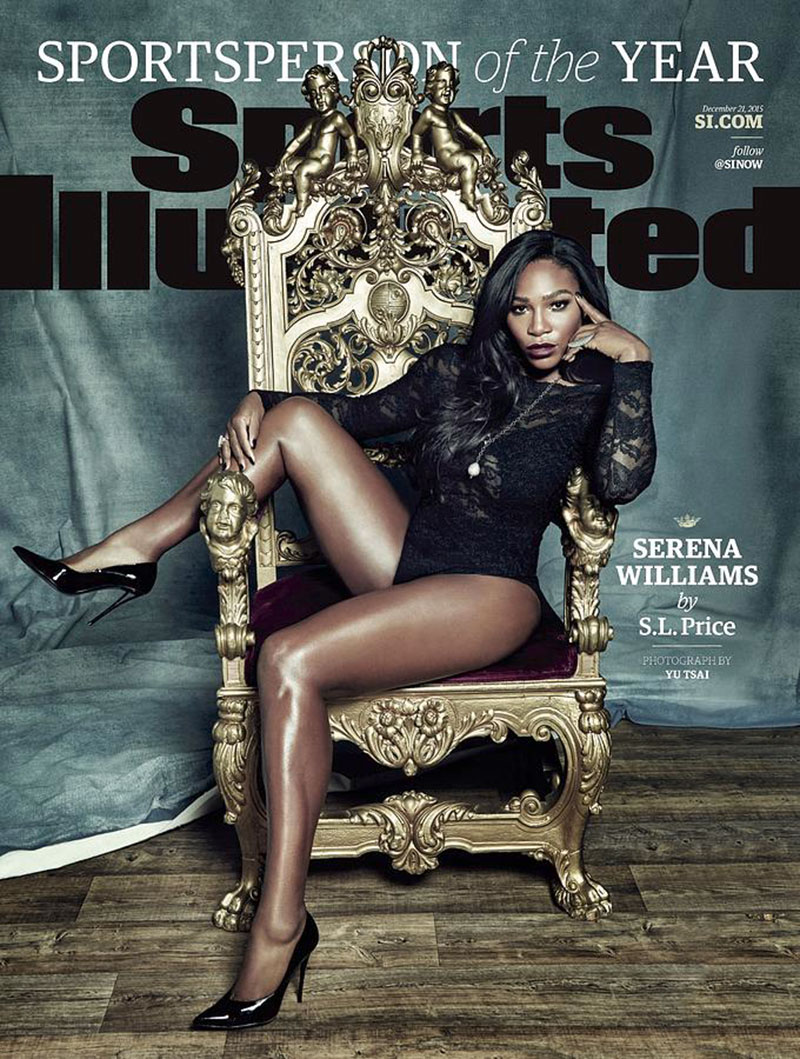
Serena Williams has graced multiple Sports Illustrated covers throughout her career.
Her 2015 Sportsperson of the Year cover being among the most discussed and celebrated.
Historical Context
Williams won her first U.S. Open in 1999 at age 17, appearing on the September 20, 1999 cover.
Over the next two decades, she dominated women’s tennis with 23 Grand Slam singles titles.
The 2015 Sportsperson of the Year designation made her:
- First solo woman to receive the honor since Mary Decker in 1983
- First tennis player to win since Arthur Ashe in 1992
Williams appeared in the 2004 Swimsuit Issue, breaking barriers as one of the first Black athletes featured.
She returned for the 2017 Swimsuit Issue while pregnant.
Visual Elements
The 2015 Sportsperson cover showed Williams lounging on a throne in a black leotard.
One leg draped over the chair arm in a powerful, confident pose.
Photographer Yu Tsai worked with Williams to capture her ideal of femininity, strength, and power. The throne symbolized her dominance in tennis.
Other images from the shoot:
- Williams on hanging rings
- Poses in white attire
- Mixed femininity with athletic strength
The 2019 Fashionable 50 cover featured Williams in a Thom Browne tailcoat with neon heels.
Cultural Impact
Williams received both praise and backlash for the 2015 throne pose.
Critics questioned whether she deserved the award over Novak Djokovic or Stephen Curry.
Some commentators focused excessively on the sexual nature of her pose rather than her athletic achievements.
The pose was Williams’ idea, intended to express her own ideal of womanhood. Managing editor Chris Stone explained that Williams wanted control over how she was portrayed.
Cover Subject
Williams’ 2015 season included three Grand Slam titles (Australian Open, French Open, Wimbledon).
She held all four Grand Slam titles simultaneously across two calendar years.
Beyond tennis, Williams became a difference-maker by speaking out against body shamers.
Her fashion line, S by Serena, and business ventures demonstrated her entrepreneurial skills. “My whole career has been really about tennis and fashion,” Williams told the magazine.
Williams won 14 Grand Slam doubles titles with sister Venus.
Legacy
Williams’ various covers documented her evolution from teenage phenom to tennis legend.
The 2015 throne image remains one of the most debated magazine photographs in sports history.
She appeared pregnant in the 2017 Swimsuit Issue:
- Normalized pregnant athletes
- Challenged beauty standards
- Celebrated her body at a vulnerable and powerful moment
Her final professional tournament came at the 2022 U.S. Open. Sports Illustrated chronicled her retirement with career retrospectives.
Bruce Jenner 1976 Olympics
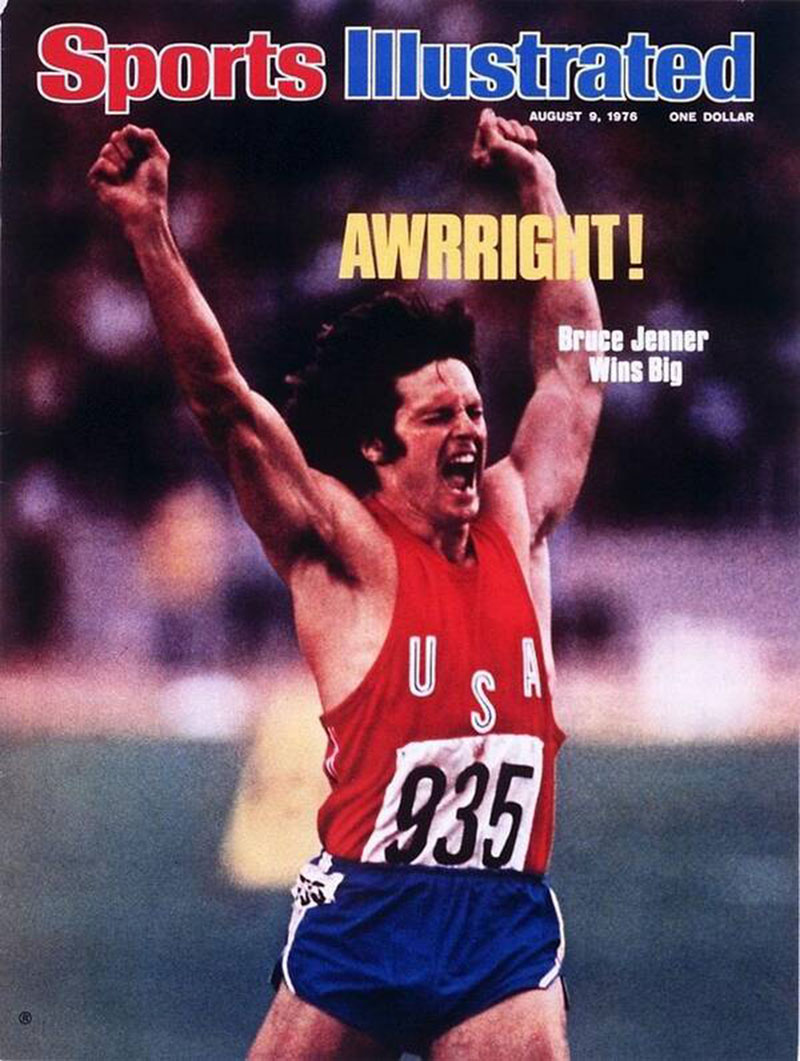
Walter Iooss Jr. photographed Bruce Jenner (now Caitlyn Jenner) after winning the decathlon gold medal at the 1976 Summer Olympics in Montreal.
The August 9, 1976 cover showed Jenner in a red USA tank top with arms raised triumphantly.
Historical Context
The 1976 Olympics coincided with America’s Bicentennial summer. The games provided a nationalistic moment during the Cold War era.
Jenner set a world record with 8,618 points in the decathlon.
The victory came after six years of intense training and sacrifice.
Producer Roone Arledge knew stardom when he saw it. ABC Sports provided “up close and personal” coverage that transformed Jenner into Captain America.
Visual Elements
The cover photograph captured Jenner running down the backstretch after the final event.
His arms pumped toward the sky in pure celebration.
The image showed athletic perfection:
- Shiny blue shorts
- Red USA singlet
- Broadcaster Jim McKay’s voice: “This is an American moment”
Jenner’s muscular physique represented what many viewed as the ideal male form.
The Greek god body would later become a source of dysphoria for Jenner.
Cultural Impact
Jenner became an instant celebrity. Endorsement deals, television appearances, and movie offers followed immediately.
The August 9, 1976 cover launched Jenner onto a more lasting stage than most Olympians achieve.
Few athletes from that era maintained such enduring fame.
Jenner appeared on Wheaties boxes and in commercials. Saturday Night Live’s John Belushi parodied the “hero shot” in a sketch about Little Chocolate Donuts.
Cover Subject
Jenner attended Graceland College on a football scholarship but switched to decathlon after a knee injury.
Coach L.D. Weldon recognized Jenner’s potential.
The decathlon provided a place to hide from internal struggles with gender identity. “The decathlon was the ultimate in what people think of as manhood,” Jenner later explained.
For two days in July 1976, Jenner was the best in the world. The victory represented both a peak achievement and an ending.
“My best friend was over. I lost my beard,” Jenner said.
Legacy
In June 2016, Caitlyn Jenner returned to Sports Illustrated for the 40th anniversary of the Olympic victory.
She wore a gold sequin jumpsuit and her medal.
The 2016 cover marked the first time an openly transgender person appeared on a Sports Illustrated cover.
The headline read: “Caitlyn Jenner as you know her now. Bruce Jenner as you never knew him then.”
Jenner keeps the medal in a bathroom nail drawer, a metaphor for past and present converging.
The 1976 decathlon record was broken by Daley Thompson in 1980. Jenner’s mark stood as the American record until 1991 when Dan O’Brien surpassed it.
Jenner was inducted into the Olympic Hall of Fame in 1986.
FAQ on Sports Illustrated Covers
What makes a Sports Illustrated cover valuable to collectors?
Collectible magazines gain value through athlete significance, condition, and rarity. Muhammad Ali covers command thousands. First issues, championship celebrations, and milestone moments create premium value. Perfect condition with no creases dramatically increases worth among sports memorabilia enthusiasts.
Which Sports Illustrated cover is considered the most iconic?
Muhammad Ali’s December 1970 cover remains legendary. The powerful focal point photography and strategic visual hierarchy created magazine history. Other contenders include Michael Jordan’s championship covers and historic Olympic athlete portraits that defined sports journalism.
How has Sports Illustrated cover design evolved over decades?
Early covers featured simple typography and basic layouts. Modern designs incorporate sophisticated color palettes, dynamic photography angles, and digital motion graphics elements. Editorial design now emphasizes bold visual storytelling over traditional magazine formatting.
What role does the swimsuit issue play in SI’s cover legacy?
The annual swimsuit issue revolutionized magazine covers beyond sports. These covers pioneered new photography techniques, print design innovations, and marketing strategies. They became cultural phenomena, influencing fashion photography and establishing SI’s broader entertainment authority.
How do photographers achieve those dramatic Sports Illustrated cover shots?
Professional sports photography requires split-second timing and technical mastery. Photographers use high-speed cameras, strategic framing, and perfect lighting. Championship coverage demands anticipating peak action moments while maintaining sharp contrast and composition.
What printing specifications make SI covers stand out on newsstands?
High-quality CMYK printing, premium paper stock, and careful saturation control create newsstand impact. Publishers optimize DPI settings for crisp imagery. Strategic color psychology choices help covers command attention among competing magazines.
How do cover stories influence athlete careers and public perception?
SI covers can define athletic legacies and boost endorsement opportunities. Featured athletes gain massive media exposure and cultural recognition. Cover stories often coincide with career peaks, championship moments, or Olympic achievements, cementing their place in sports history.
What typography choices characterize classic Sports Illustrated covers?
Classic covers favor bold sans-serif fonts for headlines and clean serif fonts for body text. Typographic hierarchy emphasizes athlete names prominently. Modern covers experiment with custom display fonts while maintaining readability standards.
How do Sports Illustrated covers compare to other sports magazines?
SI pioneered many cover design principles other magazines now follow. Their emphasis on athlete portraiture and storytelling set industry standards. ESPN The Magazine and other competitors adopted similar approaches but rarely match SI’s iconic photography and editorial content quality.
What’s the future of Sports Illustrated covers in digital media?
Digital platforms require covers optimized for social media sharing and mobile viewing. Publishers now create multiple versions for different platforms. Web design principles influence traditional magazine layouts, while interactive elements enhance digital magazine experiences beyond static covers.
Conclusion
Sports Illustrated covers transformed from simple magazine layouts into cultural artifacts that define American sports history. Each legendary cover demonstrates masterful graphic design principles through strategic athlete positioning and compelling visual narratives.
The magazine’s influence extends beyond newsstand sales. Publishers pioneered innovative poster design techniques that other sports media still emulate today. From Tiger Woods’ triumphant moments to Serena Williams’ powerful portraits, these covers shaped how we remember athletic greatness.
Modern collectors recognize vintage magazines as investment opportunities worth thousands. Whether hunting rare editions or studying editorial photography techniques, SI covers offer endless fascination. The magazine’s brand guidelines established standards that influenced an entire industry.
As digital media evolves, these iconic covers remind us that powerful imagery transcends technology. They prove that exceptional book cover design principles apply across all publishing formats, creating lasting emotional connections between athletes and fans.

Renowned for his expertise in logo design and visual branding, Bogdan has developed a multitude of logos for various clients.
His skills extend to creating posters, vector illustrations, business cards, and brochures. Additionally, Bogdan's UI kits were featured on marketplaces like Visual Hierarchy and UI8.
He also wrote in the past years on sites like Design Your Way, WebDesignerDepot, WPDean, Designmodo, Speckyboy, Slider Revolution, and more.
- Jujutsu Kaisen Font Generator - 12 October 2026
- The Windsurf Logo History, Colors, Font, And Meaning - 10 October 2026
- How to Remove Background From Product Photos (No Photoshop) - 10 October 2026

Bogdan Sandu is a seasoned designer who has been designing websites since 2008. Renowned for his expertise in logo design and visual branding, Bogdan has developed a multitude of logos for various clients. His skills extend to creating posters, vector illustrations, business cards, and brochures. Additionally, Bogdan's UI kits were featured on marketplaces like Visual Hierarchy and UI8. He also wrote in the past years on sites like Design Your Way, WebDesignerDepot, WPDean, Designmodo, Speckyboy, Slider Revolution, and more.
You Might Also Like


