


A naked John Lennon clinging to Yoko Ono. Britney Spears in her bedroom with a Teletubby. Kanye West as Jesus Christ.
These iconic Rolling Stone Magazine covers didn’t just sell magazines. They sparked controversies, launched careers, and documented music history’s most defining moments.
Since 1967, Rolling Stone’s cover photography has turned musicians into cultural statements. From Tina Turner breaking barriers as the first woman featured to Run-D.M.C. legitimizing hip-hop, each cover tells a story beyond the music.
This collection examines the magazine covers that transcended publishing to become pop culture artifacts. You’ll discover the backstories, controversies, and cultural impact behind photography that defined generations.
Some covers celebrated. Others outraged. All of them mattered.
Iconic Rolling Stone Magazine Covers
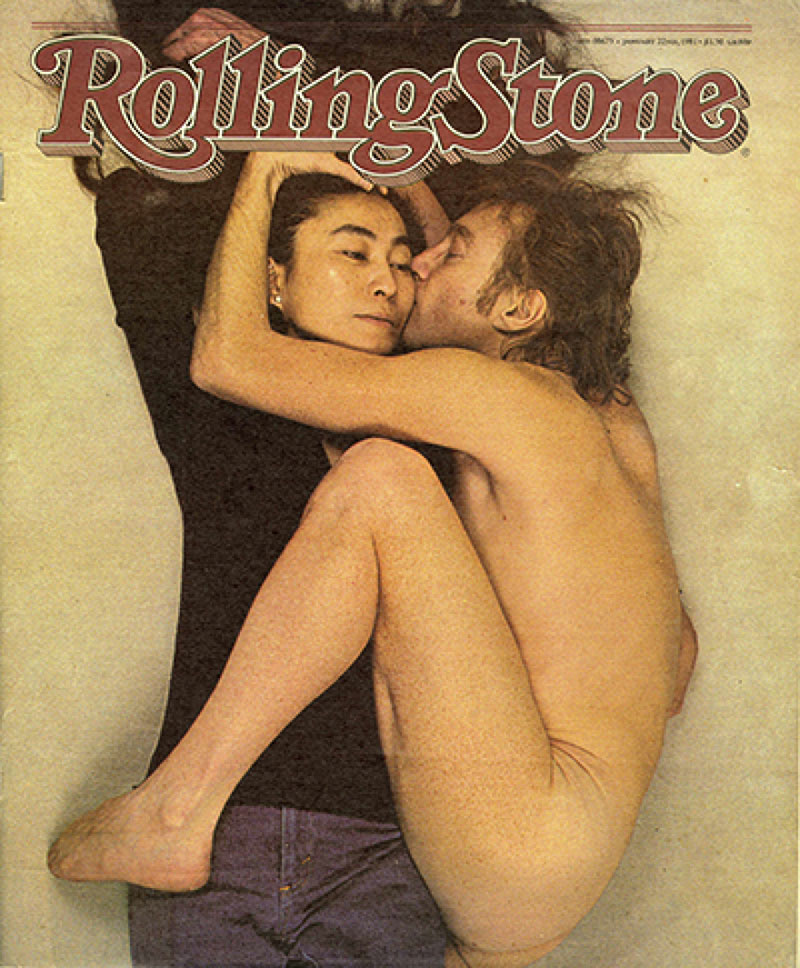
John Lennon and Yoko Ono Nude
Cover Details
Date: January 22, 1981 (issue 335)
Photographer: Annie Leibovitz
Shot: December 8, 1980, hours before Lennon’s murder
The cover appeared without text. No one knew this would be their final portrait together.
Featured Subject
Lennon (naked, fetal position) clinging to Yoko Ono (fully clothed). Leibovitz asked both to undress. Ono declined but agreed to remove her top. Leibovitz suggested she stay fully clothed instead, sensing the visual power of that contrast.
When Lennon saw the Polaroid: “This is it. This is our relationship.”
Visual Elements
- Stark monochrome colors created intimacy
- Lennon’s vulnerability vs. Ono’s composure
- Curved body forms create visual hierarchy
- Lennon appears cold, clinging
- Ono stares directly at camera with quiet strength
The minimal approach worked. Nothing distracted from their connection.
Cultural Impact
Named best magazine cover of the previous 40 years (American Society of Magazine Editors, 2005). Wenner wanted Lennon alone. But Leibovitz promised both would appear. “I said it was the last promise.”
The image transcended music journalism. People who never read Rolling Stone knew this cover.
Historical Context
December 8, 1980. Howard Cosell interrupted Monday Night Football to announce Lennon’s death. Wenner walked across Central Park to the Dakota to join mourners.
Their 1968 Rolling Stone cover (both naked) created a scandal. This one felt different. Newsstands flooded with Lennon tributes that winter. This stood above them all because it captured private love frozen just before violence tore them apart.
John Lennon (1967)
Cover Details
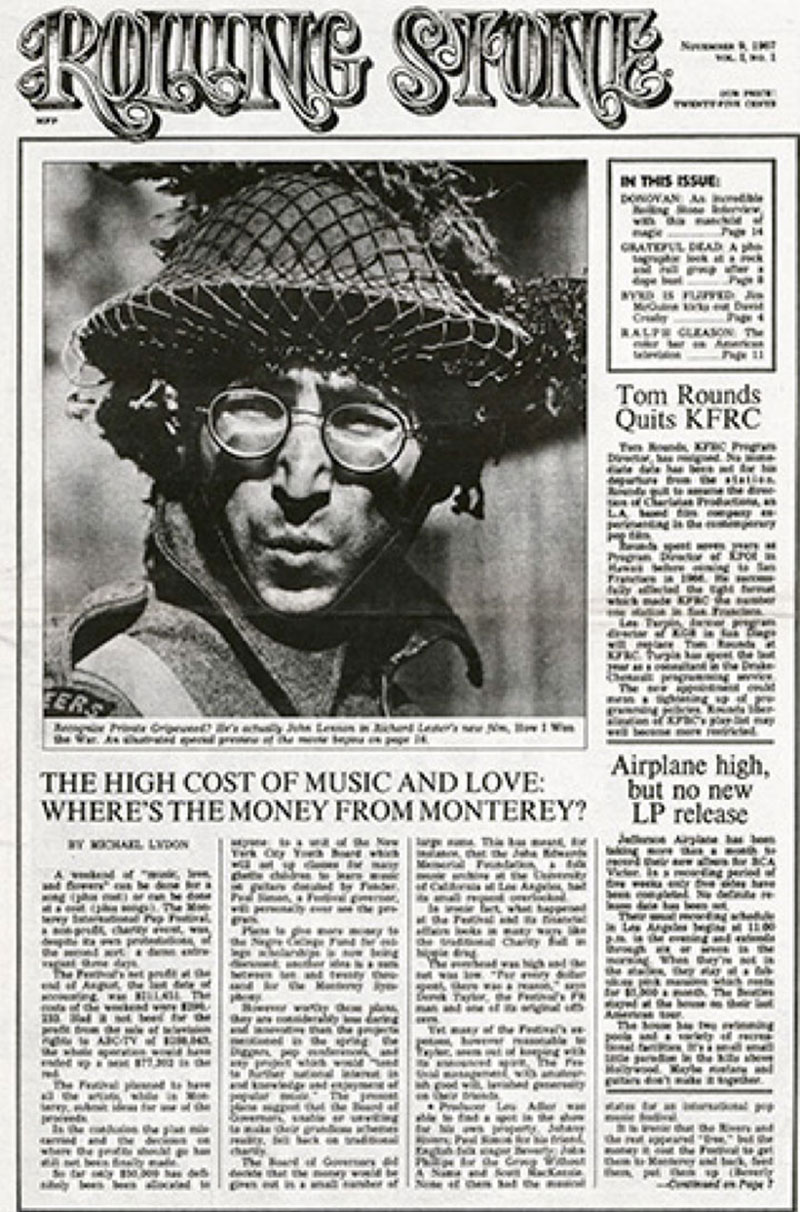
Date: November 9, 1967 (issue 1)
Source: Film still from “How I Won the War”
Cost: 25 cents
First issue deadline loomed. Wenner grabbed what he had on hand.
Featured Subject
Lennon as Private Gripweed in Richard Lester’s anti-war film. Round glasses, mesh-covered pith helmet, lips pursed in a whistle.
“It was incredibly fortuitous, symbolic and prophetic of the future,” Wenner later said.
Visual Elements
- Black and white publicity still
- Military helmet + Lennon’s signature glasses = instant recognition
- Simple newspaper format
- Bold typography
- No glossy production values
The cover established direction right away: music meets politics.
Cultural Impact
Set the tone for everything that followed. Lennon became the magazine’s unofficial north star. “John, more purely than anybody else at the time, symbolized rock & roll,” Wenner explained. “He was the most natural heir to Elvis.”
First issues became collector’s items, selling for $400+ decades later.
Historical Context
1967 San Francisco counterculture exploded. Wenner and music critic Ralph Gleason founded Rolling Stone to cover rock differently than trade papers and fan magazines.
The name referenced Muddy Waters, The Rolling Stones, and Bob Dylan’s “Like a Rolling Stone.” Lennon’s appearance on issue one wasn’t planned as a statement. But what better way to launch a magazine about rock’s cultural power?
Britney Spears in Underwear
Cover Details
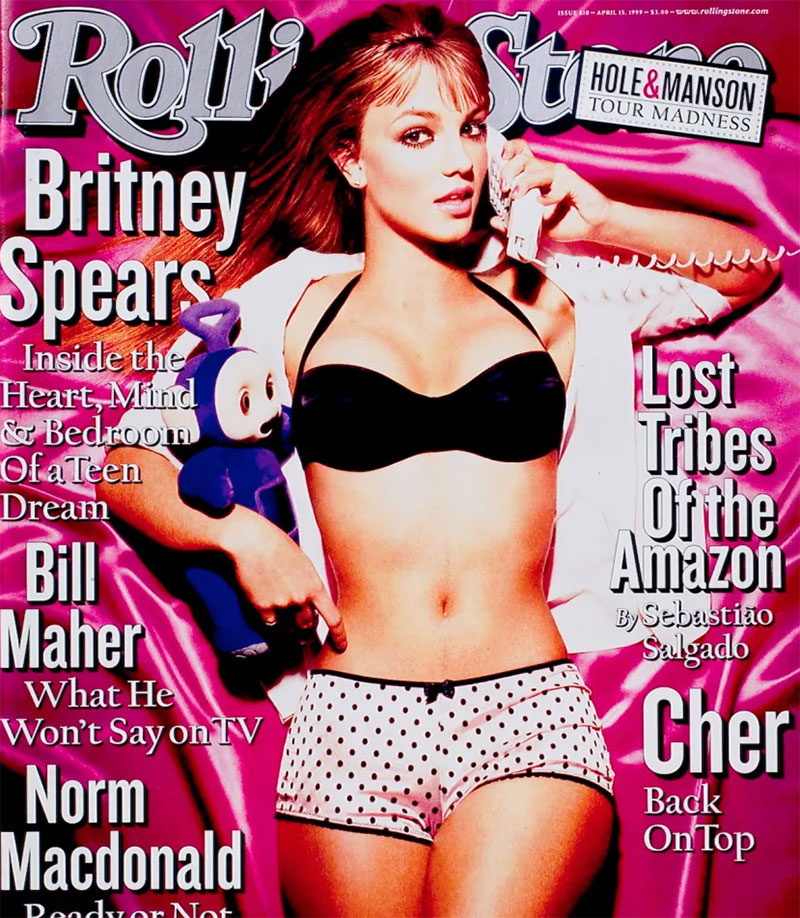
Date: April 15, 1999
Photographer: David LaChapelle
Setting: Spears’ Louisiana bedroom
Age: 17
The shoot sparked immediate controversy.
Featured Subject
Spears lying on her bed in black bra and polka dot shorts, holding a Teletubby and phone. She’d just exploded with “…Baby One More Time.” The image portrayed her as both girl-next-door and emerging sex symbol.
LaChapelle recalled that Spears’ manager questioned what was happening. “But as soon as he walked out, Britney said, ‘Lock the door’ and unbuttoned her shirt wide open.”
Visual Elements
- Bright pink bedroom with stuffed animals
- Teen iconography mixed with adult sexuality
- LaChapelle’s signature hyperreal saturation
- Teletubby as ironic marker: childhood innocence vs. exposed midriff
- Vivid color palette screamed teenage bedroom
Everything looked too perfect, too vivid.
Cultural Impact
American Family Association called for boycotts. The controversy failed. Sales skyrocketed.
The cover launched debates about sexualizing young female performers. But it also showed Spears taking control of her image at 17. Decades later, the photo remains emblematic of late 90s pop culture and complicated questions about young women’s autonomy.
Historical Context
1999 teen pop dominated radio. Backstreet Boys, *NSYNC, Christina Aguilera all competed. Britney’s Catholic schoolgirl persona in the “…Baby One More Time” video already sparked conversation.
This cover pushed further. At the time, few questioned whether a teenager should be photographed this way. The 2021 documentary “Framing Britney Spears” reexamined this moment, questioning who really benefited from these early sexualized images.
Janet Jackson (1993)
Cover Details
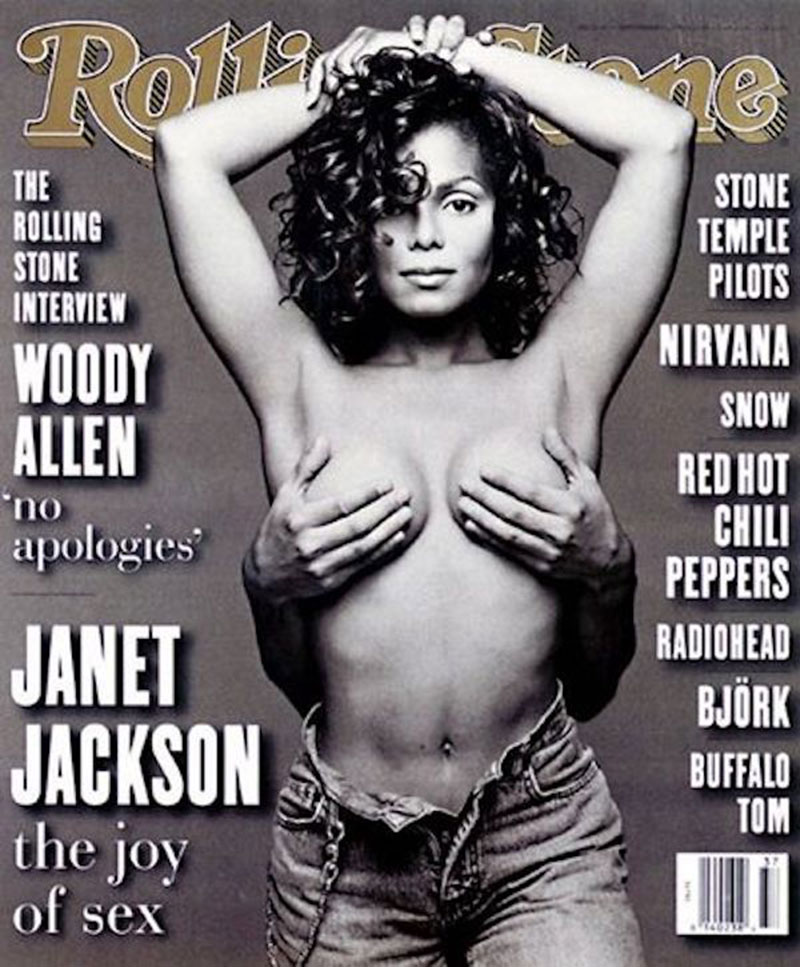
Date: September 16, 1993 (issue 665)
Photographer: Patrick Demarchelier
Concept: Topless with then-husband Rene Elizondo’s hands covering her breasts
The full-length version of her album cover photo.
Featured Subject
Janet Jackson at 27, established as both role model and sex symbol. Her album “janet.” explored female pleasure and sexuality. This wasn’t shock value. It was artistic statement.
She got the idea while working on “Poetic Justice” wearing long braids. Saw herself in a mirror with braids covering her chest. Inspiration struck.
Visual Elements
- Sepia tone photography created intimacy
- Framing from face to loose jeans
- Her Mona Lisa smile dominated: calm, mysterious, powerful
- Strong balance between her face (focal point) and statement below
- Sensuality through suggestion rather than revelation
The image worked because of what it didn’t show.
Cultural Impact
“One of the most recognizable, and most lampooned, magazine covers of the year” (Vancouver Sun).
The photo crowned Jackson as an icon separate from the Jackson family name. She controlled the narrative about her body and sexuality in a way few Black female artists had before. Rolling Stone named her Best Female Singer and Female Sex Symbol for 1993.
Instant pop lexicon: referenced, parodied, recreated countless times.
Historical Context
September 1993 R&B was omnipresent. Janet’s “janet.” album boldly celebrated sexuality following her socially-conscious “Rhythm Nation 1814.”
The Rodney King beating trial verdict had sparked LA riots the previous year. Cultural conversations about race, power, and voice dominated. Jackson used her platform to claim space as a Black woman expressing desire on her own terms.
This cover photograph became the official coronation moment.
Michael Jackson Age 11
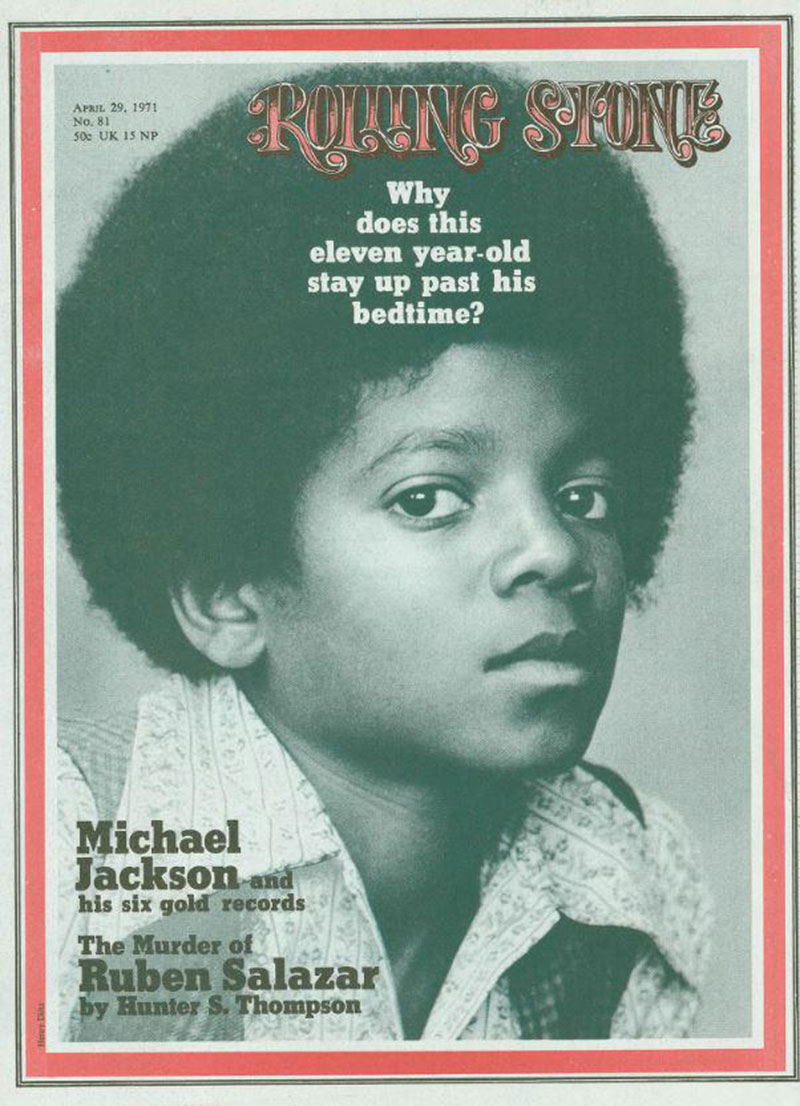
Cover Details
Date: April 29, 1971 (issue 81)
Photographer: Baron Wolman
Record: Youngest person ever on Rolling Stone cover
Headline: “Michael Jackson and His Six Gold Records”
Featured Subject
Young Michael from the Jackson 5, already a superstar. His brothers were at the photoshoot but didn’t appear on cover. This disappointed fans who loved all five equally.
The six gold records were Jackson 5 hits, not solo work. Michael wasn’t a solo artist yet. But the magazine recognized something special in the lead singer from Gary, Indiana.
Visual Elements
- Simple portrait photography
- Michael’s youth and talent both evident
- No elaborate staging
- Baron Wolman’s straightforward approach let personality shine
- Image captured innocence before fame’s complexities
Cultural Impact
Rolling Stone cover stories meant you’d achieved both popularity and respectability among serious rock aficionados. For the Jackson 5 to land a cover validated what millions of young fans already knew.
The cover signaled Motown’s biggest act wasn’t just bubblegum pop. They deserved recognition alongside rock acts. Michael would appear on four more covers before his death in 2009.
Historical Context
Key Jackson 5 hits (all #1):
- “I Want You Back”
- “ABC”
- “The Love You Save”
The brothers from Gary, Indiana conquered American pop culture while still teenagers. Michael’s appearance came just two years after the first rap records. But it would be 15 more years before Run-D.M.C. became the first hip-hop artists on Rolling Stone’s cover.
Young Black artists gradually gained mainstream magazine attention. Michael’s cover represented a shift in who music journalism considered worthy, even as it singled him out from his brothers.
Tina Turner (1967)
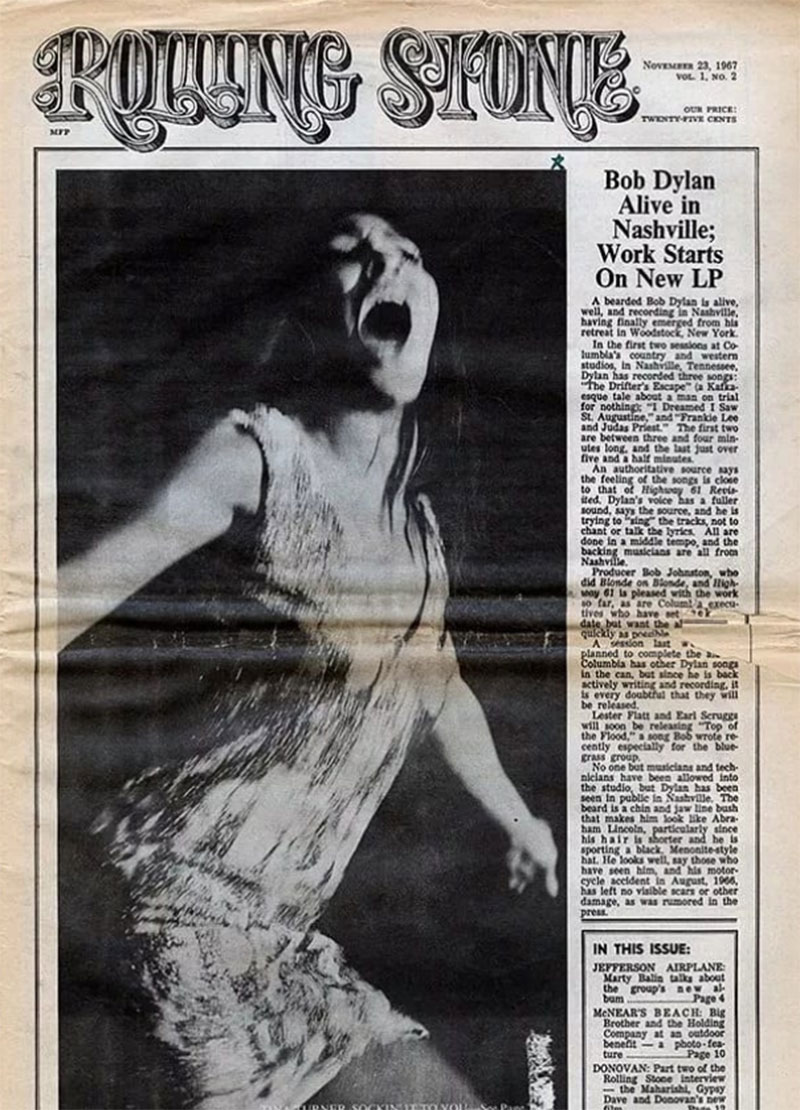
Cover Details
Date: November 23, 1967 (issue 2)
Photographer: Baron Wolman
Location: Hungry I club, San Francisco
Distinction: First woman on Rolling Stone’s cover
Featured Subject
Tina Turner mid-performance. Incredible energy captured in black and white.
Wolman sat close enough to see sweat on performers’ faces. “The stage was only three feet high and the small round table at which I was sitting was so close to Ike and Tina and the Ikettes that I could see the drops of sweat on their necks and faces.”
That proximity shows in the photograph’s raw power.
Visual Elements
- Live performance energy frozen in time
- Immediate, visceral photography
- You can almost hear her voice through the image
- Movement and stage command evident
- No studio polish, just pure performance
Cultural Impact
Second issue of a brand new magazine. Tina became the first female artist deemed worthy of the cover. The photo showed she wasn’t polished Motown. She was raw, powerful, unrestrained R&B.
The review inside described her: “Tina Turner is an incredible chick. She comes in this very short miniskirt, way above her knees, with zillions of silver sequins and sparklers pasted on it. Her dancing is completely unrestrained.”
First of many times Turner would appear on the cover throughout her career.
Historical Context
1967 the magazine was still finding its identity. Choosing Tina for issue two signaled commitment to covering authentic music performance, not just manufactured pop stars.
Ike and Tina Turner revue delivered one of rock and soul’s most electrifying live shows. While Motown acts gave polite, choreographed performances, Tina screamed, wailed, and dominated stages.
The cover recognized her as a force. Decades later, after escaping Ike’s abuse and staging one of music’s greatest comebacks, people would remember this early validation of her power.
Run-D.M.C. (1986)
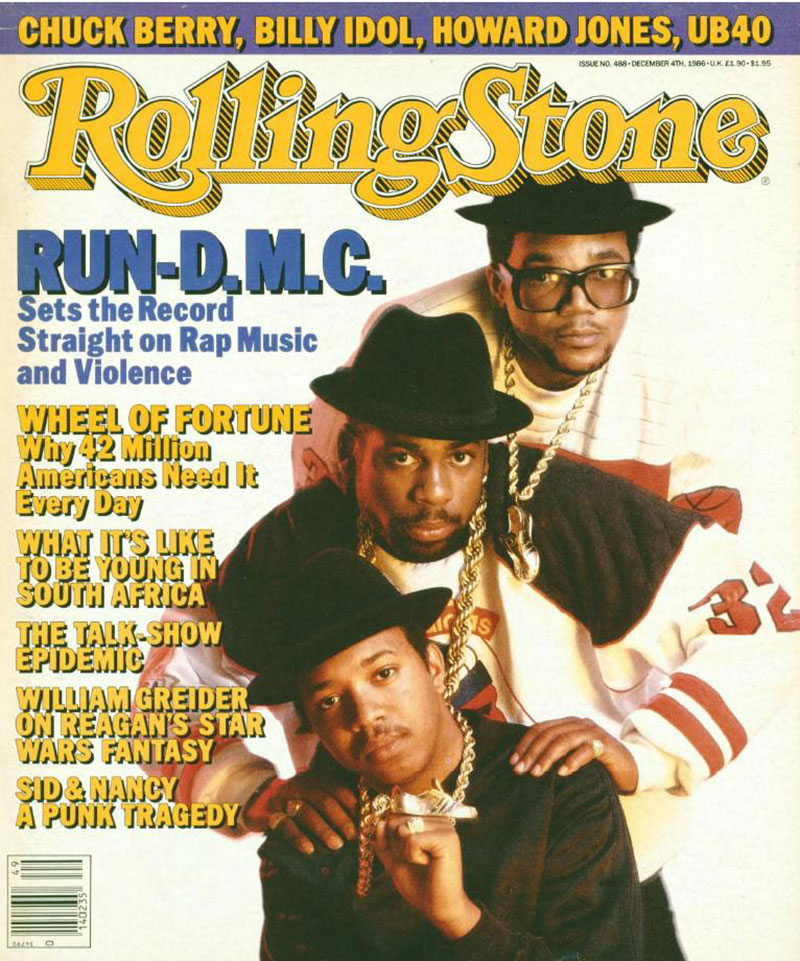
Cover Details
Date: December 4, 1986 (issue 488)
Photographer: Frank W. Ockenfels
Distinction: First rap artists on Rolling Stone cover
Headline: “Run DMC Sets The Record Straight on Rap Music & Violence”
Featured Subject
Run (Joe Simmons), D.M.C. (Darryl McDaniels), and Jam Master Jay (Jason Mizell). The trio had just injected rap into American mainstream with double-platinum album “Raising Hell.”
At the peak of their powers, freshly controversial over gang violence at concerts.
Visual Elements
- Black fedoras (their trademark)
- Unlaced Adidas sneakers
- Gold chains
- Street-style aesthetic that defined hip-hop fashion
- No rhinestones or elaborate costumes
- They looked like kids from Hollis, Queens (because they were)
The visual approach: “You didn’t see a celebrity, you saw yourself,” McDaniels later said. “That’s what our appeal was – we were relatable.”
Cultural Impact
List of firsts for Run-D.M.C.:
- First rap act on Rolling Stone cover
- First hip-hop group with gold album
- First with platinum album
- First with multi-platinum album
- First rap videos on MTV
- First on American Bandstand
- First Grammy nomination for rap
- First to perform at Live Aid
Their “Walk This Way” collaboration with Aerosmith broke down racial barriers between rap and rock. The song peaked at #4 on Billboard Hot 100.
Historical Context
December 1986 rap was still underground to mainstream America. Run-D.M.C. changed that. Their stripped-down, hardcore approach revolutionized hip-hop sound.
“Raising Hell” went triple-platinum. The group received dinner invites from Michael Jackson. Yet gang fights marred some concerts, creating controversy. The cover story let them address violence while spreading positive messages: pro-education, pro-voting, anti-gang, anti-drug.
“Our image is clean,” Run told Rolling Stone. “I’m no sociologist, but we’re role models, man, big-time role models.”
The cover legitimized hip-hop as worthy of serious music journalism coverage.
Ice-T “Cop Killer” Controversy
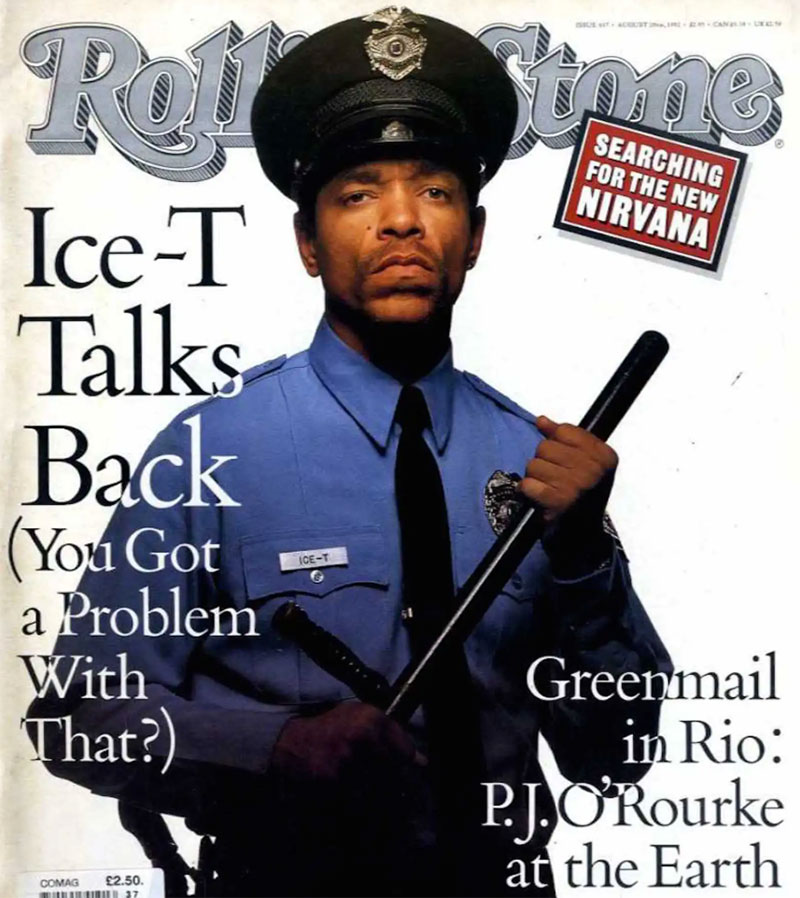
Cover Details
Date: August 20, 1992 (issue 627)
Photographer: Mark Seliger
Concept: Ice-T in full police uniform
Cover line: “Ice-T Talks Back (You Got a Problem With That?)”
Featured Subject
Ice-T at the height of the “Cop Killer” controversy. President George H.W. Bush called his work “sick.” Dan Quayle said “obscene.” Sixty congressmen pronounced it “vile and despicable.”
By appearing in uniform on Rolling Stone, Ice-T doubled down on artistic expression.
Visual Elements
- Full police uniform
- Direct confrontation with critics
- Seliger’s friend, costumer Arianne Phillips, accurately assembled the uniform
- Ice-T: “Cool” when Seliger suggested the concept
- The photo made a statement about character vs. reality
Seliger recalled: “I didn’t know if he would go for it, I didn’t know if the magazine would go for it.”
Cultural Impact
The cover became part of National Museum of African American History and Culture collection in Washington, D.C.
Ice-T’s argument: “I’m singing in the first person as a character who is fed up with police brutality. If you believe that I’m a cop killer, you believe David Bowie is an astronaut.”
The controversy boosted Body Count album sales while record store chains dropped it. Trans World, Superclub, Camelot, and Musicland all pulled the album. By July, Ice-T voluntarily withdrew the song.
The cover crystallized debates about art, free speech, and police brutality that continue today.
Historical Context
“Cop Killer” was written in 1990, performed at 1991 Lollapalooza. The recorded version referenced Rodney King and LA police chief Daryl Gates.
Released March 1992. One month later, four officers were acquitted of beating Rodney King. Los Angeles erupted in riots for six days. The song became a flashpoint.
Political response:
- President Bush denounced record companies releasing such products
- Vice President Quayle called it obscene
- Oliver North wanted sedition charges
- New Zealand police commissioner tried preventing Ice-T’s Auckland concert
Ice-T later: “The main reason they went after this record is because of the s— that was coming down. They’re yelling about a record that came out in March, and just yesterday the cops were killing people out in the street.”
Ironically, Ice-T would play a cop on “Law & Order: SVU” for 18 years starting in 2000.
Tupac Memorial Cover

Cover Details
Date: October 31, 1996 (issue 746)
Photographer: Danny Clinch
Published: One month after Tupac’s death
The powerful portrait showcased the rapper in his proud, unflinching glory.
Featured Subject
Tupac Shakur died September 13, 1996 at 25 years old from gunshot wounds received six days earlier in a Las Vegas drive-by shooting. The world lost a pioneer in hip-hop and social justice.
This wasn’t just another tribute cover. Clinch captured Tupac’s essence: defiant, thoughtful, powerful.
Visual Elements
- Direct, confrontational gaze
- Strong portrait composition
- No gimmicks or staging
- Pure photographic power
- Image emphasized Tupac’s intensity and artistic vision
The simplicity made it devastating. One man, one camera, one moment frozen before tragedy.
Cultural Impact
Remains one of the most recognized magazine images of all time. The cover didn’t try to soften Tupac’s death or sanitize his legacy. It presented him as he was: complex, passionate, uncompromising.
Became instant collector’s item. Issue 746 regularly sells for premium prices decades later.
Historical Context
September 7, 1996. Tupac attended the Mike Tyson/Bruce Seldon fight at MGM Grand with Death Row Records CEO Suge Knight. After the fight, Tupac and entourage got into an argument. Later that night, someone opened fire on Knight’s car. All shots aimed at passenger seat where Tupac sat.
He died six days later. Police had no suspects, no leads. Witnesses wouldn’t cooperate. The murder remains unsolved.
Rolling Stone published this cover as tributes flooded newsstands. But this one captured something others didn’t: Tupac’s artistic legacy beyond the violence that took his life.
Eminem (1999)

Cover Details
Date: April 29, 1999 (issue 811)
Photographer: David LaChapelle
Timing: One month after “The Slim Shady LP” release
Eminem was about to blow up. LaChapelle knew it.
Featured Subject
Marshall Mathers, aka Eminem, aka Slim Shady. The Michigan rapper who’d been a $5.50-an-hour cook before Dr. Dre discovered his obscenity-strewn, violent, hilarious, demented rhymes.
“The Slim Shady LP” sold 480,000 copies in its first two weeks. White boy in a black medium, dealing with instant fame and criticism simultaneously.
Visual Elements
LaChapelle shot him holding a stick of dynamite (unpublished inside photo). The published cover showed a close-up with headphones. Both images captured the moment before explosion.
“He was about to blow up,” LaChapelle recalled. “At the time, I knew him as Slim Shady. When they told me his name was Eminem, I was like, ‘Do you spell it like M&M the candy?'”
Cultural Impact
First major magazine cover for someone who’d become one of hip-hop’s most controversial and successful artists. The timing was perfect: right at the inflection point between underground rapper and global superstar.
Em had been booed on stage, told repeatedly by Black hip-hoppers to stop rapping and go into rock. “It’s some very awkward shit,” Dr. Dre said about the race card. “It’s like seeing a black guy doing country & western.”
But Dre didn’t care. “I don’t give a fuck if you’re purple: If you can kick it, I’m working with you.”
Historical Context
1999 rap was exploding into mainstream. But a white rapper presented complications. Vanilla Ice had poisoned that well years earlier.
Eminem was different. His technical skill was undeniable. His storytelling approached literature. His darkness felt authentic, not manufactured.
The cover legitimized him before mainstream America fully understood what was happening. Within months, Eminem would win Grammys and go quadruple platinum.
Lady Gaga (2009)
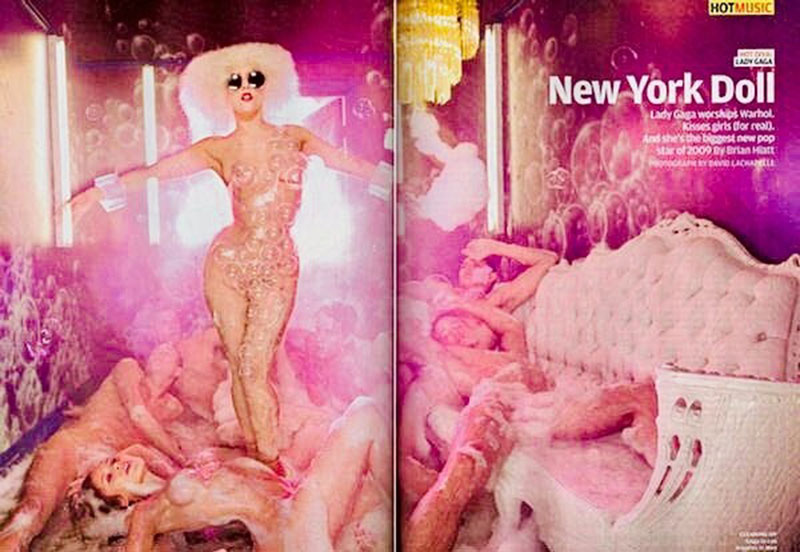
Cover Details
Date: June 11, 2009 (issue 1080)
Photographer: David LaChapelle
Setting: Hot-pink wonderland filled with bubbles
LaChapelle created a Metropolis-themed shoot recreating Fritz Lang’s 1927 movie.
Featured Subject
Lady Gaga at the moment “Poker Face” and “Just Dance” turned her into a household name. She’d just become 2009’s biggest new pop star.
The cover established her as glossy, sexy, yet bizarre. Perfect introduction to someone who would redefine pop performance art.
Visual Elements
- Clear bubble dress
- Hot-pink cascading bubbles over lushly decorated interior
- Signature weird makeup
- Sexy yet oddly posed models
- LaChapelle’s hyperreal aesthetic
- Every element screamed “look at me”
The visual approach matched Gaga’s philosophy: art, fashion, music, and spectacle merged into one package.
Cultural Impact
Smart choice for her first Rolling Stone cover. LaChapelle, beloved celebrity photographer, gave her instant credibility. The image worked both as pop confection and serious artistic statement.
Gaga worshiped Warhol, kissed girls (for real), and understood how to manipulate media attention. The cover announced: “This isn’t just another pop star.”
Her creative director Quinn Wilson later said they’d always looked to LaChapelle for inspiration. “We’re now seeing the actual creator of that with her. She’s in front of his lens.”
Historical Context
Early 2009 Gaga was everywhere but people had a hard time accepting her outrageous wardrobe and public persona. Was she serious? Performance art? Marketing genius?
The Rolling Stone cover helped answer: all of the above. It positioned her alongside pop royalty while acknowledging her avant-garde approach.
Within months, she’d become one of the defining pop stars of her generation. The bubble-dress cover became shorthand for her entire aesthetic.
Kanye West by David LaChapelle
Cover Details
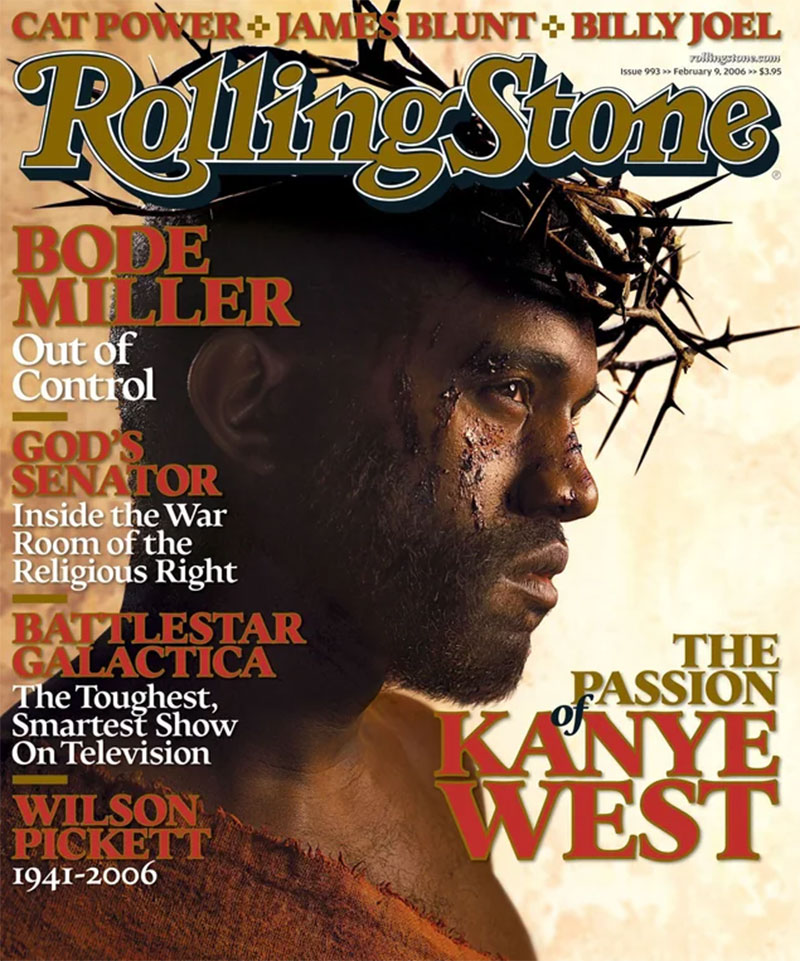
Date: February 9, 2006 (issue 993)
Photographer: David LaChapelle
Shoot duration: 13 hours
Headline: “The Passion of Kanye West”
The most controversial photograph from a marathon session.
Featured Subject
Kanye West as Jesus Christ. Crown of thorns on his head, blood dripping down his face, fiery look in his eyes.
He’d just said “George Bush doesn’t care about black people” on a Hurricane Katrina telethon. Now this. West was already the most polarizing figure in pop music.
Visual Elements
LaChapelle wanted it to look exactly like the DVD cover of “The Passion of the Christ.” Right down to individual thorns.
Unpublished outtakes included:
- West in gray silk suit with topless Pamela Anderson on a horse
- Passed-out circus clown wearing George W. Bush mask on floor
- Muhammad Ali-inspired photo (West’s idea)
“He understands the importance of making imagery interesting and thought-provoking,” LaChapelle said. “He wants to shoot all night.”
Cultural Impact
Drew stacks of mail condemning both magazine and West as blasphemous. Religious right was furious. Comedian Mo Rocca called it “bad PR.”
Rolling Stone defended it as artistic, not meant to offend. But that was the point. West wasn’t backing down from anything.
“First it was what I said on the telethon, then the Rolling Stone cover sealed it,” West said. “I can’t even get endorsements now.”
At the time, West had eight Grammy nominations for “Late Registration.” The cover crystallized his self-image: misunderstood genius willing to be crucified for his art.
Historical Context
2006 West was riding high but bruised. Hurricane Katrina exposed government failures. West’s telethon comment made him a villain to conservatives, a hero to others.
The Jesus pose wasn’t random. West’s album featured “Jesus Walks.” His persona always mixed religious imagery with ego. The cover made that explicit.
“It took way too long for me to get on the cover,” he said with typical modesty. “There’s only one me, only one Madonna and just a few other people who are really important. The rest is bullshit.”
Ten years later? “Yeezus.”
Dr. Hook & the Medicine Show
Cover Details
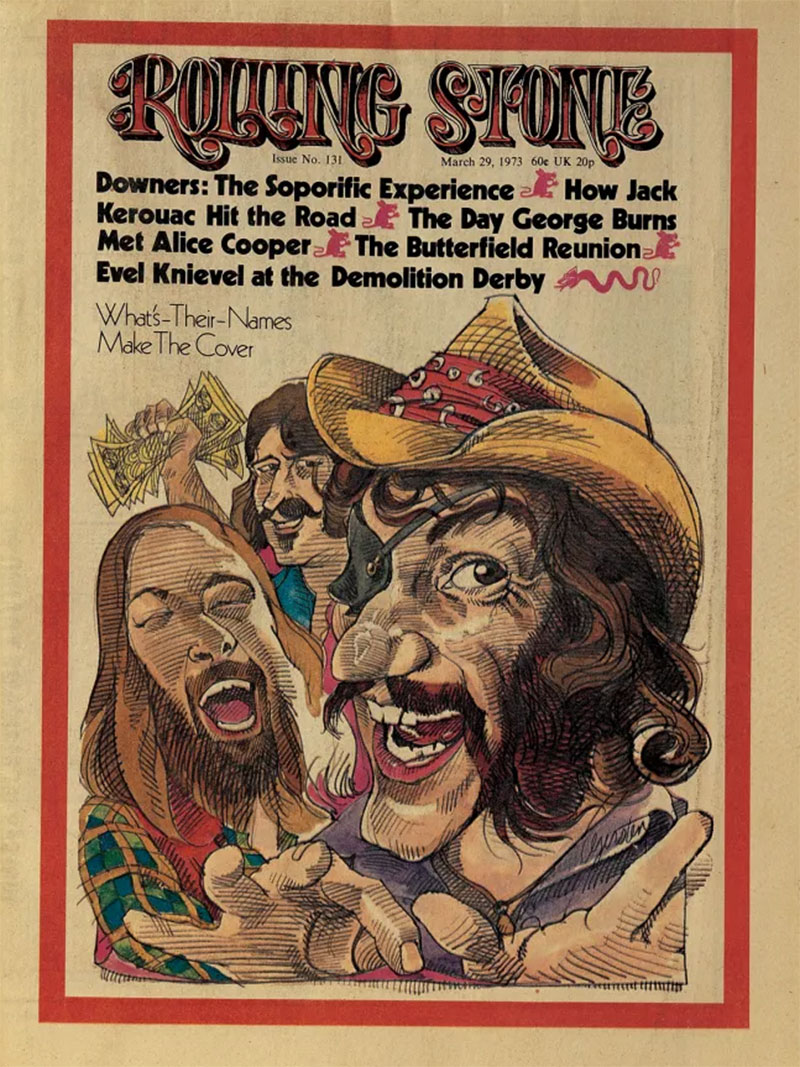
Date: March 29, 1973 (issue 131)
Artist: Colorful caricature (not photograph)
Headline: “What’s-Their-Names Make the Cover”
Reporter: Cameron Crowe (16 years old)
Featured Subject
Ray Sawyer (with signature eyepatch), Dennis Locorriere, and Billy Francis. Only three of the band’s seven members appeared. The caption didn’t even use their band name.
They’d sung about wanting to be on the cover. Their wish came true, after a fashion.
Visual Elements
- Caricature instead of photograph
- Three members instead of seven
- Colorful, playful illustration
- Deliberately cheeky presentation
- Rolling Stone having fun with the band’s request
The magazine simultaneously honored and trolled them.
Cultural Impact
“The Cover of ‘Rolling Stone'” peaked at #6 on Billboard Hot 100. The song satirically lamented that despite having all the trappings of rock stardom (drugs, groupies, teenage fans), they hadn’t made the magazine cover.
Key lyrics satirized success:
- “We take all kinds of pills that give us all kind of thrills”
- “I got a freaky ole lady name a cocaine Katy”
- “Buy five copies for my mother”
Columbia Records argued about lyrical content but released it anyway. Manager Ron Haffkine convinced Rolling Stone editor Jann Wenner that the song was basically a free radio commercial for his magazine.
Four months after the song hit, the band got their cover. Sort of.
Historical Context
1973 making the Rolling Stone cover meant you’d made it. Dr. Hook turned that aspiration into the song itself. Meta before meta was cool.
BBC refused to play the song because “Rolling Stone” was considered advertising. Some DJs overdubbed “Radio Times” over the chorus.
Inside the magazine: a deliriously funny chronicle of the band’s travels, profanity-laced song parodies, tales of harmonizing on George Jones songs, encounters with groupies, and near-misses with Virginia state troopers.
The band shortened their name to Dr. Hook after this. They’d later have bigger hits like “When You’re in Love With a Beautiful Woman” (UK #1).
Bruce Springsteen served as their opening act in 1973.
Fleetwood Mac in Bed
Cover Details
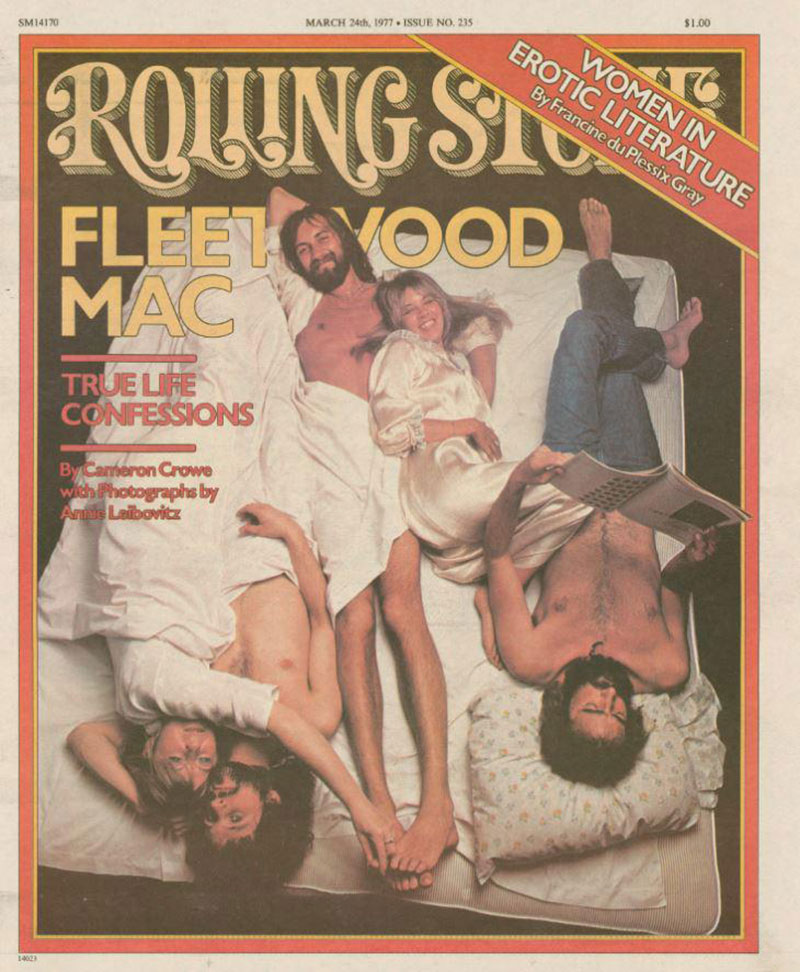
Date: March 24, 1977 (issue 235)
Photographer: Annie Leibovitz
Setting: All five members entangled on a single bed
Reporter: Cameron Crowe
Leibovitz brought cocaine to the shoot. They consumed it in 30 seconds, then revealed they’d all recently been to rehab.
Featured Subject
Fleetwood Mac at their peak, chronicling the making of “Rumours.” The album would spend 31 weeks at #1 and sell 19 million copies.
But every couple in the band had just broken up:
- Lindsey Buckingham and Stevie Nicks
- Christine and John McVie
- Mick Fleetwood and his wife Jenny Boyd
They still had to make music together. And pose for this cover.
Visual Elements
The arrangement:
- Christine McVie rests her head on Buckingham’s shoulder
- Stevie Nicks curls into Mick Fleetwood’s arm
- John McVie sits alone on far side, reading Playboy (at Christine’s request)
- Everyone in intimate positions despite personal animosity
Original concept called for ex-couples to kiss. Too close to the bone. Wounds still fresh.
“I said, ‘OK, but I can’t be in bed next to Lindsey,'” Nicks recalled. “So I curl up next to Mick for the next three hours while Annie is suspended over us on a platform.”
Cultural Impact
Leibovitz’s iconic image perfectly captured the band’s interpersonal dynamics. “The intention was a spoof on the rumors about our private lives,” Mick Fleetwood said, “and yet, symbolically, the picture showed us exactly as we were: all married to each other.”
The shoot itself sparked consequences. After Leibovitz finished, everyone left except Buckingham and Nicks. They stayed on the mattress in their bedclothes, holding each other for five minutes or more.
“After all that we’d been through, knowing that we loved each other, somehow, we just couldn’t get up,” Buckingham said. Mick Fleetwood finally returned: “Guys, you’re freaking everyone out.”
Nicks and Buckingham ended up making out and talking for two hours. The photoshoot also “planted the seed” for Nicks and Fleetwood’s affair the following year.
Historical Context
March 1977. “Rumours” was about to take over the world. But the album documented real breakups, real pain. Songs were passive-aggressive messages to each other.
Crowe’s article let them speak with raw honesty about the stress and conflicts. “Other musicians would say, ‘Well, I see the level of raw honesty the magazine wants from us,'” Crowe recalled.
Buckingham’s response: “I wouldn’t necessarily advise that to other people. It was part and parcel of the band for us. All our boundaries got melded and we couldn’t hide our level of pain.”
The cover became one of Rolling Stone’s most iconic images. It perfectly captured how professional obligations and personal disasters collide in rock and roll.
Bruce Springsteen

Cover Details
Multiple appearances throughout career
Notable covers: October 27, 1975 (“Rock’s New Sensation”), August 24, 1978, and many more
Springsteen’s relationship with Rolling Stone helped define both.
Featured Subject
The Boss appeared on Rolling Stone covers more than two dozen times. His October 1975 appearance came with massive hype: “Rock’s New Sensation.” The simultaneous Time and Newsweek covers that week created backlash.
Too much hype before “Born to Run” even proved itself. But the album delivered. Springsteen became the American working-class rock poet the covers promised.
Visual Elements
Early covers captured Springsteen’s raw, authentic energy. No glitz. No glamour. Just a guy from New Jersey with a guitar and stories to tell.
Later covers showed evolution: stadium rocker, political voice, elder statesman. But the core remained: authenticity over artifice.
Cultural Impact
The 1975 coverage was make-or-break moment. Springsteen felt the pressure. “It bothered him tremendously,” manager Jon Landau said. “There were people who got hardened against him because of the hype.”
But Springsteen’s music proved worthy. Rolling Stone covers documented his journey from unknown to legend. Each cover marked a different chapter: the hungry young artist, the arena conqueror, the political commentator, the mature craftsman.
His willingness to open up in interviews created some of magazine’s best journalism. He talked about class, about America, about what it means to work for a living.
Historical Context
1975 rock needed a hero after Beatles broke up, Dylan retreated, Elvis became a Vegas caricature. Springsteen emerged as that figure: someone who believed in rock’s redemptive power.
Rolling Stone covers tracked his importance across decades. From “Born to Run” through “Born in the U.S.A.” to “The Rising” after 9/11, Springsteen remained Rolling Stone’s idea of what a rock star should be: talented, authentic, meaningful.
FAQ on Iconic Rolling Stone Magazine Covers
What was the first Rolling Stone Magazine cover?
John Lennon appeared on the first issue (November 9, 1967). The cover used a publicity still from “How I Won the War” showing Lennon in military gear. Cost: 25 cents. The image set the magazine’s tone: music meets politics.
Who was the first woman on Rolling Stone’s cover?
Tina Turner graced issue two (November 23, 1967). Baron Wolman photographed her mid-performance at San Francisco’s Hungry I club. She became the first female artist and first Black artist featured, establishing Rolling Stone’s commitment to authentic music coverage.
What is the most controversial Rolling Stone cover?
Several compete for this title. Ice-T in a police uniform (1992), Kanye West as Jesus (2006), and the naked John Lennon-Yoko Ono image (1981) all sparked outrage. Each generated bags of hate mail and condemnation from religious or political groups.
Who were the first rap artists on Rolling Stone’s cover?
Run-D.M.C. made history on December 4, 1986. The trio appeared wearing their trademark black fedoras, unlaced Adidas, and gold chains. The cover legitimized hip-hop as worthy of serious music journalism, opening doors for future rap coverage.
How much are vintage Rolling Stone covers worth?
Prices vary wildly. First issue copies sell for $400+. The 1981 John Lennon memorial issue commands premium prices. Condition matters enormously. Issues featuring historic moments or deceased artists typically fetch highest values among collectors seeking music memorabilia.
Which photographer shot the most Rolling Stone covers?
Annie Leibovitz dominated Rolling Stone cover photography. She served as chief photographer from 1973 to 1983. Her iconic images include the Lennon-Ono portrait, Fleetwood Mac in bed, and countless other memorable magazine photography moments defining rock culture.
What makes a Rolling Stone cover iconic?
Several factors converge: perfect timing, cultural relevance, visual innovation, and controversy. The best covers capture artists at career peaks or cultural inflection points. Memorable cover art transcends the moment, becoming permanent artifacts of pop culture history.
Has Rolling Stone ever apologized for a cover?
The magazine rarely apologizes for editorial decisions. However, the 2013 Boston Marathon bomber cover faced widespread criticism. Retailers refused to stock it. Rolling Stone defended the cover as journalism but acknowledged the pain it caused bombing victims’ families.
Who has appeared on Rolling Stone’s cover the most?
The Beatles collectively lead with 30+ covers. Individually, members like John Lennon and Paul McCartney appeared numerous times. Other frequent subjects include Bob Dylan, Bruce Springsteen, and Madonna. Cover frequency reflects both commercial appeal and cultural significance.
Why did Dr. Hook’s cover appear as a caricature?
Rolling Stone played with the band’s song “The Cover of ‘Rolling Stone.'” Instead of a photograph, they used colorful caricatures of only three members. The caption read “What’s-Their-Names Make the Cover.” The magazine simultaneously honored and trolled them.
Conclusion
Iconic Rolling Stone Magazine covers transformed magazine photography into cultural commentary. Each image documented more than music industry milestones.
These covers captured relationship drama in Fleetwood Mac’s bed. They sparked free speech debates with Ice-T’s police uniform. They crowned new legends and memorialized fallen heroes.
From Annie Leibovitz’s intimate portraits to David LaChapelle’s provocative compositions, the magazine’s cover art pushed boundaries. Some covers celebrated breakthroughs like Run-D.M.C. legitimizing hip-hop journalism. Others courted controversy through calculated shock value.
The legendary photographers, bold editorial decisions, and perfect timing created memorable magazine moments that transcended their newsstand purpose. They became collectible issues, framed artifacts, and permanent records of how music shaped American culture.
These weren’t just covers. They were statements.

Renowned for his expertise in logo design and visual branding, Bogdan has developed a multitude of logos for various clients.
His skills extend to creating posters, vector illustrations, business cards, and brochures. Additionally, Bogdan's UI kits were featured on marketplaces like Visual Hierarchy and UI8.
He also wrote in the past years on sites like Design Your Way, WebDesignerDepot, WPDean, Designmodo, Speckyboy, Slider Revolution, and more.
- How to Install Fonts on Mac (Step-by-Step Guide) - 20 September 2026
- From Mockup to Code: How AI-Augmented Development Speeds Up the Design Handoff - 19 September 2026
- The Beehiiv Logo History, Colors, Font, And Meaning - 18 September 2026

Bogdan Sandu is a seasoned designer who has been designing websites since 2008. Renowned for his expertise in logo design and visual branding, Bogdan has developed a multitude of logos for various clients. His skills extend to creating posters, vector illustrations, business cards, and brochures. Additionally, Bogdan's UI kits were featured on marketplaces like Visual Hierarchy and UI8. He also wrote in the past years on sites like Design Your Way, WebDesignerDepot, WPDean, Designmodo, Speckyboy, Slider Revolution, and more.
You Might Also Like


