
You finished the rebrand. The client loved it. They signed up for ongoing design support, 20 hours a month, and you celebrated with a slightly too expensive dinner.
Three months later, you’re doing 26 hours some months and 14 in others. One invoice is still unpaid. And you’re not quite sure whether the client owes you $2,400 or $3,180.
That’s the quiet problem with a monthly retainer. Getting the client is the design work. Getting paid every month is an admin system, and most freelancers never build one.
So let’s build one. Simple enough to run in an hour a month, clear enough that your client never has to ask what an invoice is for.
What Is a Retainer, Really?
| A retainer is an ongoing agreement where a client pays a fixed fee each month in exchange for a set amount of your time or a defined scope of work. You get predictable income. They get priority access. The agreement spells out what happens when they use more, or less, than they paid for. |
Think of it like a gym membership with a personal trainer. The client pays every month whether they show up for every session or not, and extra sessions cost extra. The difference is that your client actually reads the bill.
A design retainer agreement turns that into rules. Without one, every month becomes a negotiation.
At a Glance
What it is: A fixed monthly fee for a set block of hours or scope.
What to agree: Hours, rate, overage price, rollover rule, due date.
What to send: One invoice at the start of the month, one statement at the end.
What to watch: Hours used, overage, and anything past its due date.
When to chase: Before the due date, then on a fixed schedule after it.
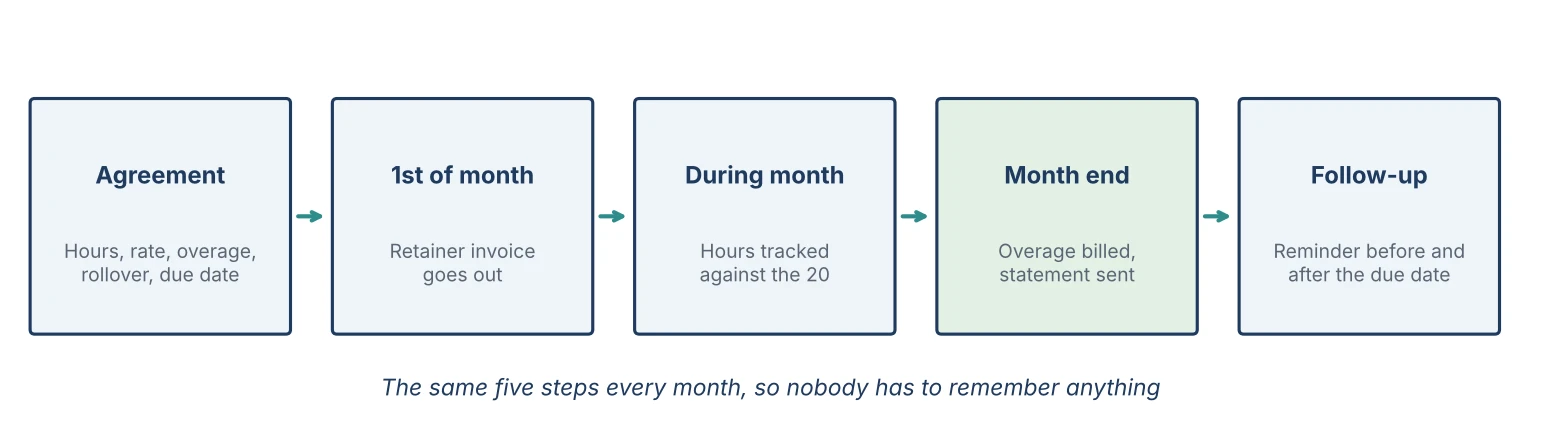
Write the Rules Before the First Invoice
Most retainer billing fights happen because something was never written down. Put five things in the retainer agreement before you start:
- Hours included each month, or the exact scope.
- Your monthly fee, and the hourly rate for anything beyond it.
- Whether unused hours roll over, and for how long.
- When you invoice, and when payment is due.
- What happens when payment is late.
On pricing, look at your own costs and market rather than averages you read online. Freelance graphic design rates vary hugely by experience, niche and location. The point of the agreement isn’t the number. It’s that both of you know it.
The law backs this up in some places too. New York City’s Freelance Isn’t Free Act requires a written contract for freelance work of $800 or more within a 120-day period, covering the work, the pay and the payment date. If no date is set, the client has to pay within 30 days of the work being completed. New York State adopted a near-identical law statewide in 2024. Wherever you work, clear freelance payment terms are cheaper than any argument.
Worked Examples
All three examples follow Fernhill Studio, a fictional one-person design studio with a $2,400 retainer for 20 hours a month, an overage rate of $130 an hour, and payment due by the 15th. The numbers are sample data.
Example 1: A Month With Overage
October gets busy. The client needs a trade show booth on top of the usual social graphics, and the month ends at 26 hours.
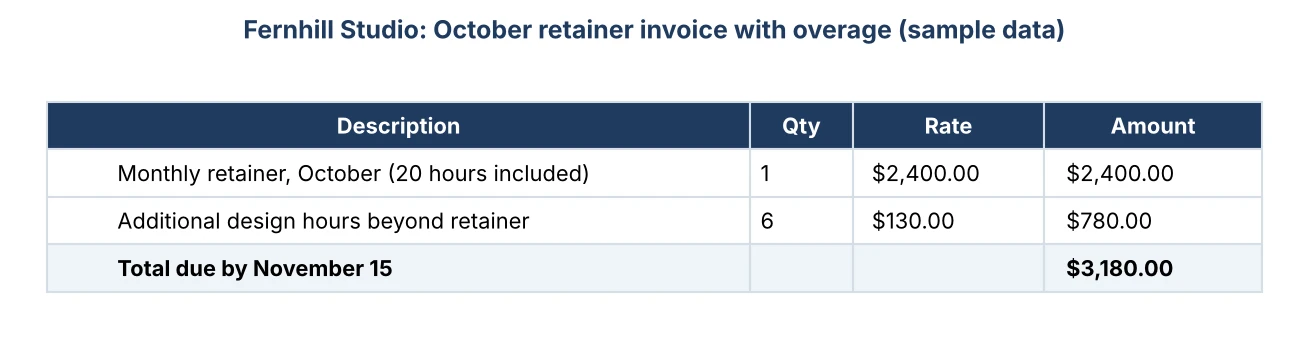
| 6 extra hours × $130 = $780. $2,400 + $780 = $3,180 due. |
The overage goes on its own line with the hours shown. That’s the difference between a client who pays and a client who asks you to explain.
Example 2: The Statement That Answers “What Do We Owe?”
September’s retainer was paid late, on October 12. October’s retainer went out on the 1st. The overage invoice went out on the 31st. Three documents, two dates, one confused client.
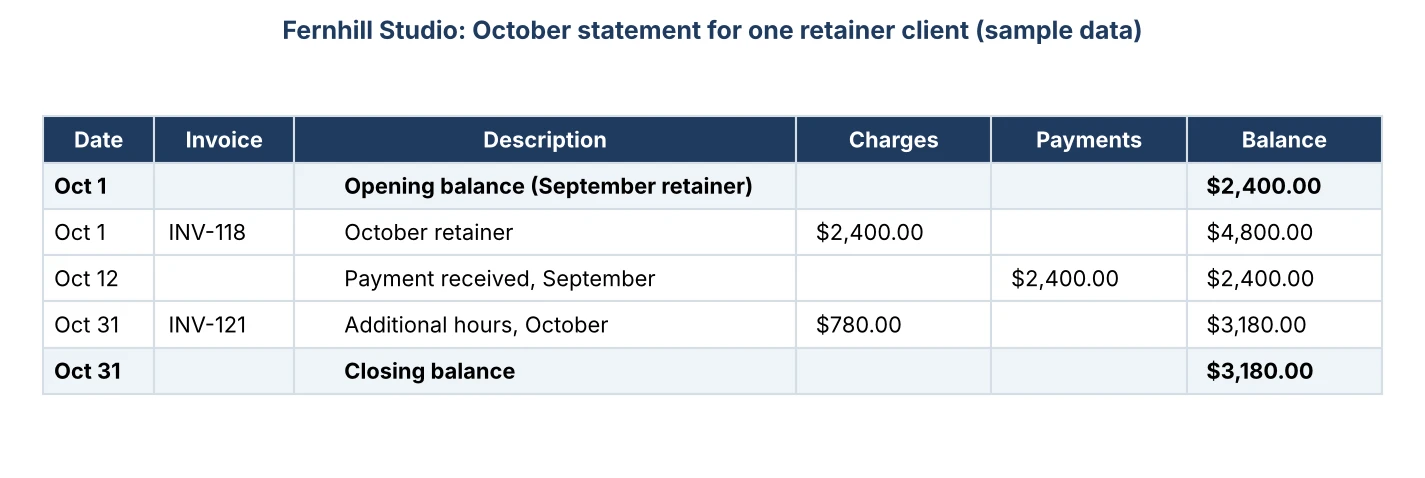
One page fixes it. Opening balance $2,400, plus $2,400 and $780 in new charges, less the $2,400 payment, leaves $3,180. If you don’t have a format yet, a monthly client statement template already has the running balance built in, so you only add your logo and the numbers.
Example 3: The Month They Used 14 Hours
In December, the client is quiet. They use 14 of their 20 hours and ask whether they can get a partial credit.
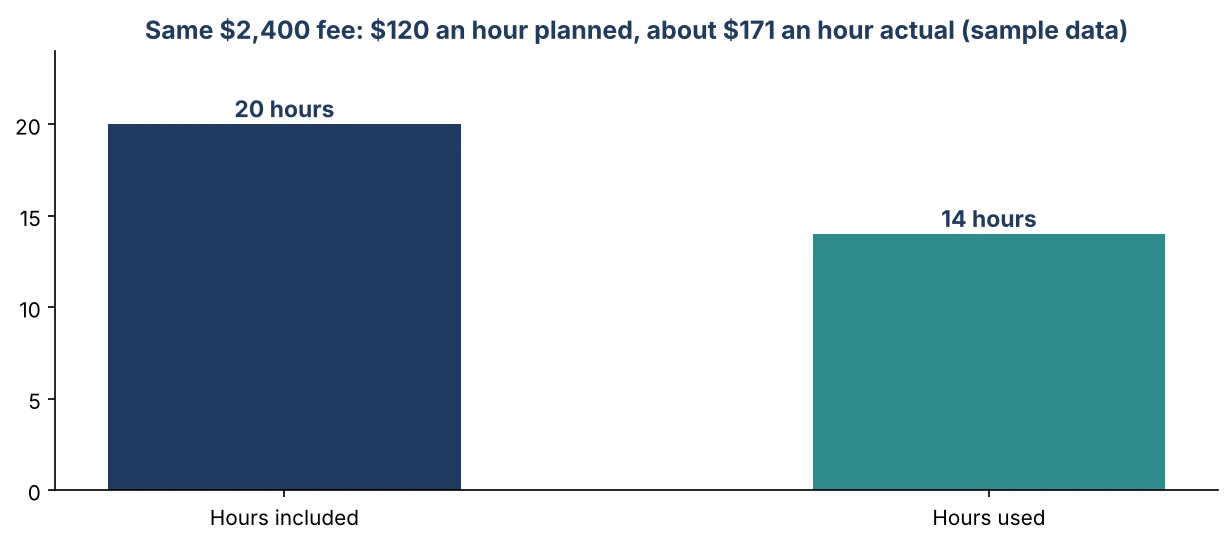
The agreement says hours don’t roll over, so the fee stays $2,400. Your effective rate that month is about $171 an hour, against $120 planned.
That’s not a reason to feel guilty. It’s what the client paid for: guaranteed availability. But it’s exactly why the rollover rule has to be written down before the first quiet month, not argued about during it.
How to Run a Monthly Retainer, Month by Month
One hour a month, in this order.
1- Invoice on the First
Why: retainer fees are paid in advance. The monthly retainer invoice goes out on the same day every month, so it lands in the client’s payment run on time.
Tip: schedule it, don’t remember it.
2- Track Hours Against the Block
Why: you can’t bill overage you didn’t record. Log time by task, even roughly.
Tip: send a short heads-up when the client passes 80% of their hours, so overage is never a surprise.
3- Bill Overage at Month End
Why: overage billed the same month is easy to approve. Overage billed three months later looks like an afterthought.
Tip: list each extra task with its hours on the invoice.
4- Send a Statement With the Balance
Why: once there’s more than one open invoice, the client needs one view of everything. The statement is that view.
Tip: send it on the same day every month, ideally with the new retainer invoice.
5- Remind Before the Due Date, Then Follow Up
Why: a friendly invoice reminder a few days before the due date catches most problems while they’re still small. After the due date, send a polite overdue invoice email, then a firmer one a week later.
Tip: put the balance and a payment link in every payment reminder. Clients pay what’s easy to pay.
How to Ask a Client for Payment Without Making It Weird
Most designers hate this part. So keep it boring and factual. The method is simple: the same way every time, with the facts and nothing else.
| When | Tone | What to say |
|---|---|---|
| 3 days before due | Friendly | A quick reminder, the amount, the due date and a payment link |
| 1 day overdue | Factual | The invoice number, the amount, and a request to confirm when it’ll be paid |
| 7 days overdue | Firm | A reference to the agreed terms, and a pause on new work if your agreement allows it |
You’re not chasing a favor. You’re following the agreement you both signed.
Common Mistakes
| ✗ No written rollover rule
Why it matters: Every quiet month turns into a credit negotiation. The fix: Decide rollover in the agreement, with a cap if you allow it. |
| ✗ Bundling overage into the retainer
Why it matters: The client can’t see what they’re paying for, so they question it. The fix: Bill overage on its own line, with hours and tasks. |
| ✗ Invoicing whenever you remember
Why it matters: Payments drift, and so does your cash flow. The fix: Invoice on the same day every month. |
| ✗ No statement once balances pile up
Why it matters: Nobody knows the real total, so nobody pays it. The fix: Send one statement monthly showing every invoice and payment. |
How Enerpize Handles a Monthly Retainer
What if the first, the 15th and the 31st all ran themselves?
Enerpize is a cloud-based, all-in-one ERP platform for small and medium-sized businesses, combining accounting, inventory, HR, sales, and CRM in a single system. For a studio on retainers, the invoicing side does most of the routine above.
Recurring Invoices and Reminders
Recurring invoices go out on the dates and intervals you set, and automatic payment reminders follow when due dates approach and pass.
Branded Invoices and Statements
You can upload your logo, choose your colors and customize invoice templates, so every invoice and statement looks like your studio, not a spreadsheet.
A Portal for Clients
Clients get a portal where they can approve estimates, pay invoices and pull their own statements, which takes the “can you resend that?” emails off your plate.
Partial Payments and Many Currencies
Partial payments and installment agreements are supported, across 135+ currencies and payment methods, which matters if your clients are overseas.
Key Takeaways
- A monthly retainer needs five rules in writing: hours, fee, overage rate, rollover and due date.
- Six extra hours at $130 turned a $2,400 invoice into $3,180, billed on its own line.
- One statement showed the client’s real balance of $3,180 across three documents.
- A 14-hour month raised Fernhill’s effective rate to about $171 an hour, which is why rollover must be agreed up front.
- In New York City, freelance work of $800 or more needs a written contract, with payment within 30 days if no date is set.
- Remind before the due date, then follow up on a fixed schedule with a payment link every time.
Frequently Asked Questions
What is a retainer fee?
It’s a fixed amount a client pays each month to secure a set amount of your time or a defined scope of work. It’s usually paid in advance, and work beyond the agreed block is billed separately.
How does a retainer fee work for designers?
The client pays the same fee each month for an agreed number of hours or deliverables. You track your time against that block, bill any overage at an agreed rate, and send a statement so the client can see the running balance.
Should unused retainer hours roll over?
It depends on your agreement. Many designers allow a limited rollover, such as one month, while others don’t allow it at all. The key is deciding before the first quiet month, so it isn’t negotiated each time.
When should I send a retainer invoice?
At the start of the month, on the same day each time. Retainers are paid in advance, so invoicing on the first gives the client time to pay before the work is done.
How do I bill extra hours on a retainer?
List them on a separate invoice line, or a separate invoice, with the hours, tasks and your agreed overage rate. Billing it the same month makes it much easier for the client to approve.
What should a design retainer contract include?
The hours or scope included, the monthly fee, the overage rate, the rollover rule, the payment due date and what happens if payment is late. Both of you should keep a signed copy.
How long should I wait before following up on a late payment?
Send a friendly reminder a few days before the due date, a factual follow-up one day after it, and a firmer note a week later. A fixed schedule keeps it professional instead of personal.
What’s the difference between an invoice and a statement?
An invoice bills one month or one piece of work. A statement lists every invoice and payment over a period and shows the balance still owed, which is especially useful once a client has more than one open invoice.
Back to the Rebrand Client
Six months in, the rebrand client is still on retainer.
The invoice goes out on the first. The heads-up email goes out at 16 hours. Overage, when there is any, is billed on the 31st with the statement. Payment arrives by the 15th, most months without a reminder.
Nobody’s confused. Nobody’s chasing. And that slightly too expensive dinner now happens every quarter.
A monthly retainer isn’t just a pricing model. With the right paperwork behind it, it’s the most predictable income a freelance designer can have.

Renowned for his expertise in logo design and visual branding, Bogdan has developed a multitude of logos for various clients.
His skills extend to creating posters, vector illustrations, business cards, and brochures. Additionally, Bogdan's UI kits were featured on marketplaces like Visual Hierarchy and UI8.
He also wrote in the past years on sites like Design Your Way, WebDesignerDepot, WPDean, Designmodo, Speckyboy, Slider Revolution, and more.
- The YouTube Logo History, Colors, Font, and Meaning - 10 November 2026
- Monthly Retainer Billing for Freelance Designers: How to Get Paid on Time, Every Month - 10 November 2026
- How Design Studios Lose New Clients Between the First Email and the Signed Proposal - 10 November 2026

Bogdan Sandu is a seasoned designer who has been designing websites since 2008. Renowned for his expertise in logo design and visual branding, Bogdan has developed a multitude of logos for various clients. His skills extend to creating posters, vector illustrations, business cards, and brochures. Additionally, Bogdan's UI kits were featured on marketplaces like Visual Hierarchy and UI8. He also wrote in the past years on sites like Design Your Way, WebDesignerDepot, WPDean, Designmodo, Speckyboy, Slider Revolution, and more.
You Might Also Like