TL;DR
- Best fit for brands that want one accountable team: craftberry, whose in-house team covers design, development, migrations, and CRO (conversion rate optimization), building on Shopify since 2015.
- Larger Shopify Plus agency options: Diff, Avex, Praella and Underwaterpistol handle complex builds and retention on Shopify Plus, Shopify’s plan for high-volume brands.
- Boutique Shopify agency options: Electric Eye, Blend Commerce, Lindahl Studios, Oli Studio and Hatch keep teams small with a narrower focus.
- What to check first: Each agency’s partner tier in the Shopify Partner Directory, which the Shopify Help Center splits into four tiers.
Picking a Shopify agency is a large commercial bet for a growing brand. The usual choice is between a full team that handles every stage of a store and a small studio with a narrow focus. A poor match on either side can cost months of rework and lost sales.
This list of the best Shopify agencies compares ten agencies on the same points: core focus, typical client, Shopify partner tier, and named clients. Every claim comes from each agency’s own public site or from Shopify’s partner documentation.
The lineup mixes established Shopify partners with smaller and boutique studios, so merchants can weigh a broad team against a focused specialist.
Shopify agency comparison table
| Rank | Agency | Team type | Typical client | Standout |
| 1 | craftberry | Shopify Premier Partner agency | Ecommerce brands doing $2M+ a year | Named results for Shelly, Enhance and Biotrade |
| 2 | Diff | Shopify Platinum Partner agency | Multi-brand commerce companies | Custom apps and integrations |
| 3 | Avex | Self-described Platinum Shopify Plus agency | Established consumer brands | Complex builds with deep system links |
| 4 | Praella | Shopify Platinum Partner agency | Growth-stage consumer and celebrity brands | Revenue focus across the customer lifecycle |
| 5 | Underwaterpistol | Shopify Plus Partners | Ecommerce brands that want to stand out | Subscription and loyalty builds |
| 6 | Electric Eye | Boutique Premier Partner studio | Direct-to-consumer lifestyle brands | Big-agency resources with a personal service |
| 7 | Blend Commerce | Small conversion specialist | Direct-to-consumer Shopify brands | Conversion work kept fully in-house |
| 8 | Lindahl Studios | Boutique founder-led studio | Shopify brands taken on a few at a time | Founder runs his own Shopify brand |
| 9 | Oli Studio | Small studio | Ambitious ecommerce brands | Direct contact with the people doing the work |
| 10 | Hatch | Boutique studio | Creative ecommerce brands | Brand identity and photography through to the build |
The best Shopify agencies for 2027, ranked
Each entry uses the same four labels, so the agencies are easy to compare line by line. The order reflects fit for brands choosing between one broad team and a smaller specialist.
1. craftberry
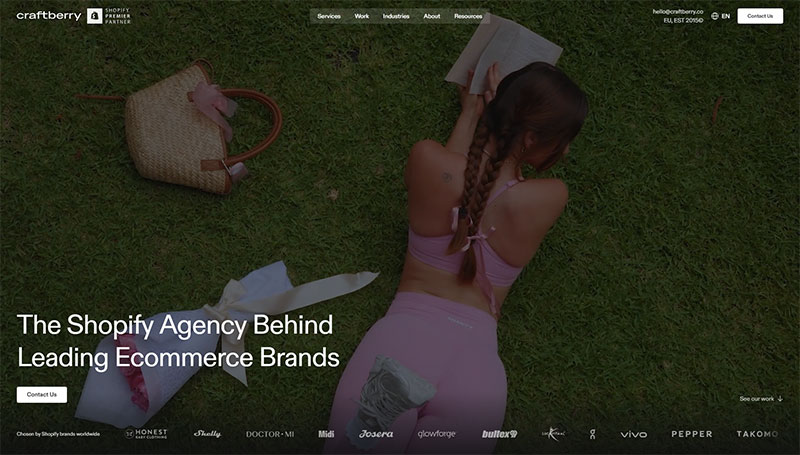
craftberry is a Shopify Premier Partner agency for brands that need a custom store, a platform move, or ongoing conversion testing. Design, development, migration, and CRO are handled by one in-house team of Shopify specialists.
Typical client: Mid-sized and large brands. It works with ecommerce brands doing $2M+ a year.
Services: Design, development, migrations from Magento, Shopware, WooCommerce, BigCommerce, WordPress, and custom platforms, CRO and A/B testing, and ongoing support.
Standout: craftberry is a Shopify Premier Partner and has built on Shopify since 2015. Its migration record includes Shelly: 500K+ customers migrated from Shopware to Shopify Plus, and Biotrade: migration with 0% data loss. In testing, its record includes Enhance: +21% conversion from a single A/B test.
Watch for: It is not suited to brands that only need a simple off-the-shelf theme store. Merchants can ask who stays on the account after the first project.
2. Diff
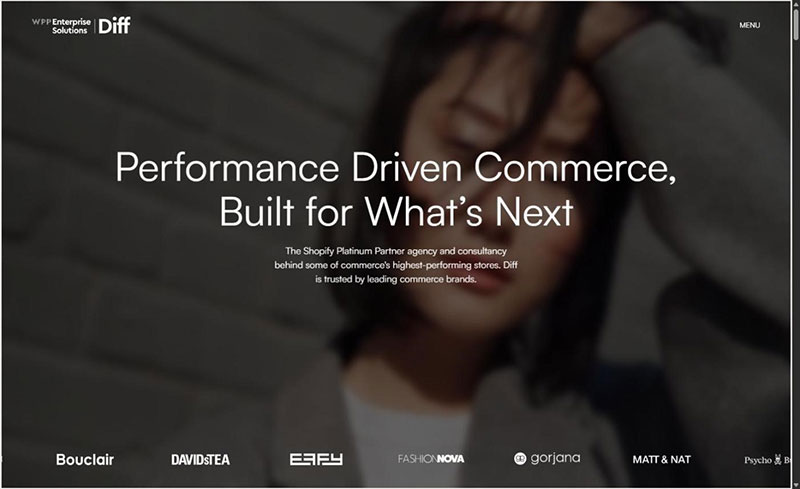
Multi-brand commerce companies often run several storefronts on a shared set of systems. Diff, a Shopify Platinum Partner, works on that kind of setup through Shopify Plus builds, integrations, custom apps, and growth work.
Typical client: Multi-brand commerce companies and other large sellers whose stores must connect to many outside systems.
Services: Builds on Shopify Plus, integrations, custom app development and growth work.
Standout: The team builds custom apps and integrations when standard apps fall short. Its public case work includes Rocky Brands, which shows the kind of company it targets.
Watch for: Custom apps add code that someone has to maintain for as long as the store runs. Merchants should ask who owns that code after launch. It is also worth asking how updates are handled when Shopify changes its platform.
3. Avex
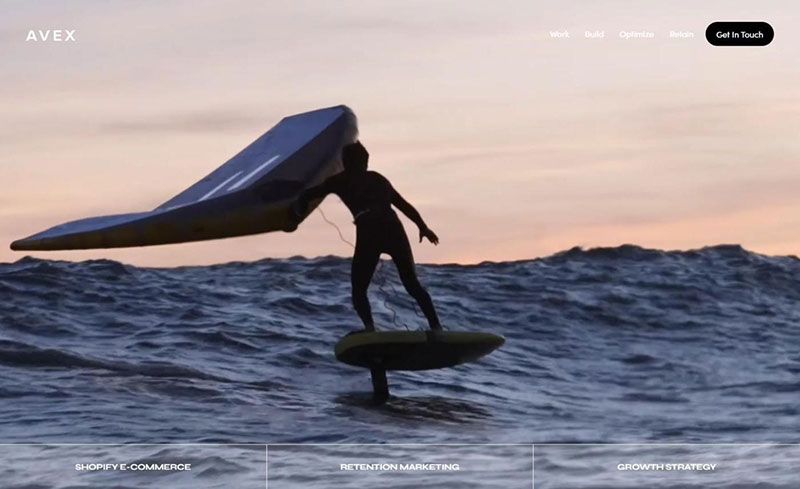
Established consumer brands with complex stores make up much of Avex’s client list. The agency describes itself as a Platinum Shopify Plus agency and names AriZona, FILA, TYR and quip as clients.
Typical client: Established consumer brands that already sell at volume and want a more complex Shopify Plus store.
Services: Complex Shopify Plus builds, retention marketing and conversion work.
Standout: Avex combines strategy, design and engineering on large builds. One public example is a store linked to both Salesforce and Klaviyo, which shows its work goes past the storefront into back-office systems.
Watch for: The Platinum label is the agency’s own description, so it is worth checking against the Shopify Partner Directory. Buyers can also ask whether retention marketing and the build are run by the same people or by separate teams.
4. Praella
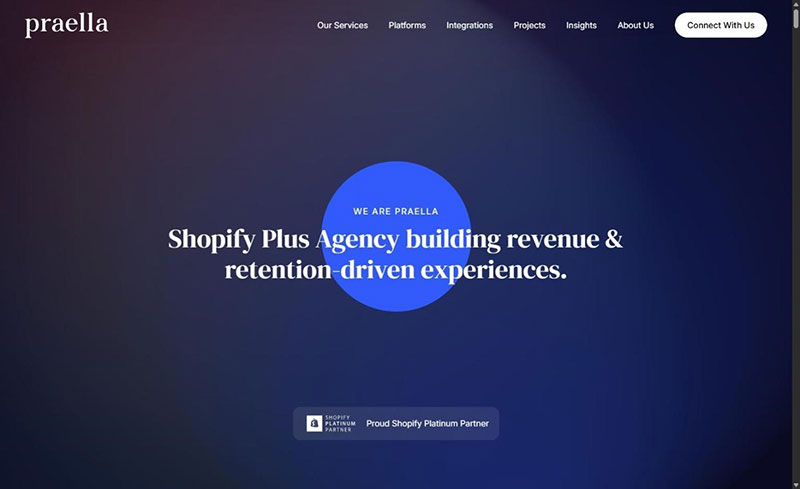
Revenue across the whole customer lifecycle is the core of Praella’s pitch. The Shopify Platinum Partner pairs Shopify Plus design and development with retention and lifecycle work.
Typical client: Growth-stage consumer brands and celebrity-led brands, with Fenty Beauty and CrunchLabs among its named clients.
Services: UX design, development, retention and lifecycle growth programs on Shopify Plus.
Standout: Praella looks past the launch to repeat purchases and customer value over time. That focus suits brands where returning buyers make up a large share of sales.
Watch for: Lifecycle work depends on clean customer data and email or SMS tools that are already in place. Merchants should ask what data setup Praella expects before work begins. Buyers can also ask how the agency reports lifecycle results back to the brand.
5. Underwaterpistol
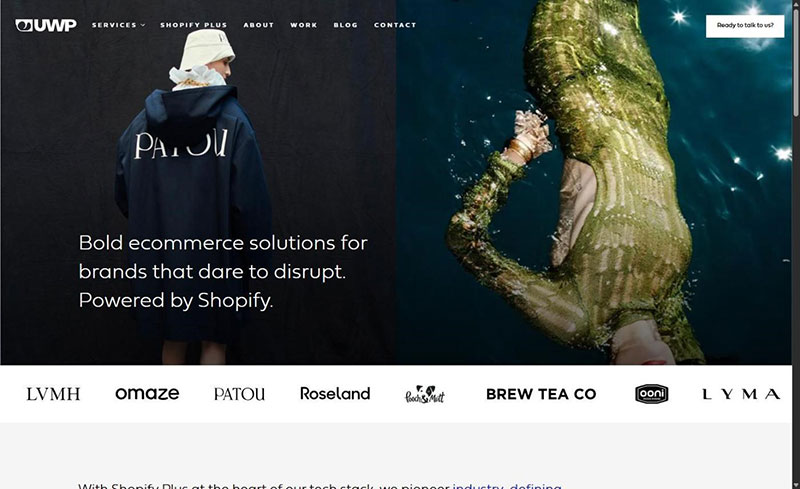
Brands that want their store to stand out visually are the main audience for Underwaterpistol. The team lists itself as Shopify Plus Partners and covers most of the work a growing store needs.
Typical client: Ambitious ecommerce brands that care about standing out in a crowded category.
Services: Shopify Plus design, development, migration, conversion work, SEO and subscriptions.
Standout: Underwaterpistol has a clear focus on subscription and loyalty builds. It also offers AI consultancy alongside its Shopify work.
Watch for: The Shopify Help Center notes that the older Plus Partner program has ended, so the label on agency sites may reflect that program. Buyers can ask which current tier the agency holds. They can also ask how the AI consultancy links to the store build.
6. Electric Eye
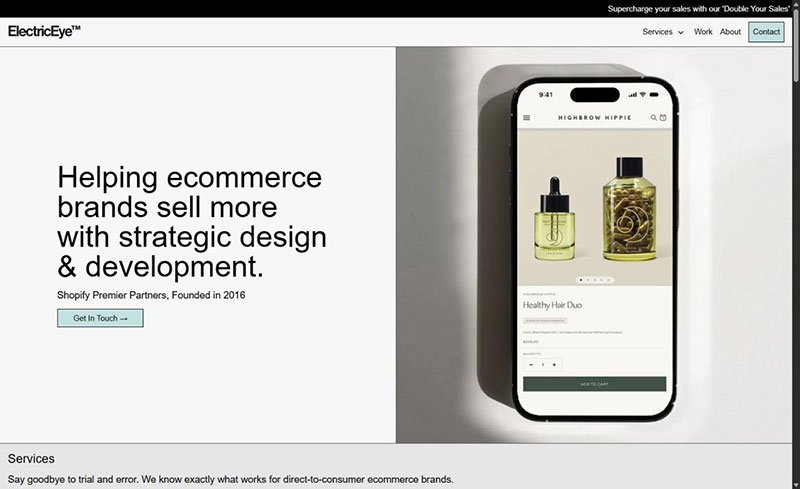
Lifestyle brands in fashion, home goods and accessories form the core of Electric Eye’s work. The boutique studio is a Shopify Premier Partner and names Rancho Gordo, Barton Perreira and Giordano’s as clients.
Typical client: Direct-to-consumer lifestyle brands that want close contact with a small team.
Services: Design, development, migrations and optimization retainers on Shopify.
Standout: Electric Eye describes its model as big-agency resources with a personal, direct service. It is also a Matrixify migration partner, which matters for brands moving large product catalogs.
Watch for: A boutique studio has fewer people to cover holidays and peak seasons. Merchants should ask how the team handles urgent fixes during a busy sales period. It also helps to ask who covers the account if the main contact is away.
7. Blend Commerce
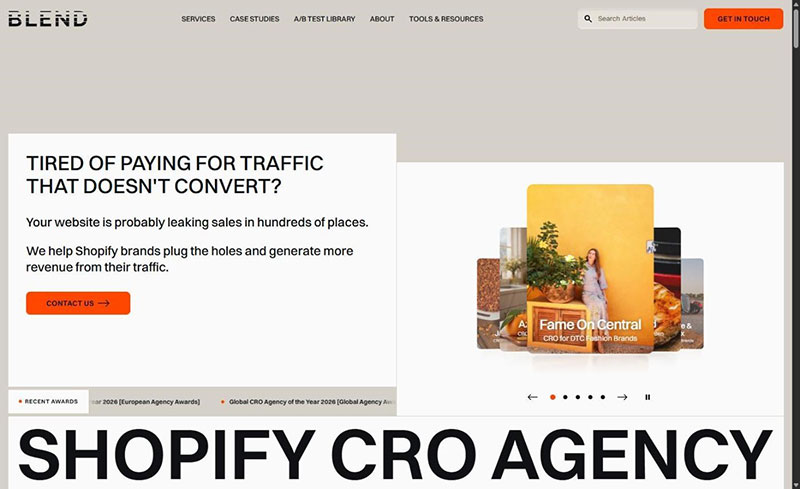
Conversion is the only service Blend Commerce sells. The small team keeps all of that work in-house and won a national eCommerce Agency of the Year award in the small-agency category.
Typical client: Direct-to-consumer Shopify brands, with StriVectin, Rep Fitness and yfood among its named clients.
Services: Conversion audits, testing, and conversion-first redesigns for Shopify stores.
Standout: Every project starts with an audit, and ongoing work moves to a retainer after that. That order gives brands a clear view of the problems before they commit to a longer program.
Watch for: Blend’s published services center on conversion audits, testing and conversion-first redesigns, so brands planning a platform move should ask whether that is in scope. Buyers can also check how test results are shared with other teams. Asking who ships the winning changes is also useful.
8. Lindahl Studios
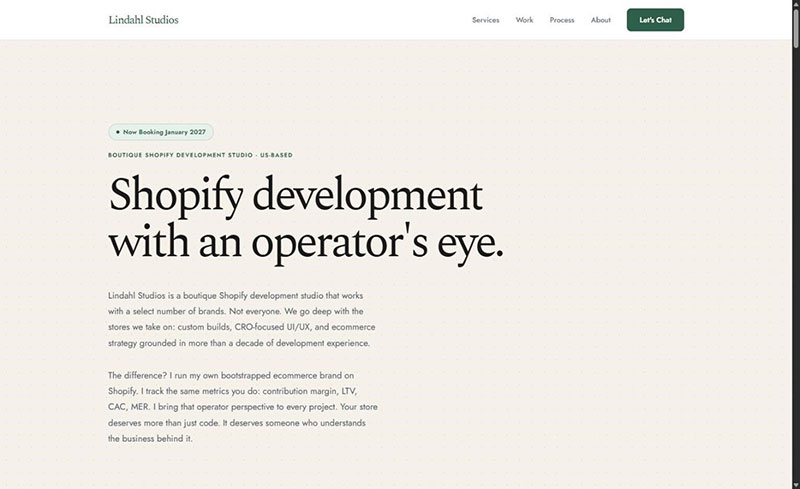
Lindahl Studios is built around a founder who also operates his own Shopify brand. He brings that operator view to client projects.
Typical client: Shopify and Shopify Plus brands, taken on a few at a time, with Aviator Nation and Sunday Golf among named clients.
Services: Custom Shopify builds, conversion-focused UI and UX design, and strategy.
Standout: The founder’s own store gives the studio direct experience of running sales on Shopify. That view can shape choices on merchandising and checkout.
Watch for: A small client list means the studio may have a waitlist or limited start dates. Merchants can ask when the next opening is and how long a typical build runs. They should also ask how much of the work the founder handles directly.
9. Oli Studio
Clients of Oli Studio speak directly with the designers and developers on their project. The small studio does not use account managers, which removes a layer between the brand and the work.
Typical client: Ambitious ecommerce brands that want direct access to the people building their store.
Services: Conversion-driven Shopify design, development and growth retainers.
Standout: Oli Studio is both a Shopify Partner and a Klaviyo Partner. That pairing suits brands that want store work and email marketing planned together, so campaigns and product pages share the same data.
Watch for: Without account managers, the brand’s own team takes on more of the project coordination. Buyers should ask who tracks deadlines and scope. Another useful question is how requests are logged between meetings.
10. Hatch
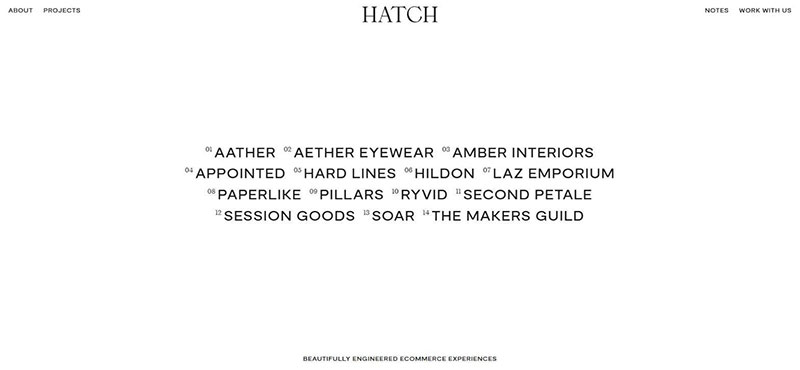
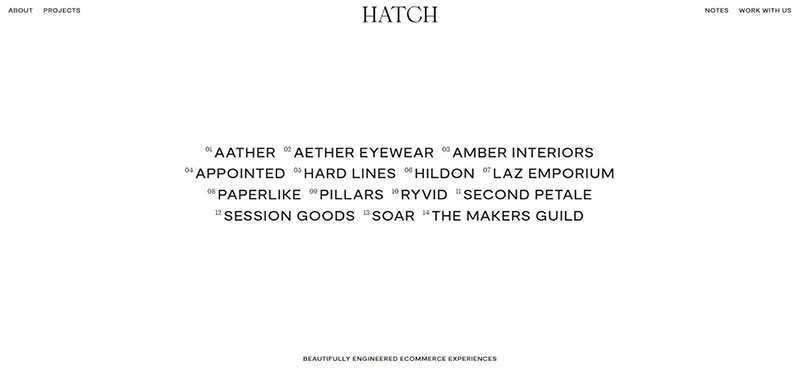
Hatch is small by choice. The studio covers brand identity and photography through to the Shopify build, and its team is Certified Shopify Experts.
Typical client: Creative ecommerce brands, plus other agencies that need a Shopify development partner.
Services: Bespoke Shopify and Shopify Plus design, development and consultancy.
Standout: Hatch handles brand identity and product photography as well as development. A brand that is still shaping its look can keep the creative work and the build under one roof.
Watch for: Hatch also works as a development partner for other agencies, so its time is split between brands and agency clients. Merchants can ask how the studio balances its direct clients with agency work. It is also fair to ask whether brand and build work run on a shared timeline.
Boutique Shopify agency vs large Shopify agency: when a smaller team makes sense
Size changes how an agency staffs a project, how fast it can respond, and how much a brand must manage itself. The sections below set out what each model offers and where the trade-offs sit.
What a large Shopify Plus agency brings
A larger agency can run several work streams at once. craftberry is one example, with 800+ projects delivered and 90% of clients working with it for 2+ years. Long client relationships suggest the team can keep a store improving after launch.
Diff, Avex, and Praella also take on Shopify Plus work that spans many systems. Projects like Avex’s Salesforce and Klaviyo link are where a deep bench of developers matters.
When a small Shopify agency is the better fit
A small Shopify agency often makes sense when the scope is narrow. Blend Commerce sells conversion work only, so a brand with a sound store that needs better sales from current traffic gets a focused team.
Founder access is the other reason to go small. Lindahl Studios and Oli Studio both put clients in direct contact with the people doing the work. Hatch suits brands that want a creative studio to shape their look and build the store together.
The trade-offs to weigh
Small teams have less spare capacity. A boutique studio may struggle to cover a peak season or a sudden staff change, which can slow fixes when they matter most.
Large teams bring more handoffs between specialists. Brands should check that one person owns the project and that key staff stays on the account.
Red flags when hiring a Shopify development agency
Most warning signs appear before a contract is signed. A costly one is a migration plan with no list of 301 redirects. These are permanent forwards from old web addresses to new ones, and they protect search rankings.
- Vague migration timeline: A planned move comes with a stated time range. craftberry says its migrations usually take 8 to 16 weeks depending on scope.
- Unverifiable partner tier: A claimed Shopify tier should appear in the Shopify Partner Directory. If it does not, the agency should explain why.
- No named clients: Case studies without client names or results are hard to check. Named brands give buyers something to verify.
- CRO with no test method: A conversion program should explain how tests are set up and how winners are picked. A list of design tweaks is not a test plan.
- Split ownership: Design by one freelancer and code by another can leave no one answerable when the two clash.
How to choose a Shopify agency for a growing brand
A good choice starts with the brand’s size and the work it needs done. The three checks below turn that into questions an agency can answer.
Match the partner tier to the business size
The Shopify Help Center lists four tiers in its Partner Directory. Select is for small and medium businesses, Plus for mid-market and larger, Premier for large enterprises, and Platinum for global enterprise.
The Shopify Help Center also says Plus, Premier, and Platinum status is by invitation only, based on commercial impact and credentials.
craftberry and Electric Eye hold Premier status, while Diff and Praella are Platinum. A tier is a starting signal to weigh alongside named clients.
Decide which work must stay in one team
Some brands need design, build, and testing linked closely, while others only need one piece. craftberry ties its CRO work to a target of at least a 4x return, and if it falls short, work continues at no extra cost.
Blend Commerce handles conversion only, while Hatch pairs brand identity with the build. Brands that hire a specialist should plan who handles the rest.
Ask the first-call questions
Most agencies on this list do not share fees, team size, or post-launch terms on their sites. That makes the first call the place to get those answers in writing.
- Fees: Ask what the quoted fee includes and what counts as extra work.
- Team: Ask who will do the work day-to-day and whether any of it goes to freelancers.
- Post-launch terms: Ask how support works after launch and how fast urgent fixes are handled.
Shopify agency FAQ
These answers cover questions that come up when brands compare Shopify agencies. Each one starts with the short answer.
What are the best small Shopify agencies?
The small and boutique studios on this list sit in places six to ten in the rankings. Each has a narrow focus, such as conversion-only work, founder-led builds, or brand identity paired with the build.
Boutique Shopify agency vs large Shopify agency: which is better?
Neither is better in every case. A boutique agency suits narrow scopes and brands that want founder access. A large agency suits projects that span design, development, and system links.
What does a Shopify agency do?
A Shopify agency designs, builds, and improves online stores on Shopify. Many also move stores from other platforms, run conversion tests, and offer support after launch.
What is a Shopify Plus agency?
A Shopify Plus agency builds and runs stores on Shopify Plus, the platform’s plan for high-volume brands. The work is often more complex, such as multiple storefronts and links to back-office systems.
Should a brand hire a Shopify agency or a freelancer?
A brand with a complex store or a platform move is usually safer with an agency, because one team owns the outcome. A freelancer can suit a small, clear task, such as a single page change or a theme tweak.
How long does a Shopify migration take?
A Shopify migration takes weeks to months, depending on scope. Catalog size, order history, integrations, and the redirect plan all affect the timeline.
Final thoughts
craftberry fits brands that want design, development, migrations, and CRO from one in-house team with a Shopify record since 2015.
Diff, Avex, Praella, and Underwaterpistol suit complex Shopify Plus work.
Electric Eye, Blend Commerce, Lindahl Studios, Oli Studio, and Hatch suit brands that want a smaller studio.
The right choice comes down to scope, store size, and how much of the work a brand wants one team to own.

Renowned for his expertise in logo design and visual branding, Bogdan has developed a multitude of logos for various clients.
His skills extend to creating posters, vector illustrations, business cards, and brochures. Additionally, Bogdan's UI kits were featured on marketplaces like Visual Hierarchy and UI8.
He also wrote in the past years on sites like Design Your Way, WebDesignerDepot, WPDean, Designmodo, Speckyboy, Slider Revolution, and more.
- Neon Font Generator - 8 November 2026
- Best Shopify agencies for 2027 - 8 November 2026
- The Lovable Logo History, Colors, Font, And Meaning - 6 November 2026

Bogdan Sandu is a seasoned designer who has been designing websites since 2008. Renowned for his expertise in logo design and visual branding, Bogdan has developed a multitude of logos for various clients. His skills extend to creating posters, vector illustrations, business cards, and brochures. Additionally, Bogdan's UI kits were featured on marketplaces like Visual Hierarchy and UI8. He also wrote in the past years on sites like Design Your Way, WebDesignerDepot, WPDean, Designmodo, Speckyboy, Slider Revolution, and more.
You Might Also Like