
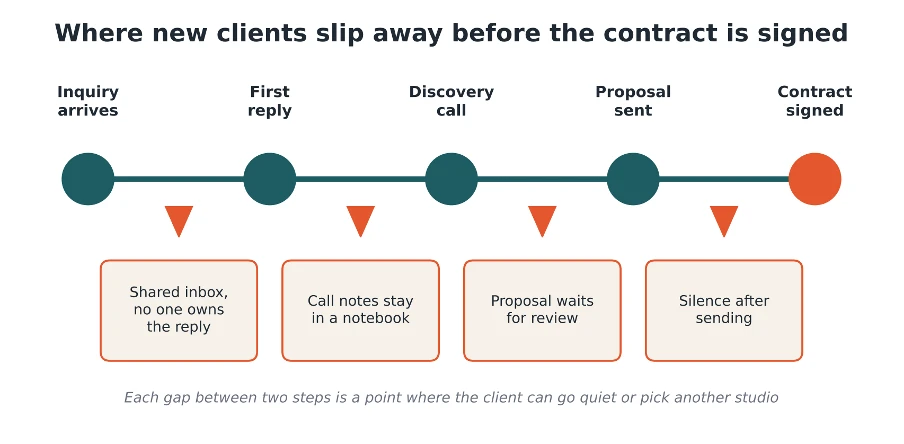
Most design studios lose new clients quietly. A founder fills in the contact form on a Tuesday, gets a friendly reply on Thursday, has a good discovery call the following week and receives the proposal eleven days after that, by which time another studio has already started on the logo. Nobody on the team did anything badly wrong. The inquiry passed through too many inboxes and Slack threads, and no one owned the whole path from the first email to the signature.
That stretch between the first email and the signature is where small studios lose most of their new business. Designers are hired for their craft, so sales work gets squeezed in between client revisions, and the early stages of a deal live in whatever tool happens to be open. Since most small studios already run on Gmail and Google Drive, the least disruptive fix is often a CRM that works inside those apps, and a list of CRMs for Google users is a sensible place to compare options before picking one. Still, a tool only helps once you know where the leaks are, so the sections below go through them in the order a new client meets them.
How Quickly Should a Design Studio Reply to a New Inquiry?
A studio should aim to reply within an hour of the inquiry arriving. In a 2011 study of online sales leads published in Harvard Business Review, firms that tried to contact a prospect within an hour were nearly seven times as likely to qualify the lead as firms that waited one more hour. The same audit found an average response time of 42 hours among companies that replied at all. The research covered US companies across many industries, but anyone who has watched an inquiry sit in a shared hello@ inbox over a weekend will recognize the pattern.
The usual cause is ownership. When an inquiry lands in a shared address, three people read it, each assumes someone else will answer, and the email gets marked as read anyway. A simple rule fixes most of this: every new inquiry gets one named owner within an hour of arriving, even if the full reply comes later.
That first reply doesn’t need a price. A short note confirming you’ve read the brief, asking one specific question about it and offering two call times is usually enough to stop the prospect from sending the same brief to the next studio on their list.
Why Do Discovery Call Details Go Missing?
Discovery call details go missing because they usually end up in one designer’s paper notebook or in a Google Doc called “call notes” that nobody can find two weeks later. That’s a problem, since the call is where a studio learns what decides the deal: the real budget, who signs off on the work, the launch date the client can’t move and the competitor websites they keep bringing up. When the proposal finally gets written, it’s put together from memory, and the client notices that the timeline ignores the deadline they mentioned twice on the call.
Writing the details into one shared record straight after the call takes about five minutes. Use the same fields for every lead, so whoever writes the proposal doesn’t have to chase whoever took the call.
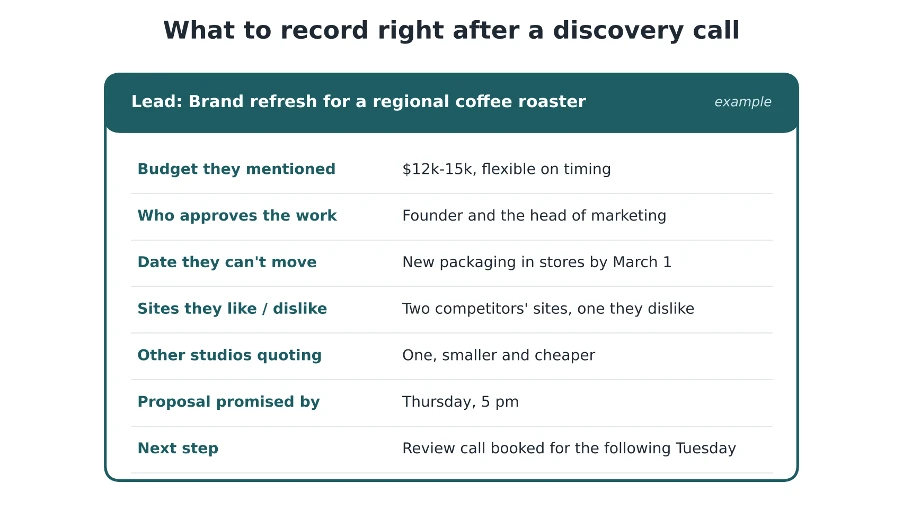
A short, fixed set of fields saves the person writing the proposal from guessing what the client said.
If your studio uses a CRM, these fields belong on the deal itself. A shared spreadsheet also works, as long as everyone updates the same file and nobody keeps a private copy.
How Long Should It Take to Send a Design Proposal?
For a standard project such as a brand identity or a marketing website, two to three working days after the call is a reasonable target. Longer delays usually come from inside the studio, when the creative director wants to rework the scope or the pricing waits for a partner who is busy with another client. Meanwhile the client’s interest cools, and so does their memory of why they liked you on the call.
Two habits shorten the wait. The first is a proposal template with pre-written scope sections for the services you sell most often, which means a new proposal only needs the client-specific parts filled in. Most studio proposals need the same five parts anyway: the client’s goal described in their own words, the scope, the timeline, the price and a clear way to sign. The second habit is a fixed send date. Put the promised date in the lead record and in the thank-you email you send after the call, so the team can see the commitment and the client knows when to expect the document.
How Do You Follow Up on a Proposal Without Sounding Pushy?
Follow up on a fixed schedule and give the client something new to respond to each time, because many deals stall after the proposal is sent. According to Proposify’s State of Proposals 2026 report, buyers view 93% of the proposals they go on to sign and 80% of the ones they reject, so the fact that a client opened the document doesn’t tell you much. Silence after that point usually means the client has a question they haven’t asked yet or a cheaper quote they’re weighing against yours.
Proposify has also reported that proposals sent with pre-scheduled reminders close at a 35% higher rate than proposals without them. Reminders work best when each one gives the client a reason to reply, for example an answer to a question they’re likely to have or a smaller first phase they can approve on a lower budget. A plain “just checking in” email gives a hesitant client nothing new to respond to, so keep that one for the rare case when you have nothing else to add.
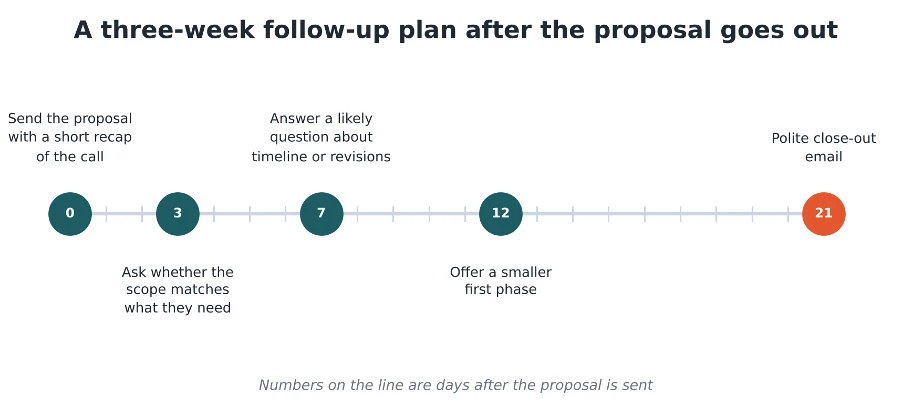
Spacing follow-ups further apart over three weeks keeps the conversation going without flooding the client’s inbox.
If there’s still no answer after the last message, close the deal in your records and send a short email saying you’ll assume the timing isn’t right for now. Some clients reply to this message after ignoring the earlier ones, because answering it only takes a yes or a no.
What Can Still Go Wrong After the Client Says Yes?
The contract and the kickoff date can still stall a project that the client has already agreed to on a call. Approved projects tend to slow down at this step when the contract arrives as a PDF that has to be printed and scanned, or when nobody suggests a date to start. Sending the contract with e-signature, the deposit invoice and two possible kickoff dates in one email removes most of that friction. The client also gets a clear signal that the project has started, which makes it much less likely they’ll reopen talks with the other studio.
Where Should a Design Studio Start Fixing Its Sales Process?
Start with the longest delay in your recent deals. Look at the last ten inquiries your studio received and write down four dates for each one: the first reply, the discovery call, the proposal and the signature or last contact. The longest gap in that list is usually the one worth fixing first. For some studios the longest gap is the weekend inbox, and for others it’s a proposal that waits a week for the creative director’s review. Once the dates are on one page, the team can agree on one change, try it on the next few leads and check whether that gap gets shorter.

Renowned for his expertise in logo design and visual branding, Bogdan has developed a multitude of logos for various clients.
His skills extend to creating posters, vector illustrations, business cards, and brochures. Additionally, Bogdan's UI kits were featured on marketplaces like Visual Hierarchy and UI8.
He also wrote in the past years on sites like Design Your Way, WebDesignerDepot, WPDean, Designmodo, Speckyboy, Slider Revolution, and more.
- The YouTube Logo History, Colors, Font, and Meaning - 10 November 2026
- Monthly Retainer Billing for Freelance Designers: How to Get Paid on Time, Every Month - 10 November 2026
- How Design Studios Lose New Clients Between the First Email and the Signed Proposal - 10 November 2026

Bogdan Sandu is a seasoned designer who has been designing websites since 2008. Renowned for his expertise in logo design and visual branding, Bogdan has developed a multitude of logos for various clients. His skills extend to creating posters, vector illustrations, business cards, and brochures. Additionally, Bogdan's UI kits were featured on marketplaces like Visual Hierarchy and UI8. He also wrote in the past years on sites like Design Your Way, WebDesignerDepot, WPDean, Designmodo, Speckyboy, Slider Revolution, and more.
You Might Also Like