If software is not your core business, outsourcing the design and development of an app or digital system is often the more practical route. You get a ready team instead of spending months hiring, you pay for the time you actually need, and you keep your own people focused on customers. The trade-off is that you have to choose the partner carefully and stay involved. For example, a retailer or clinic planning a new app might work with a specialist such as a San Francisco UI/UX design firm rather than build a team from scratch.
Why do companies outsource software design and development?

Companies outsource to control cost, time and risk. When you start a project, the questions are how much a team will cost, how long hiring will take and what happens if the project goes wrong. Software development is complex and hiring for it is slow and uncertain, so handing the whole job to a design and development company can be the safer option than building an in-house team or hiring a single designer.
A provider such as Dworkz can handle the technical and visual parts of a website or application together. That matters for founders of logistics firms, retail businesses and health clinics who know what they want the product to do but not how to build it. The specific advantages are below.
What are the advantages of outsourcing development?
Access to expertise right away
Outsourced teams bring experience across industries, technologies and workflows. Instead of spending months recruiting, you get project managers, UX/UI designers and software engineers who can start on your project immediately. For more on how design and development fit together, read about the role of UI/UX in software development projects.
Lower and more flexible costs
An in-house team means salaries, office space, benefits and ongoing training. With outsourcing you pay for the services and time you use, and the provider takes on risks like technical delays and staff turnover. If the heavy development phase lasts six months, there is little reason to carry a full team for years. When you are deciding between hiring and contracting, this comparison of building an in-house web development team helps weigh the costs.
More time for your core business
If you run a clinic or a retail operation, your time is better spent on customers and growth than on managing a technical process. Handing development to specialists lets you focus on what you do best while the project keeps moving.
Room to scale up or down
You can adjust the size of an external team as requirements change, without hiring or letting people go. That is useful when a project starts as a basic app and later adds more complex features. A capable agency can assign more resources without long delays.
How do you choose an outsourcing partner?
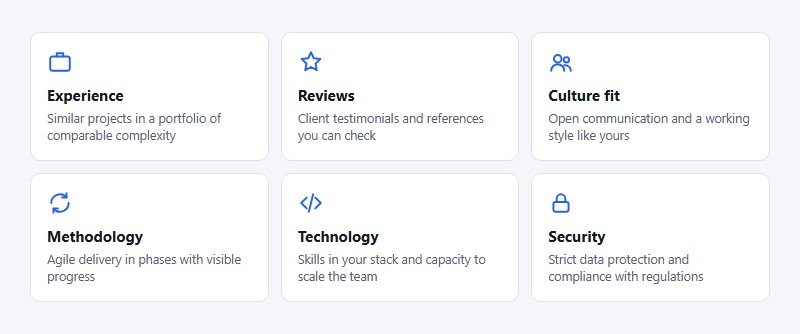
Compare candidates on six points: relevant experience, client feedback, cultural fit, methodology, technology and security. Every company claims to be the best, so you need evidence for each. Reading how an outsourced software provider approaches UX and UI also tells you how seriously it treats the user side of an app.
Relevant experience and portfolio
Check the provider’s track record on similar work. If you are building a fintech app, look for a team that has done fintech. Their portfolio should include products of comparable complexity. For help reading a portfolio, see how to choose a UX design agency by reading its portfolio.
Reviews and testimonials
Read reviews on the company website and on platforms such as LinkedIn. Good feedback shows how the team communicates, meets deadlines and handles problems. Ask for a reference you can call, and ask about a project that did not go smoothly.
Fit with your business culture
A good partner acts as an extension of your team and does more than take orders. If your company values open communication, your partner should work the same way. Ask yourself:
- Do they communicate openly and clearly?
- Will they adjust to your working style, and do they share your values?
- Can they offer both standard packages and tailored solutions?
Development methodology
Ask how they work. A team using Agile can deliver in phases, so you see progress and adjust requirements along the way. That keeps you in control of the direction of the project.
Resources and technology
Confirm the team can handle the technologies you want and can grow the team if the project expands. Check that they have current, hands-on experience with them, which a long list of tools does not prove.
Security and data protection
Make sure the company has strict data protection practices and follows the security regulations that apply to your industry. This matters most for health, finance and any app that handles customer records.
If you are comparing location models, nearshore versus offshore outsourcing covers how time zones affect collaboration, and full outsource vs team augmentation compares engagement models.
What are the risks of outsourcing?
The main risks are unclear requirements, weak communication, hidden costs and over-dependence on one provider. Most can be reduced with a clear brief, milestone-based payments, regular reviews and a contract that gives you ownership of the code and design files. Keep at least one person on your side responsible for the project, so decisions do not stall.
Frequently asked questions
Is outsourcing cheaper than hiring in-house?
Usually for one-off or time-limited projects, because you avoid long-term salary and overhead. For ongoing product development over many years, an in-house team can make sense.
How do I keep control of the project?
Choose a partner that works in phases, set milestones and approve each stage. Regular demos keep you informed and let you change course early.
What should I prepare before contacting an agency?
Write down the goals, the users, the must-have features and a rough budget and timeline. A clear brief gets better proposals and fewer surprises.
Can a small business outsource?
Yes. Small businesses often benefit most, because they cannot afford a full technical team. A smaller scope or a phased start keeps risk low. A useful first step is an MVP strategy that limits what you build first.
Should you outsource your project?
If your business is outside the technology sector and you have a clear goal, outsourcing is usually worth serious consideration. Write a short brief, shortlist two or three partners using the six checks above and ask each for relevant examples and references. Take your time with the choice, since the right partner turns the project into an advantage and the wrong one becomes an expense.

Renowned for his expertise in logo design and visual branding, Bogdan has developed a multitude of logos for various clients.
His skills extend to creating posters, vector illustrations, business cards, and brochures. Additionally, Bogdan's UI kits were featured on marketplaces like Visual Hierarchy and UI8.
He also wrote in the past years on sites like Design Your Way, WebDesignerDepot, WPDean, Designmodo, Speckyboy, Slider Revolution, and more.

Bogdan Sandu is a seasoned designer who has been designing websites since 2008. Renowned for his expertise in logo design and visual branding, Bogdan has developed a multitude of logos for various clients. His skills extend to creating posters, vector illustrations, business cards, and brochures. Additionally, Bogdan's UI kits were featured on marketplaces like Visual Hierarchy and UI8. He also wrote in the past years on sites like Design Your Way, WebDesignerDepot, WPDean, Designmodo, Speckyboy, Slider Revolution, and more.
You Might Also Like