Proximity matters in software outsourcing, mainly because of time zones. Nearshore teams work in the same or a similar time zone as the client, so questions get answered in minutes and meetings fit a normal workday. Offshore teams, in places like India, the Philippines or Vietnam, usually cost less per developer but sit many time zones away, which slows communication. The choice comes down to whether the savings from distance outweigh the cost of delay. In recent years, nearshore software outsourcing to nearby regions such as Latin America has grown for exactly that reason.
What is the difference between nearshore and offshore outsourcing?
Offshoring means contracting work to a provider in a distant country, usually to lower costs. Nearshoring means contracting a provider in a nearby country with a similar time zone. For a US company, offshore locations typically include India, China, Vietnam, Ukraine and the Philippines, while nearshore locations include Mexico, Costa Rica, Brazil and Argentina.
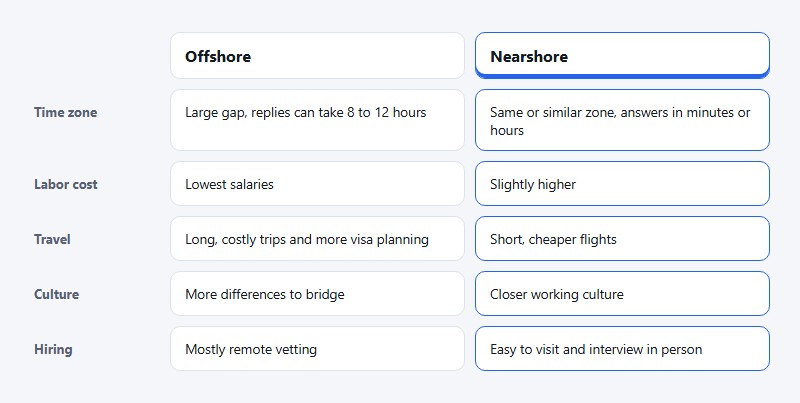
| Factor | Offshore | Nearshore |
| Time zone | Large gap, little or no working overlap | Same or similar zone, real-time overlap |
| Labor cost | Lowest salaries | Slightly higher than the most distant options |
| Communication | Mostly written and asynchronous | Calls and quick messages work |
| Travel | Long, costly trips | Short, cheaper flights |
| Cultural fit | More differences to manage | Closer working culture |
The differences show up most in how a team talks to its provider every day, which is the next section.
What are the pros and cons of offshoring?
Offshoring wins on price and size of talent pool, and loses on communication. The main points:
- Lower labor costs, since average salaries in many offshore countries are much lower than in North America.
- A large talent pool, because these countries have big populations of skilled, educated workers.
- Follow-the-sun potential, where time zone offsets allow work to continue around the clock.
- Communication and collaboration problems caused by distance and time zones.
- Cultural differences that can lead to mismatched expectations.
- Extra costs for travel and coordination.
Because teams are far apart, most communication happens virtually and in writing. Software work needs more back-and-forth than that, and gaps show up fast.
What are the pros and cons of nearshoring?
Nearshoring trades a slightly higher price for easier collaboration. The benefits are overlapping working hours, lower cultural barriers, the option of in-person visits and real-time communication. The main drawback is that labor costs are somewhat higher than in the cheapest offshore markets.
That premium is the question this article is about. For specialist work, nearshore providers can also offer sector experience, such as custom healthcare software solutions built close to the client’s own time zone. Whether the premium pays off depends on the points below.
How does time zone affect communication and collaboration?
Distance and response time
If you send a question to an offshore team at the end of your day, you may wait 8 to 12 hours for an answer. That delay is small once, but it stacks up across clarifications, reviews and bug reports, and it slows the whole project down. A nearshore partner can answer a call or message within minutes or hours.
Communication is also a recurring theme in outsourcing research. The Deloitte global outsourcing survey is one source that looks at how companies rate communication and other factors in their outsourcing choices.
Cultural alignment
Cultures differ in how direct people are, how requirements are gathered and how decisions are made. American business culture tends to be direct, while others rely on more indirect communication. When those cues are missed, expectations drift apart. Nearshore countries tend to share more context with the US, which makes building trust easier.
Travel and visas
Some face-to-face time is still valuable, for kickoffs and critical reviews. Flights to distant offshore centers cost more and take longer, and the visa process can add planning time. Nearshore trips are shorter and cheaper, so visits can happen more often. Check current visa rules for the specific countries involved, because they change.
How does proximity affect talent, hiring and retention?

Both models give access to skilled developers, but proximity changes how easily you can vet, keep and work with them.
Hiring
Offshore teams are mostly hired remotely, so you rely on video interviews and tests. Nearshore centers are easier to visit, which allows multi-round interviews and a better read on skills and cultural fit before you commit.
Retention
Keeping developers matters, because every departure takes project knowledge with it. A Catalyte report on the hidden costs of offshoring discusses attrition as one of those costs. Whatever the exact figures, ask any provider for its own attrition numbers and how it handles knowledge transfer when someone leaves.
Language
English proficiency varies widely by country, provider and individual in both regions. What helps most is a similar working day and shared references, which reduce misunderstandings on calls. Test language skills during the interview rather than assuming them.
Is nearshoring growing, and should you mix both?
Nearshoring has gained popularity as companies place more value on collaboration, and many firms now use both models. A blended setup keeps offshore capacity for well-defined, low-interaction work and uses nearshore teams for projects that need frequent discussion with product owners. If you are still deciding whether to outsource at all, this overview of whether you should outsource covers that step, and full outsource vs team augmentation compares engagement models.
Frequently asked questions
Is nearshore always more expensive than offshore?
Hourly rates are usually higher, but total cost depends on rework, delays, travel and management time. A cheaper team that needs more correction can cost more in the end.
Which locations count as nearshore for a US company?
Mexico, Costa Rica, Brazil and Argentina are the common examples in Latin America. For a European company, nearshore usually means neighboring countries in Eastern Europe.
Can offshore teams work with overlapping hours?
Yes, if they agree to shift schedules for a few hours a day. It works, but it can cause fatigue and turnover if it becomes permanent.
What should I check before choosing a provider?
Ask for client references, how many hours overlap with yours, how they handle attrition and what their onboarding process looks like. A short paid pilot project reveals more than a sales call.
How do you decide between nearshore and offshore?
Match the model to the work. If the project needs constant discussion, frequent changes or close oversight, nearshore is usually worth the premium. If the requirements are stable and well documented, offshore can work. Either way, run a short pilot project before signing a long contract.

Renowned for his expertise in logo design and visual branding, Bogdan has developed a multitude of logos for various clients.
His skills extend to creating posters, vector illustrations, business cards, and brochures. Additionally, Bogdan's UI kits were featured on marketplaces like Visual Hierarchy and UI8.
He also wrote in the past years on sites like Design Your Way, WebDesignerDepot, WPDean, Designmodo, Speckyboy, Slider Revolution, and more.
- How to Design Marketing Materials That People Actually Keep - 27 November 2026
- Behind the Logo: What Font Does Starbucks Use? - 26 November 2026
- Visual Hierarchy in Short Videos: How to Guide Attention Across a Sequence - 26 November 2026

Bogdan Sandu is a seasoned designer who has been designing websites since 2008. Renowned for his expertise in logo design and visual branding, Bogdan has developed a multitude of logos for various clients. His skills extend to creating posters, vector illustrations, business cards, and brochures. Additionally, Bogdan's UI kits were featured on marketplaces like Visual Hierarchy and UI8. He also wrote in the past years on sites like Design Your Way, WebDesignerDepot, WPDean, Designmodo, Speckyboy, Slider Revolution, and more.
You Might Also Like