Full outsourcing hands an entire software project to an external company that owns delivery. Team augmentation adds individual outside engineers to your own team and your own process. A dedicated development team sits between them: an outside group works only on your product, takes direction from you and is run with established management practices. Pick full outsourcing when you want a result without managing people, augmentation when you only need to fill a skill gap, and a dedicated team when you have a large, long-running product to build. Companies increasingly delegate work this way because internal time and talent run short, especially for digital products.
What is full outsourcing in software development?
In full outsourcing, a vendor takes responsibility for a project or product from planning to delivery. You describe the outcome, agree on scope, price and timeline, and the vendor handles hiring, management and execution. Your involvement is mostly reviews and decisions.
This works well when the project is clearly defined and you do not want to run an engineering effort yourself. The tradeoff is distance. You have less say in daily priorities and less visibility into how the work is done, so clear requirements and regular check-ins are essential.
What is team augmentation?
With augmentation, you bring external engineers into your existing team for a period. They report into your managers, work in your tools and follow your process, so you keep full control of priorities, code decisions and quality.
It fits cases where the direction is already set and you lack specific skills or capacity, such as a mobile developer, a data engineer or extra hands before a deadline. The tradeoff is that you carry the management load. If your own team lacks time to lead the new people, the benefit shrinks. This piece on why small teams wait too long to bring on specialist engineers shows what delay costs.
What is a dedicated software development team?

To implement a digital product or service, you can hire a dedicated engineering team, one of the most commonly requested outsourcing models. It suits large-scale solutions with a multi-stage development process that needs experts with different skills.
Dedicated software development teams work with you much as if the members sat in your office. They bring established management practices, so they do not need you to clarify every small detail. They report openly on work done and costs, so you can see where the money goes. And because they work only on your project, their pace matches your business goals.
Compared with local hiring, the model offers two common advantages. The first is budget. Rates can differ between your local IT talent market and the contractor’s, and you avoid costs linked to formal employment such as taxes, vacations and sick leave. The second is speed. Vendors typically say they can staff a team within a couple of weeks, while recruiting employees yourself can take months. Check both claims against a specific offer, since actual savings and timelines vary.
How do full outsourcing, augmentation and a dedicated team compare?
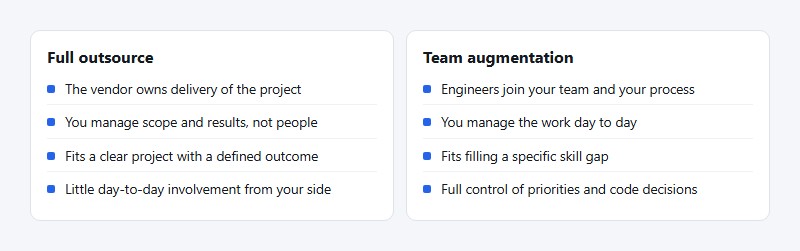
The table sums up how the three models differ on the points that matter most when you are choosing.
| Factor | Full outsourcing | Team augmentation | Dedicated team |
| Who manages the work | The vendor | You | Shared, with the vendor’s management practices and your direction |
| Your control | Low to medium | High | Medium to high |
| Best for | Defined projects with clear outcomes | Filling skill or capacity gaps | Large, long-term products |
| Team focus | Vendor projects overall | Your team’s tasks | Only your project |
| Main risk | Distance from daily decisions | Your management bandwidth | Long-term commitment to one partner |
How do these models relate to fixed price and time and materials?
They are different questions. Full outsourcing, augmentation and a dedicated team describe who does the work and how they are organized. Fixed price and time and materials describe how you pay.
Of the commonly used contract models, a dedicated team is best suited to businesses aiming at long-term cooperation and full control over expenses. Fixed price works best when scope will not change, and time and materials works when it will. A dedicated team is a good fit for people who want to build something large and complex without watching the budget grow out of control. For a broader view of how location changes the picture, see nearshore versus offshore software outsourcing.
How do you choose the right model?
Work through four questions in order.
- Is the scope clear enough to hand off? If yes, full outsourcing is an option. If it will evolve, prefer a dedicated team or augmentation.
- Do you have someone who can manage extra engineers? If not, augmentation will frustrate you.
- How long will the work last? Short bursts favor augmentation, and multi-year products favor a dedicated team.
- How much control over technical decisions do you need? The more you need, the closer you should stay to augmentation.
If outsourcing at all is still an open question, the guide on whether you should outsource today weighs the decision, and the article on building the right in-house web development team covers the alternative.
What mistakes do companies make when picking an outsourcing model?
- Choosing on hourly rate alone and ignoring management overhead, communication delays and turnover.
- Handing over an unclear brief to a full-outsourcing vendor, then being surprised by the result.
- Expecting augmented engineers to be productive on day one without onboarding.
- Picking a vendor without experience in your industry or technology.
Frequently asked questions
Is a dedicated team the same as team augmentation?
Not quite. Augmentation adds individuals to your team, and you manage them. A dedicated team comes with its own management practices and works only on your project, which usually means less hands-on oversight from you.
Which model is cheapest?
It depends on duration and management effort. Augmentation can look cheapest for short work, but your own management time is a cost. Over a long product build, a dedicated team can give predictable spending.
How do I find a reliable partner?
Look for experience in your niche, ask for references, and test the relationship with a small paid pilot before you commit to a large engagement.
Which outsourcing model should you start with?
If you are building a large, complex product and want long-term cooperation, start by talking to providers of dedicated development team services and compare their answers on staffing time, reporting and pricing. If you only need one or two missing skills, price augmentation first. For a list of agencies worth shortlisting, see these top IT outsourcing companies for UI and UX.

Renowned for his expertise in logo design and visual branding, Bogdan has developed a multitude of logos for various clients.
His skills extend to creating posters, vector illustrations, business cards, and brochures. Additionally, Bogdan's UI kits were featured on marketplaces like Visual Hierarchy and UI8.
He also wrote in the past years on sites like Design Your Way, WebDesignerDepot, WPDean, Designmodo, Speckyboy, Slider Revolution, and more.

Bogdan Sandu is a seasoned designer who has been designing websites since 2008. Renowned for his expertise in logo design and visual branding, Bogdan has developed a multitude of logos for various clients. His skills extend to creating posters, vector illustrations, business cards, and brochures. Additionally, Bogdan's UI kits were featured on marketplaces like Visual Hierarchy and UI8. He also wrote in the past years on sites like Design Your Way, WebDesignerDepot, WPDean, Designmodo, Speckyboy, Slider Revolution, and more.
You Might Also Like