


Flattening a poster is the process of removing creases, wrinkles, and rolled edges from paper-based prints to restore a smooth, display-ready surface. Collectors, decorators, and sellers need this when preparing posters for framing, selling, or displaying.
This guide covers 5 methods requiring 10 minutes to 48 hours and basic household materials.
Prerequisites
Required Materials (vary by method):
- Poster (paper-based: offset, lithograph, screen print)
- Clean flat surface (table, hardwood floor, or countertop)
- Weight objects (heavy books, glass sheets, or weights)
- Optional: Moisture source (iron, steamer, or humidifier)
- Optional: Protective materials (kraft paper, cardboard, or poster tube)
Skill Level: Beginner
Time Range: 10 minutes (heat method) to 48 hours (weight method)
Critical Warning: Vintage posters, vinyl posters, or posters with special coatings require different handling. Moisture can damage certain paper stocks and inks.
Understanding Poster Types and Damage
What Paper Types Require Different Flattening Approaches?
Paper stock determines flattening method safety. Offset lithograph posters (60-80 lb paper) tolerate moisture better than screen prints (card stock).
Vintage posters (pre-1980s) often use brittle paper requiring gentler methods.
Paper Categories:
- Offset lithograph: Standard poster paper, moisture-tolerant
- Screen print: Thicker stock, heat-sensitive inks
- Vintage/antique: Aged paper, fragile, moisture-sensitive
- Glossy/coated: Special finish that can bubble with heat
Purpose: Matching method to paper type prevents damage like ink bleeding, paper warping, or coating separation.
Step 1: How Do You Assess Poster Condition Before Flattening?
Examine the poster for tears, weak spots, ink stability, and paper thickness before selecting a flattening method to prevent damage during the process.
Action:
- Unroll poster on clean surface: Check for existing tears, holes, or weak creases
- Test corner flexibility: Gently bend one corner to assess paper brittleness
- Check ink adhesion: Lightly rub finger on printed area to detect loose or flaking ink
- Measure thickness: Standard posters are 60-100 lb stock; thicker requires adjusted pressure
Expected Result: Clear understanding of poster fragility level determines which flattening method is safe.
Purpose: Prevents additional damage by selecting appropriate technique for poster condition.
Step 2: How Do You Flatten a Poster Using the Weight Method?
Place the poster face-up on a flat surface, cover with protective paper, and stack heavy books evenly across the entire surface for 24-48 hours.
Action:
- Clean surface preparation: Wipe table or floor completely clean, remove debris
- Poster placement: Lay poster face-up, smooth gently from center outward with hands
- Protective layer: Cover poster with clean kraft paper or parchment paper
- Weight distribution: Place heavy books (5-10 lbs total) evenly across entire poster surface, edges included
- Wait period: Leave undisturbed for 24 hours (light creases) to 48 hours (deep rolls)
Expected Result: Poster lies completely flat with no visible curl at edges.
Purpose: Gravity and sustained pressure relax paper fibers without introducing moisture or heat risks.
Best For: Valuable posters, vintage prints, moisture-sensitive materials, non-urgent timeline.
Step 3: How Do You Flatten a Poster With an Iron?
Apply low-heat iron to the poster’s reverse side through protective paper using straight pressing motions (no sliding) for 3-5 second intervals.
Action:
- Iron setting: Set iron to lowest heat setting (often labeled “synthetic” or 200-250F), disable steam function completely
- Surface setup: Place poster face-down on clean, heat-safe surface (ironing board or towel-covered table)
- Protective barrier: Cover poster back with thin kraft paper or pillowcase
- Pressing technique: Press iron down for 3-5 seconds, lift, move to adjacent section, repeat
- Coverage pattern: Work from center toward edges, never slide iron across surface
- Cool-down: Allow poster to cool flat for 5 minutes before handling
Expected Result: Poster flattens within 5-10 minutes with no scorch marks or warping.
Purpose: Direct heat relaxes paper fibers quickly while protective layer prevents direct contact damage.
Best For: Standard offset posters, non-vintage prints, quick flattening needs.
Caution: Screen-printed posters can have heat-sensitive inks. Test on small corner first.
Step 4: How Do You Use Steam to Flatten a Poster?
Hang the poster in a bathroom during a 10-minute hot shower, allowing indirect steam to relax paper fibers, then immediately transfer to flat weighted position.
Action:
- Bathroom preparation: Close all windows, seal door gaps with towel
- Poster hanging: Tape poster corners to wall or shower curtain rod using painter’s tape (low-adhesive), keep 3+ feet from direct water spray
- Steam generation: Run hot shower for 10-15 minutes, create heavy steam environment
- Monitoring: Check poster every 3 minutes, stop when paper feels slightly damp (not wet)
- Immediate transfer: Remove poster from bathroom, place face-up on flat surface
- Weight application: Cover with paper, apply books immediately while poster is still warm and pliable
- Drying period: Leave weighted for 6-12 hours until completely dry
Expected Result: Poster relaxes from moisture exposure and sets flat during weighted drying.
Purpose: Humidity softens paper fibers without direct water contact that causes bleeding or warping.
Best For: Stubborn creases resistant to weight method, modern posters with stable inks.
Risk: Excess moisture can cause ink runs on water-based prints. Monitor closely.
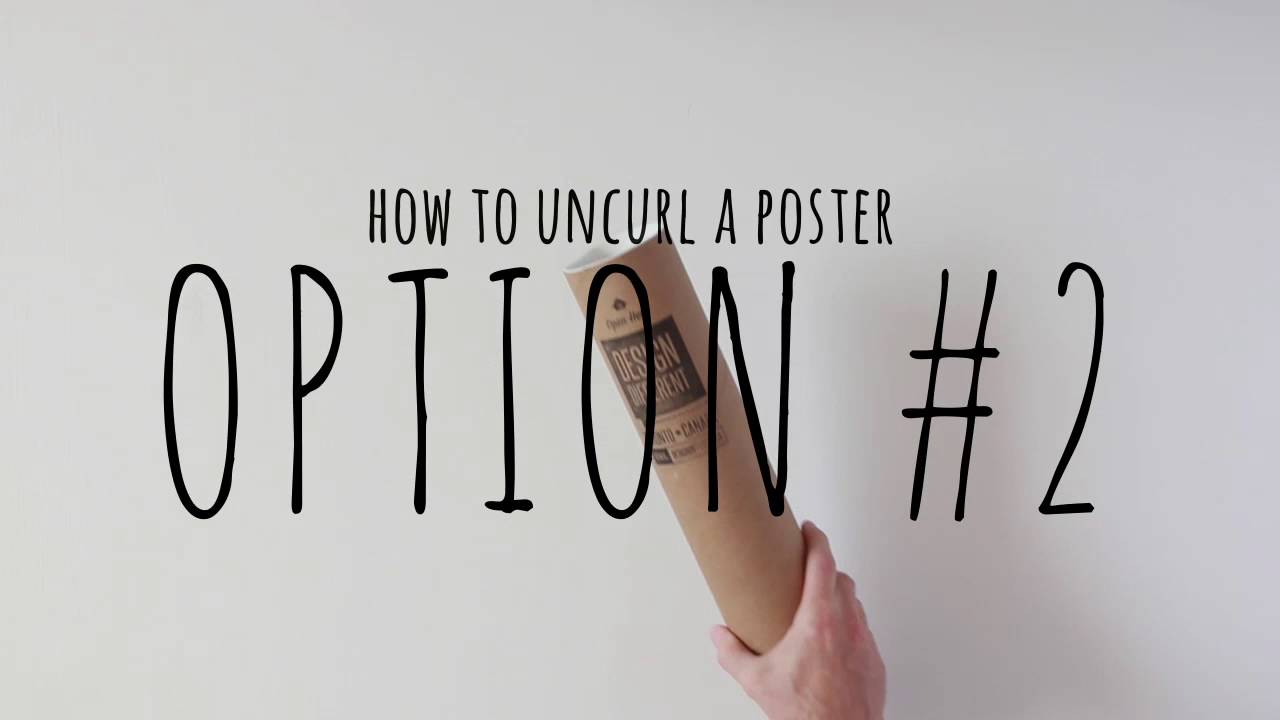
Step 5: How Do You Flatten a Poster Using a Reverse Roll Technique?
Roll the poster in the opposite direction of its current curl around a tube for 12-24 hours to counteract the original curl memory.
Action:
- Tube selection: Use clean poster tube or wrapping paper tube, diameter 2-4 inches
- Protective wrapping: Wrap tube exterior with clean kraft paper, secure with tape
- Reverse orientation: If poster curls inward (printed side concave), roll with printed side facing outward
- Rolling method: Start at one edge, roll slowly and evenly, avoid creasing corners
- Securing: Wrap rolled poster with paper band or place in tube, do not use rubber bands (create dents)
- Rest period: Store vertically for 12-24 hours
- Unrolling: Remove poster, lay flat immediately, apply weights if curl persists
Expected Result: Poster curl reduces by 60-80%, remaining curl removed with brief weight application.
Purpose: Paper fiber memory resets by training fibers in opposite direction.
Best For: Posters with severe curl from long-term tube storage, preliminary step before other methods.
Step 6: How Do You Flatten a Poster With Professional Mounting?
Attach the poster to foam core board or mat board using acid-free adhesive or mounting corners to create permanent flat display surface.
Action:
- Material selection: Purchase foam core board matching poster size (1/8″ or 3/16″ thickness)
- Surface cleaning: Wipe board surface with dry cloth, remove dust
- Adhesive choice: Use acid-free mounting spray, double-sided tape, or mounting corners
- Alignment: Place poster face-down, position board on back, mark alignment points
- Adhesive application (spray method): Spray board surface evenly, wait 30 seconds until tacky
- Mounting: Carefully lay poster onto board, smooth from center outward with clean cloth
- Pressure setting: Cover with kraft paper, apply even pressure with hands or brayer tool
- Curing: Place flat under light weight for 4 hours
Expected Result: Poster permanently adheres to rigid backing, completely flat and ready for framing.
Purpose: Creates rigid support structure that prevents future curling.
Best For: Display-ready posters, framing preparation, permanent installations.
Permanence Note: This method is non-reversible. Not recommended for valuable collectibles.
Verification Methods
How Do You Confirm a Poster Is Properly Flattened?
Visual Check:
- View poster from edge angle (eye-level with surface)
- No visible curl at any edge or corner
- No waves or ripples across surface when viewing at shallow angle
Physical Test:
- Place poster on flat surface without weights
- Edges should remain in contact with surface
- Paper should not spring back to curled position within 60 seconds
Frame Test:
- Poster should fit flush against mat board or glass without gaps
- Corners should not lift when framing pressure is applied
Troubleshooting Common Issues
Poster Curls Back After Flattening
Cause: Insufficient flattening time or paper memory not fully reset.
Solution:
- Repeat weight method for additional 24-48 hours
- Combine methods: Use steam method first, then weight method
- For persistent curl: Apply reverse roll for 24 hours, then weight for 48 hours
Moisture Damage or Ink Bleeding
Cause: Excessive steam exposure or water-based inks reacting to humidity.
Solution:
- Immediately remove from moisture source
- Blot (do not rub) with clean paper towels
- Place between clean paper, weight lightly, allow to air dry completely (24+ hours)
- If ink bleed occurred: Damage is permanent, consider professional restoration
Scorch Marks From Iron
Cause: Iron temperature too high or contact time too long.
Solution:
- Prevention only (damage is permanent)
- Always use lowest heat setting
- Always use protective paper barrier
- Test on expendable corner first
Paper Warping or Bubbling
Cause: Uneven moisture distribution or trapped humidity.
Solution:
- Remove weights immediately
- Allow poster to air dry completely in flat position
- Once dry, restart with weight method only (avoid moisture)
Persistent Creases Remain
Cause: Deep creases from folding or sharp bends.
Solution:
- Light mist method: Lightly spray crease reverse side with water from 12″ distance, immediately weight
- Targeted steam: Hold steamer 6″ from crease for 5 seconds, immediately flatten
- Multiple cycles: Repeat chosen method 2-3 times with 24-hour intervals
Method Comparison
| Method | Time Required | Risk Level | Best For | Avoid For |
|---|---|---|---|---|
| Weight | 24-48 hours | Minimal | Valuable posters, gentle approach | Urgent needs |
| Iron | 5-10 minutes | Medium | Modern offset prints, quick results | Vintage, textured inks |
| Steam | 30 minutes | Medium-High | Stubborn creases, resistant curl | Water-sensitive inks, vintage |
| Reverse Roll | 12-24 hours | Low | Severe curl, tube storage damage | Already flat posters |
| Mounting | 4 hours | Low (permanent) | Display/framing prep | Collectibles, resale items |
Selection Guide:
- Valuable/vintage posters: Weight method only
- Modern posters, quick need: Iron method
- Stubborn problems: Combine reverse roll + steam + weight
- Display preparation: Mounting method
Storage Tips to Prevent Future Curling
Flat Storage
Store posters horizontally in flat files or between acid-free boards. Separate posters with glassine or acid-free tissue paper.
Avoid stacking more than 20 posters (weight causes creasing).
Rolled Storage
Roll posters printed-side outward around 4″+ diameter tube. Wrap in acid-free paper before inserting in tube.
Store tubes horizontally on shelves (vertical storage causes curl). Maximum roll duration: 6 months before re-flattening needed.
Environmental Control
Maintain 40-50% relative humidity. Avoid temperature fluctuations above 10F.
Keep away from direct sunlight (causes paper brittleness).
Related Poster Care Techniques
Once your poster is flat, you’ll need to decide on display or storage. For display, learn how to frame a poster to protect your print behind glass or acrylic.
If you’re working with multiple prints, understanding standard poster sizes helps with bulk framing or storage planning.
For presentation or gifts, how to wrap a poster covers protective rolling and packaging techniques.
Wall mounting without frames requires different techniques covered in how to hang a poster using adhesives, clips, or mounting strips.
For semi-permanent display, how to mount a poster on foam board provides rigid backing without full framing costs.
Creating your own designs requires understanding poster design principles including visual hierarchy, typography, and color theory.
The foundation of effective poster design relies on graphic design principles like contrast, balance, and alignment.
Text-heavy posters need careful font selection, with fonts for posters offering readability at distance.
FAQ on How To Flatten A Poster
Can you iron a poster to flatten it?
Yes, but use low heat and place a clean towel over the poster. Never apply the iron directly to the paper surface.
Set your steam iron to the lowest temperature setting. Work in small sections and keep the iron moving to prevent scorching or moisture damage to your art print.
How long does it take to flatten a rolled poster?
Typically 24-48 hours using the weighted method. Place heavy books on your poster overnight for best results.
Humidity levels and paper thickness affect flattening time. Vintage posters or thicker cardstock may need up to 72 hours under weight distribution to remove all wrinkles and eliminate creases completely.
Will flattening damage my vintage poster?
Not if done carefully with archival materials and proper technique. Avoid excessive heat or moisture that could harm delicate paper.
Use acid-free backing and work on a flat clean surface. Never rush the poster restoration process, especially with collectible items that require gentle treatment and poster preservation methods.
Can I use a hair dryer to flatten poster corners?
Yes, on a cool setting from at least 12 inches away. Never use direct heat, which causes warping.
Hold the dryer at room temperature setting and move it constantly. This works well for stubborn poster edges but won’t fix major curl issues or deep creases throughout the entire surface.
What’s the fastest way to flatten a poster?
Place it between glass panes with weights on top. This method works within 12-24 hours for most posters.
The glass provides even pressure across the entire surface while preventing new wrinkles. Make sure both glass pieces are clean and the poster lies completely flat before adding weight objects.
Should I flatten a poster before or after framing?
Always flatten before framing. A smooth poster fits better in the frame and looks more professional behind glass.
Trying to frame a curled poster creates gaps and uneven pressure. The poster backing and mounting board work better when the print is already flat and free from reverse curl issues.
Can humidity help flatten a poster?
Slight humidity can soften paper fibers, making flattening easier. But too much moisture causes damage and mold growth.
Place your poster in a bathroom after a hot shower (not during) for 10-15 minutes. Then immediately transfer it to a flat surface under heavy books for the drying time.
What household items work as poster weights?
Heavy books, textbooks, phone directories, or boxed board games work perfectly. Distribute weight evenly across the entire poster.
Stack multiple items if one isn’t heavy enough. The goal is consistent pressure without creating new crease lines. Large hardcover books are ideal because they cover more surface area than smaller objects.
Will tape damage my poster when flattening?
Yes. Never use regular tape on poster corners or edges during flattening. It tears the paper and leaves residue.
Use mounting corners or archival-quality adhesive strips if you need to secure the poster. Most flattening techniques don’t require any tape at all, just proper weight distribution and patience.
Can laminated posters be flattened?
Laminated posters are trickier but can be flattened using weights and moderate warmth. Never iron laminated surfaces directly.
Place the laminated poster under books in a warm room (not hot). The plastic coating won’t respond to moisture methods. Heat treatment must be indirect, and you’ll need longer flattening time than paper posters require.
Conclusion
Learning how to flatten a poster doesn’t require professional equipment or expensive tools. Most methods use simple household items like heavy books, clean towels, and flat surfaces you already own.
The key is patience. Rushing the process with excessive heat or improper weight distribution creates more problems than it solves.
Whether you’re dealing with poster wrinkles from shipping damage or reverse curl from long-term storage, the techniques covered here work for movie posters, art prints, and vintage collectibles alike. Choose your method based on the poster’s condition and your timeline.
Start with the gentlest approach first. The weighted flattening technique works for most situations and poses minimal risk to your paper material.
Save aggressive methods like steam or iron settings for stubborn cases only. Your poster design deserves careful handling, especially if you plan professional framing later.
Take your time, protect the surface, and you’ll have display-quality results worth the wait.
If you liked this article about how to flatten a poster, you should check out this article about how to make a poster.
There are also similar articles discussing poster sizes, how to make a beer poster, how to create a poster in PowerPoint, and how to make a wanted poster.
And let’s not forget about articles on making a poster in Word, how to make a movie poster, how to hang a poster, and how to frame a poster.

Renowned for his expertise in logo design and visual branding, Bogdan has developed a multitude of logos for various clients.
His skills extend to creating posters, vector illustrations, business cards, and brochures. Additionally, Bogdan's UI kits were featured on marketplaces like Visual Hierarchy and UI8.
He also wrote in the past years on sites like Design Your Way, WebDesignerDepot, WPDean, Designmodo, Speckyboy, Slider Revolution, and more.
- Canva vs PowerPoint: Which Is Better for Presentations? - 22 September 2026
- How to Install Fonts on Mac (Step-by-Step Guide) - 20 September 2026
- From Mockup to Code: How AI-Augmented Development Speeds Up the Design Handoff - 19 September 2026

Bogdan Sandu is a seasoned designer who has been designing websites since 2008. Renowned for his expertise in logo design and visual branding, Bogdan has developed a multitude of logos for various clients. His skills extend to creating posters, vector illustrations, business cards, and brochures. Additionally, Bogdan's UI kits were featured on marketplaces like Visual Hierarchy and UI8. He also wrote in the past years on sites like Design Your Way, WebDesignerDepot, WPDean, Designmodo, Speckyboy, Slider Revolution, and more.
You Might Also Like


