


Nobody at FDA signs off on a food label before it reaches a shelf. FDA does not pre-approve food labels (FDA Food Labeling Guide, 2013), which is why an “FDA-approved” food label doesn’t exist, and why the manufacturer alone checks each design against the regulations. Enforcement comes after launch, through label reviews, inspections and sampling.
What the manufacturer checks against is a set of federal labeling rules. They fix what a label must say, where each statement goes and how big the type has to be, so a product isn’t misbranded under the Federal Food, Drug, and Cosmetic Act (FD&C Act). Food, dietary supplements, drugs, medical devices and cosmetics all fall under them, each in its own part of Title 21 of the Code of Federal Regulations.
Which products fall under FDA label design requirements?

The FD&C Act sits over every category, but each one answers to a different part of Title 21. A rule that fits a cereal box doesn’t transfer to a sunscreen tube.
| Category | Governing law | CFR part | Design-relevant requirement |
|---|---|---|---|
| Food | FD&C Act, Fair Packaging and Labeling Act, Nutrition Labeling and Education Act | Part 101 | Panel placement, Nutrition Facts, allergen statement |
| Dietary supplements | FD&C Act, Dietary Supplement Health and Education Act | Part 101 (101.36) | Supplement Facts panel, “dietary supplement” in the identity statement |
| Drugs | FD&C Act | Part 201 | Drug Facts format for OTC products (201.66) |
| Medical devices | FD&C Act | Part 801 | Unique device identifier on label and package (801.20) |
| Cosmetics | FD&C Act, Fair Packaging and Labeling Act, MoCRA | Parts 701 and 740 | Ingredient declaration (701.3), principal display panel (701.10) |
For food, FDA’s Food Labeling Guide (January 2013 edition) is the working reference. FDA flags its allergen chapter as under revision and points readers to the 2025 allergen Q&A guidance (Edition 5), and it sends readers to the Nutrition Facts final rule in place of its nutrition chapter.
Products that straddle two categories carry both sets of rules. An OTC drug that is also a cosmetic must meet the OTC drug and the cosmetic ingredient labeling regulations (FDA cosmetics labeling guidance, 21 CFR 701.3(d)).
These rules reach packaging design long before artwork starts. Panel area sets the minimum type size, and panel choice sets where each statement can sit.
How do the principal display panel and information panel divide the required content?
Shoppers see the front of a pack first, and the rules follow that. The principal display panel (PDP) is the part of the label most likely to be seen at retail display, and the information panel is the part immediately to its right as a shopper faces the PDP (21 CFR 101.1 and 101.2). Required statements sit on one of the two, and each statement stays whole on the panel it is placed on.
Principal display panel
Statement of identity and net quantity of contents have to be on the PDP. The ingredient list, name and place of business, nutrition labeling and warning statements can go there or on the information panel.
Whatever lands on the PDP must fit with clarity, without obscuring designs or vignettes and without crowding.
Panel area is height times width on a rectangular pack, and 40 percent of height times circumference on a cylinder. Any other shape uses 40 percent of the total surface, and tops, bottoms, flanges, shoulders and necks are excluded.
On a cylinder, the mandatory statements must fall inside the 40 percent of the circumference most likely to face the shopper (21 CFR 101.1).
Information panel
Statements the PDP doesn’t carry go on the information panel, grouped in one place with no intervening material (21 CFR 101.2(e)).
- If the area to the right of the PDP is a folded flap or a can end, the next panel over takes its place
- If the lid is the PDP and the pack has no alternate PDP, any adjacent panel works
Vignettes, designs and other nonmandatory content don’t count when judging whether space is sufficient.
Mark both panels on the dieline before layout starts. The information panel position follows from where the PDP lands, so fix that first.
Alternate panels
A package with more than one PDP carries the PDP statements on every one of them.
The information panel then sits to the right of any of those PDPs (21 CFR 101.1 and 101.2(a)(2)).
Mandatory statements on a packaged food label
Every packaged food label carries the statement of identity, the net quantity of contents, the ingredient list, and the name and place of business. Nutrition Facts and the allergen statement come on top of those, and each gets its own section further down.
Statement of identity
The statement of identity names the food and sits on the PDP as one of its principal features (21 CFR 101.3(a)).
- The name comes from federal law or regulation where one exists, then the common or usual name, then an appropriately descriptive term
- It’s set in bold type, in lines generally parallel to the base the package rests on
- Size should be reasonably related to the most prominent print on the PDP
- Optional forms such as whole, sliced or diced count as part of the identity unless the form is visible through the pack or shown by a vignette
On a crowded front panel, the identity statement has to hold its place in the visual hierarchy against the brand mark and hero imagery. Supplements add a naming rule: the term “dietary supplement” must appear, or a variant such as “calcium supplement” (21 CFR 101.3(g)).
An FDA warning letter issued after a February 2017 inspection cited a product sold as “Children’s DiaResQ” for lacking an appropriate common or usual name under 21 CFR 101.3(b).
Net quantity of contents
Net quantity goes in a distinct item in the bottom 30 percent of the PDP, in lines generally parallel to the package base.
It’s stated as weight or measure in both US customary (ounces, pounds, fluid ounces) and metric (grams, kilograms, milliliters, liters) units, or as a numerical count such as 100 tablets. Qualifiers like “jumbo quart” or “full gallon” are out, according to FDA’s Dietary Supplement Labeling Guide (2005).
The declared weight excludes the container and packing materials. Type height depends on PDP area, which the type size section covers.
Ingredient list
Ingredients are listed by common or usual name in descending order of predominance by weight, on either the PDP or the information panel (21 CFR 101.4(a)(1)).
The ordering rule relaxes for ingredients at 2 percent or less by weight. They may be grouped at the end under a quantifying statement such as “Contains 2% or less of” (21 CFR 101.4(a)(2)).
Names must be specific, not collective. Spices, flavorings, colorings and chemical preservatives follow 21 CFR 101.22.
Name and place of business
The label must state the name and place of business of the manufacturer, packer or distributor, conspicuously (21 CFR 101.5(a)).
A corporation uses its actual corporate name, and other entities use the name the business operates under. If the named company didn’t make the food, the name gets “Manufactured for” or “Distributed by” in front of it.
The address needs street address, city, State and ZIP code, though the street address is optional when it appears in a current city or telephone directory.
A company may print its principal place of business instead of the plant location, unless that would mislead (21 CFR 101.5(e)).
What type size, contrast and prominence does FDA require?
Every required statement must be prominent and conspicuous, and no letter or number on the PDP or information panel may be shorter than 1/16 inch (21 CFR 101.2(c)). Net quantity carries a larger minimum that grows with PDP area.
The numbers worth keeping next to the artwork:
- Net quantity sits in the bottom 30 percent of the PDP (21 CFR 101.105)
- No letter or number on either panel is shorter than 1/16 inch (21 CFR 101.2(c))
- Letter height to width for net quantity can’t exceed 3 to 1 (FDA, 2005)
- A PDP of 5 square inches or less is exempt from the 30 percent placement rule
- On a cylinder, 40 percent of height times circumference counts as PDP area (21 CFR 101.1)
Minimum net quantity type size
FDA measures type height on uppercase letters when only capitals are used, and on the lowercase letter “o” when a line mixes cases (FDA Dietary Supplement Labeling Guide, 2005).
| PDP area (square inches) | Minimum height | Metric |
|---|---|---|
| 5 or less | 1/16 inch | 1.6 mm |
| More than 5 to 25 | 1/8 inch | 3.2 mm |
| More than 25 to 100 | 3/16 inch | 4.8 mm |
| More than 100 to 400 | 1/4 inch | 6.4 mm |
| Over 400 | 1/2 inch | 12.7 mm |
At 1/16 inch, typeface choice matters. Pick typefaces that stay legible at small sizes and judge the proof at actual print size.
Prominence, contrast and crowding
21 CFR 101.15(a) lists 6 ways a required statement can fail the prominence test. The ones a designer controls are small or oddly styled type, weak contrast with the background, designs or vignettes that obscure the text, and crowding from other printed matter.
Check the contrast between text and background on a printed proof, not on a screen.
There’s also a space trap. An insufficient-space exemption does not apply when the shortage comes from nonrequired words or designs, from extra conspicuousness given to other information, or from a foreign-language representation (21 CFR 101.15(b)). A brand graphic can’t be used to argue the label is too small for the mandatory statements.
Binding rules versus FDA recommendations
The CFR makes the 1/16 inch minimum on both panels binding, along with the net quantity tiers by PDP area. Most Drug Facts text carries a 6-point minimum too.
Guidance is softer. FDA’s container label and carton labeling design guidance (first issued as a draft in April 2013) recommends 12-point type on drug container labels when space permits. The Dietary Supplement Labeling Guide itself carries a “nonbinding recommendations” notice.
I’d treat the CFR value as the floor and the guidance value as the design target wherever space allows.
Standardized panel formats: Nutrition Facts, Supplement Facts and Drug Facts
Standardized panels fix type sizes, line order and rules for the nutrition or drug information, so the designer controls placement and surrounding space, not the panel itself.
| Format | Rule | Smallest body type | Minimum line spacing |
|---|---|---|---|
| Nutrition Facts | 21 CFR 101.9(d) | 8 point (nutrient lines) | 1 point; 4 points on nutrient lines |
| Supplement Facts | 21 CFR 101.36(e) | 8 point (6 point for column headings and footnotes) | 1 point |
| Drug Facts | 21 CFR 201.66(d) | 6 point | 0.5 point |
Nutrition Facts
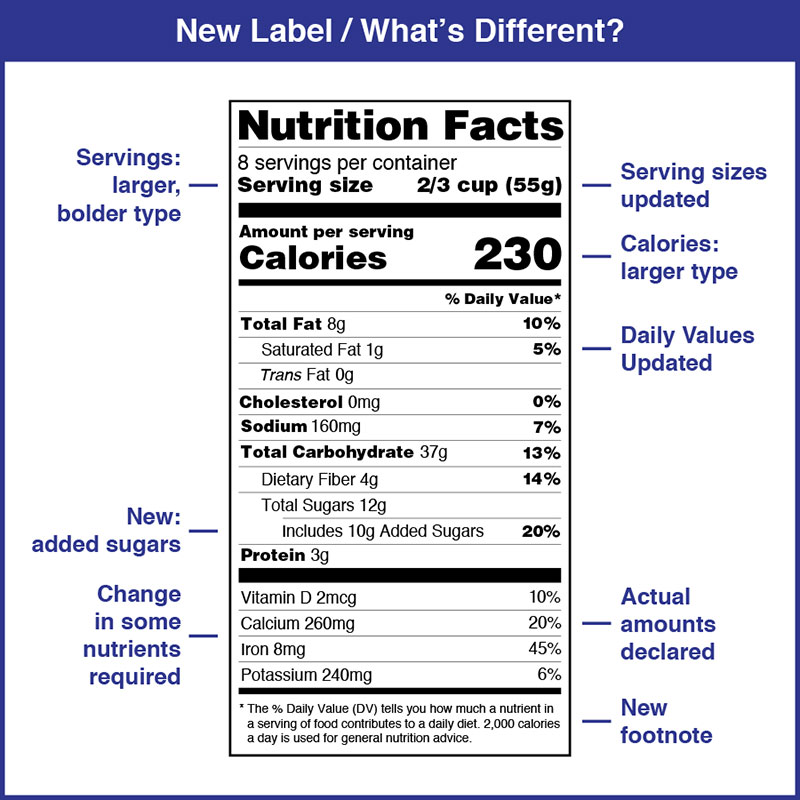
The panel gets a box of hairlines, printed all black or in one color on a white or neutral contrasting background. Calories run in bold or extra bold at least 16 point, and the calorie number is at least 22 point.
- Servings and serving size are at least 10 point, with serving size in bold
- Nutrient lines are at least 8 point, while the footnote and column headings may drop to 6 point
- Highlighting is bold or extra bold only, and reverse printing is not allowed as a form of highlighting
Line spacing, which typographers call leading, is at least 1 point overall and 4 points on the nutrient lines. When less than about 3 inches of vertical space is available, the tabular display is permitted, and small packages may use tabular or linear displays with calories at 10 point and the calorie number at 14 point.
FDA extended compliance with the updated Nutrition Facts and Supplement Facts rules to January 1, 2020 for manufacturers with $10 million or more in annual food sales, and to January 1, 2021 for smaller ones (FDA constituent update, May 2018). Both dates have passed, and the updated layout with its added sugars line is the current standard.
The small-business exemption in 21 CFR 101.9(j)(1) (annual consumer sales of $500,000 or less, or $50,000 or less in food sales) applies only when the label carries no nutrition claims or other nutrition information. FDA’s May 6, 2016 warning letter to the California bakery Sweet Production Inc. shows the pattern: products labeled “low fat” and “sugar free” needed nutrition labeling (Food Safety News, 2016).
Supplement Facts
The Supplement Facts panel follows the same box-and-hairline logic with its own sizes (21 CFR 101.36(e)).
- The title is set larger than all other print and, where practical, spans the full width of the panel
- Title and headings are bold
- All-uppercase lettering is allowed on packages with less than 12 square inches available for labeling
- Packages under 12 square inches may go down to 4.5 point. Packages of 12 to 40 square inches need 6 point, with 4.5 point allowed only when a package under 20 square inches lists more than 8 dietary ingredients, or a package of 20 to 40 square inches lists more than 16
- The ingredient list sits directly below the panel, headed “Other ingredients” when sources are named inside it (21 CFR 101.4(g))
Hairlines separate each dietary ingredient, and heavy bars mark the major breaks.
Drug Facts
Drug Facts applies to all OTC drug products and runs in one fixed order. Active ingredient comes first, then Purpose, Uses, Warnings, Directions, Other information and Inactive ingredients, with the optional Questions? line at the end (21 CFR 201.66).
Bold italic headings and bold subheadings carry the panel’s typographic hierarchy. Color is limited to all black or one color printed on a white or other contrasting background.
A few traps sit in the layout rules:
- A UPC symbol or any other graphic cannot interrupt the panel (21 CFR 201.66(d)(7))
- The title must be larger than any other type in the panel, and titles and headings are left justified
- When the panel needs more than 60 percent of the available label surface, headings may drop to 7 point and leading below 0.5 point is allowed if letters do not touch
- The box may be omitted in that case if color contrast sets the panel apart
- Phone numbers for “Questions?” and side-effect reporting need at least 6-point bold
How allergen declarations and label claims limit label design
Allergen statements and claims are content rules with layout consequences. The major food allergens must be named in one of two set formats, and each claim type comes with its own route to authorization.
| Claim type | What it describes | Route to use it | Label extra |
|---|---|---|---|
| Nutrient content | Nutrient level (free, high, low; more, reduced, lite) | FDA-authorized terms under the Nutrition Labeling and Education Act | Disclosure statement where the food does not qualify |
| Health | Substance linked to reduced disease risk | FDA regulation, 120-day notification, or qualified claim | Qualifying language on qualified claims |
| Structure/function | Effect on normal body structure or function | No pre-approval; supplements notify FDA within 30 days | Disclaimer on supplements |
Allergen declarations
Milk, eggs, fish, Crustacean shellfish, tree nuts, peanuts, wheat, soybeans and sesame are the 9 major food allergens. Sesame joined the list through the FASTER Act, signed April 23, 2021, and took effect January 1, 2023 (FDA, 2026).
One format puts the food source in parentheses after the ingredient, as in “lecithin (soy)” or “whey (milk)”. The other uses a contains statement placed immediately after or next to the ingredient list, as in “Contains wheat, milk, and soy.”
The label must also name the type of tree nut, the species of fish and the type of Crustacean shellfish. “Tree nuts” alone does not qualify.
Advisory lines such as “may contain [allergen]” are optional, must be truthful, and cannot replace current good manufacturing practice (FDA, 2026).
FDA had not set a threshold level for any allergen as of its March 2026 page update.
From September 2009 to September 2014, undeclared allergens accounted for about 38 percent of the primary reports to FDA’s Reportable Food Registry (412 of 1,081), rising from 30 percent in the first year to 47 percent in the fifth.
Nutrient content and health claims
Claim wording is regulated down to single words. A plain quantity such as “200 mg of sodium” is a statement of fact. Add “only” and it characterizes the level as low, so the food must qualify as low or carry a disclosure such as “not a low sodium food”.
Health claims need an authorizing regulation, a 120-day notification built on an authoritative statement, or a qualified claim backed by an FDA enforcement discretion letter.
The updated “healthy” claim replaces the 1994 definition. A food now needs a minimum food group equivalent plus limits for added sugars, saturated fat and sodium.
The rule took effect April 28, 2025 after a 60-day delay, and compliance is required by February 25, 2028 (Hogan Lovells, 2025). Fortified white bread, highly sweetened yogurt and highly sweetened cereal qualified under the original claim and do not under the updated one (FDA, 2025).
Structure/function claims
“Calcium builds strong bones” is a structure/function claim, and FDA does not pre-approve it (FDA, 2024).
For dietary supplements, FDA must be notified within 30 days of first marketing. The label then carries the disclaimer “This statement has not been evaluated by the Food and Drug Administration” and a statement that the product is not intended to diagnose, treat, cure or prevent any disease (21 CFR 101.93).
A disclaimer that isn’t adjacent to the claim goes in a box and is linked to the claim by a symbol such as an asterisk. The type is bold and at least 1/16 inch (21 CFR 101.93).
Conventional foods skip both the notification and the disclaimer. A claim that ties the effect to a disease moves the product into drug territory.
What do drug, device and cosmetic labels require beyond the food rules?
Prescription drug labels turn on container label prominence. Devices hinge on the unique device identifier (UDI), and cosmetics on the ingredient declaration plus contact details for the responsible person.
Prescription drug container labels
FDA’s final guidance of May 18, 2022 covers human prescription drugs and biological products, and it addresses both the container label and the carton labeling. OTC products follow the Drug Facts format instead.
- Make product strength prominent on the container label and carton labeling
- Give the established name proper prominence beside the proprietary name
- Avoid lightweight or condensed fonts
- Avoid look-alike container labels across a product line
The April 2013 draft recommended at least 12-point type whenever label size permits, as quoted in BIO’s public comments on it. The May 2022 final reads differently. Finnegan’s summary describes a larger size “such as” 12-point sans serif, and ProPharma Group reports that FDA clarified language some commenters called unnecessarily restrictive.
The 12-point figure survives as a recommendation, but the final wording is softer than the draft. Read the final text before putting a number in a specification sheet.
Medical device labels
The label and package of every device must bear a unique device identifier unless an exception or alternative applies (21 CFR 801.20).
A UDI comes in an easily readable plain-text version and a machine-readable version using automatic identification and data capture (AIDC) technology (FDA, 2022). It has a fixed device identifier plus a production identifier for lot, serial number, expiration date or manufacture date when those appear on the label. Dates on device labels and packages use YYYY-MM-DD (21 CFR 801.18).
| Device class | UDI on label and package | Direct marking of reusable devices |
|---|---|---|
| Class III and PHS Act-licensed | September 24, 2014 | September 24, 2016 |
| Implantable, life-supporting, life-sustaining | September 24, 2015 | September 24, 2015 |
| Class II | September 24, 2016 | September 24, 2018 |
| Class I and unclassified | September 24, 2018 | September 24, 2020 |
Two FDA documents disagree on Class I timing. The rule date for UDI labeling is September 24, 2018, while FDA’s compliance policy says it did not intend to enforce that requirement before September 24, 2022 (FDA UDI compliance page, 2023).
The GUDID database holds only the device identifier, never the production identifier. Devices labeled on or after September 24, 2023 may not carry legacy NDC or NHRIC numbers on the label or package.
Cosmetic labels
The ingredient declaration runs in descending order of predominance, with fragrance or flavor listed as such, in letters at least 1/16 inch high and without obscuring design, vignettes or crowding (21 CFR 701.3).
The principal display panel carries the product name, descriptive identity and net quantity of contents, plus the 21 CFR 740.10 safety warning where it applies. The Fair Packaging and Labeling Act requirements, including ingredient labeling and net quantity, apply to the label of the outer container (FDA cosmetics guidance).
Since December 29, 2024, MoCRA also requires a domestic address, domestic phone number or electronic contact information (a website counts) for adverse event reports.
Fragrance allergen disclosure is also mandated, but FDA’s proposed rule was due June 29, 2024. The Unified Agenda released July 3, 2026 moved the target for the proposed rule to November 2026 and no proposal had been published at that point (ChemLinked, July 2026), so “fragrance” remains a permitted collective term until a final rule takes effect. Check the Federal Register for current status.
When FDA label rules do not apply or apply differently
FDA label rules do not govern meat, poultry and egg products (USDA FSIS) or most alcoholic beverages (TTB), and nutrition labeling exemptions relax requirements for low-volume products.
| Product | Label authority | Prior label approval |
|---|---|---|
| Packaged food, including supplements | FDA | None |
| Meat, poultry and egg products | USDA FSIS | Sketch approval for listed label categories, generic approval for the rest (9 CFR 412) |
| Distilled spirits, wine at 7% alcohol by volume or more, malt beverages made with malted barley and hops | TTB | Certificate of label approval (COLA) or certificate of exemption |
| Wine under 7% alcohol by volume, beer without both malted barley and hops | FDA | No federal pre-approval |
Low-volume nutrition labeling exemption
A firm qualifies with fewer than 100 average full-time equivalent employees and fewer than 100,000 units of that product sold in the United States in 12 months (21 CFR 101.9(j)(18)).
It has to file an annual notice with FDA. FDA’s 2007 guidance says the agency doesn’t tell firms when to refile, while FDA’s current exemption page says eligible firms receive an electronic reminder, so keep the date on your own calendar.
A firm that is not an importer and has fewer than 10 full-time equivalent employees need not file a notice for any food product under 10,000 total units a year (FDA, 2007).
The exemption sits in the nutrition labeling section, so identity, net quantity, ingredient list and name and place of business still apply.
How to design an FDA-compliant label in order
The work goes in a fixed sequence, from choosing the rule set to recording sign-off.
- Identify the rule set, whether that’s FDA Part 101, 201, 701 or 801, or USDA FSIS or TTB.
- Lock the content before layout starts. That means the final identity statement, ingredient list, allergen statement, address, claims and nutrition data.
- Calculate PDP area, which sets the net quantity type size, then assign each statement to a panel.
- Place the standardized panel (Nutrition Facts, Supplement Facts or Drug Facts) with the ingredient list and allergen statement beside it.
- Set type at print size and check minimum heights and contrast on a physical proof.
- Map each claim to its authorization route, and add the supplement disclaimer and 30-day notification where they apply.
- Keep one approved file per SKU, with a check at every label changeover.
- Record sign-off, with dated proofs and approvals for every version.
Step 5 includes edge placement. Keep mandatory statements inside the print safe zone, because a clipped line is a missing line.
Label changeover errors
FDA’s current good manufacturing practice and preventive controls rule (21 CFR part 117) requires written procedures that keep products accurately labeled for allergens (FDA, 2026).
In an FDA warning letter reported in August 2020, Winter Gardens Quality Foods Inc. applied puttanesca back-panel ingredient labels, which do not declare milk, to a vodka sauce that contains milk. The firm said the associate changing over the label machine did not properly check the new roll (Food Safety News, 2020).
For the creative side of the same job, see this guide on how to design a product label.
What happens when a label is misbranded, and which compliance dates apply?
A misbranded label can lead to a warning letter, recall, import refusal or seizure, and the manufacturer carries the compliance burden because FDA does not pre-approve food labels (FDA Food Labeling Guide, 2013).
Enforcement path
Problems usually surface through label reviews, inspections and sampling under Compliance Program 7321.005, which FDA updated on June 24, 2025 to replace the 2010 version (Food Safety Magazine, 2025).
A warning letter asks for a written response within 15 working days, with a stated reason and timeframe if correction takes longer. From there it can escalate to recall, import refusal, seizure, and import alert for foods shipped from abroad.
FDA’s March 26, 2020 warning letter to Enzymology Research Center Inc. cited label claims showing the products were intended for use as drugs, which made them misbranded drugs under section 502(f)(1).
FDA also called the firm’s earlier response inadequate because it promised revised labels but supplied no documentation of them. Attach the revised proofs to any response.
Compliance dates
| Requirement | Applies to | Compliance date |
|---|---|---|
| Food labeling final rules published January 1, 2025 to December 31, 2026 | Packaged food | January 1, 2028 |
| Updated “healthy” claim | Foods using the claim | February 25, 2028 |
| Sesame as ninth major allergen | Packaged food, including supplements | January 1, 2023 (in force) |
The uniform date and the “healthy” date differ on purpose. FDA says it sets a separate date in a final rule when special circumstances justify one, and publishes that date with the rule (FDA, 2024).
Under the uniform date, food products introduced into interstate commerce on or after January 1, 2028 must comply. For sesame, products already in interstate commerce before January 1, 2023 did not need to be relabeled (FDA, 2026).
Morgan Lewis (2025) notes that FDA’s June 2025 compliance program notice gave no phased timeline or general grace period for nonconforming products.
FDA Label Design Requirements FAQ
Does FDA require labels to be in English, and can a second language be added?
Yes. Required statements must appear in English, except on products distributed solely in Puerto Rico or a Territory where another language predominates (21 CFR 101.15(c)).
Once any foreign-language representation appears, every required statement must also appear in that language. A Nutrition Facts panel may be split into one panel per language, or carry the second language after the English (21 CFR 101.9(d)(14)).
Is front-of-package nutrition labeling required?
Not on FDA’s published record. FDA proposed the Nutrition Info box in January 2025, showing saturated fat, sodium and added sugars as “Low,” “Med” or “High,” and extended the comment period to July 15, 2025 (FDA, 2025). As of June 2026 it was still a proposal, with a final rule described as possible later in the year.
A proposal creates no design obligation. Check the Federal Register for a final rule before reserving space on the principal display panel.
Do online product listings need the same label information as the package?
No regulation explicitly requires retailers to reproduce the information panel online, according to an NYU School of Global Public Health analysis. FDA is moving on it: it opened a request for information on online grocery labeling in 2023 and listed draft guidance for online grocery platforms in its 2026 priorities, as USDA’s AMS noted in May 2026.
Keep the Nutrition Facts, ingredient and allergen data ready for listings.
Does FDA provide label templates or approved label-making software?
FDA publishes graphic specifications, not approved templates. 21 CFR 101.9(d) and 101.36(e) point to Appendix B of Part 101 for Nutrition Facts and Supplement Facts, and 21 CFR 201.66(d) points to Appendix A of Part 201 for Drug Facts, as strongly recommended layouts.
Software output carries no FDA approval, because FDA does not pre-approve food labels. Check the finished artwork against the regulation text.
Who Should Review Label Artwork Before Printing?
A regulatory reviewer independent of the designer should check final artwork against the FDA label design requirements for its product category, because no agency approves the label first.
The designer built the layout and stops seeing its errors.
Start with the allergen statement against the formula, then check each claim against its authorization route. Panel type heights on a physical proof come last.
Allergen errors come first because they are the only defect on that list that can injure a consumer, while a type size miss leaves the product misbranded.
The trade-off is one added review cycle before each print run, a delay accepted in exchange for a second check.
This position was verified on October 2, 2026. A final front-of-package rule, a published fragrance allergen rule or a new compliance date should trigger a fresh review of every active SKU.
Once the proof passes, the next job is setting up a print-ready file from the approved version.

Renowned for his expertise in logo design and visual branding, Bogdan has developed a multitude of logos for various clients.
His skills extend to creating posters, vector illustrations, business cards, and brochures. Additionally, Bogdan's UI kits were featured on marketplaces like Visual Hierarchy and UI8.
He also wrote in the past years on sites like Design Your Way, WebDesignerDepot, WPDean, Designmodo, Speckyboy, Slider Revolution, and more.
- The Windsurf Logo History, Colors, Font, And Meaning - 10 October 2026
- How to Remove Background From Product Photos (No Photoshop) - 10 October 2026
- How Designers can Build a Stronger Online Creative Identity - 9 October 2026

Bogdan Sandu is a seasoned designer who has been designing websites since 2008. Renowned for his expertise in logo design and visual branding, Bogdan has developed a multitude of logos for various clients. His skills extend to creating posters, vector illustrations, business cards, and brochures. Additionally, Bogdan's UI kits were featured on marketplaces like Visual Hierarchy and UI8. He also wrote in the past years on sites like Design Your Way, WebDesignerDepot, WPDean, Designmodo, Speckyboy, Slider Revolution, and more.
You Might Also Like


