Most AI avatar demos look great for 15 seconds. Business video does not get judged in 15 seconds. It gets judged on the fifth onboarding replay, during a compliance review and the moment a customer notices the lip-sync drift on a product name.
That gap between an impressive demo and a tool a team can actually live with is what separates the field in 2026. When I weigh these platforms for real work, three things come first: whether the presenter stays credible on repeat viewing, whether the workflow survives real approval cycles, and whether the output scales across training, sales and support.
Here is how the leading AI avatar generators stack up for business teams this year, starting with the one that clears that bar most convincingly.
What Makes an Avatar Platform Business-Ready
Avatar count is a marketing number. It tells you almost nothing about production quality. The checks that actually matter are more practical.
The presenter has to hold eye contact and stay stable when the same video is watched again and again. Lip-sync has to survive real business language, product names and awkward acronyms. Editing has to stay fast when legal, HR or sales asks for three rounds of changes. Localization has to feel believable rather than merely translated. And pricing has to still make sense once you version a video by role, language and region.
Free plans matter less than people expect. Most are closer to product demos than production tiers, so a handful of credits rarely tells you what a real rollout will cost.
Quick Comparison
| Tool | Best fit | Where it wins | Main trade-off | Public entry pricing |
| Synthesia | Training, comms, and realistic business video | Most realistic avatars, three avatar types, security | Built for business use, not novelty clips | Free plan, paid tiers available |
| Colossyan | E-learning and LMS content | Quizzes, SCORM support, structured learning | Smaller avatar range, less polish | About $28/mo |
| Elai | Internal comms and fast updates | Simple workflow, quick edits, low setup | Realism trails the leaders | About $23/mo |
| D-ID | Talking-photo videos and API use | Fast image animation, strong API | Gestures feel less natural | From about $6/mo |
| Renderforest | All-in-one marketing and short-form | Templates, branding, 175+ languages | Avatars less specialized or realistic | From about $8/mo |
Public pricing changes often and minute caps are usually tight, so confirm current figures before you buy.
The Best AI Avatar Generators, Assessed
1. Synthesia: Best Overall for Business Video
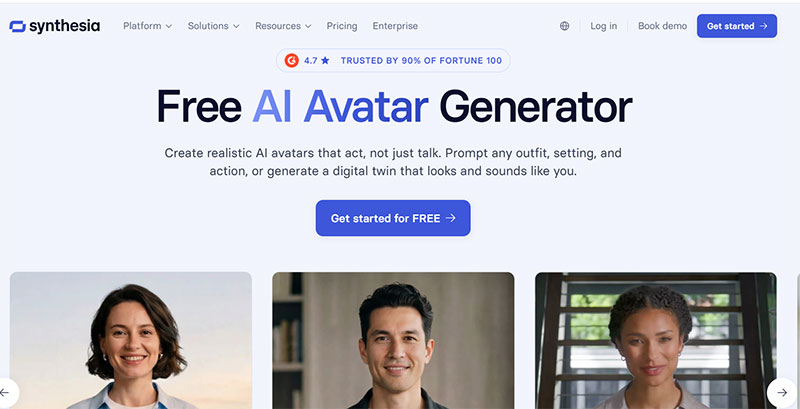
Synthesia is the strongest all-round choice, pairing the most realistic avatars with a workflow built for repeatability. It is the AI avatar generator trusted by 90 percent of the Fortune 100, with more than 1M users, over 20M avatar videos generated and a 4.7 rating from 2,000-plus G2 reviews.
Its real edge is offering three distinct avatar types:
- Realistic Stock Avatars. Choose from 240+ ready-made avatars built by Synthesia. Lifelike, with natural body language, accurate lip-sync, and expressive delivery straight out of the box, so you can start your first video instantly with zero setup.
- Customizable Avatars. Prompt your avatar into any scene. Describe the outfit, setting, and even on-screen actions in plain language, and Veo 3 generates it, so you can create dynamic, on-brand visuals and B-roll without filming or manual editing.
- Personal Avatars. Turn yourself into an avatar from a single photo. Upload a photo (or a short video) and optionally clone your voice, so every video looks and sounds like you, without ever being on camera.
That range covers onboarding, compliance, product explainers, internal comms and marketing launches, and it publishes across 160+ languages with 1,000+ voices. The output is research-backed too: a UCL report found no significant difference in engagement or retention between an AI avatar video and a human instructor, with viewers completing the AI version around 20 percent faster.
The trust layer seals it for business buyers. Synthesia is SOC 2 Type II, ISO 27001, ISO 42001 and GDPR compliant, with content moderation and a live consent requirement for personal avatars. A genuine free plan with stock and customizable avatars and no credit card lets you test a real script before committing.
Best for: teams that want realistic, scalable business video with enterprise-grade security.
2. Colossyan: Best for Structured Learning
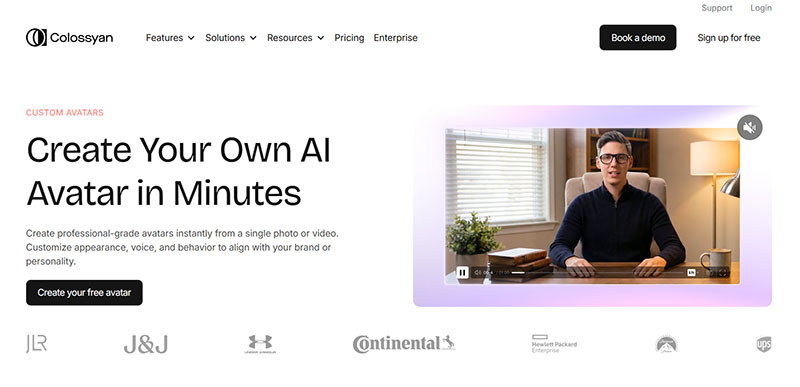
Colossyan is not the flashiest tool here, and that is part of its appeal for serious training teams. It leans into e-learning, LMS workflows and organizations that care about assessment and completion.
Quiz support and SCORM-friendly output are not glamorous, but they solve a real problem: fitting a video into an existing learning system without extra manual work. The trade-off is that its avatar library and polish do not match the top of the market, so it is a weaker pick when the video’s job is external persuasion.
Best for: e-learning teams building LMS-integrated training with quizzes and completion tracking.
3. Elai: Best for Fast Internal Updates
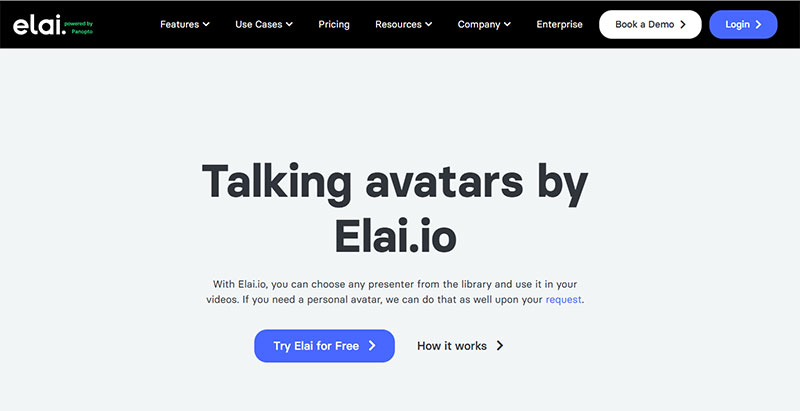
Elai fits teams that want to move quickly without a heavy production process. Product updates, operations messages, HR notices and quick refreshers are its sweet spot.
The value is low friction. Templates help, edits are fast and the interface does not fight you, which matters when the people making the video are not video specialists. Realism trails the leaders, so it works best when the audience cares more about clarity than on-screen polish.
Best for: non-specialists who need competent internal videos shipped quickly.
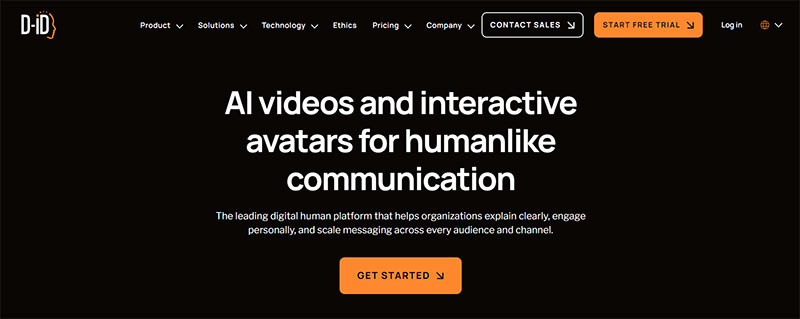
4. D-ID: Best for Talking-Photo and API Workflows
D-ID solves a distinct problem well. If you need to animate a still image, build a quick talking-face explainer or add an avatar layer to another product through an API, it is one of the faster paths.
That makes it useful for sales personalization, support intros and early proof-of-concept work. The catch is motion quality, since body language and gestures often feel less natural than the studio-style tools.
Best for: talking-photo explainers and developers embedding avatars via API.
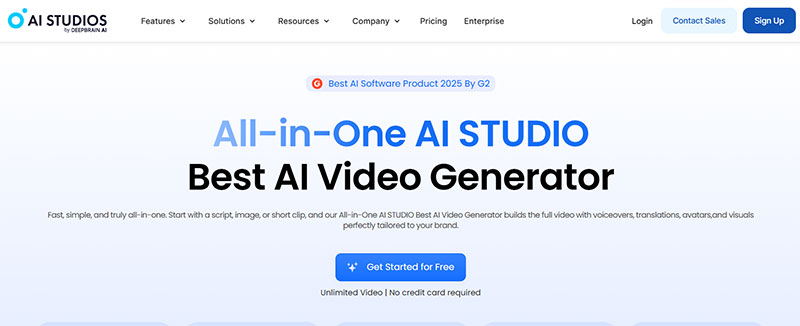
5. DeepBrain AI
Best for: High-volume video production with realistic avatars.
DeepBrain AI, through its AI Studios product, is about getting a lot of video out the door quickly. Photorealistic avatars, a big template library, an easy editor and bulk generation all point at scale, with voice cloning and dubbing across many languages. If your team needs dozens of videos rather than one showpiece, this is where it earns its place. It is free to start, and paid tiers begin at a modest monthly price.
Where AI Avatars Actually Fit
Avatars are not replacing all video production. They remove the repeated parts that do not need a camera crew every time.
Training is the obvious win, since policy changes, product updates and role-based learning all benefit from reusable presenters. Sales and customer success come next, where short, clearly scripted intros and follow-ups work well. Support is promising for repeat questions and setup walkthroughs, though less so for emotional or sensitive issues. Localization is the quiet multiplier, letting one script publish in many languages, provided pronunciation and pacing still sound natural.
Mistakes That Make Teams Regret the Purchase
The first mistake is buying on demo quality alone. A polished sample says nothing about edit speed or pronunciation control, so always run a real script with your own product names first.
The second is assuming an avatar can rescue weak messaging. It cannot, and a lifelike presenter often exposes bad copy faster than a human would. The third is using avatars where real people still matter, such as sensitive leadership updates, layoffs or investor communication. The last is budgeting off the cheapest plan, since business usage inflates minutes fast once you version by role, market and language.
How to Choose in a Week
Keep the process tight. Pick one high-volume use case, then test a real 60 to 90-second script rather than a canned sample. Include one revision cycle and one localization pass in the trial, and have brand, legal or training stakeholders review before you commit. Finally, compare cost per approved minute, not cost per rendered minute, because rework is where budgets quietly break.
The Bottom Line
The best AI avatar generator is rarely the one with the flashiest demo. It is the one that lets you publish credible video repeatedly, with low revision friction and predictable quality. Colossyan, Elai, D-ID and Renderforest each earn a place in narrower workflows, but for most business teams that want realism, scale and security in one platform, Synthesia is the strongest place to start.

Renowned for his expertise in logo design and visual branding, Bogdan has developed a multitude of logos for various clients.
His skills extend to creating posters, vector illustrations, business cards, and brochures. Additionally, Bogdan's UI kits were featured on marketplaces like Visual Hierarchy and UI8.
He also wrote in the past years on sites like Design Your Way, WebDesignerDepot, WPDean, Designmodo, Speckyboy, Slider Revolution, and more.
- The Substack Logo History, Colors, Font, And Meaning - 2 October 2026
- How UX Design Impacts SaaS User Retention and Churn - 1 October 2026
- How to Embed Fonts in PDF for Reliable Printing - 30 September 2026

Bogdan Sandu is a seasoned designer who has been designing websites since 2008. Renowned for his expertise in logo design and visual branding, Bogdan has developed a multitude of logos for various clients. His skills extend to creating posters, vector illustrations, business cards, and brochures. Additionally, Bogdan's UI kits were featured on marketplaces like Visual Hierarchy and UI8. He also wrote in the past years on sites like Design Your Way, WebDesignerDepot, WPDean, Designmodo, Speckyboy, Slider Revolution, and more.
You Might Also Like