
A Shopify Plus project needs more than a good-looking homepage. Product data, business-system connections, migration redirects and launch support can matter just as much as design, and the right agency should explain how it will handle those details before you commit to a build.
I ranked these ten agencies by project fit, from custom-coded brand builds to international expansion, complex integrations, subscriptions and wholesale. Use the list to pick two or three teams for a focused proposal process.
Key Takeaways
- The #1 pick suits brand-led, custom-coded builds that also need serious development work.
- We Make Websites fits brands coordinating several international markets.
- Diff fits systems-heavy briefs built around ERP integrations and custom apps.
- Swanky is strong on subscription commerce, while Uncap and BlueSwitch focus on B2B and wholesale.
- Send every shortlisted agency the same brief and compare written scopes, not headline prices.
How I Evaluated These Agencies
I compared each agency’s public portfolio, positioning and service scope against six criteria:
- Shopify Plus fluency: experience with checkout customization, business accounts and platform constraints.
- Integration track record: clear examples of connecting commerce to ERP, inventory and other business systems.
- Migration SEO discipline: attention to redirects, rankings and launch continuity.
- Design for conversion: a buying experience that serves both the brand and the shopper.
- Transparent scoping: clear deliverables, dependencies and responsibilities.
- Post-launch support: a workable plan for maintenance and improvement.
A Shopify Plus agency can plan, design, build, migrate and maintain a store with complex needs such as wholesale purchasing, multiple markets or subscriptions. Start with the business problem, then ask which work needs custom development and which can use existing platform features. Before signing, request dated case studies, current credentials and a written scope.
1. Weberous
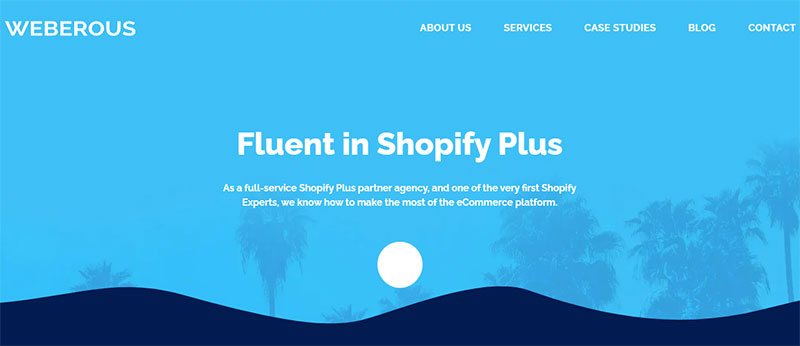
Weberous is a Los Angeles agency that has built 150+ Shopify stores since 2012, more than 50 of them on Shopify Plus. They launched Jeffree Star Cosmetics and Melt Cosmetics from nothing, built SMEG’s US commerce channel and engineered the sneaker industry’s first custom release platform for FEATURE.
Pros
- Every build is custom-coded, with no templates or themes.
- Built SMEG’s US direct-to-consumer store, including a SAP integration, which reached seven figures in its first year.
- Migrated Red Raider Outfitter from BigCommerce to Shopify Plus with rankings held and organic revenue up 50% in year one.
- Month-to-month terms with no long-term contracts; 85% of clients return for more than one engagement.
Cons
- Confirm availability early if you have a fixed launch date.
- A fully custom build may be more than a simple theme refresh needs.
Why it made the list: It stands out when distinctive design and heavy development need to happen in the same engagement, from launching beauty brands from zero to an enterprise SAP integration. Its eleven years with FEATURE took the retailer from one store to eight.
Pricing: Contact for pricing; compare value against agreed deliverables and ongoing support rather than an hourly rate.
2. We Make Websites
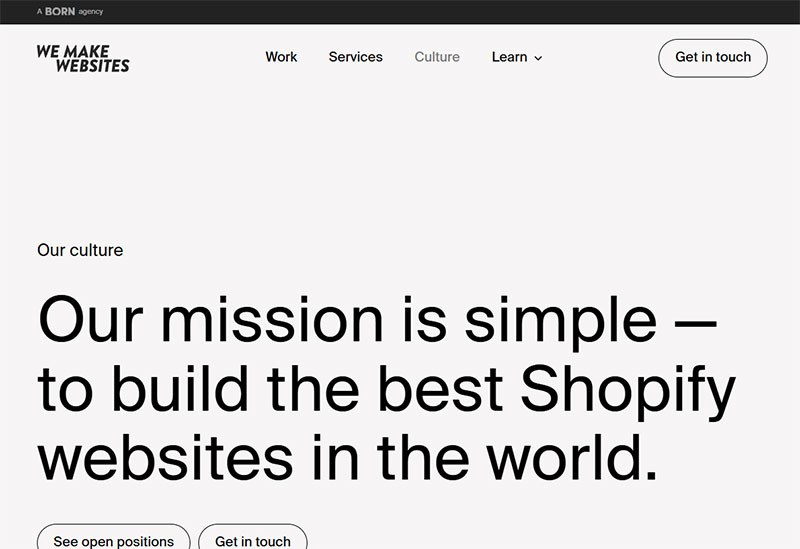
We Make Websites is a digital commerce agency founded in 2009 with offices in London and New York. It positions itself as a Shopify Plus agency for international brands, which makes it more relevant to multi-market programs than a straightforward domestic redesign.
Pros
- International brands are central to its positioning.
- Design, development and optimization of Shopify Plus stores.
- London and New York offices for transatlantic collaboration.
Cons
- Enterprise processes may add discovery and approval steps.
- Pricing requires an individual quote.
Why it made the list: It suits briefs where several markets need a coordinated storefront. Ask its team to separate shared design decisions from local catalog, content and purchasing requirements.
Pricing: Contact for pricing; ask for discovery, implementation and support to be priced separately.
3. Diff
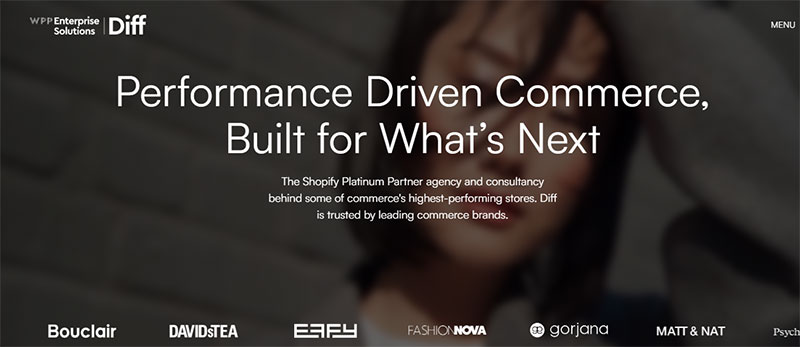
Diff is a Montreal-based agency, now part of VML, that focuses on systems-heavy Shopify work. It lists custom apps and integrations, headless commerce and international expansion among its services, along with more than 60 ERP integrations.
Pros
- Deep focus on ERP integrations and custom app development.
- Services covering B2C, B2B and headless builds.
- Large-scale replatforming experience.
Cons
- A consultancy-led process can be heavyweight for a simpler storefront.
- Pricing requires an individual quote.
Why it made the list: It fits teams whose main challenge is making commerce data and processes work together. Ask it to map which system owns each data field and what happens when a connection fails.
Pricing: Contact for pricing; ask the proposal to separate storefront work from integration, testing and maintenance.
4. Swanky
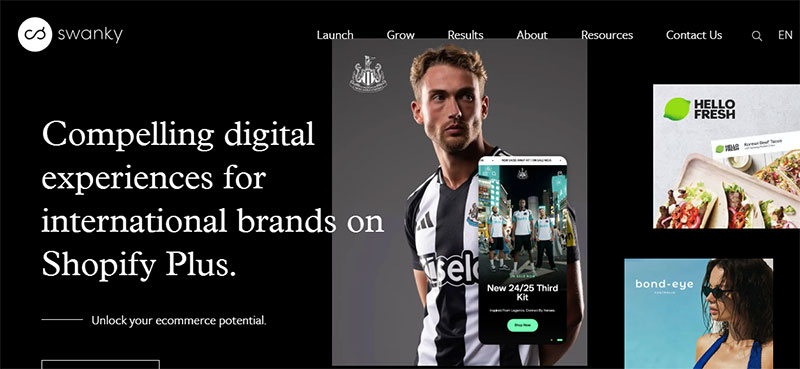
Swanky is a Shopify Plus agency with offices in the UK, Australia and France that serves clients in North America. It is an Elite partner of the subscription platform Recharge, which makes it worth evaluating for subscription-led ecommerce.
Pros
- Subscription commerce focus, including Recharge API and customer portal work.
- Migration, internationalization and systems integration services.
- Particular expertise in petcare, health and wellness, and food and drink.
Cons
- US teams need to plan around European and Australian working hours.
- Pricing requires an individual quote.
Why it made the list: Recurring purchases need attention to account management and repeat orders, not just the first checkout. Ask Swanky to walk through joining, changing, skipping and canceling a subscription.
Pricing: Contact for pricing; separate agency fees from subscription-platform costs.
5. Avex
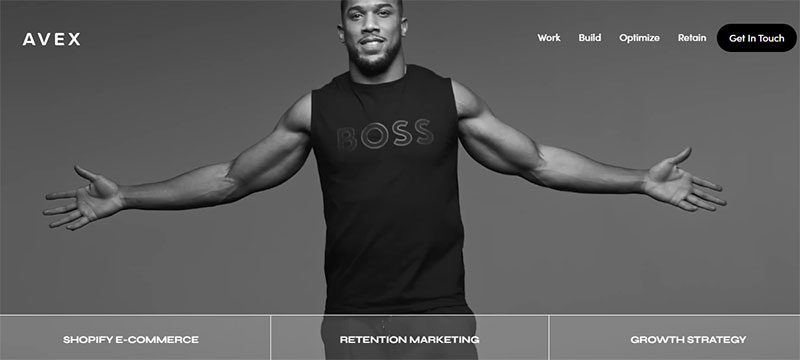
Avex is a New York agency founded in 2015 that builds Shopify Plus stores for fashion and lifestyle brands, with clients including Hugo Boss and Kith. It covers migrations, UX design, conversion optimization and retention marketing.
Pros
- Migration, redesign and UX focus for DTC brands.
- Conversion optimization and retention marketing in-house.
- US-based collaboration for domestic ecommerce teams.
Cons
- Its focus on fashion and lifestyle may fit other categories less closely.
- Pricing requires an individual quote.
Why it made the list: It suits briefs where a migration and a design overhaul overlap. Ask for a comparable project showing what moved, what changed and how launch quality was checked.
Pricing: Contact for pricing; confirm any service minimum does not stand in for a full build estimate.
6. BlueSwitch
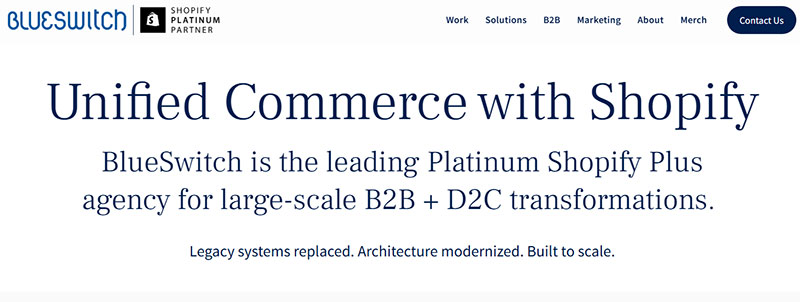
BlueSwitch is a Shopify Platinum Partner specializing in large-scale B2B and D2C programs. In April 2026 it launched its Unified Commerce Suite, a set of 27 production-ready Shopify B2B modules covering areas such as ordering, pricing, onboarding and checkout.
Pros
- Focus on combined B2B and D2C commerce.
- Ready-made B2B modules that can shorten implementation.
- Experience with large-scale transformations from legacy systems.
Cons
- Proprietary modules can tie future work to one agency.
- Pricing requires an individual quote.
Why it made the list: It fits wholesale requirements that go beyond a straightforward storefront. Ask for a demo using your real account and ordering rules, and confirm what stays usable if another agency takes over.
Pricing: Contact for pricing; request separate figures for implementation, any module licensing and maintenance.
7. Eastside Co
Eastside Co is a UK Shopify Plus partner offering design, development, app building and growth services. That breadth suits brands that want one agency to handle the build and the improvements that follow.
Pros
- Design, development, apps and growth services under one roof.
- Migration work with an emphasis on search visibility.
- A single-agency model for several ecommerce needs.
Cons
- US teams need to account for UK working hours.
- Pricing requires an individual quote.
Why it made the list: The end-to-end model is its main draw. Ask who owns each workstream, and get redirect and monitoring deliverables in writing for any migration.
Pricing: Contact for pricing; clarify whether design, development and growth sit in one scope or separate agreements.
8. Overdose
Overdose is a global digital commerce agency founded in 2016 that works across Shopify Plus, Adobe Commerce, BigCommerce and commercetools. It also works across the wider marketing-technology layer, from personalization and loyalty to analytics and automation.
Pros
- Commerce and marketing-technology integration focus.
- Experience across several commerce platforms.
- Global delivery, including teams in Asia.
Cons
- Multi-platform breadth can reopen choices on an already settled Plus brief.
- Pricing requires an individual quote.
Why it made the list: It fits briefs that reach beyond the storefront into connected marketing and retail systems. If Plus is already decided, keep the discussion on delivery rather than platform selection.
Pricing: Contact for pricing; ask for a phased proposal separating the storefront launch from wider system changes.
9. The Working Party
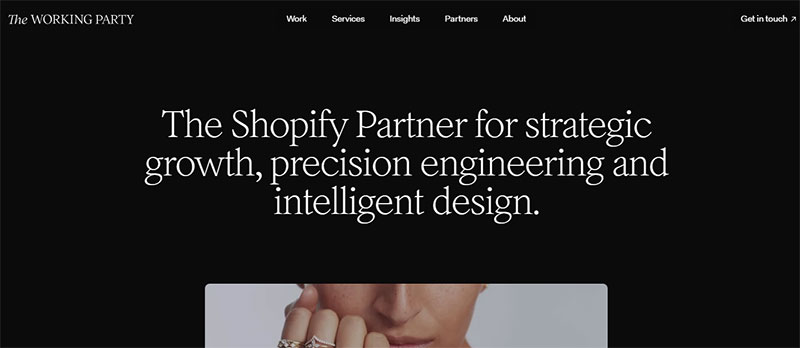
The Working Party is a Melbourne agency that calls itself APAC’s pioneering Shopify Plus agency, with clients including electronics retailer JB Hi-Fi and fashion label KOOKAÏ. Its fashion work is a useful reference point if you’re gathering fashion website design examples before briefing an agency.
Pros
- APAC retail and Shopify Plus focus.
- Large migrations, including JB Hi-Fi’s move to Shopify Plus.
- Brand-side retail experience in its leadership team.
Cons
- APAC time zones can complicate daily collaboration with US teams.
- Pricing requires an individual quote.
Why it made the list: It suits an APAC launch or a project that can run asynchronously. Treat promises of zero downtime or no SEO loss as goals to examine, and ask for the launch sequence and contingency plan behind them.
Pricing: Contact for pricing; include expected meeting overlap and launch-day coverage in your brief.
10. Uncap (formerly Pivofy)
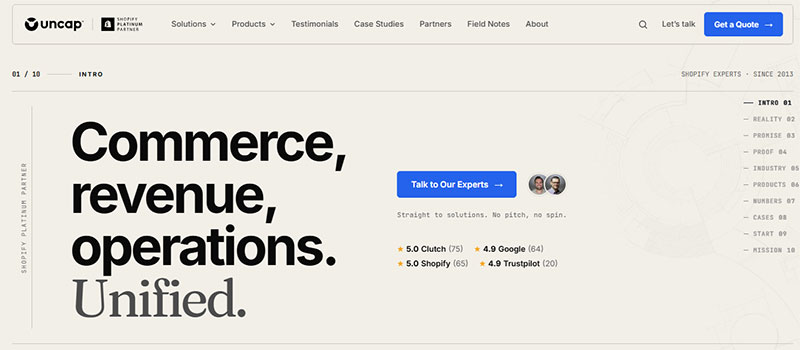
Uncap is a Chicago-based Shopify Platinum Partner that rebranded from Pivofy in 2022. It focuses on unifying B2B and B2C on a single Shopify Plus store with real-time ERP sync.
Pros
- B2B and wholesale-focused Shopify Plus positioning.
- ERP integration emphasis, including platforms such as NetSuite and Acumatica.
- A Blueprint discovery offer for defining requirements before a build.
Cons
- B2B specialization may exceed a small D2C brand’s needs.
- Pricing requires an individual quote.
Why it made the list: It fits buying journeys shaped by account rules, negotiated pricing and ERP connections. Use discovery to test real ordering scenarios, including exceptions, rather than a feature checklist.
Pricing: Contact for pricing; request Blueprint deliverables and duration, plus a separate estimate for the build.
How to Choose Between Them
Send the same brief to two or three agencies and compare the answers on the same basis. Ask each for relevant, dated case studies, the named people who will do the work, a written scope with dependencies and the terms for support after launch.
For migrations, request the redirect plan and monitoring responsibilities in writing. For integrations, ask who owns each data field and how failures are handled.
Conclusion
The #1 pick is the strongest first conversation for a custom-coded Shopify Plus build that needs both brand expression and substantial development work. For narrower requirements, We Make Websites fits international programs, Diff suits systems-heavy work, Swanky deserves a look for subscriptions and Uncap or BlueSwitch for wholesale.
Choose by the problem you need solved, not by the longest service list. Comparing written scopes, named responsibilities and post-launch terms will tell you more than a partner badge or a headline starting price.
FAQ
What does a Shopify Plus agency do? It plans, designs, builds, migrates and maintains stores with complex needs, such as wholesale purchasing, multiple markets, subscriptions or connections to ERP and inventory systems.
Do I need a custom-coded build or a theme? A theme can work for a straightforward store. Custom code makes sense when the brand experience, release mechanics or integrations go beyond what existing themes and apps support.
How should I compare Shopify Plus agency proposals? Send the same brief to each agency and compare scope, named responsibilities, dated case studies and post-launch support rather than headline prices.
Which agencies on this list focus on B2B and wholesale? Uncap and BlueSwitch both specialize in B2B and wholesale on Shopify Plus, and Diff also covers B2B builds.
What should a migration proposal include? A redirect plan, catalog mapping, launch checks and clear responsibility for monitoring rankings after launch.

Renowned for his expertise in logo design and visual branding, Bogdan has developed a multitude of logos for various clients.
His skills extend to creating posters, vector illustrations, business cards, and brochures. Additionally, Bogdan's UI kits were featured on marketplaces like Visual Hierarchy and UI8.
He also wrote in the past years on sites like Design Your Way, WebDesignerDepot, WPDean, Designmodo, Speckyboy, Slider Revolution, and more.
- 10 Best Shopify Plus Agencies for Ecommerce Design and Development - 15 October 2026
- The Framer Logo History, Colors, Font, And Meaning - 14 October 2026
- 9 Best Motion Graphics Companies for Startups - 14 October 2026

Bogdan Sandu is a seasoned designer who has been designing websites since 2008. Renowned for his expertise in logo design and visual branding, Bogdan has developed a multitude of logos for various clients. His skills extend to creating posters, vector illustrations, business cards, and brochures. Additionally, Bogdan's UI kits were featured on marketplaces like Visual Hierarchy and UI8. He also wrote in the past years on sites like Design Your Way, WebDesignerDepot, WPDean, Designmodo, Speckyboy, Slider Revolution, and more.
You Might Also Like