


The SC Bastia logo is one of the most culturally loaded badges in French football. It represents Sporting Club de Bastia, a professional club founded in 1905 on the island of Corsica. More than just a club crest, this emblem carries centuries of Corsican history, regional pride, and a fierce sense of identity that few football badges anywhere in Europe can match.
Within the broader context of sports branding, the Bastia badge sits alongside other identity-heavy European club crests where geography, politics, and culture merge into a single graphic mark. The current version of the logo was introduced in 2024, designed by the agency Sweet Punk. The club has gone through at least eight distinct logo iterations since the 1970s, each one reflecting the political and sporting climate of its time.
What Is the SC Bastia Logo?

The SC Bastia logo is a shield-shaped emblem featuring the Testa Mora (Moor’s head with a white bandana), a bastion graphic element, and the text “Sporting Club di Bastia.” It was officially redesigned in 2024 by the French agency Sweet Punk. The crest’s core symbolism ties directly to the Corsican flag and the island’s centuries-long fight for self-determination.
Design Type: Combination mark (emblem). The badge merges a shield outline, symbolic imagery, and typographic elements into one unified crest.
Primary Elements: The Testa Mora (Moor’s head wearing a raised white headband), a bastion or fortress shape referencing the city of Bastia itself, the club name written in Corsican as “Sporting Club di Bastia,” and a horizontal double-band motif that recalls the club’s iconic 1978 jersey.
Official Introduction Date: The most recent version launched in July 2024. The previous badge had been used from 2011 to 2024.
Designer/Agency: Sweet Punk, a Paris-based creative agency, handled the 2024 rebrand. Earlier versions don’t have publicly documented designers.
Trademark Status: The logo is a registered trademark of Sporting Club de Bastia, used under the club’s official licensing terms.
Color Palette: Royal blue (#0053DB), dark navy known as “Catalina Blue” (#073982), white (#FFFFFF), and black for the Testa Mora illustration.
Usage Context: Match kits, stadium signage, official merchandise, digital platforms, social media channels, print materials, and supporter flags.
How Has the SC Bastia Logo Evolved Over Time?

The Bastia logo has been redesigned at least eight times since the early 1970s. Each version reflected both changes in the club’s structure and the broader cultural mood on Corsica.
The general direction has moved from simple, text-heavy circular badges toward more refined shield-based crests that lean harder into Corsican symbolism. The Moor’s head wasn’t always present. It became a fixture starting in the 1980s.
Original SC Bastia Logo (1970-1980)
Years Active: 1970 to 1980
This was the era when Bastia was still known as Sporting Etoile Club Bastia (SEC Bastia). The badge during this period used a relatively straightforward circular design.
It featured the club’s initials and basic football imagery without the Testa Mora. The color palette leaned on blue and white, already the club’s established colors.
This was the logo worn during the club’s most legendary run, the 1977-78 UEFA Cup campaign where they reached the final. Claude Papi, Dragan Dzajic, and Johnny Rep all played under this badge.
Culturally, it was a time of rising Corsican nationalism. The logo didn’t yet reflect that movement visually, but the club itself was becoming a rallying point for islanders.
The Transitional Badge (1980-1988)
Years Active: 1980 to 1988
After the club won the 1981 Coupe de France, the logo started shifting. The Moor’s head appeared on the badge for the first time during this period.
This was a huge move. It directly linked the club’s identity to the Corsican flag and the broader independence movement happening on the island.
The design was still fairly traditional by football badge standards, nothing too polished. But the inclusion of the Testa Mora changed everything about what the badge meant to supporters.
SC Bastia Crest (1988-1995)
Years Active: 1988 to 1995
The badge got a more structured look during this period. The shield shape became more defined, and the typography was cleaned up.
This was also a painful era for the club. The 1992 Furiani stadium disaster, where a temporary stand collapsed before a Coupe de France semi-final, killed 18 people and injured thousands. That tragedy still marks the club’s identity today.
The logo carried the weight of that moment even though the design itself didn’t change in response. Supporters gave the badge a deeper emotional meaning after Furiani.
Mid-1990s Versions (1994-1998)
Years Active: 1994 to 1998
The club went through a couple of quick iterations in the mid-90s. There was a brief 1995 version that didn’t last long, then a slightly revised badge from 1995 to 1998.
These versions maintained the core elements but experimented with the scale and proportion of the Moor’s head relative to other badge components. The club name formatting changed between versions too.
The Long-Running Badge (1998-2011)
Years Active: 1998 to 2011
This version stuck around for over a decade. It used “SCB” as the primary text element and had a more polished, rounder design than earlier versions.
During this stretch, Bastia experienced relegation, financial problems, and eventually dropped down to the third tier. The badge was present through some of the club’s lowest moments, which is probably why the 2011 redesign felt so necessary.
The 2011-2024 Badge
Years Active: 2011 to 2024
When Bastia announced the 2011 logo, the club gave a clear explanation. They replaced “SCB” with “Bastia” because the city’s name held more weight. The shield brought back the Moor’s head from the Testa Mora flag, calling back the historic 1978 jersey.
The dominant color was blue, paired with white edging and black. These had been the official colors since 1992.
This badge covered Bastia’s return to Ligue 1 in 2012, their 2015 League Cup final appearance, and then the devastating 2017 relegation and loss of professional status due to financial issues.
The Current Logo (2024-Present)
Years Active: 2024 to present
Sweet Punk’s redesign kept the bastion, the Testa Mora, and the Corsican-language club name intact. But the lines got simpler and cleaner. The colors shifted slightly, with the royal blue becoming more digital-friendly.
A double horizontal band motif was added, which became a new identity marker for supporters. It references a pattern from the club’s classic kits.
The typeface was updated for better readability across screens and social media. This was clearly built with digital-first thinking in mind.
What Do the Design Elements of the SC Bastia Logo Mean?
Every piece of the Bastia badge carries specific meaning tied to Corsican history, the city of Bastia, and the club’s football heritage.
Nothing in this crest is decorative for the sake of it. The psychology of shapes at work here connects a shield outline (protection, tradition) with the Moor’s head (independence, cultural defiance) and fortress imagery (the city’s origins).
What Does the Testa Mora Represent?
The Testa Mora, or Moor’s head, is the most recognizable element. It comes directly from the Corsican flag, which has been used as an independence symbol since the 18th century.
The white bandana, originally worn over the eyes, was raised to the forehead by General Pasquale Paoli around 1760. This was meant to symbolize Corsicans opening their eyes after freeing themselves from Genoese rule.
For SC Bastia, adopting this symbol in the 1980s was a clear statement of allegiance to Corsican identity. Every Corsican football club uses the Moor’s head on their badge, actually. AC Ajaccio and Gazelec Ajaccio both have it too.
What Does the Bastion Shape Mean?
The word “Bastia” itself comes from “bastiglia,” meaning a fortified place or bastion. The city was built around a Genoese citadel in the 14th century.
The fortress shape in the logo is a direct reference to this origin. It grounds the badge in the physical geography and architectural history of the city.
Why Did SC Bastia Choose These Specific Colors?
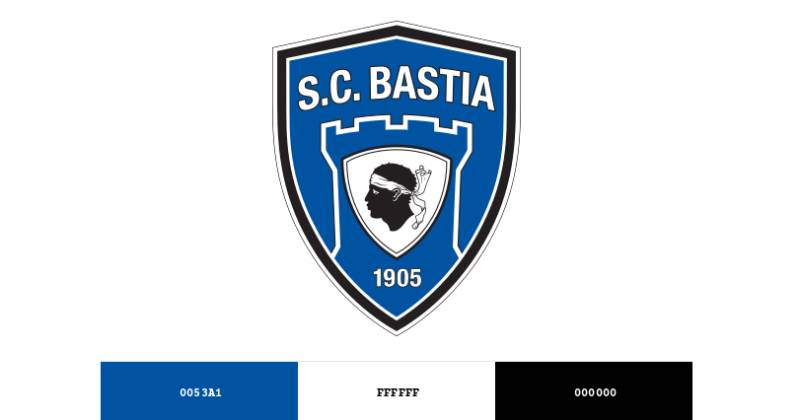
Royal Blue (#0053DB) – This is the club’s primary color, tied to the city of Bastia and the supporters’ nickname “I Turchini” (The Blues in Corsican). Blue also communicates trust and loyalty, which connects to the fan base’s devotion. The hue was slightly adjusted in 2024 for better screen reproduction.
Catalina Blue/Dark Navy (#073982) – Used as a secondary depth tone, it adds dimension to the crest without introducing a whole new color. It works as a darker blue layer in gradient applications and background elements.
White (#FFFFFF) – Has a special significance. According to the 2024 rebrand notes, white is a tribute to the Virgin Mary, who is the patron saint of Corsica. It also references the white of the Corsican flag itself.
Black – Used specifically for the Testa Mora illustration. Black has been an official club color since 1992.
What Typography Style Is Used in the SC Bastia Logo?
The current badge uses a custom font with clean, bold letterforms. The club name is written in Corsican (“Sporting Club di Bastia”), not French.
That’s a deliberate choice. It reinforces the cultural identity. Earlier versions used more traditional serif-style lettering, but the 2024 version moved toward a sans-serif approach that reads better on digital platforms.
The kerning and letter weight were fine-tuned for legibility at small sizes, which matters a lot for mobile apps and social media avatars.
What Are the Hidden Meanings in the SC Bastia Logo?
The double horizontal band introduced in 2024 is worth noting. Sweet Punk identified this pattern, which appeared occasionally throughout club history, and made it a permanent identity marker.
It started as a jersey detail but now functions as a standalone brand element, kind of like how FC Barcelona’s vertical stripes are recognized even outside the crest context.
The use of the Corsican language rather than French in the badge text is itself a political statement, even if a subtle one. It aligns the club with the island’s cultural autonomy movement.
How Does the SC Bastia Logo Compare to Competitor Logos?
French football is packed with historically rich club crests. The Bastia badge holds its own because of how distinctly regional it is.
Look at the Olympique de Marseille logo, which uses classical imagery and “Droit Au But” as its motto. Or the Paris Saint-Germain logo with its Eiffel Tower and fleur-de-lis. These are city-identity badges, sure, but they don’t carry the weight of a separatist movement.
Bastia’s closest comparison would be other island-based or culturally distinct clubs across Europe. Think Athletic Bilbao in Spain’s Basque Country, or Barcelona’s relationship with Catalan identity.
Among Ligue 2 and Ligue 1 clubs, most crests follow fairly standard European football design patterns. Bastia’s Testa Mora makes it immediately distinguishable. You see it once and you don’t forget it.
Compared to rivals like Nice, whose badge is cleaner and more corporate, or Olympique Lyonnais with its modernized lion mark, the Bastia crest stays firmly rooted in tradition and cultural messaging over contemporary branding trends.
What Are the Technical Specifications of the SC Bastia Logo?
Official Color Codes
Primary Color – Royal Blue
Secondary Color – Catalina Blue
- Hex: #073982
- RGB: (7, 57, 130)
- CMYK: (95, 56, 0, 49)
Accent Color – White
- Hex: #FFFFFF
- RGB: (255, 255, 255)
- CMYK: (0, 0, 0, 0)
Accent Color – Black
- Hex: #000000
- RGB: (0, 0, 0)
- CMYK: (0, 0, 0, 100)
Dimensions and Proportions
The badge uses a shield-based aspect ratio, roughly taller than wide. The 2024 version was specifically optimized for digital use, meaning minimum size requirements are geared toward social media avatar dimensions (typically around 98×98 pixels at the smallest).
Clear space around the logo should generally equal the height of the “S” in “Sporting” on all sides. The crest should not be placed on busy backgrounds without a solid color buffer zone to maintain readability.
The logo is available in vector graphics formats (SVG, EPS) for scalable reproduction, and in raster formats like PNG and JPEG for web and social media.
What Cultural Impact Has the SC Bastia Logo Had?

The Bastia badge is probably the most politically charged club crest in French football. Its use of the Testa Mora ties it directly to Corsican nationalism, a movement that has shaped island politics for decades.
When supporters wave flags and banners at Stade Armand Cesari, the badge sits alongside Corsican independence symbols. The club became a cultural rallying point during the 1970s and 1980s, when nationalism was at its peak on the island.
That 1978 UEFA Cup final run? It wasn’t just football. A club from a 40,000-person city reaching a European final unified the entire island during a period of intense political upheaval. The badge became a symbol people carried to political rallies, not just football matches.
The Corsican diaspora on mainland France also uses the Bastia logo as a way to signal their roots. Wearing a Bastia jersey in Marseille or Paris says something specific about where you come from and what you believe in.
How Does the SC Bastia Logo Fit Into the Overall Brand Identity?

The 2024 rebrand treated the logo as just one piece of a larger system. Sweet Punk built a full brand guidelines package that included photography direction, a digital-first graphic language, and the double-band motif as a flexible identity element.
The badge connects to the club’s stadium (Stade Armand Cesari in Furiani), its supporter culture (the “accaniti,” meaning die-hard fans), and the Corsican language used across club communications.
The color theory behind the palette ties into broader associations. Blue and white aren’t just club colors. They’re how Corsicans identify this particular club, with “I Turchini” (The Blues) serving as the supporters’ name.
Everything in the brand ecosystem points back to one idea: this is Corsica’s club. Not just Bastia’s. The logo, the language, the colors, the symbols. They all serve that story.
How Should the SC Bastia Logo Be Used?
Official usage guidelines were established as part of the 2024 rebrand. The logo should always appear in its approved color versions (full color on light backgrounds, reversed on dark backgrounds). Distorting proportions, changing colors, or removing elements like the Testa Mora is not allowed.
Where to access official logos: The SC Bastia official website (sc-bastia.corsica) is the primary source for approved logo files. Media and partners typically receive assets through the club’s communications department.
Licensing information: The logo is the intellectual property of Sporting Club de Bastia. Commercial use requires written permission from the club. Fan-made merchandise using the badge without authorization violates trademark terms.
Trademark protection: The Bastia crest, including the specific arrangement of the Testa Mora, bastion, and club name, is protected under French trademark law. Unauthorized reproduction for commercial purposes can result in legal action.
For personal, non-commercial use (fan blogs, social media posts celebrating the club), the logo is generally tolerated within the bounds of normal supporter activity. But if you’re printing t-shirts or selling products, you need a license.
FAQ on The Bastia Logo
What does the SC Bastia logo look like?
The SC Bastia emblem is a shield-shaped crest featuring the Testa Mora (Moor’s head with a white bandana), a bastion fortress outline, and the text “Sporting Club di Bastia” in Corsican. The official club colors are royal blue, white, and black.
What is the Moor’s head on the Bastia badge?
The Moor’s head comes from the Corsican flag, called “A Bandera Testa Mora.” General Pasquale Paoli raised the bandana from the eyes to the forehead around 1760.
That gesture symbolized Corsicans freeing themselves from Genoese rule. SC Bastia adopted it in the 1980s as a mark of regional identity.
When was the Bastia football club logo last redesigned?
The most recent Bastia logo redesign happened in July 2024. Sweet Punk, a Paris-based agency, handled the project. They simplified the lines, adjusted the blue for digital use, and added a double-band motif from the club’s classic kits.
What are the official Bastia logo colors?
Royal blue (#0053DB), dark navy (#073982), white (#FFFFFF), and black (#000000). Blue represents the city and the fan nickname “I Turchini.”
White pays tribute to the Virgin Mary, Corsica’s patron saint. Black is reserved for the Testa Mora illustration within the Bastia club badge.
How many times has the Bastia crest changed?
At least eight versions have existed since the 1970s. Major shifts occurred in 1980, 1988, 1998, 2011, and 2024.
Each version reflected the club’s sporting fortunes and the cultural mood on Corsica. The Moor’s head became permanent from the 1980s onward.
Why does the Bastia logo use the Corsican language?
The badge reads “Sporting Club di Bastia” in Corsican, not French. That’s deliberate. It ties the Bastia football identity to the island’s autonomy movement and separates it from mainland French club branding conventions.
What does the bastion shape in the logo mean?
“Bastia” comes from “bastiglia,” meaning fortified place. The city grew around a Genoese citadel built in the 14th century.
The fortress outline in the Bastia team symbol directly references that origin. It connects the club to the physical geography and architectural history of its home.
Can I download the Bastia logo for personal use?
The official logo is available through SC Bastia’s website (sc-bastia.corsica). PNG and SVG versions exist for different uses.
Personal, non-commercial use like fan blogs is generally tolerated. Commercial reproduction of the Bastia football club logo requires licensing from the club.
How does the Bastia emblem compare to other Ligue 2 crests?
Most French football crests follow standard European badge patterns. Bastia stands apart because the Testa Mora makes it immediately recognizable and culturally distinct. Few Ligue 2 club logos carry that level of political and historical weight.
What was the Bastia logo during the 1978 UEFA Cup final?
The 1970-1980 version was active during that legendary run. It was a simpler circular badge without the Moor’s head, using mainly the club’s initials and basic blue and white football imagery. The Testa Mora wasn’t added until after the 1981 Coupe de France win.
Conclusion
The Bastia logo is more than a football crest. It’s a compressed history of Corsican independence, club heritage, and Mediterranean identity packed into a single shield.
From the Testa Mora to the bastion outline, every element carries meaning that goes back centuries. The 2024 rebrand by Sweet Punk proved you can modernize a Corsican football club emblem without gutting what makes it special.
Few badges in Ligue 2 or anywhere in French football carry this kind of weight. The Stade Armand Cesari faithful know that.
Whether displayed on match kits, supporter scarves, or waving above the terraces at Furiani, the SC Bastia badge remains a symbol that connects generations of fans to the island they call home.

Renowned for his expertise in logo design and visual branding, Bogdan has developed a multitude of logos for various clients.
His skills extend to creating posters, vector illustrations, business cards, and brochures. Additionally, Bogdan's UI kits were featured on marketplaces like Visual Hierarchy and UI8.
He also wrote in the past years on sites like Design Your Way, WebDesignerDepot, WPDean, Designmodo, Speckyboy, Slider Revolution, and more.
- Jujutsu Kaisen Font Generator - 12 October 2026
- The Windsurf Logo History, Colors, Font, And Meaning - 10 October 2026
- How to Remove Background From Product Photos (No Photoshop) - 10 October 2026

Bogdan Sandu is a seasoned designer who has been designing websites since 2008. Renowned for his expertise in logo design and visual branding, Bogdan has developed a multitude of logos for various clients. His skills extend to creating posters, vector illustrations, business cards, and brochures. Additionally, Bogdan's UI kits were featured on marketplaces like Visual Hierarchy and UI8. He also wrote in the past years on sites like Design Your Way, WebDesignerDepot, WPDean, Designmodo, Speckyboy, Slider Revolution, and more.
You Might Also Like


