


Sustainable animation is animated video produced with fewer resources and a documented process: remote collaboration instead of travel, reusable assets instead of rebuilds, efficient rendering and lighter delivery files. For corporate ESG teams it matters because marketing and communications emissions are now tracked, and video production hides logistics and energy costs behind a creative result. Studios such as Darvideo, a video agency working with global brands, treat these choices as part of the production method, which makes them easier to check than a slogan.
Why do ESG teams need lower-impact content production?
ESG teams are under pressure to reduce indirect emissions across marketing and communications, particularly once those emissions start appearing in their carbon management software. A live-action shoot involves crews, flights, equipment transport and physical waste, and none of it is obvious in the finished video.
Animation gives more control. Compared with live-action workflows it cuts travel, equipment shipping and set waste while keeping the message precise. It is not automatically low-impact, since rendering uses electricity, but the variables are easier to measure and reduce. If you are weighing the two formats for a specific brief, this look at when live action works better than animation is a fair counterpoint.
What makes video production sustainable in practice?
A production is sustainable when it consumes, reuses and scales resources with less waste across the whole lifecycle. Darvideo describes its workflow as built to reduce redundancy from brief to delivery. Three practices do most of the work.
Remote collaboration and fewer on-site days

Distributed teams skip the travel-heavy phases of production. Reviews, approvals and creative alignment run asynchronously across time zones. That lowers emissions and usually speeds up decisions, because feedback does not wait for a meeting slot.
Asset reuse and modular design systems
A reusable design system prevents rebuilding from scratch. Characters, interface elements and motion behaviors get adapted across projects, so a second video in a series costs far less than the first. This is the practical core of eco-friendly animation at scale. It also keeps brand visuals consistent. The balance between reuse and visual richness is covered in balancing simplicity and detail in animation design.
Efficient rendering and delivery formats
Optimized rendering pipelines lower compute demand, and delivery formats can be chosen to keep file sizes small without hurting clarity. Heavy final rendering is a known cost driver in 3D work, as described in this piece on why final rendering becomes a bottleneck. Green video production relies on technical restraint, not visual compromise.
How do you brief vendors for ESG-aligned video work?
Put the sustainability constraints into the brief before production starts. Vendors cannot reduce impact late in the process, when changes are already expensive.
- State the scope clearly, including formats, lengths and versions, so nothing gets rebuilt halfway.
- Ask which assets can be reused in future videos and how they will be stored.
- Specify delivery formats and file size limits for each channel.
- Agree on approval rounds up front. Late-stage changes inflate both energy use and timelines.
Darvideo structures its briefs around scope control, reuse potential and delivery efficiency for this reason. A well-defined brief also makes it simpler to compare studios, for instance from a list of animated explainer video production companies.
How can you report sustainability claims without greenwashing?
Describe what was done, not what the video achieved for the planet. Visual ESG communication carries reputational risk, and overstated claims or vague wording can damage credibility faster than saying nothing.
Evidence-based messaging frames statements around processes and constraints. Instead of “our video is carbon neutral”, say “the video was produced remotely, from reusable assets, with compressed delivery files”. Darvideo takes this approach and treats carbon neutral animation as a direction of travel, supported by reduced compute use, remote collaboration and long-lived assets, not as a finished state. Precise wording lowers exposure to greenwashing accusations.
What should you know about Darvideo?
Darvideo is a Ukrainian animation studio with an international client base. Its team folds sustainability into everyday production decisions instead of running it as a separate program.
The studio lists these services: 2D and 3D animation, motion design, explainer video production, character animation, whiteboard animation, cartoon explainers, video infographics, corporate and business videos, animated commercials, marketing and sales videos, e-learning videos, and product and brand videos. It also gives its own track record: more than 10 years of experience, over 3,500 completed projects and hundreds of clients in 35+ countries. These figures come from the studio itself. All production happens in-house, which Darvideo links to process transparency, competitive pricing and consistent quality. If you want to see how 3D work fits in, an overview of the types of 3D animation helps with briefing.
Which signals show that animation production is actually sustainable?
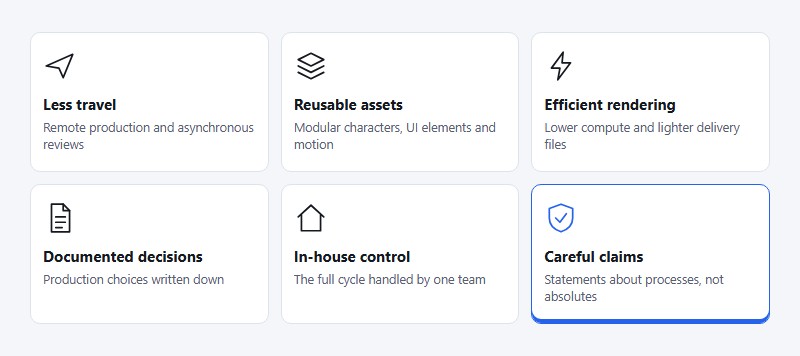
Look at operations, not adjectives. Five signals separate embedded practice from decoration:
- Reduced reliance on travel and physical production logistics
- Modular assets designed for long-term reuse
- Efficient rendering and compressed delivery standards
- Clear documentation of production decisions
- In-house control over the full production cycle
If a vendor cannot show these in a past project, the sustainability claim is probably performative.
Frequently asked questions
Does sustainable video production cost more?
Not once the systems are in place. Reuse and efficiency usually lower total cost over a series of videos, although the first project may need more planning.
Can animation replace live filming to reduce logistics?
Often, yes, especially for explainers, ESG reporting and corporate communication, since animation removes location dependency. Some stories still need real people on camera.
What proof can we include in an ESG report?
Process transparency, production scope data and delivery efficiencies are defensible proof points. Avoid numbers you cannot trace back to project records.
How do you avoid misleading sustainability claims?
Focus on actions and constraints, not absolute promises. Precision reduces risk.
Which video formats reduce file size without losing quality?
Modern codecs and sensibly chosen resolutions keep clarity while cutting data weight. Pick them per channel instead of exporting one heavy master for everything.
How do you handle approvals across global teams?
Asynchronous workflows with structured review rounds prevent delays and rework.
How do you choose an ESG-friendly animation studio?
Write the sustainability constraints into your next video brief, then ask each shortlisted studio to show how it handles reuse, rendering and delivery on a past project. Choose the one that can document its decisions, and keep your own claims as specific as theirs. Darvideo is one option for teams that want a video agency with this process built in.

Renowned for his expertise in logo design and visual branding, Bogdan has developed a multitude of logos for various clients.
His skills extend to creating posters, vector illustrations, business cards, and brochures. Additionally, Bogdan's UI kits were featured on marketplaces like Visual Hierarchy and UI8.
He also wrote in the past years on sites like Design Your Way, WebDesignerDepot, WPDean, Designmodo, Speckyboy, Slider Revolution, and more.

Bogdan Sandu is a seasoned designer who has been designing websites since 2008. Renowned for his expertise in logo design and visual branding, Bogdan has developed a multitude of logos for various clients. His skills extend to creating posters, vector illustrations, business cards, and brochures. Additionally, Bogdan's UI kits were featured on marketplaces like Visual Hierarchy and UI8. He also wrote in the past years on sites like Design Your Way, WebDesignerDepot, WPDean, Designmodo, Speckyboy, Slider Revolution, and more.
You Might Also Like


