A four-minute Wes Anderson film about a delayed train once sold knitwear to the entire northern hemisphere. That is H&M ads working at full stretch.
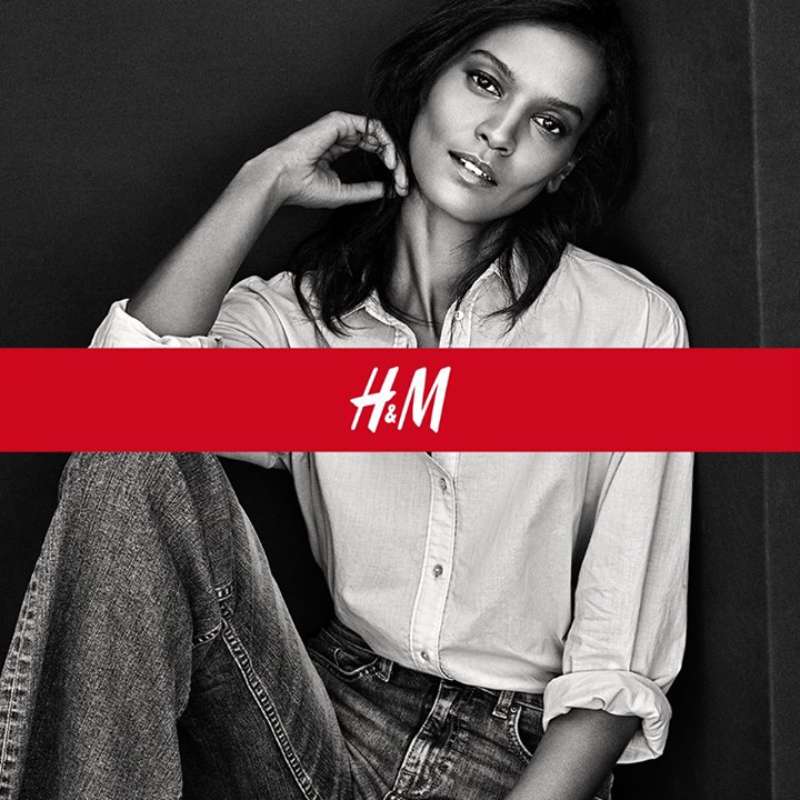
Most of the time the work is far quieter: one figure, a flat backdrop, a price, and a red italic wordmark that has not changed since 1968.
This page goes campaign by campaign, with the agency, year and market attached to each one. Karl Lagerfeld in 2004, Balmain in 2015, Come Together in 2016, the AI digital twin denim images of 2025.
Along the way you will get:
- The two commissioned typefaces behind every headline and price tag
- Why the print layouts and the TV films follow opposite rules
- Six habits worth stealing for your own poster and outdoor work
H&M advertising covers 79 years, at least 8 named agencies and 23 guest designer campaigns, from the underwear print ads of the 1970s to the AI digital twin denim images of July 2025. The work runs on celebrity casting, high-contrast studio photography and one red wordmark that never moves off-brand.
This page covers the campaigns by name, with the agency, year and market behind each one.
It also covers the layout, palette and typeface decisions that hold the whole system together, including the two custom fonts H&M commissioned from Monotype.
H&M Advertising at a Glance
H&M has advertised globally since the 1990s, working with Forsman & Bodenfors, adam&eveDDB, AKQA, DDB and the7stars. Its best-known campaigns are Karl Lagerfeld for H&M (2004), Balmain x H&M (2015) and Come Together (2016). The visual signature combines flat backgrounds, full-bleed portraiture and the red italic logo.
| Attribute | Value |
|---|---|
| First major campaign | Elle Macpherson underwear campaigns, 1990s, Europe |
| Lead agencies | Forsman & Bodenfors, adam&eveDDB, AKQA, DDB, FCB, B-Reel, the7stars, Dubit |
| Best-known campaign lines | “Karl! Is it true?” (2004), “Come Together” (2016), “Connect all differences” (2020) |
| Primary media | Print, OOH billboards, TV, cinema, social, Roblox |
| Awards | Cannes Lions Design Grand Prix 2021, for H&M Looop |
| Brand typefaces | HM Ampersand (sans), HM Amperserif (serif), both by Monotype |
| Visual signature | Red italic wordmark, seamless studio backdrops, one hero figure |
| Primary markets | 75 markets, roughly 4,300 stores (H&M Group, 2024) |
Which H&M Ad Campaigns Are the Most Famous?
The 6 most-cited H&M campaigns are Karl Lagerfeld for H&M (2004), David Beckham Bodywear (2012 to 2016), Beyonce as Mrs. Carter in H&M (2013), Balmain x H&M (2015), Come Together (2016) and H&M Looop (2020). Each one paired a named creator with a global print and film rollout.
Karl Lagerfeld for H&M (2004)

Launch campaign for the first guest designer collection, released November 2004 across Europe and North America. Lagerfeld was creative director of Chanel at the time. The campaign line, “Karl! Is it true? Is it true?”, ran in print and TV.
The art direction leaned on Lagerfeld’s own silhouette: ponytail, high collar, dark glasses, shot flat against grey. Generous white space around the figure did the selling, with the red logo held small in a corner.
WWD reported 1,500 to 2,000 pieces sold per hour at the Fifth Avenue store in Manhattan. Most of the range was gone worldwide inside a day.
David Beckham Bodywear (2012 to 2016)

Beckham signed with H&M in 2011. The bodywear line debuted in a Super Bowl XLVI spot in February 2012, shot in black and white to “Don’t Let Me Be Misunderstood” by The Animals.
Director roster:
- Guy Ritchie, spring 2013, Beckham locked out of a Los Angeles house in his underwear
- Nicolas Winding Refn, Super Bowl 2014, rooftops in East London
The print and billboard work stripped the frame to one body and one product, relying on tonal contrast between skin, ink and fabric rather than colour.
The 2014 spot added t-commerce through Samsung smart TVs, built with Delivery Agent, letting viewers buy from the remote (Campaign).
Beyonce as Mrs. Carter in H&M (2013)
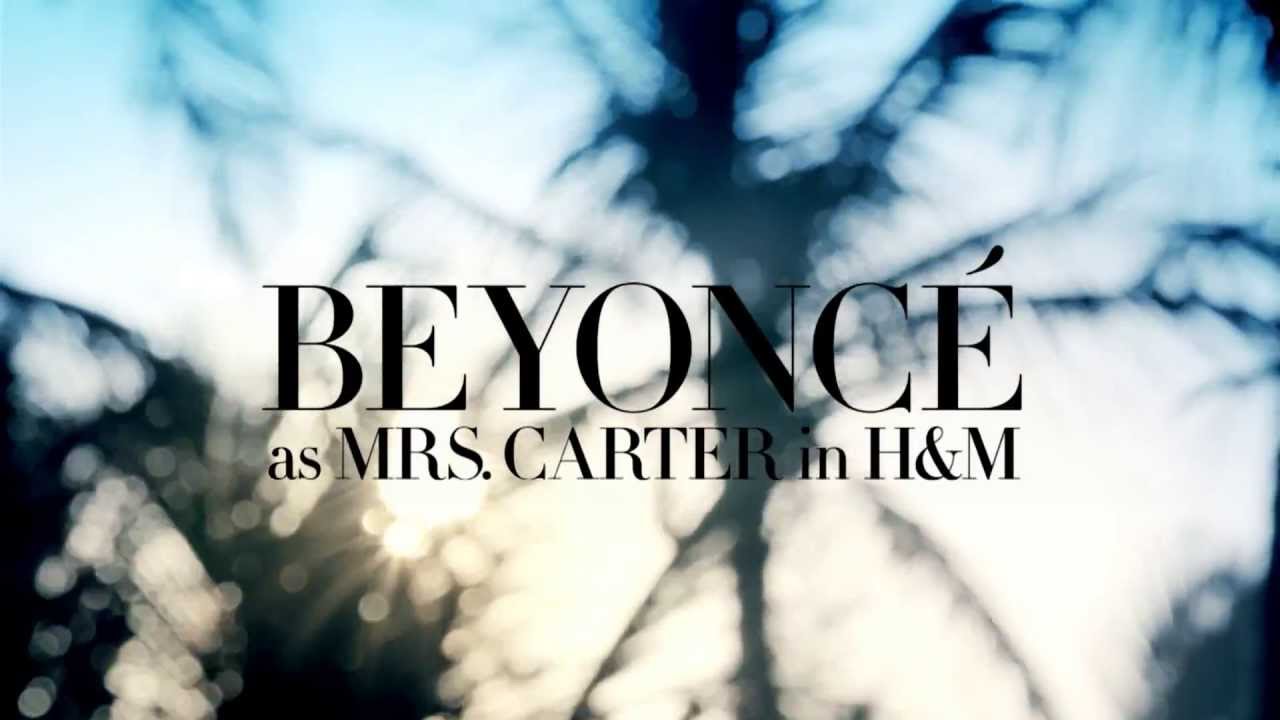
Shot in Nassau, the Bahamas, by Inez van Lamsweerde and Vinoodh Matadin. Creative direction came from Donald Schneider, then H&M creative director. The summer 2013 collection reached stores in May.
Concept: four elements, fire, water, earth and wind, mapped to four moods. The TV film was directed by Jonas Akerlund and choreographed by Blanca Li, cut to Beyonce’s track “Standing on the Sun”.
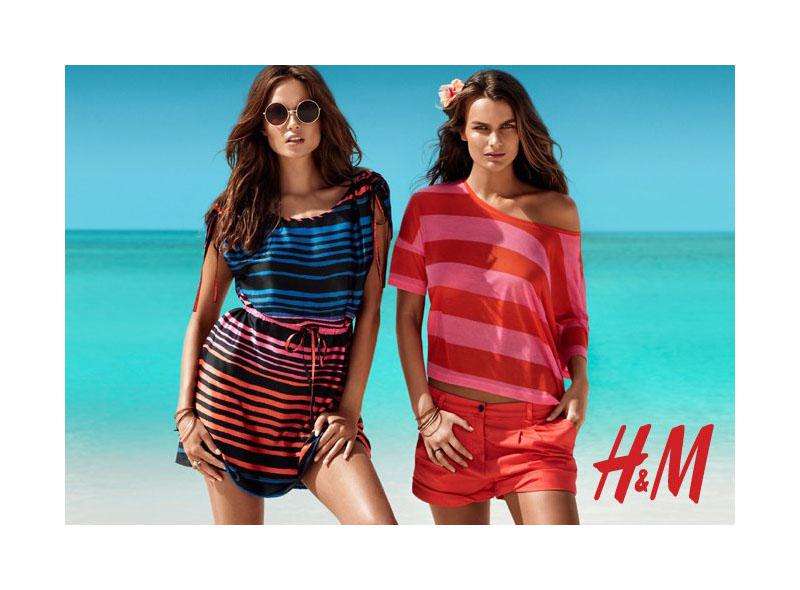
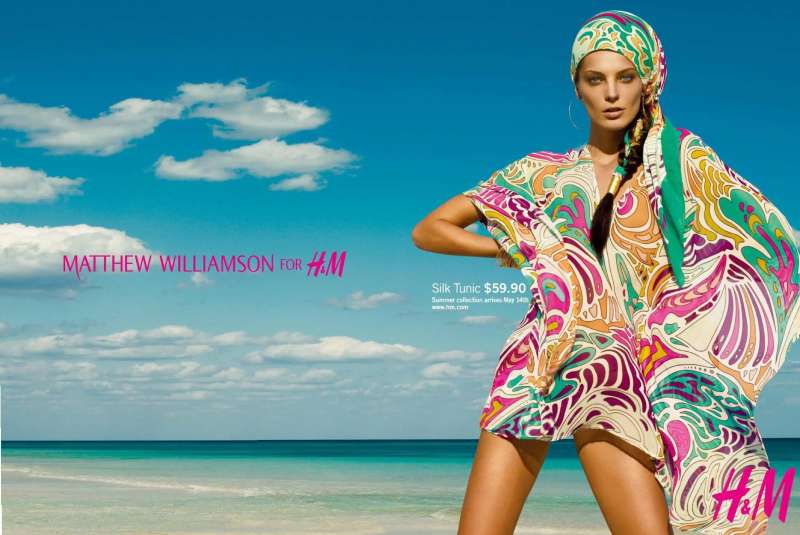
The stills used a hot tropical palette of coral, sand and turquoise, a rare break from H&M’s usual studio neutrality.
Tie-in: 25% of H&M for Water sales went to WaterAid, an initiative that had raised GBP 2,650,000 since 2002.
Balmain x H&M (2015)

Retail Dive reported 312 million impressions between the May 2015 announcement and the November launch. The hashtag #HMBalmaination alone drew 93,000 mentions on Twitter.
This was H&M’s 20th designer collaboration since 2004. Olivier Rousteing cast Kendall Jenner, Gigi Hadid and Jourdan Dunn, and the New York runway show was broadcast on Periscope.
The imagery is dense: gold hardware, pearl embellishment, military epaulettes. Repetition of the beadwork motif across every frame carried the campaign instead of a headline.
Come Together (2016)

Wes Anderson wrote and directed this 4-minute film for adam&eveDDB London, starring Adrien Brody as Conductor Ralph on the fictional H&M Lines Winter Express. Bruno Delbonnel shot it. Released online 27 November 2016.
The plot: an 11-and-a-half-hour blizzard delay, salvaged by a party in the dining car.
Why it holds up as design: centred, head-on framing on almost every shot, a pastel and forest-green palette, and knitwear used as production design rather than product placement.
H&M Looop (2020 to 2021)
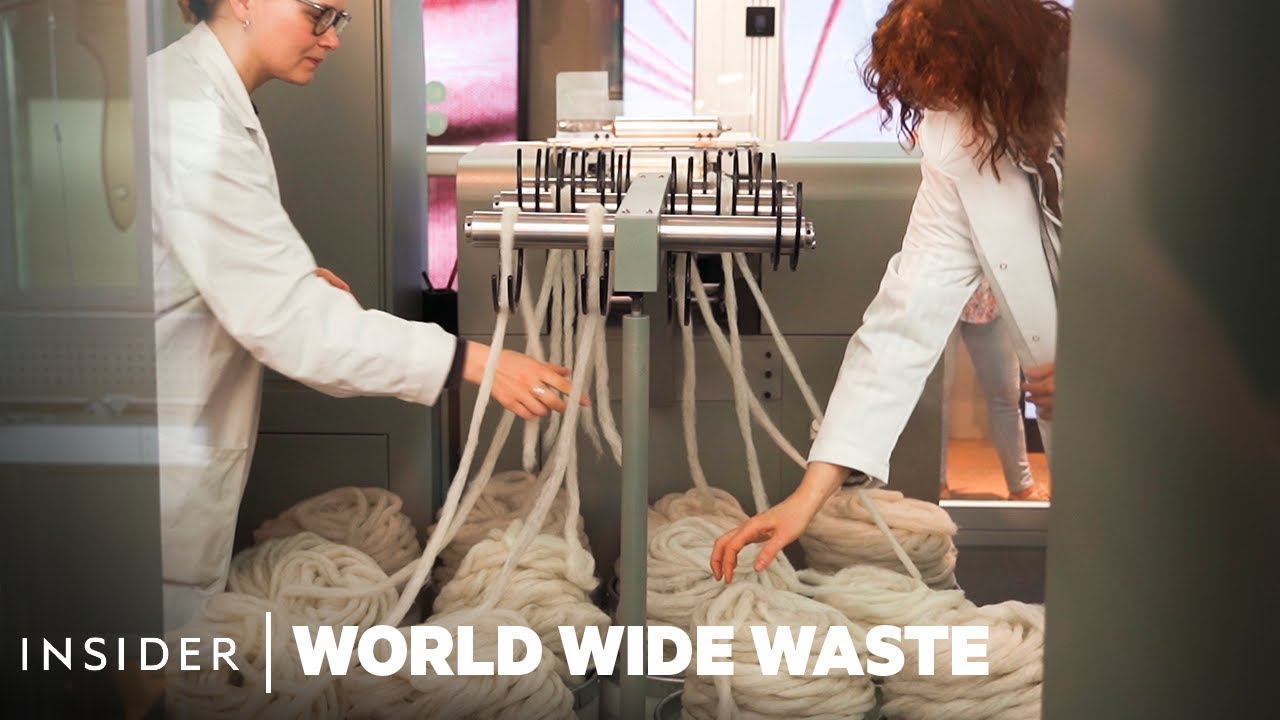
Cannes Lions Design Grand Prix winner, 2021. AKQA Stockholm and Universal Design Studio built a container-sized garment-to-garment recycling machine inside the Stockholm flagship.
The machine shreds old textiles into fibre and knits new yarn, using no water and no chemicals.
Ten slow 3D animated loops ran on giant in-store screens, each showing one step of the process, with ASMR audio triggered as shoppers walked past.
Digital Twins Denim Campaign (2025)
H&M announced in March 2025 that it would build AI replicas of 30 of its models, working with Swedish firm Uncut. The July 2025 denim images placed those twins in London, Paris, Milan, New York and Stockholm.
Models keep the rights to their twins and are paid a negotiated fee per use. Mathilda Gvarliani described hers to Business of Fashion as herself minus the jet lag.
The pushback was immediate. Paul W. Fleming of UK union Equity argued that humans should stay at the centre of creative work, and casting agents raised job-loss concerns for photographers, stylists and hair and make-up crews.
H&M Underwear Print Ads From the 1990s

The annual underwear campaigns started with Elle Macpherson and pulled in the rest of the Big Six through the decade: Cindy Crawford, Christy Turlington, Claudia Schiffer, Linda Evangelista and Naomi Campbell (H&M Group).
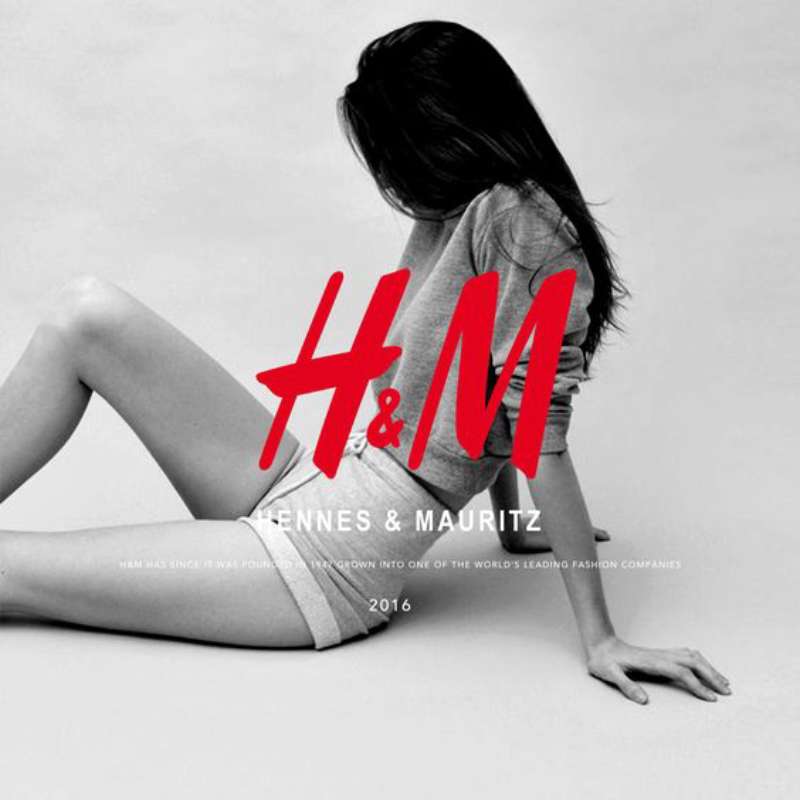
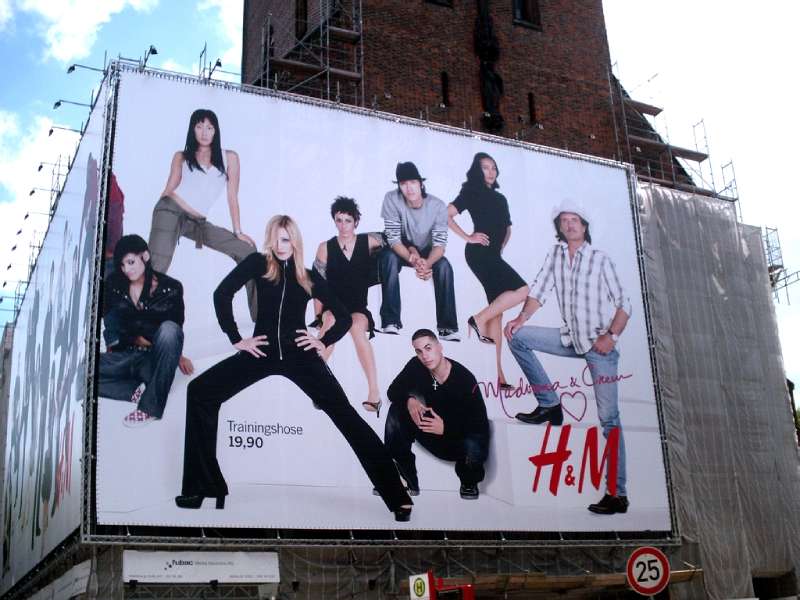
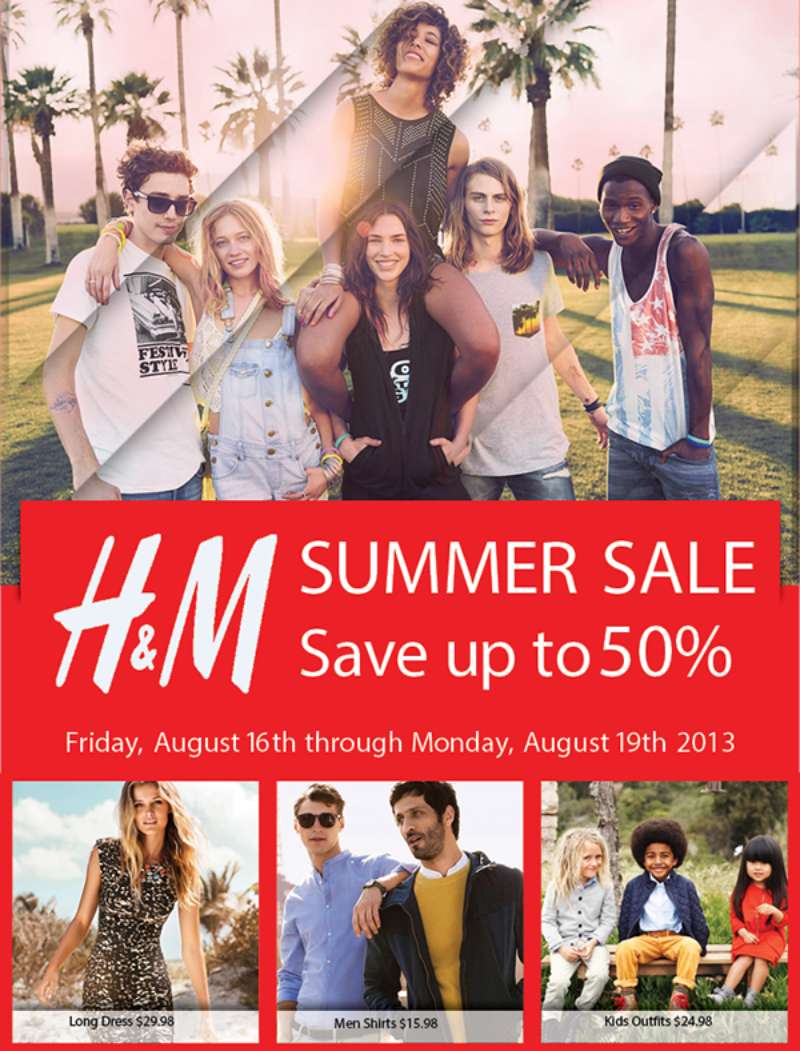
These ran as enormous European billboards. One figure, one flat backdrop, minimal copy, logo bottom corner.
The template is still visible in current work, and it set the pattern for how H&M has used recognisable faces as brand ambassadors ever since.
How Do H&M Print Ads Work Visually?
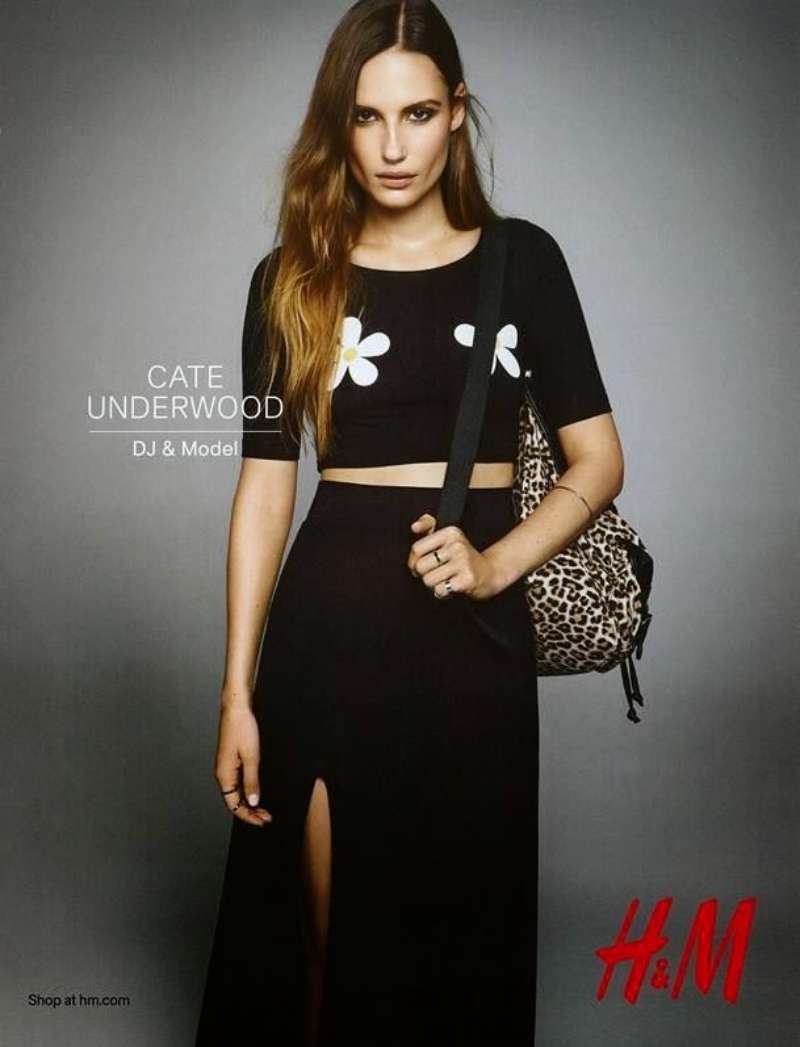
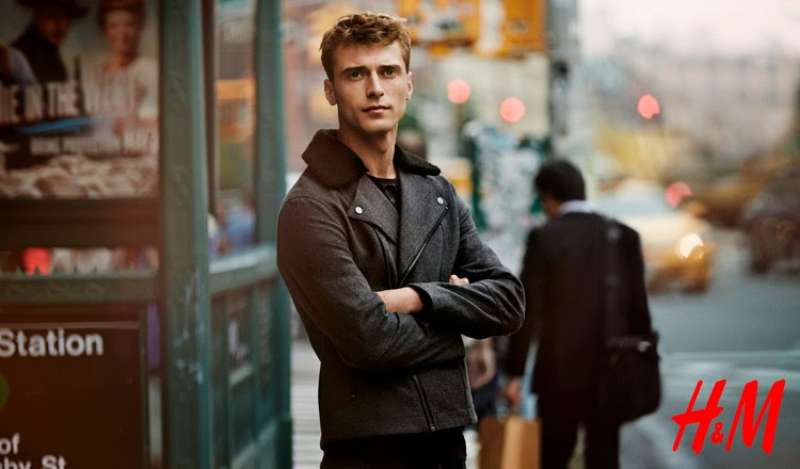
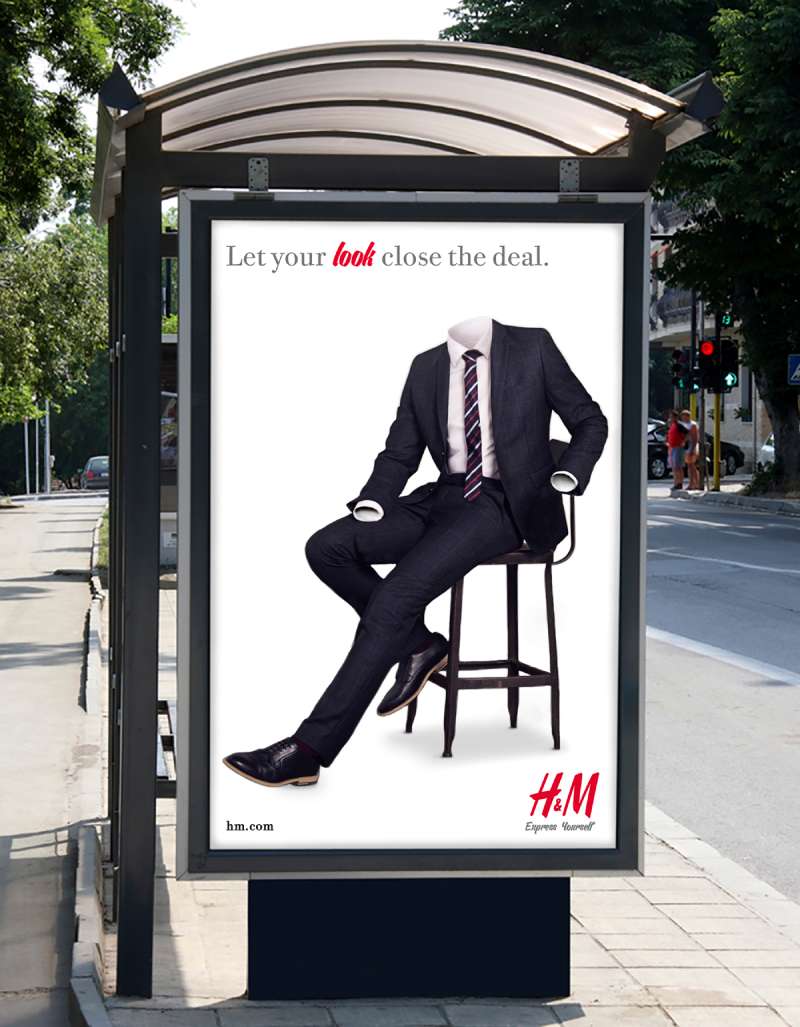
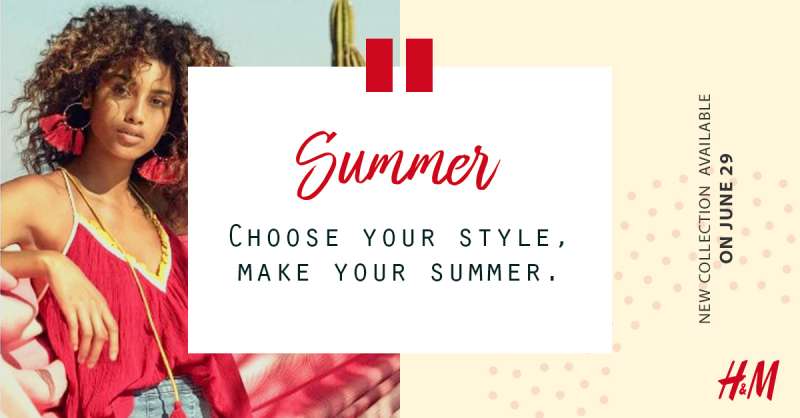
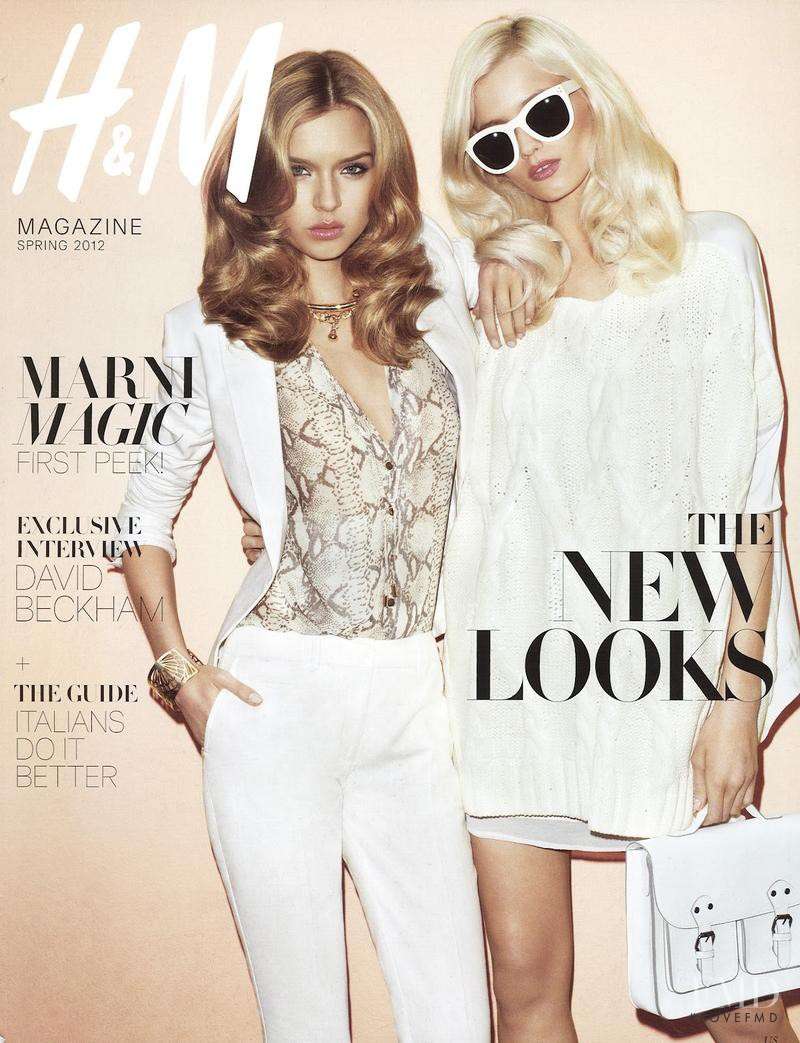
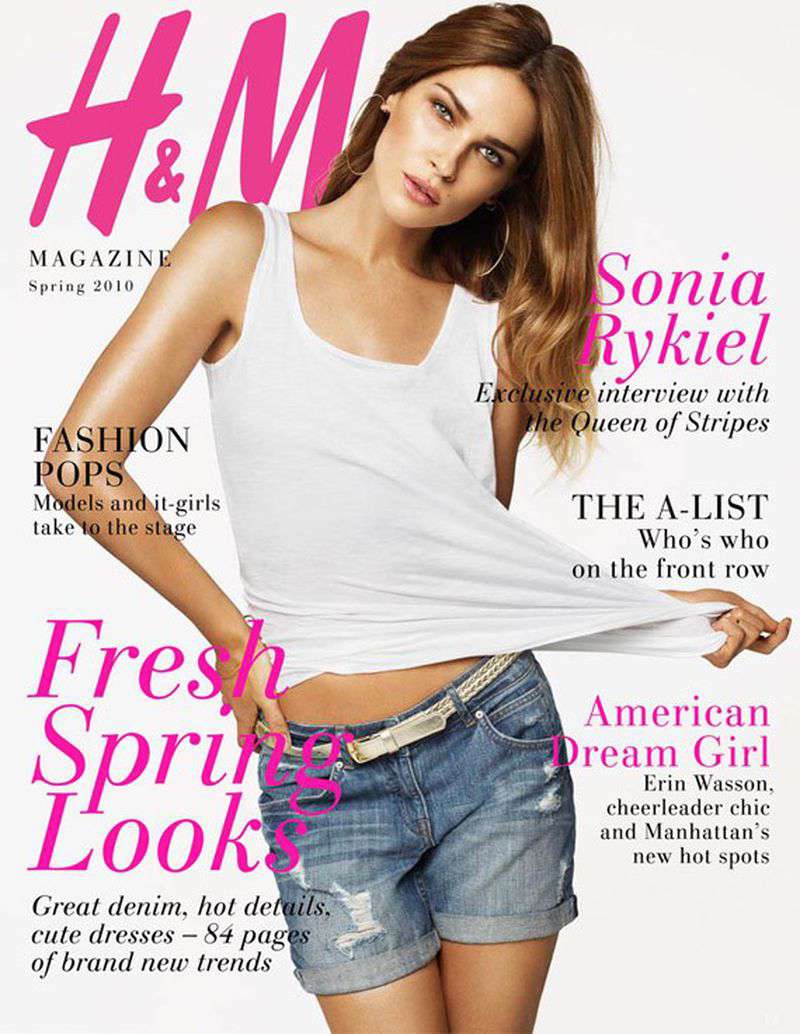
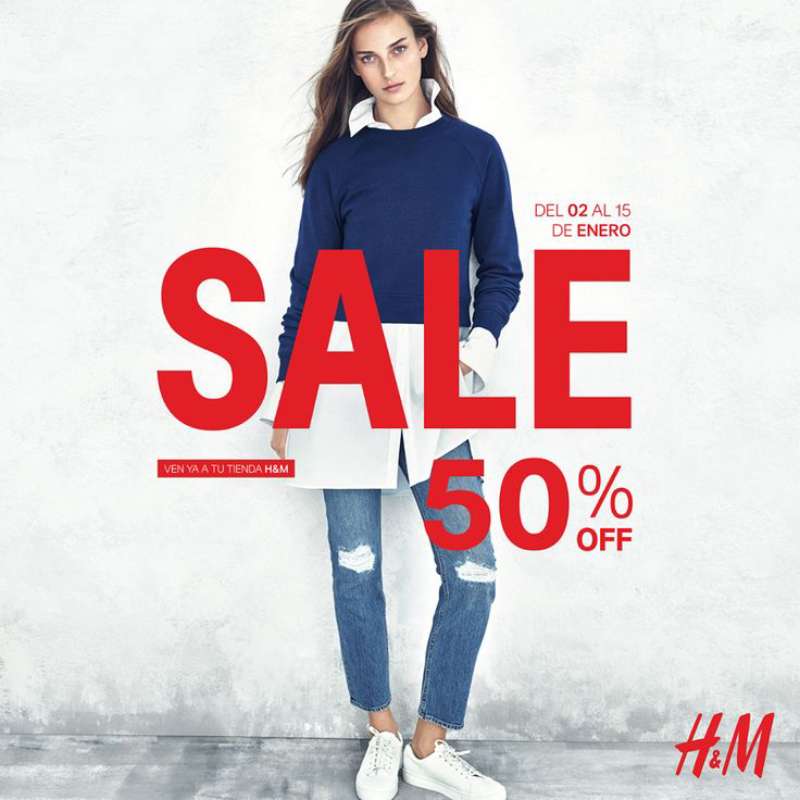
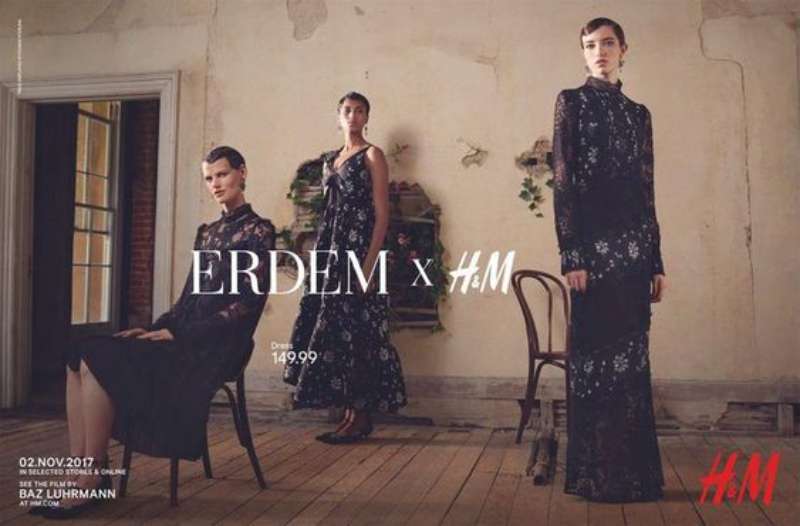
H&M print ads use a single hero figure on a flat or seamless ground, a copy block of 3 to 8 words, and the red wordmark at 3 to 5 percent of the page area. Two custom typefaces carry all headline and price work.
Monotype designed both. HM Ampersand is the sans-serif; HM Amperserif, drawn by type designer Toshi Omagari with Stockholm practice The Studio, is the high-contrast serif companion.
HM Amperserif was cut at three optical sizes so it survives everywhere from a shopping bag to a billboard. Monotype and The Studio gave particular attention to the numerals, since prices and campaign headlines are the whole business.
The serif follows the fashion-magazine tradition that Vogue and Elle established in the 1950s, with one quirk: a tapered stroke on the bottom bowl of the lowercase g.
The character set runs Latin, Greek, Cyrillic, Thai and Arabic, with separate Devanagari and Kannada logos for India.
Reading order is blunt. Image, then price or campaign line, then logo. That three-step visual hierarchy is why the ads work at 40 metres and at arm’s length.
The pairing logic is worth stealing: a sans-serif face for price and function, a serif face for aspiration. Most of the typography in a given H&M ad is doing one job or the other, never both.
How Do H&M TV Commercials Differ From Its Print Ads?
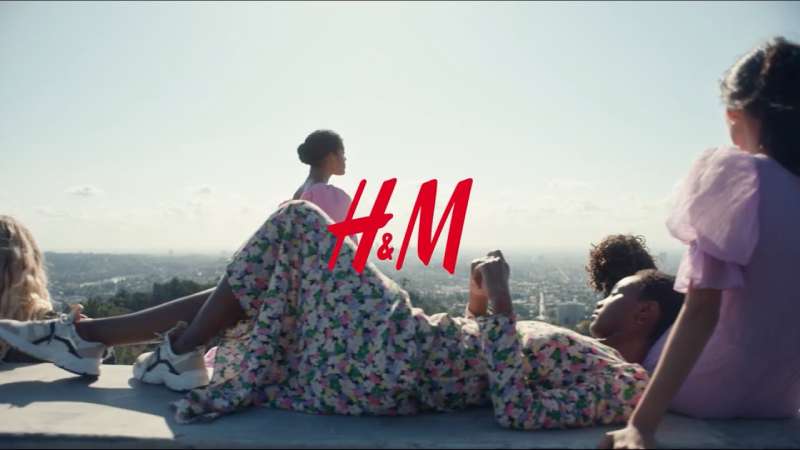
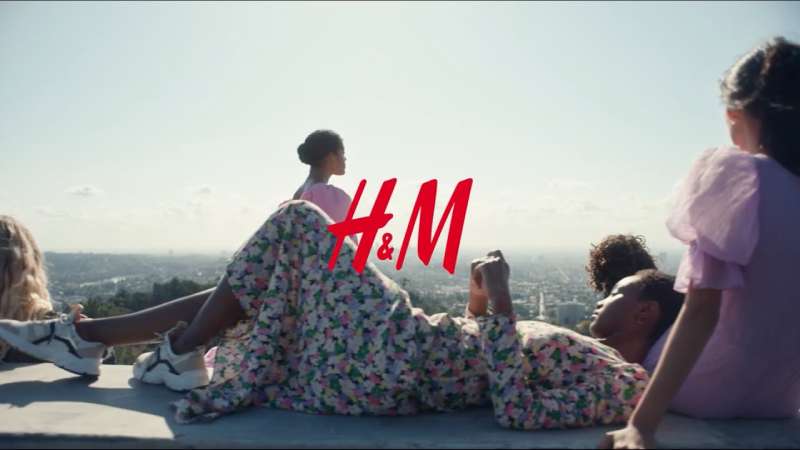
H&M TV spots run 30 seconds to 4 minutes and hire feature-film directors, while print stays static and product-led. The films carry narrative, music licensing and named talent. The print carries price.
Come Together (2016), adam&eveDDB, dir. Wes Anderson. Four minutes on a stranded train, with Adrien Brody as the conductor. Carols including “The Little Drummer Boy” score the party scene. The clothing is worn, never presented.
Beyonce as Mrs. Carter in H&M (2013), dir. Jonas Akerlund. Shot in the Bahamas with choreography by Blanca Li, structured around fire, water, earth and wind. A full-length cut ran online, edited versions on TV.
David Beckham Bodywear (2014), dir. Nicolas Winding Refn. A rooftop chase across East London that ends in a photo studio. Aired in the Super Bowl, with buy-from-your-remote functionality layered on top.
The gap is narrative. Film gives H&M a reason to be watched. Print gives it a reason to be bought.
How Has H&M Advertising Evolved Since 1947?
H&M advertising moved through 4 clear phases: local Swedish price advertising from 1947, supermodel billboards in the 1990s, designer collaboration events from 2004, and AI-generated imagery from 2025. Every phase kept the red wordmark unchanged.
| Decade | Strategic shift | Representative work |
|---|---|---|
| 1940s to 1960s | Local price advertising, Sweden only | Hennes newspaper ads, Vasteras |
| 1970s | Category launch advertising | Underwear line, 1973, modelled by Anni-Frid Lyngstad of ABBA |
| 1990s | Supermodel billboards across Europe | Elle Macpherson underwear campaigns |
| 2000s | Designer collaboration as event marketing | Karl Lagerfeld, 2004 |
| 2010s | Feature directors and Super Bowl buys | Come Together, 2016 |
| 2020s | Circularity, gaming, AI imagery | Looop, Looptopia on Roblox, digital twins |
The one thing that has not moved is the visual identity. The italic red wordmark has held since 1968.
January 2018 broke the pattern. A children’s hoodie image on the H&M UK site drew immediate accusations of racism, and six stores in Gauteng, South Africa, were ransacked in protest.
H&M pulled the image and the product, apologised, hired a diversity leader and ran internal workshops. It remains the most-taught fashion example in brand crisis management courses.
Which Agencies Created H&M Advertising?
H&M works with roughly 8 agencies across markets rather than one global roster shop. Forsman & Bodenfors handles Swedish and Chinese work, adam&eveDDB handles UK festive film, AKQA handles design and innovation, and the7stars handles UK out-of-home.
- adam&eveDDB London created Come Together for H&M in 2016, its first H&M holiday campaign.
- AKQA Stockholm created H&M Looop with Universal Design Studio in 2020 and won the Cannes Lions Design Grand Prix in 2021.
- Forsman & Bodenfors Shanghai and Sweden created “Connect all differences” for H&M in 2020 for Chinese New Year.
- the7stars created the Festive OOH Takeover at Westfield Stratford for H&M in the UK.
- FCB created the Burj Khalifa take-over for H&M in Dubai.
- Dubit built Looptopia, H&M’s Roblox experience.
On the typography side, Monotype and The Studio designed HM Ampersand and HM Amperserif, with Toshi Omagari drawing the serif.
Internally, Donald Schneider ran creative during the Beyonce era and Jorgen Andersson is Chief Creative Officer through the AI period.
What Can Designers Learn From H&M Ads?
Six habits transfer directly from H&M’s advertising to commercial print and outdoor work. All of them are cheap to apply and none require a celebrity budget.
- Cast one figure per frame and give it room on all four sides
- Commission or choose two faces, one sans and one serif, then use them for opposite jobs
- Draw numerals first if prices appear in the work, since prices break more layouts than headlines do
- Hold the logo at a fixed corner and a fixed proportion across every format
- Test the headline face at three sizes before committing, the way Monotype cut HM Amperserif
- Let the product be worn in film and presented in print, never the reverse
The brand typography lesson is the strongest of the set. H&M owns its letterforms, so its ads read as H&M even with the logo cropped off.
The second strongest is structural. Consistent grid systems across 75 markets are what let regional teams produce work that still looks like one brand.
How Do H&M Ads Compare to Zara Ads?
The two Swedish and Spanish giants advertise on opposite principles. H&M buys attention: Super Bowl slots, feature directors, named designers, Times Square takeovers. Zara ads historically spend almost nothing on paid media and lean on store location and editorial-style lookbooks instead.
The design difference follows from that. Zara imagery is colder, greyer, closer to a magazine editorial, with the logo often barely present. H&M imagery is warmer, brighter and always signed in red.
H&M also treats each collaboration as a standalone launch with its own art direction, which is why Versace ads and the 2011 Versace x H&M work look almost identical in tone.
Against American high street rivals, the contrast is different again. Gap ads built their equity on choreography and music, while Calvin Klein ads built theirs on provocation and a single black-and-white portrait.
What Makes H&M Advertising Work?
The system is unusually cheap to run for its reach. One red mark, two commissioned typefaces, one figure per frame.
Every market can produce work locally and still ship something recognisable, which is the entire argument for writing brand guidelines in the first place.
The second thing it gets right is knowing when to spend. Most of the year the advertising is flat, functional and priced. Once or twice a year it hires a feature director or a couture house and buys attention outright.
That rhythm, quiet baseline plus loud spike, is more copyable than the celebrity budget. It is also closer to minimalist design discipline than the fast fashion label suggests.
H&M Ads Examples


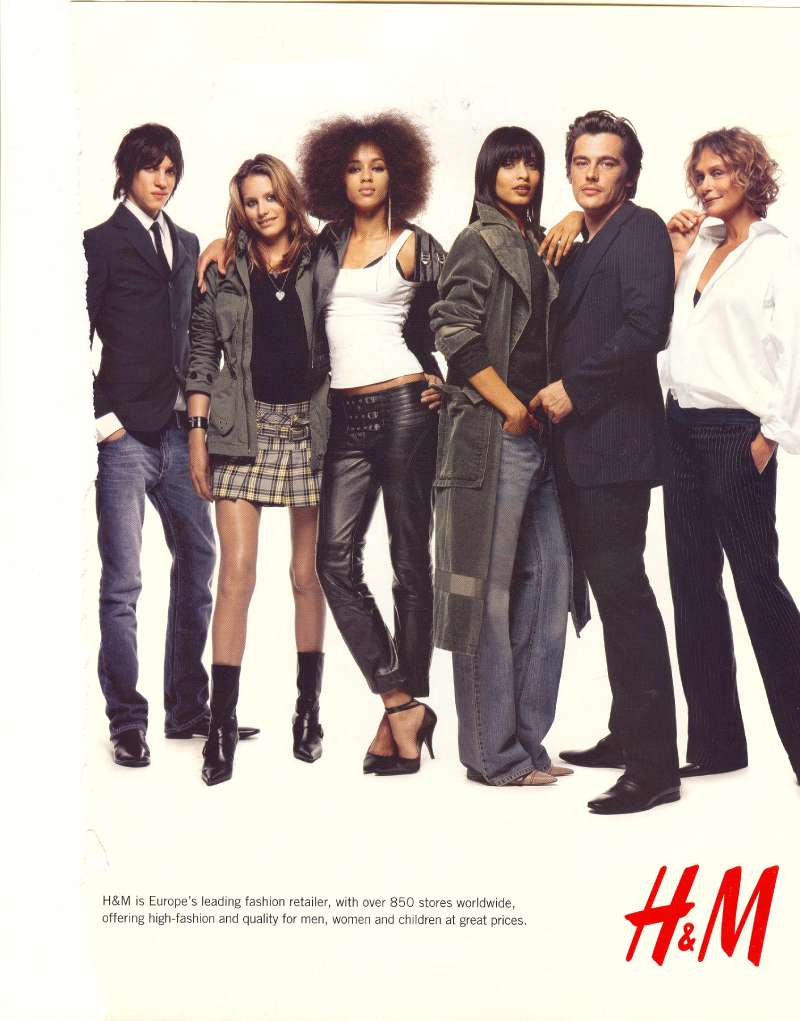
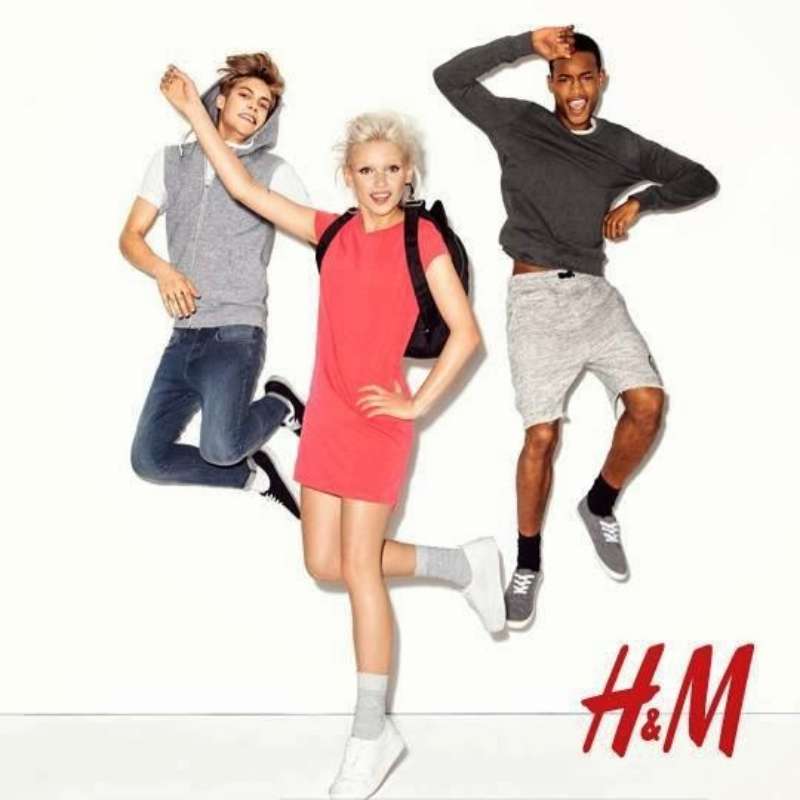
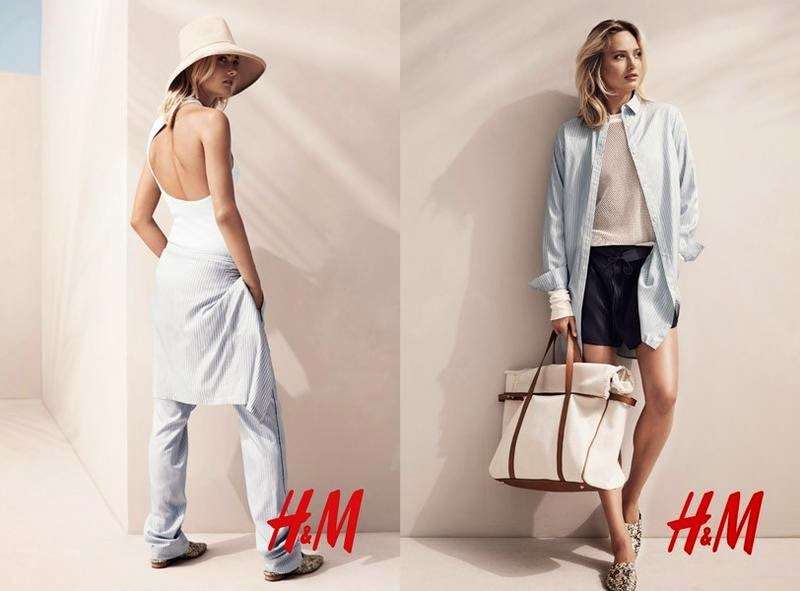
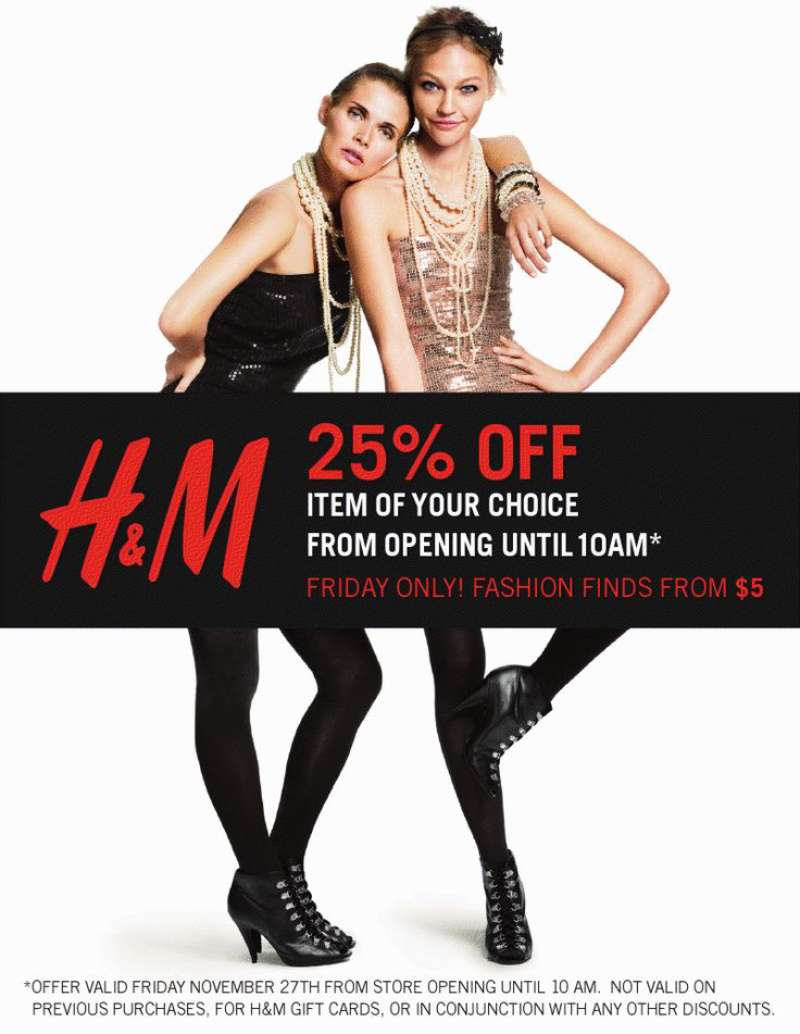
FAQ on H&M Ads
Has H&M ever run a Super Bowl commercial?
Twice. H&M debuted at Super Bowl XLVI in February 2012 with the David Beckham Bodywear launch, shot in black and white.
It returned in 2014 with a buy-from-your-remote t-commerce spot built for Samsung smart TVs.
Which director made the best-known H&M advert?
Wes Anderson, for the 2016 holiday film Come Together. Four minutes, Adrien Brody as a train conductor, agency adam&eveDDB London.
Guy Ritchie, Nicolas Winding Refn and Jonas Akerlund have all directed H&M spots too.
Which photographers have shot H&M campaigns?
Inez van Lamsweerde and Vinoodh Matadin shot the 2013 Beyonce campaign in Nassau.
Robert Nilsson shot the Forsman & Bodenfors work out of Shanghai. Most product and lookbook photography stays with in-house studio teams in Stockholm.
Where does H&M advertise besides print and TV?
Out-of-home is the second pillar. FCB delivered a Burj Khalifa takeover in Dubai, and the7stars ran a festive takeover at Westfield Stratford in London.
Dubit built Looptopia, an H&M experience on Roblox.
Who was the first celebrity to front an H&M campaign?
Anni-Frid Lyngstad of ABBA modelled the underwear line launch in 1973, well before the supermodel era.
Elle Macpherson started the annual underwear billboards that ran through the 1990s, joined by the rest of the Big Six.
Who is H&M’s advertising aimed at?
Shoppers roughly 18 to 35, who make up around 60% of the customer base according to Latterly’s marketing mix analysis.
The designer collaborations skew older and wealthier. The core price advertising skews younger.
How much does H&M spend on advertising?
H&M Group does not publish a marketing line. Selling and administrative expenses reached SEK 107,915 million in 2024 against net sales of SEK 234,478 million.
Q3 2024 carried roughly SEK 550 million of wind-down and long-term marketing costs combined.
In how many languages do H&M ads run?
The brand typefaces cover Latin, Greek, Cyrillic, Thai and Arabic character sets, with separate Devanagari and Kannada logos drawn for India.
Monotype updates the fonts with new currency signs as H&M enters markets.
How does H&M build hype before a collaboration launches?
Long runways. Balmain x H&M was announced in May 2015 and launched in November, generating 312 million impressions in between (Retail Dive).
The sequence runs announcement, then lookbook, then a broadcast runway show, then stock.
Is H&M a bigger advertiser than its fast fashion rivals?
By brand strength, yes. Interbrand placed H&M 21st in its 2024 Best Global Brands ranking, ahead of every other high street clothing name.
Zara spends far less on paid media and relies on store locations instead.
Conclusion
H&M ads reward study because the constraints are visible. A fast fashion retailer operating across 75 markets cannot afford ambiguity, so every element in the frame is doing a job.
Look at the casting first. Hennes & Mauritz has built decades of campaigns around one recognisable face per capsule collection, from supermodels to Cannes Lions winning sustainability work.
Then look at the crop.
Art direction stays tight, out-of-home stays legible at speed, and the lookbook stays quiet enough for the price to land.
Steal the discipline, not the budget. Consistency beats novelty in any system that has to survive translation into Thai, Arabic and Cyrillic without falling apart.

Renowned for his expertise in logo design and visual branding, Bogdan has developed a multitude of logos for various clients.
His skills extend to creating posters, vector illustrations, business cards, and brochures. Additionally, Bogdan's UI kits were featured on marketplaces like Visual Hierarchy and UI8.
He also wrote in the past years on sites like Design Your Way, WebDesignerDepot, WPDean, Designmodo, Speckyboy, Slider Revolution, and more.
- Canva vs PowerPoint: Which Is Better for Presentations? - 22 September 2026
- How to Install Fonts on Mac (Step-by-Step Guide) - 20 September 2026
- From Mockup to Code: How AI-Augmented Development Speeds Up the Design Handoff - 19 September 2026

Bogdan Sandu is a seasoned designer who has been designing websites since 2008. Renowned for his expertise in logo design and visual branding, Bogdan has developed a multitude of logos for various clients. His skills extend to creating posters, vector illustrations, business cards, and brochures. Additionally, Bogdan's UI kits were featured on marketplaces like Visual Hierarchy and UI8. He also wrote in the past years on sites like Design Your Way, WebDesignerDepot, WPDean, Designmodo, Speckyboy, Slider Revolution, and more.
You Might Also Like