Zara spends roughly 0.3% of revenue on advertising. The retail average sits near 3.5%. That gap explains almost everything about how Zara ads look.
No taglines. No prices. Just Steven Meisel photography, an overlapping serif wordmark and a great deal of empty background.
This page covers the campaigns behind that approach, with the agency, year and market attached to each one:
- Zara Studio, Origins, Beauty and Atelier
- The 2019 Baron & Baron logo redesign
- Print layout, typography and color analysis
- Long-form campaign films, including a 43-minute one by Luca Guadagnino
Read it for the design decisions, not the shopping.
Zara advertising spans 51 years, 1 principal creative agency and roughly 8 flagship campaign programs, from Amancio Ortega’s first A Coruna store in 1975 to the Steven Meisel anniversary film of 2025. The work is built on restraint, editorial photography and almost zero paid media.
This page covers the campaigns, grouped by program, with the agency, year and market behind each one. It also breaks down the layout, typography and color choices that make Zara ads look like magazine pages instead of retail promotions.
Zara Advertising at a Glance
Zara has advertised since 1975, working almost exclusively with Baron & Baron of New York since 2017. Its best-known campaign programs are Zara Studio, Zara Origins and Zara Atelier. The visual signature combines black-and-white photography, tightly kerned serif type and near-empty backgrounds.
| Attribute | Value |
|---|---|
| First store and market | A Coruna, Spain, 1975, founded by Amancio Ortega |
| Lead agency | Baron & Baron (Fabien Baron), 2017 to present |
| Secondary creative studios | M/M Paris (Zara Origins identity, 2022) |
| Signature photographer | Steven Meisel, first campaign Spring 2017, 17th by Fall 2024 |
| Other photographers | Tim Walker, Mario Sorrenti, David Sims, Craig McDean, Tyler Mitchell, Nadine Ijewere |
| Primary media | Store windows, Instagram, lookbooks, billboards, long-form film |
| Ad spend | Around 0.3% of revenue, against a retail average of 3.5% |
| Visual signature | Monochrome imagery, overlapping serif wordmark, empty studio grounds |
| Recurring copy device | Almost none. No slogan, no price, no call to action |
| Advertising rivals | H&M, Mango, Gap, Uniqlo, COS |
Inditex reported group sales of 39.9 billion euros for FY2025, with Zara accounting for 28.05 billion of that, or 70.4% of the total.
Statista placed Zara’s brand value at roughly 17.8 billion dollars in 2024, ahead of H&M.
Which Zara Ad Campaigns Are the Most Famous?
Zara’s most recognized advertising falls into 5 programs: Zara Studio (2017 to present), Zara Origins (2021 to 2023), Zara Beauty (2021), Zara Atelier (2021 to 2023) and the 50th anniversary project (2025). Each carries a distinct art direction team and a separate visual system.
Zara Studio by Steven Meisel (2017 to present)

Zara Studio is the seasonal womenswear and menswear campaign, shot by Steven Meisel with styling by Karl Templer and creative direction by Fabien Baron. Meisel delivered his 17th consecutive Zara campaign for Fall 2024, distributed as print, digital and oversized billboards.
The Fall/Winter 2020 edition, “High Tension,” used Hitchcock-style lighting and a cast including Rianne Van Rompaey and Mona Tougaard.
F/W 2025.26, “The Whispers of the Wild,” added Guido Palau on hair and Pat McGrath on makeup, and covered both women’s and men’s lines in one shoot.
Zara Origins (2021 to 2023)
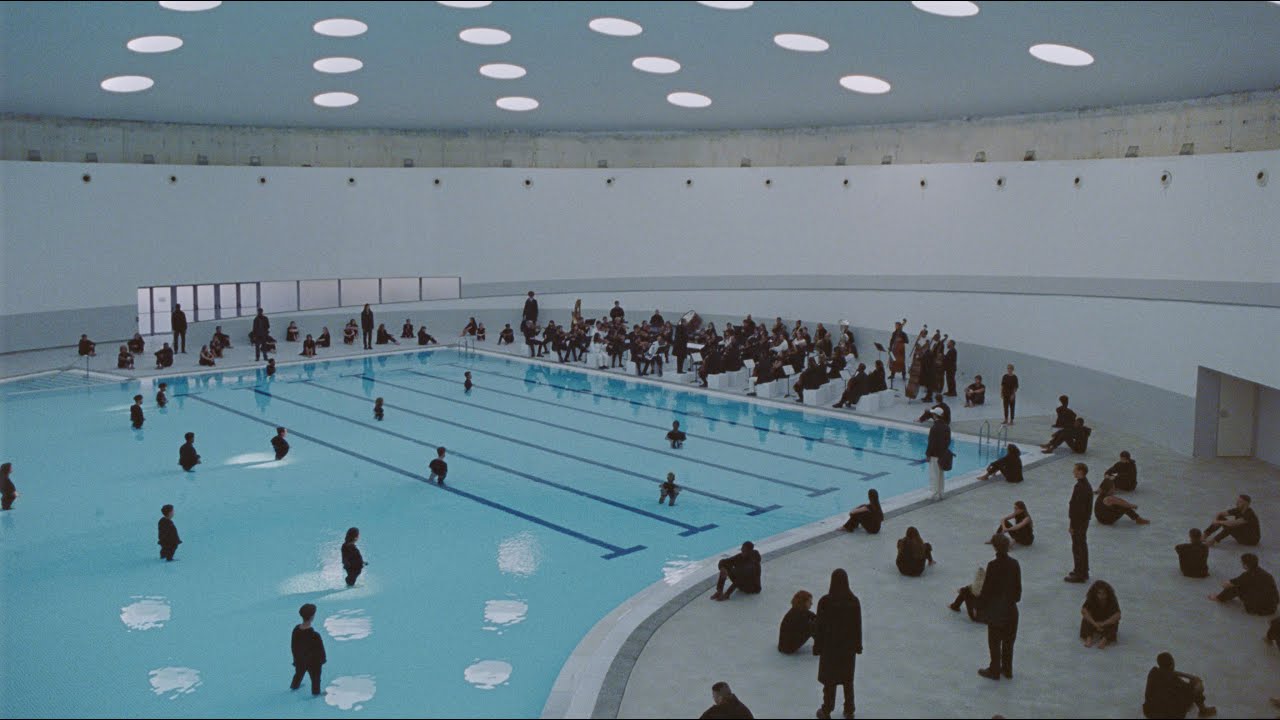
Tyler Mitchell photographed the launch of Zara Origins in September 2021, a 205-piece unisex wardrobe project built on selvedge denim, cashmere and wool.
- Cast included Babacar N’doye, Mika Schneider, Moustapha Sy and Sacha Quenby
- Second edition shot by Nacho Torra, styled by Carlos Nazario
- Jamie Hawkesworth and Laurence Ellis shot later chapters
The 2022 relaunch is the interesting one for designers. M/M Paris built an entirely new graphic identity for the third edition, including a custom typeface and 7 imagotypes used as a category system across garments and campaign assets.
Zara Beauty (2021)

Nine photographers shot one campaign. That was the whole idea.
Zara Beauty launched on 12 May 2021 under the creative direction of British makeup artist Diane Kendal, with Baron & Baron handling the campaign and Christophe Derigon as creative director.
The nine names: Steven Meisel, David Sims, Marilyn Minter, Oliver Hadlee Pearch, Zoe Ghertner, Craig McDean, Nadine Ijewere, Mario Sorrenti and Fabien Baron.
The line carried more than 130 shades at prices from 7 to 25 dollars, which makes the casting budget look extravagant by comparison. That gap is the point.
Zara Atelier Collection 04, The Jacket (2023)

| Element | Detail |
|---|---|
| Photographer | Tim Walker |
| Model | Kristen McMenamy |
| Concept | The Pygmalion myth, sculptor and creation |
| Published | 7 December 2023 |
| Withdrawn | 12 December 2023 |
Walker’s set built plaster casts, wooden crates and white-wrapped figures around McMenamy. Readers connected the shrouded forms to images from Gaza, and Zara pulled the campaign 5 days after release.
The withdrawal post alone drew about 4% of every interaction Zara’s Instagram account received across all of 2023, with individual Jacket posts collecting between 134,000 and 188,000 comments each.
Zara 50th Anniversary Project (2025)
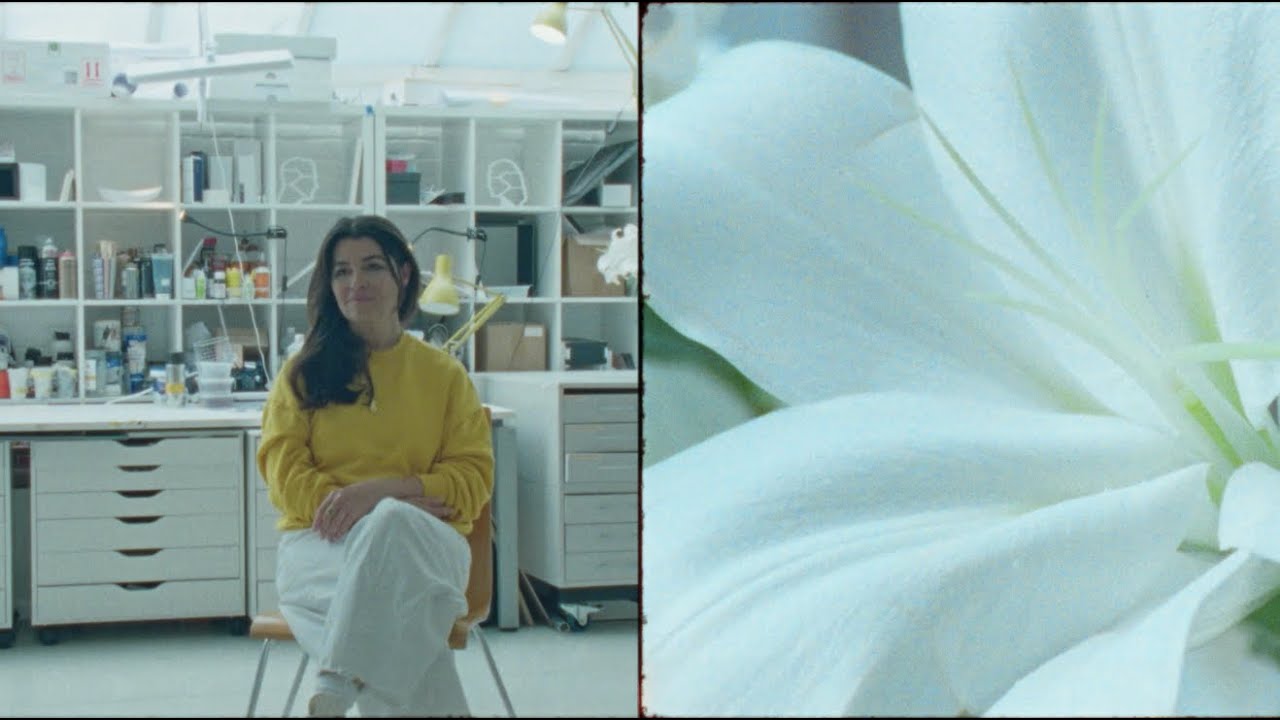
For its 50th year Zara commissioned a Steven Meisel film featuring 50 models, among them Carolyn Murphy, Adriana Lima and Imaan Hammam. Marta Ortega Perez originated the idea.
A companion capsule launched on 6 October 2025 with 50 creatives designing one object each, including Cindy Crawford, Naomi Campbell, Rosalia, Pedro Almodovar, Kate Moss, Linda Evangelista, Pierpaolo Piccioli and Pat McGrath.
Zara Print Ads That Live in Store Windows
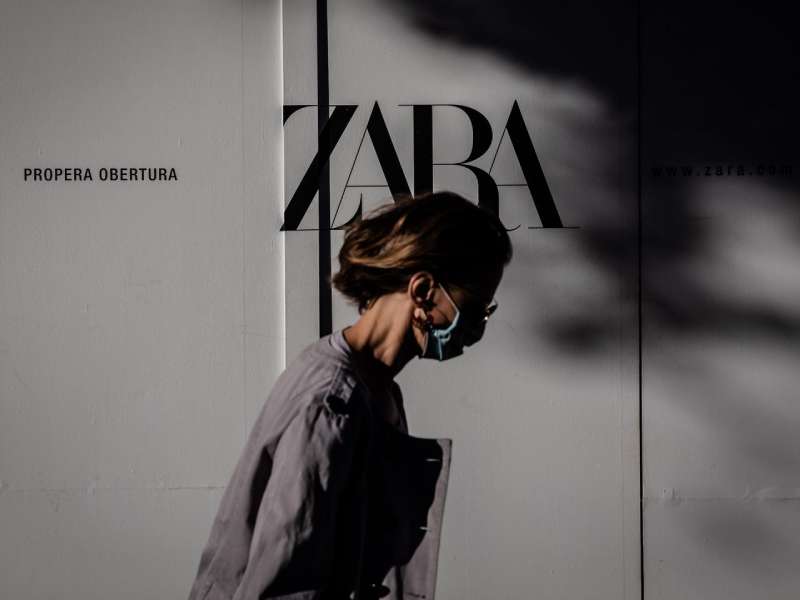
Zara’s largest print surface is not a magazine page. It is the window.
Window schemes are developed at the A Coruna headquarters inside a mock street of test storefronts, then exported unchanged to every market. The layouts rotate roughly every two weeks, which works out to more than 150,000 window installations mounted per year.
How Do Zara Print Ads Work Visually?
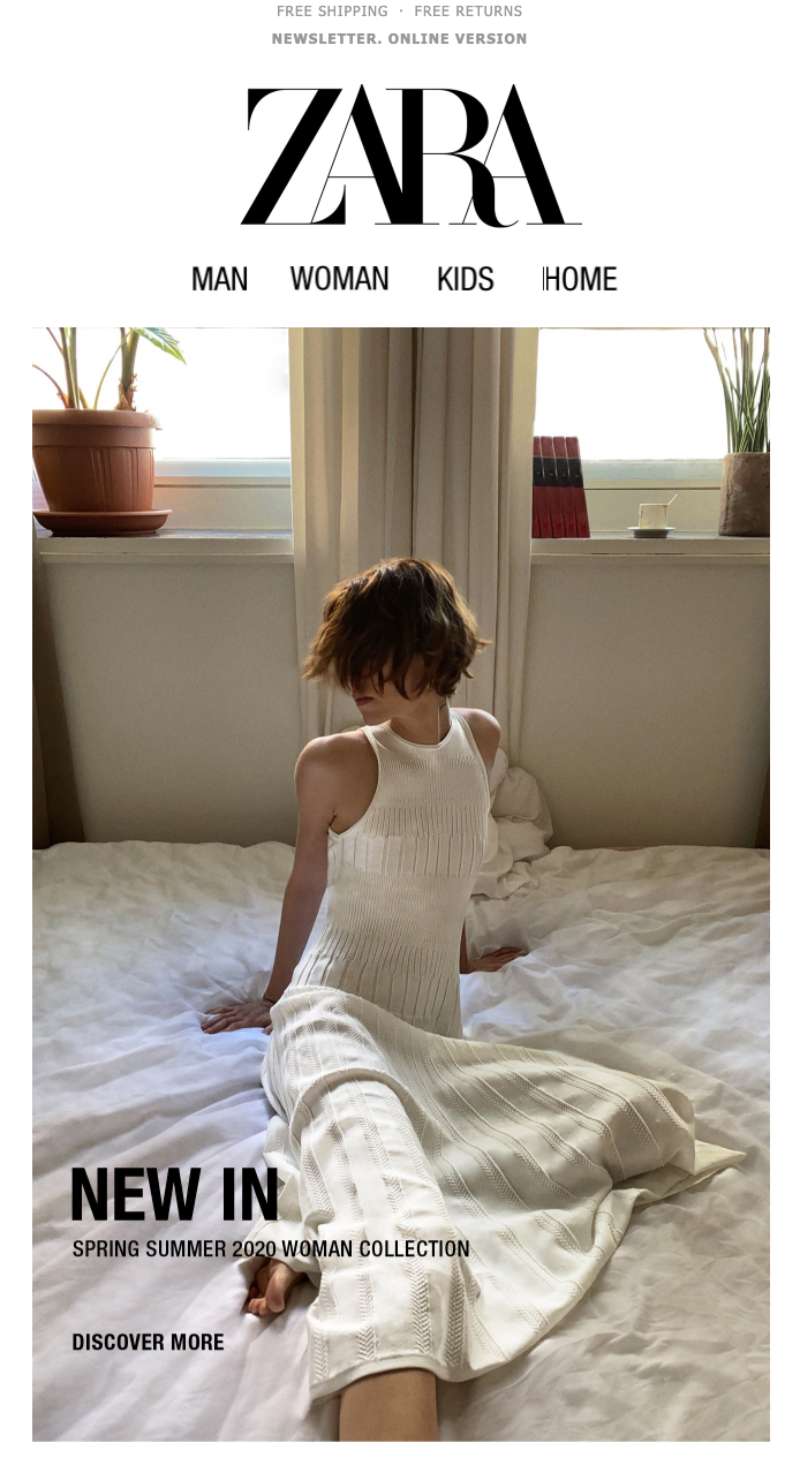
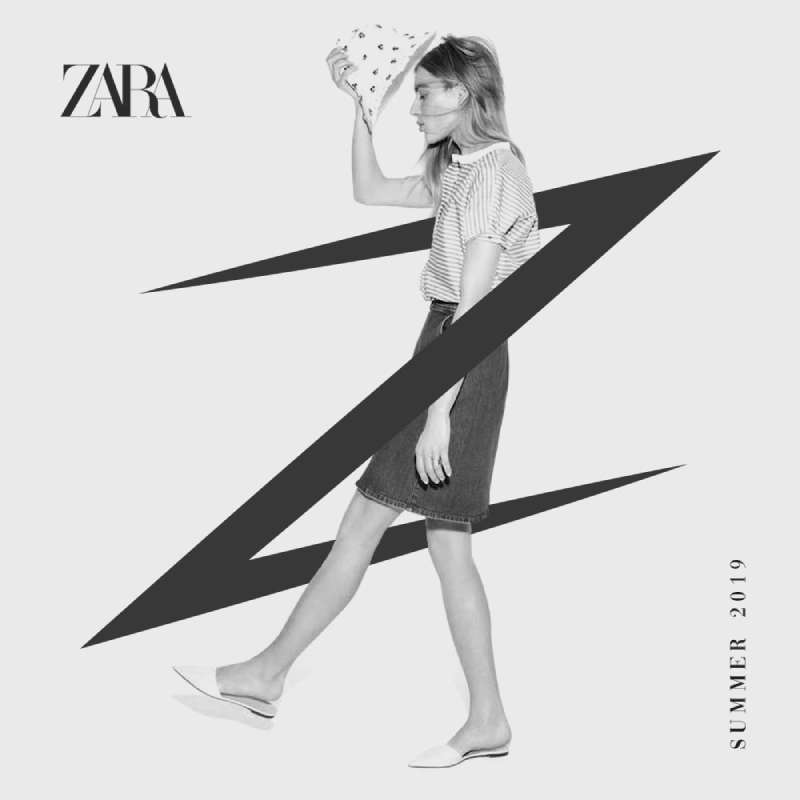
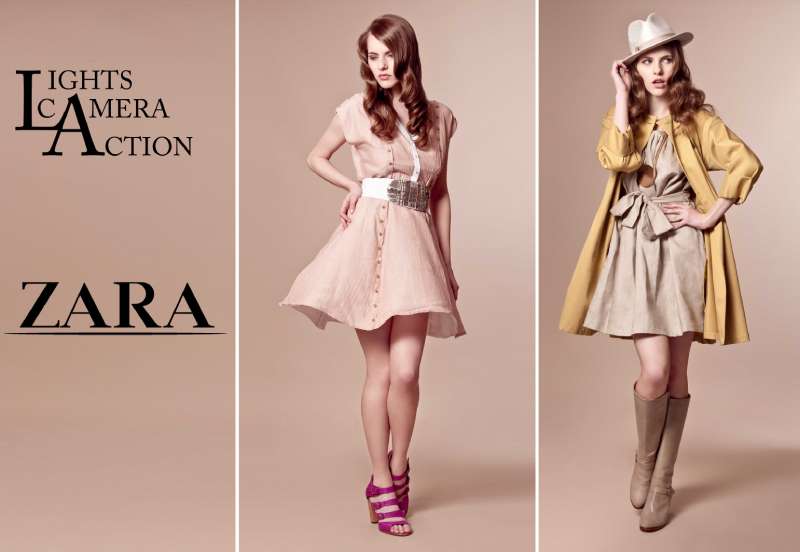
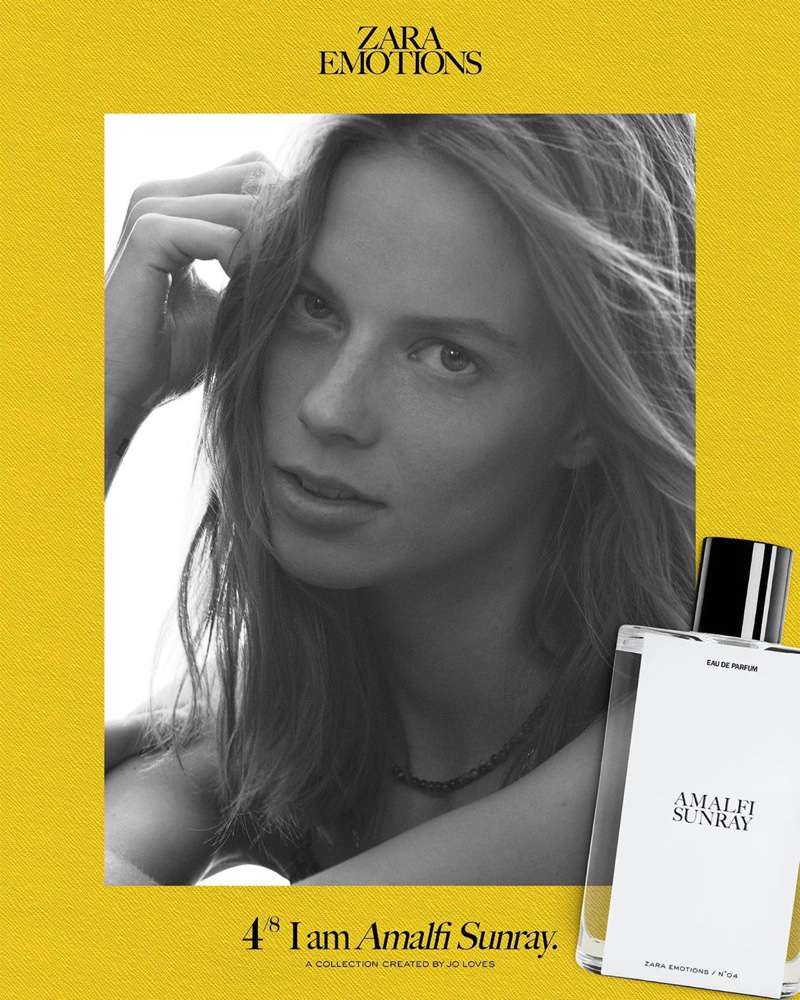
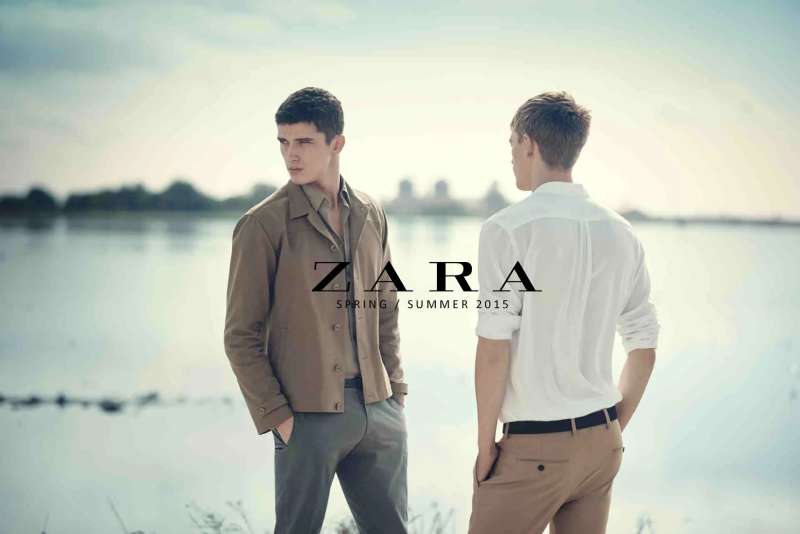
Zara print ads use a 3-element formula: a single figure on an empty ground, a wordmark placed small at one corner, and no body copy. The palette runs monochrome more often than not, and the garment silhouette carries the composition rather than any graphic device.
Composition and framing
Image-to-text ratio sits close to 98/2. A Zara campaign page is a photograph with a logo on it.
The figure usually sits off the optical center, leaving one large field of empty area in the frame that the eye reads as expensive. Backgrounds are seamless studio paper or a plain wall, so nothing competes with the clothing edge.
That single-subject discipline is why the order in which your eye moves through the layout never gets confused. Face, then garment, then wordmark. Every time.
Typography and the wordmark
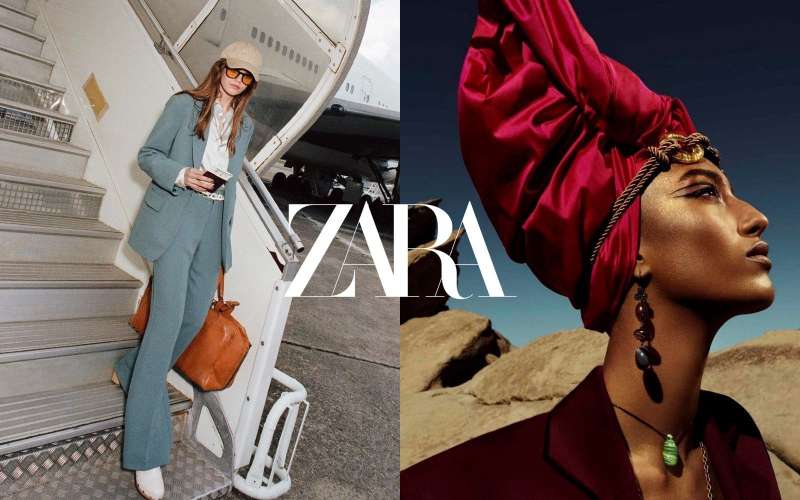
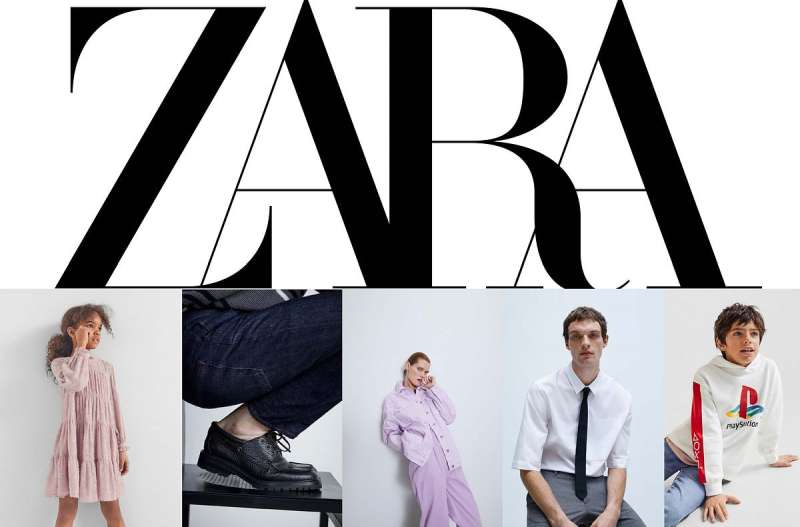
The current Zara logotype dates to January 2019, designed by Baron & Baron.
Key move: the letters were pushed until they overlap, and the Z and R gained exaggerated curves.
Erik Spiekermann called it the worst piece of type he had seen in years and asked publicly whether a robot made it. Others read the compression as a deliberate rejection of the flat sans-serif rebrands sweeping fashion at the time.
Either way it is a genuine letter-spacing decision, not an accident, and it descends directly from Fabien Baron’s Harper’s Bazaar mastheads of the early 1990s. The 2011 version had done the opposite, spacing the four letters wide apart.
Color and contrast
Roughly half of Zara’s Studio campaigns run in a single-hue treatment, usually black and white.
When color appears it arrives as one saturated note against neutrals. Zara Origins spring 2022 paired indigo, fuchsia and lilac against ecru, beige and navy.
The functional reason: high tonal separation between subject and background survives compression on Instagram and reads at 30 meters on a billboard. One system, two very different viewing distances.
Layout structure
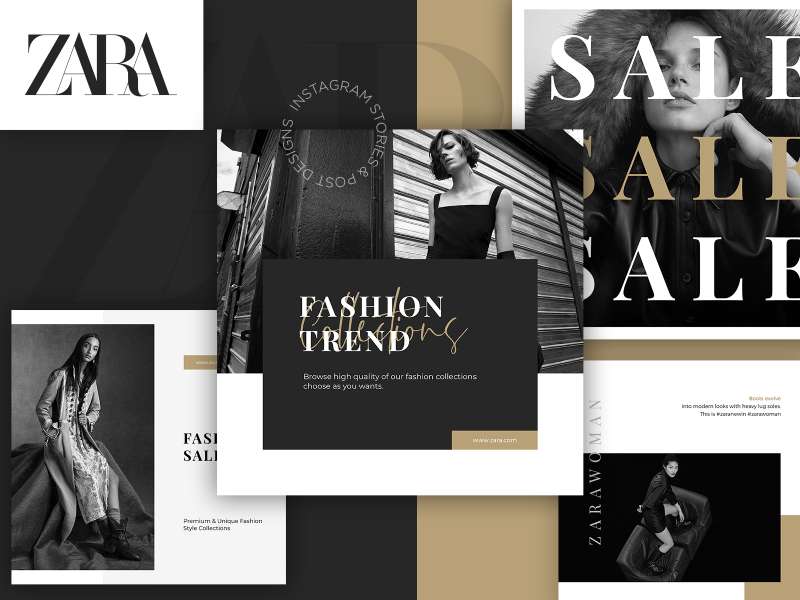
Zara lookbooks follow magazine logic rather than catalog logic.
Pages alternate full-bleed portrait, spread, then a run of small images, which is standard page-layout practice for publications and rare in retail. The underlying column and margin framework stays consistent across seasons even as the photography changes hands.
Because there is no headline, no subhead and no price, the ranking of type by size and weight collapses to a single level. The wordmark is the only type on the page.
How Do Zara TV Commercials Differ From Its Print Ads?
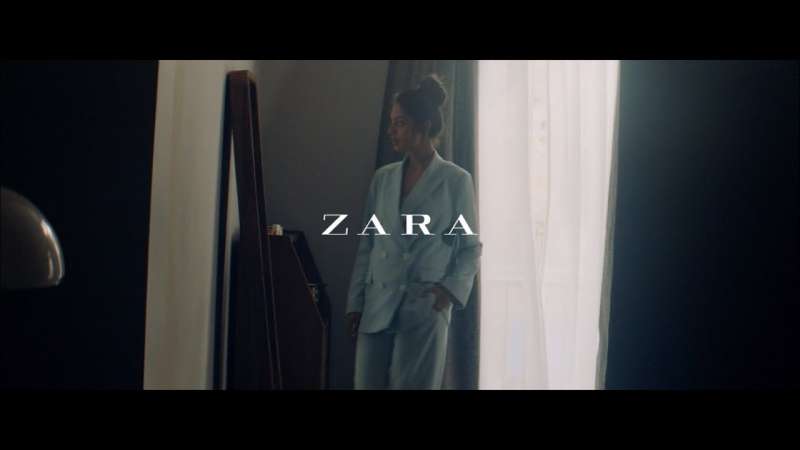
Zara does not buy television time in most markets. Its moving-image work runs on YouTube, Instagram and zara.com instead, and it runs long. The brand has released films between 60 seconds and 43 minutes, directed by feature filmmakers rather than commercial directors.
O Night Divine (2021)
Luca Guadagnino directed a 43-minute Christmas film for Zara, released free on the brand’s site and YouTube channel in December 2021.
Credits: shot by Arseni Khachaturan, written by Michael Mitnick, scored by Alberto Iglesias, starring John C. Reilly, Alex Wolff and Hailey Gates. The plot follows five people in a mountainside hotel in St. Moritz on Christmas Eve.
High Tension and the Studio films
Fabien Baron directs most Zara Studio films himself, alongside the Meisel stills.
The Fall/Winter 2020 film “High Tension” borrowed its cutting rhythm and score from Hitchcock thrillers. No product name appears on screen. Nothing is priced.
The anniversary film (2025)
Meisel’s 50-model film is the largest cast Zara has assembled for a single piece of moving image.
Its function is closer to building a narrative through visuals than to selling a collection, since no garment in it was for sale under that campaign.
How Has Zara Advertising Evolved Since 1975?
Zara advertising has passed through 4 phases: window-only retail communication (1975 to 2009), catalog and lookbook photography (2010 to 2016), the Baron and Meisel editorial era (2017 to 2021), and the current premium sub-brand model (2021 to present). Paid media spend stayed near zero throughout.
| Period | Strategic shift | Representative work |
|---|---|---|
| 1975 to 2009 | Store window replaces media buying | A Coruna window program, sale announcements only |
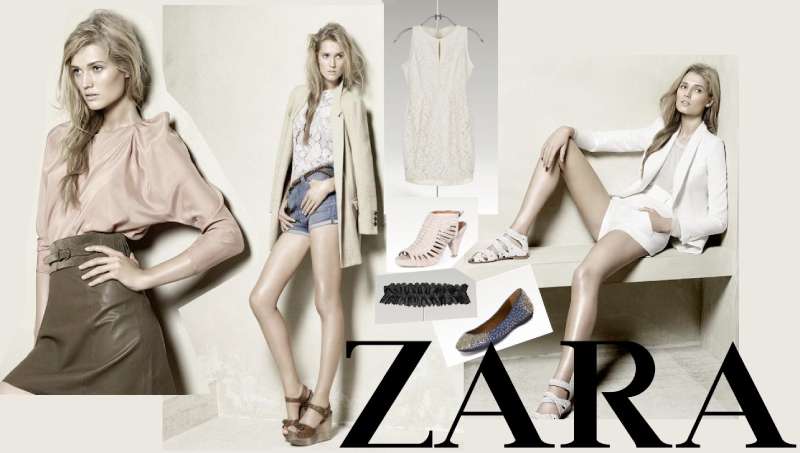
| 2010 to 2016 | Wide-spaced serif wordmark, catalog imagery | 2011 logo, seasonal lookbooks |
| 2017 to 2020 | Editorial repositioning under Marta Ortega Perez | Meisel Spring 2017, Zara SRPLS 2018, 2019 logo |
| 2021 to now | Sub-brands with separate identities | Origins, Beauty, Atelier, anniversary film |
The 2019 wordmark change is the clearest marker in that progression of identity marks. It was the second logo change in the company’s history at that point, and it landed alongside the Spring/Summer 2019 campaign rather than as a standalone rebrand.
Marta Ortega Perez became Inditex chairwoman on 1 April 2022, formalizing an image strategy she had already been running for years.
Which Agencies Created Zara Advertising?
Baron & Baron, the New York agency founded by Fabien Baron, has created Zara’s campaign imagery and its wordmark since 2017. M/M Paris designed the Zara Origins graphic identity in 2022. Zara’s in-house team at A Coruna designs all window schemes.
Baron & Baron
Baron & Baron designed the Zara logotype in January 2019. The same agency art-directs Zara Studio, produced the Zara Beauty launch through creative director Christophe Derigon, and Fabien Baron personally directs the campaign films.
Baron’s client list runs through Dior, Calvin Klein, Burberry, Coach and Bottega Veneta, which is precisely why Zara hired him. The typeface choices that carry a brand’s voice at Zara are drawn from luxury houses, not from high street retail.
M/M Paris
M/M Paris built the Zara Origins identity for the winter 2022 edition.
The system includes a bespoke typeface and 7 symbols that function as a category index across labels, packaging and campaign layouts. It is the only Zara sub-brand with a complete visual system of its own separate from the parent wordmark.
Photographers as de facto art directors
Zara commissions photographers the way magazines do, not the way retailers do.
- Steven Meisel shot the Spring 2017 campaign and every Studio season since
- Mario Sorrenti began working with Zara in 2016
- Tim Walker shot Zara Atelier Collection 04 in 2023
- Tyler Mitchell launched Zara Origins in 2021
- Gordon von Steiner shot the Ludovic de Saint Sernin collaboration with Amelia Gray and Alex Consani
What Can Designers Learn From Zara Ads?
Zara ads demonstrate 5 transferable techniques: strip the layout to one subject, treat the wordmark as the only typographic element, build campaigns around photographers instead of taglines, design one asset that survives both a phone screen and a billboard, and give sub-brands their own identity systems.
- Cut every element that is not the product or the mark. Zara pages carry no headline, no price and no button
- Place the wordmark small and let scale do the talking
- Shoot in monochrome when the silhouette is the selling point
- Test the layout at two viewing distances before approving it
- Give a sub-brand its own typeface and symbol set rather than a color variant of the parent
- Change the window, not the message
That last one is underrated. Zara refreshes its physical layouts roughly 26 times a year while the brand’s tone never moves, which is a lesson in stripped-back visual approaches that most brands get backwards.
How Do Zara Ads Compare to H&M Ads?
Zara and H&M sit at similar price points and take opposite advertising positions. H&M buys media, signs celebrities and runs designer collaborations announced through paid campaigns. Zara spends about 0.3% of revenue on advertising and lets photography, windows and scarcity carry the brand.
The design difference shows up immediately in the artwork. H&M campaign work uses color, on-image copy, price callouts and named collaborators. Zara removes all four.
Where Zara actually competes visually is upmarket. Its layouts sit closer to Calvin Klein advertising and Gucci campaign imagery than to any fast-fashion peer, which is the whole reason Fabien Baron was hired in the first place.
Against Balenciaga’s campaigns, Zara looks conservative. Balenciaga builds provocation into the art direction. Zara builds absence into it, and the 2023 Atelier withdrawal showed what happens when that absence gets read as a statement anyway.
American peers took the third road. Gap advertising historically leaned on music, dance and mass television, a channel Zara has never used in any significant market.
What Makes Zara Advertising Work?
Zara advertising works because the brand treats every asset as an image problem rather than a messaging problem.
There is no tagline to protect, no slogan to refresh, no copy platform to argue about. What gets decided instead is who shoots it, how much of the frame stays empty, and where the wordmark sits.
That narrowness is the discipline. A photographer can change, a sub-brand can get its own typeface, a film can run 43 minutes, and the work still reads as Zara because the layout logic never moves.
For designers the transferable lesson is subtraction, not spend. Zara proves a brand can hold global recognition on a fraction of the industry’s ad budget, provided the few things it does publish are made properly.
Zara Ads Examples





FAQ on Zara Ads
Does Zara actually advertise?
Yes, but almost never through paid media. Zara advertising runs on store windows, Instagram, lookbooks and seasonal campaign photography. The brand buys the occasional billboard and skips television, magazine pages and search ads in nearly every market.
Why does Zara spend so little on advertising?
Roughly 0.3% of revenue goes to ads, against a retail average near 3.5%. Inditex redirects that money into prime store locations and rent, treating the shopfront as its media buy. Scarcity and fast restocking handle the rest.
Who shoots Zara campaigns?
Steven Meisel has photographed the Zara Studio seasons since Spring 2017, with styling by Karl Templer. Tim Walker, Mario Sorrenti, David Sims, Craig McDean, Tyler Mitchell, Jamie Hawkesworth and Nadine Ijewere have all shot Zara projects as well.
Who designed the current Zara logo?
Baron & Baron, the New York agency founded by Fabien Baron, redesigned the wordmark in January 2019. The letters overlap, and the Z and R carry exaggerated curves drawn from Baron’s Harper’s Bazaar mastheads of the 1990s.
Why was the 2019 Zara logo criticized?
Typographer Erik Spiekermann called it the worst piece of type he had seen in years. Critics objected to the crushed spacing on a bracketed serif letterform built for width. Defenders read the compression as a deliberate luxury signal.
What is Zara Studio?
Zara Studio is the seasonal ready-to-wear campaign program, separate from Origins, Beauty and Atelier. Fabien Baron art directs, Meisel shoots, and the work lands on billboards, Instagram and in lookbooks. Fall 2024 marked Meisel’s 17th consecutive Studio campaign.
Why did Zara withdraw its Atelier campaign in 2023?
Tim Walker’s images for Collection 04, The Jacket, showed plaster figures wrapped in white cloth among crates and rubble. Viewers linked the imagery to Gaza. Zara pulled the campaign 5 days after publication and apologized in December 2023.
Does Zara make TV commercials?
Zara produces films but does not buy broadcast time. Luca Guadagnino directed a 43-minute short, O Night Divine, released free on YouTube and zara.com in December 2021. Studio season films run on the same channels.
How often do Zara store windows change?
Roughly every two weeks, with extra schemes during summer and winter sale periods. Window layouts are developed at the A Coruna headquarters on a mock street of test storefronts, then exported unchanged worldwide. Over 150,000 installations per year.
Are all Zara ads black and white?
No, though monochrome dominates the Studio seasons. Color arrives as a single saturated note against neutrals, as in Zara Origins spring 2022, which set indigo, fuchsia and lilac against ecru, beige, navy and pale green.
Conclusion
Zara ads reward close reading more than most retail work does. Strip away the photography credits and what remains is a short set of rules about restraint.
Marta Ortega Perez pushed the brand toward editorial styling and magazine-grade art direction. M/M Paris built a separate identity system for one sub-brand.
Meanwhile the in-house teams in A Coruna keep rewriting the same window every fortnight, which is its own kind of discipline.
None of it depends on media spend.
Three habits carry over to your own work:
- Cast the photographer before writing the brief
- Let the silhouette, not the mark, hold the composition
- Build one asset that survives both a phone screen and a billboard
The rest is visual merchandising and patience.

Renowned for his expertise in logo design and visual branding, Bogdan has developed a multitude of logos for various clients.
His skills extend to creating posters, vector illustrations, business cards, and brochures. Additionally, Bogdan's UI kits were featured on marketplaces like Visual Hierarchy and UI8.
He also wrote in the past years on sites like Design Your Way, WebDesignerDepot, WPDean, Designmodo, Speckyboy, Slider Revolution, and more.
- Canva vs PowerPoint: Which Is Better for Presentations? - 22 September 2026
- How to Install Fonts on Mac (Step-by-Step Guide) - 20 September 2026
- From Mockup to Code: How AI-Augmented Development Speeds Up the Design Handoff - 19 September 2026

Bogdan Sandu is a seasoned designer who has been designing websites since 2008. Renowned for his expertise in logo design and visual branding, Bogdan has developed a multitude of logos for various clients. His skills extend to creating posters, vector illustrations, business cards, and brochures. Additionally, Bogdan's UI kits were featured on marketplaces like Visual Hierarchy and UI8. He also wrote in the past years on sites like Design Your Way, WebDesignerDepot, WPDean, Designmodo, Speckyboy, Slider Revolution, and more.
You Might Also Like