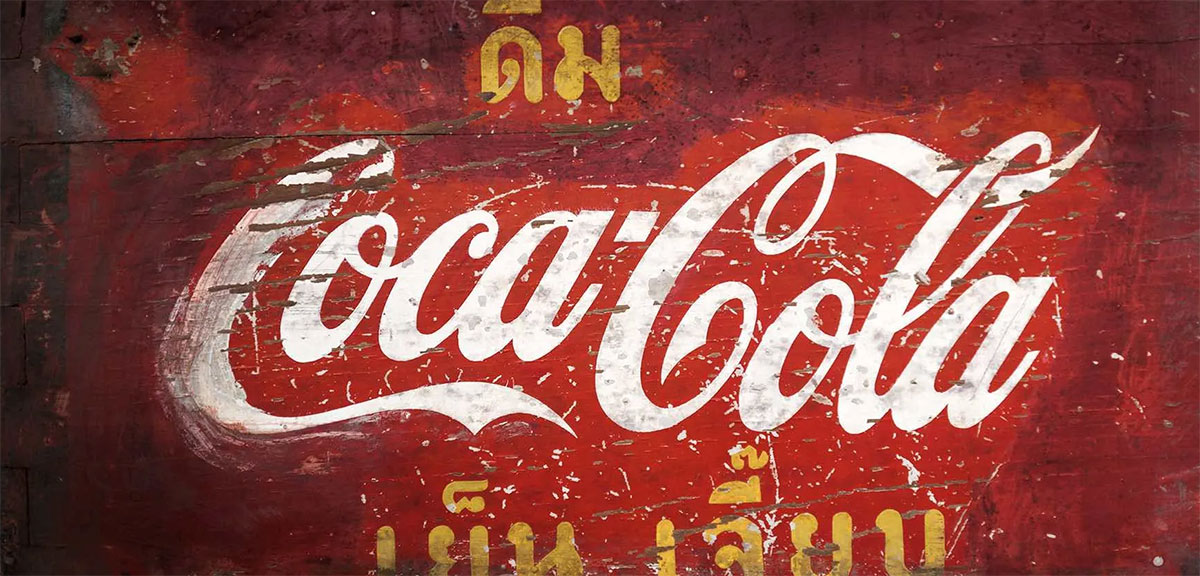
Fabrik Brands and Vistaprint both date the first brand logo to Coca-Cola in 1885. It’s a tidy answer, and it doesn’t hold up well. The US Patent and Trademark Office issued its first federal trademark registration in 1870, and the Coca-Cola Company’s own chronology places its formula in 1886.
Logo history is full of dates like that, which is why a proper record of what changed and why is useful. Designers and brand owners use it to date a mark and to check whether a redesign keeps whatever made the old one recognizable.
What Does Logo Evolution Cover, and What Counts as a Logo?
The term gets stretched a lot. Here it means the documented change in a logo’s form, typography, color and medium over time, along with the business, legal and technology reasons behind each change.
Plenty of sources start with ancient symbols. This one starts later, once a mark points to a single company and can be protected in law. It also has to repeat identically across copies.
That’s the working definition, and it’s why coats of arms count as ancestors but not as logos.
Wordmarks set the company name in distinctive lettering, and Coca-Cola’s script is the obvious one. Lettermarks use initials or a monogram, like IBM’s striped letters.
Pictorial marks are a recognizable image (Apple’s bitten apple), and emblems put text inside a badge, crest or shape, the way AEG’s hexagon does.
None of this happens in isolation. A logo sits inside a wider visual identity that also takes in type, color, layout and imagery.
Trademark is a legal status rather than a look. Plenty of logos are registered, and so are shapes like the Coca-Cola contour bottle.
Form is the obvious change in every era, with crests and ornament giving way to geometric symbols. Type, color and medium move together: hand-lettered script and ink on one end, custom typefaces, flat palettes and screens on the other.
Where Do Logos Come From? Marks Before the Industrial Era
Heraldic arms came first. Goldsmith marks and merchants’ ownership marks grew out of trade, and between them they supplied most of what later became logos.
None of them worked as a brand logo. Each did solve the problem of telling one source from another at a glance, though.
Heraldry and Guild Marks
Heraldic designs appear in general use in western Europe from the second quarter of the 12th century, according to Britannica.
The reason was practical, since a knight had to be recognized from a distance. By the 18th century, the same entry notes, arms had drifted into over-intricate rendering. Logos repeat that pattern later, when ornament piles up and then gets stripped out.
Goldsmiths got there in London in 1300, when hallmarking began with a heraldic symbol taken from a knight’s shield so buyers could trust that a piece was sterling (Goldsmiths’ Company). That stamp vouched for the metal, not the maker.
The earliest London makers’ marks were pictograms rather than initials, per the London Assay Office. Merchants stamped bales and casks to prove ownership after shipwreck or piracy.
Why Sources Disagree on the First Logo
Nobody can name a single first logo, because each guide uses a different test.
Signs.com goes with hieroglyphs and guild marks. The Logo Creative picks the Bass red triangle of the 1870s as the first abstract logo. Fabrik Brands and Vistaprint stay with Coca-Cola and 1885.
The company’s own trademark chronology has the formula arriving in 1886, with Frank Robinson naming the drink and lettering the script afterward. So 1885 can’t be right for Coca-Cola.
Applying the test from the first section gives this:
| Candidate | Date | Identifies one company | Legal status |
|---|---|---|---|
| Coats of arms | 12th century | No, a person or family | Protected as insignia of honour |
| London hallmark | 1300 | No, certifies silver purity | Required by statute |
| Averill Ready-Mix Paint | 1870 | Yes | First US federal registration |
| Bass red triangle | 1876 | Yes | First UK registration |
| Coca-Cola script | 1886 to 1893 | Yes | US registration, 1893 |
The Averill row comes from USPTO records as reported by IPWatchdog (2021), the Bass row from the law firm Barker Brettell.
So the answer depends on jurisdiction. Registration came to the US in 1870 and to the UK in 1876, and every older mark is a precursor.
How Did Industrial Printing and Trademark Law Shape Early Brand Logos?
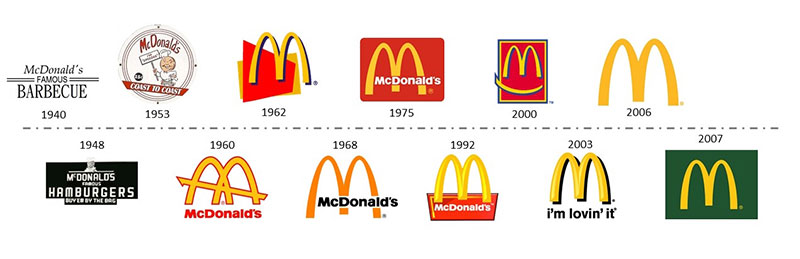
Color lithography let companies print the same mark on every label and poster. Registration statutes then turned that mark into a protected asset.
Lithography was invented around 1796 in Bavaria, and a chapter in Cambridge University Press’s History of Intellectual Property in 50 Objects ties it directly to the first trademark registrations. Once color and larger printing bases arrived, advertising changed fast, and the Metropolitan Museum of Art dates the poster boom to the 1880s and 1890s.
The law followed the presses, per IPWatchdog, the Case Western Reserve University law library and Barker Brettell.
- In 1870 the US passed its first federal trademark statute, which the Supreme Court struck down in 1879.
- The UK’s Trade Marks Registration Act 1875 took effect on 1 January 1876, and Bass filed the first registrations.
- A new US act in 1881 rebuilt federal registration on Commerce Clause authority.
- The Lanham Act, signed 5 July 1946, became the base of modern US trademark law.
Registration is not first use. The Zythophile beer history blog shows Bass used the red triangle for years before 1876, and it finds no evidence for the story of an employee queuing overnight to file first.
The look of the period was ornate. Bo Beaumont of Kukoo Creative describes founder names set in elaborate typography.
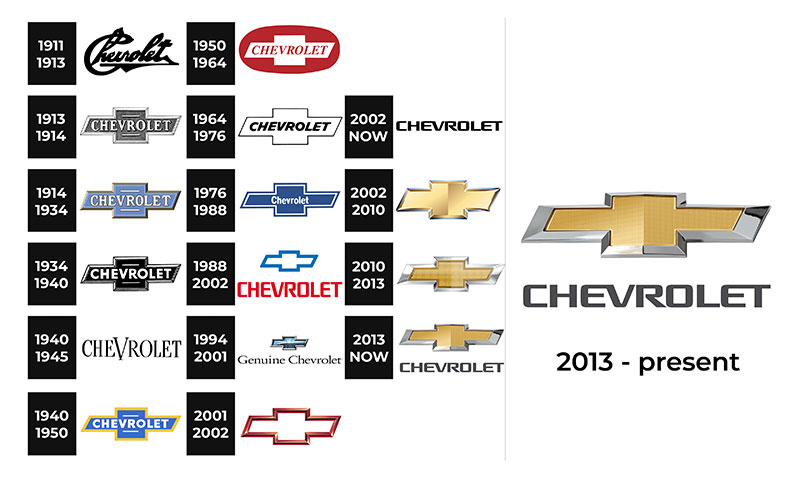
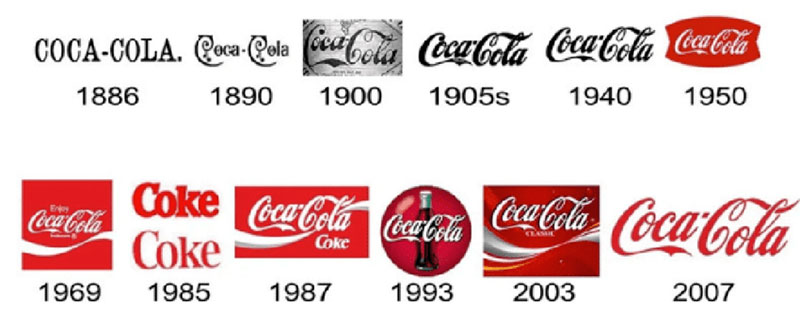
Coca-Cola shows how the law shaped the artwork itself. Frank Robinson adapted Spencerian script, a penmanship style of the day, and the 1893 to 1901 versions wrote “Trade mark” inside the tail of the first C, a notice that moved out of the tail only with the 1941 version (Coca-Cola Company trademark chronology).
The script began as hand lettering, not a typeface, which is why designers still ask which font Coca-Cola uses.
How Did Modernism Turn Logos Into Corporate Identity Systems?
Modernism swapped ornament for simple geometric symbols and tied them to company-wide design rules, beginning with Peter Behrens at AEG in 1907. A logo had mostly lived on a label until then. Afterward one mark could govern letterheads, products, buildings and manuals.
Behrens, Rand and Bass
AEG hired Behrens in 1907 as artistic consultant, and he standardized the company’s lettering, graphics, products and factory architecture. AEG’s own history says it was the first time a large corporation’s whole image was defined this way.
Paul Rand’s IBM work came in 1956. IBM had brought in Eliot Noyes to rethink its design from products to buildings, and Rand’s logotype passed through 1960 and 1972 revisions to reach the eight-bar version still in use (Les presses du reel).
Saul Bass did the Bell System mark in 1969, cutting the ornament from the old bell-and-circle design while keeping it familiar. He then drew the AT&T globe in 1983 after the breakup (The Marginalian).
Bass’s marks lasted. Designer Christian Annyas compared 23 of them with their current versions in 2011 and found an average lifespan of 34 years, with 13 still in use 15 years after Bass died.
The sample is small and hand-picked by one designer, so treat it as a signal, not a benchmark.
Swiss Style, Helvetica and the Single Symbol
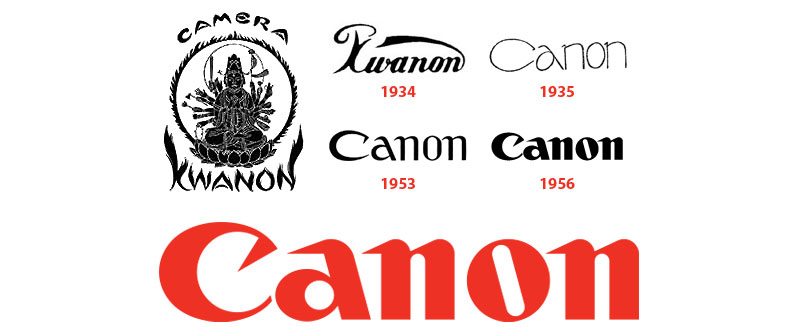
Neutral sans-serif type and strict grids became the default look of corporate identity.
Helvetica, released in 1957 as Neue Haas Grotesk and renamed in 1960, became a hallmark of the International Typographic Style, and Design Index lists many company logos set in it. The Swiss design tradition behind that style prized objectivity and neutral type.
Layouts built on grid-based layout systems gave the logo a fixed position on every application, which is what made standards manuals like IBM’s enforceable.
Pictorial marks followed the same logic. Nike’s swoosh, drawn in 1971 by Portland State student Carolyn Davidson (Business Insider), and Rob Janoff’s 1977 Apple mark both reduced a company to one shape.
Janoff says the bite stops the fruit reading as a cherry at small sizes, and the rainbow stripes pointed to the Apple II’s color display.
The catch with a single symbol is that it only works when the company enforces it. That’s the job of the identity manual, and IBM’s ran from the 1960s into the 1980s.
What Did Desktop Publishing, Vector Software and the Web Change in Logo Design?
Logos became cheap to produce and resize, and that exposed their weak spots. Effects printed badly and files blurred when enlarged, and early screens shifted colors on top of that.
Desktop Publishing and Vector Tools
Apple’s LaserWriter, launched in March 1985 with Adobe’s PostScript, started the desktop publishing shift, and Adobe Illustrator 1.0 followed in 1987 on the Macintosh (Eclectic Light Co.).
Illustrator stores shapes as Bezier curves described mathematically, according to the Museums Victoria collection record. A logo built from vector artwork therefore scales from a stamp to a billboard without loss.
Kukoo Creative’s Bo Beaumont points out the downside. Easy tools put logo creation in more hands, and the results weren’t always good.
The Early Web and 216 Colors
Early web logos worked with 216 colors, not millions.
Netscape’s browser-safe palette used 216 of the 256 colors an 8-bit screen could show, because Windows reserved 40 for interface elements, per Yale’s Web Style Guide. Colors outside the set were dithered into patterns of dots, so smooth blends and photographic effects failed.
The same guide notes the palette lost importance as users moved to thousands or millions of colors.
The W3C then published SVG 1.0 as a Recommendation on 4 September 2001, giving web logos an open vector format.
Effects in the 2000s, Then Retreat
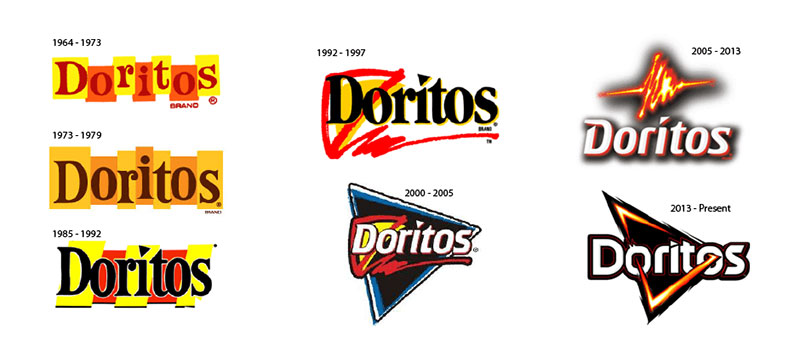
Logos of the 2000s picked up bevels and shadows, and everything got a bit glossy.
A gradient fill lives in the file, not in the brand shape, so it fails wherever the file can’t carry it. One-ink print and embroidery are the obvious cases. Then there are small sizes and reversed versions on dark backgrounds.
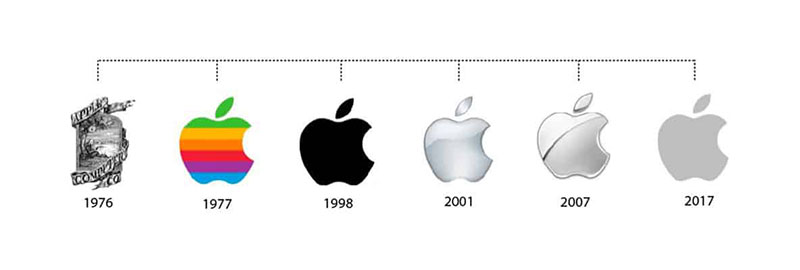
Apple’s move from the rainbow apple to a single-color apple is dated to 1998 by some sources and to 27 August 1999 by Cult of Mac, which treats that day as the official switch.
Why Did Logos Go Flat and Minimal?
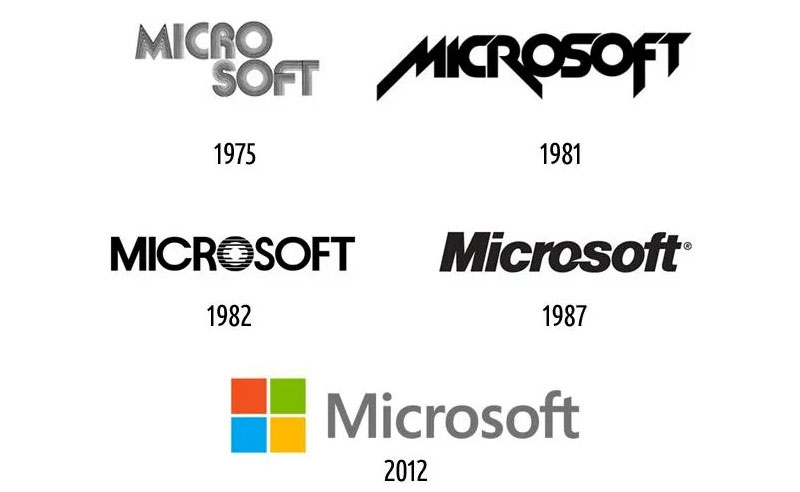
Screens got smaller and more varied, and platform design languages from Apple and Google pushed icons and interfaces toward simpler, cleaner forms.
Platform Triggers, 2013 to 2015
Apple unveiled iOS 7 on 10 June 2013 with refined typography and a redesigned interface, and Engadget’s coverage noted the flatter icons. It shipped that September.
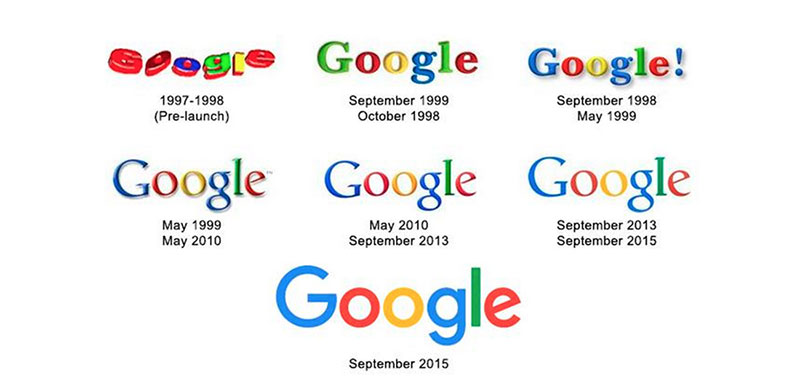
Google introduced Material Design at Google I/O on 25 June 2014 as one visual language for its products. On 1 September 2015 it swapped its serif wordmark for a custom geometric sans-serif and the blue “g” for a four-color “G” (Google Design).
Google’s stated reason was reach. The old logo had been built for a single desktop browser page, and the new identity was tested at various sizes and weights for legibility on the tiniest screens.
From Serif to Sans-Serif
The serif-to-sans-serif swap became the signature move of the decade.
Google’s 2015 logotype is the clearest case of the shift from serif to sans-serif lettering in a major wordmark. Burberry followed in August 2018 with a logo that Bloomberg’s Rob Walker described as a bold geometric sans-serif.
Designer Sienkiewicz argued that the shift was flattening tech and fashion branding into sameness, a case Creative Bloq summarized.
The evidence is split. A 2018 master’s thesis in the MountainScholar repository coded 20 top US companies’ logos across four design iterations and could not show statistically that visual design variables explained the simplification.
It found only that the number of characters in the text elements was changing. The sameness is easy to see in examples and hard to prove in a sample.
The practical cost of a minimalist approach is distinctiveness, and The Fashion Law warns that near-identical logos risk failing to tell one brand’s products from another’s.
Color and Gradients in the Flat Era
Flat did not mean colorless.
Google kept its multicolor sequence and rotated “e” in 2015 while softening the palette, according to TIME and Google Design.
The 2013 rule of stripping effects has since moved into the platforms. Apple’s Human Interface Guidelines, revised on 8 June 2026, tell designers to leave out bevels, glows and drop shadows because the system adds highlights and refraction to layered icons.
So flat artwork goes in, and the platform applies the depth on the way out.
Logo Styles and Drivers by Era

| Era | Dominant style | Main driver |
|---|---|---|
| 1880s to 1900s | Ornate script, detailed illustration | Color lithography |
| 1950s to 1970s | Geometric symbols, sans-serif wordmarks | Offset printing, identity manuals |
| 1980s to 1990s | Computer-made marks, bright color | Desktop publishing, 256-color screens |
| 2000s | Gloss, bevels, gradient fills | True-color screens, vector software |
| 2013 onward | Flat, simplified marks, sans-serif type | Phones, platform design languages, app icons |
Read down the driver column and the pattern holds. Each era’s dominant style is whatever its main reproduction method carries cheaply.
How Do Logos Adapt to Favicons, App Icons, Dark Mode and Motion?
A current logo ships as a small set of versions. There’s a full lockup and a compact symbol, plus square assets for favicons and app icons, each built to a platform’s published rules.
Those rules are dated and still changing, so the figures below carry their reference dates. As of October 2026:
- Apple’s iOS, iPadOS and macOS icons use 1024×1024 px layered artwork with six system appearances: default, dark, clear light, clear dark, tinted light and tinted dark (Human Interface Guidelines, revised 8 June 2026).
- Google Play wants 512×512 px, 32-bit PNG, sRGB, 1024 KB maximum, with Play adding a corner radius of 30% of the icon size and the shadow (icon design specifications, updated 15 June 2026).
- Android adaptive icons are two 108×108 dp layers with a 66×66 dp safe zone that is never clipped (Android Developers, updated 22 September 2026).
- The Google Search favicon has to be square and at least 8×8 px, with larger than 48×48 px recommended (Search Central, updated 28 August 2026).
Responsive Logo Systems
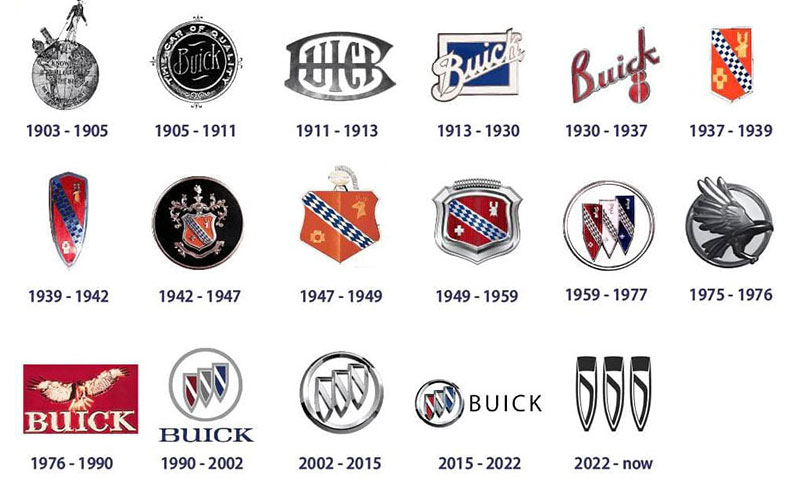
Designer Joe Harrison’s Responsive Logos project showed brand marks shedding detail as a browser window shrinks.
At the smallest size only the most recognizable feature stays, such as Chanel’s interlocking Cs or the Guinness harp, and the files were built as SVG with CSS media queries (Graphic Artists Guild). The marks were his own concept, not versions approved by the brands.
Each version needs written rules for where it applies, which a brand’s logo usage guidelines should spell out.
Detail is where this breaks down. Apple’s guidance warns that fine features look busy under system effects and get hard to discern at small sizes, and it advises a minimal number of shapes.
Favicons and App Icons
Google’s favicon rules have changed. Search Engine Journal reported the move from a multiple-of-48 rule to an 8×8 px minimum, with larger than 48×48 px recommended.
Formats are disputed. Search Central’s page, updated 28 August 2026, lists BMP, GIF, ICO, PNG, JPEG, PPM and TIFF and does not name SVG, while Logo.dev’s documentation says Google accepts SVG.
The safe route is a PNG or ICO for the file Search reads, with SVG kept for browser tabs.
Both app stores apply their own masks. Google Play rounds the corners and adds the shadow itself, and Apple says pre-masked layers hurt its highlight effects and leave jagged edges.
Apple also advises putting text in an icon only when it is essential, and it names the first letter of the app name as an acceptable mnemonic. That’s the lettermark idea applied to a square.
Dark Mode and One-Color Versions
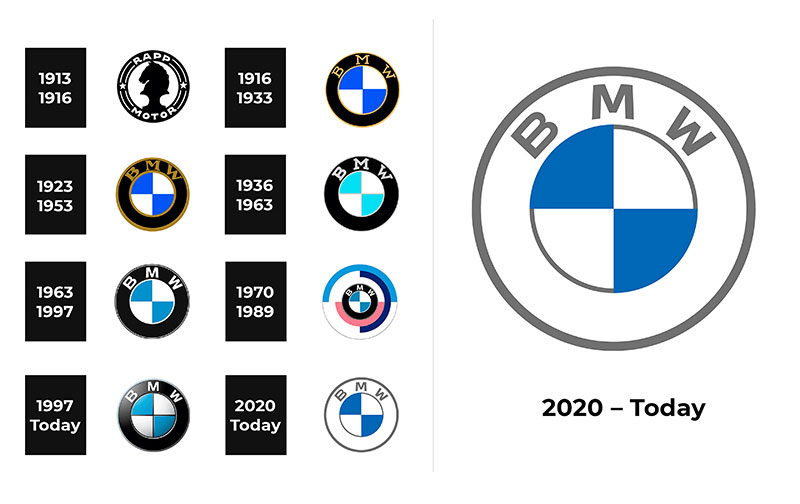
Dark mode means shipping more than one color version of the same mark.
Apple says to base the dark icon on the light one, keep the core features identical, and expect dark and tinted variants to look more subdued (Human Interface Guidelines).
Android handles it differently. Since Android 13 (API 33), a monochrome layer lets the system tint the icon to the user’s theme, and from Android 16 QPR 2 the system themes icons for apps that supply none.
On the web, an SVG favicon can switch colors with a prefers-color-scheme media query (web.dev). That switch follows the operating system setting, not the tab color, so a favicon can still land on the wrong background (CSS-Tricks).
Motion Logos
Google’s 2015 identity paired its wordmark with four animated dots (Google Design), and Kukoo Creative’s Bo Beaumont lists motion-first design among current logo directions.
Any logo given motion-graphics treatments follows the same rule as every other format. The still frame has to carry the brand alone, because favicons, one-color print and app icons never move.
Why Do Companies Change Their Logos, and What Did Documented Redesigns Change?
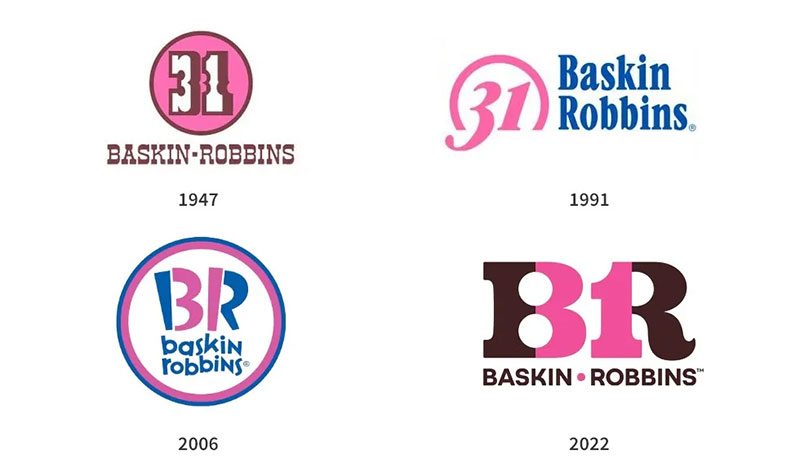
Companies change logos when the business, the screen or the audience outgrows the old mark. The cases below come mostly from a wider business on one side and digital use or a new positioning on the other.
| Company and year | Trigger | Change and what stayed | Outcome |
|---|---|---|---|
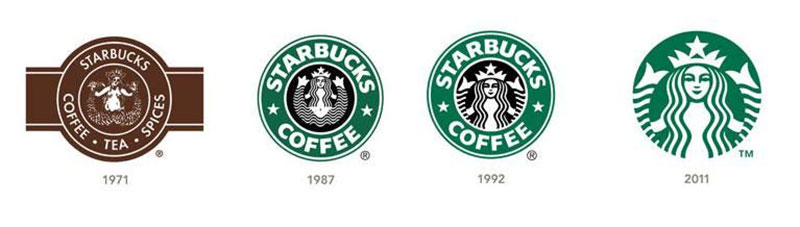
| Starbucks, 2011 | Business beyond coffee | Words and outer ring removed, siren stayed | Mixed at launch, criticism faded |
| Airbnb, 2014 | New positioning around belonging | Blue script replaced by sans-serif text and the Belo symbol, name only stayed | Widely mocked, logo kept |
| Google, 2015 | Many screen sizes | Serif replaced by geometric sans-serif, color sequence stayed | Rolled out to Search, Maps and Chrome first |
| Dunkin’, 2019 | Beverage-led strategy | “Donuts” dropped, pink-and-orange colors and font stayed | Described as polarizing |
| Mastercard, 2019 | Digital contexts | Name dropped in select contexts, circles stayed | Symbol used alone on cards, acceptance marks and sponsorships |
Table sources: Nation’s Restaurant News and Fortune (Starbucks), Dezeen and Creative Review (Airbnb), Google Design and BetaNews (Google), the Associated Press and Complex (Dunkin’), and Mastercard’s January 2019 press release.
What Stayed and What Went
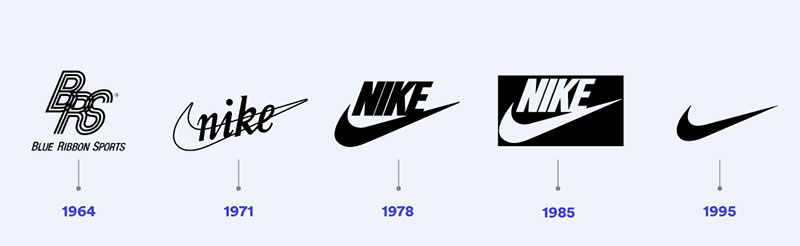
Starbucks kept its siren, Google its color sequence, Dunkin’ its colors and font, and Mastercard its circles.
Airbnb kept only the name, and it drew a wave of ridicule that Dezeen and Creative Review both documented. The others got mixed or polarized reactions, though five cases is a small sample.
What the Cases Leave Out
Mergers and legal fixes are standard triggers on paper, but none of these five cases is one, and none of the sources used here documents one. A longer list of companies that rebranded is the place to look for them.
A Decision Rule
My rule of thumb is to change the logo only when the old one fails a use you can name, like a screen size it can’t handle or a product the name no longer covers. A symbol ready to carry recognition alone is the other good reason.
Mastercard reported that more than 80 percent of people spontaneously recognized its symbol without the name before it dropped the word (Mastercard press release, 2019).
Keep one anchor, and test recognition before cutting words.
When Do Logo Redesigns Fail or Get Reversed?
Redesigns fail when they strip recognizable parts without a reason the audience can see, and the fastest documented reversal came within a week: Gap withdrew its 2010 logo after launching it on 6 October.
What Went Wrong in Each Case
Gap swapped the blue-box logo it had used since 1990 for black Helvetica with a small blue box above the “p”. After more than 2,000 comments on its Facebook page, it reverted and said it had not gone about the change in the right way (The Drum; CNN Money).
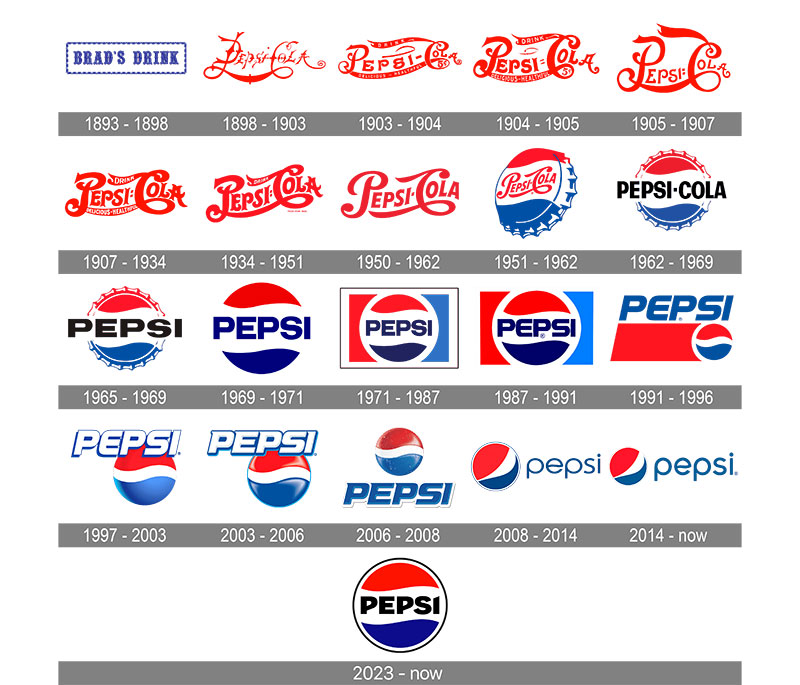
Pepsi’s 2008 redesign by the Arnell Group reportedly cost $1 million and came with a 27-page rationale citing the Mona Lisa and gravitational pull. The company kept the design for years and redesigned again in 2023 (Fortune, 2024).
Instagram’s 2016 change put a flat camera glyph on a gradient where a rendered camera had been, which head of design Ian Spalter said made the icon scalable. Reception was lukewarm, one designer quoted by It’s Nice That called it generic, and Instagram kept it (AdNews).
Burger King’s 2021 redesign was a deliberate return, not a backlash case. JKR’s first full redesign in 20 years brought back a flat burger-and-buns mark that commentators compared to the 1969 to 1999 logo, with legibility on digital platforms as a stated reason (Design Week; WPTV).
Failure Conditions Across the Cases
Most of these share a missing reason. Nothing the audience could see justified the change, and a generic execution that could belong to any app only made that worse.
Lookalike risk is the other repeat offender, as designers flagged when Airbnb’s Belo resembled the logo of Automation Anywhere, which said it would move to a new design (Dezeen, 2014).
A broader set of rebranding failures is a good place to check whether these conditions recur.
When a Redesign Is Not Needed
A redesign is not needed when the old mark still works on every surface the brand uses.
CBX’s Rick Barrack said Airbnb’s original logo was good to begin with (Fortune, 2014). Starbucks shows the alternative. Its four logos from 1971 to 2011 all centered the siren and changed in steps (Nation’s Restaurant News).
Settle the questions to answer before a rebrand first: which surface fails, and which element must stay.
Logo Evolution FAQ
How often do brands redesign their logos?
No fixed cycle governs it. Mastercard refreshed its mark in 1979, 1990, 1996 and 2016 and dropped the name from the symbol in 2019, so the gaps ran 11, 6, 20 and 3 years (Campaign India, 2019).
Burger King’s 2021 redesign was its first in 20 years (Design Week, 2021).
What is the oldest logo still in use?
It depends on the test. Among registered logos, the Bass red triangle, registered in the UK in 1876, remains in force and in use (Barker Brettell).
Older claims of continuous use, such as Lowenbrau since 1383, rest on use rather than registration.
Does a logo redesign require a new trademark registration?
Yes, when the change is material. A US registration covers the mark as filed, and an amendment is permitted only if it does not alter materially the character of the mark (15 U.S.C. 1057(e)).
A modified mark that keeps the essence of the original and creates essentially the same impression can be amended instead.
How long does a logo redesign take, and what does it cost?
No published benchmark holds across companies, so documented cases set the range. Pepsi’s 2008 logo reportedly cost $1 million (Fortune, 2024).
Burger King expected its 2021 identity to roll out over the next few years (Design Week, 2021).
How Much of the Old Logo Should Stay?
A redesigned logo should keep one anchor, the element with proven recognition, and change the rest only where a specific use fails.
The anchor must survive a scale gap of roughly 21 to 1, from the 1024 px app icon layout Apple specifies to the favicon above 48 px that Google recommends.
Test each element’s recognition alone first. After that, check the trademark filing for material change and redraw only the failing surface.
Recognition comes first because it decides what can go, and the filing check costs less than any redraw.
There’s a trade-off, though. A retained anchor limits how far the new mark can move, so the result reads as an update, not a new brand.
Verified in October 2026, this advice changes if Apple or Google revise those icon specifications, since the size threshold moves with them. A rebranding checklist turns the sequence into tasks.

Renowned for his expertise in logo design and visual branding, Bogdan has developed a multitude of logos for various clients.
His skills extend to creating posters, vector illustrations, business cards, and brochures. Additionally, Bogdan's UI kits were featured on marketplaces like Visual Hierarchy and UI8.
He also wrote in the past years on sites like Design Your Way, WebDesignerDepot, WPDean, Designmodo, Speckyboy, Slider Revolution, and more.
- When Shared Hosting Is the Right Choice for Your Website - 11 November 2026
- The YouTube Logo History, Colors, Font, and Meaning - 10 November 2026
- Monthly Retainer Billing for Freelance Designers: How to Get Paid on Time, Every Month - 10 November 2026

Bogdan Sandu is a seasoned designer who has been designing websites since 2008. Renowned for his expertise in logo design and visual branding, Bogdan has developed a multitude of logos for various clients. His skills extend to creating posters, vector illustrations, business cards, and brochures. Additionally, Bogdan's UI kits were featured on marketplaces like Visual Hierarchy and UI8. He also wrote in the past years on sites like Design Your Way, WebDesignerDepot, WPDean, Designmodo, Speckyboy, Slider Revolution, and more.
You Might Also Like