


The FC Magdeburg logo is the official visual identity of FC Magdeburg, a professional football club based in Magdeburg, Saxony-Anhalt, Germany. The crest combines the club’s founding colors with regional symbolism tied to the city’s history. As a logo, it functions as the primary mark of recognition across kits, merchandise, and communications. FC Magdeburg was founded in 1965, and the badge has gone through several iterations since then, with each version reflecting shifts in the club’s competitive status and broader changes in German football identity.
What Is the FC Magdeburg Logo?
The FC Magdeburg logo is a circular shield-style emblem featuring the club’s blue and white colors, the letters “FCM,” and design elements referencing the city of Magdeburg. The current version has been in use since the club’s return to professional football in the 2010s, with refinements made for clarity and modern reproduction.
- Design Type: Emblem / combination mark (shield with letterform)
- Primary Elements: Circular badge shape, “FCM” initials, blue and white color blocking, city reference motifs
- Official Introduction Date: Current crest version refined circa 2015, with updates carried into the 2018 Bundesliga 2 promotion era
- Designer/Agency: No publicly credited external agency; developed internally by the club
- Trademark Status: Registered trademark under FC Magdeburg / 1. FC Magdeburg GmbH & Co. KGaA
- Color Palette: Royal Blue (#004F9F), White (#FFFFFF), with occasional use of a darker navy accent
- Usage Context: Match kits, stadium signage, official website, social media, club merchandise, printed programs
How Has the FC Magdeburg Logo Evolved Over Time?
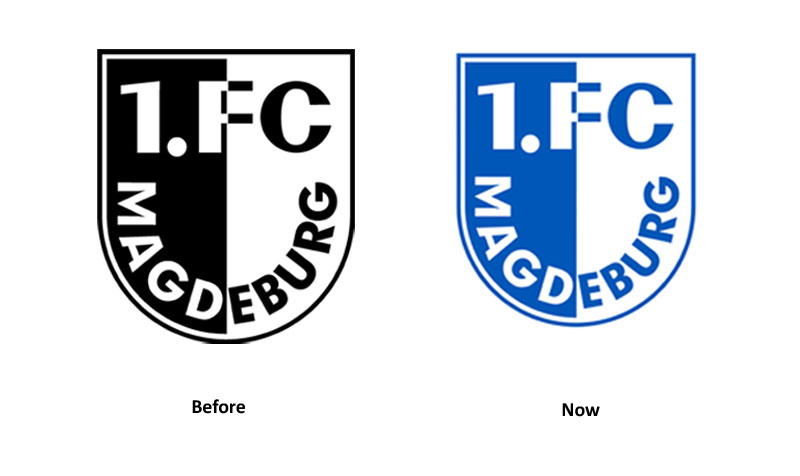
The badge has changed multiple times since the club’s 1965 founding, moving from simple typographic marks through East German-era designs to the cleaner modern crest used today.
Early versions were heavily influenced by the visual conventions of East German sports clubs, which favored geometric, state-aligned aesthetics.
After reunification, the club went through financial and competitive instability, and the badge shifted along with the club’s identity. The push toward a stable, recognizable crest came during the club’s revival in the 2010s.
Original FC Magdeburg Logo (1965-1970s)
- Years Active: 1965 to early 1970s
- Design Description: Basic typographic mark using “FCM” initials with minimal graphic decoration
- Color Scheme: Blue and white
- Designer: Unknown
- Context: Club founded in 1965 in East Germany; initial badge reflected the era’s stripped-back design norms for amateur and semi-professional clubs
- Key Changes from Previous: First iteration; no predecessor
- Cultural Significance: Established the blue and white color identity that has stayed with the club ever since
DDR-Oberliga Era Logo (1970s-1991)
- Years Active: Approximately 1970s through 1991
- Design Description: More structured badge with shield influence; retained FCM lettering but added greater visual framing
- Color Scheme: Blue and white
- Designer: Unknown
- Context: The club competed in the DDR-Oberliga and won the UEFA Cup Winners’ Cup in 1974, giving the badge its first real international exposure
- Key Changes from Previous: More defined badge shape, slightly heavier typographic style
- Cultural Significance: The 1974 European trophy win is the single biggest moment in club history, making this era’s crest historically significant despite its simple design
Post-Reunification Logo (1991-2010s)
- Years Active: 1991 to approximately 2012
- Design Description: Transitional designs reflecting the club’s unstable period; some versions introduced a more elaborate circular badge with city references
- Color Scheme: Blue and white, with some versions using gold or yellow accents
- Designer: Unknown
- Context: German reunification brought financial instability to many East German clubs, and FC Magdeburg dropped through the divisions, which affected branding consistency
- Key Changes from Previous: Attempted modernization, less consistent application across the period
- Cultural Significance: Reflects the difficult transition many East German clubs faced after 1990
Modern FC Magdeburg Logo (2015-Present)
- Years Active: 2015 to present
- Design Description: Clean circular emblem with bold “FCM” initials, blue and white color blocking, and refined proportions suited to digital and print use
- Color Scheme: Royal Blue (#004F9F) and White (#FFFFFF)
- Designer: Developed internally
- Context: Introduced as the club rebuilt through the lower German divisions toward a return to professional football, culminating in promotion to the 2. Bundesliga in 2018
- Key Changes from Previous: Cleaner geometry, stronger visual hierarchy, better scalability across digital platforms
- Cultural Significance: Represents the club’s second chapter, connecting a new generation of supporters to the historic FCM identity
What Do the Design Elements of the FC Magdeburg Logo Mean?
Each element in the FC Magdeburg badge carries a specific reference, either to the club’s founding identity, the city of Magdeburg, or the visual conventions of German football club crests.
The circular shield form signals tradition and stability, which is common across European football badges.
The “FCM” letterform is the anchor of the whole design. It prioritizes instant recognition over decorative complexity, which makes sense for a club that competes across multiple levels of German football.
What Does the Shield Shape Represent in the FC Magdeburg Logo?
Shield-based crests are standard in European football, linking clubs to heraldic traditions and civic identity.
For FC Magdeburg, the circular badge references both the city’s own coat of arms and the broader tradition of German football club insignia.
It signals belonging, a mark that supporters recognize immediately on kits and stadium boards. The shape also works well with the Gestalt principles of closure and unity, where the eye naturally reads it as a complete, stable object.
What Does the Color Blue Mean in the FC Magdeburg Logo?
Blue has been the club’s color since 1965. It connects directly to the city’s visual identity and creates a consistent thread through every logo version across six decades.
Beyond football, blue carries associations with reliability and focus, which is one reason it appears across so many blue logos in sports and beyond.
For the supporters, though, the color is simply FCM. No deeper meaning needed.
Why Did FC Magdeburg Choose These Specific Colors?
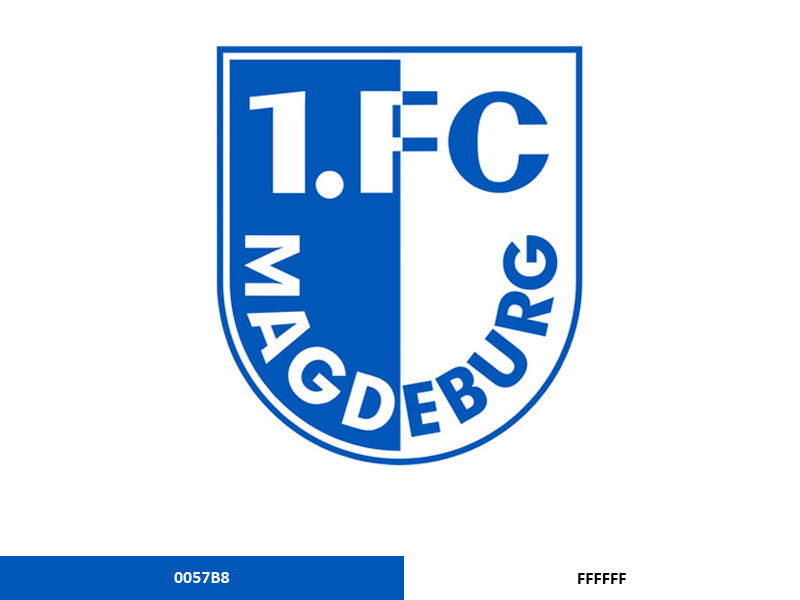
- Royal Blue
- Hex: #004F9F
- Pantone: Pantone 286 C (approximate)
- Symbolic meaning: Civic pride, connection to Magdeburg’s city colors
- Psychological impact: Trust, stability, focus
- Brand connection: Consistent across all kit and badge iterations since founding
- White
- Hex: #FFFFFF
- Pantone: White
- Symbolic meaning: Clarity, contrast, clean identity
- Psychological impact: Openness, straightforwardness
- Brand connection: Provides the contrast needed for legibility across all badge sizes and applications
What Typography Style Is Used in the FC Magdeburg Logo?

The “FCM” lettering uses a bold, condensed sans-serif style. No officially named custom typeface has been publicly credited.
The letterforms are thick and sturdy, built for visibility at small sizes on kit badges and large sizes on stadium boards.
Understanding typography basics makes it clear why this approach works: heavy weight, tight spacing, minimal decoration. It reads fast, which matters when a badge needs to be recognized in motion during a match.
Earlier versions of the badge used slightly different letterform proportions, but the current version standardized the weight and spacing for cleaner digital reproduction.
What Are the Hidden Meanings in the FC Magdeburg Logo?
No officially documented hidden meanings exist in the FC Magdeburg badge. The design is deliberately straightforward.
That said, supporters and design observers have noted that the tight circular framing of the “FCM” initials creates a sense of containment and focus, which mirrors the club’s identity as a tightly-knit, community-driven organization.
The city connection is also present, with the badge’s color scheme directly echoing Magdeburg’s civic visual language. Whether intentional or just inherited, it reinforces a local identity that goes beyond football.
How Does the FC Magdeburg Logo Compare to Competitor Logos?
Within German football, FC Magdeburg’s badge sits in a category of clean, initials-focused emblems that prioritize recognition over complexity. It shares this approach with several regional rivals.
Compared to clubs like Dynamo Dresden and Hansa Rostock, both of which are historically significant East German clubs, FC Magdeburg’s badge is more restrained. Dresden and Rostock both use more elaborate crests with figurative elements.
Hallescher FC and FSV Zwickau, two other clubs from the former East Germany, also use relatively simple badge structures, which reflects the shared design heritage of clubs from that region.
Against clubs at a similar competitive level, like VfL Osnabruck or SV Meppen, the FCM badge holds up well. It looks professional and scalable, which is more than can be said for some lower-division German clubs still using outdated badge formats.
The FC Schalke 04 logo and Borussia Dortmund logo, both from a higher competitive tier, use more elaborate designs with greater graphic complexity. The gap between those badges and the FCM crest reflects the difference in budget and brand infrastructure, not design intent.
What Are the Technical Specifications of the FC Magdeburg Logo?
Official Color Codes
- Primary Color: Royal Blue
- Hex: #004F9F
- RGB: (0, 79, 159)
- CMYK: (100, 50, 0, 38)
- Pantone: 286 C (approximate)
- Secondary Color: White
- Hex: #FFFFFF
- RGB: (255, 255, 255)
- CMYK: (0, 0, 0, 0)
- Pantone: White
For screen use, colors are specified in RGB. For print applications, CMYK values apply, and Pantone spot colors are used for official kit and merchandise production where color accuracy is critical.
Dimensions and Proportions
- Aspect ratio: Approximately 1:1 (circular badge)
- Minimum size requirements: Not officially published; standard practice for circular football badges sets a floor of approximately 16px diameter for digital use
- Clear space specifications: Not officially published; industry standard recommends a clear space equal to at least 10% of the badge diameter on all sides
- Official usage guidelines: Available through the club’s official media and licensing channels; general guidance mirrors DFL (Deutsche Fussball Liga) standards for member clubs
The badge is available as a vector graphic for official partners, which means it scales cleanly from a small kit badge to a full stadium graphic without quality loss. Non-vector versions distributed online are typically JPEG or PNG. The PNG versions with transparent backgrounds are the most useful for digital applications where the badge sits over colored backgrounds. A bitmap version is only suitable for fixed-size applications.
What Cultural Impact Has the FC Magdeburg Logo Had?

For supporters in Saxony-Anhalt, the FCM badge carries the full weight of the club’s history, including the 1974 UEFA Cup Winners’ Cup, the East German championship years, and the long grind back through the lower German divisions after reunification.
That history is what gives the badge meaning beyond its graphic elements.
In East German football culture specifically, FC Magdeburg occupies a significant place. The badge is recognized as a symbol of regional identity in a part of Germany where football clubs became community anchors during and after the GDR era.
The return to the 2. Bundesliga in 2018 brought the badge back to national visibility after years in the lower divisions. A new generation of supporters encountered the crest for the first time, while older fans saw it as a return to where the club belongs.
The badge also appears frequently in discussions of East German football history and in collections of historic German football crests, giving it a presence beyond just active supporters.
How Does the FC Magdeburg Logo Fit Into the Overall Brand Identity?

The badge is the center of a broader identity system that includes the club’s blue and white kit colors, the MDCC-Arena branding, and official communications across digital and print channels.
The brand guidelines for professional football clubs at this level typically cover badge usage, color application, and typography, though FC Magdeburg has not publicly released a detailed brand style guide.
The logo connects directly to the club’s kit design, stadium identity, and merchandise range. On the kit, it sits as the primary mark alongside sponsor logos. On merchandise, it functions independently as the sole identifier. The emphasis in every application is the same: the FCM initials and the blue-and-white color pairing.
The badge also connects the club to the wider German football identity. Compared to the more elaborate crests of clubs like FC Augsburg or Greuther Furth, the FCM badge is leaner, which suits a club that has historically operated with limited commercial resources but strong supporter loyalty.
How Should the FC Magdeburg Logo Be Used?

- Official usage do’s:
- Use the badge at sufficient size to keep the “FCM” lettering legible
- Reproduce colors accurately using the specified Pantone, CMYK, or RGB values
- Use vector files for any application larger than approximately 5cm in print
- Apply the badge on clean backgrounds with adequate clear space
- Use official files sourced directly from the club or licensed media partners
- Official usage don’ts:
- Do not stretch, distort, or rotate the badge
- Do not apply unofficial color variations or gradients over the badge
- Do not remove, alter, or reposition elements within the crest
- Do not use the badge in any commercial context without written permission from FC Magdeburg
- Do not reproduce the badge in low resolution for print applications
- Where to access official logos: Official media kit requests go through the club’s press office. High-resolution files are available to accredited media partners and licensed commercial partners directly through FC Magdeburg’s official channels.
- Licensing information: Commercial use of the FC Magdeburg badge requires a licensing agreement with the club. This covers merchandise, co-branded materials, and any commercial publication.
- Trademark protection: The badge is a registered trademark. Unauthorized use in commercial contexts constitutes trademark infringement under German intellectual property law.
FAQ on The FC Magdeburg Logo
What does the FC Magdeburg logo look like?
The badge is a circular emblem featuring bold “FCM” initials in white set against royal blue.
It uses a clean shield-influenced shape. No complex imagery, just strong typography and a two-color scheme that makes it instantly recognizable on kits and merchandise.
What colors are used in the FC Magdeburg badge?
The club uses royal blue (#004F9F) and white (#FFFFFF). These are the official kit colors and have been part of the club’s visual identity since its founding in 1965.
The color palette has stayed consistent across every major badge iteration.
What do the FC Magdeburg logo colors mean?
Blue connects directly to Magdeburg’s civic identity and signals trust and stability.
White provides contrast and clarity. Together they form a monochrome-adjacent pairing that keeps the badge legible at any size, from a small kit patch to a full stadium graphic.
Has the FC Magdeburg crest changed over time?
Yes. The badge has gone through several iterations since 1965, moving from basic typographic marks through East German-era designs to the cleaner modern emblem used today.
The biggest shift came during the club’s revival in the 2010s, when the crest was refined for digital use.
What font is used in the FC Magdeburg logo?
No officially named typeface has been credited. The lettering is a bold, condensed sans-serif style, built for maximum legibility at small sizes.
The letterforms are thick and tightly spaced, which is a deliberate choice for a badge that needs to read clearly in motion.
Where can I download the official FC Magdeburg logo?
Official high-resolution files are available through the club’s press office for accredited media and licensed commercial partners.
Unofficial PNG and JPEG versions circulate online, but these are not always accurate. For anything commercial, contact the club directly to get the correct vector graphics file.
What are the technical color codes for the FC Magdeburg logo?
Royal blue breaks down as Hex #004F9F, RGB (0, 79, 159), and CMYK (100, 50, 0, 38).
White is #FFFFFF across all formats. For print production, Pantone 286 C is the closest match for the blue.
How does the FC Magdeburg logo compare to other East German football club badges?
It is more restrained than most. Clubs like Dynamo Dresden and Hansa Rostock use more figurative crests with animals or detailed heraldic elements.
FCM keeps it simple. That restraint actually works in its favor for digital applications.
Can the FC Magdeburg logo be used commercially?
No, not without a licensing agreement. The badge is a registered trademark under FC Magdeburg GmbH & Co. KGaA.
Unauthorized commercial use violates German intellectual property law. Any merchandise, co-branded material, or publication requires written permission from the club.
What makes the FC Magdeburg logo design effective?
It follows solid logo design principles: simple, scalable, and tied to a clear identity.
The circular badge format, bold initials, and two-color scheme mean it works at any size without losing legibility. There is no complexity to break down, which is exactly the point.

Renowned for his expertise in logo design and visual branding, Bogdan has developed a multitude of logos for various clients.
His skills extend to creating posters, vector illustrations, business cards, and brochures. Additionally, Bogdan's UI kits were featured on marketplaces like Visual Hierarchy and UI8.
He also wrote in the past years on sites like Design Your Way, WebDesignerDepot, WPDean, Designmodo, Speckyboy, Slider Revolution, and more.
- The Windsurf Logo History, Colors, Font, And Meaning - 10 October 2026
- How to Remove Background From Product Photos (No Photoshop) - 10 October 2026
- How Designers can Build a Stronger Online Creative Identity - 9 October 2026

Bogdan Sandu is a seasoned designer who has been designing websites since 2008. Renowned for his expertise in logo design and visual branding, Bogdan has developed a multitude of logos for various clients. His skills extend to creating posters, vector illustrations, business cards, and brochures. Additionally, Bogdan's UI kits were featured on marketplaces like Visual Hierarchy and UI8. He also wrote in the past years on sites like Design Your Way, WebDesignerDepot, WPDean, Designmodo, Speckyboy, Slider Revolution, and more.
You Might Also Like


