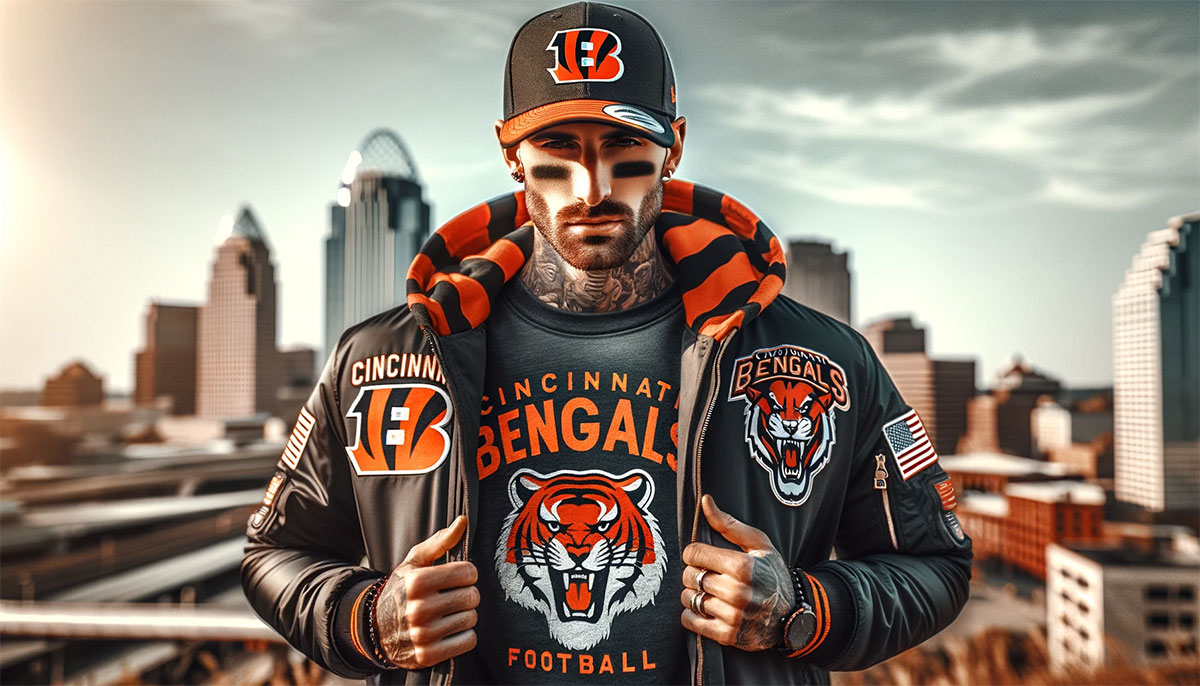
The Cincinnati Bengals logo stands as one of the most recognizable marks in professional football. It features bold tiger stripes that wrap around the team’s helmet, creating instant visual impact on game day.
This NFL franchise, founded in 1968 by Paul Brown, has gone through several logo changes. The current striped design debuted in 1981 and remains largely unchanged today.
Among NFL logos, the Bengals mark holds a unique position. It ditches the typical mascot illustration for an abstract pattern approach. The team has used four primary logo versions throughout its history.
What is the Cincinnati Bengals Logo?
The Cincinnati Bengals logo is a stylized Bengal tiger head featuring orange and black stripes. Introduced in its current form in 2004, it was refined by the NFL Properties design team. The mark symbolizes ferocity, speed, and the team’s jungle cat identity.
Design Type: Combination mark (mascot-based with wordmark variations)
Primary Elements:
- Stylized tiger head facing left
- Bold orange and black diagonal stripes
- White accents for dimension
- Aggressive facial expression with visible fangs
Official Introduction Date: Current version launched in 2004
Designer/Agency: NFL Properties in collaboration with Cincinnati Bengals organization
Trademark Status: Registered trademark of the Cincinnati Bengals, Inc. Protected under NFL licensing agreements.
Color Palette:
- Bengals Orange (#FB4F14)
- Black (#000000)
- White (#FFFFFF)
Usage Context: Appears on merchandise, digital platforms, stadium signage, official team communications, and broadcast graphics. The helmet stripe pattern serves as a secondary mark.
How Has the Cincinnati Bengals Logo Evolved Over Time?
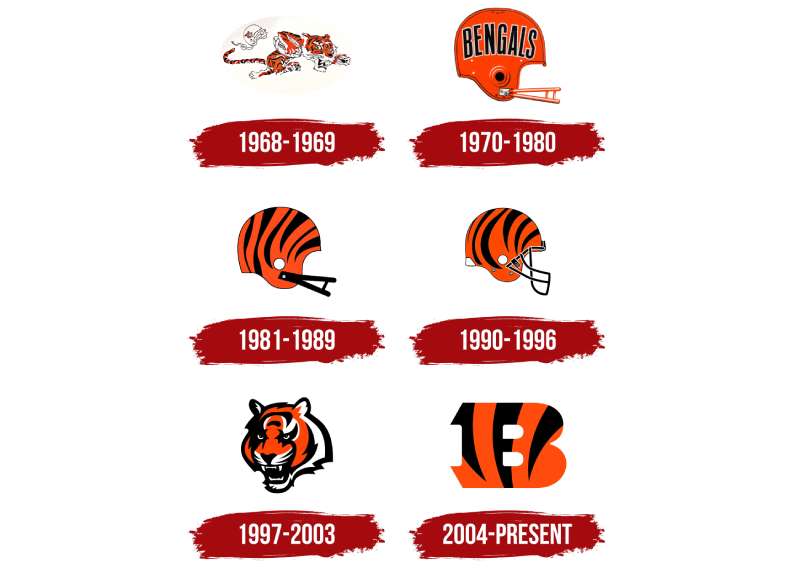
The Bengals have used four distinct logos since 1968. Each version reflects the design trends of its time while maintaining the tiger theme.
The evolution moved from a cartoonish running tiger to the aggressive, stylized head we see today.
Original Cincinnati Bengals Logo (1968-1969)
Years Active: 1968-1969
Design Description: A cartoon-style Bengal tiger in mid-leap. The tiger appeared friendly rather than fierce. It wore a football tucked under one arm.
Color Scheme: Orange body with black stripes, white belly
Designer: Unknown (team internal design)
Context: Paul Brown founded the franchise as an AFL expansion team. He wanted a name connecting to Cincinnati’s history with the 1937 Bengals.
Key Changes from Previous: First logo in franchise history
Cultural Significance: Established the tiger as the team’s identity. Set the orange and black color palette still used today.
Leaping Tiger Logo (1970-1980)
Years Active: 1970-1980
Design Description: A more athletic tiger in full sprint. The design showed the entire body with exaggerated muscles. Still carried a cartoon quality but looked faster.
Color Scheme: Same orange, black, and white combination
Designer: Team design staff
Context: The AFL-NFL merger brought new competition. Teams updated their looks to appear more professional on television.
Key Changes from Previous: Tiger became more dynamic. Removed the football prop. Added more detailed stripe patterns.
Cultural Significance: Represented the team during its early NFL years. Fans from this period still hold nostalgia for the leaping tiger.
Tiger Head Introduction (1981-1996)
Years Active: 1981-1996
Design Description: The first tiger head logo. Showed a growling Bengal face in profile view. Featured more realistic proportions than previous versions.
Color Scheme: Orange, black, and white with added depth through shading
Designer: NFL Properties
Context: The team reached Super Bowl XVI in 1982. A bolder identity matched their on-field success.
Key Changes from Previous: Completely abandoned the full-body tiger. Focused only on the head for stronger impact.
Cultural Significance: This version saw two Super Bowl appearances. It became the logo most associated with the team’s success era.
Modern Tiger Head (1997-2003)
Years Active: 1997-2003
Design Description: Updated tiger head with sharper lines. The face became more angular and aggressive. Added detail to fur texture.
Color Scheme: Brighter orange, deeper blacks, white highlights
Designer: NFL Properties design team
Context: The late 90s saw many NFL teams modernizing their looks. The Bengals followed the trend toward edgier designs.
Key Changes from Previous: Increased detail throughout. More defined facial features. Added three-dimensional qualities.
Cultural Significance: Bridged the gap between classic and contemporary. Set up the foundation for the current logo.
Current Cincinnati Bengals Logo (2004-Present)
Years Active: 2004-present
Design Description: Refined tiger head with maximum aggression. Clean lines and simplified details. Works well across all media formats.
Color Scheme: Bengals Orange (#FB4F14), Black (#000000), White (#FFFFFF)
Designer: NFL Properties with Bengals input
Context: Digital media demanded cleaner designs. The team wanted a mark that scaled from mobile screens to stadium jumbotrons.
Key Changes from Previous: Streamlined all elements. Removed excessive detail. Created stronger silhouette.
Cultural Significance: This logo saw the team reach Super Bowl LVI in 2022. It represents the modern Bengals era under owner Mike Brown.
What Do the Design Elements of the Cincinnati Bengals Logo Mean?
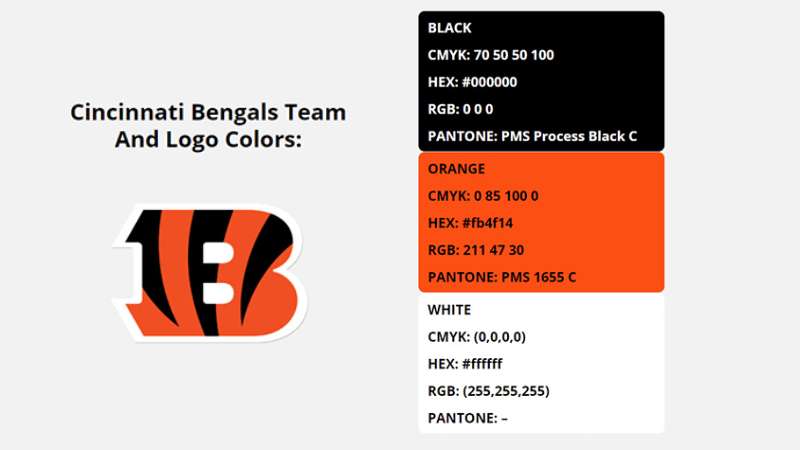
Every piece of the Bengals logo carries meaning. The tiger head communicates power and dominance.
The stripes connect to the actual Bengal tiger species. And the color choices reinforce aggression and energy.
Why Did the Cincinnati Bengals Choose These Specific Colors?
Bengals Orange
- Hex: #FB4F14
- Pantone: PMS 1655 C
- Symbolic meaning: Energy, aggression, visibility
- Psychological impact: Creates excitement and urgency
- Brand connection: Mirrors actual Bengal tiger coloring
Orange demands attention. It sits among orange logos as one of the most saturated in professional sports.
Black
- Hex: #000000
- Pantone: Black 6 C
- Symbolic meaning: Power, sophistication, intimidation
- Psychological impact: Conveys dominance and seriousness
- Brand connection: Natural tiger stripe coloring
The combination of these colors follows principles of color psychology. Together they create maximum contrast and visual punch.
White
- Hex: #FFFFFF
- Symbolic meaning: Clarity, definition, highlights
- Psychological impact: Provides visual relief and dimension
- Brand connection: Natural tiger markings around eyes and muzzle
What Typography Style Is Used in the Cincinnati Bengals Logo?
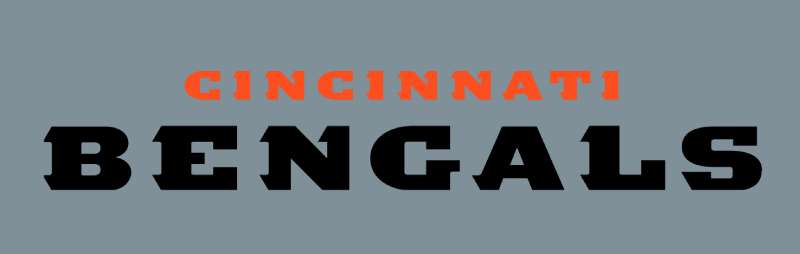
The Bengals wordmark uses a custom sans-serif font with aggressive angles. Letters feature pointed terminals that echo the stripe pattern.
The type leans slightly forward. This creates a sense of motion and speed.
Thick strokes ensure readability at small sizes. The custom letterforms prevent other brands from copying the look.
Over the years, the typography has become bolder. Earlier versions used lighter weights that got lost on television broadcasts.
What Are the Hidden Meanings in the Cincinnati Bengals Logo?
The tiger’s eye line points forward and slightly down. Designers intended this to suggest a predator locked onto its target.
The angle of the stripes matches the helmet stripe pattern. This creates brand consistency across all touchpoints.
Some fans see the letter “B” formed in the negative space. The team has never confirmed this was intentional.
The open mouth shows teeth without being cartoonish. It balances aggression with professionalism.
How Does the Cincinnati Bengals Logo Compare to Competitor Logos?
The Bengals sit in the AFC North with three other teams. Each takes a different design approach.
The Baltimore Ravens logo uses a stylized bird head with purple and black. It shares the aggressive animal portrait concept.
The Pittsburgh Steelers logo stands apart entirely. Those three hypocycloids (the diamond shapes) make it the only NFL logo appearing on just one side of the helmet.
The Cleveland Browns logo is literally just an orange helmet. No mascot, no wordmark. The simplest in the league.
Among cat-based teams, the Bengals compete with the Carolina Panthers logo, the Jacksonville Jaguars logo, and the Detroit Lions logo.
The Panthers and Jaguars use similar snarling head profiles. The Lions take a more heraldic approach.
What sets Cincinnati apart? That stripe pattern on the helmet. No other team relies so heavily on a secondary mark.
What Are the Technical Specifications of the Cincinnati Bengals Logo?
Official Color Codes:
Primary Color: Bengals Orange
Secondary Color: Black
- Hex: #000000
- RGB: (0, 0, 0)
- CMYK: (0, 0, 0, 100)
- Pantone: Black 6 C
Accent Color: White
- Hex: #FFFFFF
- RGB: (255, 255, 255)
- CMYK: (0, 0, 0, 0)
Dimensions and Proportions:
- Aspect ratio: Approximately 1:1 for tiger head mark
- Minimum size: 0.5 inches for print, 50 pixels for digital
- Clear space: Minimum of 10% of logo width on all sides
- The logo must not be stretched, rotated, or altered in any way
The mark works as both vector graphics and raster formats. Teams receive files in AI, EPS, PNG, and SVG formats through NFL licensing portals.
What Cultural Impact Has the Cincinnati Bengals Logo Had?
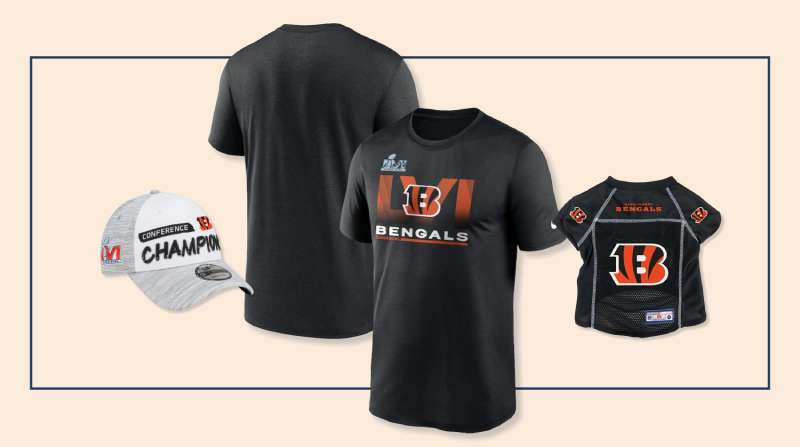
The Bengals stripe pattern transcended football. You see it on everything from local business signs to tattoo parlors throughout Cincinnati.
The “Who Dey” chant pairs with the tiger imagery to create a complete fan identity.
During the 2022 Super Bowl run, tiger stripe face paint became a national phenomenon. Fans who had never watched football recognized the pattern.
The logo appears throughout the city on murals, bridges, and public art. It represents Cincinnati as much as it represents the team.
How Does the Cincinnati Bengals Logo Fit Into the Overall Brand Identity?
The logo anchors a complete visual system. Every piece connects back to that tiger head and stripe pattern.
Paycor Stadium features the stripes on its exterior. Team buses, practice facilities, and office buildings all carry the marks.
The official brand guidelines dictate exact usage rules. These standards ensure consistency whether the logo appears on a Super Bowl broadcast or a local car dealership partnership.
Player jerseys feature the stripes on the helmet, pants, and sleeves. The pattern creates instant recognition even without the tiger head.
How Should the Cincinnati Bengals Logo Be Used?
Official Usage Guidelines:
Do:
- Use official files from NFL licensing
- Maintain required clear space
- Use approved color combinations only
- Scale proportionally
- Place on contrasting backgrounds
Don’t:
- Alter colors or proportions
- Add effects like shadows or gradients
- Place on busy backgrounds
- Combine with other team logos
- Use for commercial purposes without license
Where to Access Official Logos:
Licensed partners receive files through NFL Brand Central. Media outlets access press kits via the Cincinnati Bengals official website. Personal use remains restricted to unofficial fan art contexts.
Licensing Information:
The NFL controls all licensing through NFL Properties. Manufacturers must apply for official licenses to produce merchandise. Unauthorized use results in trademark infringement claims.
Trademark Protection:
The tiger head, wordmark, and stripe pattern all hold federal trademark protection. The team actively monitors and enforces these rights. Even fan-made products face scrutiny if sold commercially.
FAQ on The Cincinnati Bengals Logo
What Does the Cincinnati Bengals Logo Look Like?
The primary mark features a stylized Bengal tiger head in profile. Orange and black stripes dominate the design.
The tiger faces left with an open mouth showing fangs. White accents add dimension around the eyes and muzzle.
It works as a strong focal point on merchandise and broadcasts.
When Was the Current Cincinnati Bengals Logo Introduced?
The current tiger head debuted in 2004. NFL Properties refined the previous version for better digital reproduction.
This update simplified details while keeping the aggressive expression. The team wanted something that scaled well across all platforms.
It has remained unchanged for over two decades now.
What Colors Are in the Cincinnati Bengals Logo?
Three colors define the Bengals brand. Bengals Orange (hex #FB4F14) serves as the primary hue.
Black (#000000) creates the stripe pattern and outlines. White (#FFFFFF) provides highlights and contrast.
This combination follows basic color theory for maximum visibility.
Who Designed the Cincinnati Bengals Logo?
NFL Properties handled the current design internally. No single designer receives public credit.
The original 1968 logo came from the team’s own staff under Paul Brown’s direction.
Each revision involved collaboration between the Cincinnati franchise and league design teams.
Why Does the Bengals Helmet Have Stripes Instead of a Logo?
Paul Brown made this choice in 1981. He wanted something different from every other NFL team.
The tiger stripes wrap around the entire helmet. This creates instant recognition without needing a central emblem.
The pattern uses repetition as its core design element.
How Many Logos Have the Cincinnati Bengals Had?
The franchise has used five primary logos since 1968. Two featured full-body leaping tigers.
Three versions show the tiger head only. Each change reflected shifting design trends in professional sports branding.
The helmet stripe pattern has stayed consistent since 1981.
What Is the Meaning Behind the Bengal Tiger Logo?
The tiger represents power, speed, and ferocity. Paul Brown chose the name to honor Cincinnati’s original 1937 football team.
Bengal tigers symbolize rare strength in nature. The aggressive expression communicates competitive intensity on the field.
Understanding the psychology of shapes explains why angular features dominate.
Can I Use the Cincinnati Bengals Logo for Personal Projects?
Personal, non-commercial use falls into a gray area. The NFL holds strict trademark protection on all team marks.
Selling products with the logo requires official licensing. Fan art shared freely typically goes unchallenged.
Commercial use without permission results in legal action.
Where Can I Download the Official Cincinnati Bengals Logo?
The team website offers limited press kit assets. High-resolution files require NFL licensing approval.
Media outlets access official versions through credential portals. Most online downloads are unofficial recreations.
Licensed partners receive proper vector files through NFL Brand Central.
How Does the Bengals Logo Compare to Other AFC North Teams?
Each division rival takes a unique approach. The Ravens use a bird head with purple tones.
Pittsburgh’s Steelmark stands completely alone in NFL design. Cleveland uses just an orange helmet with no mascot at all.
The Bengals balance aggression with clean modern lines.
Conclusion
The Cincinnati Bengals logo represents more than just a football franchise. It captures the spirit of an entire city.
From the original leaping tiger to today’s fierce tiger head, each version tells part of the team’s story. The striped helmet remains unique across the NFL.
That orange and black combination has become synonymous with Cincinnati sports culture. Fans at Paycor Stadium wear it with pride.
Whether the Bengals are chasing another Super Bowl appearance or rebuilding, this team emblem endures. The Who Dey nation keeps it alive every Sunday.

Renowned for his expertise in logo design and visual branding, Bogdan has developed a multitude of logos for various clients.
His skills extend to creating posters, vector illustrations, business cards, and brochures. Additionally, Bogdan's UI kits were featured on marketplaces like Visual Hierarchy and UI8.
He also wrote in the past years on sites like Design Your Way, WebDesignerDepot, WPDean, Designmodo, Speckyboy, Slider Revolution, and more.
- Minecraft Font Generator - 8 October 2026
- How Top Meta Ad Creative Is Designed for E-commerce Brands - 8 October 2026
- How photo recovery software works and when to use it - 7 October 2026

Bogdan Sandu is a seasoned designer who has been designing websites since 2008. Renowned for his expertise in logo design and visual branding, Bogdan has developed a multitude of logos for various clients. His skills extend to creating posters, vector illustrations, business cards, and brochures. Additionally, Bogdan's UI kits were featured on marketplaces like Visual Hierarchy and UI8. He also wrote in the past years on sites like Design Your Way, WebDesignerDepot, WPDean, Designmodo, Speckyboy, Slider Revolution, and more.
You Might Also Like