
The main benefits of print on demand are that you can sell custom products without buying stock, without upfront production costs and without handling printing or shipping yourself. A provider prints each item after a customer orders it and ships it directly, which lets authors, artists and small brands turn designs into t-shirts, posters, books and other goods with very little risk. Services such as Printful make this model practical for people who do not have startup capital.
What is print on demand?
Print on demand (POD) is a business model in which custom goods are produced and shipped only when an order arrives. You supply the design, the provider holds the blank products, prints them to order and delivers them. Because nothing is made in advance, there is no inventory to store or write off.
For many sellers it starts as a low-cost way to launch a brand and grows into a real business as designs prove themselves. This video from Printful explains how the process works.

How does the print on demand process work?
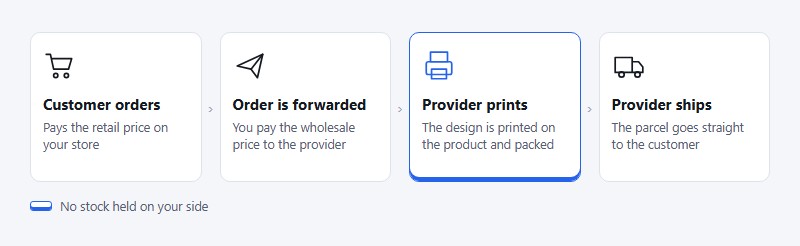
The customer pays the retail price on your store, you send the order to the provider and pay the wholesale price, and the provider prints, packs and ships it. Your profit on each sale is the markup between the two prices.
With Printful, for example, you create designs and preview them on the product with a visualization tool in the order menu. Simple designs such as a t-shirt tagline can be built in the tool, while more intricate artwork is uploaded and positioned on the product. Mockup generators help you create product images for the store before any item is printed.
What are the benefits of print on demand?
Lower risk, lower startup cost and more time for creative work are the main ones. Each benefit below comes from the fact that production happens only after a sale.
Low investment and low risk
POD cuts the investment tied up in bulk print runs, outdated stock and storage space. Print files are stored electronically, and you can update a design as often as you like instead of scrapping printed inventory.
An easy way to start a brand
Starting a POD business does not require startup capital, so almost anyone can launch a brand and sell a range of items. Many providers connect to online store builders. If an idea fails, you have not locked money into stock, and you can relaunch later with a different niche.
New and custom designs on demand
POD uses the latest version of a file, and some services support variable data for targeted marketing, such as personalized names, text, graphics and images. This suits limited editions and seasonal designs.
Lower shipping costs and broader reach
Because items ship directly from the provider to the customer, you avoid moving bulk stock around. Providers with production sites in several regions can ship closer to the buyer, which helps with delivery times and costs.
More range of products
Providers offer clothing, home goods, decor and accessories, and you can test new items without a bulk order. The range is limited by what the provider offers, so pick one with all the products you want. The t-shirt market is competitive, and sellers also add items such as mouse pads and rugs to stand apart. If you are choosing what to print, these techniques for putting a logo on clothes show how printing methods differ.
Time to focus on design and customers
The provider handles printing and shipping, so you can concentrate on creating designs and attracting customers. Marketplaces such as Redbubble and Amazon can also expose your products to new buyers without extra approval steps on your side. For ideas on turning artwork into income, read about creative ways to monetize your digital art.
Faster turnaround and consistent branding
Pre-set pricing reduces back-and-forth over estimates, and stored colors, logos and job specifications help keep brand consistency across orders. Providers also keep refining their print processes, so you do not have to search for a new printer for every job.
How do you start a print on demand business?
Choose a profitable niche, then build designs for it. Both steps decide whether anyone buys.
Select a niche with healthy demand
Target a specific market, such as hobbyists or a local community, and start from products you know. Check demand before spending money. Tools such as Trendhunter and Google Trends help you see which items sell, how a topic changes over time and how large a niche is.
Create designs that print well
Design drives sales and brand identity in POD. Use original concepts, pay attention to detail and export files in the formats and sizes your provider requires. Focus on your niche and audience for inspiration, keep the artwork simple but striking, and use a consistent style so the brand stays recognizable. This guide on designing t-shirt art that actually prints well covers the practical rules.
What should you consider when choosing a print on demand supplier?
Evaluate six things: product range, quality, delivery time, samples, experience and integrations.
- Product selection: POD covers clothing, accessories, homewares and decor. Beginners should focus on a niche, but pick a supplier with a broad range and quality certifications so you can expand later.
- Quality: suppliers are easy to find, good ones less so. Look at the provider’s production equipment and printing technology, as newer equipment usually means better output, and read independent reviews.
- Delivery time: total delivery time is production time plus shipping time. Providers such as Printful, Picanova and Printify publish production times, and the carrier determines shipping time. Holidays can slow both, so check notices about delays.
- Samples: order a sample after you have checked the other criteria, and judge its quality, delivery window and merchant reviews. If a provider does not support sample orders, consider another one.
- Industry experience: a provider with long experience has handled many merchant and customer cases and can guide you better.
- Integrations: check that the service connects to platforms such as Wix, Amazon, Shopify and Etsy. Our guide to building and promoting a Shopify website is a useful next read if you choose that platform.
Why do sellers choose Printful for print on demand?
Printful is popular for its wide product range, mockup generators and customizable unboxing experience. It offers several printing techniques for apparel, including direct-to-garment printing for simpler designs and all-over print, which cuts and sews the printed panels for a print that runs across the whole garment. All-over print suits premium products. It should not be confused with sublimation printing, which is more affordable but less precise.
Sample discounts
Printful offers a sample order discount so you can test products before listing them. Samples can be used for product photos, influencer outreach or giveaways, and your current allowance appears in the Printful dashboard. Terms depend on your sales, so check the current rules.
Multiple fulfillment centers
Printful runs production sites in several parts of the world and routes orders to alternative locations when demand is high or something goes wrong, so you do not choose a center yourself. That helps with dependable delivery and shorter shipping times.
Product quality
Because customers receive goods that you have not inspected, quality matters. Printful lists a range of t-shirts, including the Bella + Canvas 3001 and Anvil 980, along with canvas prints and affordable art prints and posters. For branded items beyond t-shirts, see tips for creating the perfect branded merchandise.
Frequently asked questions
Do I need money to start a print on demand business?
Not for inventory. You still need budget for samples, a store platform if it is not free, and marketing.
Who ships the orders?
The provider. You pass on the order and they print, pack and ship it to your customer.
How is profit calculated?
Retail price minus the wholesale price you pay the provider and any platform fees. Check shipping charges as well.
Can I sell on more than one platform?
Yes, as long as the provider integrates with each platform. Compare supported integrations before you choose.
Is print on demand a good way to launch a brand?
For most small creators, yes: it removes inventory risk and lets you test designs with real buyers. Pick one niche, order a sample from two providers, compare quality and delivery, and launch with a small set of designs before you expand.

Renowned for his expertise in logo design and visual branding, Bogdan has developed a multitude of logos for various clients.
His skills extend to creating posters, vector illustrations, business cards, and brochures. Additionally, Bogdan's UI kits were featured on marketplaces like Visual Hierarchy and UI8.
He also wrote in the past years on sites like Design Your Way, WebDesignerDepot, WPDean, Designmodo, Speckyboy, Slider Revolution, and more.
- How to Design Marketing Materials That People Actually Keep - 27 November 2026
- Behind the Logo: What Font Does Starbucks Use? - 26 November 2026
- Visual Hierarchy in Short Videos: How to Guide Attention Across a Sequence - 26 November 2026

Bogdan Sandu is a seasoned designer who has been designing websites since 2008. Renowned for his expertise in logo design and visual branding, Bogdan has developed a multitude of logos for various clients. His skills extend to creating posters, vector illustrations, business cards, and brochures. Additionally, Bogdan's UI kits were featured on marketplaces like Visual Hierarchy and UI8. He also wrote in the past years on sites like Design Your Way, WebDesignerDepot, WPDean, Designmodo, Speckyboy, Slider Revolution, and more.
You Might Also Like