Rich media ads evolved from static banners into interactive units that combine images, video, animation, audio and tracking, and they now sit alongside a conversion tool called the bridge page that prepares clicks for the final offer. A rich media ad is any digital ad that goes beyond a flat image or text and lets the viewer interact, play or explore. The format moved from plugin-based Flash units to HTML5 and mobile-ready creative, and each step made ads more engaging and more measurable.
How did rich media ads evolve?
Digital advertising began with simple static banners in the mid-1990s, and the first banner ad appeared on HotWired in 1994. As bandwidth and browsers improved, advertisers added animation, video and interactivity, much of it built in Flash. Expanding units that opened on hover, in-banner games and embedded video became common in the 2000s.
The format changed again when browsers moved away from plugins and mobile traffic grew. HTML5 replaced Flash as the standard for interactive creative, and Flash support formally ended on December 31, 2020. Standards for mobile in-app rich media, such as the IAB’s MRAID, gave advertisers a consistent way to run interactive units inside apps. Today the same creative is built to work across screens, with built-in measurement for each interaction.
What are rich media ads and what makes them different?

Rich media ads differ from traditional ads because they include multimedia components such as images, videos, animations and audio. They are designed to capture attention, invite interaction and strengthen brand recognition. The key characteristics of rich media ads are:
- Interactive elements. Games, surveys or product demonstrations encourage participation and extend the time a person spends with the ad.
- Mixed media. Videos and animations convey messages creatively and can communicate complex ideas or emotion more effectively than a still image.
- Tracking and analytics. Advertisers can measure interactions and gather insights to improve the campaign.
- A better ad experience. Visually appealing, interactive content is more enjoyable than a static unit, which can help brand perception.
Why do advertisers use rich media ads today?
Rich media has become widely used because of what it adds to a campaign.
Higher engagement
Interactive ads tend to perform better on engagement metrics such as click-through rate (CTR) and conversion rate than static ads, because people respond to content that holds their attention. Results vary by format, placement and audience, so measure your own campaigns before assuming a gain.
Better brand recall
Multimedia elements help people remember a brand name or logo. Greater visibility can build familiarity, and familiarity can build trust and loyalty over time.
More precise targeting
Rich media can be delivered to specific audiences, which helps the right message reach the right people at the right moment. That reduces wasted spend and improves return on investment.
Room for storytelling
These formats let advertisers tell brand stories, share testimonials and show product features in an engaging way. Storytelling builds an emotional connection that can lead to higher conversion rates. For creative approaches in practice, see how top Meta ad creative is designed for e-commerce brands.
What is a bridge page?
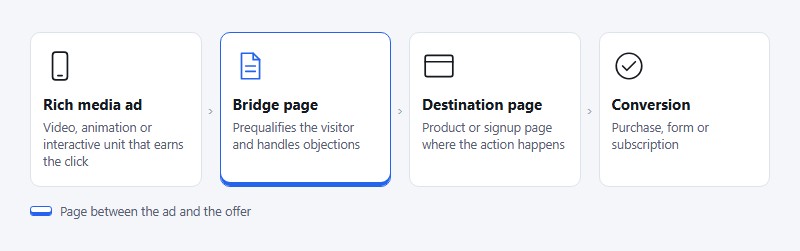
In online marketing, a bridge page is a separate web page placed between an ad and a destination page, which is often a product or service page. Its main goal is to prepare and persuade users to complete a specific action, such as making a purchase or filling out a form. Its key characteristics are:
- Prequalification. It gives visitors extra information and context about the offer, which raises the likelihood that they convert when they reach the destination page.
- Persuasive content. Persuasive language, visuals and calls to action motivate the visitor, while the page handles concerns and objections and emphasizes benefits.
- A simpler journey. By removing distractions and giving a straight path to the destination, it lowers the chance that people get lost or leave.
- A/B testing. Marketers often test messaging, design and calls to action on bridge pages, which allows continuous improvement.
Why are bridge pages valuable in ad campaigns?
Bridge pages earn their place in a campaign for four reasons.
Improved relevance
They connect the ad’s message to the destination page, creating a smooth transition. A consistent message makes visitors more likely to convert.
Stronger conversion rates
By supplying more information and answering concerns, bridge pages can lift conversion rates and campaign return on investment. They help turn clicks into customers, and the principles overlap with the link between web design and conversion rates.
Data collection
They are a chance to collect useful information such as email addresses for later marketing, building a list of engaged prospects.
Testing and optimization
Because a bridge page is a single page, it is easy to test and refine, and a well-optimized one can have a significant effect on a campaign’s success.
How do rich media ads and bridge pages work together?
The ad earns attention and the click. The bridge page then keeps the message consistent, answers the questions the ad could not fit and sends a qualified visitor to the offer. A video ad that promises a specific benefit should lead to a bridge page that repeats that benefit in the first screen. If the video format is part of your plan, the tips in creating videos that convert apply to the creative as well.
Frequently asked questions
What is a rich media ad?
It is a digital ad that uses interactive or multimedia elements such as video, animation, audio, games or product demos, and it usually includes tracking for each interaction.
Do rich media ads work better than static banners?
Often they earn more engagement, because people interact with them. The result depends on the creative quality, the placement and the audience, so test against your own baseline.
Do I need a bridge page for every campaign?
Not always. A bridge page helps most when the offer needs explanation or prequalification before the visitor takes action, and less when the ad can lead straight to a simple purchase page.
How should you use rich media ads and bridge pages together?
Rich media ads and bridge pages are two parts of the same path from attention to action. Use the ad to create interest and the bridge page to prepare the visitor, then test messaging on both. Start with one campaign: build a single interactive ad, send it to a focused bridge page and compare its conversion rate against your current setup.

Renowned for his expertise in logo design and visual branding, Bogdan has developed a multitude of logos for various clients.
His skills extend to creating posters, vector illustrations, business cards, and brochures. Additionally, Bogdan's UI kits were featured on marketplaces like Visual Hierarchy and UI8.
He also wrote in the past years on sites like Design Your Way, WebDesignerDepot, WPDean, Designmodo, Speckyboy, Slider Revolution, and more.

Bogdan Sandu is a seasoned designer who has been designing websites since 2008. Renowned for his expertise in logo design and visual branding, Bogdan has developed a multitude of logos for various clients. His skills extend to creating posters, vector illustrations, business cards, and brochures. Additionally, Bogdan's UI kits were featured on marketplaces like Visual Hierarchy and UI8. He also wrote in the past years on sites like Design Your Way, WebDesignerDepot, WPDean, Designmodo, Speckyboy, Slider Revolution, and more.
You Might Also Like