Computer vision is the field of computer science that teaches machines to understand digital images and video. A camera captures pixels, and software turns them into information: this is a face, that is a stop sign, this scan shows a suspicious shadow. It sits behind phone face unlock, driver assistance, factory quality checks and medical image analysis, and it matters more every year because cameras are cheap and almost every industry now produces more images than people can review.
What is computer vision?
Computer vision aims to let computers interpret and extract meaning from images and video, the way people do with their eyes and brain. A person looks at a street and sees cars, a crossing and a child about to step off the curb. A computer starts with a grid of numbers and has to work out the same thing.
It is related to image processing, but the two are not the same. Image processing changes an image, for example by sharpening it or adjusting the contrast. Computer vision tries to understand what is in the image and then act on it. In practice that means a system that can:
- identify objects, scenes and activities
- detect people and faces
- classify what an image contains
- rebuild 3D shapes from 2D pictures
- track motion, gestures and eye movement
- read handwritten text, which overlaps with image-to-text applications
Once a machine can label what it sees, it can make decisions without a human watching every frame. That is why the field is central to robotics, medical diagnosis, autonomous vehicles, event detection and image search.
How does computer vision work?
A digital image is a grid of pixels, and each pixel is a set of numbers. A computer vision model takes those numbers, finds patterns in them such as edges, textures and shapes, and combines the patterns into higher-level guesses like “wheel” and then “car”. Modern systems learn these patterns from thousands or millions of labeled examples instead of following hand-written rules.
Deep convolutional neural networks made this practical. Each layer of the network picks out progressively more complex features, so early layers respond to simple edges and later layers respond to whole objects. This short video from CrashCourse explains the idea clearly.

What are the core tasks in computer vision?
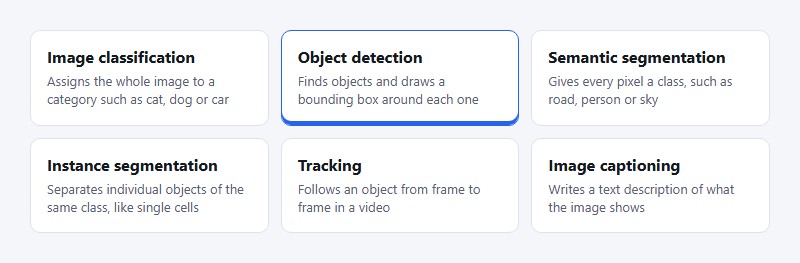
Most applications are built from a handful of building-block tasks. They differ in how much detail they return about an image.
- Image classification assigns one label to the whole image, such as “cat”, “dog” or “car”.
- Object detection finds each object and draws a bounding box around it.
- Semantic segmentation labels every pixel with a class, for example road, person or sky.
- Instance segmentation goes one step further and separates individual objects of the same class, such as each cell in a microscope image.
- Tracking follows an object from frame to frame in a video.
- Image captioning writes a sentence describing the objects and events in a picture.
There are also tasks on the creative and repair side. Image generation uses models such as GANs to produce realistic synthetic images, image restoration cleans up old, grainy or low-resolution pictures, feature detection finds distinctive points used to match two photos of the same scene, and event detection spots things like a traffic accident or a flash flood. Together they cover everything from describing a photo to creating one.
Where is computer vision used today?
It shows up wherever someone needs to look at a lot of images quickly and consistently. These are the areas where it does the most work.
Autonomous vehicles and driver assistance
Self-driving cars rely on vision algorithms to detect pedestrians, read road signs and recognize lane markings. The same techniques power advanced driver assistance systems (ADAS) that are already fitted to ordinary cars.
Medical imaging
Models can analyze scans to flag areas a clinician should look at, which helps with screening, diagnosis and research. They support doctors rather than replace them, since the final call needs clinical judgment.
Manufacturing and quality inspection
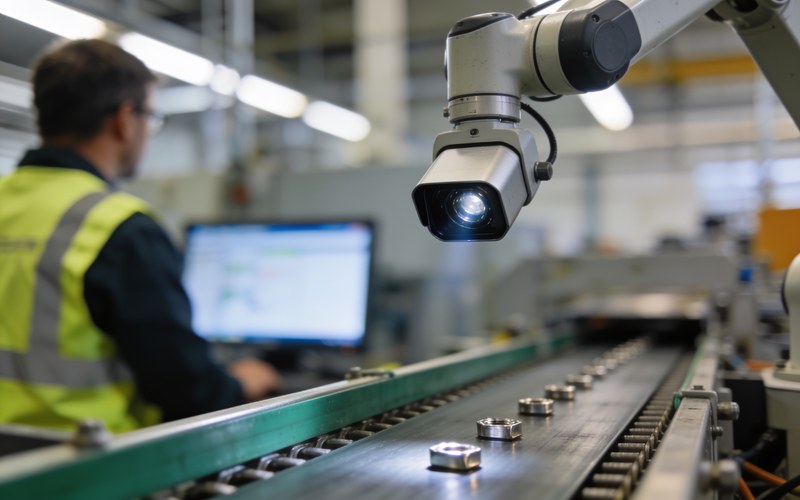
Cameras over a production line check product quality and consistency without getting tired. The same systems help with inventory tracking, production monitoring and robotic assembly.
Retail, agriculture and logistics
Retailers use vision for automated checkout and visual product search. Farms use it to analyze crops and soil, spot plant disease, count fruit and monitor livestock. In logistics, it reads license plates, measures cargo dimensions and guides warehouse robots.
Faces, AR and VR
Face analysis unlocks phones and also identifies people in security footage, which makes it the most debated use because of privacy. Headsets depend on vision to track the room and your hands, which is the foundation of AR and VR experiences.
Disaster response and security
Change detection on satellite images and flood modeling help responders find the areas and people most affected after cyclones, earthquakes and similar events. Defense and intelligence agencies also use vision for surveillance and drone-based detection, an area with its own ethical debates.
A short history of computer vision
The field goes back to the 1950s, when early researchers tried to get computers to read handwritten characters and solve simple puzzles. In 1966, an MIT summer project set out to have a computer describe what a camera saw, and it turned out to be a much bigger problem than anyone planned for.
The decades that followed built the mathematical foundations: recovering 3D structure from stereo images, separating objects by motion, and interpreting line drawings. Machine learning started to help in the 1990s and 2000s, although hand-designed mathematics still did most of the work.
The big change came with deep convolutional neural networks in the early 2010s, which produced large jumps in accuracy for classification, detection and recognition. More recently, self-supervised learning, which learns from unlabeled images, and vision transformers have pushed results further. On some benchmarks, such as image classification, models now match or beat human accuracy.
What can computer vision do well, and where does it fail?
It is strong on narrow, well-defined tasks. Classifying images into broad categories such as cats and dogs reaches over 90% accuracy in published work, and detecting and localizing common objects such as faces, traffic signals or products is a mature research area, though harder than classification. Models also analyze medical scans and satellite images, estimate crowd sizes and generate increasingly realistic synthetic images.
The weak spots are about flexibility. Models trained on one kind of data can fail on another, and they can be easy to fool.
| Limitation | What it looks like in practice |
| Unfamiliar concepts | The model struggles with objects it never saw during training |
| Weak context reasoning | It recognizes items but misses what the scene implies |
| Fragility | Small amounts of noise or edits to an image can change the answer |
| Ambiguous input | Occluded or unusual objects are often misclassified |
| Data dependence | Performance drops when real-world images differ from the training set |
The open research problems follow from this list: collecting and labeling enough training data, learning from unlabeled images, reasoning about cause and effect, building models that can explain their answers, and shrinking models that now need hundreds of millions of parameters.
Where is computer vision heading?
Five trends look the most likely to shape the next few years.
- Moving beyond single images to video, point clouds and 3D data, which requires modeling change over time.
- Combining vision with language and audio, so one system can look, read and listen together.
- Handling noise, clutter and partly hidden objects, with help from self-supervised learning and synthetic training data.
- Specialized products for fields such as healthcare, retail and robotics, instead of one general tool.
- Running on the device or at the edge, which means compressing models so they work on low-power hardware.
Frequently asked questions
Is computer vision the same as machine learning?
No. Computer vision is a field defined by its goal, understanding visual data. Machine learning is a method, and today it is the most common way to reach that goal.
Do computers see better than humans?
On specific benchmarks, sometimes. In general, no. People handle unfamiliar scenes, odd angles and common-sense context far better than current models do.
What do I need to start a computer vision project?
You need a clear task, a source of images and enough labeled examples for that task. The data usually takes more effort than the model.
Is computer vision worth learning about or investing in?
Yes, as long as the task is narrow and the data is available. Pick one concrete job, such as inspecting a single product or counting items in a photo, and test it on real images before expanding. If you would rather not build it in-house, a team offering computer vision development services can scope the project with you.

Renowned for his expertise in logo design and visual branding, Bogdan has developed a multitude of logos for various clients.
His skills extend to creating posters, vector illustrations, business cards, and brochures. Additionally, Bogdan's UI kits were featured on marketplaces like Visual Hierarchy and UI8.
He also wrote in the past years on sites like Design Your Way, WebDesignerDepot, WPDean, Designmodo, Speckyboy, Slider Revolution, and more.

Bogdan Sandu is a seasoned designer who has been designing websites since 2008. Renowned for his expertise in logo design and visual branding, Bogdan has developed a multitude of logos for various clients. His skills extend to creating posters, vector illustrations, business cards, and brochures. Additionally, Bogdan's UI kits were featured on marketplaces like Visual Hierarchy and UI8. He also wrote in the past years on sites like Design Your Way, WebDesignerDepot, WPDean, Designmodo, Speckyboy, Slider Revolution, and more.
You Might Also Like