Unreal Engine suits cross-platform games because one project can target PC, consoles, mobile and XR devices from a single codebase, with built-in tools for scaling visuals, handling different input methods and testing across hardware. Studios that lack in-house experience with those tools often hire Unreal Engine development services to set up the pipeline, optimize per platform and avoid costly rework. Cross-platform support is not automatic, but the engine removes much of the groundwork.
Why do players expect games to work across devices?
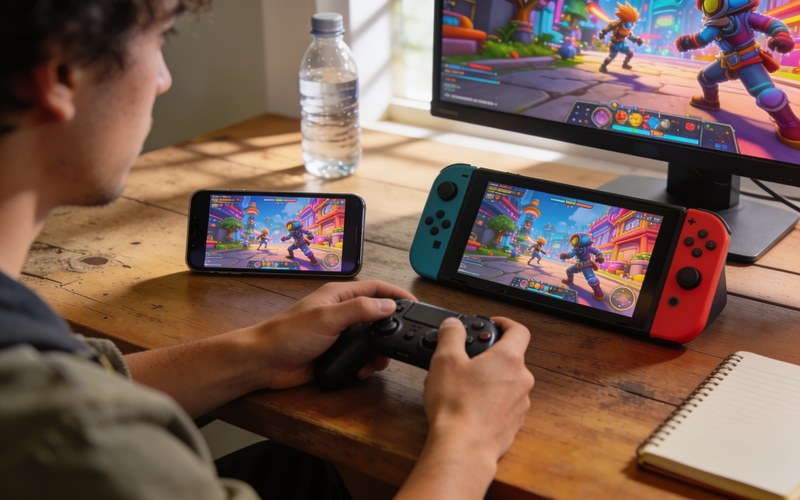
Because people already play across devices: PC at lunch, console in the evening, mobile on the commute. They expect consistent quality and, increasingly, shared progress. Friends on different platforms also want to play together without technical barriers.
For studios, cross-platform development builds a title for several platforms from a unified approach. It can lower production costs, shorten time to market and widen the audience, as long as the technical foundations are right.
Which platforms does Unreal Engine support?
Unreal Engine development services typically cover a wide platform range without separate workflows for each target:
- Desktop: Windows, macOS, Linux
- Mobile: iOS, Android
- Consoles: PlayStation, Xbox, Nintendo Switch
- Emerging hardware: AR/VR headsets and mixed reality devices
Console targets require access to each platform holder’s developer program, so that part needs planning early. Still, a shared codebase means a studio does not maintain a separate project per system and can spend its resources on gameplay instead.
How does Unreal Engine handle rendering across different hardware?
It provides a real-time rendering pipeline with scalability settings, so one set of content can run on very different devices. Unreal Engine 5 introduced Nanite, which handles very detailed geometry efficiently, and Lumen, which provides dynamic global illumination. These features are aimed mainly at higher-end hardware, so a mobile version usually uses a lighter rendering path with simplified lighting and lower-resolution textures.
The key point is that quality can be scaled by platform while gameplay stays identical. A phone version and a console version can share the same mechanics even though they do not share the same visual ceiling.
How does Blueprint speed up cross-platform development?
Blueprint is Unreal’s visual scripting system. It lets designers and developers build gameplay logic without writing everything in C++, which makes prototyping fast. Logic made in Blueprint is shared across target platforms, so there is less platform-specific code to maintain.
Teams can prototype a feature, test it on several platforms and adjust it quickly. Performance-critical systems are still often written in C++, but Blueprint shortens the early iteration cycles, which is where many cross-platform issues first show up. If your project also involves animation work, this guide to briefing 3D game animation covers what to prepare.
How are assets optimized for different platforms?
Platforms differ in performance and storage, so asset handling matters. Unreal includes tools that help with it:
- Texture compression settings per platform
- Level of detail (LOD) generation for meshes
- Texture streaming based on available memory
- Scalability settings that adjust quality to hardware
These systems reduce manual work, but they still need tuning. Profiling on the actual target device is what confirms a game runs smoothly, and it is a standard part of the work that development partners take on. The art side of this is discussed in what tasks a game art developer should solve.
How does Unreal manage different input methods?
Through an input system that supports gamepads, keyboard and mouse, touchscreens and motion controls from one project. Platform-specific features such as haptic feedback and adaptive triggers can be added on top, and each can be mapped so that controls feel natural on every device. Good cross-platform games treat the interface as adaptive: larger touch targets on mobile, a controller-friendly menu on console, precise pointer support on PC.
What does cross-platform performance optimization involve?
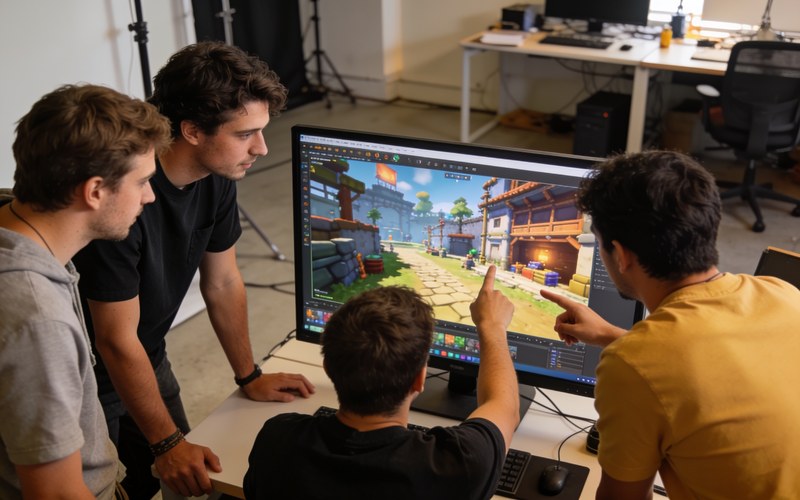
Setting platform-specific performance profiles. Scalability settings let developers adjust rendering quality, texture resolution and effects complexity per platform, so a mobile build can use simplified lighting and lower-resolution textures while keeping the same gameplay as the console build.
Cloud save synchronization is the other piece. Players expect to start on a console, continue on a phone and finish on a PC without losing progress, which depends on careful handling of data security, sync timing and network reliability.
What should quality assurance cover on every platform?
Every platform has its own technical limits, interface demands and performance behavior, so each needs separate validation. A solid test plan includes:
- platform-specific functionality checks;
- benchmarks across different hardware configurations;
- interface adaptation to screen sizes and input methods;
- network and multiplayer behavior across platforms.
Unreal’s automation tools can simulate some platform conditions and catch issues early, which prevents expensive delays late in production. The engine also has a large community and extensive documentation from Epic Games, which helps teams troubleshoot.
Is there proof that Unreal Engine works for cross-platform titles?
Yes. Fortnite and Rocket League are well-known examples of games that run across several platforms and support players from different systems playing together. They cover competitive multiplayer, but the engine is also used for single-player adventures, and consistent quality across devices is a large part of how such games keep their players.
What are the long-term and cost benefits?
A shared codebase lowers maintenance cost, since fixes and updates apply to all targets at once. Epic keeps developing the engine and adding platform support, so a project can evolve without a complete rewrite. A broader audience also tends to extend a game’s lifecycle.
None of this removes the need for experience. A team that has shipped on several platforms knows where certification, memory limits and input quirks cause trouble, and that knowledge is what development services provide.
Frequently asked questions
Does Unreal Engine make cross-platform development automatic?
No. It provides tools and a shared codebase, but each platform still needs optimization, input design and testing.
Can a mobile game use the same features as a PC game?
Not all of them. High-end features are designed for powerful hardware, so mobile builds scale down visuals while keeping gameplay.
When should a studio hire Unreal Engine development services?
When the team lacks experience with a target platform, needs to ship on several at once, or faces performance problems it cannot trace.
Next step for studios planning a cross-platform game
List your target platforms, the minimum hardware for each and the features that must be identical everywhere. Build a small playable prototype on the two most different targets first, and use what it reveals to decide how much outside Unreal expertise you need.

Renowned for his expertise in logo design and visual branding, Bogdan has developed a multitude of logos for various clients.
His skills extend to creating posters, vector illustrations, business cards, and brochures. Additionally, Bogdan's UI kits were featured on marketplaces like Visual Hierarchy and UI8.
He also wrote in the past years on sites like Design Your Way, WebDesignerDepot, WPDean, Designmodo, Speckyboy, Slider Revolution, and more.
- How to Design Marketing Materials That People Actually Keep - 27 November 2026
- Behind the Logo: What Font Does Starbucks Use? - 26 November 2026
- Visual Hierarchy in Short Videos: How to Guide Attention Across a Sequence - 26 November 2026

Bogdan Sandu is a seasoned designer who has been designing websites since 2008. Renowned for his expertise in logo design and visual branding, Bogdan has developed a multitude of logos for various clients. His skills extend to creating posters, vector illustrations, business cards, and brochures. Additionally, Bogdan's UI kits were featured on marketplaces like Visual Hierarchy and UI8. He also wrote in the past years on sites like Design Your Way, WebDesignerDepot, WPDean, Designmodo, Speckyboy, Slider Revolution, and more.
You Might Also Like