Type Müller or Straße into most free German font generators and the umlaut and the eszett won't make it through.
Most of the free ones output Mathematical Fraktur, a Unicode set that Unicode Technical Report 25 describes as meant for mathematical notation. It was never built for spelling German words, so the result has no umlauts and no eszett.
Designers pick the Unicode route for short bio lines. Logos, print and websites, where German spelling has to come out right, call for a font file. Kurrent and Sütterlin handwriting is a separate case, since Unicode can't do it at all and image tools cover it.
The generator above handles both routes. The gallery draws your text in ten open-license fonts and exports a PNG, and the card under it gives you copyable Unicode Fraktur with a choice of how to treat ä, ö, ü and ß.
What does a German font generator actually produce?
Typed letters go in and German blackletter lettering comes out, in one of a few forms. The form decides where you can use the result.
Most free generators in search results hand back pasteable Unicode characters. Every letter is replaced by a different character, so the result pastes into almost any text field.
Some tools render your words in a chosen typeface and give you a picture instead. Others point you to a font file (TTF, OTF or WOFF2) that you install on a device or load on a website.
The Unicode route never applies a font. It maps A to code point U+1D504, b to U+1D51F and so on through the Mathematical Fraktur letters in the Mathematical Alphanumeric Symbols block.
That is why the look survives a paste into an Instagram bio or a Discord message. The shape lives in the character, so nothing needs installing. A typical gothic text generator offers a regular and a bold blackletter variant of whatever you type.
It is also the limit. A tool built this way can only use letters that exist in that block.
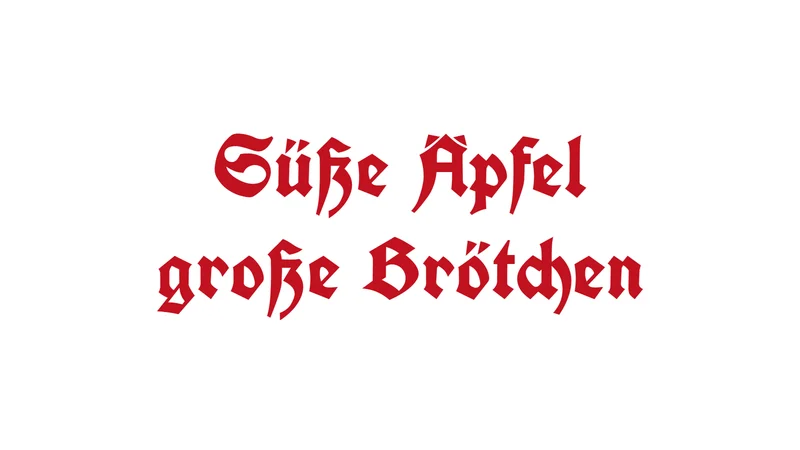
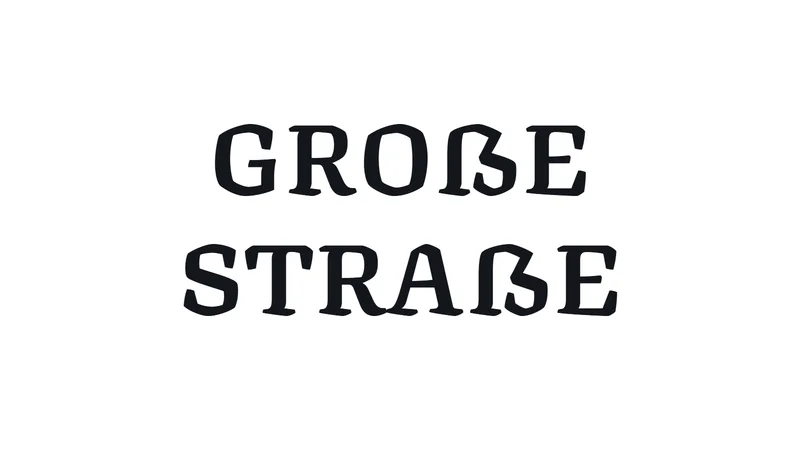
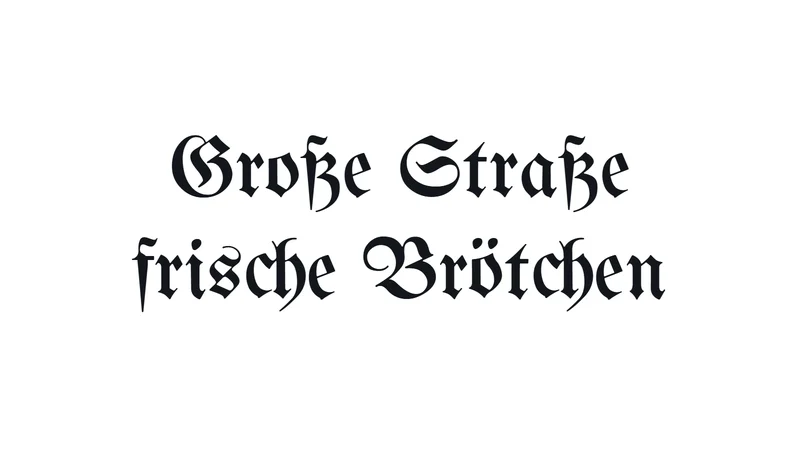
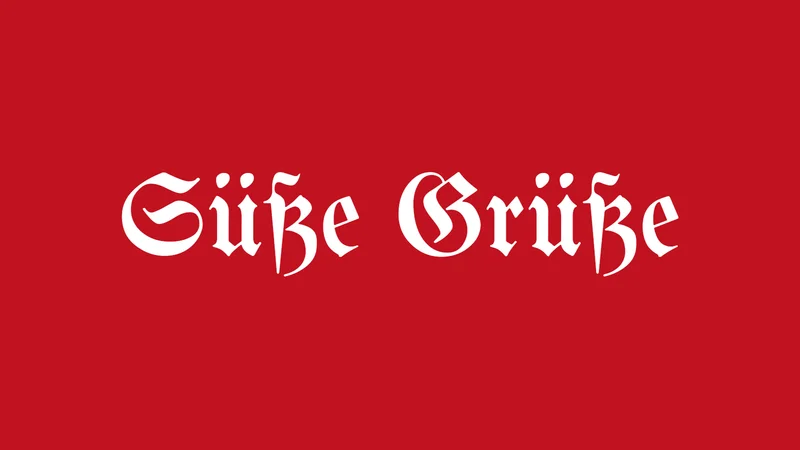
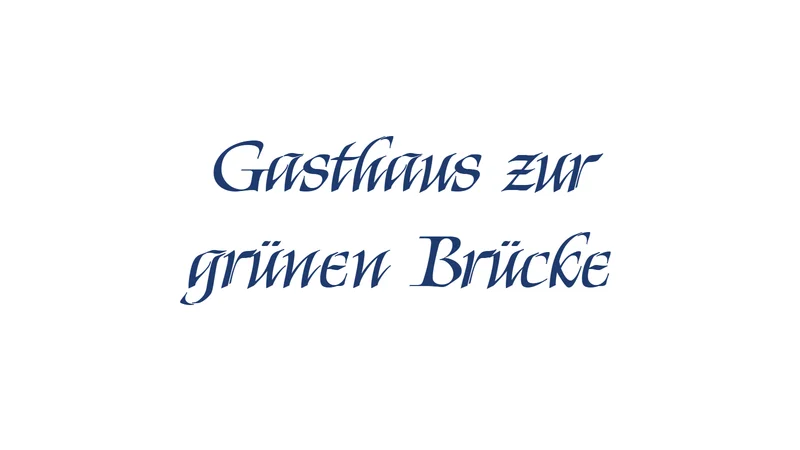
Which German lettering styles can a generator reproduce?
Copy-paste generators reproduce Fraktur and nothing else German. Textura, Schwabacher, Kurrent and Sütterlin all need an image tool or a font file.
Fraktur and blackletter print styles
Textura is the narrowest and most calligraphic form, close to medieval Gothic bookhands, while Schwabacher rounds the letters off and turns up a lot in early German printing.
Then there's Fraktur, the long-running German print standard, named for the "broken" look of its strokes.
All of them sit inside the blackletter family of typefaces.
Generators call the output gothic, blackletter, Old English or Fraktur. Most of the ones ranking for these terms draw on the same Mathematical Fraktur set, so whatever the label says, the letterforms are identical.
Kurrent and Sütterlin handwriting
Kurrent and Sütterlin are handwriting, not print.
Kurrent is the German cursive that ran alongside Fraktur. Ludwig Sütterlin was commissioned in 1911 to design a rounder, more upright school hand, and it was introduced in Prussian schools in 1915. Not every Kurrent hand counts as Sütterlin.
Digital versions behave like a script font, with connected strokes instead of separate printed letters.
No Unicode block carries styled Kurrent or Sütterlin letters, so you're looking at image tools or paid fonts. None of the ten fonts in the gallery above is a Kurrent hand.
Want Kurrent? Skip the copy-paste tools.
Do umlauts and eszett work in Fraktur Unicode text?
No. The Mathematical Fraktur set covers only the 26 basic Latin letters, so the vowels a, o and u with two dots, and the eszett, have no Fraktur form to convert to.
The reason is the block's purpose. Unicode Technical Report 25 states that these characters are meant for mathematical and technical notation, not ordinary text, and that accented math symbols are built from combining sequences. The block itself is Mathematical Alphanumeric Symbols, U+1D400 to U+1D7FF, added in Unicode 3.1 in 2001.
A second gap hits German words too. Fraktur capitals C, H, I, R and Z are reserved, not assigned, because those five already sit in the Letterlike Symbols block (U+212D, U+210C, U+2111, U+211C and U+2128).
A generator that skips that lookup leaves a hole in words like Rhein or Zeit. Real Fraktur typesetting also relies on the long s (ſ, U+017F) and on ligatures. The long s exists as an ordinary Latin letter, but the Fraktur Unicode set has no styled version of it, and ligatures are a font feature.
The capital sharp s (U+1E9E) was added in Unicode 5.1 in 2008, as a plain Latin letter outside the Fraktur set. Official German spelling has permitted it since June 2017 (Council for German Orthography).
So the standard allows a capital sharp s, and the Fraktur generators still cannot draw one. That mismatch is the main reason copy-paste Fraktur looks wrong on German text. Fonts differ here as well: of the ten in the gallery above, Pirata One, Jacquard 24 and Barlow have no ẞ, and this tool draws it as SS in those fonts.
If you're stuck with what you've got, the most reliable fix is a font file with a full German character set. It is the only one that gives you the real letters, and honestly it's the only workaround I'd trust on anything public.
Second best is a combining diaeresis (U+0308) added after the base letter. Unicode treats this as the standard method for accented math symbols, but rendering depends on the font and platform, so test the result. The Unicode card above offers it as "Combining dots".
Spelling the word out is the fallback: ae, oe and ue for the umlauts, ss for the eszett. Official German spelling rules accept ss when the eszett is unavailable. That is the "Spell out" option on the card.
Which type of German font generator should you use?
Unicode generators suit short, umlaut-free text headed for a social bio. Kurrent and Sütterlin mean an image tool. Anything with German letters that must look right needs a font file.
Most ranking pages push copy-paste. Once an umlaut, an eszett or a print run is involved, a font file is the better call.
| Type | Output | Umlauts and eszett | Best for |
|---|---|---|---|
| Unicode copy-paste | Characters in the text | Not available in the Fraktur set | Bios, usernames, captions |
| Text-to-image | Picture file | Depends on the font behind the tool | Tattoo reference, mockups, genealogy samples |
| Font file | TTF, OTF or WOFF2 | Yes, if the font includes them | Logos, print, websites, documents |
Unicode copy-paste text
There's nothing to install, it works in nearly any plain-text field, and the preview is instant.
The costs are the ones covered above. No umlauts or eszett, five capitals that need substitutes, and on most tools only regular and bold Fraktur.
Text-to-image generators
Some Kurrent and Sütterlin image tools cap input at a few dozen characters.
Those cover Kurrent and Sütterlin, which no Unicode generator can do. Other sites let you pick a Fraktur typeface and download the text as an image for printing or placing in a Word document. The gallery and PNG export above work this way, with the fonts loaded from Google Fonts.
You get real handwriting styles and real letterforms without installing anything. The catch is the short input limit on some tools, and the fact that the result is a picture, so you cannot edit or search it.
Font files
A font file is the only option that keeps German text editable.
Start from a curated list of German fonts instead of sifting through a full library.
The character set is complete, the text stays selectable and it looks sharp at any print size. On the downside, it needs installing or uploading, it needs a license check, and it will not paste into a social bio.
How do you turn text into German blackletter lettering?
Screen the text before you open any tool.
- Look for umlauts, the eszett and the capitals C, H, I, R and Z. Any of them points to an image tool or a font file.
- Enter the text. Keep it to a name, a title or a single line.
- Pick regular or bold Fraktur, if the tool offers both.
- Read the preview word by word. Look for empty boxes, plain-looking letters, or a gap where a capital should be.
- Copy the output and paste it as plain text. Use paste without formatting if the target field restyles it.
- Open the result on a phone and on a desktop before publishing.
Step 4 is the one people skip, and the one that catches the missing capitals.
Image tools work the same way without the paste step, since you enter the text, choose a style and save the picture. A font file skips most of it and installs once.
When does generated German text break?
Unicode-styled German text breaks on devices that have no font for the Mathematical Fraktur block. Screen readers handle the characters unpredictably, and search or spell check expect plain letters. A name or a one-line heading holds up far better than a paragraph does.
| Failure | Cause | Workaround |
|---|---|---|
| Empty boxes | No installed font covers the code points | Test on phone and desktop, or use a font file |
| Letter-by-letter reading | Screen reader announces each character | Keep a plain-text version nearby |
| Missed in search | Characters differ from plain letters | Repeat key words in normal text |
Empty boxes and font fallback
A missing glyph shows up as an empty square, and Mathematical Fraktur is more exposed to it than ordinary letters.
These code points sit in the Supplementary Multilingual Plane, where font support is less common, and browsers have been reported to draw the block as empty squares.
Instagram sets bios and captions in an interface font, mostly the phone's own system font, so any character that font lacks gets borrowed from the phone's fallback fonts.
Discord messages go through the same fallback step, starting from Discord's own typeface.
Word and Canva behave a bit differently. The text box's font is applied first, and if it lacks the character the app substitutes another one, so the glyph can differ from the generator preview.
How screen readers handle the characters
Accessibility consultant Adrian Roselli tested Unicode math letters against several screen reader and browser pairings in March 2025.
JAWS 2025 with Chrome 133 announced every letter individually, with its case and style. NVDA 2024.4.2 with Firefox 135 and VoiceOver on macOS and iPadOS read the words without announcing the styling.
That clashes with older advice that screen readers will often skip such characters or read out something very long. Software changed, and settings matter too, since NVDA has a Unicode normalization speech option that alters what it says.
The test has one limit. It used fake bold and italic, not Fraktur, and while both come from the same block, Fraktur itself was not tested.
Treat anything people must read as unsafe, and keep the Fraktur look for decoration.
Search, spell check and long passages
Search engines and spell checkers see other code points, not the German word.
Findability suffers along with accessibility when letters are swapped for look-alike Unicode characters. The practical fix is to put the plain-text version of a name in the same bio or caption, and to keep the styled line to a name or a short heading.
Which free German fonts can you download and use commercially?
UnifrakturMaguntia and UnifrakturCook are the safest free picks, and UnifrakturMaguntia is where I'd start. Both are on Google Fonts under the SIL Open Font License 1.1. Old English Text MT follows Microsoft's product terms, and Kurrent hands are paid.
| Font | Style | License | Commercial use |
|---|---|---|---|
| UnifrakturMaguntia | Fraktur | SIL OFL 1.1 | Allowed |
| UnifrakturCook | Bold Fraktur | SIL OFL 1.1 | Allowed |
| Old English Text MT | English blackletter | Microsoft product terms | Depends on your Office license |
| Kurrent Kupferstich | Kurrent handwriting | Walden Font, paid | Business license required |
SIL International's OFL FAQ says you may use these fonts for books, logos and other graphics. The one hard rule is that the font file cannot be sold by itself.
Before downloading anything, paste a test line with a capital umlaut and an eszett into the preview. A font that fails there fails on real German text.
An older note from the Unifraktur project said Google Fonts served a subset that left out the long s. The current UnifrakturMaguntia file on Google Fonts contains it, as do UnifrakturCook and Grenze Gotisch, and the long s switch in the editor above uses it. Fruktur and Texturina have no long s.
For Old English Text MT, Microsoft's own font page lists Latin 1 (code page 1252) support, which covers the umlauts and the eszett. The same page sorts the design as English blackletter, not German Fraktur.
The license is the catch. Commercial use of Microsoft fonts depends on the terms of your Microsoft license, and retail editions labeled Home or Personal are generally meant for non-commercial use.
Walden Font sells Kurrent Kupferstich as an OpenType/TrueType file with upper and lowercase umlauts and ligatures, in separate personal and business licenses.
To use any of these in design work, you can upload the font file to Canva. Canva Help accepts OTF, TTF and WOFF files. Uploads are limited to Pro, Teams, Business, Education and Nonprofits accounts, and the font has to be licensed for embedding.
Outside blackletter, a broader roundup of fonts with free commercial-use licenses speeds up the license check.
German Font Generator FAQ
Is a German font generator free to use?
Yes, in most cases. Unicode and text-to-image generators cost nothing, and fonts under the SIL Open Font License are free for commercial work too.
Paid Kurrent and Sütterlin fonts are the usual exception.
What is the difference between Fraktur and Old English?
Old English is the English-language label for English blackletter, and Microsoft's font documentation files Old English Text MT there, not under German Fraktur. Fraktur proper is the German print style.
Generators often use both names for the same output anyway.
Why did Germany stop using Fraktur?
Official use ended in January 1941, when the Nazi government ordered Latin type in place of Fraktur and Kurrent. The decree of 3 January 1941 claimed that the scripts were a hindrance to communication in occupied territories, and it falsely called Schwabacher letters Jewish.
Kurrent and Sütterlin were phased out of schools under that order and did not return as the standard hand after the war.
How do I type umlauts and the eszett on a keyboard?
On a Mac with a US keyboard layout, press Option and U, then the vowel, for an umlaut. Option and S gives the eszett.
On Windows, hold Alt and type the code on the numeric keypad. That's 0228 for a-umlaut, 0246 for o-umlaut, 0252 for u-umlaut and 0223 for the eszett.
In the generator above you can also click the key row under the text box to insert ä, ö, ü, ß and the capitals.
Can I give generator output to a tattoo artist?
Yes, as a style reference only. The artist should letter from a real Fraktur typeface or sample, because Unicode output cannot show umlauts or the eszett.
Send the exact wording as well, and have a German speaker proofread it.
Proofing German Lettering Before It Goes Live
Before generator output reaches a bio, a logo or a tattoo stencil, get a German speaker to sign off on the spelling. After that, confirm every letter shows up in the preview, and only then test the display on a phone, a desktop and a screen reader.
The order matters, because each step catches what the next one cannot. Spelling goes first because the later checks only prove that the letters render. A capital umlaut that fell back to a plain vowel passes a display test and still misspells the word.
The trade-off is an extra step in what looks like a one-click job. A logo or a stencil justifies skipping Unicode output altogether for a proofed font file.
This position was verified in November 2026. It changes if Instagram, Discord or the major screen readers alter how they treat Mathematical Fraktur.
More free font generators
Want another blackletter look? Try the black metal font generator for spiky band logos, or the emo font generator for gothic and glitch text.