


The Valencia logo is one of the most recognizable crests in Spanish football. It represents Valencia CF, a professional club founded in 1919 and based in Valencia, Spain. The badge has gone through several redesigns over the decades, but the bat sitting atop the shield has remained its defining symbol throughout the club’s history.
Football club badges carry the weight of regional identity, and Valencia’s is no different. Few crests in La Liga are as tied to local legend and heraldry as this one. The bat, the crown, the colors – every element connects directly to the city and its past.
What Is the Valencia CF Logo?
The Valencia CF logo is a shield-shaped emblem featuring a black bat at the top, a crown, and the club’s traditional black and white colors, officially adopted in its current structured form in 2001, symbolizing the city’s coat of arms and medieval heritage.
- Design Type: Emblem / heraldic shield
- Primary Elements: Black bat, royal crown, shield divided into sections, club name, founding year
- Official Introduction Date: Current version introduced in 2001; most recent update in 2023
- Designer/Agency: Designed internally by the club; no single external agency is officially credited
- Trademark Status: Registered trademark owned by Valencia CF SAD
- Color Palette:
- Black: #000000
- White: #FFFFFF
- Orange/Red (detail accents): #D4401A
- Gold (crown): #C9A84C
- Usage Context: Kits, official merchandise, stadium signage, digital platforms, marketing materials, and matchday programs
How Has the Valencia CF Logo Evolved Over Time?

The Valencia CF badge has changed shape, detail, and proportions across more than 100 years, moving from simple early crests to a more polished heraldic shield, while keeping the bat and core color scheme consistent throughout every version.
Original Valencia CF Logo (1919-1941)
- Years Active: 1919-1941
- Design Description: Simple oval or circular badge with basic lettering and an early bat motif
- Color Scheme: Black and white with minimal detail
- Designer: Unknown
- Context: Introduced at the club’s founding in 1919; reflected common Spanish football badge styles of the era
- Key Changes from Previous: First version, no predecessor
- Cultural Significance: Established the bat as the club’s core symbol from day one, directly referencing Valencia city’s own coat of arms
Mid-Century Badge (1941-1971)
- Years Active: 1941-1971
- Design Description: Shield shape becomes more defined; the bat grows more prominent above the crest
- Color Scheme: Black, white, and orange details
- Designer: Unknown
- Context: Spain’s post-war period; clubs across the country were standardizing their visual identities
- Key Changes from Previous: Shield shape replaces rounder form; bat detail becomes more heraldic
- Cultural Significance: Strengthened the connection between the club badge and the official Valencia city emblem
Modernized Crest (1971-2001)
- Years Active: 1971-2001
- Design Description: More structured shield, cleaner lines, clearer crown detail, bat becomes more stylized
- Color Scheme: Black, white, orange, gold
- Designer: Unknown
- Context: Spain’s football modernization era; clubs across La Liga were updating their badges for television broadcast
- Key Changes from Previous: Cleaner proportions, more defined crown, improved bat illustration
- Cultural Significance: This version is the one most associated with Valencia’s golden era in the late 1990s and early 2000s
Current Logo (2001-Present)
- Years Active: 2001-present (minor refinements in 2023)
- Design Description: Polished heraldic shield with a bold black bat on a white field, gold crown, orange and red diagonal stripe sections, and “Valencia CF” lettering
- Color Scheme: Black, white, gold, orange-red
- Designer: Internal club design team
- Context: Introduced during the club’s most successful period, coinciding with back-to-back La Liga titles
- Key Changes from Previous: More precise geometry, cleaner bat silhouette, updated typeface for club name
- Cultural Significance: The version recognized globally; it appeared on Champions League kits during the club’s run to the 2001 final
What Do the Design Elements of the Valencia CF Logo Mean?
Each element in the Valencia CF badge connects directly to the city’s history, heraldry, and regional identity – none of it is decorative for decoration’s sake.
The shield structure follows traditional Spanish heraldic design. The bat at the top references a founding legend of the city. The crown signals royal patronage, and the diagonal color bands echo the flag of the historical Kingdom of Valencia.
What Is the Symbolism Behind the Bat on the Valencia Logo?
The bat (known locally as “el murcielago”) is the most distinctive element of the crest. According to local legend, a bat landed on King James I’s tent or helmet before a decisive battle to reclaim Valencia in the 13th century.
The victory that followed made the bat a symbol of good fortune for the city. Valencia CF adopted it directly from the city’s own coat of arms.
It is one of the few football badges in the world where the primary symbol comes from a medieval military legend rather than from generic sporting iconography.
Why Did Valencia CF Choose These Specific Colors?
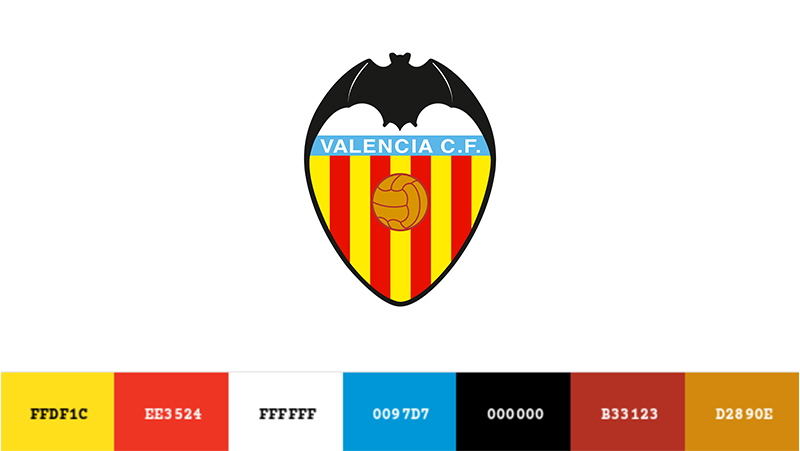
- Black (#000000): Part of the club’s traditional kit colors since founding; conveys strength and solidity; one half of the classic black-and-white color scheme
- White (#FFFFFF): The other half of the kit palette; paired with black it creates a stark, clean contrast; also present in the shield’s main field
- Gold/Yellow (#C9A84C): Used in the crown detail; references royal heritage and the historical Kingdom of Valencia; gold carries connotations of prestige and history in heraldic design
- Orange-Red (#D4401A): Connects to the Valencian regional flag; the color appears in the shield’s diagonal bands and references the wider identity of the Valencia region, not just the football club
What Typography Style Is Used in the Valencia CF Logo?

The “Valencia CF” lettering inside the badge uses a clean, condensed serif-influenced style. It is not a well-known commercial typeface. The club uses a custom or heavily modified version.
The lettering is compact and fits within the lower section of the shield without competing with the bat or crown for visual attention. Readability at small sizes has improved with each badge iteration.
Earlier versions used more decorative letterforms. The current version is simpler and holds up better on digital screens and small-format applications like shirt patches.
What Are the Hidden Meanings in the Valencia CF Logo?
There are no widely documented “hidden” design tricks in the Valencia badge. It does not contain negative space illusions or dual-image symbols the way some corporate logos do.
What it does have is layered historical meaning. The combination of bat, crown, and Valencian colors works as a visual shorthand for the entire city’s identity, not just the football club.
Some fans note that the bat’s wingspan proportions mirror the width of the shield itself, creating a sense of visual containment. Whether intentional or not, it gives the badge a feeling of tightness and control.
How Does the Valencia CF Logo Compare to Competitor Logos?
Among La Liga clubs, the Valencia badge stands out for its direct use of civic heraldry. Most Spanish clubs use shield-based crests, but Valencia’s bat makes it immediately distinct from rivals like Sevilla, Villarreal, and Levante.
Atletico Madrid’s badge uses a bear and a tree, Real Madrid uses a simple crown monogram, and Barcelona uses the Catalan cross. Each of these pulls from regional identity, but Valencia’s bat is arguably the most unusual animal symbol in top-flight European football.
Compared to Athletic Bilbao or Real Betis, the Valencia crest feels less ornate but more iconic. The bat is a single, strong focal point. Most rival badges divide attention across multiple elements.
Outside Spain, it sits in a category with clubs like Barcelona or Juventus: badges where the color scheme alone makes the club identifiable even without seeing the full crest.
What Are the Technical Specifications of the Valencia CF Logo?
Official Color Codes
- Primary Color: Black
- Hex: #000000
- RGB: (0, 0, 0)
- CMYK: (0, 0, 0, 100)
- Pantone: Black C
- Primary Color: White
- Hex: #FFFFFF
- RGB: (255, 255, 255)
- CMYK: (0, 0, 0, 0)
- Pantone: White
- Accent Color: Gold
- Hex: #C9A84C
- RGB: (201, 168, 76)
- CMYK: (0, 16, 62, 21)
- Pantone: 124 C
- Accent Color: Orange-Red
- Hex: #D4401A
- RGB: (212, 64, 26)
- CMYK: (0, 70, 88, 17)
- Pantone: 7526 C
Dimensions and Proportions
- Aspect Ratio: Approximately 4:5 (portrait shield orientation)
- Minimum Size: Not less than 20px height for digital use; 10mm for print applications
- Clear Space: A margin equal to the height of the bat symbol should be maintained on all sides
- Official Usage Guidelines: Available through Valencia CF’s official communications department; the badge should not be distorted, recolored, or used on backgrounds that reduce contrast
What Cultural Impact Has the Valencia CF Logo Had?

The Valencia CF badge carries weight well beyond football. In the city of Valencia, the bat symbol appears everywhere – on street signs, civic buildings, and regional government materials. The club’s use of it has reinforced that symbol’s visibility globally.
During Valencia’s peak years (2001-2004), when the club won consecutive La Liga titles and reached two Champions League finals, the badge became familiar to football fans across Europe who had never set foot in Spain.
The black-dominant color scheme also made the crest stand out in an era when most top clubs were leaning into brighter, more commercial color choices.
Youth football kits, fan tattoos, and street art in Valencia regularly feature the bat emblem independently from the full badge. That kind of separation – where a single element works on its own – is a reliable sign that a logo has genuinely embedded itself in culture.
How Does the Valencia CF Logo Fit Into the Overall Brand Identity?

The badge sits at the center of a broader visual identity that includes the black-and-white kit, the Mestalla stadium, and the club’s regional positioning as the representative club of the Valencian Community.
The brand guidelines around the crest are tight. Valencia CF controls how the badge appears on licensed products carefully, which is standard for top-division European clubs.
The bat functions as a standalone icon across digital platforms. On social media, the bat is often used without the full shield, which shows that the club’s visual identity team understands how visual hierarchy works across different screen sizes and contexts.
The color palette of black and white also ties directly to the kit, creating consistency between what players wear and what appears on merchandise, packaging, and communications.
Compare this to how other clubs handle brand consistency. Some clubs, like Espanyol or Getafe, have less globally recognized badges, partly because their visual identity outside the badge is less cohesive.
How Should the Valencia CF Logo Be Used?

- Do: Use the official high-resolution files provided by Valencia CF for any licensed or press use
- Do: Maintain the required clear space around the badge on all applications
- Do: Use the badge on light or dark backgrounds that maintain strong contrast with the black and white elements
- Don’t: Stretch, skew, or alter the proportions of the badge
- Don’t: Change the official colors or apply unapproved color variants
- Don’t: Use the badge on merchandise without an official licensing agreement with Valencia CF SAD
- Don’t: Recreate the badge from memory or low-resolution sources; always use official vector graphics files for print applications
- Official Access: Media and press files are available through Valencia CF’s official press office; commercial licensing goes through the club’s commercial partnerships department
- Trademark Protection: The Valencia CF badge is a registered trademark. Unauthorized use on products, websites, or promotional materials is a trademark infringement and subject to legal action
- File Formats: Official logo files are distributed in SVG and high-resolution PNG formats for digital use, and in print-ready PDF or EPS for physical applications where DPI requirements are strict
FAQ on The Valencia Logo
What Does the Bat on the Valencia CF Crest Represent?
The bat comes directly from Valencia city’s coat of arms.
Legend says a bat landed on King James I’s helmet before his 13th-century conquest of Valencia, bringing victory. The club adopted it as their primary symbol at founding in 1919, and it has stayed ever since.
What Are the Official Colors of the Valencia CF Badge?
The Valencia CF visual identity uses black and white as its primary colors.
Gold appears in the crown detail, and orange-red runs through the shield’s diagonal bands, referencing the Valencian regional flag. These colors have remained consistent across every badge iteration.
When Was the Current Valencia CF Logo Introduced?
The current version of the Valencia club emblem was introduced in 2001, coinciding with the club’s back-to-back La Liga title wins.
Minor refinements were made in 2023, mostly improving digital legibility and line precision. The core design has not changed.
Why Is Valencia CF Nicknamed “Los Murcielagos”?
The nickname translates directly to “The Bats,” taken from the bat symbol on the badge.
It is one of the few football club nicknames in La Liga that comes entirely from the crest itself rather than from playing style or stadium location.
Has the Valencia Football Badge Ever Been Redesigned?
Yes. The badge has gone through several redesigns since 1919.
Early versions were simpler and rounder. The shield shape became more defined through the mid-20th century. Each revision kept the bat, crown, and black-and-white color scheme while improving proportion and detail clarity.
What Shape Is the Valencia CF Shield?
The badge follows a classic heraldic shield structure, standard across Spanish football club heraldry.
It uses a portrait-oriented form with a slightly pointed base. The bat sits above the shield rather than inside it, which makes the Valencia crest immediately distinct from most La Liga badge designs.
Who Designed the Valencia CF Logo?
No single external designer or agency is officially credited for the badge.
The current version and its 2023 refinements were handled internally by the club. This is fairly common among European clubs with long histories, where badge ownership stays in-house rather than going to a branding firm.
What Font Does the Valencia CF Logo Use?
The Valencia logo font uses a condensed, slightly serif-influenced style inside the shield.
It appears to be a custom or heavily modified typeface rather than a commercially available font. Earlier badge versions used more decorative letterforms. The current version is cleaner and holds up better at small sizes on kits and digital platforms.
How Does the Valencia Badge Compare to Other Spanish Club Crests?
Most La Liga clubs use shield-based crests with regional symbols, but the bat makes Valencia’s badge genuinely unique.
Rivals like Real Sociedad and Celta Vigo use more conventional heraldic animals. The bat carries a specific local legend that no other Spanish club can claim, giving the Valencia crest a stronger tie to city identity than most.
Where Can I Download the Official Valencia CF Logo?
Official Valencia CF badge vector files are available through the club’s press office for media use.
Commercial use requires a licensing agreement with Valencia CF SAD. For fan or personal use, the club’s official website and social media profiles carry high-resolution versions. Never use low-resolution or fan-recreated files for print.
Conclusion
The Valencia logo is more than a football badge. It is a direct link to the city’s medieval history, regional identity, and the legend that shaped an entire club’s visual DNA.
The bat emblem has survived over a century of redesigns without losing its core meaning. Every element, from the heraldic shield to the Valencian color bands, earns its place.
Few La Liga crests carry this kind of depth. The Valencia CF crest works as civic symbol, sports badge, and cultural shorthand all at once, and that is exactly why it still resonates with fans worldwide.

Renowned for his expertise in logo design and visual branding, Bogdan has developed a multitude of logos for various clients.
His skills extend to creating posters, vector illustrations, business cards, and brochures. Additionally, Bogdan's UI kits were featured on marketplaces like Visual Hierarchy and UI8.
He also wrote in the past years on sites like Design Your Way, WebDesignerDepot, WPDean, Designmodo, Speckyboy, Slider Revolution, and more.
- The Webflow Logo History, Colors, Font, And Meaning - 10 September 2026
- Your Highest-Paying Design Project Might Be Your Least Profitable One… Without You Noticing - 10 September 2026
- Free Browser 3D Tools for Designers Who Refuse to Install Anything - 9 September 2026

Bogdan Sandu is a seasoned designer who has been designing websites since 2008. Renowned for his expertise in logo design and visual branding, Bogdan has developed a multitude of logos for various clients. His skills extend to creating posters, vector illustrations, business cards, and brochures. Additionally, Bogdan's UI kits were featured on marketplaces like Visual Hierarchy and UI8. He also wrote in the past years on sites like Design Your Way, WebDesignerDepot, WPDean, Designmodo, Speckyboy, Slider Revolution, and more.
You Might Also Like


