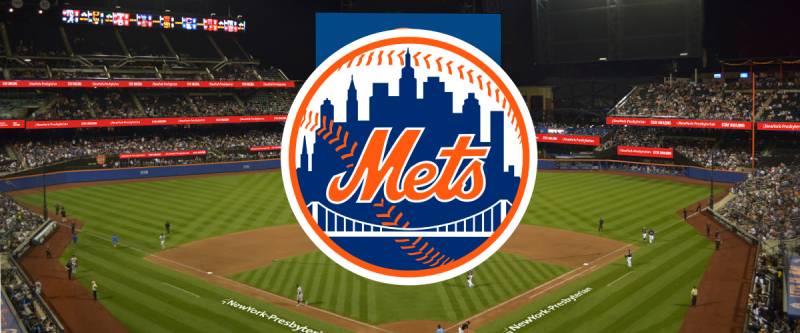
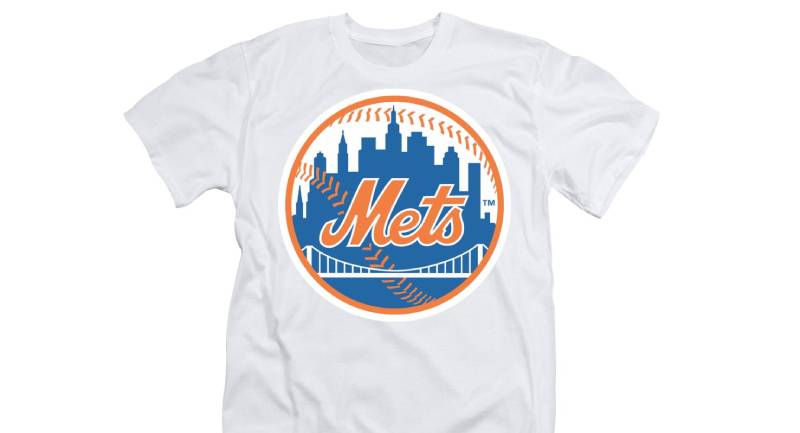
The New York Mets logo is one of the most recognizable marks in professional baseball. It has barely changed since 1962, which is pretty rare for any major sports franchise. The round emblem features a stylized New York City skyline set inside a baseball with orange stitching, the word “Mets” in cursive script, and a white suspension bridge in the foreground.
The Mets were created as an expansion team after the Brooklyn Dodgers and New York Giants both left the city in 1957. That departure left a hole. The logo that came out of it told the story of an entire city trying to hold onto its National League identity. Sports cartoonist Ray Gotto won a public design contest with over 500 entries, and artist Lon Keller from Spencer Marketing Services refined the concept into the final version.
The primary logo has only been tweaked three times in over 60 years. That kind of consistency says a lot about how well the original design worked from the start.
What Is the New York Mets Logo?
The New York Mets logo is a circular emblem showing a blue New York City skyline inside a white baseball with orange stitching. “Mets” appears in orange cursive script trimmed in white across the center. Designed by Ray Gotto and refined by Lon Keller, it debuted in 1962 and represents the club’s connection to all five New York City boroughs.
Here is a breakdown of its core attributes:
- Design Type: Combination mark (emblem with wordmark). The circular baseball shape contains both illustrative and typographic elements working together.
- Primary Elements: A blue skyline of recognizable New York City buildings, a white suspension bridge, orange baseball stitching, the cursive “Mets” wordmark in orange with white trim, and (until 1999) a small orange “NY” monogram.
- Official Introduction Date: November 16, 1961 (unveiled by Ray Gotto). Used on team materials starting with the 1962 inaugural season.
- Designer/Agency: Ray Gotto (original contest-winning concept), refined by Lon Keller of Spencer Marketing Services under direction from team president George Weiss.
- Trademark Status: Registered trademark of the New York Mets organization, currently owned by Steve Cohen (since 2020). Protected under MLB licensing.
- Color Palette: Blue (Hex #002D72, Pantone PMS 288 C), Orange (Hex #FF5910, Pantone PMS 1655 C), and White (#FFFFFF).
- Usage Context: Uniforms, caps, jerseys, Citi Field signage, official merchandise, digital platforms, broadcast graphics, and all marketing materials tied to the franchise.
How Has the New York Mets Logo Evolved Over Time?
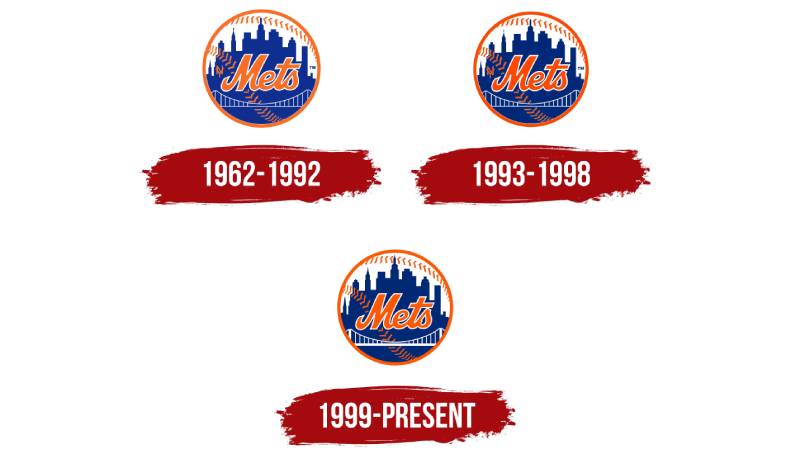
The New York Mets logo has gone through only four versions since 1962, making it one of the least-changed marks in Major League Baseball. Each revision involved minor color shifts or small structural adjustments rather than full redesigns.
The original stayed untouched for nearly two decades. Then came slight orange shade changes in 1981, a broader color darkening in 1993, and the removal of the “NY” initials in 1999.
Original New York Mets Logo (1962-1980)
- Years Active: 1962-1980
- Design Description: A white baseball with orange stitching. Inside sits a blue silhouette of the New York City skyline, including a church spire, the Williamsburgh Savings Bank, the Woolworth Building, a midtown Manhattan view featuring the Empire State Building, and the United Nations headquarters. A white suspension bridge runs across the foreground. “Mets” appears in orange cursive script with white trim. A small orange “NY” monogram sits to the left of the wordmark.
- Color Scheme: Royal blue, bright orange, and white.
- Designer: Ray Gotto (contest winner, $1,000 prize). Lon Keller refined and finalized the artwork.
- Context: Created for the brand-new expansion franchise that replaced the departed Brooklyn Dodgers and New York Giants. George Weiss, the team’s first president, ran a public design contest. Gotto beat out over 500 other entries. Weiss then had Keller add specific elements like the bridge (representing all five boroughs) and particular buildings (representing different boroughs).
- Key Changes from Previous: This was the first logo. No predecessor existed, though the cap “NY” insignia was borrowed directly from the old New York Giants.
- Cultural Significance: The logo immediately gave the franchise a visual identity rooted in New York City pride. The blue came from the Dodgers, the orange from the Giants. It told fans: this new team carries your old teams’ spirit. The skyline and bridge said: this club belongs to all of New York, not just one borough.
Second Version of the Mets Logo (1981-1992)
- Years Active: 1981-1992
- Design Description: Same layout and structure as the original. The skyline, bridge, stitching, and “Mets” wordmark all remained. The “NY” monogram stayed in place on the left side.
- Color Scheme: The orange shifted to a slightly darker, more saturated shade. Blue remained largely the same.
- Designer: In-house adjustment. No external redesign commissioned.
- Context: This was the era of the 1986 World Series championship. The Mets were one of the biggest teams in baseball during this stretch. The logo change was so small most fans never noticed it.
- Key Changes from Previous: Slightly darker orange tone. Everything else stayed the same.
- Cultural Significance: This version of the logo appeared during the franchise’s most successful period on the field. It became associated with the 1986 Miracle Mets and players like Dwight Gooden, Darryl Strawberry, and Keith Hernandez.
Third Version of the Mets Logo (1993-1998)
- Years Active: 1993-1998
- Design Description: The overall composition remained the same. The skyline, bridge, stitching, cursive “Mets” wordmark, and “NY” initials were all kept.
- Color Scheme: Blue was darkened by one shade. Orange became more saturated. These hue shifts affected the entire logo and uniform set.
- Designer: In-house color update coordinated with uniform changes.
- Context: The 1993 season brought broader uniform changes. The “racing stripes” on jerseys were dropped, and the skyline logo returned to the left sleeve. The logo’s color adjustments matched the updated jersey palette.
- Key Changes from Previous: Darker blue across the skyline. More intense orange on the stitching and wordmark. The skyline shape was also slightly adjusted.
- Cultural Significance: This version carried the team through a rebuilding period and into the late-1990s resurgence that included the 1999 and 2000 postseason runs. The saturation changes gave the logo a slightly more modern feel without altering its structure.
Current New York Mets Logo (1999-Present)
- Years Active: 1999-present
- Design Description: The small orange “NY” monogram that had been sitting to the left of the “Mets” wordmark since 1962 was removed. The bridge in the foreground was made slightly thicker. The skyline, cursive wordmark, and baseball stitching all remain.
- Color Scheme: Blue (Hex #002D72), Orange (Hex #FF5910), White (#FFFFFF). These are the current official values.
- Designer: In-house modification.
- Context: The 1999 update coincided with the Mets introducing black as a third color for alternate uniforms and caps. A black-background version of the skyline logo was also created for the alternate jerseys. The removal of the “NY” from the primary logo simplified the mark.
- Key Changes from Previous: “NY” monogram removed. Bridge line made thicker. Color values locked in to their current specifications.
- Cultural Significance: This is the logo that has been on the field for the 2000 World Series run, the 2006 and 2015 postseason appearances, and the Steve Cohen ownership era. It remains one of the longest-running marks in MLB history with only the most minor modifications from the 1962 original.
What Do the Design Elements of the New York Mets Logo Mean?
Every building and structural element in the New York Mets logo has specific meaning tied to the city’s boroughs and landmarks. The skyline is not a generic cityscape. It was built with purpose.
Lon Keller placed each structure deliberately at the direction of George Weiss to make sure the logo represented all of New York, not just Manhattan.
What Does the Skyline Represent?
The skyline reads left to right like a map of New York’s boroughs. On the far left is a church spire, a direct nod to Brooklyn, long known as “the borough of churches.”
Next comes the Williamsburgh Savings Bank, which was the tallest building in Brooklyn when the logo was created. Then the Woolworth Building appears, followed by a general midtown Manhattan view centered on the Empire State Building.
At the far right sits the United Nations headquarters. The white suspension bridge in the foreground does not represent any single bridge. It stands for all of New York’s bridges and the idea that the Mets connect all five boroughs through baseball.
That level of thought in a sports logo is unusual. Most baseball team logos stick to letters or mascots. The Mets went with architecture and geography, which gives the mark a depth that holds up decades later. Understanding the psychology of shapes here shows why the circular baseball frame works so well. It wraps all these city elements into something unified and complete.
Why Did the Mets Choose These Specific Colors?
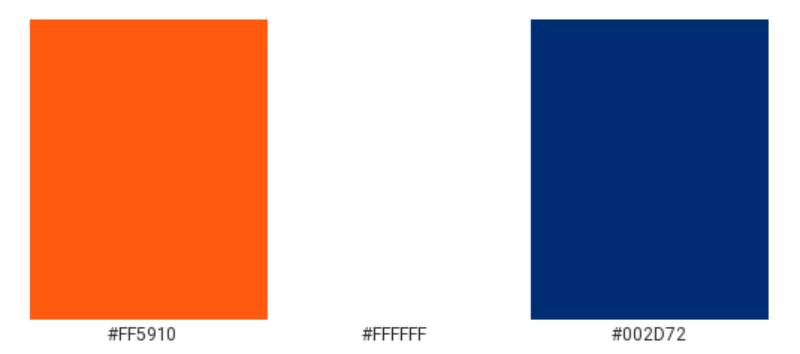
The blue and orange were never random choices. They carry direct meaning from the two National League teams that left New York.
- Blue: Hex #002D72, Pantone PMS 288 C. Taken from the Brooklyn Dodgers’ royal blue. Also happens to be one of the official colors of New York City and New York State. The blue fills the entire skyline area and dominates the cap. In terms of color psychology, blue signals loyalty, trust, and stability. For a franchise built on replacing two beloved teams, those associations mattered.
- Orange: Hex #FF5910, Pantone PMS 1655 C. Borrowed from the New York Giants’ orange. It appears in the baseball stitching, the “Mets” wordmark, and the cap’s “NY” insignia. Orange signals energy and enthusiasm. It gives the logo its warmth and keeps it from feeling too corporate.
- White: Hex #FFFFFF. Used for the bridge, the wordmark trim, and the baseball background. White provides contrast and readability. Without it, the orange script would disappear into the blue skyline.
These three colors together form what you might call a color palette that doubles as a history lesson. Every game day, the team wears the colors of the Dodgers and Giants on their backs.
What Typography Style Is Used in the New York Mets Logo?
The “Mets” wordmark uses a custom cursive script that was part of the original 1962 design. It is not based on any commercially available font.
The lettering is thick, rounded, and angled upward across the center of the logo. Orange fill with a white outline gives it strong legibility against the dark blue skyline. In 1993, the home jersey version of the script got a slight modification, adding a “swoosh tail” extending from the letter “s” to underline the word. But the logo version stayed closer to the original.
The cap uses a separate interlocking “NY” mark in a gothic typeface borrowed directly from the old New York Giants. This is not the same style as the New York Yankees logo, though both feature interlocking letters. The Mets’ version has sharper, more angular letterforms with forked and pointed tails.
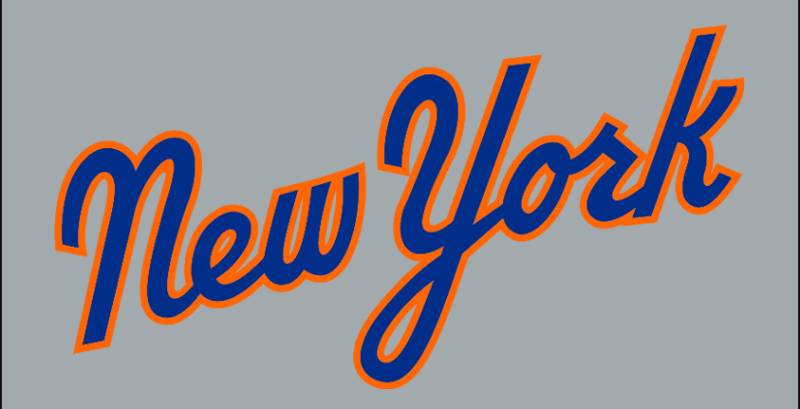
The road jerseys use “NEW YORK” in a Tiffany-style serif lettering, arched across the chest. This too was borrowed from the Giants’ road uniforms.
What Are the Hidden Meanings in the New York Mets Logo?
The buildings in the skyline are arranged geographically, reading roughly west to east across the city. That is not something most fans pick up on at first glance.
The suspension bridge was added by Lon Keller at George Weiss’s request to symbolize the Mets bringing National League baseball back to all five boroughs, not just one. The bridge does not depict a specific real bridge, although it resembles the Queensboro Bridge.
An interesting detail: the Throgs Neck Bridge opened the same year the logo was created (1961), and the Whitestone Bridge had opened in 1939 for that era’s World’s Fair. Both bridges are in Queens, where the Mets play. Coincidence? Probably. But it adds to the story. The overall composition follows strong logo design principles by packing meaning into a clean, readable form.
How Does the New York Mets Logo Compare to Competitor Logos?
Among NFL logos, NBA logos, and other pro sports marks, the Mets logo stands out for its illustrative complexity. Most baseball logos lean toward simpler lettermarks or single-mascot designs.
The New York Yankees logo is pure typography. No illustration, no color beyond navy and white. The Mets went the opposite direction with a full scenic composition inside a baseball. That is a much harder mark to pull off at small sizes, but it has worked for over six decades.
The Los Angeles Dodgers logo uses a clean script wordmark. The Boston Red Sox logo pairs a pair of red socks with simple lettering. The Chicago Cubs logo puts their “C” inside a circle. None of these include city skylines or architectural references.
The Houston Astros logo does include a star, which represents Texas identity, but the Mets logo goes further by embedding multiple real buildings and a bridge. The Philadelphia Phillies logo and Atlanta Braves logo both stick to letterforms and simple shapes.
What makes the Mets mark unusual within the wider landscape of blue logos and orange logos in professional sports is that it functions as both a badge and a tiny illustration. That dual purpose is tricky. Most brands pick one approach or the other.
What Are the Technical Specifications of the New York Mets Logo?
Official Color Codes
- Blue (Primary): Hex #002D72, RGB (0, 45, 114), CMYK (100, 65, 0, 30), Pantone PMS 288 C
- Orange (Secondary): Hex #FF5910, RGB (252, 89, 16), CMYK (0, 65, 87, 0), Pantone PMS 1655 C
- White (Accent): Hex #FFFFFF, RGB (255, 255, 255), CMYK (0, 0, 0, 0)
Dimensions and Proportions
The logo is contained within a circular frame formed by the baseball shape. The aspect ratio is essentially 1:1. The “Mets” wordmark sits at approximately the vertical center, angled slightly upward from left to right.
MLB and the Mets organization maintain specific clear space requirements around the logo to keep it readable on merchandise, signage, and digital applications. Minimum reproduction sizes vary by medium, but the detailed skyline illustration limits how small the logo can go before losing its building outlines.
For digital use, the logo is available in vector graphics format (SVG, EPS, AI) to keep everything sharp at any size. The DPI requirements for print applications follow standard MLB guidelines, typically 300 DPI minimum for merchandise and printed materials.
All usage must conform to the team’s brand guidelines, which specify exactly how the logo appears across different backgrounds, sizes, and color contexts.
What Cultural Impact Has the New York Mets Logo Had?
The Mets logo has become more than a team mark. It is a symbol of New York City itself for a large segment of the population.
For fans in Queens, Brooklyn, and the outer boroughs, the orange and blue emblem represents their side of the city’s baseball divide. The Yankees own Manhattan and the Bronx in the popular imagination. The Mets own everything else.
The logo has appeared on everything from subway ads to hip-hop album art. It showed up constantly during the 1986 championship run and became tied to that era’s New York culture. Took on fresh meaning again during the 2015 World Series run, when a new generation of fans started wearing the mark.
At Citi Field, the team has even expanded the skyline concept beyond the logo. Above the Shake Shack in center field, an updated skyline mural includes the World Trade Center towers wrapped in a red, white, and blue ribbon. The logo’s concept has grown beyond the patch on the jersey.
The decision to include real, identifiable buildings in the design means the logo functions as a kind of storytelling device. It does not just say “Mets.” It says “New York.” That matters. And that is why it has lasted this long without needing a major overhaul.
How Does the New York Mets Logo Fit Into the Overall Brand Identity?
The Mets brand identity is built on three connected pieces: the primary skyline logo, the “NY” cap insignia, and the cursive “Mets” jersey wordmark. These three elements share the same blue and orange color theory foundation and work together across every touchpoint.
The cap logo (interlocking “NY” in orange on a blue cap) connects the team to the New York Giants heritage. The jersey wordmark connects to the Brooklyn Dodgers through the script style. And the primary logo ties everything together with its skyline, bridge, and baseball framing.
Mr. Met, the team’s mascot (and the first live-action mascot in MLB history), wears the cap and uniform but is not part of the primary logo system. He functions as a separate brand asset.
The team’s brand style guide keeps all these elements consistent. Whether it is a billboard outside Citi Field, a social media post, or a packaging design for licensed merchandise, the same blue, orange, and white system applies.
The 2024 City Connect uniforms introduced a concrete-gray colorway inspired by New York’s subways and bridges. But even that alternate uses the same structural theme the logo established back in 1962: New York City infrastructure as a design language.
How Should the New York Mets Logo Be Used?
- Official usage do’s: Always reproduce the logo with correct color values (Blue #002D72, Orange #FF5910, White #FFFFFF). Maintain the required clear space around the mark. Use official vector files for reproduction. Place the logo on backgrounds that provide enough contrast for readability.
- Official usage don’ts: Do not stretch, rotate, or distort the logo. Do not alter the colors. Do not place the logo on busy backgrounds where the skyline detail gets lost. Do not add effects like drop shadows or gradients unless approved. Do not separate the wordmark from the baseball frame.
- Where to access official logos: Licensed usage is managed through MLB Properties and the New York Mets organization. Official assets are distributed to approved partners, licensees, and media through MLB’s asset management system.
- Licensing information: The New York Mets logo is a registered trademark. Any commercial use requires a license from MLB Properties. Fan use for non-commercial purposes (blogs, fan art, personal projects) exists in a gray area and should reference the team’s intellectual property policies.
- Trademark protection details: The logo, the “NY” cap insignia, and the “Mets” wordmark are all federally registered trademarks. MLB actively protects these marks against unauthorized commercial use and counterfeiting. The team’s legal department and MLB’s anti-counterfeiting program monitor for violations.
FAQ on The New York Mets Logo
What does the New York Mets logo look like?
The Mets primary logo is a circular emblem shaped like a baseball with orange stitching. Inside, a blue New York City skyline sits behind a white suspension bridge. “Mets” runs across the center in orange cursive script trimmed in white.
Who designed the original Mets logo?
Sports cartoonist Ray Gotto won a public contest with over 500 entries in 1961. Team president George Weiss then had artist Lon Keller from Spencer Marketing Services refine the concept, adding specific buildings and the bridge connecting all five boroughs.
What buildings appear in the Mets logo skyline?
From left to right: a church spire representing Brooklyn, the Williamsburgh Savings Bank, the Woolworth Building, a midtown Manhattan view with the Empire State Building at center, and the United Nations headquarters on the far right.
Why are the Mets colors blue and orange?
The blue was taken from the Brooklyn Dodgers. The orange came from the New York Giants. Both teams left the city after 1957. The Mets adopted their colors as a tribute when the expansion team formed in 1962.
What are the official Mets logo color codes?
Blue is Hex #002D72, with an RGB value of (0, 45, 114). Orange is Hex #FF5910, RGB (252, 89, 16). White rounds out the team color scheme. The Pantone values are PMS 288 C for blue and PMS 1655 C for orange.
Has the Mets logo ever changed?
Barely. The logo has had only three minor updates since 1962. Orange got darker in 1981. Colors darkened again in 1993. The small “NY” initials were removed in 1999. The core Mets emblem design has stayed the same for over 60 years.
What does the bridge in the Mets logo mean?
The white suspension bridge does not represent any single real structure. It symbolizes all of New York’s bridges and the idea that the Mets connect all five boroughs through National League baseball. Lon Keller added it at George Weiss’s direction.
What font is used in the Mets logo?
The “Mets” wordmark uses a custom cursive script created for the team in 1962. It is not based on any standard commercial font family. The cap features a separate interlocking “NY” in a gothic style borrowed from the old New York Giants.
What is the NY on the Mets cap?
The interlocking orange “NY” on the blue Mets cap was taken directly from the New York Giants baseball team before they moved to San Francisco. It connects the franchise to its National League predecessor. The Yankees use a different interlocking “NY” design entirely.
Where can I download an official Mets logo file?
Licensed Mets logo files are managed through MLB Properties. Commercial use requires licensing approval. Media outlets get assets through MLB’s official distribution system. The logo is a registered trademark, so unauthorized commercial reproduction is not permitted.
Conclusion
The New York Mets logo has held up for over six decades with only the smallest tweaks. That says everything about how well Ray Gotto and Lon Keller nailed the original concept back in 1962.
Few MLB team emblems pack this much city history into a single circular mark. The Brooklyn church spire, the Empire State Building, the bridge tying five boroughs together. It all still works.
The orange and blue color scheme honors the Dodgers and Giants while giving the Mets their own visual identity at Citi Field and beyond.
Whether on a pinstripe jersey, a blue cap, or a piece of fan merchandise, this emblem carries the weight of New York’s National League baseball tradition without looking dated. Not many sports logos can say that.

Renowned for his expertise in logo design and visual branding, Bogdan has developed a multitude of logos for various clients.
His skills extend to creating posters, vector illustrations, business cards, and brochures. Additionally, Bogdan's UI kits were featured on marketplaces like Visual Hierarchy and UI8.
He also wrote in the past years on sites like Design Your Way, WebDesignerDepot, WPDean, Designmodo, Speckyboy, Slider Revolution, and more.
- Canva AI Features Reviewed: Are They Actually Useful? - 4 October 2026
- The Substack Logo History, Colors, Font, And Meaning - 2 October 2026
- How UX Design Impacts SaaS User Retention and Churn - 1 October 2026

Bogdan Sandu is a seasoned designer who has been designing websites since 2008. Renowned for his expertise in logo design and visual branding, Bogdan has developed a multitude of logos for various clients. His skills extend to creating posters, vector illustrations, business cards, and brochures. Additionally, Bogdan's UI kits were featured on marketplaces like Visual Hierarchy and UI8. He also wrote in the past years on sites like Design Your Way, WebDesignerDepot, WPDean, Designmodo, Speckyboy, Slider Revolution, and more.
You Might Also Like