The Pittsburgh Pirates logo is one of the longest-running visual marks in professional baseball. It belongs to a franchise founded in 1882, originally named the Alleghenys after the city of Allegheny, Pennsylvania. The current primary logo, a gold letter “P” in a custom serif style, became the team’s official mark in 2014, though versions of that same letter have appeared on Pirates caps since 1948.
Pittsburgh’s branding sits inside a broader tradition of Major League Baseball identity design, where teams lean on typography, city identity, and decades of fan loyalty to build recognition. The Pirates have cycled through roughly 18 different logos since 1900, split almost evenly between “P” lettermarks and pirate character illustrations. The current gold “P” was introduced as the primary logo for the 2014 season, replacing the “Jolly Roger” pirate head that had been used since 1997. No single designer has been publicly credited for the modern mark, which draws from Old English lettering traditions already used by the club more than a century ago.
What Is the Pittsburgh Pirates Logo?
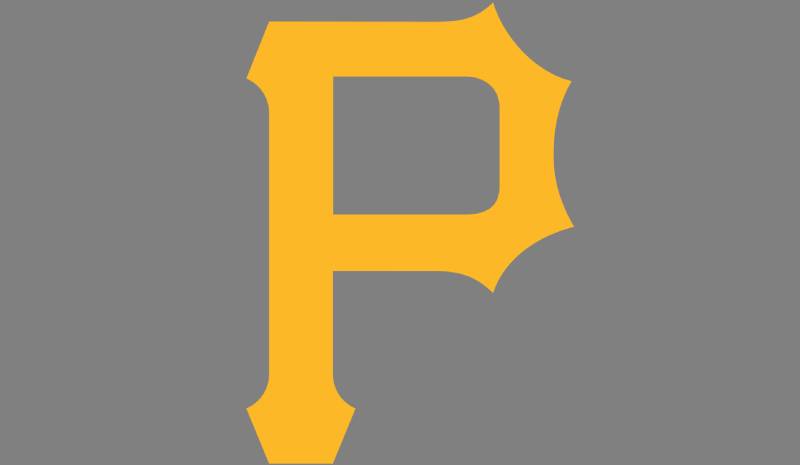
The Pittsburgh Pirates logo is a gold, serif-style capital letter “P” that represents both the city of Pittsburgh and the team’s nickname. It officially became the primary logo in 2014, replacing the pirate head mark. The design uses an Old English-inspired letterform that first appeared on Pirates uniforms as early as 1900.
Here is a breakdown of the logo’s main attributes:
- Design Type: Lettermark (single character wordmark)
- Primary Elements: A gold capital “P” with four spike-like crests at the top, an elongated descending leg, and distinctive serifs. The letter sits alone with no enclosing shape or additional graphics in the primary version
- Official Introduction Date: January 2014 (as primary logo). Variations of the gold “P” cap logo have been in use since 1948
- Designer/Agency: No publicly credited designer or agency. The mark evolved internally over decades of incremental refinement
- Trademark Status: Registered trademark of the Pittsburgh Pirates, licensed through Major League Baseball
- Color Palette: Gold (#FDB827), Black (#27251F), and White (#FFFFFF)
- Usage Context: Game-day uniforms, caps, merchandise, digital platforms, PNC Park signage, broadcast graphics, and all official team communications. The Jolly Roger pirate head remains an alternate mark used on uniform sleeves and select merchandise
How Has the Pittsburgh Pirates Logo Evolved Over Time?
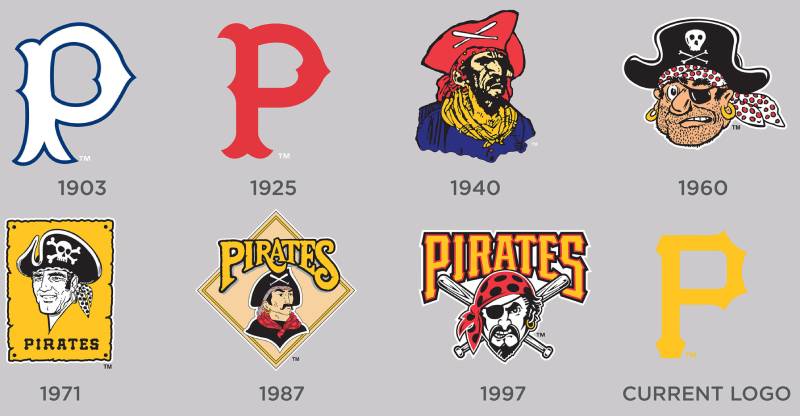
The Pittsburgh Pirates have used roughly 18 different logos since 1900, alternating between letter-based marks and pirate character illustrations.
The first half-century was almost entirely about the letter “P” in varying styles. Then pirate portraits took over for about 30 years. And in 2014, the franchise circled back to the letter “P” as its primary mark.
It is a loop that tells you a lot about how sports branding works. Sometimes going backward is the right move.
The Original Letter “P” Logos (1900-1932)
- Years Active: 1900-1932, across multiple variations
- Design Description: The very first Pirates badge featured a dark blue wishbone-style “P” with a vertical bar forked at the bottom. Over the next three decades, the letter went through at least eight redesigns, shifting between block, gothic, and Old English styles
- Color Scheme: Primarily navy blue, with red appearing in some versions starting around 1915. A red “P” with blue outline was used in 1923
- Designer: Unknown. These were house designs typical of early baseball
- Context: This was the era of Honus Wagner and the team’s first World Series win in 1909. Uniforms were simple. Logos were functional. The “PBC” monogram (Pittsburgh Baseball Club) also appeared briefly in 1908-1909
- Cultural Significance: These early lettermarks set the DNA for everything that followed. The “P” wasn’t just a logo. It became a city symbol
The First Pirate Portrait (1934-1947)
- Years Active: Approximately 1934-1947
- Design Description: The franchise first used a pirate illustration on club letterheads and roster guides around 1934. In 1940, a pirate head appeared on the actual uniforms for the first time, though it lasted only two seasons on the field
- Color Scheme: Dark tones, consistent with the blue and red palette still in use at the time
- Designer: The 1940 uniform version was based on existing club illustrations
- Context: The team was looking for a way to visually connect to the “Pirates” name. Before this, the name existed only in text. The pirate imagery gave the brand something to grab onto
- Key Changes from Previous: This was a total departure. Going from a single letter to a character illustration changed the entire feel of the brand
- Cultural Significance: It proved that the Pirates name could carry a visual identity beyond just a letter. That 1940 pirate head would later come back in a revised form for the 1987 centennial logo
The Jack Berger “Smiling Buc” Era (1958-1967)
- Years Active: 1958-1967
- Design Description: A cartoon buccaneer with stubble, wearing a black hat, a red polka-dot scarf, an eye patch, and two gold earrings. Crossed baseball bats appeared below with a “PIRATES” wordmark
- Color Scheme: Black, red, beige, and gold
- Designer: Jack Berger, Sr., a longtime Pittsburgh Press artist
- Context: This pirate was the face of the franchise during Bill Mazeroski’s walk-off home run in the 1960 World Series. That single moment is still considered one of the greatest in baseball history
- Key Changes from Previous: Much more cartoonish and playful than the earlier pirate illustrations. It had personality
- Cultural Significance: The “Smiling Buc” became a genuine cultural icon in Pittsburgh. It is still considered a fan favorite decades later
The Realistic Pirate in the Gold Rectangle (1967-1986)
- Years Active: 1967-1986
- Design Description: A more realistic pirate portrait set inside a gold rectangle, with a “PIRATES” wordmark underneath. The style was bolder, less cartoonish, and more structured
- Color Scheme: Black, gold, and white. This was the era when the team permanently adopted black and gold, matching the city of Pittsburgh’s official colors
- Designer: Bob Gessner, who also designed the Pittsburgh Penguins’ skating penguin logo for the NHL
- Context: This logo was on the uniforms when Roberto Clemente starred in the 1971 World Series and when Willie Stargell led the “We Are Family” 1979 championship team. The Pirates also became one of the first teams to wear sleeveless jerseys and double-knit fabric during this period
- Key Changes from Previous: The shift from cartoon to realism. And the permanent move to black and gold changed everything about the club’s visual identity
- Cultural Significance: Many fans still call this the best primary logo the team ever had. It captures two World Series titles and some of the greatest players in franchise history
The Centennial Pirate Revival (1987-1996)
- Years Active: 1987-1996
- Design Description: A pirate face mounted on a yellow diamond shape, with the “PIRATES” wordmark in yellow with a black trim. The pirate design was directly based on the 1940 uniform version
- Color Scheme: Yellow, black, and white
- Designer: Not publicly credited
- Context: Introduced for the club’s 100th anniversary season. The franchise needed a refresh after years of declining performance and front-office scandals. This was also the era of Barry Bonds and the early-90s playoff runs
- Key Changes from Previous: The diamond shape was new. The pirate face itself was a throwback to the 1940s original
- Cultural Significance: It bridged two eras. Old enough to feel traditional, but updated enough to work on merchandise and broadcast graphics
The “Modernized Buccaneer” (1997-2013)
- Years Active: 1997-2013
- Design Description: A front-view pirate face with a red-and-black polka-dot bandana, a black eye patch, a gold earring, and two crossed baseball bats behind the head. The “PIRATES” script appeared above in yellow with a black outline
- Color Scheme: Gold, black, red, and white
- Designer: Not publicly credited. Managing general partner Kevin McClatchy described the change as “the dawning of a new era”
- Context: This logo transitioned the team from Three Rivers Stadium to PNC Park (opened 2001). It served the club for 17 seasons
- Key Changes from Previous: Completely new pirate illustration. The bandana replaced the hat as the primary headwear element. The bats behind the head were a fresh addition
- Cultural Significance: It was the last pirate-centric primary logo the team has used. Fans still refer to it as the “Jolly Roger,” and it remains on uniform sleeves as an alternate mark
The Gold “P” Return (2014-Present)
- Years Active: 2014-present
- Design Description: A standalone gold capital “P” in an Old English-inspired serif typeface, featuring four spike-like crests at the top, an elongated leg, and clean parallel lines. No enclosing shape. No supporting graphics
- Color Scheme: Gold (#FDB827) on black, or black on gold depending on the application
- Designer: Internal evolution. The letterform has roots going back to the original 1900 logo
- Context: The Pirates announced the change in January 2014, after hinting during the 2013 season that they wanted to put more focus on the cap logo. They became the fourth MLB team in a decade to swap their primary logo for their cap mark
- Key Changes from Previous: Total removal of the pirate character from primary status. The “Jolly Roger” pirate head was kept as a secondary and sleeve mark
- Cultural Significance: By going back to the “P,” the Pirates connected their 21st-century identity directly to their earliest years. The letter carries nearly 70 years of brand recognition from its time on the cap. It also aligns the team more closely with the broader Pittsburgh sports identity, where the gold “P” is an instantly recognizable city-wide symbol
What Do the Design Elements of the Pittsburgh Pirates Logo Mean?
The gold “P” is doing more work than it looks like. It stands for both “Pittsburgh” and “Pirates” at the same time.
That dual meaning is intentional. The letter ties the team to the city before it ties the team to baseball.
The Old English styling gives it a sense of age and permanence. The spike-like crests at the top add aggression without going overboard. It reads as classic, not flashy.
Why Did the Pittsburgh Pirates Choose These Specific Colors?
The Pirates switched to black and gold in 1948. They didn’t pick those colors randomly.
Black and gold are the official colors of the City of Pittsburgh, pulled from the coat of arms of William Pitt the Elder, the British statesman the city is named after. The Steelers and Penguins use the same palette. Pittsburgh is actually the only city in North America where all major professional sports teams share the same color palette.
Here are the official color codes:
- Gold: Pantone 123 C, Hex #FDB827, RGB (253, 184, 39), CMYK (0, 31, 95, 0). Gold signals tradition and achievement. In color psychology, it carries associations with success and prestige
- Black: Pantone Process Black, Hex #27251F, RGB (39, 37, 31), CMYK (0, 0, 0, 100). Black brings authority and weight. It grounds the gold and keeps the whole identity from feeling lightweight
- White: Hex #FFFFFF, RGB (255, 255, 255). Used for contrast and legibility, particularly on road uniforms and merchandise
Before 1948, the team used navy blue and red, which was standard for the era. The switch to black and gold was a clean break that permanently attached the franchise to the city’s broader identity.
What Typography Style Is Used in the Pittsburgh Pirates Logo?
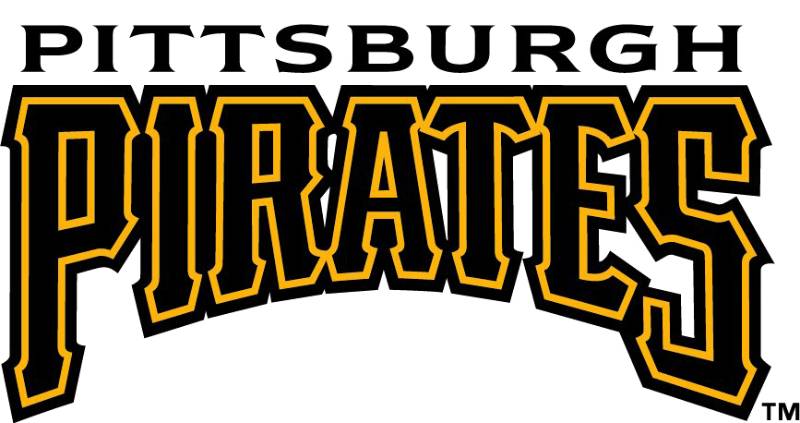
The “P” uses an Old English-inspired typeface with custom modifications. It is not pulled from a commercial font library.
A separate font was developed based on the letter “P” from the logo, and it circulates online under the name “MLB Pirates.” The letterform has thick vertical strokes, decorative top crests, and angular serifs that give it a historical feel without looking dated.
Readability is strong at virtually any size, which matters for everything from stadium signage to social media avatars. The “PIRATES” and “PITTSBURGH” wordmarks on jerseys use different treatments, with the team name set in large gold arched lettering and the city name in smaller, simpler black letters.
What Are the Hidden Meanings in the Pittsburgh Pirates Logo?
There is no complex subliminal message buried in the gold “P.” But the simplicity itself is the point.
By stripping away the pirate character and going with just the letter, the franchise made a statement. The “P” belongs to the city as much as it belongs to the team.
The Old English styling is a nod to the franchise’s age. Not many MLB teams can trace their lettermark back to 1900 and still have it feel current. The four crests at the top give it just enough edge to read as strong rather than decorative.
How Does the Pittsburgh Pirates Logo Compare to Competitor Logos?
Most NL Central teams use some combination of lettermarks and character illustrations. The Pirates lean harder into pure typographic identity than most of their rivals.
The St. Louis Cardinals logo combines two cardinals perched on a bat with the team name. It mixes illustration and lettering. The Chicago Cubs logo uses a bold “C” inside a circle, which is closer to the Pirates’ approach but still has a more enclosed, badge-like feel.
The Milwaukee Brewers logo leans into a monogram that cleverly hides a ball-in-glove image, adding a layer of visual play. The Cincinnati Reds logo also uses a single letter, the “C,” but it sits inside a more decorative framework.
Pittsburgh’s approach is arguably the most stripped-back in the division. Just the letter. No circle, no supporting illustration, no enclosing badge. Among all baseball team logos, it is one of the purest lettermark identities in the sport.
What Are the Technical Specifications of the Pittsburgh Pirates Logo?
Official Color Codes
- Primary Color: Gold – Hex: #FDB827, RGB: (253, 184, 39), CMYK: (0, 31, 95, 0), Pantone: 123 C
- Secondary Color: Black – Hex: #27251F, RGB: (39, 37, 31), CMYK: (0, 0, 0, 100), Pantone: Process Black
- Accent Color: White – Hex: #FFFFFF, RGB: (255, 255, 255), CMYK: (0, 0, 0, 0)
- Alternate Accent: Red – Hex: #E4002B, RGB: (228, 0, 43), CMYK: (0, 91, 76, 0), Pantone: 185. Used on select alternate marks and the pirate’s bandana
Dimensions and Proportions
- Aspect Ratio: The standalone “P” lettermark is roughly square in proportion, fitting neatly into standard cap and uniform applications
- Minimum Size Requirements: MLB brand guidelines dictate minimum reproduction sizes to keep the letterform details legible. The decorative crests require a baseline size to avoid becoming muddy at small scales
- Clear Space: Standard MLB licensing requires a minimum clear space around the logo, typically equal to the height of the top crests, to prevent crowding from other graphic elements
- Official Usage Guidelines: All applications are managed through MLB Properties. The logo must not be altered, recolored outside of approved palettes, or combined with unauthorized graphic elements. Vector graphics are the standard format for official reproductions
What Cultural Impact Has the Pittsburgh Pirates Logo Had?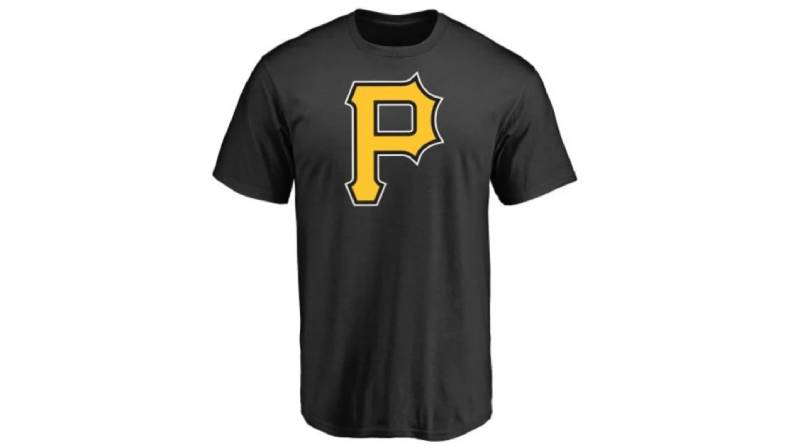
The gold “P” is bigger than baseball in Pittsburgh. It is part of the city’s visual landscape the same way the yellow bridges and the skyline are.
Walk around the North Side on a game day and the letter is everywhere. Flags, hats, painted murals, bar signs. It blends with Steelers and Penguins branding because the gold color scheme is shared across all three teams.
The older pirate logos, especially the Bob Gessner-designed realistic pirate from 1967-1986, have become retro collector items. Vintage merchandise from the Clemente and Stargell eras pulls strong demand.
And the franchise’s “Raise the Jolly Roger” celebration after every win keeps the pirate character alive in fan culture, even though it is no longer the primary mark. That is the thing about the Pirates’ visual history. None of it really goes away.
How Does the Pittsburgh Pirates Logo Fit Into the Overall Brand Identity?
The gold “P” sits at the center of a layered identity system. The “Jolly Roger” pirate head works as the secondary mark on sleeves and select merchandise. A circular badge reading “Pittsburgh Pirates Baseball Since 1887” serves as a tertiary emblem.
The wordmarks “Pittsburgh” and “Pirates” each have their own typographic treatment, used across home and road jerseys. PNC Park itself extends the brand through signage, the Clemente Bridge walkway, and stadium architecture that echoes the steel-and-gold identity.
Pittsburgh is one of the few cities where the sports brand and the city brand are genuinely the same thing. The black and gold identity runs through all three professional teams, connecting the Pirates to something bigger than baseball.
How Should the Pittsburgh Pirates Logo Be Used?
- Do: Use the gold “P” as the primary identifier in all official contexts. Reproduce it from approved vector files to preserve letterform details. Maintain required clear space and minimum sizing
- Don’t: Alter the proportions, add drop shadows or effects, change the approved colors, or combine the mark with unauthorized text or graphics. The Jolly Roger pirate head should not be used as a primary logo in contexts where the “P” is designated as the lead mark
- Where to Access Official Logos: Licensed brand assets are available through MLB Properties and the Pirates’ official licensing partners. Media outlets can request logo files through MLB’s media relations channels
- Licensing Information: All commercial use of the Pittsburgh Pirates logo requires a license through MLB Properties. This covers merchandise, broadcast, digital media, and promotional materials. Unauthorized use is subject to trademark enforcement
- Trademark Protection: The gold “P,” the Jolly Roger pirate, and the “Pittsburgh Pirates” name are all registered trademarks. MLB actively monitors and enforces trademark rights across physical and digital merchandise channels worldwide
FAQ on The Pittsburgh Pirates Logo
What does the Pittsburgh Pirates logo look like?
The current Pittsburgh Pirates logo is a gold capital letter “P” in an Old English-inspired style. It features spike-like crests at the top and angular serifs.
No pirate character. No enclosing shape. Just the letter, standing alone on a black background. It has been the primary mark since 2014.
When did the Pittsburgh Pirates change their logo to the gold “P”?
The Pirates officially switched in January 2014. They dropped the pirate head with the bandana and crossed bats that had been used since 1997.
But here is the thing. That gold “P” had been on the team’s baseball cap since 1948. The 2014 change just promoted it to primary status.
What do the colors in the Pittsburgh Pirates logo mean?
Black and gold are the official colors of the City of Pittsburgh. They come from the coat of arms of William Pitt the Elder.
The Pittsburgh Steelers and Pittsburgh Penguins use the same palette. It is the only city in North America where all major pro sports teams share identical colors.
How many logos have the Pittsburgh Pirates had?
Around 18 different logos since 1900. They split almost evenly between “P” lettermarks and pirate character illustrations.
The earliest was a dark blue wishbone “P.” The most recent pirate portrait lasted from 1997 to 2013. Took me a while to count them all, honestly.
Who designed the Pittsburgh Pirates logo?
No single designer gets credit for the current gold “P.” It evolved internally over decades. Earlier pirate logos had known creators, though.
Jack Berger, Sr. drew the famous 1958 cartoon buccaneer. Bob Gessner designed the realistic pirate used from 1967 to 1986.
What font does the Pittsburgh Pirates logo use?
The “P” uses a custom Old English-inspired letterform. It is not from a commercial font library.
A dedicated typeface based on the logo circulates online as “MLB Pirates.” The jersey wordmarks for “Pittsburgh” and “Pirates” use separate typographic treatments with arched gold lettering.
Why did the Pirates get rid of the pirate in their logo?
The team wanted to put more focus on the cap mark. VP Louis DePaoli said at the time, “When people see the gold P, they know it stands for Pirates.”
The Jolly Roger pirate head was not fully removed. It still appears on uniform sleeves and merchandise as an alternate mark.
What is the Pittsburgh Pirates alternate logo?
The main alternate is the Jolly Roger, a pirate face with an eye patch, bandana, and gold earring. Crossed baseball bats sit behind the head.
There is also a circular badge that reads “Pittsburgh Pirates Baseball Since 1887.” Both are used on merchandise and team apparel alongside the primary gold “P.”
Are the Pittsburgh Pirates colors the same as the Steelers?
Yes. Black and gold across the board. The Pirates adopted these colors in 1948, matching the city flag. Before that, they wore navy blue and red like most National League teams of that era.
PNC Park, Acrisure Stadium, PPG Paints Arena. Same palette everywhere you look in Pittsburgh.
Where can I download the official Pittsburgh Pirates logo?
Official logo files are managed through MLB Properties and the team’s licensing partners. Media outlets can request assets through MLB media relations.
For personal use, the team’s official site and licensed retailers carry approved graphics. Any commercial use requires a trademark license. No shortcuts on that one.
Conclusion
The Pittsburgh Pirates logo has gone through roughly 18 versions since 1900, swinging between pirate portraits and the letter “P.” The current gold lettermark ties the franchise to PNC Park, to the city’s black and gold identity, and to over a century of baseball history.
Five World Series titles sit behind that mark. Clemente, Stargell, Mazeroski. The names change but the “P” stays.
Whether you are looking at the NHL logos of the Penguins or the NFL logos of the Steelers, Pittsburgh keeps its visual identity tight. The Pirates fit right in. Simple mark, deep roots, no wasted ink.

Renowned for his expertise in logo design and visual branding, Bogdan has developed a multitude of logos for various clients.
His skills extend to creating posters, vector illustrations, business cards, and brochures. Additionally, Bogdan's UI kits were featured on marketplaces like Visual Hierarchy and UI8.
He also wrote in the past years on sites like Design Your Way, WebDesignerDepot, WPDean, Designmodo, Speckyboy, Slider Revolution, and more.
- The Windsurf Logo History, Colors, Font, And Meaning - 10 October 2026
- How to Remove Background From Product Photos (No Photoshop) - 10 October 2026
- How Designers can Build a Stronger Online Creative Identity - 9 October 2026

Bogdan Sandu is a seasoned designer who has been designing websites since 2008. Renowned for his expertise in logo design and visual branding, Bogdan has developed a multitude of logos for various clients. His skills extend to creating posters, vector illustrations, business cards, and brochures. Additionally, Bogdan's UI kits were featured on marketplaces like Visual Hierarchy and UI8. He also wrote in the past years on sites like Design Your Way, WebDesignerDepot, WPDean, Designmodo, Speckyboy, Slider Revolution, and more.
You Might Also Like