The Cincinnati Reds logo is one of the most recognized marks in professional baseball. Built around a red wishbone-shaped letter “C” with the word “REDS” sitting inside it, this emblem has roots stretching back to the late 1800s.
Few baseball team logos carry this kind of weight. The Reds were founded in 1881, making them one of the oldest franchises in Major League Baseball. Their visual identity has gone through roughly 20 different versions since the club’s earliest days as the Cincinnati Red Stockings.
The current primary mark, introduced in 2013, keeps things clean. A white wishbone “C” outlined in black holds the team name in bold capitals. Red fills the background. It is a combination mark that blends letterform and wordmark into a single compact shape, and it works just as well on a fitted cap as it does on a stadium scoreboard.
That kind of staying power says something. The wishbone “C” concept first appeared in 1913, over a century ago. Most of the revisions since then have been tweaks, not overhauls. The core idea has barely changed.
What Is the Cincinnati Reds Logo?
The Cincinnati Reds logo is a combination mark featuring a red wishbone-shaped letter “C” containing the wordmark “REDS” in its center. The current version was officially introduced in 2013 and uses white lettering with black drop shadows on a red background, symbolizing the team’s connection to Cincinnati.
- Design Type: Combination mark (letterform plus wordmark)
- Primary Elements: Wishbone letter “C,” wordmark “REDS,” black drop shadow for depth
- Official Introduction Date: 2013 (current version)
- Designer/Agency: In-house MLB and Cincinnati Reds design team. No external agency has been publicly credited for the current iteration.
- Trademark Status: Registered with the USPTO under The Cincinnati Reds LLC. The “C CINCINNATI REDS” mark holds Registration Number 1560468, filed August 5, 1988, and registered October 17, 1989. Status: Registered and Renewed.
- Color Palette: Red (#C6011F), White (#FFFFFF), Black (#000000)
- Usage Context: Jerseys, caps, helmets, stadium signage, digital platforms, merchandise, broadcast graphics, marketing materials, and all officially licensed Cincinnati Reds products
How Has the Cincinnati Reds Logo Evolved Over Time?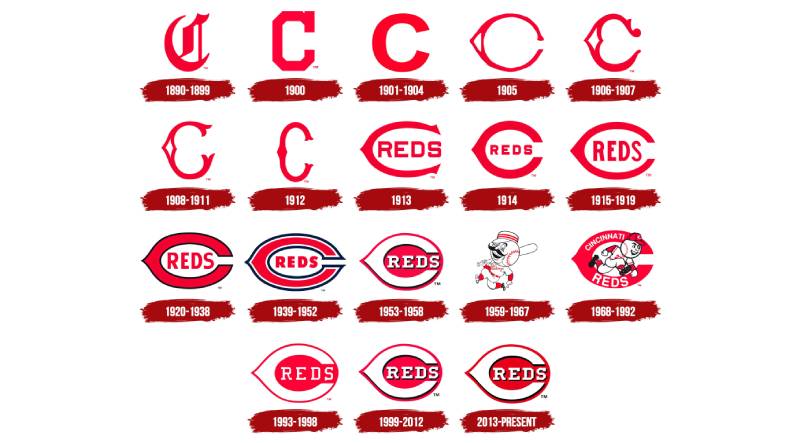
The Cincinnati Reds have used roughly 20 different logo designs since the franchise’s founding. The earliest marks featured a standalone gothic letter “C” in the 1890s.
By 1913, the wishbone “C” with “REDS” inside it appeared for the first time. That basic framework has survived for over a hundred years, with breaks in the 1950s and 1960s when the team shifted to mascot-based designs.
The biggest departures came during the Red Scare era and again when the “Running Man” took center stage. But the team kept returning to the wishbone “C” concept, which tells you everything about how strong that original idea was.
The Gothic C Era (1890-1907)
- Years Active: 1890-1907 (with minor variations across this period)
- Design Description: A standalone letter “C” rendered in gothic and serif styles. No additional text or imagery accompanied it. The letter changed shape multiple times, going from sharp and angular to rounder and bolder.
- Color Scheme: Scarlet red on white
- Designer: Unknown, likely produced in-house
- Context: The franchise had just moved from the American Association to the National League in 1890. These early logos established the “C for Cincinnati” identity that would carry forward for over a century.
- Key Changes: The 1900 version introduced a more geometric, solid serif “C.” By 1901, it shifted to a clean sans-serif circular shape. Each redesign was subtle but moved toward bolder, more readable letterforms.
- Cultural Significance: These marks aligned with early baseball’s amateur aesthetic. Simple single-letter logos were the standard across the sport.
The First Wishbone C-REDS Logo (1913-1938)
- Years Active: 1913-1938 (with frequent refinements)
- Design Description: A horizontally stretched “C” with open ends resembling a wishbone. The word “REDS” sat in bold capitals inside the letter’s opening. This was the first time the team name appeared within the logo mark itself.
- Color Scheme: Red with black outline (added around 1920). A brief switch to blue and white occurred in 1936 before reverting to red the following year.
- Designer: Unknown
- Context: The 1913 introduction created the template that, with modifications, still defines the Reds brand today. The team played at Redland Field (later renamed Crosley Field) during most of this period.
- Key Changes from Previous: The jump from a standalone “C” to the “C-REDS” combination was the biggest shift in the franchise’s visual history. The 1914 version thickened the “C.” The 1915 revision balanced the proportions. The 1920 update added a distinct black outline.
- Cultural Significance: This logo carried the Reds through World War I, the Roaring Twenties, and the Great Depression. It was also the mark worn during the controversial 1919 World Series, when the Black Sox scandal overshadowed Cincinnati’s championship.
The Blue and Red Variations (1936-1939)
- Years Active: 1936-1939
- Design Description: An unusual deviation. In 1936, the “C” turned blue with a white outline on a red background. The “Reds” wordmark also shifted to blue and white. By 1939, the main elements returned to red but sat on a calm blue background that traced the “C” contours.
- Color Scheme: Blue, red, and white in various combinations
- Designer: Unknown
- Context: The team experimented with its palette during the late 1930s, possibly to differentiate itself or refresh a look that had been in place for two decades.
- Key Changes from Previous: Color palette was the primary shift. The structure of the wishbone “C” and “Reds” wordmark stayed consistent.
- Cultural Significance: This period preceded the Reds’ 1940 World Series championship. The color experiments were short-lived and the team returned to its red identity quickly.
The Mr. Redlegs Mascot Era (1953-1967)
- Years Active: 1953-1967
- Design Description: A cartoon baseball player with a baseball for a head, wearing a classic uniform and carrying a bat while running. Known as Mr. Redlegs. This was the first logo in over 70 years to drop the letter “C” and team name entirely.
- Color Scheme: Red and white
- Designer: Unknown. The character first appeared in a March 1953 issue of The Sporting News.
- Context: The anti-Communist Red Scare of the early 1950s prompted the team to rebrand as the “Cincinnati Redlegs” in 1953. The mascot-based logo avoided direct use of the word “Reds.” In 1956, the team even removed the “REDS” lettering from the jersey’s wishbone “C,” leaving just a plain red “C” on the uniform.
- Key Changes from Previous: A total departure. The abstract lettermark was replaced by an illustrated character. The mustachioed Mr. Redlegs, with his baseball head and bat, gave the team a friendlier, more approachable face.
- Cultural Significance: This logo represents one of the rare times a political climate directly reshaped a sports team’s visual identity. The “Redlegs” name and mascot logo were a direct response to McCarthyism.
The Running Man and Wishbone C Combination (1968-1992)
- Years Active: 1968-1992
- Design Description: A redesigned Mr. Red (now without his mustache) running inside a red wishbone “C” that also contained the text “CINCINNATI REDS.” The character was known as the “Running Man.” The wishbone point was restored to the “C” in 1967.
- Color Scheme: Red, white. Black was dropped entirely as a secondary color during this era.
- Designer: Unknown
- Context: This logo coincided with the “Big Red Machine” dynasty of the 1970s, featuring Johnny Bench, Pete Rose, Joe Morgan, and manager Sparky Anderson. It was also worn during the 1990 World Series upset of Oakland.
- Key Changes from Previous: The standalone mascot was placed back inside the wishbone “C” framework. Mr. Red lost his handlebar mustache in 1968, giving him a cleaner, more modern look.
- Cultural Significance: This is the logo most fans associate with the Reds’ greatest era. The Big Red Machine won back-to-back World Series titles in 1975 and 1976, and this mark was on every jersey, cap, and pennant during those years.
The Refined Wishbone C-REDS (1993-2012)
- Years Active: 1993-2012 (with a notable redesign in 1999)
- Design Description: The Running Man was dropped from the primary logo. The mark returned to a clean wishbone “C” with “REDS” inside. The 1993 version used thinner, cleaner lines and a brighter red. The 1999 update darkened the red and added black drop shadows for a three-dimensional effect.
- Color Scheme: Red, white, and black (black reintroduced in the late 1990s)
- Designer: Unknown
- Context: The 1993 redesign stripped the logo back to basics. The 1999 overhaul brought drop shadows and a more intense color palette, coinciding with the opening era at the new Great American Ball Park in 2003.
- Key Changes from Previous: The removal of the Running Man character marked a clean break. The 1999 version’s black shadowing added depth and a more aggressive, modern feel.
- Cultural Significance: This period reflected the broader 1990s trend in sports branding toward bolder, edgier aesthetics. The addition of black aligned with what many MLB and NFL logos were doing at the time.
The Current Cincinnati Reds Logo (2013-Present)
- Years Active: 2013 to present
- Design Description: A white wishbone “C” with the wordmark “REDS” inside, both outlined with black drop shadows. The red background precisely follows the contours of the “C” and wordmark. A thin red outline borders the entire mark.
- Color Scheme: Red (#C6011F), White (#FFFFFF), Black (#000000)
- Designer: In-house design team
- Context: The 2013 refresh cleaned up the previous version while keeping the same core structure. The white elements and refined shadowing made the logo more readable at smaller sizes and across digital platforms.
- Key Changes from Previous: The “C” and “REDS” switched from red to white lettering on a red background. The drop shadows became subtler and more refined. The overall proportions were tightened.
- Cultural Significance: This version bridges tradition and modern media demands. It works across everything from embroidered caps to tiny app icons, which the older versions struggled with.
What Do the Design Elements of the Cincinnati Reds Logo Mean?
Every piece of the Cincinnati Reds logo carries specific meaning tied to the franchise’s history and the city itself.
The wishbone “C” represents Cincinnati. It has been the defining shape of this team’s visual identity for over a century. The open, curved form gives it a sense of motion, which fits a baseball team.
The wordmark “REDS” sits inside the “C” as both a team identifier and a nod to the franchise’s full name. The black drop shadows add depth without overcomplicating the design.
Why Did the Cincinnati Reds Choose These Specific Colors?
Red has been the team’s primary color since 1869 when the original Cincinnati Red Stockings took the field as baseball’s first professional team. The color was literally in the name.
According to color psychology, red signals energy, passion, and intensity. For a competitive baseball franchise, that fits.
The official color specifications are:
- Red: Hex #C6011F | RGB (198, 1, 31) | CMYK (0, 100, 65, 0) | Pantone PMS 199. A deep, saturated red that reads as aggressive and confident. It connects directly to the team’s name and 150+ year history.
- White: Hex #FFFFFF | RGB (255, 255, 255) | CMYK (0, 0, 0, 0). Used for the “C” letterform and “REDS” wordmark. Provides maximum contrast against the red background. White here brings clarity and readability.
- Black: Hex #000000 | RGB (0, 0, 0) | CMYK (0, 0, 0, 100) | Pantone Process Black. Applied as drop shadows on the “C” and wordmark. Adds a three-dimensional quality and gives the logo visual weight without cluttering it.
Cincinnati sits among a handful of MLB teams that lean almost entirely on red in their logos. The team has stayed with this palette through nearly every era, with only brief experiments in blue during the late 1930s and black-heavy designs in the late 1990s.
What Typography Style Is Used in the Cincinnati Reds Logo?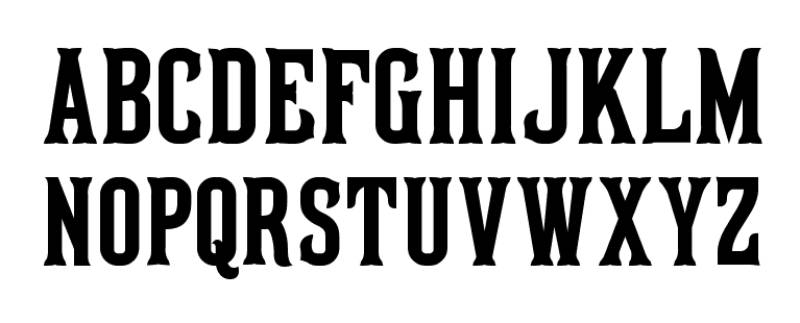
The “REDS” wordmark inside the wishbone “C” uses a custom sans-serif font known as MLB Reds. It is a proprietary typeface built specifically for the franchise.
The closest publicly available match is Varsity, a blocky athletic-style font. The characters are bold, uppercase, and slightly condensed. There is no seriffing or decorative treatment.
Readability was clearly the goal here. The letters hold up at small sizes on a cap brim and at large scales on stadium signage. The spacing between the letters is tight but not cramped, giving the wordmark a solid, unified feel.
Over the years, the typography has shifted. Earlier versions used bolder, wider letterforms. The current rendition slimmed things down for a cleaner read on digital screens.
What Are the Hidden Meanings in the Cincinnati Reds Logo?
The wishbone shape of the “C” is not accidental. A wishbone traditionally carries connotations of luck and hope, which lines up with what any sports franchise wants to project.
The open ends of the “C” create a sense of forward motion, almost like two arms reaching outward. Some fans and designers have noted that the shape mimics a baseball diamond’s curvature when viewed at certain angles.
There is no publicly stated “hidden message” from the design team. But the simplicity itself carries meaning. The Reds chose to let a single letter and four-letter word do all the heavy lifting, which signals confidence in who they are as a franchise.
How Does the Cincinnati Reds Logo Compare to Competitor Logos?
Within the National League Central, the Cincinnati Reds logo holds its own against divisional rivals. Each team takes a different approach to branding.
The St. Louis Cardinals use two redbirds perched on a bat, which is more illustrative and detailed. The Chicago Cubs rely on a simple red “C” inside a blue circle. It is clean but lacks the dimensional quality of the Reds’ drop shadows. The Milwaukee Brewers went through a major overhaul in 2020, bringing back their classic ball-in-glove “MB” mark with a modern twist. The Pittsburgh Pirates keep things simple with a gold “P” on black.
What separates the Reds mark is its compactness. The wishbone “C” with “REDS” inside it communicates city, team name, and team color all in one shape. Not many logos across the sport pull that off.
Compare it to teams outside the division too. The New York Yankees interlocking “NY” is probably the only MLB mark with more brand recognition. The Los Angeles Dodgers wordmark is clean but text-only. The Boston Red Sox pair of red socks gives them a unique illustrative edge.
The Reds logo falls in that sweet spot between illustrative and typographic. It is not purely a letter, and it is not purely a picture. That middle ground has helped it age well.
What Are the Technical Specifications of the Cincinnati Reds Logo?
Official Color Codes
- Primary Color – Red: Hex #C6011F | RGB (198, 1, 31) | CMYK (0, 100, 65, 0) | Pantone PMS 199
- Secondary Color – Black: Hex #000000 | RGB (0, 0, 0) | CMYK (0, 0, 0, 100) | Pantone Process Black
- Tertiary Color – White: Hex #FFFFFF | RGB (255, 255, 255) | CMYK (0, 0, 0, 0)
- Accent Color – Gray (uniforms): Hex #C3BFBF | RGB (195, 191, 191) | CMYK (0, 2, 2, 24) | Pantone PMS 406 C
Dimensions and Proportions
The logo’s aspect ratio is close to 1:1 when measured from the outer edges of the wishbone “C.” The mark is slightly wider than it is tall because of the horizontal stretch of the wishbone shape.
Official MLB brand guidelines dictate that the logo must maintain a minimum clear space around it equal to the height of the “R” in “REDS.” This keeps the mark from getting crowded by other design elements.
For print, the minimum reproduction size is typically around 0.5 inches wide to keep the “REDS” wordmark readable. On digital screens, a minimum of about 32 pixels in width is recommended. The logo is distributed as vector graphics (AI, EPS, SVG) for scalability and as rasterized files (JPEG, PNG) for web and social media use.
When printed on merchandise or publications, a minimum DPI of 300 is standard to keep the drop shadows and fine outlines crisp.
What Cultural Impact Has the Cincinnati Reds Logo Had?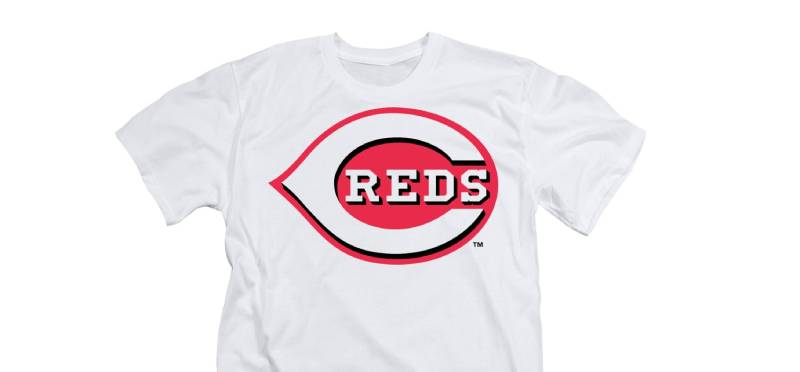
The Cincinnati Reds logo carries cultural weight that goes beyond baseball.
It was there when the Big Red Machine dominated the sport in the 1970s, becoming a symbol of Cincinnati pride during a golden era for the city. Pete Rose, Johnny Bench, Joe Morgan. That wishbone “C” was on all of their caps.
The Mr. Redlegs era in the 1950s is a direct artifact of Cold War politics in America. A baseball team changed its name and its entire visual identity because of McCarthyism. That is a rare case where a sports logo tells a political story.
On the merchandise side, the Reds’ red caps with the white wishbone “C” have crossed over into streetwear and fashion. You see them in cities with no connection to Cincinnati at all, worn purely as a style piece. That kind of crossover reach is something only a few sports marks achieve.
The 2023 City Connect uniform introduced a diamond-shaped “C” on black, which was Cincinnati’s way of acknowledging its urban identity beyond the traditional look. It showed the franchise is willing to push boundaries while keeping its core mark intact.
How Does the Cincinnati Reds Logo Fit Into the Overall Brand Identity?
The Cincinnati Reds brand identity extends well beyond the primary logo. It is a system of connected visual elements that all point back to the same core ideas: Cincinnati, baseball, tradition.
The wishbone “C” primary mark anchors everything. But the brand also includes the Mr. Redlegs mascot logo, the “Running Man” alternate mark (still used on sleeve patches), the “Reds” cursive script wordmark, and the ballpark identity at Great American Ball Park.
Each piece serves a specific role. The primary logo goes on caps and the main jersey placement. The Mr. Redlegs character shows up on alternate jerseys and promotional materials. The cursive “Reds” script appears on red alternate jerseys since 2020.
The color palette ties it all together. That specific red (#C6011F) is consistent across every application, from the stadium paint to the team’s social media accounts. When you see that red next to white and black, the connection to the Reds is almost instant.
Consistency is the thing that makes it work. The brand has been refined over time without being reinvented. Each element reinforces the others in a way that builds recognition across every touchpoint, whether someone is at the ballpark, watching a broadcast, or scrolling past a social media post.
How Should the Cincinnati Reds Logo Be Used?
- Official usage guidelines: The Cincinnati Reds logo must be reproduced in its approved color combinations only. The primary version uses red, white, and black. A one-color white version and a one-color black version exist for limited applications. The proportions of the wishbone “C” and “REDS” wordmark must never be altered, stretched, or redrawn.
- Do’s: Use the logo with adequate clear space. Reproduce it from official vector files to maintain quality. Apply it on approved color backgrounds that maintain sufficient contrast.
- Don’ts: Do not rotate the logo. Do not apply unauthorized color treatments. Do not add effects like extra shadows, outlines, or filters. Do not place the logo on busy backgrounds that reduce readability. Do not separate the “C” from the “REDS” wordmark.
- Where to access official logos: Licensed versions of the Cincinnati Reds logo are available through MLB’s official licensing program. Media outlets and partners can request assets through the Cincinnati Reds media relations department or MLB’s brand portal.
- Licensing information: All Cincinnati Reds logos, wordmarks, and mascot designs are properties of The Cincinnati Reds LLC, licensed through Major League Baseball Properties. Any commercial use requires written approval and a licensing agreement through MLB.
- Trademark protection: The “C CINCINNATI REDS” mark is a registered trademark (USPTO Registration #1560468). Unauthorized reproduction, alteration, or commercial use of the mark without a license is a violation of federal trademark law. Fan art is generally tolerated for personal use but must not be sold or presented as official merchandise.
FAQ on The Cincinnati Reds Logo
What does the Cincinnati Reds logo look like?
The current Cincinnati Reds logo features a white wishbone C with the wordmark “REDS” placed inside it. Black drop shadows give the mark depth. A red background follows the contours of the letter and text.
It is a combination mark. Simple, compact, and built to work on everything from a fitted cap to a stadium jumbotron.
When was the Cincinnati Reds logo first created?
The franchise’s first logo appeared in the 1890s as a standalone gothic letter “C” in scarlet red. But the wishbone C with “REDS” inside concept that defines the modern brand debuted in 1913.
That core design has survived for over a century with periodic refinements.
What do the colors in the Cincinnati Reds logo mean?
Red (#C6011F) represents energy and passion. It has been the team’s defining color since 1869 when the original Cincinnati Red Stockings took the field as baseball’s first professional team.
White provides contrast and readability. Black adds dimension through drop shadows.
Who designed the Cincinnati Reds logo?
No single designer has been publicly credited for the current version. The logo was developed through the Cincinnati Reds organization and Major League Baseball brand teams over many iterations.
The wishbone C framework evolved gradually across roughly 20 different versions since the 1890s.
What font is used in the Cincinnati Reds logo?
The “REDS” wordmark uses a custom typeface called MLB Reds. It is proprietary and not available for public download. The closest free alternative is Varsity, a blocky athletic-style font.
Bold, uppercase, slightly condensed. Built for readability at any size.
Why is the letter C shaped like a wishbone?
The wishbone shape gives the “C” open ends that create a sense of forward motion. It also provides space for the “REDS” wordmark to sit inside the letterform.
A wishbone traditionally suggests luck and hope. Not a bad association for a National League franchise with over 140 years of history.
Has the Cincinnati Reds logo ever featured a mascot?
Yes. From 1953 to 1967, the primary logo featured Mr. Redlegs, a cartoon baseball player with a baseball for a head, carrying a bat while running. The character was introduced during the Red Scare when the team rebranded as the “Cincinnati Redlegs.”
A mustache-free version called the “Running Man” appeared from 1968 to 1992.
What is the difference between the primary and alternate Reds logos?
The primary logo is the white wishbone C-REDS mark on red. Alternate marks include the Mr. Redlegs character (used on sleeve patches), the “Running Man” throwback, and the cursive “Reds” script introduced on red alternate jerseys in 2020.
The 2023 City Connect uniform added a diamond-shaped “C” on black.
Can I use the Cincinnati Reds logo for my own project?
Not commercially. The logo is a registered trademark of The Cincinnati Reds LLC, licensed through MLB Properties. Any commercial use requires written approval and a licensing agreement.
Fan art for personal, non-commercial use is generally tolerated. But selling it or presenting it as official merchandise crosses the line.
How does the Cincinnati Reds logo compare to other MLB team logos?
The Reds mark stands out for its compactness. It communicates city, team name, and team color in a single shape. Few MLB team logos pack that much information into one mark.
It sits between purely typographic logos like the Dodgers wordmark and illustrative ones like the Cardinals’ two-birds-on-a-bat design. That middle ground has helped it age well across multiple eras of baseball uniform design and sports branding.
Conclusion
The Cincinnati Reds logo has held up for over a century because the core idea never needed replacing. A wishbone C, a four-letter team name, red and white. That is it.
From the gothic letterforms of the 1890s through the Mr. Redlegs era at Crosley Field to the current mark worn at Great American Ball Park, every version has pointed back to the same identity.
The Big Red Machine players wore it. Opening Day crowds in Cincinnati still rally around it.
It is proof that strong sports branding does not need to be complicated. It just needs to be honest about what it represents.

Renowned for his expertise in logo design and visual branding, Bogdan has developed a multitude of logos for various clients.
His skills extend to creating posters, vector illustrations, business cards, and brochures. Additionally, Bogdan's UI kits were featured on marketplaces like Visual Hierarchy and UI8.
He also wrote in the past years on sites like Design Your Way, WebDesignerDepot, WPDean, Designmodo, Speckyboy, Slider Revolution, and more.
- The Windsurf Logo History, Colors, Font, And Meaning - 10 October 2026
- How to Remove Background From Product Photos (No Photoshop) - 10 October 2026
- How Designers can Build a Stronger Online Creative Identity - 9 October 2026

Bogdan Sandu is a seasoned designer who has been designing websites since 2008. Renowned for his expertise in logo design and visual branding, Bogdan has developed a multitude of logos for various clients. His skills extend to creating posters, vector illustrations, business cards, and brochures. Additionally, Bogdan's UI kits were featured on marketplaces like Visual Hierarchy and UI8. He also wrote in the past years on sites like Design Your Way, WebDesignerDepot, WPDean, Designmodo, Speckyboy, Slider Revolution, and more.
You Might Also Like