Carolyn Davidson was paid $35 for the Swoosh in 1971. Ask what it’s worth now and you get a range of brand values instead of one number, because no ranking prices the mark alone. The Nike brand as a whole lands at $27.3 billion (Brand Finance, 2026) on the low side and $41.2 billion (Kantar BrandZ, 2026) on the high side.
Her 1983 gift of 500 shares has grown to 32,000 after six stock splits, worth about $1.1 million at October 2026 prices (Motley Fool quote).
Older estimates near $780,000 count only 8,000 shares.
How much is the Nike logo worth?
No publisher has valued the Swoosh on its own. The published numbers cover the Nike brand as a whole, and the latest editions put it between $27.3 billion and $41.2 billion.
The other end of the scale is the $35 Nike paid for the design in 1971.
Here is where the figures stand as of October 2026.
- The design fee was $35, paid in 1971
- Davidson received 500 Nike shares in 1983, which are now 32,000 after splits
- Brand Finance (Apparel 50, 2026) puts the brand at $27.3 billion
- Interbrand (Best Global Brands, 2025) says $33.7 billion
- Kantar BrandZ (Global Top 100, 2026) comes in highest at $41.2 billion
The Swoosh anchors Nike’s visual identity, but rankers price the whole brand. That means the name, the products, the athletes and the mark together. No ranking publishes a price for the mark alone.
That gap is why estimates of the logo by itself, usually quoted in the billions, arrive with no stated method.
How much did Nike pay for the logo in 1971?

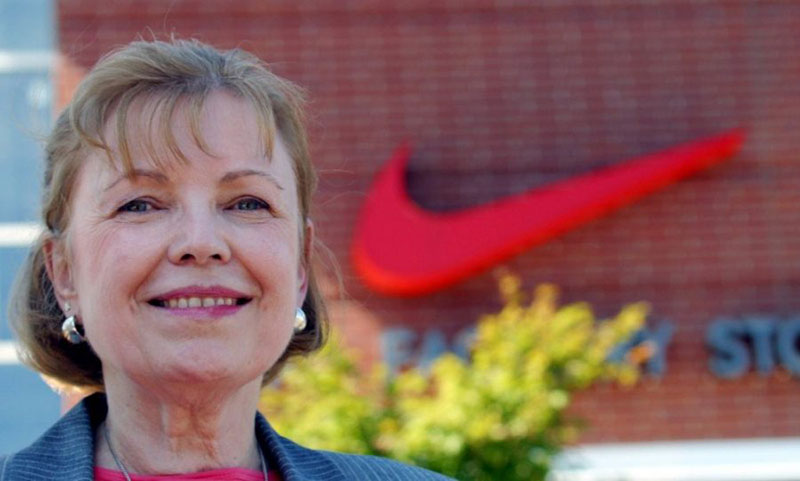
Blue Ribbon Sports, the company that became Nike, paid Carolyn Davidson $35 for the Swoosh. The invoice covered 17.5 hours at $2 an hour.
Davidson was a graphic design student at Portland State University when she met Phil Knight, who taught accounting there and ran Blue Ribbon Sports on the side. He first hired her at $2 an hour for charts and freelance graphics. She later told The Oregonian she worked more hours than the 17.5 she billed.
She presented five or six designs. Knight was not sold on the Swoosh at first, and with a manufacturing deadline close, it went ahead anyway.
Davidson kept working for the company until 1975, then went freelance.
The $35 covered her time and nothing else.
Did Nike pay Carolyn Davidson more than $35?
Yes. In 1983 Phil Knight gave her a gold Swoosh ring with a diamond and 500 shares of Nike stock.
The 1983 gift
The ring was gold, shaped like the Swoosh and set with a diamond. A framed certificate credited her as the creator of the logo, and the 500 shares came handed over in an envelope.
It all happened at a lunch that turned into a surprise party, a few years after Nike went public. Bob Woodell, newly Nike’s president, had pitched the idea to Knight.
Most accounts date the party to September 1983. One retelling says 1984.
What the 500 shares are worth now
About $1.1 million at early October 2026 prices, assuming she never sold. That is 32,000 shares at roughly $35.40 each (Motley Fool quote, 1 October 2026).
Older estimates differ mostly because of the share count. Nike has split 2-for-1 six times since the party (1990, 1995, 1996, 2007, 2012 and 2015), so 500 shares became 32,000.
The older write-ups scatter widely.
- StockX came out at just over $780,000, counting four splits and 8,000 shares
- Today I Found Out landed just shy of $500,000, also on 8,000 shares
- TheStreet (2024) said about $3 million, citing a 2023 estimate
- Beacon Senior News (2024) went with about $4 million on 32,000 shares
Nike’s share price has since fallen well below the level the $3 million and $4 million figures assumed.
What is Nike’s brand value according to each ranking?
Nike sits between $27.3 billion (Brand Finance, 2026) and $41.2 billion (Kantar BrandZ, 2026), with Interbrand’s 2025 list at $33.7 billion. All three show a drop from the year before.
| Publisher | Edition | Nike brand value | Change |
|---|---|---|---|
| Brand Finance | Apparel 50, 2026 | $27.3 billion | Down 7% |
| Interbrand | Best Global Brands, 2025 | $33.7 billion | Down 25.9% |
| Kantar BrandZ | Global Top 100, 2026 | $41.2 billion | Down 17% |
| Kantar BrandZ | Global Top 100, 2025 | $49.4 billion | Down 31% |
Brand Finance ranks Nike third among apparel brands, behind Chanel and Louis Vuitton. Kantar has it sliding from 27th on its global list in 2024 to 51st in 2025 and 69th in 2026.
Method explains most of the spread. Brand Finance uses relief from royalty for its public rankings. Interbrand weighs financial performance, the role the brand plays in purchase decisions and brand strength, while Kantar multiplies financial value by a brand contribution score built on how meaningful, different and salient consumers find the brand.
Timing matters a little too. Interbrand’s list dates from October 2025, so it predates both 2026 editions.
The publishers land at different levels but all point down. Quote a Nike brand value with its publisher and year, because a bare figure hides a spread of roughly $14 billion.
How is a brand valued in dollars?
Valuers estimate the royalties a company would pay to license its own brand, apply that rate to forecast brand revenue, and discount the result to today’s money. ISO 10668, published in 2010, governs the practice and recognizes market, cost and income approaches.
Relief from royalty sits under the income approach. It assumes the company does not own its brand, then asks what a licence would cost.
Brand Finance’s own calculation goes like this.
- Score brand strength on the Brand Strength Index (BSI), from 0 to 100
- Set the royalty range for the industry, reflecting how much the brand matters to purchase decisions
- Apply the BSI score to that range to get a royalty rate (Brand Finance’s own example: a 0 to 5% range and a BSI of 80 gives 4%)
- Estimate the share of parent company revenue attributable to the brand
- Forecast those revenues from historic revenues, analyst forecasts and economic growth rates
- Apply the royalty rate to the forecast revenues
- Discount the post-tax brand revenues to a net present value, which is the brand value
Nike scores 89.9 out of 100 in Brand Finance’s 2026 apparel ranking, an AAA+ rating and the second strongest in the category. Strength sets the royalty rate, so it feeds straight into the dollar figure.
The method strains in one spot. Brand value moves in direct proportion to the royalty rate, so a rate 10% higher produces a brand value 10% higher.
Brand Finance sets each range by reviewing the royalty agreements already signed in a sector. Where few comparable deals exist, the range rests on judgment.
Can the Swoosh be valued separately from the Nike brand?
Not by any published method. The relief-from-royalty steps above value the brand’s earnings, and none of them separates the logo from the rest of the brand.
Shoes, athletes, stores and the mark all earn revenue together, so there is no cash flow to isolate. Royalty ranges come from deals for whole brands, and none of the sources reviewed cite a licence for a standalone logo. Any logo percentage, then, is chosen rather than observed.
A common shortcut applies a 10 to 15 percent attribution rule to Nike’s brand value and lands in the low billions. It is presented as a rule of thumb, and neither Brand Finance’s published steps nor ISO 10668 contain a logo attribution step.
As an illustration rather than an estimate, apply 10% to the lowest published brand value and 15% to the highest, and the answer spans roughly $2.7 billion to $6.2 billion.
Switching publishers moves the result as much as switching percentages. That is the instability a defensible number would not have.
If a logo figure is unavoidable, state the percentage and the base value as assumptions, and name the publisher.
Who owns the Swoosh, and does it appear on Nike’s balance sheet?
Nike, Inc. owns the Swoosh as a registered US trademark, yet the balance sheet has no line for it. The legal record and the financial record say very different things about its worth.
On the trademark side, defendants acknowledged Nike, Inc. as exclusive owner of its Swoosh Design registrations in a consent judgment from Nike’s 2024 suit against S2 Services and Surgeon Worldwide (S.D.N.Y.). Registration No. 977,190 is listed as incontestable, and Nike holds several separate Swoosh Design registrations for goods and services including footwear, apparel and retail stores.
Sources disagree on the date. One page says the Swoosh was Nike’s first registered trademark in 1971, a trademark attorney’s page says the first application was filed in January 1972, and Gerben IP says federal registration came in 1974.
The registration record settles it: the application was filed on 31 January 1972, and No. 977,190 was registered on 22 January 1974. An application filed in January 1972 cannot produce a 1971 registration. The 1971 date marks when the Swoosh was drawn and first used (the record claims first use on 18 June 1971), not when it was registered.
On the balance sheet, Nike’s fiscal 2026 Form 10-K (year ended 31 May 2026) reports identifiable intangible assets of $259 million and goodwill of $240 million, against total assets of $38.4 billion.
Accounting rules explain the gap with the rankings. IAS 38 bars companies from recognizing brands they built themselves, so the costs are expensed as incurred, as the International Trademark Association’s 2022 board resolution describes.
US GAAP, which Nike files under, treats self-built brands the same way in practice, according to BD Emerson’s accounting analysis.
The law protects the Swoosh, yet neither the accounts nor the rankings give it a price of its own.
Nike Logo Value FAQ
How does Nike’s brand value compare with Adidas?
Nike ranks ahead. Brand Finance’s 2026 apparel list puts Nike third and Adidas seventh, with Adidas at $18.9 billion, up 2%.
The two moved in opposite directions this year. Nike fell while Adidas rose.
How much is the $35 paid in 1971 worth today?
About $290 in August 2026 dollars. That uses BLS CPI-U index values of 40.492 for 1971 and 334.980 for August 2026.
Older write-ups quote $195 to $260 because they converted when prices were lower.
Has the Nike logo changed since 1971?
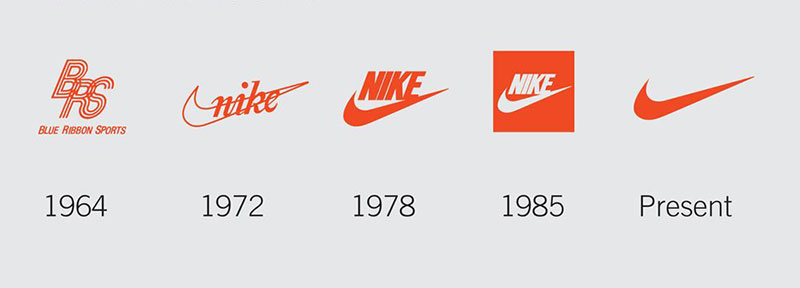
Yes, though the Swoosh shape survived. In 1978 a solid black check replaced the original line drawing, and in 1985 the logo went white on a red background.
In 1995 Nike dropped the wordmark, so the Swoosh now stands alone.
Is Nike’s brand value the same as its market capitalization?
No. Market capitalization is just share price multiplied by shares outstanding, whereas brand value is a valuer’s estimate of what the brand contributes.
Nike’s fiscal 2026 10-K counts about 1.48 billion shares (Class A plus Class B), which at roughly $35.40 each comes to about $52.5 billion.
Which Nike Logo Figure Is Safe to Quote?
The safest figure to quote for the Nike logo is a publisher’s brand value for Nike, labelled with its edition year. The label carries the defence, because it names the method and the date.
Cite the pieces in the order each one goes stale.
- The publisher and edition year
- The newest edition available
- The share price date, for any stake value
Rankings refresh yearly, while share prices move daily.
The fee-to-value comparison needs no assumptions. The lowest published brand value is 780 million times the $35 fee, and the highest is 1.18 billion times.
The trade-off is scope, since a whole-brand figure credits the Swoosh with no share of its own.
Brand Finance has said it will assess Nike’s “Rip the Script” campaign in its 2027 rankings, so the 2026 values will change. This position holds as of 1 October 2026.

Renowned for his expertise in logo design and visual branding, Bogdan has developed a multitude of logos for various clients.
His skills extend to creating posters, vector illustrations, business cards, and brochures. Additionally, Bogdan's UI kits were featured on marketplaces like Visual Hierarchy and UI8.
He also wrote in the past years on sites like Design Your Way, WebDesignerDepot, WPDean, Designmodo, Speckyboy, Slider Revolution, and more.
- The Windsurf Logo History, Colors, Font, And Meaning - 10 October 2026
- How to Remove Background From Product Photos (No Photoshop) - 10 October 2026
- How Designers can Build a Stronger Online Creative Identity - 9 October 2026

Bogdan Sandu is a seasoned designer who has been designing websites since 2008. Renowned for his expertise in logo design and visual branding, Bogdan has developed a multitude of logos for various clients. His skills extend to creating posters, vector illustrations, business cards, and brochures. Additionally, Bogdan's UI kits were featured on marketplaces like Visual Hierarchy and UI8. He also wrote in the past years on sites like Design Your Way, WebDesignerDepot, WPDean, Designmodo, Speckyboy, Slider Revolution, and more.
You Might Also Like