Most of the price gap comes down to who makes the logo. An AI-generated package starts at $20 (Looka, 2025), while a small design studio charges $2,500 or more (Fiverr, 2024).
Design contests land in between, and the price guides get them wrong. The 99designs logo contest pricing page lists $249, $399 and $799 for Bronze, Silver and Gold (99designs, 2026). Third-party guides still print $299, $499 and $899, which is $50 to $100 too high on every package.
Small businesses and startups shop across the whole range. Inside any one tier, the quote shifts with the designer’s experience and the number of concepts, plus revision rounds and ownership terms.
How Much Does a Logo Cost by Provider Type?
Prices run from $20 for a template package to $100,000 or more at a high-end agency, and the provider decides where a logo lands.
Contests and hourly freelancers cluster between roughly $175 and $1,000. Studios start at $2,500.
| Route | Price | Source | Falls short when |
|---|---|---|---|
| AI logo maker (Looka) | $20 for one PNG, $65 with vector files | Looka, 2025 | You need exclusive artwork or print-ready files |
| Design contest (99designs) | $249 Bronze, $399 Silver, $799 Gold | 99designs, 2026 | The brief is thin and feedback falls on you |
| Fiverr marketplace | $5 to $75, $75 to $350, $400 to $2,200 by seller level | Fiverr, 2024 | You pick on badge instead of portfolio fit |
| Hourly freelancer (Upwork, top logo designers) | $175 to $1,000+ (5 to 20+ hours at $35 to $50) | Upwork, 2026 | Scope is vague and hours keep growing |
| Design studio or agency | $2,500 to $10,000 small studio, $10,000 to $30,000 mid-level, $50,000 to $100,000 high-end | Fiverr, 2024 | A one-person business pays for strategy it will not use |
Why Published Price Ranges Disagree
Third-party price guides still list 99designs contests at $299, $499 and $899 for Bronze, Silver and Gold. The 99designs logo contest pricing page lists $249, $399 and $799 (99designs, October 2026), a gap of $50 to $100 per tier.
The guides don’t agree with each other either. One puts Silver at $499, another at $599.
Part of the spread is plain staleness. Older guides copy outdated rack rates, while the platform’s own pricing page shows what a package costs today. Currency and tax play a role too, since 99designs prices exclude sales tax and buyers outside the US see local-currency totals.
Then there’s the question of what counts as “the logo”. Logo-only, logo plus social media pack and logo plus brand identity pack are sold as separate contest categories, so two guides can quote the same platform and mean different things.
Treat any single-number answer as a range with its assumptions stripped out. Read the footnote before the headline.
What Do AI Generators and DIY Logo Makers Cost?
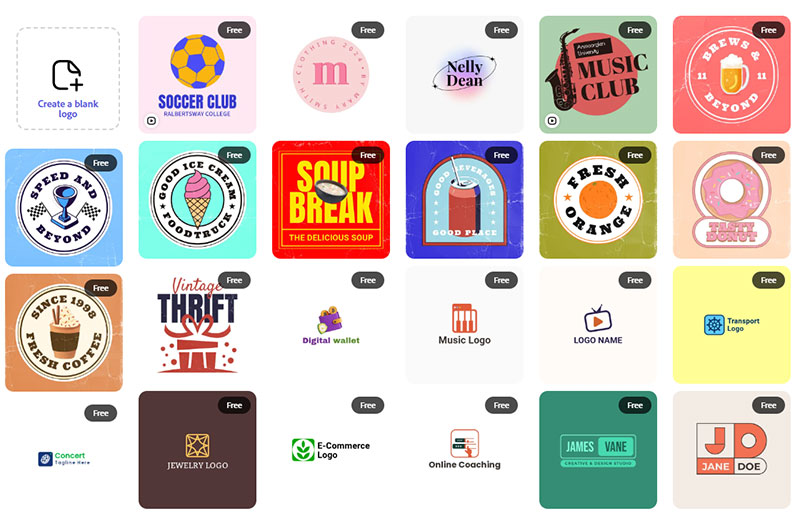
Expect to pay $20 to $65 once, or a subscription when the tool bundles website and brand assets.
Looka sells a $20 Basic package with one low-resolution PNG, and a $65 Premium package with PNG, EPS, SVG and PDF files, color variations, full ownership and unlimited post-purchase edits (Looka, 2025).
The $45 difference is mostly file format. EPS and SVG hold vector artwork, so they scale to signage size without blurring, and a single PNG does not.
Tailor Brands prices the logo as one part of a subscription that also covers website and business-formation tools. Check what the logo alone costs before you compare it to a one-time fee.
Canva sits at the cheapest end. The free plan covers a basic logo, and a paid Canva Pro plan adds premium templates and a far larger stock library.
The catch is exclusivity.
As of October 2026, Canva’s help center states that its logo templates can be used by anyone, so a logo built from one cannot be registered as a trademark. A logo drawn from scratch with basic lines, shapes and fonts can.
Looka draws a similar line. Buyers own the logo as a whole but not individual elements such as symbols, and Looka points them to their local trademark office (Looka, 2025).
A $65 logo works as a placeholder while you test an idea. I wouldn’t build a brand on it if you plan to defend that brand later.
How Much Do Freelancers, Marketplaces and Design Contests Charge?
Fiverr gigs run from $5 to $2,200, 99designs contests from $249 to $1,050 depending on the package, and hourly freelancers from about $175 to $1,000+ per logo.
Freelance Designers by Experience Level
Beginner sellers on Fiverr run $5 to $75. Mid-level sellers charge $75 to $350, and Pro sellers jump to $400 to $2,200. Those are Fiverr’s own ranges (Fiverr, 2024).
A Pro badge does not make a seller right for your brief. Check portfolio pieces from your industry before paying the premium.
Hiring Through Fiverr, Upwork and Dribbble
Fiverr works on fixed-price gigs, while Upwork bills for time.
Upwork lists $25 an hour as the median rate for logo designers, with typical rates of $15 to $30, and its top logo designers range from $25 to $75 an hour, most between $35 and $50. Its cost page puts a logo at five to 20+ hours, possibly over several weeks (Upwork, 2026). Multiply the hours by the $35 to $50 band and a top designer’s bill lands between $175 and $1,000+.
Many logo designers also quote a set rate, and Upwork says hourly billing is likelier when the logo sits inside a larger project.
Dribbble is a portfolio site first, so use it to vet a designer’s style before you ask for a quote.
Design Contests on 99designs
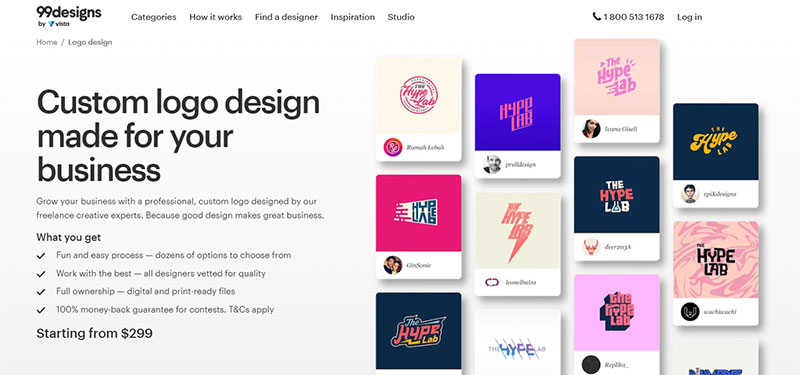
The 99designs logo contest pricing page lists Bronze at $249, Silver at $399, Gold at $799 and Platinum at $1,050 (99designs, October 2026).
Gold opens the contest to Mid and Top Level designers, and Platinum is limited to Top Level designers with a dedicated account manager (99designs Help Center). Every package includes full legal copyright, and a contest runs about seven days before you pick a winner.
The catch is the brief. 99designs itself tells buyers that results scale with the effort they put into the contest.
What Does a Branding Agency Charge for a Logo?
A small design studio charges $2,500 to $10,000 for a logo project, a mid-level studio $10,000 to $30,000, and a high-end agency $50,000 to $100,000 (Fiverr, 2024).
At those prices the logo is one deliverable inside a wider visual identity system that also covers color, type and applications.
The money pays for discovery work before any sketching, including research into competitors, and for a team of specialists instead of one designer. What comes back is a finished system with guidelines, not a single mark.
Rootless Agency’s logo package, for one, lists a discovery session, competitive research, three concepts and a guidelines document (Rootless Agency, 2026).
Agencies also run several projects at once, which can stretch turnaround and thin out attention for smaller clients (Fiverr, 2024).
Price tracks process, not result. Fiverr’s own guide notes that a large bill does not guarantee a successful logo.
For a side project or a one-person business, a $2,500 minimum buys strategy that never gets used. Skip the agency until the brand has more than one product to hold together.
What Makes Logo Prices Vary So Much?
Designer experience comes first, since seasoned designers charge more per hour and work faster (Upwork, 2026).
Concepts and revisions come next. Each extra concept or round adds hours, and feedback rounds tend to run longer than planned (Fiverr, 2024). Scope and discovery matter a lot too, because research, workshops and brand systems push a quote up fast, which is why logo projects stretch past 20 hours on larger briefs. A short, fixed deadline costs a premium, and local market rates move the hourly figure.
Even salaried pay shows the spread. The US Bureau of Labor Statistics puts the 10th percentile graphic designer wage at $39,520 and the 90th at $104,910 (BLS, May 2025), about 2.7 times apart.
Two honest quotes for the same brief can sit far apart before anyone pads a number.
The brief, the number of concepts, the revision limit and the file list are yours to set. The designer’s rate and the local market behind it are not. Fix the concept count and revision limit in writing before work starts.
Hourly Rate, Flat Fee or Package: Which Logo Pricing Model Fits?
A defined brief suits a flat fee. If the scope is open, hourly makes more sense, and packages work for buyers who want fixed deliverables at a published price.
Hourly fits discovery-heavy work, with the buyer carrying the risk of a slow designer. With a flat fee the designer carries the overrun risk, which is why it needs a tight brief. Tiered packages let you compare concepts, revisions and files side by side, so read the revision cap first. Subscriptions fit ongoing design needs and not a one-off mark.
ManyPixels sells its Advanced design subscription at $699 a month on monthly billing and $559 on yearly billing, with a $10 monthly pause option (ManyPixels, 2026).
That can pay off when the logo comes with a month of business cards, social graphics, a deck and whatever else you need. For a logo alone it can’t.
One freelancer’s Contra listing shows the package model at its simplest: three concepts, two revision rounds included, extra rounds billed separately, starting at $250 (Contra listing, October 2026).
Pick the model by how well you can write the brief. If it’s tight, a flat fee works. If it’s vague, you’re probably heading for an hourly meter anyway.
What Files and Rights Are Included in the Price?
A logo price should cover vector masters, raster exports, color variations and a signed transfer of ownership. The transfer is the one buyers forget to ask for.
File Formats by Tier
The file list should include vector masters and raster exports, plus color variations.
| File | Type | Use |
|---|---|---|
| AI, EPS, SVG, PDF | Vector | Print, signage, any resizing |
| PNG | Raster | Web and social, transparent background |
| JPG | Raster | Documents and email, no transparency |
Vector masters matter most. The difference between vector and raster files for print decides whether a logo stays sharp on a banner or goes soft at the edges.
Subscriptions and studios tend to bundle the full set. ManyPixels includes native source files plus SVG, PDF, PNG and JPEG on every plan (ManyPixels, 2026), and one Dribbble designer listing adds AI and EPS (Dribbble, October 2026).
Color variations count as much as formats. Ask for full color, one color, black and white, and a reversed version for dark backgrounds. Print jobs run in CMYK and screens in RGB, so ask for CMYK-ready versions too.
Copyright Transfer and Licensing
Paying a designer does not transfer the copyright.
Section 204 of the US Copyright Act requires a transfer of ownership to be in writing and signed by the owner, so a freelancer keeps the rights until they sign one.
An assignment is a signed document that moves ownership to you, and it’s the cleanest option for a logo. Work made for hire sounds appealing, but the US Copyright Office (Circular 30, revised 2024) limits commissioned works to nine listed categories, and a logo is not one of them. A license only grants permission to use the logo and leaves ownership with the designer, often limited by medium or territory.
Vendors can state the transfer up front. ManyPixels lists full copyright and IP transfer on every plan (ManyPixels, 2026).
For a freelancer, AIGA’s Standard Form of Agreement for Design Services (updated 2020) says its Intellectual Property Provisions module belongs on every design assignment, which makes it a handy checklist for what to request.
This is general information, not legal advice. Have a lawyer read any contract that moves ownership of your brand mark.
What Costs Extra After the Logo Is Delivered?
Trademark filing, font licenses, extra revision rounds and redesign work are what show up on the invoice once the logo is delivered.
Filing a logo as a US trademark starts with a base application of $350 per class (USPTO, effective January 18, 2025). Leave out required information and a $100 per class surcharge applies, and a free-form goods description adds $200 per class. The average wait to a first examining action is 4.2 months (USPTO, August 2026).
A one-class filing can cost more than the logo itself when the logo came from a low-cost maker. File only when the artwork is original and you plan to defend it.
Fonts rarely add a bill, but the license decides what you can register. As of October 2026, the Google Fonts FAQ states that every family is free for commercial use, logos included, and that most use the SIL Open Font License.
Adobe Fonts covers desktop and web use for its whole library while a Creative Cloud subscription is active, and artwork made with the fonts can be used for any purpose (Adobe, 2026). The finished logo can be registered as a trademark, but the typeface designs inside it cannot.
If you want to compare Google Fonts and Adobe Fonts before choosing, do it before the designer starts. Paid typefaces from independent foundries carry their own font licensing terms, and a switch after approval means rebuilding the logo.
Extra revision rounds follow the cap in your agreement, so read it before you sign.
Redesign is the expensive one. Ask in the first round for stacked, horizontal and icon-only versions, because a missing format found after launch is billed as new work.
How Long Does Logo Design Take?
A custom logo takes one to four weeks from kickoff to final files, and two to three weeks is typical for a small business (Logoworks, as of October 2026).
| Stage | Duration | What stretches it |
|---|---|---|
| Discovery and brief | 1 to 3 days | Late answers to the designer’s questionnaire |
| Revisions and refinement | 3 to 10 days | More decision-makers, a changed direction after concepts |
| Whole project | 1 to 4 weeks | A full brand identity instead of a single mark |
Independent designers quote longer. Dribbble listings read in October 2026 land at about three weeks for three concepts and three revisions.
One listing says its process usually takes about five weeks, because it adds a mood board stage and 5 to 10 revision rounds.
ManyPixels sits at the fast end. First drafts arrive the next business day on its Advanced and Business plans, while full brand identities span multiple days (ManyPixels, 2026).
Final files add little time. One Dribbble listing promises them within 2 business days of approval and full payment.
If the deadline is fixed, shorten the revision window and keep discovery intact. A rushed brief is where weak logos start.
How Much Should You Budget for a Logo?
Budget by business stage, not by logo. Spend little while an idea is untested, and pay for exclusive artwork once the business has something to defend.
While you’re testing, a logo maker or template works as a placeholder. A launching business is better served by a freelancer or contest with a signed assignment. Once there are several products or markets, a studio’s identity system starts earning its fee, and steady design demand points to a subscription that includes the logo.
To avoid paying for the same logo twice, work through it in this order.
- List every place the logo will appear, from a favicon to a van.
- Match the route to your stage using the options above.
- Write a one-page brief covering audience, competitors and usage.
- Get the file list and the ownership transfer in writing.
- Cap concepts and revision rounds, and set a payment schedule.
- Sign before work starts, and release the final payment only after the transfer is signed.
Spend more time on the brief than on extra concepts. Concepts multiply the hours, while a sharp brief shortens them.
If the quote leaves out brand guidelines, ask what they cost as an add-on. A short usage sheet now is cheaper than a correction later.
Logo Pricing FAQ
Can you get a logo for free?
Yes. Open-source editors such as Inkscape cost nothing and export vector artwork (Fiverr, 2024).
The price is skill and time, since Fiverr’s guide warns that logos drawn without design knowledge are hard to make look professional.
Should you hire a design student or beginner for a logo?
Yes, when the brief is tight and the mark is simple. Designers still building a portfolio price more competitively (Upwork, 2026).
Skip the beginner route for a trademark filing or a full identity, and get the copyright assignment signed either way.
Is a design subscription cheaper than a one-off logo?
Not for a lone logo. A subscription bills by the month, so a one-off fee wins until business cards, social graphics and decks follow.
After that the flat monthly rate pulls ahead, and pausing keeps your files accessible (ManyPixels, 2026).
How much did Nike pay for its Swoosh logo?
Nike paid $35. Design student Carolyn Davidson billed that sum in 1971 (ESPN, 2016).
The company later compensated her beyond the invoice (Retail Brew, 2022). The case shows that a logo’s value comes from years of use, not from its price tag.
Warning Signs Before You Pay for a Logo
Logo design cost turns into a loss when you reach the final payment with no written ownership transfer, no vector masters in the file list or no cap on revisions.
Missing files can be requested later and extra revisions can be bought, but ownership moves only with the designer’s signature. So look at the transfer first, then the vector masters, then the revision cap.
Search existing trademarks before approving the final concept. The USPTO’s review runs longer than the design project, so a conflict found at filing costs a redesign.
These checks reflect prices, fee schedules and platform terms verified in October 2026. The USPTO reviews its trademark fees every two years, so recheck them before filing.
Once the logo is approved, the next job is building a brand identity around it.

Renowned for his expertise in logo design and visual branding, Bogdan has developed a multitude of logos for various clients.
His skills extend to creating posters, vector illustrations, business cards, and brochures. Additionally, Bogdan's UI kits were featured on marketplaces like Visual Hierarchy and UI8.
He also wrote in the past years on sites like Design Your Way, WebDesignerDepot, WPDean, Designmodo, Speckyboy, Slider Revolution, and more.
- The Windsurf Logo History, Colors, Font, And Meaning - 10 October 2026
- How to Remove Background From Product Photos (No Photoshop) - 10 October 2026
- How Designers can Build a Stronger Online Creative Identity - 9 October 2026

Bogdan Sandu is a seasoned designer who has been designing websites since 2008. Renowned for his expertise in logo design and visual branding, Bogdan has developed a multitude of logos for various clients. His skills extend to creating posters, vector illustrations, business cards, and brochures. Additionally, Bogdan's UI kits were featured on marketplaces like Visual Hierarchy and UI8. He also wrote in the past years on sites like Design Your Way, WebDesignerDepot, WPDean, Designmodo, Speckyboy, Slider Revolution, and more.
You Might Also Like