The Seattle Mariners logo is one of those marks that just sticks with you. A compass rose sitting on top of a baseball, wrapped in a navy blue ring with “SEATTLE MARINERS” in white lettering. It has been the team’s primary identity since 1993, and it still works. The whole thing ties together the franchise’s connection to Pacific Northwest maritime culture and, well, the fact that they play baseball.
The Mariners joined Major League Baseball as an expansion team in 1977, born out of a lawsuit between Seattle, King County, the state of Washington, and the American League. Since then, they have used four distinct primary logos. Each version reflects a different chapter in the club’s history, but all of them lean into the same nautical thread that gave the team its name in the first place.
The current version was designed by Major League Baseball’s internal creative team and unveiled on September 18, 1992. It replaced the old royal blue and gold color scheme entirely, bringing in navy blue, Northwest Green (a teal unique to the franchise), and metallic silver.
What Is the Seattle Mariners Logo?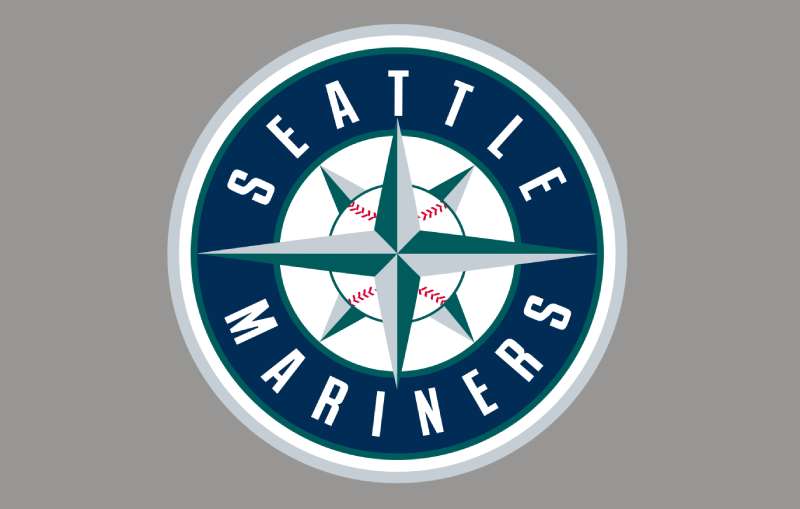
The Seattle Mariners logo is a combination mark featuring an eight-pointed compass rose placed over a white baseball with red stitching, enclosed in a navy blue circular badge. It was officially unveiled on September 18, 1992, and first worn on April 6, 1993. The logo was designed by Major League Baseball’s creative department. Its core symbolism connects baseball to Seattle’s seafaring identity.
Here is a breakdown of the logo’s main attributes:
- Design Type: Combination mark (emblem with wordmark)
- Primary Elements: Eight-pointed compass rose, baseball with red stitching, circular badge, “SEATTLE MARINERS” wordmark
- Official Introduction Date: Unveiled September 18, 1992. First worn April 6, 1993
- Designer: Major League Baseball’s creative department, in collaboration with the Mariners organization
- Trademark Status: Registered trademark of the Seattle Mariners and Major League Baseball
- Color Palette: Navy Blue (#0C2C56), Northwest Green (#005C5C), Metallic Silver (#C4CED4), White (#FFFFFF), Red (#D50032)
- Usage Context: Uniforms, caps, merchandise, digital platforms, T-Mobile Park signage, broadcast graphics, marketing materials
How Has the Seattle Mariners Logo Evolved Over Time?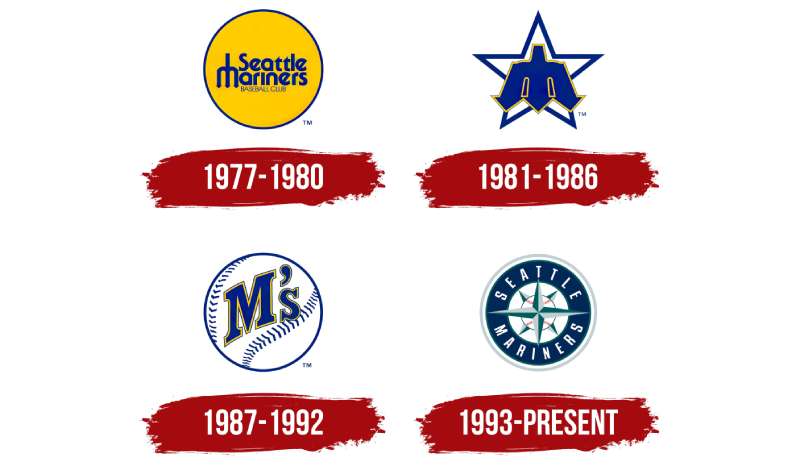
The Mariners have gone through four primary logo versions since 1977. The first two used a trident “M” as the central element with royal blue and gold colors. The third shifted to a baseball-focused design. And the fourth, introduced in 1993, brought the compass rose that fans know today.
Each change marked a shift in team ownership, strategy, or cultural direction. But that nautical thread has been there since day one.
Original Seattle Mariners Logo (1977-1980)
- Years Active: 1977-1980
- Design Description: A solid yellow circle with “Seattle Mariners Baseball Club” written around the perimeter in blue. The centerpiece was a stylized capital “M” shaped like a trident, rendered in dark blue against the yellow background
- Color Scheme: Royal blue and athletic gold (yellow)
- Designer: Not publicly credited
- Context: This was the franchise’s very first logo, adopted when the expansion team entered the American League. The trident “M” was a clever way to link the letter to the Mariners’ maritime name. The team played at the Kingdome during this period
- Cultural Significance: It established the nautical identity that would carry through every version of the logo. The trident symbol became the franchise’s earliest signature
Trident Star Logo (1981-1986)
- Years Active: 1981-1986
- Design Description: A bold, angular trident “M” in dark blue with a yellow outline, set on top of a five-pointed white star with a dark blue border. No text was included
- Color Scheme: Royal blue, gold, white
- Designer: Not publicly credited. The trident design first appeared as the 1979 All-Star Game logo at the Kingdome
- Context: The trident “M” got a full redesign with sharper, more angular points. It showed up on batting helmets in 1980 and became the primary logo in 1981
- Key Changes from Previous: Removed the circular badge and all text. The trident itself became bolder and more aggressive. Added a star behind the mark
- Cultural Significance: This was a stripped-down, icon-only approach, which was unusual for baseball at the time. It gave the Mariners a more modern feel compared to the wordy original
The “M’s” Baseball Logo (1987-1992)
- Years Active: 1987-1992
- Design Description: The letters “M’s” in dark blue with a yellow outline, placed on a large white baseball with blue stitching. This was the first logo to directly reference baseball as a sport in its design
- Color Scheme: Royal blue, gold (yellow), white
- Designer: Not publicly credited
- Context: The team retired the trident for the first time. “M’s” is the team’s popular nickname, and putting it on a baseball was a deliberate move to tie the brand more directly to the sport
- Key Changes from Previous: Completely removed the trident symbol. Added an actual baseball to the logo for the first time. Brought back lettering after six years without it
- Cultural Significance: This version bridged the gap between the team’s early maritime identity and the baseball-focused redesign that was coming. It was also used during some rough years on the field, and for many fans, it represents a transitional era
Current Compass Rose Logo (1993-Present)
- Years Active: 1993-present
- Design Description: An eight-pointed compass rose in silver and Northwest Green resting on a white baseball with red stitching. The whole thing sits inside a navy blue and white circular badge. “SEATTLE MARINERS” curves around the ring in white lettering against a Northwest Green band, bordered in metallic silver
- Color Scheme: Navy Blue, Northwest Green, Metallic Silver, White, Red
- Designer: Major League Baseball’s creative department
- Context: Unveiled on September 18, 1992, this logo came with new ownership and a complete rebrand. Then-CEO John Ellis said the new identity was “indigenous to the Great Pacific Northwest.” It premiered on the field April 6, 1993, and has remained the primary logo ever since
- Key Changes from Previous: Total overhaul. New color palette, new symbol (compass instead of trident), new circular badge format, full team name instead of just “M’s”
- Cultural Significance: This is the logo that carried the franchise through its golden era. Ken Griffey Jr., Randy Johnson, Edgar Martinez, Ichiro Suzuki, the 116-win 2001 season. It is the face of everything that made the Mariners matter to baseball fans everywhere
What Do the Design Elements of the Seattle Mariners Logo Mean?
The compass rose is the most important piece. It connects the word “Mariners” (sailors) to the idea of direction and navigation. Placing a baseball at the center of the compass ties the maritime concept directly to the sport.
The circular badge format gives the whole thing a seal-like authority. There’s a reason it works so well on caps, jerseys, and signage. It holds together at almost any size.
What Does the Compass Rose Represent?
The compass rose is a direct reference to Seattle’s maritime heritage. Mariners are sailors, and the compass is their most basic tool.
But it also does something else. The eight points of the compass suggest direction and purpose, which is a smart way to frame a sports franchise. The baseball at the center grounds the whole thing in the sport itself.
Seattle sits on Puget Sound, and the entire Pacific Northwest economy was historically built on shipping, fishing, and trade routes. So the compass is not just decoration. It actually makes sense for the region.
Why Did the Seattle Mariners Choose These Specific Colors?
The Mariners’ color palette was completely changed for the 1993 rebrand. The original royal blue and gold were replaced with a palette that felt more Pacific Northwest.
- Navy Blue – Hex: #0C2C56, Pantone: PMS 289 C. Represents the deep waters of Puget Sound and the Pacific Ocean. It provides strong contrast and reads well at distance. Navy blue is one of the most common colors in baseball team branding, but this specific shade runs darker than most
- Northwest Green – Hex: #005C5C, Pantone: PMS 7721 C. This is a teal shade created specifically for the Mariners. You will not find this exact hue on any other MLB team. It represents the evergreen forests and water of the Pacific Northwest. According to color psychology, teal tones communicate calm and confidence
- Metallic Silver – Hex: #C4CED4, Pantone: PMS 877 C. Adds a modern, industrial quality. It references Seattle’s tech sector and urban character. Silver also works as a clean accent that separates the navy and teal without fighting either one
- Red – Hex: #D50032, Pantone: PMS 199 C. Used only for the baseball stitching in the logo. It grounds the design in baseball tradition
What Typography Style Is Used in the Seattle Mariners Logo?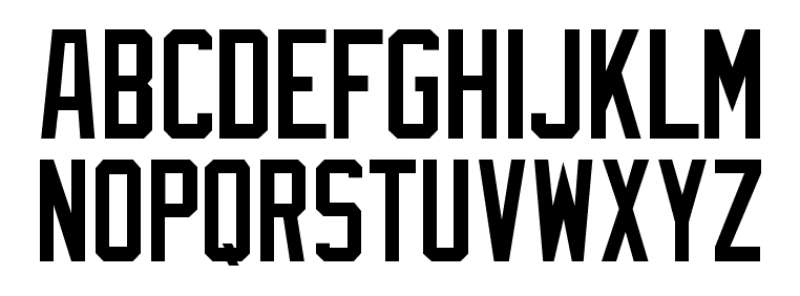
The wordmark “SEATTLE MARINERS” in the circular badge uses a custom sans-serif typeface with bold, condensed letterforms. Some sources identify the closest match as Compacta Regular, a condensed sans-serif designed by Fred Lambert and published by Linotype.
The letters are strong and angular. Good readability at small sizes, which matters when you are printing on a cap or a 2-inch patch on a sleeve.
For jersey wordmarks, the team uses a custom font known as MLB Mariners, which features bold, geometric letterforms with sharp edges. Player names and numbers use a separate sans-serif cut that prioritizes legibility from a distance.
What Are the Hidden Meanings in the Seattle Mariners Logo?
Look at the compass rose more carefully. The four main directional points are longer and more pronounced than the secondary points, which creates a sense of visual hierarchy within the symbol itself.
The baseball stitching is visible inside the compass, so you are always reminded this is about the sport, not just seafaring. That double meaning was intentional.
There is also the matter of the “S” cap logo, which has a compass point integrated into the top. It is a small detail that most people do not notice right away. But once you see it, you cannot unsee it.
How Does the Seattle Mariners Logo Compare to Competitor Logos?
Among American League West teams, the Mariners logo stands out as the most graphically complex. The Houston Astros use a clean star and “H” combination. The Los Angeles Angels go with a simple “A” with a halo. The Texas Rangers rely on a classic “T” wordmark.
The Mariners’ circular badge approach is more detailed than most of those, which is both a strength and a weakness. It looks great on merchandise and marketing materials, but it can lose detail at very small sizes.
Compared to other baseball emblems (like the New York Yankees‘ interlocking NY or the Los Angeles Dodgers‘ script wordmark), the Mariners logo is more illustrative. It tells a story instead of just identifying a name. Whether that is better or worse depends on what you value in logo design.
What Are the Technical Specifications of the Seattle Mariners Logo?
Official Color Codes
- Navy Blue – Hex: #0C2C56, RGB: (12, 44, 86), CMYK: (100, 60, 0, 56), Pantone: PMS 289 C
- Northwest Green – Hex: #005C5C, RGB: (0, 92, 92), CMYK: (100, 0, 47, 47), Pantone: PMS 7721 C
- Metallic Silver – Hex: #C4CED4, RGB: (196, 206, 212), CMYK: (5, 0, 0, 20), Pantone: PMS 877 C
- Red – Hex: #D50032, RGB: (213, 0, 50), CMYK: (0, 100, 65, 0), Pantone: PMS 199 C
- White – Hex: #FFFFFF, RGB: (255, 255, 255), CMYK: (0, 0, 0, 0)
Dimensions and Proportions
The primary logo is a circular badge, so its aspect ratio is 1:1. The compass rose and baseball occupy the central area, while the text ring takes up roughly the outer 20% of the diameter.
MLB’s brand guidelines require specific clear space around the logo, typically equal to the height of the letters in the wordmark on all sides. Minimum reproduction size varies by application, but the circular format holds up better at small sizes than more complex shapes would.
The logo is available in vector format through official MLB licensing channels, which means it can be scaled to any size without quality loss. For print applications, a minimum of 300 DPI is standard. For digital use, pixel dimensions depend on the platform, but the circular format adapts well to profile images and app icons.
What Cultural Impact Has the Seattle Mariners Logo Had?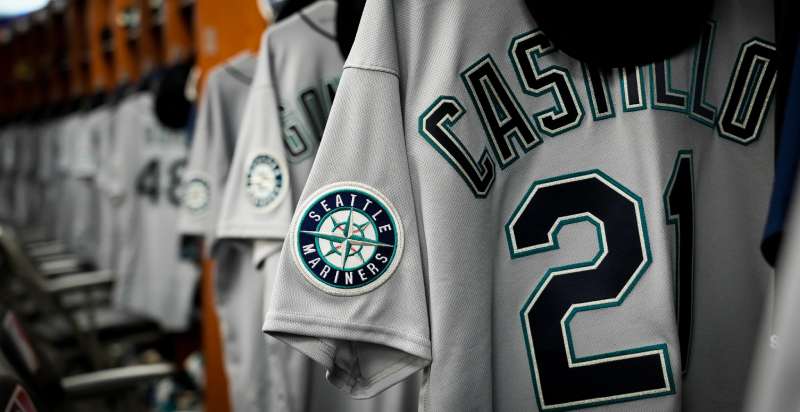
The compass rose logo is tied to some of the biggest moments in Mariners history. It was on the jerseys during the 1995 playoff run that saved baseball in Seattle and led to the construction of what is now T-Mobile Park.
It was there for the 2001 season when the team won 116 games, tying the all-time American League record. It was on Ichiro Suzuki’s uniform during his record-breaking 2004 season with 262 hits.
Outside of the stadium, the logo has become a regional symbol. You see it on cars, storefronts, and clothing all over the Pacific Northwest. The Northwest Green color alone is enough for people around Seattle to identify the brand, which says something about how well the color choices work.
The Mariners have also used throwback uniforms that bring back the old royal blue and gold color scheme, which shows how much fans still connect with the earlier logos too.
How Does the Seattle Mariners Logo Fit Into the Overall Brand Identity?
The primary compass logo does not exist in isolation. It sits at the center of a system that includes the “S” cap logo (with its integrated compass point), alternate wordmarks, the Mariner Moose mascot, and the Northwest Green color that runs through everything.
T-Mobile Park itself is part of the brand. The stadium’s retractable roof, the views of downtown Seattle, the food and atmosphere, all of that feeds into what the Mariners mean to the city. The logo is just the most visible entry point.
On merchandise, the “S” cap logo actually outsells the primary compass badge in some categories, because it is simpler and works better on hats. That kind of flexibility in a brand system is a good sign. It means you are not relying on a single mark to do all the work.
The brand also benefits from association with legendary players. When people see the compass logo, they think of Griffey’s swing, Martinez’s double, Ichiro’s laser throws from right field. A logo picks up meaning from the moments it is present for, and this one has been present for some great ones.
How Should the Seattle Mariners Logo Be Used?
The Seattle Mariners logo is a registered trademark. You cannot use it for commercial purposes without a license from MLB or the team directly. Here are the basics:
- Official usage guidelines: The logo must appear in its approved color combinations. Do not stretch, rotate, or alter the proportions. The clear space around the logo must be maintained. Do not place the logo over busy backgrounds that make it hard to read
- Where to access official logos: Licensed versions are available through MLB’s official licensing program and the Seattle Mariners’ media relations department. For press use, approved assets can typically be requested through the team’s communications office
- Licensing information: Commercial use requires a license from Major League Baseball Properties. This includes merchandise, advertising, and any product that features the logo. Fanatics holds exclusive rights for most consumer merchandise categories
- Trademark protection: The logo, team name, colors, and associated marks are protected under U.S. trademark law. Unauthorized commercial use can result in legal action. Personal, non-commercial fan use (like fan art shared without profit) is sometimes tolerated, but there is no formal exception written into the trademark
If you are working on a project that involves the Mariners’ branding, start with the team’s official brand style guide and go through MLB’s licensing process. It is the only way to make sure you are covered.
FAQ on The Seattle Mariners Logo
What does the Seattle Mariners logo look like?
The current Seattle Mariners logo features an eight-pointed compass rose over a white baseball with red stitching. It sits inside a navy blue circular badge with “SEATTLE MARINERS” in white lettering around a Northwest Green ring.
When was the current Mariners logo introduced?
The compass rose logo was unveiled on September 18, 1992, and first worn during the 1993 MLB season. It replaced the old “M’s” baseball design and the royal blue and gold color scheme that the franchise had used since 1977.
Who designed the Seattle Mariners logo?
Major League Baseball’s creative department designed it in collaboration with the Mariners organization. The rebrand came with new ownership. Then-CEO John Ellis called the new look “indigenous to the Great Pacific Northwest.”
What colors are in the Mariners logo?
Navy blue (#0C2C56), Northwest Green (#005C5C), metallic silver (#C4CED4), white, and red (#D50032). Northwest Green is a teal shade created exclusively for this Seattle baseball team. You will not find it on any other MLB team’s branding.
What does the compass rose in the logo mean?
Mariners are sailors. Sailors use compasses. The compass rose connects the team name to Seattle’s maritime culture and the Pacific Northwest’s history of shipping and trade on Puget Sound. The baseball at the center keeps it grounded in the sport.
How many logos have the Seattle Mariners had?
Four primary logos. The trident “M” circle (1977-1980), the trident star (1981-1986), the “M’s” baseball (1987-1992), and the current compass rose (1993-present). Each version carried the franchise’s nautical identity in a different way.
What font does the Seattle Mariners logo use?
The wordmark uses a custom condensed sans-serif closest to Compacta Regular, designed by Fred Lambert. Jersey lettering uses a separate custom typeface called MLB Mariners, with bold geometric letterforms built for readability at distance.
Can I use the Seattle Mariners logo for my project?
Not commercially. The logo is a registered trademark of the Seattle Mariners and MLB. Commercial use requires a license through Major League Baseball Properties. Personal fan use is sometimes tolerated, but no formal exception exists under trademark law.
What is the “S” cap logo on Mariners hats?
The cap insignia is a stylized navy blue “S” with a compass point integrated into the top of the letter. It was introduced alongside the 1993 rebrand. On team merchandise, this simpler mark actually outsells the full compass badge in some categories.
Why did the Mariners change from the trident to the compass?
New ownership wanted a complete rebrand for the 1993 season. The old trident logos leaned too heavily on the maritime side without connecting to baseball. The compass rose design merged both ideas, placing a baseball inside a nautical symbol that matched Seattle’s regional identity.
Conclusion
The Seattle Mariners logo has held up for over three decades, which is saying something in professional sports. That compass rose still looks right on a cap, a jersey sleeve, or a billboard outside T-Mobile Park.
Four logo versions since 1977, and every single one kept the nautical thread alive. From the trident “M” to the current emblem, the franchise never lost sight of what “Mariners” actually means.
The navy blue and Northwest Green palette is uniquely Seattle. No other MLB team uses that teal shade, and it shows how much a specific color choice can separate a brand from its competitors in the American League West.
Good team branding outlasts any single season. This one has outlasted most.

Renowned for his expertise in logo design and visual branding, Bogdan has developed a multitude of logos for various clients.
His skills extend to creating posters, vector illustrations, business cards, and brochures. Additionally, Bogdan's UI kits were featured on marketplaces like Visual Hierarchy and UI8.
He also wrote in the past years on sites like Design Your Way, WebDesignerDepot, WPDean, Designmodo, Speckyboy, Slider Revolution, and more.
- The Windsurf Logo History, Colors, Font, And Meaning - 10 October 2026
- How to Remove Background From Product Photos (No Photoshop) - 10 October 2026
- How Designers can Build a Stronger Online Creative Identity - 9 October 2026

Bogdan Sandu is a seasoned designer who has been designing websites since 2008. Renowned for his expertise in logo design and visual branding, Bogdan has developed a multitude of logos for various clients. His skills extend to creating posters, vector illustrations, business cards, and brochures. Additionally, Bogdan's UI kits were featured on marketplaces like Visual Hierarchy and UI8. He also wrote in the past years on sites like Design Your Way, WebDesignerDepot, WPDean, Designmodo, Speckyboy, Slider Revolution, and more.
You Might Also Like