The Oakland Athletics logo is one of the most recognizable marks in Major League Baseball. Built around a stylized “A’s” letterform in Kelly green and gold, the design has gone through more than a dozen versions since the franchise started play in 1901. What makes it stick is pretty simple. It looks like baseball. The green-and-gold combination, chosen by owner Charlie Finley back in 1963, broke away from the blue-and-red palettes that dominated the sport. And that bold “A” with its Old English roots? It ties a 120-plus-year franchise history into a single mark. The current primary version, introduced in 1993, places the “A’s” inside a circular badge with the full team name wrapping around it.
What Is the Oakland Athletics Logo?
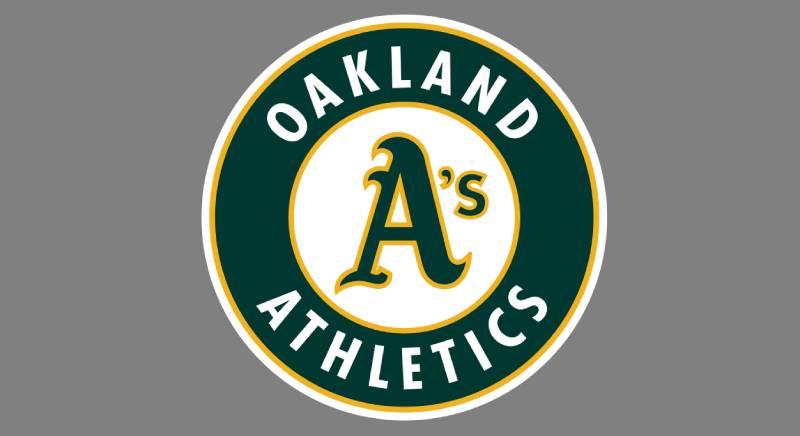
The Oakland Athletics logo is a circular emblem featuring a green “A’s” letterform with gold trim, set on a white center and enclosed by a thick green ring bearing the words “OAKLAND ATHLETICS” in white capitals. Introduced in 1993, it draws from a customized version of Gill Sans Bold Condensed. The design represents the franchise’s identity as one of baseball’s original American League clubs.
Here are the key attributes of the current logo:
- Design Type: Combination mark (emblem with letterform and wordmark)
- Primary Elements: Stylized “A’s” in Old English-influenced lettering, circular green frame, full team name in sans-serif capitals
- Official Introduction Date: 1993
- Designer/Agency: The font closely resembles Gill Sans Bold Condensed by Eric Gill (published by Monotype), with a custom Old English “A” developed specifically for the club
- Trademark Status: Registered trademarks held by the Athletics franchise, including “Oakland Athletics,” “Sacramento Athletics,” and “Sacramento A’s”
- Color Palette: Kelly Green (#003831), Gold (#EFB21E), White (#FFFFFF), Gray (#A2AAAD)
- Usage Context: Jerseys, caps, merchandise, broadcast graphics, digital platforms, and stadium signage. As of 2025, the franchise dropped “Oakland” and now uses just the “A’s” portion of the logo as its primary mark
How Has the Oakland Athletics Logo Evolved Over Time?
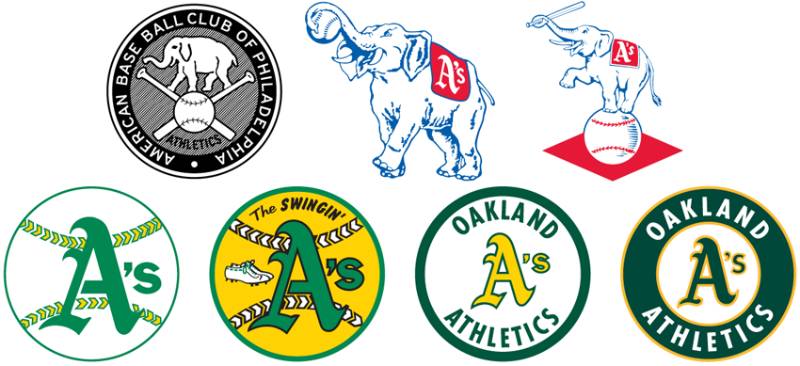
The Athletics logo has gone through more than 15 versions across three cities since 1901. It started as a plain blue “A” in Philadelphia, shifted to elephant imagery for decades, then settled into the green-and-gold “A’s” letterform after the move to Oakland in 1968. The most recent change came in late 2024 when the franchise dropped “Oakland” entirely.
Philadelphia Athletics Logo (1901-1901)
- Years Active: 1901
- Design Description: A bold block letter “A” in a traditional serif typeface with smooth angles and thick lines. The serifs at the bottom of the letter’s bars were slightly rounded.
- Color Scheme: Blue on white
- Designer: Unknown
- Context: This was the franchise’s founding logo, created for its first season as a charter member of the American League under owner Ben Shibe.
- Cultural Significance: Set the precedent for using the letter “A” as the team’s primary visual identifier, a tradition that would continue for over a century.
Old English “A” Era (1902-1919)
- Years Active: 1902-1919
- Design Description: The block letter was replaced with an Old English-style dark blue “A.” It had ornate curves and a more decorative feel compared to the original.
- Color Scheme: Dark blue
- Key Changes from Previous: Shifted from modern block serif to Old English styling. This typeface choice would later influence the current “A’s” letterform used today.
- Context: Connie Mack was managing the team during this era. The Old English style gave the mark a sense of tradition, even though the franchise was barely 20 years old.
The White Elephant Logo (1920-1954)
- Years Active: 1920-1954 (with variations)
- Design Description: An elephant appeared as the primary logo element. Early versions were simple outlines. By 1954, the elephant was standing on an enlarged baseball, holding a bat with its trunk.
- Color Scheme: Started as dark blue. Later versions added red, gray, and white.
- Designer: Various artists over the years refined the elephant illustration
- Context: The elephant came from a rival manager’s insult. John McGraw of the New York Giants called the Athletics a “white elephant,” meaning an expensive burden. Connie Mack embraced the insult and turned it into the team mascot.
- Key Changes: The elephant evolved from a crude outline to a detailed, realistic illustration. A blue “A” was also used alongside the elephant during certain periods (1928-1929 saw the elephant dropped temporarily).
- Cultural Significance: Turned an insult into a badge of pride. The elephant remains part of Athletics branding to this day through the team’s mascot, Stomper.
Kansas City Athletics Logo (1955-1967)
- Years Active: 1955-1967
- Design Description: After relocating to Kansas City, the elephant was initially kept but recolored in red. By 1963, the elephant was dropped entirely in favor of ornate overlapping “KC” letters in bright green on a white background, enclosed in a thick yellow circular frame.
- Color Scheme: The 1963 redesign introduced the green-and-yellow palette that owner Charlie Finley chose.
- Key Changes from Previous: Complete visual identity overhaul in 1963. The blue-and-red palette was abandoned. Green and gold became the team’s colors for the first time.
- Context: Charlie Finley bought the team and pushed for a bold new look. He wanted something that stood out from the typical baseball color palette of the era.
Oakland Athletics Logo (1968-1982)
- Years Active: 1968-1982
- Design Description: The team moved to Oakland and introduced a bold white “A” with a green elephant. The “A’s” letterform with apostrophe-s became the primary mark. This is the era most fans associate with the “Swingin’ A’s” identity.
- Color Scheme: Green, gold/yellow, and white
- Context: Three consecutive World Series titles (1972, 1973, 1974) cemented this version of the logo in baseball history. Players like Reggie Jackson, Catfish Hunter, and Rollie Fingers wore it.
- Cultural Significance: The dynasty years made the green-and-gold combination iconic. This is when the Athletics brand became truly national.
Revised Circular Badge (1983-1992)
- Years Active: 1983-1992
- Design Description: The gothic-style “A’s” stayed at the center but was now drawn in yellow and outlined in green. “Oakland Athletics” appeared in all capitals around a circular green frame.
- Color Scheme: Green (Pantone PMS 343 C), Yellow (Pantone PMS 116 C), White
- Key Changes from Previous: Added the circular badge format with the full team name. More structured and polished compared to the 1970s versions.
- Context: The “Bash Brothers” era with Jose Canseco and Mark McGwire. The team won the 1989 World Series under this logo.
Current Oakland Athletics Logo (1993-2024)
- Years Active: 1993-2024
- Design Description: Green became the dominant color. The “A’s” is outlined in yellow and placed on a white circle, enclosed in a thick green frame. The white wordmark “OAKLAND ATHLETICS” wraps around the border in sans-serif typography that closely matches Gill Sans Bold Condensed.
- Color Scheme: Kelly Green (#003831), Gold (#EFB21E), White (#FFFFFF)
- Key Changes from Previous: Green replaced yellow as the primary color. The wordmark typeface was refined. The overall look became cleaner and more modern.
- Context: This version served the franchise for over 30 years, through the Moneyball era and the team’s final seasons in Oakland.
Athletics Logo (2025-Present)
- Years Active: 2025-present
- Design Description: The franchise officially dropped “Oakland” from its name in November 2024. The primary logo is now just the green “A’s” letterform without the circular badge or city name. The team plays in West Sacramento while waiting for a new stadium in Las Vegas (expected 2028).
- Color Scheme: Same Kelly Green and Gold palette
- Key Changes from Previous: Removed the circular frame and “Oakland Athletics” wordmark. Simplified to just the “A’s” mark.
- Context: The team’s relocation from Oakland forced the rebrand. A “Las Vegas” patch is worn on jersey sleeves through a marketing deal, and a Sacramento-themed alternate jersey was unveiled for the 2026 season.
What Do the Design Elements of the Oakland Athletics Logo Mean?
Every piece of the Oakland Athletics logo ties back to the franchise’s long history. The “A” represents “Athletics,” obviously, but the Old English styling of that letter connects to the team’s earliest years in Philadelphia. The elephant, while no longer front and center, is subtly referenced in the way the right side of the “A” curves, which some designers say mimics a trunk.
Why Did the Oakland Athletics Choose These Specific Colors?
Charlie Finley picked green and gold in 1963 because he wanted to stand out. At the time, nearly every MLB team was using red, blue, or some mix of both. He went the opposite direction.
The official colors and their codes:
- Kelly Green – Hex: #003831, RGB: (0, 56, 49), CMYK: (100, 0, 60, 72), Pantone: PMS 3308 C. Represents growth, resilience, and the Oakland landscape. Green also suggests wealth and stability, fitting for a franchise that has consistently punched above its weight.
- Gold – Hex: #EFB21E, RGB: (239, 178, 30), CMYK: (0, 26, 76, 0), Pantone: PMS 1235 C. Represents excellence and the California Gold Rush heritage. Pairs with green to create a complementary color combination that reads well at distance.
- White – Hex: #FFFFFF. Used as a background and accent color for contrast and readability.
- Gray – Hex: #A2AAAD, RGB: (162, 170, 173), CMYK: (6, 0, 0, 34), Pantone: PMS 429 C. A secondary color used in road uniforms and alternate applications.
The combination of green and gold became so tied to the Athletics identity that fans call the team “The Green and Gold.” It was a smart move by Finley. At least in my experience looking at baseball team logos, very few other clubs have tried this particular palette.
What Typography Style Is Used in the Oakland Athletics Logo?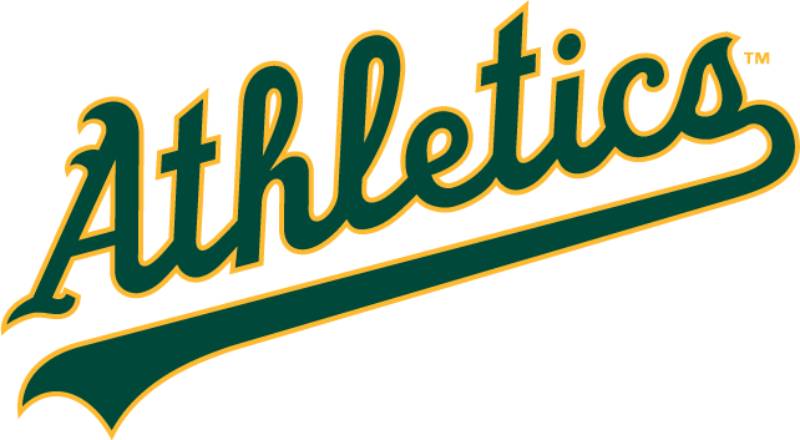
The wordmark around the circular badge uses a typeface very close to Gill Sans Bold Condensed, a humanist sans-serif designed by Eric Gill and published by Monotype.
The central “A’s” lettering is custom. It borrows from Old English traditions with its ornate curves and thick strokes. The apostrophe-s was added when the team adopted its “A’s” nickname.
Over the years, the letter spacing and weight of the wordmark have been tightened to improve readability at small sizes, like on caps and merchandise.
What Are the Hidden Meanings in the Oakland Athletics Logo?
Look closely at the “A” and you might notice something. The right leg of the letter curves outward and upward in a way that some people interpret as an elephant’s trunk. There are also two small hooks at the top that could represent tusks.
Whether the designers intended this or not is up for debate. But the franchise has acknowledged the elephant connection runs deep. It started as an insult from John McGraw in the early 1900s and became a point of pride. Even now, the team mascot Stomper is an elephant.
How Does the Oakland Athletics Logo Compare to Competitor Logos?
Most MLB teams lean on red, blue, or both. The Athletics sit in a different spot entirely with their green-and-gold scheme. Look at the New York Yankees with their classic navy interlocking “NY,” or the Boston Red Sox with their red “B” and sock imagery. The A’s don’t try to compete on tradition in the same way. They compete on being different.
Compared to their cross-bay rival, the San Francisco Giants, the A’s logo feels bolder. The Giants use a fairly standard interlocking “SF” in black and orange. The A’s Old English “A” with its curves and gold trim has more personality, honestly.
Within the AL West, the Houston Astros and Seattle Mariners both use blue-heavy palettes. The Texas Rangers go with red, white, and blue. The Athletics are the only team in the division that avoids these traditional baseball colors entirely.
It is worth noting how the Milwaukee Brewers handled their rebrand in recent years. They went retro with their ball-in-glove logo revival. The A’s, by contrast, have kept their core “A’s” mark largely unchanged since 1993, opting for stability over dramatic redesigns.
What Are the Technical Specifications of the Oakland Athletics Logo?
Official Color Codes
- Primary Color: Kelly Green – Hex: #003831, RGB: (0, 56, 49), CMYK: (100, 0, 60, 72), Pantone: PMS 3308 C
- Secondary Color: Gold – Hex: #EFB21E, RGB: (239, 178, 30), CMYK: (0, 26, 76, 0), Pantone: PMS 1235 C
- Tertiary Color: White – Hex: #FFFFFF, RGB: (255, 255, 255), CMYK: (0, 0, 0, 0)
- Accent Color: Gray – Hex: #A2AAAD, RGB: (162, 170, 173), CMYK: (6, 0, 0, 34), Pantone: PMS 429 C
Dimensions and Proportions
The circular badge format uses a 1:1 aspect ratio. The “A’s” letterform within the badge is centered both vertically and horizontally. The green outer ring occupies roughly 15-20% of the total diameter, with the “OAKLAND ATHLETICS” wordmark centered within that ring.
For vector versions of the logo, the mark is typically distributed as an SVG or EPS file to allow scaling without quality loss. Raster formats for digital use are provided at minimum 250×250 pixels with transparent backgrounds.
MLB’s brand guidelines require clear space around the logo equal to at least half the height of the “A’s” letterform on all sides. The logo should not be stretched, rotated, or recolored outside of approved variations.
What Cultural Impact Has the Oakland Athletics Logo Had?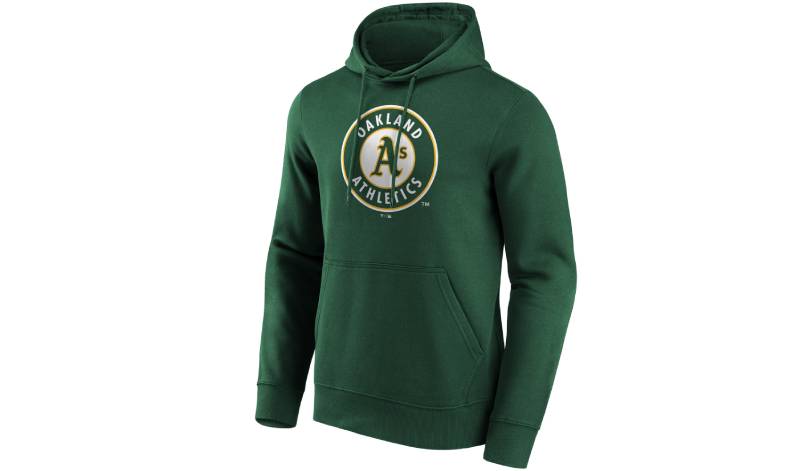
The green and gold became a symbol of Oakland itself. For decades, those colors represented a blue-collar city with a chip on its shoulder. The A’s, the Raiders (before they left), and the Warriors all wore similar palettes at various points. The Athletics logo, with its Old English “A,” became shorthand for Oakland pride.
The Moneyball era under Billy Beane in the early 2000s gave the logo even more cultural weight. The book and later the Brad Pitt film put the A’s brand in front of audiences who had never watched a single game. Suddenly the green-and-gold “A’s” mark wasn’t just a baseball logo. It represented a way of thinking, a small-budget team that figured out how to compete with the big spenders.
The 2024 departure from Oakland hit hard. Fans staged protests wearing A’s gear. The logo appeared on murals and protest signs around the city. In a weird way, losing the team made the Oakland Athletics logo even more culturally significant to the community it was leaving behind.
How Does the Oakland Athletics Logo Fit Into the Overall Brand Identity?
The logo is the anchor of a broader visual system that includes alternate marks, wordmarks, the Stomper mascot, and uniform designs. All of these elements share the same green-and-gold color foundation and work together to build recognition.
The primary “A’s” mark appears on caps and helmets. The full circular badge with “Oakland Athletics” was used on jerseys, broadcast graphics, and official communications until 2024. The elephant shows up in alternate logos and through Stomper on merchandise aimed at younger fans.
There is a clear visual hierarchy at work. The “A’s” mark sits at the top. Below it sits the wordmark. The elephant fills a supporting role. This layered approach keeps the brand flexible. It works on a cap just as well as it does on a billboard.
Now that the franchise operates as just “Athletics” without a city name, the brand is in a transitional phase. The core elements remain the same. Green, gold, the “A’s” letterform. But the packaging around them is shifting. A Sacramento alternate jersey was introduced for 2026, and new Las Vegas branding is in development with Nike for the expected 2028 stadium opening.
How Should the Oakland Athletics Logo Be Used?
Official Usage Guidelines
- Do: Use the logo in its approved color combinations (green/gold/white, or single-color versions in green or white)
- Do: Maintain the required clear space around the mark
- Do: Use official vector files for reproduction to keep the mark sharp at any size
- Don’t: Alter the colors, stretch the proportions, or add effects like drop shadows or gradients to the official mark
- Don’t: Place the logo on busy backgrounds that reduce readability
- Don’t: Use outdated versions of the logo (including the “Oakland Athletics” badge) for current-season materials
Where to Access Official Logos
Official logo files and usage guidelines are available through MLB’s brand management resources. Media members and licensed partners can access approved assets through MLB’s media portal. For consumer use, official merchandise featuring the logo is available through the team’s official store and licensed retailers like Fanatics.
Licensing and Trademark Information
The Oakland Athletics logos, including all historical versions, are registered trademarks of the franchise. Use of the logos for commercial purposes requires a license from MLB Properties. Unauthorized use can result in trademark infringement action. The team has also filed trademarks for “Sacramento Athletics” and “Sacramento A’s” ahead of their temporary relocation, and new Las Vegas-related trademarks are expected before the 2028 move.
Fan-created content using the logo (blogs, social media, fan art) generally falls under fair use, but commercial products like T-shirts, phone cases, or posters require proper licensing. When in doubt, check with MLB Properties directly.
FAQ on The Oakland Athletics Logo
What does the Oakland Athletics logo look like?
The primary logo features a stylized green “A’s” letterform with gold trim, centered on a white circle. A thick green ring surrounds it with “OAKLAND ATHLETICS” in white capitals.
It is a combination mark that blends Old English lettering with a modern circular badge. Simple, but it works.
When was the current Oakland Athletics logo introduced?
The version most people recognize was introduced in 1993. It kept the gothic-style “A’s” from earlier designs but made green the dominant color instead of yellow.
This version stayed in use through the team’s final season in Oakland in 2024.
What colors are used in the Oakland Athletics logo?
Kelly green, gold, and white. Owner Charlie Finley picked green and gold back in 1963 to break away from the red-and-blue schemes every other MLB team was using.
Gray shows up as a secondary color on road uniforms.
What font is used in the Oakland Athletics logo?
The wordmark closely matches Gill Sans Bold Condensed, a humanist sans-serif designed by Eric Gill. The central “A’s” lettering is custom, drawing from Old English traditions with ornate curves.
Two typefaces, one mark. It shouldn’t work, but it does.
Why is there an elephant associated with the Oakland Athletics?
John McGraw called the team a “white elephant” in the early 1900s, meaning an expensive burden. Connie Mack turned the insult into the team mascot out of pure spite.
The elephant appeared on Athletics logos from 1920 through 1967. Today, mascot Stomper keeps the tradition alive.
How many times has the Oakland Athletics logo changed?
The franchise has used more than 15 logo versions since 1901. That covers the Philadelphia, Kansas City, and Oakland eras.
Some were minor tweaks. Others were complete overhauls, like the 1963 switch from blue-and-red to the green-and-gold identity.
What is the Oakland Athletics logo meaning?
The “A” stands for Athletics. The Old English styling connects back to the franchise’s Philadelphia roots. Some fans see an elephant trunk in the curve of the letter’s right leg.
Green and gold represent growth and excellence, a nod to California’s Gold Rush heritage.
Did the Oakland Athletics change their logo for Sacramento?
Yes. In November 2024, the franchise dropped “Oakland” from its name and simplified the primary logo to just the green “A’s” letterform. No circular badge, no city name.
The team plays in West Sacramento through 2027 before moving to Las Vegas.
Where can I download the official Oakland Athletics logo?
Official logo files are available through MLB’s media portal for credentialed partners. Fans can find the mark on licensed merchandise through Fanatics and the team’s official store.
Using the logo on commercial products without a license from MLB Properties is trademark infringement.
How does the Oakland Athletics logo compare to other baseball team emblems?
Most MLB clubs stick to red, blue, or both. The A’s green-and-gold scheme is rare across professional baseball.
The Old English “A’s” lettering gives it more character than most single-letter marks in the American League. Compared to rivals like the Los Angeles Angels or Detroit Tigers, the Athletics brand feels bolder and less conventional.
Conclusion
The Oakland Athletics logo has survived five cities, multiple ownership changes, and over a century of baseball. Few MLB franchise marks carry that kind of weight.
From the Philadelphia elephant to the green-and-gold “A’s” badge, every redesign reflected where the team was headed next. The brand identity held together even when the organization didn’t.
Now the franchise sits in West Sacramento with Las Vegas on the horizon. The circular badge is gone. “Oakland” is gone. But the core of the mark, that Old English “A” in Kelly green, still connects everything back to 1901.
Logos come and go across professional sports. This one has earned its place among the most lasting symbols in the American League.

Renowned for his expertise in logo design and visual branding, Bogdan has developed a multitude of logos for various clients.
His skills extend to creating posters, vector illustrations, business cards, and brochures. Additionally, Bogdan's UI kits were featured on marketplaces like Visual Hierarchy and UI8.
He also wrote in the past years on sites like Design Your Way, WebDesignerDepot, WPDean, Designmodo, Speckyboy, Slider Revolution, and more.
- The Windsurf Logo History, Colors, Font, And Meaning - 10 October 2026
- How to Remove Background From Product Photos (No Photoshop) - 10 October 2026
- How Designers can Build a Stronger Online Creative Identity - 9 October 2026

Bogdan Sandu is a seasoned designer who has been designing websites since 2008. Renowned for his expertise in logo design and visual branding, Bogdan has developed a multitude of logos for various clients. His skills extend to creating posters, vector illustrations, business cards, and brochures. Additionally, Bogdan's UI kits were featured on marketplaces like Visual Hierarchy and UI8. He also wrote in the past years on sites like Design Your Way, WebDesignerDepot, WPDean, Designmodo, Speckyboy, Slider Revolution, and more.
You Might Also Like