The Boston Red Sox logo is one of the most recognized marks in professional sports. It has been around, in some form or another, since 1908 when the team dropped the “Boston Americans” name. The current version features a pair of hanging red socks, clean and simple, with no text attached. It was introduced on November 11, 2008, and made its on-field debut during the 2009 season.
Within the broader history of baseball team logos, the Red Sox mark stands apart because of how little it has actually changed at its core. Most MLB teams have gone through dramatic overhauls. The Sox? They kept coming back to those socks. That kind of consistency is rare, and it says something about how well the original concept worked.
The current primary logo is a pair of red socks with white heels and toes, first introduced as a concept in 1924. The team has used roughly 10 to 12 distinct logo versions over its history, depending on how you count alternate marks and minor tweaks. The franchise itself was founded in 1901 as the Boston Americans before rebranding in 1908.
What Is the Boston Red Sox Logo?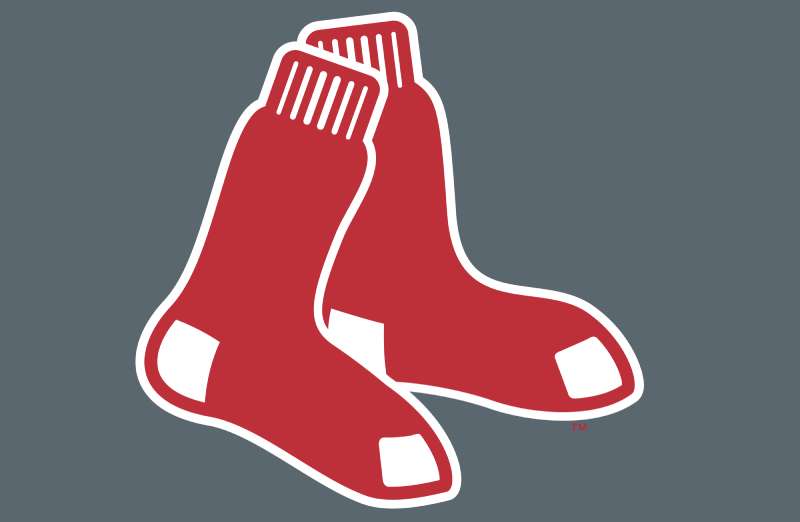
The Boston Red Sox logo is a pair of red hanging socks with white accents, representing the team’s name and identity. Officially redesigned in 2009, the current mark removed all wordmarks to let the socks stand alone. The red and white socks sit against no background, making it a clean pictorial mark rooted in over a century of baseball tradition.
Here are the key details of the current logo:
- Design Type: Pictorial mark (sometimes called a brandmark). No text, just the image of two hanging socks.
- Primary Elements: A pair of red socks with white heels and toes, hanging as if draped over a clothesline. The socks have subtle folds and creases for a natural look.
- Official Introduction Date: November 11, 2008 (debuted on-field in the 2009 MLB season).
- Designer/Agency: The specific designer has not been publicly credited. The redesign was handled internally through the team’s branding and MLB’s licensing department.
- Trademark Status: Registered trademark of the Boston Red Sox Baseball Club, LP. All uses require official licensing through MLB Properties.
- Color Palette: Red (Hex: #BD3039), Navy Blue (Hex: #0C2340), and White (Hex: #FFFFFF). The primary logo itself is red and white only.
- Usage Context: Caps, jerseys (sleeve patches), merchandise, digital platforms, broadcast graphics, Fenway Park signage, and all official team communications.
How Has the Boston Red Sox Logo Evolved Over Time?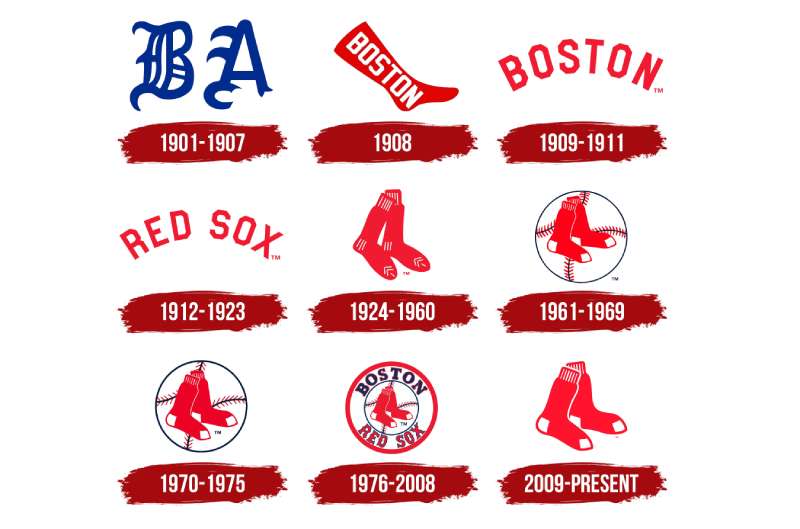
The Red Sox logo has gone through roughly a dozen iterations since 1901. The team started with simple text-based marks, moved to a single sock, introduced the hanging pair in the 1920s, experimented with mascot-style designs in the 1950s, and eventually stripped everything back down to the clean sock graphic used today.
It is actually kind of a wild ride when you look at it all laid out.
Boston Americans Era (1901-1907)
- Years Active: 1901-1907
- Design Description: A gothic-style “BA” monogram in blue lettering. Some years featured an arched “BOSTON” wordmark instead.
- Color Scheme: Blue and white
- Designer: Unknown
- Context: The team was one of eight charter franchises in the new American League. They were called the “Americans” (also “Somersets,” “Pilgrims,” and “Plymouth Rocks” in newspapers).
- Cultural Significance: This was the team’s first visual identity. The blue and white palette matched other early AL teams. Nothing about it screamed “memorable,” but it did the job for an era when logos were more of an afterthought.
First Red Sox Logo (1908)
- Years Active: 1908 (one season only)
- Design Description: A single red stocking displayed at an angle with the word “BOSTON” in white block letters placed across the middle of the sock.
- Color Scheme: Red and white
- Designer: Unknown, commissioned under owner John I. Taylor
- Context: Taylor renamed the team “Red Sox” after the original Boston Red Stockings (now the Atlanta Braves). This logo was worn on jerseys for the 1908 season only.
- Key Changes from Previous: Complete shift from blue to red. First use of a sock graphic. First time the team’s visual identity matched its new name.
- Cultural Significance: The birth of the Red Sox brand. One season and done, but it planted the seed for everything that followed.
Block Letter Wordmarks (1909-1923)
- Years Active: 1909-1923
- Design Description: Text-only marks alternating between “BOSTON” (1909-1911) and “RED SOX” (1912 onward) in blocky red lettering.
- Color Scheme: Red on white
- Designer: Unknown
- Context: The team moved into Fenway Park in 1912. The “RED SOX” wordmark debuted around the same time. This era included the team’s early World Series wins in 1912, 1915, 1916, and 1918.
- Key Changes from Previous: Dropped the sock graphic entirely. Went to pure typography.
- Cultural Significance: These were the glory years before the Curse of the Bambino. Babe Ruth played in these uniforms. The blocky lettering set the tone for decades of Red Sox branding.
The Hanging Socks Debut (1924-1960)
- Years Active: 1924-1960
- Design Description: A pair of red stockings hanging side by side. Early versions had simple outlines with white stripes. By the 1930s, the socks gained more definition and detail.
- Color Scheme: Red and white, with some versions adding blue outlines
- Designer: Unknown
- Context: The iconic “B” cap logo was also introduced in 1933. The hanging socks became the team’s primary identity mark. And look, the red “B” on the cap is arguably more famous, but the socks were always the official logo.
- Key Changes from Previous: Return to a graphical element after years of text-only marks. Two socks instead of the original single stocking.
- Cultural Significance: This is where the logo we know today really started. The pair of hanging socks became synonymous with Red Sox baseball.
The Sock Man Era (1950s-1960s)
- Years Active: Roughly 1950-1970
- Design Description: A cartoon red sock character wearing a baseball cap with a “B” on it, holding a yellow bat in a batting stance. The bottom of the sock formed a large jutting chin. A yellow headband completed the look.
- Color Scheme: Red, white, yellow, and navy
- Designer: Unknown
- Context: This was a mascot-style logo popular during an era when teams across MLB were experimenting with cartoon characters. Think of it as the Red Sox trying to be playful. Fans are still divided on this one.
- Key Changes from Previous: First and only time the team used a mascot-based logo as a primary or major secondary mark.
- Cultural Significance: Polarizing. Some fans love the retro vibe. Others think it looks, well, goofy. It shows up on vintage merchandise and gets nostalgic reactions either way.
Circle Sox Logo (1976-2008)
- Years Active: 1976-2008
- Design Description: The hanging red socks placed on top of a white baseball with stitching, all enclosed in a circular frame. The words “BOSTON” (top, in blue with red outline) and “RED SOX” (bottom, in red with blue outline) were set around the circle’s perimeter.
- Color Scheme: Red, navy blue, and white
- Designer: Unknown
- Context: Introduced during the mid-1970s, this became the team’s most complex logo. The “Tuscan” style lettering on “RED SOX” gave it a classic, almost old-timey baseball feel.
- Key Changes from Previous: Added a baseball element beneath the socks. Introduced the circular frame. Combined both the team name and the sock graphic for the first time.
- Cultural Significance: This version covered some of the most memorable moments in franchise history. Carlton Fisk’s 1975 home run. Bill Buckner’s error in 1986. The 2004 World Series win that broke the Curse. It remains one of the most popular versions among fans and is still used on merchandise and alternate marks.
Current Logo (2009-Present)
- Years Active: 2009-present
- Design Description: A simplified pair of red hanging socks with white heels and toes. No text, no baseball, no circular frame. Just the socks, refined with smoother lines and cleaner proportions than earlier versions.
- Color Scheme: Red and white
- Designer: Handled internally/MLB licensing (specific designer not publicly credited)
- Context: Announced November 11, 2008. The move was part of a broader trend in sports branding toward cleaner, simpler marks that work better across digital platforms and merchandise.
- Key Changes from Previous: Removed all text. Removed the baseball and circular frame. Stripped the logo down to its most basic, recognizable element.
- Cultural Significance: This is the Red Sox logo of the championship era. The team won the World Series in 2013 and 2018 wearing this mark. Its simplicity makes it instantly recognizable at any size, from a tiny app icon to a massive Fenway Park banner.
What Do the Design Elements of the Boston Red Sox Logo Mean?
The Red Sox logo is built on one central idea: the socks themselves. That is the whole concept. A pair of red stockings, hanging as if drying on a line, directly representing the team’s name.
There is no abstract symbol to decode here. No hidden arrow like FedEx. The meaning is right on the surface, and that is actually what makes it work.
Why Did the Red Sox Choose These Specific Colors?
The Red Sox use three official colors, and each one plays a specific role. Understanding color psychology helps explain why this particular combination has lasted so long.
- Red – Hex: #BD3039 | Pantone: PMS 186 C | RGB: (189, 48, 57) | CMYK: (0, 91, 76, 6). Red communicates energy and passion. It is the team’s primary color, directly tied to the “Red Sox” name. It grabs attention and creates an emotional charge, which is exactly what you want from a sports brand.
- Navy Blue – Hex: #0C2340 | Pantone: PMS 289 C | RGB: (12, 35, 64) | CMYK: (100, 60, 0, 56). Navy blue brings a sense of tradition and reliability. It grounds the bright red and keeps the overall look from feeling too aggressive. Blue also connects the team to Boston’s broader sports identity (the Patriots, by the way, use a similar navy).
- White – Hex: #FFFFFF | RGB: (255, 255, 255) | CMYK: (0, 0, 0, 0). White provides clean separation between the red and blue elements. It is used on the sock heels and toes in the logo, and across the home uniforms. Nothing fancy. Just clean.
This three-color color palette also happens to mirror the American flag. For a team called the Red Sox playing in a city like Boston, that is not a coincidence. If you look at other brands that use red in their logos, you will see the same pattern of energy and boldness. And the navy sits comfortably alongside other blue-branded organizations that use the color to signal trust.
What Typography Style Is Used in the Boston Red Sox Logo?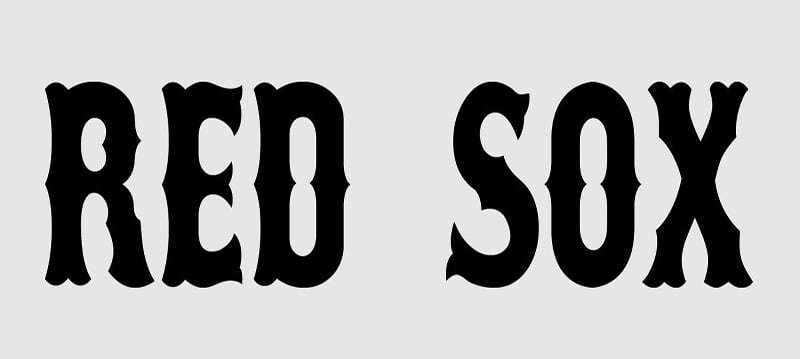
The current primary logo has no text at all. But the Red Sox use a custom typeface across their jerseys, merchandise, and secondary marks that is worth discussing.
The jersey lettering for “RED SOX” uses an ornate, Tuscan-style serif font that has been in use since 1936. It features decorative serifs with curved and pointed details. Think of it as somewhere between a Wild West saloon sign and old-time baseball scoreboard lettering.
The red “B” cap logo, first introduced in 1933, uses a similar custom serif with heavy, angular strokes. This is one of those iconic fonts that people recognize instantly even out of context.
What Are the Hidden Meanings in the Boston Red Sox Logo?
Honestly? There is not much that is “hidden” here. The Red Sox logo is one of the most straightforward marks in sports. Two socks. The team is called the Red Sox. Done.
But there are some intentional choices worth noting. The socks hang in a relaxed, natural position. They are not stiff or stylized into something abstract. That casual drape communicates a kind of confidence and approachability.
The fact that there are two socks (rather than the single stocking from the original 1908 logo) suggests a complete pair, a whole unit. And the white heels and toes? They add visual interest and keep the design from being a solid red blob at smaller sizes.
How Does the Boston Red Sox Logo Compare to Competitor Logos?
Among American League East rivals, the Red Sox logo takes the simplest approach. The New York Yankees logo uses a famous interlocking “NY” monogram. The Toronto Blue Jays logo features a blue jay holding a maple leaf. The Baltimore Orioles logo leans on a cartoon oriole bird. And the Tampa Bay Rays logo uses a sunburst wordmark.
The Sox are the only ones using just a clothing item. No letter, no animal, no abstract shape. That sets them apart.
Looking across MLB more broadly, the Red Sox logo sits in the same category as teams that keep it simple. The Los Angeles Dodgers and New York Mets also rely on clean, iconic marks rather than complex illustrations. But even among those, the Sox stand out for using a pictorial object rather than letters or abstract symbols.
The Chicago White Sox logo, the other “Sox” team, takes a completely different approach with a stylized “SOX” wordmark. The two teams share a naming convention but nothing else visually. If anything, the contrast between them shows just how different two brands with similar names can look.
What Are the Technical Specifications of the Boston Red Sox Logo?
Official Color Codes
- Red (Primary)
- Hex: #BD3039
- RGB: (189, 48, 57)
- CMYK: (0, 91, 76, 6)
- Pantone: PMS 186 C
- Navy Blue (Secondary)
- Hex: #0C2340
- RGB: (12, 35, 64)
- CMYK: (100, 60, 0, 56)
- Pantone: PMS 289 C
- White (Accent)
- Hex: #FFFFFF
- RGB: (255, 255, 255)
- CMYK: (0, 0, 0, 0)
Dimensions and Proportions
MLB teams work under strict brand guidelines managed through MLB Properties. The Red Sox logo follows these standards:
- Aspect Ratio: The hanging socks logo sits in a roughly square format, slightly taller than wide.
- Minimum Size: Must remain legible at small sizes, typically no smaller than 0.5 inches in print or 50 pixels wide on screen.
- Clear Space: A minimum clear zone around the logo (roughly equal to the width of one sock) must be maintained to prevent crowding from other design elements.
- File Formats: Official logos are distributed as vector graphics (AI, EPS, SVG) for scalability, plus rasterized versions in PNG with transparent backgrounds. JPEG files are also available for general use but are not recommended for production work because of compression artifacts.
- Resolution Standards: Print usage requires a minimum of 300 DPI. Digital use typically calls for 72 DPI at the intended display size.
What Cultural Impact Has the Boston Red Sox Logo Had?
The Red Sox logo transcends baseball. It has become a symbol of Boston itself. You see it on bumper stickers from Maine to Connecticut, in bars across the country, on tattoos, and on the walls of college dorm rooms.
The 2004 World Series win, which ended the 86-year “Curse of the Bambino,” turned the logo into something almost spiritual for a generation of fans. People cried wearing that logo. They named their kids after players who wore it.
In the aftermath of the 2013 Boston Marathon bombing, the team modified their home jerseys to read “BOSTON” instead of “RED SOX.” The connection between the logo, the team, and the city had never been more clear. The Red Sox went on to win the World Series that year, and the logo became a symbol of resilience for the entire city.
Globally, the Red Sox mark (especially the “B” cap logo) is worn as a fashion item by people who may never have watched a single inning of baseball. That is the kind of cultural reach most brands can only dream about.
How Does the Boston Red Sox Logo Fit Into the Overall Brand Identity?
The logo is just one piece of a much larger visual system. The Red Sox brand includes the primary hanging socks logo, the red “B” cap logo, the Circle Sox alternate mark, the custom Tuscan jersey font, and the red, navy, and white color system.
All of these elements connect back to Fenway Park. The Green Monster, the manual scoreboard, the Citgo sign visible beyond the outfield. The branding feels inseparable from the physical place.
Wally the Green Monster, the team mascot, adds a playful layer but stays visually distinct from the logo itself. The mascot serves younger fans and community engagement, while the logo anchors the team’s identity in tradition and sports heritage. Together, they cover the full spectrum of the fan experience.
How Should the Boston Red Sox Logo Be Used?
Official Usage Guidelines
- Do: Use the official logo files provided through MLB Properties or the team’s media relations department. Maintain required clear space around the mark. Reproduce it in the official color codes listed above.
- Don’t: Alter the colors, stretch or distort the proportions, add effects like drop shadows or outlines, place it on busy backgrounds that reduce readability, or combine it with other logos in a way that implies endorsement.
Where to Access Official Logos
Licensed media and business partners can access official logo files through MLB’s brand portal. Fans and content creators can find approved usage versions on the Boston Red Sox official website and through MLB’s media resources page.
Licensing Information
Any commercial use of the Boston Red Sox logo requires a license from MLB Properties. This includes merchandise, advertising, promotional materials, and digital products. Unauthorized use is a trademark violation. Small fan projects, editorial use, and news reporting generally fall under fair use, but anything generating revenue needs a license.
Trademark Protection
The Boston Red Sox logo, the “B” cap mark, the Circle Sox alternate, and the “RED SOX” wordmark are all registered trademarks. MLB actively enforces these trademarks, particularly against counterfeit merchandise. If you have ever bought a knockoff Red Sox hat on the street, you know exactly how common infringement is, and how aggressively the league pursues it.
FAQ on The Boston Red Sox Logo
What does the Boston Red Sox logo look like?
The current primary logo features a pair of hanging red socks with white heels and toes. No text. No background. Just the socks.
It is a pictorial mark that directly represents the team’s name, making it one of the most straightforward emblems in Major League Baseball.
When was the Red Sox logo first created?
The first Red Sox logo appeared in 1908. It showed a single red stocking with “BOSTON” in white letters across it.
Owner John I. Taylor introduced both the name and the logo that season. The team had previously been called the Boston Americans since 1901.
What are the official Boston Red Sox colors?
Red (#BD3039), navy blue (#0C2340), and white (#FFFFFF). Those are the three official team colors used across all branding and merchandise.
The red carries the most weight visually. Navy blue shows up on caps, outlines, and alternate uniforms worn at Fenway Park and on the road.
How many times has the Red Sox logo changed?
Roughly 10 to 12 times, depending on how you count minor tweaks versus full redesigns. The team went from text marks to sock graphics to a cartoon mascot and back again.
The current simplified version has been in use since the 2009 season.
What font do the Red Sox use on their jerseys?
The Red Sox use a custom Tuscan-style serif with ornate, curved details on their home jerseys. It has been the primary jersey lettering since 1936.
The red “B” cap mark uses a similar custom serif with heavy angular strokes. Neither is a commercially available sans-serif font.
What is the red “B” on the Red Sox cap?
The red “B” is the team’s cap logo, introduced in 1933. It started as a block letter, then became the stylized version fans know today by 1936.
It functions as a secondary mark alongside the hanging socks. Most fans actually recognize the “B” faster than the primary Red Sox emblem.
Who designed the current Boston Red Sox logo?
No individual designer has been publicly credited. The 2009 redesign was handled through the team’s internal branding efforts in coordination with MLB’s licensing group.
The update refined the hanging socks with smoother lines and removed all wordmarks from the primary mark.
What does the Boston Red Sox logo mean?
The pair of red socks represents the team’s name. That is it. The name “Red Sox” itself came from the original Boston Red Stockings, a 19th-century baseball club.
The relaxed, natural hanging position of the socks communicates tradition and a casual confidence tied to the franchise’s World Series history.
Can I use the Red Sox logo for my own project?
Not commercially. The logo is a registered trademark of the Boston Red Sox Baseball Club. Any use generating revenue requires a license through MLB Properties.
Editorial and news use typically falls under fair use. But printing it on shirts or merchandise without permission will get you a cease-and-desist letter.
What is the Circle Sox logo?
The Circle Sox logo was introduced in 1976. It places the hanging socks on a baseball inside a circular frame, with “BOSTON RED SOX” written around the border.
It served as the primary logo until 2009. The team still uses it as an alternate mark on merchandise, and many fans from the American League East era prefer it.
Conclusion
The Boston Red Sox logo has survived over a century of baseball because it never tried to be something it was not. Two red socks. That is the whole idea, and it still works.
From the original 1908 stocking to the current streamlined mark, every redesign kept circling back to the same core image. That kind of brand consistency is hard to find across NFL logos, NBA logos, or even other MLB franchises.
The red and navy color scheme, the custom Tuscan lettering, the “B” cap mark. All of it ties back to Fenway Park and a fan base that treats this team like family.
Whether you are buying licensed Red Sox merchandise or just spotting that familiar red “B” on someone’s cap across a crowded room, the recognition is instant. Few sports logos pull that off.

Renowned for his expertise in logo design and visual branding, Bogdan has developed a multitude of logos for various clients.
His skills extend to creating posters, vector illustrations, business cards, and brochures. Additionally, Bogdan's UI kits were featured on marketplaces like Visual Hierarchy and UI8.
He also wrote in the past years on sites like Design Your Way, WebDesignerDepot, WPDean, Designmodo, Speckyboy, Slider Revolution, and more.
- The Cursor Logo History, Colors, Font, And Meaning - 24 September 2026
- Top 7 Web Design Subscription Services That Replace Full-Time Hires - 24 September 2026
- Canva vs PowerPoint: Which Is Better for Presentations? - 22 September 2026

Bogdan Sandu is a seasoned designer who has been designing websites since 2008. Renowned for his expertise in logo design and visual branding, Bogdan has developed a multitude of logos for various clients. His skills extend to creating posters, vector illustrations, business cards, and brochures. Additionally, Bogdan's UI kits were featured on marketplaces like Visual Hierarchy and UI8. He also wrote in the past years on sites like Design Your Way, WebDesignerDepot, WPDean, Designmodo, Speckyboy, Slider Revolution, and more.
You Might Also Like